Linda's Literary Home

Tag: politics

  • Amanda Gorman’s “For Renee Nicole Good”

    Image:  Amanda Gorman

    Amanda Gorman’s “For Renee Nicole Good”

    Amanda Gorman’s “For Renee Nicole Good” tries to be an elegy, but it falters in displaying contrived diction, strained prosody, clichéd imagery, and manipulative historical framing—all compromising its position as an elegiac form. 

    Introduction and Text of “For Renee Nicole Good”

    Spurred on by the January 7, 2026, incident in which Renee Nicole Good was fatally shot by an ICE agent in Minneapolis, inaugural poetry reader Amanda Gorman has focused on the unfortunate event for moral and political effect, prioritizing rhetoric over grief and glossing over a complex historical reality.

    Gorman’s piece commemorates Renee Nicole Good, a 37-year-old Minneapolis woman, who was killed during a federal immigration enforcement operation. The incident, widely reported in major media, involved Good ramming her 4,000-pound Honda Pilot into an ICE officer, causing him to suffer internal injuries. Allegedly, the officer reacted by shooting Good in self-defense.  

    Political and media pundits have continued to debate federal characterizations of her actions, including claims that labeled her a “domestic terrorist.”  Talking heads on various media outlets have continued to exploit the dismal affair by interpreting the videos of the event to fit their own narratives.

    Gorman’s piece attempts to position Good’s death as the result of systemic failure couched in moral urgency; however, the literary execution of the piece weakens  Gorman aim at elegy.  The rime is forced and uneven, diction is inflated and often awkward, and imagery slips into abstraction or cliché. 

    The use of figurative language remains symbolic and moralistic, rather than being grounded in Good’s specific circumstances. While the piece attempts elegiac elevation, its rhetorical ornamentation and moral abstraction produce nothing more than mere posturing. 

    The piece remains merely decorative verse lacking emotional precision or nuanced engagement with historical fact.  The piece remains an excellent example of “miselegy”—not elegy.

    For Renee Nicole Good

    Killed by I.C.E. on January 7, 2026

    They say she is no more,
    That there her absence roars,
    Blood-blown like a rose.
    Iced wheels flinched & froze.
    Now, bare riot of candles,
    Dark fury of flowers,
    Pure howling of hymns.

    If for us she arose,
    Somewhere, in the pitched deep of our grief,
    Crouches our power,
    The howl where we begin,
    Straining upon the edge of the crooked crater
    Of the worst of what we’ve been.

    Change is only possible,
    & all the greater,
    When the labour
    & bitter anger of our neighbors
    Is moved by the love
    & better angels of our nature.

    What they call death & void,
    We know is breath & voice;
    In the end, gorgeously,
    Endures our enormity.

    You could believe departed to be the dawn
    When the blank night has so long stood.
    But our bright-fled angels will never be fully gone,
    When they forever are so fiercely Good.

    Commentary on “For Renee Nicole Good”

    Amanda Gorman’s piece is rhetorically inflated and abstract, inflating symbolic moral critique over concrete grief. It glosses over key facts and turns personal tragedy into generalized indictment.  The result is both stylistic weakness and historical distortion.

    First Movement: “They say she is no more”

    They say she is no more,
    That there her absence roars,
    Blood-blown like a rose.
    Iced wheels flinched & froze.
    Now, bare riot of candles,
    Dark fury of flowers,
    Pure howling of hymns.

    If for us she arose,
    Somewhere, in the pitched deep of our grief,
    Crouches our power,
    The howl where we begin,
    Straining upon the edge of the crooked crater
    Of the worst of what we’ve been.

    The piece fails as elegy from its opening lines, with vagueness masquerading as intensity. The vague claim—“They say she is no more”—screams out as a slack, secondhand construction.  The nondescript, distancing phrase “they say” bypasses the elegist’s most important obligation—to bear direct witness to loss. 

    Compare this avoidance to the stark authority of Walt Whitman’s “When Lilacs Last in the Dooryard Bloom’d” or even a simple declarative statement such as  “She is dead”: the circumlocution here drains the death of immediacy before the piece has properly begun.

    The use of figurative language compounds the failure. “Blood-blown like a rose” aspires to vivid compression but achieves only decorative incongruity: ”blood-blown” suggests violence, yet the rose is so overworked a poetic symbol that it softens rather than sharpens what ought to be a disturbing image. Thus, the two terms are pitted against each other. 

    Similarly, “Iced wheels flinched & froze” is so obscure that it remains meaninglessness: wheels, obviously belong to the 4000 pound vehicle, but wheels do not flinch.  The verb “flinch” describes a human reaction of nervousness, and to assign wheels this involuntary recoil is to sentimentalize machinery rather than illuminate human grief.

    The lines “bare riot of candles, / Dark fury of flowers, / Pure howling of hymns” reveal another besetting weakness: the piece’s reliance on oxymoronic abstract nouns to manufacture feeling it has not earned. A riot is not bare; fury is not dark in any illuminating sense; howling is not pure; see Malcolm M. Sedam’s appraisal of Allen Ginsberg’s “Howl.” 

    These contradictions do not exert a useful tension; instead, they simply hint at emotional extremes without grounding them in any specific detail of the occasion, the mourners, or the deceased. Readers learn nothing about who this woman was or who weeps for her.

    The closing lines’ prosody also undermines its ambitions.  The lines “Crouches our power, / The howl where we begin” strain for prophetic weight but the inversion “crouches our power” is merely awkward, and “the howl where we begin” is so abstract as to be empty—begin what? 

    The final image of “the crooked crater / Of the worst of what we’ve been” gestures at collective historical shame but without any specific referent.  Although this piece concerns a real death in a specific circumstance—one involving an officer’s injury and reaction of likely self-defense, the needed context is entirely absent. 

    Elegy, at its best, as in Auden’s “In Memory of W.B. Yeats,” earns any generalization by first anchoring itself in specificity. This piece attempts the reverse, and the result is rhetoric without a foundation that is, nevertheless, loud, shapeless, unmoved and unmoving.

    Second Movement: “Change is only possible”

    Change is only possible,
    & all the greater,
    When the labour
    & bitter anger of our neighbors
    Is moved by the love
    & better angels of our nature.

    What they call death & void,
    We know is breath & voice;
    In the end, gorgeously,
    Endures our enormity.

    The second movement opens with a conditional proposition in the first stanza of the movement, and this proposal immediately reveals the piece’s central confusion of purpose: elegy is not argument. The conditional “when” converts mourning to a political syllogism: grief is admissible only insofar as it produces the correct social outcome. The dead woman has already been subordinated to a thesis.

    The phrase “better angels of our nature” compounds the problem by alluding to Lincoln’s famous phrase without earning it. In Abraham Lincoln’s First Inaugural Address, the phrase carried the weight of a young nation on the verge of civil war; here it is borrowed to lend gravitas to what is essentially a political slogan. The allusion does not illuminate; it appropriates.

    The lines “What they call death & void, / We know is breath & voice” represent the most telling failure in the passage. The opposition of “they” and “we” divides the world into the politically benighted and the enlightened speaker’s community, and in doing so it abandons the elegiac mode entirely. 

    Elegy confronts death as an irreducible, universal fact, intrinsic to the human condition; it does not reframe death as a misperception held by ideological opponents. To argue that death is not merely what the unenlightened “call” it is not consolation; it is evasion dressed as affirmation.

    The closing couplet reaches for the lapidary but lands in obscurity. “Enormity” in precise usage means moral outrage or wickedness, which may be the intended meaning, but then “gorgeously” becomes grotesque in the wrong way, not productively paradoxical but simply muddled. 

    If “enormity” is used loosely to mean vastness or magnitude, the line collapses into vague self-congratulation: we are very large, and we endure. Neither reading redeems the couplet, and neither brings the reader any closer to a specific dead woman, her specific life, or the specific circumstances of her death. The piece has fully exchanged the particular for the rhetorical, and what endures is not grief but posture.

    Third Movement: “You could believe departed to be the dawn”

    You could believe departed to be the dawn
    When the blank night has so long stood.
    But our bright-fled angels will never be fully gone,
    When they forever are so fiercely Good.

    The final movement opens with a conditional that immediately points to its own uncertainty: “You could believe departed to be the dawn.” The addition of the verb “believe” does not signal the tentativeness of honest doubt; it is the tentativeness of a versifier who knows the metaphor is not working. 

    That time of day known as dawn as a poetic device for death’s transcendence is among the most exhausted—therefore clichéd—resources in the elegiac tradition, and to introduce it with “you could believe” rather than committing to it fully exposes an acknowledgment of its staleness. The line asks readers to entertain a consolation that the piece itself does not fully trust.

    The line “The blank night has so long stood” attempts to deepen the light-and-darkness opposition but “blank” is doing no useful work here.  Night is characterized only by the absence of qualities, which is itself an absence of imagination. 

    Compare the productive darkness in elegies that have earned their consolations through prior engagement with specific grief.  For example, Thomas Gray’s “Elegy Written in a Country Churchyard” lingers over the obscurity and stifled potential of the rural dead before arriving at its muted, hard‑won consolations.   The darkness in Gorman’s piece has no particular texture because the woman mourned has never been rendered particular.

    The line “Our bright-fled angels” is symptomatic of the movement’s broader failure. The compound adjective “bright-fled” strains for originality but produces only a vague luminous blur.  Readers cannot see these angels, cannot locate them, cannot feel their specific absence. And “angels,” used here for the second time in the piece, has by this point become the piece’s default finger pointing toward the transcendent, deployed only wherever the sentiment runs short of concrete reality.

    The closing line “When they forever are so fiercely Good” makes the piece’s central substitution explicit and, in doing so, exposes its paucity. The capitalization of “Good” collapses the woman’s surname into a moral abstraction, transforming a specific human being into an emblem of virtue—a claim which is never realized.

    This kind of sleight-of-hand is the opposite of what elegy requires. The great elegies, including Milton’s “Lycidas,” Tennyson’s “In Memoriam A. H. H,” and Wilcox’s “The Queen’s Last Ride,” depend upon the irreplaceable particularity of the lost individual. 

    Here, the decedent’s’ name is conscripted into the piece’s rhetorical argument: she is “Good” [good]; therefore, her death indicts a system that is not. The wordplay, however well-intentioned, subordinates the woman’s personhood to her usefulness as a symbol, which is precisely the charge that the piece is leveling at the broader social forces it purports to critique.

    Taken as a whole, “For Renee Nicole Good” fails as elegy because its every formal and figurative decision moves away from the particular and toward the general, away from grief and toward argument, away from the irreducibly human fact of one woman’s death and toward the consolations of political and moral statement. 

    Doggerel is not merely a matter of clumsy versification; it is verse that reaches beyond its own imaginative and emotional resources. This piece reaches very far and grasps nothing of substance.

    Further Reading

    Cornelius Eady’s “Renée Nicole Good Is Murdered”  Another miselegy targeting the death of Ms Good.

  • Graveyard Whistler: A Political Poem Find,”Liberal Mud with Commentary”

    Image:  High Frontier

    Graveyard Whistler: A Political Poem Find,”Liberal Mud with Commentary”

    Graveyard Whistler unearths a piece of doggerel that nevertheless caught his fancy, as it presented, in his opinion, a much needed corrective to the misuse of a beloved term.

    Foreword from the Graveyard Whistler

    Let me make it clear right away: I despise politics.  National politics, hate it.  Local politics, hate it.  Office politics, hate it the worst.  So I rarely delve into issues that might lead me to the necessity of discussing politics.  However, as I have so often touted the treasure trove from my old, late buddy Stoney’s Stone Gulch Literary Arts, I feel the need to address some political issues that Stoney addressed.

    At first, my inclination was to simply avoid all of his political scribblings, but then after I actually read this offering, I realized I had actually learned something, which has changed my view about political issues.  You will notice that it’s not just a poem—actually, it’s a piece of doggerel, as Stoney called it—but it has a commentary that is well researched with sources.  I’m still not allowing myself to become immersed in those issues, but I don’t feel that avoiding them completely does me or anyone else any good.

    You see, I’ve always considered myself “liberal”—that is opposed to stuffy conservative thought that disavows all progress, including science and minority rights—and until encountering this piece called “Liberal Mud,” I did not realize the difference between “classical liberal” and “modern liberal.”  To me, liberal was liberal which was a good thing, always. Full stop.

    As usual, Stoney has not made it clear that he wrote this piece; it just kind of popped up at the bottom of a clipping of Stoney delivering a speech to a college assembly.  How I would love to include that image of Stoney speaking—but alas! when he gifted me with his site-full of writings, he insisted he remain anonymous, so any image or even Stoney’s real name will never appear in my writings.

    Without further ado, I present the piece of doggerel—and that’s what Stoney called it—for what it’s worth:

    “Liberal Mud with Commentary”

    This piece of doggerel titled, “Liberal Mud,” is brazenly political; it focuses on the nature of the much abused term, “liberalism,” which denotes freedom from the overreach of governmental restraints.  

    The term, “liberal,” has been much abused. For example, in contemporary American politics, the party that claims the label of liberal is the party whose policies are formulated to control every aspect of life of the citizens of the United States from healthcare to business practices to what each American is allowed to think. That party even seeks to quash freedom of religion, which was a major impetus leading to the founding the country.

    Under the guise of “liberalism,” that party claims large swaths of the citizenry who have fallen for the corrupt concept of “identity politics.” For example, the party claims huge numbers of African Americans, women, gays, and young voters. The party appeals to many of the uninformed/misinformed in those “groups” simply by offering them government largesse and claiming to represent their interests. 

    A common misconception is that the Democratic and Republican parties switched policies a few decades ago. That lie has been perpetuated by Democrat vote seekers because history reveals that the Republican Party has always been the party of freedom; it was, in fact, President Abraham Lincoln, the first Republican president, who issued the Emancipation Proclamation that freed the slaves during the American Civil War.

    As Rev. Wayne Perryman has averred: “Many believed the Democrats had a change of heart and fell in love with blacks. To the contrary, history reveals the Democrats didn’t fall in love with black folks, they fell in love with the black vote knowing this would be their ticket to the White House.” As they have experienced the result of luring the votes of black folks, Democrat politicians have worked the same old lie to get the votes of the other identity groups: women, gays, young voters.

    Originally, the term, “liberal,” indicated the positive quality of allowing freedom from government overreach, and generally those who wish to unleash themselves from harsh constraints on behavior that harms no one are, in fact, liberal. The American Founding Fathers were the liberals of that period of history. Those colonists who wished to remain tied to England, instead of seeking independence, were the conservatives.  In current, common parlance, there is a distinction between “classical liberal” and “modern liberal.”

    Whether an ideology is liberal or conservative depends entirely upon the status quo of the era. If a nation’s government status quo functions as a socialist/totalitarian structure and a group of citizens works to convert it to a republic, then that group would be the liberals, as was the case at the founding of the democratic republic of the United States of America. However, if a country’s governing status quo structure functions as a democratic republic, and a group of citizens struggles to change it into a socialist/totalitarian structure — a la Bernie Sanders, Hillary Clinton, Barack Obama, or any other current member of the Democratic Party — then that group would be the liberals, however, mistakenly that term would be when applied to such a stance.

    Conservatism is the desire to maintain the status quo despite the nature of that status quo, but then again it is necessary to delineate what that status quo is. If the status quo allows freedom, then it should be conserved; if it does not, it should be liberalized. It is unfortunate that those terms have become so flabby, but then that is the nature of political speak: the side that has the lesser argument will always seek to convert language, instead of converting their feckless policies.

    This piece hails forth in the current acceptance of a liberalism that is anything but liberal:  modern liberalism vs classical liberalism. The piece (doggerel) might well be titled “Totalitarian Mud.” But part of the point is to report the denatured use of the term, “liberal,” as it decries the effects of that denatured term.

    Liberal Mud

    Every soldier takes to battle
    His duty for survival
    Marching against the rival.

    The enemy muscles the air
    Against all that is fair
    Against putrid politics.

    Liberal dust smothering light,
    Converts gloom against the fight
    To save freedom from the sand.

    Liberal breath pollutes the way
    Through politics that betray
    Their fellows natural rights.

    Liberal thieves convert the vote
    To steal the sacred note
    As enemies rise from hell.

    Licking their wounds, their paws,
    Leaving the press no answer
    Save all the fake men of straws.

    No hypocrite gives more haste
    Than a mind without a compass.
    It remains a terrible waste

    To slime the brain’s red blood
    In the bog pond of liberal mud.

    Commentary on “Liberal Mud”

    The fight for freedom never ends.  True liberal thought that leads to fairness must continually be pursued to avoid its opposite, tyranny.

    First Tercet:  Fight for Freedom

    Every soldier takes to battle
    His duty for survival
    Marching against the rival.

    These particular soldiers represent the fight for what is right, correct, that which gives the most freedom to the most people.  Modern-day liberals would take away these soldiers, the fight, and the freedom and replace them with goose-stepping thugs who would enforce totalitarian rule.  One need only observe examples of the Democratic party  such as the Clintons, and how they mistreated the military to understand the verity of this observation. 

    Lt. Col. Robert Patterson reports in his book, Dereliction of Duty: Eyewitness Account of How Bill Clinton Compromised America’s National Security, that Clinton’s kick-the-can attitude toward taking out Al-Qaeda and Saddam Hussein’s nuclear facility convinced Patterson that Clinton was the “greatest security risk to the United States.”  

    In Ronald Kessler’s book, The First Family Detail: Secret Service Agents Reveal the Hidden Lives of the Presidents, Kessler recounts how a simple greeting of “Good Morning, ma’am” to the First Lady Hillary Clinton would provoke a reply of “F*ck off!” from that future failed Democratic presidential hopeful.

    The Obama White House managed to behave no better toward the men and women in uniform, as President Obama continued to downsize both the troop strength and the pay and pension of each troop.

    Second Tercet:   Vanity Leads to Loss

    The enemy muscles the air
    Against all that is fair
    Against putrid politics.

    The great example of this claim is the winning of the War in Iraq by President George W. Bush, only to be squandered and lost under the vain, tepid, backward responses of President Barack H. Obama.

    Thomas Sowell has summarized the situation accurately stating:

    Despite the mistakes that were made in Iraq, it was still a viable country until Barack Obama made the headstrong decision to pull out all the troops, ignoring his own military advisers, just so he could claim to have restored “peace,” when in fact he invited chaos and defeat.

    Third Tercet:   The Glass Eye of Dictatorship

    Liberal dust smothering light,
    Converts gloom against the fight
    To save freedom from the sand.

    The dust of liberal thinking covers all the furniture of a republic.  Gouging out the eyeballs of freedom, replacing them with the glass eye of dictatorship.  Suspending industry, encouraging the sex-crazed lazy to spend tax dollars on abortifacients.

    Fourth Tercet:   Lies, Deception, Obfuscation

    Liberal breath pollutes the way
    Through politics that betray
    Their fellows natural rights.

    But somehow the putrid politics of the Democratic Party breathe on, polluting the environment with lies, deceptions, obfuscations that kill and maim as society turns violent in the wake of lawlessness.

    Observe Democratic Baltimore Mayor Stephanie Rawlings-Blake offering looters “space to destroy” by commanding law enforcement to stand down. Of course, after making such a ludicrous remark, she then lies and says she didn’t say that.

    Fifth Tercet:  Leading from Behind Is not Leading 

    Liberal thieves convert the vote
    To steal the sacred note
    As enemies rise from hell.

    The Obamaniacs’ “lead from behind”— the likes of fake purple heart winner turned Secretary of State John Kerry accepts a deal with a terror sponsoring nation that will lead to the obliteration of a neighboring democracy and encourage other dictatorships to go nuclear.

    Sixth Tercet:  The Birth of Fake News

    Licking their wounds, their paws,
    Leaving the press no answer
    Save each fake man of straws.

    Everyone suffers the abominations, and the corrupt liberal press continues to fail to hold to account those who are steering their country into a poverty stricken mess, too weak to defend itself, too dependent on government to know how to earn its own living.

    Seventh Tercet:  Mindless, Rudderless, Moral Mess

    No hypocrite gives more haste
    Than a mind without a compass.
    It remains a terrible waste

    The moral compass of the country has been hacked into a pile of unworkable fragments.

    Final Couplet:  Lack of Moral Clarity

    To slime the brain’s red bloodIn the bog pond of liberal mud.

    The final two movements echo the adage: “A mind is a terrible thing to waste.” And the minds of so many young folks have been wasted in the dumpster of fake “liberal” ideology.

    Applying the Lessons of History

    Poetry and politics are uneasy bedfellows.  They struggle to fall asleep, often simply through mistrust, but often because the nature of beauty remains deeply personal, and politics, by its nature, must look outward.

    Unfortunately, or perhaps fortunately, depending upon how one looks at it, all that can be done about “politics” — identity and otherwise — is to continue to debate the merits of each policy that presents itself.  One would also continue to hope that those debaters know their history and have some skill in applying the lessons of that history as they analyze and scrutinize each policy.

    Sources

    Afterword from Graveyard Whistler

    I know this entry must have seemed like a bunch of mud to slog through, and I promise I will not be engaging in this kind of rhetoric very often—I’m not swearing off entirely because Stoney does have a few other pieces that I think might help light up the political landscape.

    Anyway, I do hope you can find some benefit from following such a piece.  Stoney has an interesting mind, an expansive mind, so I feel it would not be fair to him if I just leave out whole swaths of his views.  Plus his writing ability remains unique in the annals of the world of literary studies.  While I do believe that poetry and politics make strange if not impossible bedfellows, sometimes it is necessary to give both their due.

    Until next time, I remain

    Literarily yours,
    Belmonte Segwic
    aka Graveyard Whistler

  • Graveyard Whistler Presents Verönique Flüres’ “A Tale of Political Intrigue”

    Image:  Donkeyspeak – Cartoonstock

    Graveyard Whistler Presents Verönique Flüres’ “A Tale of Political Intrigue”

    Graveyard Whistler posts primarily what he discovers in his literary studies research.  But a politico, Verönique Flüres, sent him this piece, saying she thought it important to get this information out because she knows all the pertinent facts.  She changed names and dates to mask the guilty.

    A Pre-Foreword from Graveyard Whistler

    As my regular readers know, I plant most of my writings on my personal website, and I have gained a rather dedicated following.  However, one of my readers suggested that I might try posting articles on a site called Fulcrum Letters.

    The Fulcrum Letters outfit claims to be for writers and purports to feature only the best pieces of work in any field of endeavor and to pay writers for their efforts.  The reader/follower suggested that I might make a few extra dollars on my more worthy pieces.  I was skeptical but I thought I’d give it try.

    I discovered that the editors of the site have an obvious, political bias.  But more important was the discovery that they cannot distinguish between fiction vs non-fiction and literary vs expository writings.  

    Here’s how I know:  every article that I submitted that contained any negative view or refutation of their political bias garnered a red-flag, meaning they would keep the article up (because it receives lots of traffic and ad clicks), but they red-flagged them and admonished me to reconsider the “tone” and revise to a more “acceptable state of standard logic.”

    And that happened not only on expository pieces that did have an obvious political view, but even with literary fiction (even satire)—pieces that might have a character whose dialog identified him as leaning toward one end of the political spectrum.  

    In the “Conversations Area” of the site, I asked other writers if they had experienced such treatment, and many responded with the same complaint that I have, and some even stated that they actually had articles censored—poof, deleted from the site—even satire, that argued against or presented ideas against the bias of the FL editors.

    Of course, not all literary pieces are of equal value, but writers know their own works and when they see that their pieces are being unfairly criticized or censored, they know they are the victims of unfair bias.  

    I finally decided to remove all of my articles from Fulcrum Letters—close to 600 of them in all—and leave those biased editors to go after whatever it is they were chasing.  On the one hand, I feel guilty for allowing myself to engage in self-censorship, but on the other hand, I could not in good conscience allow my work to be used by those editors for their own financial gain, as I received just a pittance for my work. 

    Censorship is a travesty in a supposedly free country; unfree countries themselves are travesties.  But when we run up against any organization that engages in political bias and censorship, we must stand and push back against it.  

    Actually, political bias in and of itself is not the problem.  The problem is when editors allow their bias to unfairly criticize, denigrate, and censor their opposition.  We need to hear all sides of issues, and if we can’t, we don’t have enough information to make good choices.

    The piece I offer here—Verönique Flüres’  “A Tale of Political Intrigue”—is an example of that bad “tone” and “substandard logic” that the editors of Fulcrum Letters found unsavory.  After wiping it form FL, I revised it and am now placing it here on my personal site. Verönique Flüres wanted her message to get out, and I’m honoring her wishes.  

    Luckily, I don’t have to self-censor on my own site!  Have a happy!  And enjoy!  

    Foreword by Graveyard Whistler: On Verönique Flüres

    Customarily, I post things here only that I have encountered in my literary research.  But this gem came to me from a source, who says she just wanted to get this story out because she knows the true facts of the situations.  Still, she claims she has changed the names of people and places to protect the guilty.

    Her name is Verönique Flüres; she is a citizen of Lichtenbourg but has worked for three decades in Washingtown, Metropolis District, and traveled overseas often between that locale and Mukabull, Krimelin-in-Russha, and she may be the only person in the world who actually knows personally all of the people involved with those two political items in question:  the dossier and the laptop.

    The “Tin-Pot Dossier”—aka the “Tambor-KiR Conspiracy Report”—and the “Numrod Frake, Jr., Laptop”—aka the “Computer from Hell-Hole”—will likely remain two of the most controversial items to grace—or disgrace, as it were—the political scene:  one is authentic, the other could not be more inauthentic.

    So I turn the floor over to Verönique Flüres:

    The Dutiful Dossier

    In July 20–, after business tycoon Reynaldo Manuel Tambor, declared his intention to run for the office of President of the Principalities (POP), the world-famous Britnish scholar and humanitarian, Professor K. S. Timmpott, began an in-depth research project to determine the eligibility and desirability of the noted businessman and former silver screen celebrity to hold that high office.

    Timmpott found himself embroiled in an undertaking of a lifetime, and he was thrilled to find that high ranking Principalities politicians, including  former Underwriter of the Commonweal, Murftry Brainfree, and her political allies in the Demon-Run-in Party (DRiP) were eager to not only verbally encourage Timmpott’s project but more than willing to support financially that important research.

    Important Findings

    In record time with the assistance of lucrative financial arrangements from the Brainfree Conglomeration and the DRiP, which allowed the hiring of an army of research assistants, Timmpott was able to finish his project, which culminated in the famous Timmpott Dossier, aka Tin-Pot Dossier. 

    The final report appeared by January 20–, just in time to begin throwing monkey wrenches into the machine known of the Tambor Presidential Campaign.

    The dossier was released and the upstream media organizations then began the vetting process, and again in record time were able to corroborate the findings that Professor Timmpott’s work had produced. Key findings include the following:

    1. A high level cohort of Tambor campaign workers, including the Tambor family and Tambor himself, were exposed as agents of the Krimelin-in-Russha (KiR).  Tambor was revealed as a puppet of Vladivostok Kagebee, strong man and dictator extraordinaire of KiR.
    2. During federal police raids on the Tambor campaign headquarters in every major city of the Principalities, the top spy agency retrieved a treasure trove of names, dates, and strategies coordinated by the Tambor campaign and Krimelin-in-Russha (KiR) agents.  Many phone and texts message between Tambor and Kagebee were seized.  
    3. Records were found involving emails, text messages, photos, bank accounts, and many lists of KiR requests for Tambor once he was installed in the Ovalish Office, for example, one of the most damning requests directly from Vladivostok Kagebee, was that a newly elected POP Tambor was to hobble the progress of the weakened but struggling government of YiTrane, a neighboring country to KiR.  
    4. Tambor’s main messenger, coordinating many of the meetings and communiques between Tambor and Kagebee, was Karen Suss-Wage, a high level operative who traveled to KiR over 30 times between July 20– and January 20–.  It is expected that Suss-Wage will be one of the first Tambor campaign operatives to be tried for treason after Tambor’s presidential term has ended.
    5. Not only did the Tambor campaign collude with KiR to win the 20– election, it also sought to say mean things about Murftry Brainfree.  For example, it was revealed that Kagebee had suggested that Tambor continually refer to Murftry Brainfree as “Mad Money Murftry,” which the presidential contender then did at every one of his campaign rallies.

    Conclusion

    Despite the findings of Professor Timmpott’s thoroughly vetted and widely reported dossier, Reynaldo Manuel Tambor did succeed to the presidency because of the many acts of collusion with KiR.  Evidence has even been discovered that three out of five voting machines during the 20– election process had been hacked and votes changed by KiR computer specialists.

    While many citizens of the Principalities have remained nearly oblivious to most of the credible information offered by Professor Timmpott’s dossier as the upstream media has continued to protect and cover for Tambor, their favored candidate.

    That protection and cover remains even now moving into the next election season, sources say that after Tambor’s term is over, he and the Tambor family will all be arrested and will face charges of treason, along with all of the other campaign operatives including Karen Suss-Wage.  

    Tamborian opponents in the government are waging a campaign to re-instate public hanging as punishment for treason.  Very likely the entire Tambor family and all government officials, including High Court picks, will hang in the public square—likely in the courtyard of the Emancipator Memorial.  Tickets to view the hanging will be sold on eBay, and sources say they expect to sell enough tickets to pay off the entire national debt.

    The Lurking Laptop

    In April 20–, Numrod Frake, Jr., brilliant, accomplished son of the beloved former vice-president, Numrod Frake, Sr.,—who humbly declared that Junior Frake is the “smartest dude he ever had the acquaintance to”—took a laptop computer that his father had given him for Christmas to a LapTop Computer Repair Shop in — (city retracted to protect residents), to find out why the computer was running so slow.  

    The LapTopRepairman, Jeff Johnus, saw immediately that the LapBook had too many files on the desktop, an operation notorious for slowing down computers. The LapTopRepairman noticed some of the filenames and became suspicious:  things like “Pops and the YiTrane Prosecutor,” “Pops or the ‘big lug’ as I lovingly call him,” “Uncle Jock and the Ching-Chang Comm-Brunch date,” and “list of big bucks for each of us Frakes—Yay!”

    Suspicious Repairman and the Malignant Mayor

    The suspicious LapTopRepairman hatched a plan to get into those files.  He’d heard on the conspiracy dabbling WOLFPACKnews Network that the Frakes had been pulling some shady deals in foreign countries to haul in big bucks by offering to those countries the influence of the big Frake name. 

    He also knew that the current president was finally being held accountable by being impeached for his quid-pro dealings with YiTrane.  So to get Junior Frake to leave his laptop, the LapTopRepairman told the brilliant but unsuspecting lad that he would have to keep the computer overnight so he could send for parts to help repair the slow-running machine.

    So Junior Frake leaves the laptop.   But then when he did not return the next day to retrieve it, the LapTopRepairman let the computer sit on his shelf for the 75 days required for considering the computer abandoned. After the 90 days, he tried to contact Junior Frake but was unable to locate him. 

    Waiting another week, he then tried to contact Junior one more time but again was unable to contact the very busy world traveling entrepreneur-now-turned Picasso-esque artist.  Then Jeff Johnus made several copies of the computer’s hard drive.

    Jeff Johnus, the LapTopRepairman, then decided to give the hard drive to a man named Cosmo Karakus, who had been the mayor of a large city, running that city into the ground—literally in that on one fine day in September some people managed to do something that exploded and brought down several of the tallest buildings in that city, killing over a million citizens and maiming many millions more for life.  

    So the disgraced mayor fiddled with emails, made them look like poor Numrod Frake, Jr., and his beloved father and world-class statesman, Numrod Frake, Sr., had done something mean.

    Conclusion

    The morally bankrupt mayor then peddled a concocted story to several smut magazines and waited for the stuff to hit the fan.  Of course, the stuff never did hit the fan because all of the legitimate news outlets were able to see that the stuff was just that—stuff, or more specifically “Krimelin-in-Russha disfornication.”  

    Thus, the country was finally made aware that Vladivostok Kagebee was still in charge of their country and likely would be until the country could safely elect Junior Frake’s beloved father as president—or perhaps evict the scoundrel Tambor, perhaps even installing the rightful heir to the Ovalish Office, the long-suffering Murtry Brainfree, who has sacrificed so much for her country.  

    The shame of all shames is that had Ms. Murftry Brainfree been elected and secured the Ovalish Office, none of the preceding would have even occurred.

    Well, that’s what I know for now.  I’ll report more as it comes in.

    Afterword by Graveyard Whistler

    Pretty bizarre story, but Verönique said she was glad to get it out there so folks can do with it what they will.  I’m glad I could be a platform on which she could offer her insights.  History is brimming with such subterfuge, and I am always glad that my concentration area is literature instead of hard history.  Too much politics for my blood!

    Literarily yours,
    Graveyard Whistler,
    aka Belmonte Segwic

    🕉

    Some good whistlin’ goin’ on!! Enjoy!

  • William Butler Yeats’ “The Second Coming”

    Image: William Butler Yeats – Howard Coster – National Portrait Galley, London

    William Butler Yeats’ “The Second Coming”

    William Butler Yeats’ “The Second Coming” remains one of the most widely misunderstood poems of the 20th century. Many scholars and critics have failed to criticize the exaggeration in the first stanza and the absurd metaphor in the second stanza, which render a potentially fine poem a critical failure.

    Introduction with Text of “The Second Coming”

    Poems, in order to communicate, must be as logical as the purpose and content require. For example, if the poet wishes to comment on or criticize an issue, he must adhere to physical facts in his poetic drama. If the poet wishes to emote, equivocate, or demonstrate the chaotic nature of his cosmic thinking, he may legitimately do so without much seeming sense.

    For example, Robert Bly’s lines—”Sometimes a man walks by a pond, and a hand / Reaches out and pulls him in” / / “The pond was lonely, or needed / Calcium, bones would do,”—are ludicrous [1] on every level.   Even if one explicates the speaker’s personifying the pond, the lines remain absurd, at least in part because if a person needs calcium, grabbing the bones of another human being will not take care of that deficiency. 

    The absurdity of a lake needing “calcium” should be abundantly clear on its face.  Nevertheless, the image of the lake grabbing a man may ultimately be accepted as the funny nonsense that it is.   William Butler Yeats’ “The Second Coming” cannot be dismissed so easily; while the Yeats poem does not depict the universe as totally chaotic, it does bemoan that fact that events seem to be leading society to armageddon.

    The absurdity surrounding the metaphor of the “rough beast” in the Yeats poem renders the musing on world events without practical substance.

    The Second Coming

    Turning and turning in the widening gyre   
    The falcon cannot hear the falconer;
    Things fall apart; the centre cannot hold;
    Mere anarchy is loosed upon the world,
    The blood-dimmed tide is loosed, and everywhere   
    The ceremony of innocence is drowned;
    The best lack all conviction, while the worst   
    Are full of passionate intensity. 

    Surely some revelation is at hand;
    Surely the Second Coming is at hand.   
    The Second Coming! Hardly are those words out  
    When a vast image out of Spiritus Mundi
    Troubles my sight: somewhere in sands of the desert   
    A shape with lion body and the head of a man,   
    A gaze blank and pitiless as the sun,   
    Is moving its slow thighs, while all about it   
    Reel shadows of the indignant desert birds.   
    The darkness drops again; but now I know   
    That twenty centuries of stony sleep
    Were vexed to nightmare by a rocking cradle,  
    And what rough beast, its hour come round at last,   
    Slouches towards Bethlehem to be born? 

    Commentary on “The Second Coming”

    William Butler Yeats’ “The Second Coming” remains one of the most widely anthologized poems in world literature.  Yet its hyperbole in the first stanza and ludicrous “rough beast” metaphor in the second stanza result in a blur of unworkable speculation.

    First Stanza: Sorrowful over Chaos

    Turning and turning in the widening gyre   
    The falcon cannot hear the falconer;
    Things fall apart; the centre cannot hold;
    Mere anarchy is loosed upon the world,
    The blood-dimmed tide is loosed, and everywhere   
    The ceremony of innocence is drowned;
    The best lack all conviction, while the worst   
    Are full of passionate intensity. 

    The speaker is sorrowing over the chaos of world events that have left in their wake many dead people.  Clashes of groups of ideologues have wreaked havoc, and much blood shed has smeared the tranquil lives of innocent people who wish to live quiet, productive lives. 

    The speaker likens the seemingly out of control situation of society to a falconer losing control of the falcon as he attempts to tame it.   Everyday life has become chaotic as corrupt governments have spurred revolutions.  Lack of respect for leadership has left a vacuum which is filled with force and violence.

    The overstated claim that “The best lack all conviction, while the worst / Are full of passionate intensity” should have alerted the poet that he needed to rinse out the generic hyperbole in favor of more accuracy on the world stage.  

    Such a blanket, unqualified statement, especially in a poem, lacks the ring of truth:  it simply cannot be true that the “best lack all conviction.”  Surely, some the best still retain some level of conviction, or else improvement could never be expected.  

    It also cannot be true that all the worst are passionate; some of the worst are likely not passionate at all but remain sycophantic, indifferent followers.  Any reader should be wary of such all-inclusive, absolutist statements in both prose and poetry.  

    Anytime a writer subsumes an entirety with the terms “all,” “none,” “everything,” “everyone,” “always,” or “never,” the reader should question the statement for its accuracy.  All too often such terms are signals for stereotypes, which produce the same inaccuracy as groupthink.

    Second Stanza: What Revelation?

    Surely some revelation is at hand;
    Surely the Second Coming is at hand.   
    The Second Coming! Hardly are those words out  
    When a vast image out of Spiritus Mundi
    Troubles my sight: somewhere in sands of the desert   
    A shape with lion body and the head of a man,   
    A gaze blank and pitiless as the sun,   
    Is moving its slow thighs, while all about it   
    Reel shadows of the indignant desert birds.   
    The darkness drops again; but now I know   
    That twenty centuries of stony sleep
    Were vexed to nightmare by a rocking cradle,  
    And what rough beast, its hour come round at last,   
    Slouches towards Bethlehem to be born? 

    The idea of “some revelation” leads the speaker to the mythological second coming of Christ.  So he speculates on what a second coming might entail.  However, instead of “Christ,” the speaker conjures the notion that an Egyptian-Sphinx-like character with ill-intent might arrive instead.  

    Therefore, in place of a second coming of godliness and virtue, as is the purpose of the original second coming, the speaker wonders:  what if the actual second coming will be more like an Anti-Christ?  What if all this chaos of bloodshed and disarray has been brought on by the opposite of Christian virtue?

    Postmodern Absurdity and the “Rough Beast”

    The “rough beast” in Yeats’ “The Second Coming” is an aberration of imagination, not a viable symbol for what Yeats’ speaker thought he was achieving in his critique of culture. If, as the postmodernists contend, there is no order [2] in the universe and nothing really makes any sense anyway, then it becomes perfectly fine to write nonsense. 

    Because this poet is a contemporary of modernism but not postmodernism [3], William Butler Yeats’ poetry and poetics do not quite devolve to the level of postmodern angst that blankets everything with the nonsensical.  Yet, his manifesto titled A Vision is, undoubtedly, one of the contributing factors to that line of meretricious ideology. 

    Hazarding a Guess Can Be Hazardous

    The first stanza of Yeats’ “The Second Coming” begins by metaphorically comparing a falconer losing control of the falcon to nations and governments losing control because of the current world disorder, in which “[t]hings fall apart; the centre cannot hold.” 

    Political factions employ these lines against their opposition during the time in which their opposition is in power, as they spew forth praise for their own order that somehow magically appears with their taking the seat of power.

    The poem has been co-opted by the political class so often that Dorian Lynskey, overviewing the poem in his essay, “‘Things fall apart’: the Apocalyptic Appeal of WB Yeats’s The Second Coming,” writes, “There was apparently no geopolitical drama to which it could not be applied” [4].

    The second stanza dramatizes the speaker’s musing about a revelation that has popped into his head, and he likens that revelation to the second coming of Christ; however, this time the coming, he speculates, may be something much different.  

    The speaker does not know what the second coming will herald, but he does not mind hazarding a dramatic guess about the possibility.   Thus, he guesses that the entity of a new “second coming” would likely be something that resembles the Egyptian sphinx; it would not be the return of the Christ with the return of virtue but perhaps its opposite—vice. 

    The speaker concludes his guess with an allusion to the birth of such an entity as he likens the Blessed Virgin Mother to the “rough beast.”   The Blessèd Virgin Mother, as a newfangled, postmodern creature, will be “slouching toward Bethlehem” because that is the location to which the first coming came.  

    The allusion to “Bethlehem” functions solely as a vague juxtaposition to the phrase “second coming” in hopes that the reader will make the connection that the first coming and the second coming may have something in common.  The speaker speculates that at this very moment wherein the speaker is doing his speculation some “rough beast” might be pregnant with the creature of the “second coming.” 

    And as the time arrives for the creature to be born, the rough beast will go “slouching” towards its lair to give birth to this “second coming” creature: “its hour come round at last” refers to the rough beast being in labor. 

    The Flaw of Yeats’ “The Second Coming” 

    The speaker then poses the nonsensical question: “And what rough beast, its hour come round at last, / Slouches towards Bethlehem to be born?”   In order to make the case that the speaker wishes to make, these last two lines should be restructured in one of two ways: 

    And what rough beast, its hour come round at last,
    Slouches towards Bethlehem to give birth? 

     or

    And what rough beast’s babe, its time come at last,
    Is in transport to Bethlehem to be born?

    An unborn being cannot “slouch” toward a destination.  The pregnant mother of the unborn being can “slouch” toward a destination.   But the speaker is not contemplating the nature of the rough beast’s mother; he is contemplating the nature of the rough beast itself.  

    The speaker does not suggest that the literal Sphinx will travel to Bethlehem. He is merely implying that a Sphinx-like creature might resemble the creature of the second coming.  Once an individual has discounted the return of Jesus the Christ as a literal or even spiritual fact, one might offer personal speculation about just what a second coming would look like. 

    It is doubtful that anyone would argue that the poem is dramatizing a literal birth, rather than a spiritual or metaphorical one.    It is also unreasonable to argue that the speaker of this poem—or Yeats for that matter—thought that the second coming actually referred to the Sphinx.   A ridiculous image develops from the fabrication of the Sphinx moving toward Bethlehem. Yeats was more prudent than that. 

    Exaggerated Importance of Poem

    William Butler Yeats composed a manifesto to display his worldview and poetics titled A Vision, in which he set down certain tenets of his thoughts on poetry, creativity, and world history.   Although seemingly taken quite seriously by some Yeatsian scholars, A Vision is of little value in understanding either meaning in poetry or the meaning of the world, particularly in terms of historical events.  

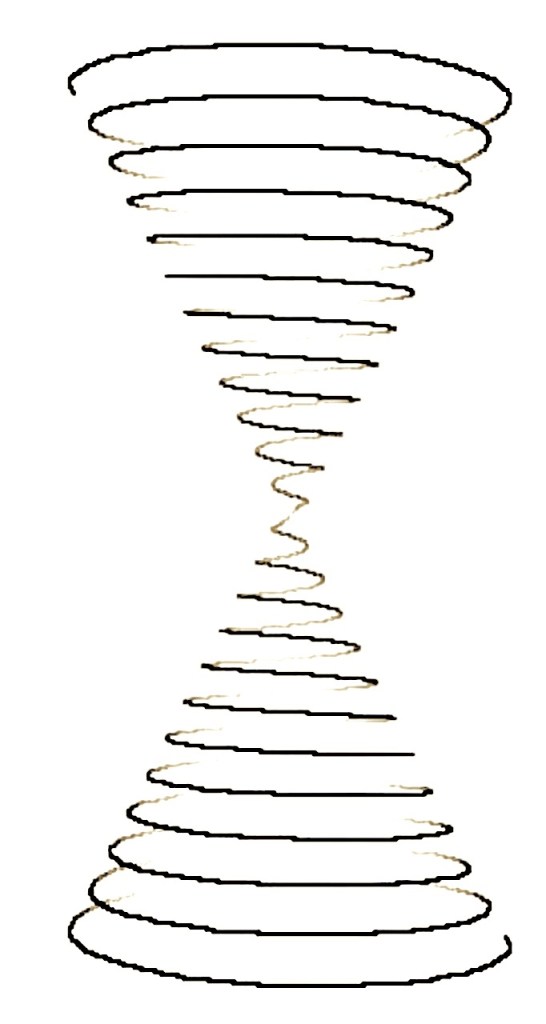
    An important example of Yeats’ misunderstanding of world cycles is his explanation of the cyclical nature of history, exemplified with what he called “gyres” (pronounced with a hard “g.”)  Two particular points in the Yeatsian explanation demonstrate the fallacy of his thinking:

    1. In his diagram, Yeats set the position of the gyres inaccurately; they should not be intersecting but instead one should rest  one on top of the other:  cycles shrink and enlarge in scope; they do not overlap, as they would have to do if the Yeatsian model were accurate. 

    Image :  Gyres – Inaccurate Configuration from A Vision

    Image:  Gyres –  Accurate Configuration

    2.  In the traditional Second Coming, Christ is figured to come again but as an adult, not as in infant as is implied in Yeats’ poem “The Second Coming.”

    Of great significance in Yeats’ poem is the “rough beast,” apparently the Anti-Christ, who has not been born yet.  And most problematic is that the rough beast is “slouch[ing] towards Bethlehem to be born.”  The question is, how can such a creature be slouching if it has not yet been born?  There is no indication the speaker wishes to attribute this second coming fiasco to the mother of the rough beast.

    This illogical event is never mentioned by critics who seem to accept the slouching as a possible occurrence.  On this score, it seems critics and scholars have lent the poem an unusually wide and encompassing poetic license.

    The Accurate Meaning of the Second Coming

    Paramahansa Yogananda has explained in depth the original, spiritual meaning of the phrase “the second coming”[5] which does not signify the literal coming again of Jesus the Christ, but the spiritual awakening of each individual soul to its Divine Nature through the Christ Consciousness.  

    Paramahansa Yogananda summarizes his two volume work The Second Coming of Christ: The Resurrection of the Christ Within You:

    In titling this work The Second Coming of Christ, I am not referring to a literal return of Jesus to earth . . . 

    A thousand Christs sent to earth would not redeem its people unless they themselves become Christlike by purifying and expanding their individual consciousness to receive therein the second coming of the Christ Consciousness, as was manifested in Jesus . . . 

    Contact with this Consciousness, experienced in the ever new joy of meditation, will be the real second coming of Christ—and it will take place right in the devotee’s own consciousness. (my emphasis added)

    Interestingly, knowledge of the meaning of that phrase “the second coming” as explained by Paramahansa Yogananda renders unnecessary the musings of Yeats’ poem “The Second Coming”and most other speculation about the subject. Still, the poem as an artifact of 20th century thinking remains an important object for study. 

    Sources

    [1]  Linda Sue Grimes.  “Robert Bly’s ‘The Cat in the Kitchen’ and ‘Driving to Town Late to Mail a Letter’.”  Linda’s Literary Home. December 24, 2025. 

    [2]  David Solway.  “The Origins of Postmodernitis.”  PJ Media.  March 25, 2011.  

    [3]  Linda Sue Grimes. “Poetry and Politics under the Influence of Postmodernism.” Linda’s Literary Home.  Accessed December 3, 2025.

    [4]  Dorian Lynsey. “‘Things fall apart’: the Apocalyptic Appeal of WB Yeats’s The Second Coming.” The Guardian.  May 30, 2020.

    [5]  Editors. “The Truth Hidden in the GospelsSelf-Realization Fellowship. Accessed October 27, 2023.

  • Cornelius Eady’s “Renée Nicole Good Is Murdered”

    Image:  Cornelius Eady 

    Cornelius Eady’s “Renée Nicole Good Is Murdered”

    Cornelius Eady’s “Renée  Nicole Good Is Murdered” attempts an elegy motivated by political propaganda instead of poetic insight. With clumsy imagery such as “melted from / The ice pack” and melodramatic effusions such as “see what fucking / With the bull gets you,” the piece descends into propaganda which fails to speak to the gravity of the event to which it refers.

    Introduction and Text of “Renée  Nicole Good Is Murdered”

    Cornelius Eady is a fairly well-known American poet, whose work often exploits race and identity but also often focuses on music. Because the field of po-biz in its postmodern garb currently awards talentless and bombastic versifiers, who engage little more than identify politics, Eady can boast of having received Lamont and National Book Award nominations. 

    However, Eady’s 2026 piece “Renée  Nicole Good Is Murdered” falls flat because it focuses on political propaganda; it shows no characteristic of an authentic elegy and no formal poetic craft.

    A traditional elegy reflects and mourns the life of a well-known and/or well-respected individual, who has performed acts that support and defend a country or a set of widely well-regarded principles. Examples of traditional elegies are Audre Lorde’s “Father Son and Holy Ghost,” and Ella Wheeler Wilcox’s “The Queen’s Last Ride,” and Walt Whitman’s “When Lilacs Last in the Dooryard Bloom’d.”

    The Subject of the Elegy

    Renée Nicole Good was a recent citizen of Minnesota, who, on January 7, 2026, was impeding the work of U.S. Immigration and Customs Enforcement agents as they engaged in their task of locating and arresting illegal migrants for deportation, many of whom had criminal records for murder, rape, and armed robbery.

    As Good attempted to ram her Honda Pilot into an ICE agent, the agent shot and killed her.  The event has sparked national attention, with political activists exploiting the sorrowful event to score political points.  Democrats governor Tim Walz and mayor Jacob Frey have continued to gin up further violence, encouraging their citizens to continue to impede the ICE agents as those federal agents simply attempt to do their job.

    An Elegy Goes Astray

    It should be obvious that the subject to this “elegy” does not comport with the definition of a that form; the death of Renée Nicole Good is not a tragedy in the traditional, literary definition, but it is sorrowful event that we all mourn and wish desperately had not happened.  

    Good’s character flaw lay only in her failure to understand and/or accept the truth of  the political turmoil that currently grips the nation, especially Trump Derangement Syndrome, a condition that dictates that anything happening under the Trump administration is evil and must fought against by any means necessary–including attempting to run down an ICS agent with two ton vehicle.

    While Homeland Security secretary Kristi Noem’s labeling Good a “domestic terrorist” has received pushback, it does seem that the definition of that phrase clearly speaks to what Renée Good was doing that day: 

    Domestic terrorism in the United States is defined by federal statute in 18 U.S.C. § 2331(5), which states that it means activities that meet three criteria: (A) involve acts dangerous to human life that violate U.S. or state criminal laws; (B) appear intended to intimidate or coerce a civilian population, influence government policy by intimidation or coercion, or affect government conduct by mass destruction, assassination, or kidnapping; and (C) occur primarily within U.S. territorial jurisdiction. [my emphasis added: describing Good’s activism and actions]

    Serious Matter Captured by Propaganda

    The death of any individual causes concern and sorrow, especially when violence is involved, and the death of Renée Good is horrifying and remains particularly sad because she died because of the misguided urgings she believed from her fellow travelers—including the governor of her state and the mayor of her city.

    Now comes the verse maker Cornelius Eady adding more dreck to the filth that has already been spewed about this horrific event.  And this time the discourse is masquerading as an elegy—an elegy for an unfortunate, misguided woman whose action has been labeled domestic terrorism!

    The subject matter is grave, but Eady’s treatment of it as a elegiac poem makes a mockery not only the human subject but the art of poetic elegy itself.  The piece collapses into political sloganeering along with a clunky metaphor that undermines both elegiac seriousness and poetic craft. 

    Instead of focusing on complex human experience, the versifier substitutes  caricatures for genuine people and emotion, such as a “dormant virus” and the “super cops”; these phrases ring in as contrived mountebanks rather than genuine images. 

    Instead of engaging with any nuanced reality of Good’s actual life and violent death, the piece’s political propaganda sorely diminishes the ability to even grieve, and it has no chance to illuminate. 

    The piece conflates contrived imagery of viral ice-packs with law enforcement as it inserts overt hostility (“see what fucking / With the bull gets you”). Eady’s obscene, flabby phrasing sacrifices reality for blunt political postering, yielding a piece of discourse that sadly falls flat as an elegy.

    Renée Nicole Good Is Murdered

    Up rides the super cops,
    The cancellation squad.
    A dormant virus, melted from
    The ice pack,
    And the conversation
    Is end-stopped when
    The shell cracks her
    Car window, does its
    Dumb duty,
    Brings silence
    To a poet’s mind.

    The President says:
    You’re a terror bot
    If you don’t comply.
    Homeland security
    Puts on a ten gallon
    Texas size hat,
    Says see what fucking
    With the bull gets you.
    There is a picture of her
    Just before it tips rancid,
    Just before she’s dragged
    Into how they see her.

    I wish I could read the words
    As they blaze their last, unsuspected
    Race through her skull.
    A language poem that ends on
    The word
    Impossible.

    Commentary on “Renée  Nicole Good Is Murdered”

    The piece’s political sloganeering and awkward images undermine the gravity and craft of elegy, and diminish the gravity of the event it intends to mourn.

    First Movement: “Up rides the super cops”

    Up rides the super cops,
    The cancellation squad.
    A dormant virus, melted from
    The ice pack,
    And the conversation
    Is end-stopped when
    The shell cracks her
    Car window, does its
    Dumb duty,
    Brings silence
    To a poet’s mind.

    When a piece offered as a poem begins with a bald-face lie in its title, what can one expect from the rest of the piece?  The fact is that Renée  Nicole Good was not “murdered.”  She was killed by an ICE agent, acting in self-defense, as she appears to ram the agent with her two ton vehicle, a Honda Pilot.

    The opening stanza attempts to set a dramatic scene with bold imagery: “Up rides the super cops” and “The cancellation squad.” The labeling of ICE agents as “super cops” is talky and unserious, and calling them the “cancellation squad” is equal as vapid.  What’s with the grammatical error using a singular verb with a plural subject?  That one might be overlooked  and laid to an attempt at conversational dialect.

    Quite the reverse is true about the “cancellation” notation; instead of canceling anything, ICE’s work entails removing crime and restoring the social order that works well for its citizens.  The cartoonish labeling reveals more about the ignorance of real news, immaturity, and disingenuousness of the would-be poet than it does about the target of his ire.

    The next line—“A dormant virus, melted from / The ice pack”—is even more asinine. There is no connection between a virus and the Minneapolis shooting of Good. The phrase hangs out like a concocted political conflation, intending to bring to mind the pandemic era as it critiques law enforcement actions as disease-like.  Such a metaphor reduces real individuals to abstract threats and hazards. 

    Poetic metaphor and image require calibration: a powerful metaphor/image resonates with emotional truth. Here, the metaphors as well as the images feel arbitrary and jarring, unanchored to experience or sensation. It,  therefore,  becomes political propaganda rather than poetic reflection.

    The speaker of the piece  is undermining his thoughts by marginalizing them with clumsy syntax and incoherent imagery. Lines such as “The shell cracks her / Car window” attempt to point to violence but lack clarity or context, leaving the reader unsure whether the “shell” is literal or figurative. 

    These surreal pivots never come together to reveal any recognizable emotional reaction or narrative flavor.  Abrupt shifts, awkward line breaks, and absurd references place the verse into the doggerel category rather than with crafted poetry. 

    Instead of exploring grief or loss, the imagery functions to flatten any complexity of thought in favor of bald assertion. As a result, the piece establishes a tone that bespeaks propaganda instead of elegy.

    Second Movement: “The President says”

    The President says:
    You’re a terror bot
    If you don’t comply.
    Homeland security
    Puts on a ten gallon
    Texas size hat,
    Says see what fucking
    With the bull gets you.
    There is a picture of her
    Just before it tips rancid,
    Just before she’s dragged
    Into how they see her.

    The second movement intensifies these absurdities already presented in the first movement; it shifts into over-drive as is becomes pure political caricature. The claim about what the “President says” reads as hyperbolic ventriloquism rather than credible critique of actual quotation.  

    Effective elegy builds a sympathetic connection between public tragedy and private humanity, but this piece merely reduces the subject’s death to a cartoonish struggle between an imaginary oppressive state and a pathetically symbolic victim. 

    The reference to “Homeland security” donning a “ten gallon / Texas size hat” reduces would-be satire to stereotype, substituting fake bravado for engagement with real political language. DHS secretary Kristi Noem often dons Western style outfits, quite appropriately as the former governor of South Dakota.

    Profanity-laden lines aim for shock but dislocate the tone of a piece intended to elegize its subject.  This tonal imbalance further distances the piece from the contours of elegy. Even gestures toward tenderness—“There is a picture of her / Just before it tips rancid”—feel tacked on and tacky as they are aiming at rhetorical bluster.

    Third Movement: “I wish I could read the words”

    I wish I could read the words
    As they blaze their last, unsuspected
    Race through her skull.
    A language poem that ends on
    The word
    Impossible.

    The final movement tries to offer some introspection by the speaker,  but his attempt lapses into melodrama. Imagining words “blazing”  as they “race through her skull” aestheticizes the violent act rather than honoring the dead. 

    The closing epigram—ending on the word “Impossible”—feels unconvincing because it sounds so completely contrived, lacking the emotional grounding so necessary for resonance. 

    Through its three movements, the piece substitutes forced metaphor/image, political sloganeering, and abstraction for specificity, empathy, genuine emotion, and reality itself. 

    Because of all of those weaknesses, the piece fails to meet the demands of a true elegy, instead it collapses into rhetorically heavy, emotionally shallow doggerel that neither illuminates the horrific event, nor does it pay tribute and honor its subject.

  • Thomas Thornburg’s “Serving the South”

    Image: Thomas Thornburg 

    Thomas Thornburg’s “Serving the South”

    The irony in the title of Thomas Thornburg’s “Serving the South” serves the hatred spewed by a Northern bigot on a fancied journey through the Southland of the United States of America, as he engages stereotypes to disparage Southerners.

    Introduction with Text of  “Serving the South”

    The speaker in Thomas Thornburg’s “Serving the South” from his final published collection American Ballads: New and Selected Poems is a bigoted northerner who is ostensibly reporting his observations about his southern neighbors.  

    However, all he actually accomplishes is a warming up and reworking of a handful of worn out clichés and stereotypes about the American South.   An especially egregious example of these ignorant stereotypes plays out in the speaker’s deliberate misspelling of the word, “eccyclema” as “ekkuklema” [1]. 

    All those “k’s” and the replacement of the “y” with “u” is meant to trigger in the minds of readers an image of the KKK—Ku Klux Klan—which for many northerners like this speaker remains one of the few things they actually know about the American South.  The speaker comes across as a pathetic yet pedantic wielder of left-over 20th century animus of the North that continues to castigate the South for its culture.  

    And yet while no contemporary southerners believe that slavery represents a useful and gloried past to which they would gladly return, some northerners (along with some westerners and easterners) continue to tar the entire South with that broad brush of racism.  That tarring is most often done for political purposes.  This speaker is engaging in that atrocious act primarily for poetic drama.  

    Serving the South

    deadended on a siding in Midway, Alabama,
    stand 6.5 miles of RR cars.
    covered in kudzu and time, they stand,
    iron cheeks squaring their gothic mouths;
    they are Southern and Serve the South
    (hub-deep in red clay) this land,
    this ekkuklema of southern drama.
    still, it is Bike Week in Daytona,
    and the Lady is sold in yards from rucksacks
    where a tattooed mama fucks & sucks
    (her name is not Ramona).
    here will come no deus ex machina,
    this American South, this defeated dream.
    drunken, drugged, dolorous in their dementia,
    forbidden by Law to wear their colors,
    these cavaliers race their engines and scream
    where the marble figure in every square
    shielding his eyes as the century turns
    stands hillbilly stubborn and declares.
    heading back north having spent our earnings,
    honeyed and robbed we are fed on hatred
    cold as our dollar they cannot spurn,
    and we are in that confederate.

    “Serving the South,” from American Ballads: New and Selected Poems
    © Thomas Thornburg 2009

    Reading 

    Commentary on “Serving the South”

    A northern bigot looks down his nose at the people of the South. As he does so, his use of stereotypes reveals inaccuracies as well as his shallow understanding of his target.    Employment of mere stereotypes nearly always results in wrong-headedness and even gross but often wide-spread fabrications.

    Image 2:  Southern Serves the South

    First Movement:  Symbolizing of the South

    deadended on a siding in Midway, Alabama,
    stand 6.5 miles of RR cars.
    covered in kudzu and time, they stand,
    iron cheeks squaring their gothic mouths;
    they are Southern and Serve the South
    (hub-deep in red clay) this land,
    this ekkuklema of southern drama.

    The speaker begins his rant in what, at first, seems to be a mere description of a length of railroad cars that have been sitting in Midway, Alabama, unattended so long that kudzu is growing on them.  The cars have seemingly begun to sink into the “red clay”—(Northerners are often taken aback at the sight of southern “red clay.”)

    The drama that plays out in this opening movement reveals the bigotry and ignorance of this low-information speaker.  He employs the term “ekkuklema” to describe the railroad cars.  This usage could signal a useful metaphor, as the Greek term refers to the vehicle used in Greek dramas to assist in shifting scenes.  

    However, this speaker’s usage merely signals an attempt to focus readers on the despicable and now nearly defunct and everywhere debunked group that blackened the reputation of the South following the American Civil War.

    The traditional, anglicized spelling of this Greek term is “eccyclema” (pronounced ɛksɪˈkliːmə), but it does have an alternate spelling “ekkyklēma.”  However, no alternate spelling exists that replaces the “y” with a “u.”  This speaker has coined his own term, and for a very clever reason, he, no doubt, believes.

    In choosing to spell “eccyclema” as “ekkuklema,” the speaker points to the most heinous organizations that did, in fact, develop in the South, the Ku Klux Klan.   The organization served as an unofficial terror group for the Democratic Party [2], after the first Republican president, Abraham Lincoln, and the Civil War put an end to slavery.  

    The KKK attempted to dismantle the citizenship rights of former slaves through cross burnings, lynchings, and intimidation. The Klan also attempted to overthrow Republican governors by assassinating black leaders.

    With one simple, innocent word, this speaker has alluded to that despicable group that began in the South, specifically in Pulaski, Tennessee,  December 24, 1865.   The stone-throwers of the North like to pretend innocence in such ventures, but the KKK spread North, and by 1915, Indiana and many other northern states [3] could boast their own branches of the Klan.

    This speaker’s sole purpose in coining a new spelling for the Greek stage term is to remind readers of that Southern flaw, with which he hopes his readers will be instructed to believe that all southerners remain racists.

    As the railroad cars become a symbol of non-productive laziness—stuck in red clay—the speaker lays on the stereotype of racism as a quality of the South. The South is served by these railroad cars that go nowhere, having sat idle so long that kudzu is covering them, while they sink into the mud of “red clay.”

    Second Movement:  From Alabama on to Florida

    still, it is Bike Week in Daytona,
    and the Lady is sold in yards from rucksacks
    where a tattooed mama fucks & sucks
    (her name is not Ramona).

    The speaker has now moved on from Alabama to Florida, where it is “Bike Week in Daytona.”  His participation in Bike Week remains a mystery, but what he actually does pay attention to is most revealing:  he is after cocaine and c*nt.  

    The speaker reports that he can get cocaine, “White Lady,” or “Lady” from dealers anywhere selling from backpacks.   He seems especially interested in purchasing from a woman with tattoos from whom he can also receive sexual service because this “mama f*cks & sucks.”   The tattooed mama is not a looker, that is, she is not a “Ramona”—slang term for a very good-looking woman.  

    The speaker has done such a marvelous job of condemning the South in his first movement that he lets the second movement slide a bit, except for the fact that cocaine is flowing freely.   And ugly women with tattoos continue selling coke and c*nt during “Bike Week” in Daytona.  But what about the bikers?

    Third Movement:  The Colors

    here will come no deus ex machina,
    this American South, this defeated dream.
    drunken, drugged, dolorous in their dementia,
    forbidden by Law to wear their colors,
    these cavaliers race their engines and scream
    where the marble figure in every square
    shielding his eyes as the century turns
    stands hillbilly stubborn and declares.

    Indeed, there cannot be any happy ending involving this God-forsaken place.  No “god” is going to jump out of the “machine” called the South and save it from perdition, according to this stereotype-wielding bigot from the North.

    Now the speaker is ready let loose how he really feels about the American South:  it is a “defeated dream.”  Southerners are nothing but demented druggies and drunks.   His cleverly alliterative line-and-a-half reeks of desperation: “defeated dream. / drunken, drugged, dolorous in their dementia.”  

    The speaker then makes a huge error with the line, “forbidden by Law to wear their colors.”  Actually, there is no “Law” that forbids bikers to wear their patches or “colors.” The speaker is confusing the controversy that erupted in Florida and other states that resulted in many bars and restaurants refusing services to bikers wearing their club insignia.  

    There has been a decades-old movement [4] seeking legislation to end the unfair discrimination against bikers, as some areas continue to post signs demanding “No colors.  No guns.” 

    That demand violates both the first and second amendment rights of bikers:  wearing their club insignia is protected speech under the first amendment, and carrying a gun is protected by the second amendment.  

    The speaker then concocts an unseemly image of the bikers, whom he refers to as “cavaliers,” racing their engines and screaming under the statues of the Confederate war heroes, which the speaker places in “every square.”  Oddly, many of those bikers would not be southerners at all because bikers from all over the world attend events such as Daytona’s Bike Week. 

    The speaker further describes the men in the statues as covering their eyes and standing “hillbilly stubborn” at the turn of the century. According to the implications of this speaker, the dirty, dastardly southerners should be becoming more like their betters in the North.

    Fourth Movement:  Seriously Confederate

    heading back north having spent our earnings,
    honeyed and robbed we are fed on hatred
    cold as our dollar they cannot spurn,
    and we are in that confederate.

    Finally, this speaker reports that he and his group are “heading back north.”  They have spent all their money, but he calls the money “earnings,” leaving it a mystery whether he means the money they earned up North at their jobs, or money they might have earned wagering at the bike track.

    The speaker now blames the southerners he has encountered for his and his group’s spending all their money.  Southern flattery (“honeyed”) has motivated these savvy northerners to spend their money, but now he translates the act of voluntary spending into being “robbed.”  

    And what, in fact, did they buy—well, nothing, really, they were just “fed on hatred.”  This speaker would have his readers believe that southern hate is notorious for robbing innocent, white northerners who are just out to have a good time.

    Then the speaker offers a surprising revelation: the southerners could not spurn those northern dollars, even though those dollars were cold like the southern hatred that the speaker et al apparently experienced at every turn.  

    The speaker is subtly suggesting that southerners make up the bulk of that now iconic and famous Clintonian “basket of deplorables,” who are “racist, sexist, homophobic, xenophobic, Islamaphobic—you name it” [5].   The speaker then remarks that on the issue of money, or “earnings,” he, his group, and the southerners are “confederate,” or in agreement, or so it seems.  

    So money is after all the great leveler.  Everybody needs cash, is trying to secure cash—North, South, East, and West—all groups become “confederate” in their need for financial backing on this mud ball of a planet.

    But still the cliché dictates that when “other” people—in this case those deplorable southerners—work to get the money they need, they are still deplorable.  But when the virtuous northerner and his little group work for their cash, they are virtuous, and only “confederate” with those “others” in the mere fact that they need it.

    No doubt the speaker’s cuteness in thus employing the term “confederate” elicits from him a wild-eyed, wide-mouthed guffaw.  He and his group are, after all, heading home to the North, where things are sober, sane, and sympathetic to the political correctness that is flaying the world and turning stereotypes sprinkled with clichés into models for language and behavior.

    Sources

    [1]  Editors.  “Eccyclema.”  Britannica.  Accessed April 5, 2023.

    [2]  Editors.  “Ku Klux Klan.”  History.  Accessed April 5, 2023.

    [3]   Gail Schontzler.  “Bozeman’s Hidden History with the Ku Klux Klan.”  Bozeman Daily Chronicle.  September 17, 2017.

    [4]  Andrew Gant.  “Bikers Rally in Daytona Beach for End to Ban on Club Patches.”  The Daytona Beach News-Journal.  March 2, 2014.

    [5]  Rick Fuentes. “What’s in a Basket of Deplorables?American Thinker.  April 25, 2021.

  • Seamus Heaney’s “Whatever You Say, Say Nothing”

    Image:  Seamus Heaney

    Seamus Heaney’s “Whatever You Say, Say Nothing”

    Seamus Heaney’s “Whatever You Say, Say Nothing” is displayed in four parts. The piece dramatizes a rough-style free verse with an irregularly paced rime scheme. The speaker is describing the events surrounding the command for political operatives to be extremely careful with what they say.

    Introduction and Text of “Whatever You Say, Say Nothing”

    The title, “Whatever You Say, Say Nothing,” originates with the secretive activity of Northern Ireland’s rebel paramilitary that admonished its members with this demand. 

    Its purpose was to advise members to be extremely careful with what they say. If they speak to “civilians” at all, they should make their talk so small that it would reveal nothing about their activity. 

    Whatever You Say, Say Nothing

    I

    I’m writing just after an encounter
    With an English journalist in search of  ‘views
    On the Irish thing’.  I’m back in winter
    Quarters where bad news is no longer news,
    Where media-men and stringers sniff and point,
    Where zoom lenses, recorders and coiled leads
    Litter the hotels. The times are out of joint
    But I incline as much to rosary beads
    As to the jottings and analyses
    Of politicians and newspapermen
    Who’ve scribbled down the long campaign from gas
    And protest to gelignite and Sten,
    Who proved upon their pulses ‘escalate’,
    ‘Backlash’ and ‘crack down’, ‘the provisional wing’,
    ‘Polarization’ and ‘long-standing hate’.
    Yet I live here, I live here too, I sing,
    Expertly civil-tongued with civil neighbours
    On the high wires of first wireless reports,
    Sucking the fake taste, the stony flavours
    Of those sanctioned, old, elaborate retorts:
    ‘Oh, it’s disgraceful, surely, I agree.’
    ‘Where’s it going to end?’ ‘It’s getting worse.’
    ‘They’re murderers.’ ‘Internment, understandably …’
    The ‘voice of sanity’ is getting hoarse.

    II

    Men die at hand. In blasted street and home
    The gelignite’s a common sound effect:
    As the man said when Celtic won, ‘The Pope of Rome’s
    a happy man this night.’ His flock suspect

    In their deepest heart of hearts the heretic
    Has come at last to heel and to the stake.
    We tremble near the flames but want no truck
    With the actual firing. We’re on the make

    As ever. Long sucking the hind tit
    Cold as a witch’s and as hard to swallow
    Still leaves us fork-tongued on the border bit:
    The liberal papist note sounds hollow

    When amplified and mixed in with the bangs
    That shake all hearts and windows day and night.
    (It’s tempting here to rhyme on ‘labour pangs’
    And diagnose a rebirth in our plight

    But that would be to ignore other symptoms.
    Last night you didn’t need a stethoscope
    To hear the eructation of Orange drums
    Allergic equally to Pearse and Pope.)

    On all sides ‘little platoons’ are mustering-
    The phrase is Cruise O’Brien’s via that great
    Backlash, Burke-while I sit here with a pestering
    Drouth for words at once both gaff and bait

    To lure the tribal shoals to epigram
    And order. I believe any of us
    Could draw the line through bigotry and sham
    Given the right line, aere perennius.

    III

    “Religion’s never mentioned here”, of course.
    “You know them by their eyes,” and hold your tongue.
    “One side’s as bad as the other,” never worse.
    Christ, it’s near time that some small leak was sprung
    In the great dykes the Dutchman made
    To dam the dangerous tide that followed Seamus.
    Yet for all this art and sedentary trade
    I am incapable. The famous
    Northern reticence, the tight gag of place
    And times: yes, yes. Of the “wee six” I sing
    Where to be saved you only must save face
    And whatever you say, you say nothing.
    Smoke-signals are loud-mouthed compared with us:
    Manoeuvrings to find out name and school,
    Subtle discrimination by addresses
    With hardly an exception to the rule
    That Norman, Ken and Sidney signalled Prod
    And Seamus (call me Sean) was sure-fire Pape.
    O land of password, handgrip, wink and nod,
    Of open minds as open as a trap,
    Where tongues lie coiled, as under flames lie wicks,
    Where half of us, as in a wooden horse
    Were cabin’d and confined like wily Greeks,
    Besieged within the siege, whispering morse.

    IV

    This morning from a dewy motorway
    I saw the new camp for the internees:
    A bomb had left a crater of fresh clay
    In the roadside, and over in the trees
    Machine-gun posts defined a real stockade.
    There was that white mist you get on a low ground
    And it was déjà-vu, some film made
    Of Stalag 17, a bad dream with no sound.
    Is there a life before death? That’s chalked up
    In Ballymurphy. Competence with pain,
    Coherent miseries, a bite and sup,
    We hug our little destiny again.

    Commentary on “Whatever You Say, Say Nothing”

    The poem, “Whatever You Say, Say Nothing,” is displayed in four parts. The piece dramatizes a rough-style free verse with an irregularly paced rime scheme.

    First Part:  Harassed by Reporters

    I’m writing just after an encounter
    With an English journalist in search of  ‘views
    On the Irish thing’.  I’m back in winter
    Quarters where bad news is no longer news,
    Where media-men and stringers sniff and point,
    Where zoom lenses, recorders and coiled leads
    Litter the hotels. The times are out of joint
    But I incline as much to rosary beads
    As to the jottings and analyses
    Of politicians and newspapermen
    Who’ve scribbled down the long campaign from gas
    And protest to gelignite and Sten,
    Who proved upon their pulses ‘escalate’,
    ‘Backlash’ and ‘crack down’, ‘the provisional wing’,
    ‘Polarization’ and ‘long-standing hate’.
    Yet I live here, I live here too, I sing,
    Expertly civil-tongued with civil neighbours
    On the high wires of first wireless reports,
    Sucking the fake taste, the stony flavours
    Of those sanctioned, old, elaborate retorts:
    ‘Oh, it’s disgraceful, surely, I agree.’
    ‘Where’s it going to end?’ ‘It’s getting worse.’
    ‘They’re murderers.’ ‘Internment, understandably …’
    The ‘voice of sanity’ is getting hoarse.

    In Part I, the speaker reports that he is being harassed by reporters.  They seek information about how the Irish feel about their situation.  The intrusive reporters shove cameras and microphones into the faces of the locals.  They “litter” the localities and disturb the peace.    

    The speaker then describes the chaos of the political situation.  He claims that he leans more toward religion than politics, but because he is also a citizen he has to pay some attention to current events.

    The speaker portrays the situation as fractious and obstreperous.  As the citizens discuss the chaos, each has his own opinion.  But this speaker/observer notes that certain phrases keep popping up as the folks wonder how all the fighting and back-biting will end.   They all agree that the situation is disagreeable even full of disgrace.

    The speaker even hears his neighbors complaining and keening cries about murderers.  They seem to have no recourse to keep themselves safe.  There seems to be no one around them who possesses a healthy attitude.   

    The speaker’s attitude runs the gamut from amusement to sheer philosophical angst as he looks on the chaos.  He becomes Yeastian at times as he marvels, condemns, and pontificates. 

    Second Part:  After Centuries of War Zone Living

    Men die at hand. In blasted street and home
    The gelignite’s a common sound effect:
    As the man said when Celtic won, ‘The Pope of Rome’s
    a happy man this night.’ His flock suspect

    In their deepest heart of hearts the heretic
    Has come at last to heel and to the stake.
    We tremble near the flames but want no truck
    With the actual firing. We’re on the make

    As ever. Long sucking the hind tit
    Cold as a witch’s and as hard to swallow
    Still leaves us fork-tongued on the border bit:
    The liberal papist note sounds hollow

    When amplified and mixed in with the bangs
    That shake all hearts and windows day and night.
    (It’s tempting here to rhyme on ‘labour pangs’
    And diagnose a rebirth in our plight

    But that would be to ignore other symptoms.
    Last night you didn’t need a stethoscope
    To hear the eructation of Orange drums
    Allergic equally to Pearse and Pope.)

    On all sides ‘little platoons’ are mustering-
    The phrase is Cruise O’Brien’s via that great
    Backlash, Burke-while I sit here with a pestering
    Drouth for words at once both gaff and bait

    To lure the tribal shoals to epigram
    And order. I believe any of us
    Could draw the line through bigotry and sham
    Given the right line, aere perennius.

    The speaker is, however, also capable of spouting the same jeremiads that the Irish have spouted for centuries of residing in a war zone.  Understandably, they have become hardened and discouraged seeing people dying around them as homes are bombed and streets are littered with fire power and debris.   

    The speaker claims that a common sound is the explosion of  “gelignite.” He seems fascinated by the term “gelignite,” which he continues to spread liberally throughout his passages. 

    The speaker is also, however, dramatizing the socialist nature of the crowd and manages to fling off a worked-over cliché:  “cold as a witch’s tit” becomes “hind tit / Cold as a witch’s”—his colorful way of dramatizing the angst. 

    The speaker’s colorful portrayals lurch the poem forward, even if the politics gives it a decided lag, as he confounds the papal intrusion with emptiness.   The continued explosions, however, rip the night and rattle the people’s minds and hearts as well as the windows of their houses.

    Of course, the reader is aware that eventual outcomes depend totally upon which side one is shouting for.  The speaker philosophizes that all the citizens could find the correct solution given enough time and space.  

    They would likely be better at cutting through the bigotry and fake political posturing than those seeking personal gain at the expense of others.  Enough time and anything could be accomplished, the speaker wants to suggest. 

    Third Part:  The Resistance vs Authority

    “Religion’s never mentioned here”, of course.
    “You know them by their eyes,” and hold your tongue.
    “One side’s as bad as the other,” never worse.
    Christ, it’s near time that some small leak was sprung
    In the great dykes the Dutchman made
    To dam the dangerous tide that followed Seamus.
    Yet for all this art and sedentary trade
    I am incapable. The famous
    Northern reticence, the tight gag of place
    And times: yes, yes. Of the “wee six” I sing
    Where to be saved you only must save face
    And whatever you say, you say nothing.
    Smoke-signals are loud-mouthed compared with us:
    Manoeuvrings to find out name and school,
    Subtle discrimination by addresses
    With hardly an exception to the rule
    That Norman, Ken and Sidney signalled Prod
    And Seamus (call me Sean) was sure-fire Pape.
    O land of password, handgrip, wink and nod,
    Of open minds as open as a trap,
    Where tongues lie coiled, as under flames lie wicks,
    Where half of us, as in a wooden horse
    Were cabin’d and confined like wily Greeks,
    Besieged within the siege, whispering morse.

    In Part III, the poem’s title appears, warning that the members of the resistance should take great care not to tip their hand.  If they speak to anyone, they must keep their conversation as neutral as possible.

    They must be quiet, so quiet that a smoke-signal would sound louder.  They must keep their talk to a level of mum.  They must not reveal their plans to anyone lest some authority figure get hold of them.

    Fourth Part:  Is There Life Before Death?

    This morning from a dewy motorway
    I saw the new camp for the internees:
    A bomb had left a crater of fresh clay
    In the roadside, and over in the trees
    Machine-gun posts defined a real stockade.
    There was that white mist you get on a low ground
    And it was déjà-vu, some film made
    Of Stalag 17, a bad dream with no sound.
    Is there a life before death? That’s chalked up
    In Ballymurphy. Competence with pain,
    Coherent miseries, a bite and sup,
    We hug our little destiny again.

    In the final part, the speaker describes what he has seen.  He saw a crater in the middle of an internee camp.  The bomb has carved out the crater and the fresh clay has been spewed all over the trees and the road.

    The speaker then sums up his report with a statement filled with questions.  He wonders if there is life before death.  He also questions the notions of pain and competence.  It seems that life is filled with contradictions, that misery can be coherent stands in his mind as a blind trust.  

    If they are to enjoy their dinner, they must grasp their own destiny repeatedly as they wait for each bit of knowledge that will eventually lead them out of chaos. 

    Reading: Seamus Heaney reading Part 3 of his poem:  

  • Ben Okri’s Poem “Obama”

    Image:  Ben Okri

    Ben Okri’s Poem “Obama”

    A no-achievement president confounds the ability of a poet, who tries to celebrate the outgoing leader but can find no achievements to celebrate.

    Introduction with Text of Ben Okri’s “Obama” 

    On Thursday, January 19, 2017, one day before the inauguration of Donald Trump as the 45th president of the United States of America, the U.S.A. edition of The Guardian published Ben Okri’s poem [1] simply titled “Obama,” about which the publication claimed, “With Donald Trump about to enter the White House, a poet celebrates the achievements of the outgoing president.”

    One will peruse Okri’s poem in vain looking of any achievements that might be associated with President #44.  One will also peruse this poem in vain looking for any “celebration.”  The poem offers four musings of a philosophical nature, each handled in each of the four movements that structure the piece:  

    1. “Sometimes the world is not changed / Till the right person appears who can / Change it.”
    2. “For it is our thoughts that make / Our world.”
    3. “Being a black president is not a magic wand / That will make all black problems disappear.”
    4. “And so what Obama did and did not do is neither / Here nor there, in the great measure of things.”

    Each musing remains a vague utterance, especially in relationship to its avowed subject.  The promise of celebrating achievements becomes a dumbfounded leitmotiv that like the Obama presidency fails to deliver anything substantial.

    Toward the end of the piece, the speaker even seems to have become aware that he had not, in fact, offered anything concrete regarding the achievements of this president.  Thus, he rehashes an old lie that people wanted this president to fail so they could support their racism.  

    For any opposition to a black president has to be racist! 

    The opposition cannot be opposing a black president because they do not agree with his policies; that opposition must be the result of the “race-hate, twin deity of America,” despite the blaring fact that that race-hateful America elected this black man to their highest office twice.

    Okri usually provides level-headed, balanced thinking on most issues, even the race issue.  He knows the difference between achievement and lack thereof; thus, in this poem, he has his speaker spouting philosophical stances and then only implying that they apply to Barack Obama. 

    Okri, the thinking man, knows that Barack Obama is the epitome of an “empty-suit.”  Obama can lay no claim to achievements accept negative ones.  This poem might even be considered one of those that “damn with faint praise” [2].

    Obama

    Sometimes the world is not changed
    Till the right person appears who can
    Change it. But the right person is also
    In a way the right time. For the time
    And the person have to work
    The secret alchemy together.
    But to change the world is more than
    Changing its laws. Sometimes it is just
    Being a new possibility, a portal
    Through which new fire can enter
    This world of foolishness and error.
    They change the world best who
    Change the way people think.

    For it is our thoughts that make
    Our world. Some think it is our deeds;
    But deeds are the children of thought.
    The thought-changers are the game-changers,
    Are the life-changers.
    We think that achievements are symbols.
    But symbols are not symbols.
    Obama is not a mere symbol.
    Sometimes even a symbol is a sign
    That we are not dreaming potently
    Enough. A sign that the world is the home
    Of possibility. A sign that our chains
    Are unreal. That we are freer than we
    Know, that we are more powerful than
    We dare to think. If he is a symbol at all,
    Then he is a symbol of our possible liberation.
    A symbol also that power in this world
    Cannot do everything. Even Moses could
    Not set his people free. They too had to
    Wander in the wilderness. They too turned
    Against their leaders and their God
    And had to overcome much in their
    Make up and their history to arrive
    At the vision their prophets had long before.

    Being a black president is not a magic wand
    That will make all black problems disappear.
    Leaders cannot undo all the evils that
    Structural evils make natural in the life
    Of a people. Not just leadership, but
    Structures must change. Structures of thought
    Structures of dreams structures of injustice
    Structures that keep a people imprisoned
    To the stones and the dust and the ash
    And the dirt and the dry earth and the dead
    Roads. Always we look to our leaders
    To change what we ourselves must change
    With the force of our voices and the force
    Of our souls and the strength of our dreams
    And the clarity of our visions and the strong
    Work of our hands. Too often we get fixated
    On symbols. We think fame ought to promote
    Our cause, that presidents ought to change our
    Destinies, that more black faces on television
    Would somehow make life easier and more just
    For our people. But symbols ought to only be
    A sign to us that the power is in our hands.
    Mandela ought to be a sign to us that we cannot
    Be kept down, that we are self-liberating.
    And Obama ought to be a sign to us that
    There is no destiny in colour. There is only
    Destiny in our will and our dreams and the storms
    Our “noes” can unleash and the wonder our “yesses”
    Can create. But we have to do the work ourselves
    To change the structures so that we can be free.
    Freedom is not colour; freedom is thought; it is an
    Attitude, a power of spirit, a constant self-definition.

    And so what Obama did and did not do is neither
    Here nor there, in the great measure of things.
    History knows what he did, against the odds.
    History knows what he could not do. Not that
    His hands were tied, but that those who resent
    The liberation of one who ought not to be liberated
    Blocked those doors and those roads and whipped
    Up those sleeping and not so sleeping demons
    Of race-hate, twin deity of America. And they turned
    His yes into a no just so they could say they told us so,
    Told us that colour makes ineffectuality, that colour
    Makes destiny. They wanted him to fail so they could
    Prove their case. Can’t you see it? But that’s what
    Heroes do: they come through in spite of all that blockage,
    All those obstacles thrown in the path of the self-liberated.
    That way the symbol would be tainted and would fail
    To be a beacon and a sign that it is possible
    To be black and to be great.

    Commentary on Ben Okri’s  “Obama”

    Ben Okri is a fine poet and thinker.  His unfortunate choice of subject matter for this piece, however, leads his speaker down a rocky path to nowhere.

    First Movement:  “Change”?  But Where is the “Hope”?

    The speaker of Okri’s “Obama” has a mighty task before him:  he must transform a sow’s ear into a silk purse.  And of course, that cannot be done.  But the speaker tries, beginning with some wide brush strokes that attempt to sound profound:  only the right person appearing at the right time can change with world.  

    Changing laws is not sufficient to change the world, so sometimes it is only a “new possibility” which functions like a new door “through with a new fire can enter.”  

    The speaker is, of course, implying that his subject, Obama, is that “portal” through which a new fire has entered.  Readers will note that the speaker is only implying such; he does not make any direct statement about Obama actually being that new door or new fire.

    The election of 2016, after eight years of this implied new fire that has supposedly changed the way people think, proved that American citizens were indeed thinking differently.

    They had grown tired of stagnant economic growth, the destruction of their health care system, the rampant lawlessness of illegal immigrants, the war on law enforcement officers fueled by that “hope and change” spouting candidate, the ironically deteriorated race relations, and the installation of a petty dictatorship fueled by political correctness.  

    This beckon of hope and change had promised to fundamentally change [3] the United States of America, and his policies indeed had put the country on a path to an authoritarian state from which the Founders had guarded the country through the U. S. Constitution.  Obama proceeded to flout that document as he ruled by executive order, circumventing the congress.

    Indeed, after those abominable, disastrous eight years, people’s minds had changed, and they wanted no more of those socialistic policies that were driving the country to the status of a Banana Republic.

    The speaker, of course, will never refer to any of the negative accomplishments of his subject, but also he will never refer to any positive accomplishment because there simply are none.  Thus, no achievement is mentioned in the opening movement.

    Five days away:  

    Second Movement:  Symbols, Signs, Still No Achievements

    The speaker then continues with the mere philosophizing, offering some useful ideas that have nothing to do with his subject.  He asserts the importance of thought, how thought is the mother of deeds.  He then begins an equivocating series of lines that indeed fit quite well with the shallow, misdirection of the subject about which he tries to offer a celebration.

    The speaker makes a bizarre, false claim, “We think that achievements are symbols.”  We do not think any such thing; we think that achievements are important, useful accomplishments.

    A presidential achievement represents some act which the leader has encouraged that results in better lives for citizens. 

    Americans had high hopes [4] that the very least this black president could achieve would be the continued improvement of race relations.  Those hopes were dashed as this president from his bully pulpit denigrated whole segments of society—the religious, the patriotic, and especially the members of law enforcement [5].  

    Obama damaged the reputation of the entire nation as he traveled on foreign soil, apologizing for American behavior [6] that had actually assisted those nations in their times of distress.  

    The speaker then ludicrously states, “symbols are not symbols,” which he follows with “Obama is not a mere symbol.”  

    In a kind of syllogistic attempt to define a symbol, the speaker admits the truth that Obama actually had no achievements. If achievements are symbols, and Obama is not a “mere” symbol, then we hold the notion that Obama does not equal achievements, except for whatever the word “mere” might add to the equation.

    But the speaker then turns from symbols to signs. Signs can show us whether we are dreaming correctly or not.  Signs can show us that we are more free than we know.  But if Obama is any kind of  symbol, he symbolizes “our possible liberation.”  

    But he is also a symbol that “power in this world / Cannot do everything.”  He then turns to Moses’ inability to liberate his people.

    The sheer inappropriateness of likening the lead-from-behind, atheistic Obama to the great historical, religious figure Moses boggles the mind.  The speaker then makes an astoundingly arrogant inference that Americans turning against Obama equates to Moses’ people turning against him “and their God.”  

    Americans turning against leader Obama means they will have to “wander in the wilderness” until they at last come to their senses and return to the “vision of their prophets.”

    The speaker again has offered only musings about symbols, signs, power, lack of power, dreams, and misdirection, but he offers nothing that Obama has done that could be called an achievement.

    Third Movement:  Color Is not Destiny

    This movement offers a marvelous summation of truths, which essentially places all leaders in their proper places.  Leaders can serve only as symbols or signs to remind citizens that only the people themselves have the power to change the structures of society that limit individuals.  

    Black presidents possess no “magic wand” with which to make all “black problems disappear.”  Even Nelson Mandela should serve only as a sign that we are all “self-liberating.”

    The speaker rightly laments that we tend to look to our leaders to perform for us the very acts that we must perform for ourselves.  Our leaders cannot guarantee our inner freedom, only we can do that. 

    He asserts that Obama must remain only a sign that there is “no destiny in colour.”  Our destiny is in our own will and in our own dreams. 

    The speaker correctly asserts, “Freedom is not colour; freedom is thought; it is an / Attitude, a power of spirit, a constant self-definition.”

    Sadly, Obama has never demonstrated that he understands the position taken in Okri’s third movement.  Obama is so steeped in political correctness and radical collectivism that he always denigrates the stereotypical white privileged over the stereotypical groups of race, gender, nationality, and religion.  

    Obama’s warped, highly partisan stance would never accept the statements about freedom as described by Okri.  Obama believes that only the state can grant freedom to the proper constituencies as it punishes others.  Okri’s analysis runs counter to the Obama worldview [7].

    Thus, again, in its third movement, this poem that claims to be a celebration of the presidential achievements of the 44th president offers only philosophical musings, and although some of those musings state an accurate position, there still remains no positive achievement that can attach to Obama.

    Fourth Movement:  Obama, Neither Here nor There 

    With complete accuracy once again, Okri’s speaker states baldly, “And so what Obama did and did not do is neither / Here nor there, in the great measure of things.”  Certainly, one who looks for positive achievements will find the blandness of this statement on the mark.  The speaker then adds that history will record what Obama did and also what he was unable to do.

    Then the narrative goes totally off the rails.  American racists, those “racists” who had elected this black president twice, threw up road blocks that limited this president’s accomplishments.  

    They wanted him to fail because being black he had no right to succeed.  The speaker implies that those American racists thought that this black president did not deserve liberation, meaning they thought he should be a slave—a ludicrous, utterly false claim. 

    The speaker then concludes with a weak implication that Obama is a hero, who demonstrated that it is possible to be “black and to be great”:  

    They wanted him to fail so they could
    Prove their case. Can’t you see it? But that’s what
    Heroes do: they come through in spite of all that blockage,
    All those obstacles thrown in the path of the self-liberated.
    That way the symbol would be tainted and would fail
    To be a beacon and a sign that it is possible
    To be black and to be great.

    The problem with this part of the narrative again is, on the one hand, that it is only an implication, not a positive statement making the claim that Obama was, in fact, a hero; on the other hand, it is obvious why the speaker would only imply these positive qualities to Obama:  the man is not a hero; indeed, he is a fraud [8].  

    Fraudulent Claims of Literary Prowess

    There is a certain bit of irony in having a poem attempt to celebrate the achievements of a colossal fraud [9].  Nowhere is the evidence of Obama’s characteristic as a fraud more evident than in his claims to have written his two books, Dreams from My Father, and The Audacity of Hope

    Jack Cashill’s “Who Wrote Dreams from My Father?” [10] offers convincing evidence that Barack Obama could not have written the books he claims to have authored.  And Cashill continues his analysis of Obama’s writing skills in “Who Wrote Audacity of Hope?” [11].

    Writing in the Illinois Review, Mark Rhoads [12] poses the same question regarding the Obama works.  Even Obama’s presidential library [13] will offer no evidence that the president possessed any literary skills.

    Clearly, Okri’s poem provides a mélange of attitudes toward its subject.  On the one hand, it wants to praise the outgoing president, but on the other, it simply can find nothing with which to do so. 

    That the poem concludes with a bald-face lie is unfortunate, but understandable.  Still, it cannot hide the truth:  that Barack Obama offered it no achievements, which it could celebrate; at best, only phony ones [14].

    Sources

    [1]  Ben Okri.  “Barack Obama: a celebration in verse.”  The Guardian.  January 19, 2017.

    [2] Alexander Pope.  Rape of the Lock and Other Poems.  Project Gutenberg.  October 18, 2003.

    [3]  Barack Obama. “We Are 5 Days From Fundamentally Transforming America.” YouTube.  Feb 2, 2012.

    [4] Jeffrey M. Jones. “In U.S., Obama Effect on Racial Matters Falls Short of Hopes.” Gallup. August 11, 2016.

    [5]  Ben Smith. “Obama on small-town Pa.: Clinging to religion, guns, xenophobia.”  Politico.  April 11, 2008.

    [6]   Nile Gardiner and Morgan Lorraine Roach.  “Barack Obama’s Top 10 Apologies: How the President Has Humiliated a Superpower.”  The Heritage Foundation.  June 2, 2009.

    [7]  Andrew Miller.  “Unriddling the Radical Worldview of President Obama.”  The Trumpet. January 2016.

    [8]  Andrew McCarthy.  “Obama’s Massive Fraud.”  National Review Online.  November 9, 2013.

    [9]  Jack Cashill.  “‘Roots,’ ‘Dreams,’ and the Unequal Punishment of Fraud.”  The American Spectator.  December 26, 2021.

    [10]   – – – . “Who Wrote Dreams From My Father?American Thinker.  October 9, 2008.

    [11]  – – – .  “The Question the Times Should Have Asked ‘Writer’ Barack Obama.”  The American Spectator.  January 25, 2017.

    [12]  Mark Rhoads.  “Did Obama Write ‘Dreams from My Father or ‘Audacity of Hope’?”  Illinois Review. October 16, 2008.

    [13] Lolly Bowean.  “Without archives on site, how will Obama Center benefit area students, scholars?”  Chicago Tribune. October 8, 2017.

    [14]  Jennifer Rubin.  “Obama’s phony accomplishments leave us worse off.”  Washington Post.  Feb. 12, 2016.

    🕉

    You are welcome to join me on the following social media:
    TruthSocial,Locals,Gettr,X,Bluesky,Facebook,Pinterest 

    🕉

    Share