Refuting the Big Lie That the “Three/Fifths Compromise” Enshrined Slavery in the U. S. Constitution
The “Three/Fifths Compromise 1787” permitted the Southern slave states to count 60% of their slave population for representation—even though slaves were property, not citizens. That compromise did not state—or even imply—that each slave was only “three/fifths of a person.”
Representation, Not Percentage of Personhood
The delegates to the Constitutional Convention [1] met in Philadelphia from May 25 to September 17, 1787, for the purpose of revising the Articles of Confederation.
That document had proven too weak to address the issues that the newly formed nation was facing. Alexander Hamilton and James Madison had believed that revising the Articles was impossible and that a complete overhaul was necessary.
Thus, the members of the Constitutional Convention scrapped the Articles of Confederation in favor of composing a new document, which, of course, resulted in the Constitution, under which the U.S. has been governed since its ratification.
The convention members were confronted with two problems as they were creating the sections regarding representation in the House of Representatives and the Senate. States with small populations demanded that each state have equal representation, while large states demanded that representation be based of population. The respective demands would guarantee a desired advantage for each state.
The Constitutional conveners thus solved that problem by allowing the upper house to have 2 senators, while the lower house would have a number of representatives based on population.
However, after this fix of representation, a second issue arose: slave states demanded that slaves be counted for purposes of representation, even though slaves would not be afforded the right to vote or otherwise participate in citizenship.
Free states insisted that no slaves be counted because counting non-participating individuals would give the slave states an unfair advantage. That advantage would mean that abolishing slavery would be next to impossible. In effect, if slaves were counted for purposes of representation, that slave count would help perpetuate slavery.
Slaves Were Not Voting Citizens
Slaves possessed no rights of citizenship [2]: they could not vote, run for office, or participate in any civic discussion. Slaves were not citizens; they were property [3] in a similar sense that cattle and cotton were property.
Slave were not even allowed to learn how to read; they were kept illiterate and uneducated in order to keep them subservient. Keeping slaves as property was a priority in the slave states. And by counting slaves, their population would overpower the free states who would seek the end of slavery.
While far from being a perfect solution, the “Three/Fifths Compromise” settled the issue of counting the slave populace: instead of counting the entire population of slaves, it allowed slave states to count three/fifths of that total number for the purpose of representation.
Nowhere in that Compromise or in the Constitution does it state or even imply that each slave is only three/fifths of a person. The sole purpose of the compromise was to determine representation in the House of Representatives, not the percentage of personhood each individual slave possessed.
The slave states demanded full counting of slaves, while the free states demanded that none of the slave population count, because slaves were not citizens.
Following the logic that the “Three/Fifths Compromise” deemed each slave three/fifths of a human, the slave owners were insisting that their slaves were fully human. The free states, who later worked to abolish slavery, were implying that slaves had no personhood at all: Both of those propositions are patently absurd and opposite of the intentions of the slave and free states.
The slave states wanted it both ways essentially: for the purpose of representation, they wanted slaves to be counted as citizens, but in every other capacity, they wanted slaves to remains non-citizens or mere property.
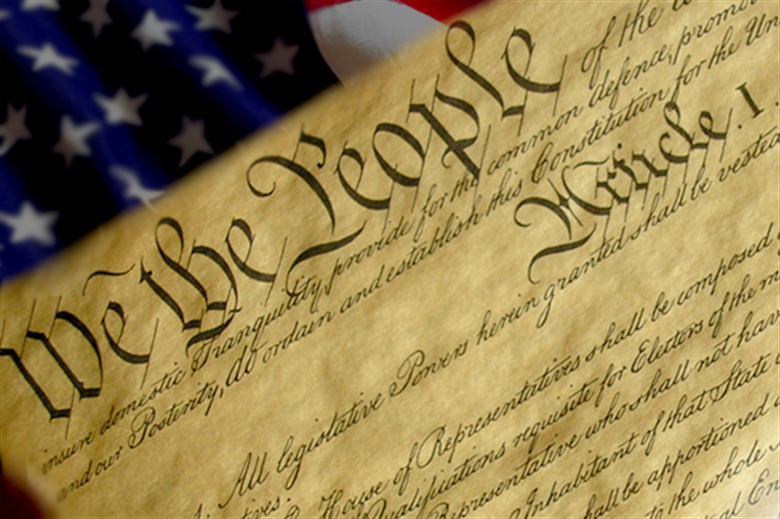
The following excerpt, Article 1, Section 2, Paragraph 3, from the Constitution [4] shows clearly that the “Three/Fifths Compromise” does not refer to the individual personhood of each slave:
Representatives and direct Taxes shall be apportioned among the several States which may be included within this Union, according to their respective Numbers, which shall be determined by adding to the whole Number of free Persons, including those bound to Service for a Number of Years, and excluding Indians not taxed, three fifths of all other Persons. (emphasis added)
The “three fifths of all other Persons” designates the slave population and any other groups not specifically names; it does not designate that the personhood of each person in those groups is only three/fifths that of a free, tax-paying citizen.
The terms “Negroes,” “black,” “slaves,” and “slavery” do not appear in “Three/Fifths Compromise” of the U.S. Constitution.
The term “slavery” appears in the Thirteenth Amendment to “enshrine” the abolition of that evil institution. The term “slave” appears in the Fourteenth Amendment in the phrase “emancipation of any slave.”
The Fourteenth Amendment guaranteed that the former slave-holders could not petition the government for reparations for losing their slaves. Thus, those amendments, added in 1865, were not in place when Frederick Douglass [5], the foremost black abolitionist in the 1840s remarked,
If the Constitution were intended to be by its framers and adopters a slave-holding instrument, then why would neither “slavery,” “slave-holding,” nor “slave” be anywhere found in it?
Image 2: Frederick Douglass Portrait by Greg Groesch/The Washington Times
First Step to the Abolition of Slavery
The founders [6] of the United States of America and framers of the Constitution were well aware of the travesty of slavery and well understood that that institution could not endure, despite the fact that some of them owned plantations supported by slave labor.
However, as it is with most deeply ingrained cultural traditions, that evil societal feature could not be mandated in a document that was needed to help govern the young country.
Possibly, if the free states had insisted that the slave states not count any of their slave population, it would have been impossible to frame the new governing document.
Also possible was the eruption of warring factions that might have resulted in an earlier civil war. Those two eventualities were avoided through the “Three/Fifths Compromise.”
In order to assure that the southern slaves states accept the new document, the framers had to make the concession of allowing those states to count part of their slave population. But that concession can be viewed as the first step toward eradicating slavery from the country. It allowed the Constitution to become the governing document of the young nation.
By the strength of that document’s tenets, the nation was able to end the institution of slavey while remaining unified, after suffering the bloody Civil War that did occur from 1861 to 1865.
The great Founding Father, Frederick Douglass, who worked to abolish slavery understood that the ideals and words of those earlier statesmen had laid the groundwork to eliminate that evil institution. Douglass averred [7],
Notwithstanding the dark picture I have this day presented, of the state of the nation, I do not despair of this country. There are forces in operation, which must inevitably, work the downfall of slavery . . .
Discerning historians, looking back with an open mind, have determined that certain compromises such as the “Three/Fifths Compromise 1787” have, in fact, functioned for “the downfall of slavery.”
The Three/Fifths Big Lie Persists
False notions known as big lies, have staying power because they have been loudly repeated by the perpetrators until they become ingrained in the culture. Even though the phrase, “the big lie” [8], was popularized by Adolf Hitler [9] and his propaganda minister, Joseph Goebbels, American statist politicians have never been immune to employing that concept to smear their opponents.
The “Three/Fifths Compromise 1787” has been widely misrepresented as enshrining slavery in the U. S. Constitution, deeming that a slave was only three/fifths of a person. However, nowhere in the United States Constitution does the text state or even imply that the personhood of each black individual is only “three/fifths of a person.”
That persistent falsehood has been debunked repeatedly, yet it remains part of a popular mythology. The institution of slavery and the decades of Jim Crow Laws and Black Codes remain permanent stains on the history of the United States.
And those issues need to be addressed, explained, and understood, but what Americans do not need is for political operatives to falsify that history to make it more heinous than it was.
The falsehood that blacks were once considered three/fifths of a person needs to be addressed and refuted whenever and wherever it resurfaces. As Malik Simba from BlackPast.org explains,
Often misinterpreted to mean that African Americans as individuals are considered three-fifths of a person or that they are three-fifths of a citizen of the U.S., the three-fifths clause (Article I, Section 2, of the U.S. Constitution of 1787) in fact declared that for purposes of representation in Congress, enslaved blacks in a state would be counted as three-fifths of the number of white inhabitants of that state. [10]
Despite the many explanations and corrections from historians and other Constitutional experts [11], which are widely available online, the false claim that blacks were considered to be only “three/fifths a person” continues to appear regularly.
Some critics assert that the U.S. Constitution enshrined slavery [12] with the “Three/Fifths Compromise of 1787,” and others make the inaccurate statement that blacks in the U.S. were thought to be three/fifths of a person at one point in history.
Two particularly egregious examples of this “big lie” come from two high level, otherwise knowledgeable government officials: Condoleezza Rice [13], 66th Secretary of State and General Mark Milley [14], 20th chairman of the Pentagon’s Joint Chiefs of Staff.
Secretary Rice, in speeches abroad has claimed [15], “In the original U.S. Constitution, I was only three-fifths of a person.” And General Mark Milley, refers to that falsehood, as he mistakes the fraction as “three/fourths” [16] instead of “three/fifths.”
These misstatements by such accomplished and knowledgeable individuals demonstrate how widespread and deep some errors have been carved into the culture. It is past time to discard this “big lie” along with other false notion [17] that the Democratic and Republican Parties switched sides on race.
The accurate teaching of history must become a valued part of education if America is to remain free and prosperous.
Debunking the Big Lie That Democrats and Republicans Switched Sides on Race
Republican failure to refute Democrats’ “big lie” that their parties switched sides on race has allowed that falsehood to spread. Republicans need to refute the Democrats’ lie to reclaim for their Party its history in fighting slavery and racism. The GOP has always been the party of Civil Rights.
The Big Lie and American Politics
The phrase “the big lie” [1] was popularized by Adolf Hitler [2] and his propaganda minister, Joseph Goebbels. The primary purpose of the big lie technique as employed by Hitler and the Nazis was to turn German citizens against the Jews.
The technique worked so well that the Holocaust, resulting in the deaths of upward of eleven million people, including at least six million Jews, became a stain on humanity and a historical reference point.
Unfortunately, American politics has never become immune to the diseased concept of the big lie.
Numerous fabrications have flourished and influenced in heinous ways the relationship between various identities groups that make up the United States of America.
Debunking a Pernicious Myth
One of the biggest of the big lies in American politics is that the two major political parties, Democratic and Republican, switched sides on the issue of race. In Dan O’Donnell’s “The Myth of the Republican-Democrat ‘Switch’,” the writer offers a useful introduction to the issue:
When faced with the sobering reality that Democrats supported slavery, started the Civil War when the abolitionist Republican Party won the Presidency, established the Ku Klux Klan to brutalize newly freed slaves and keep them from voting, opposed the Civil Rights Movement, modern-day liberals reflexively perpetuate the rather pernicious myth—that the racist southern Democrats of the 1950s and 1960s became Republicans, leading to the so-called “switch” of the parties. This is as ridiculous as it is easily debunked. [3]
Because the Republican Party was founded to abolish slavery and has always been the party of Civil Rights—including the struggle for women’s suffrage—in the U.S.A, the Democratic Party seized the issue, turning racism into a Republican problem by claiming that the parties switched sides of race.
The big lie of the parties switching sides on race, however, is not the only falsehood that litters the political landscape. Various factions have filled historical reportage with inaccurate claims that persist; for example, a 2015 Washington Post headline blares, “We used to count black Americans as 3/5 of a person” [4].
Political ideologues and agenda-driven academics often claim that in establishing the Constitution, the Founding Fathers thought that blacks were only three/fifths human because of the three-fifths compromise; however, the “Three/Fifths Compromise” focused on representation to congress not on the humanity of each person.
Even Condoleezza Rice [5], an educated, accomplished former secretary of state, fell for this lie: “In the original U.S. Constitution, I was only three-fifths of a person.” Such a misstatement by a sophisticated and knowledgeable person just shows how widespread and deep some errors have been carved into the culture.
Then there is the false assertion that “Nazis” are right wing. The term “Nazi” is short for National Socialist German Worker Party, translation from the German, “Nationalsozialistische Deutsche Arbeiterpartei.”
The political right has never endorsed “socialism.” Along with “fascism,” the term by definition includes statism or government control of the lives of citizens—the antithesis of the political right’s stance.
Confronting an Inconvenient Past
When confronted with the inconvenient history of their party regarding the issue of race, the American Democratic Party members and its sycophants insist that the Republican and Democratic Parties simply switched positions on race, after the Republicans had ushered in the Civil Rights Act of 1964. This ludicrous claim can easily be laid to rest with a few pertinent facts.
On January 1, 1863, Republican President Abraham Lincoln signed the Emancipation Proclamation, which stated “that all persons held as slaves are, and henceforward shall be free.”
The country had already been suffering two years of a bloody Civi War to end slavery. Democrats had been lobbying for and passing legislation such as the Jim Crow laws and Black Codes for over a century—all designed to keep the black population from enjoying the fruits of citizenship.
President Lyndon Johnson, a Democrat, signed the Civil Right Act of 1964 in to law; however, Johnson himself had labored tirelessly against earlier civil rights legislation.
By signing that bill, Johnson merely demonstrated that he had come to understand that the way for Democrats to acquire and maintain power in future was to pacify and humor blacks, instead of denigrating them and segregating them from whites as the Democrats had always done in the past.
Allegedly, Johnson had quipped, “I’ll have those ni**ers voting Democrat for the next 200 years.” That infamous statement clearly reveals where Johnson’s loyalties lay: with acquiring power for the Democratic Party and not for recognizing African Americans as citizens. Endeavoring to deconstruct Johnson’s racist position, David Emery at snopes.com labels the claim regarding Johnson’s remark “unproven” [6].
But then as he continues his biased analysis, Emery reveals other suggestions that make it clear that Johnson’s beliefs rendered him the consummate racist. For example, Emery offers the report, in which according to Doris Kearns Godwin, Johnson quipped,
These Negroes, they’re getting pretty uppity these days and that’s a problem for us since they’ve got something now they never had before, the political pull to back up their uppityness. Now we’ve got to do something about this, we’ve got to give them a little something, just enough to quiet them down, not enough to make a difference. (my emphasis)
After continued biased bloviating, David Emery admits, “Circling back to the quote with which we started, it wouldn’t have been entirely out of character for LBJ to have said something like, ‘I’ll have those ni**ers voting Democratic (sic) for 200 years’”; however, Emery doubts it, of course.
House and Senate Vote Tally for the Civil Rights Act 1964
The following is a breakdown of the voting tally in the House and Senate [7] for the Civil Rights Act of 1964 of members voting for the bill:
Democrats: House 153 out of 253 = approx. 60% Republicans: House 136 out of 178 = approx. 80% Democrats: Senate 46 out of 67 = 69% Republicans: Senate 27 out of 33 = 82%
While about 80% of the Republicans in the House of Representatives voted for the Civil Rights Act of 1964, only about 60% of the Democrats voted aye. Also while in the Senate, 82% percent of Republicans voted for the bill, only 69% of Democrats did.
Attempting to Rehabilitate by Geography
In order to try to rehabilitate the Democrats’ negative voting record on civil rights, Democrat apologists point out that when one accounts for geographical positioning [8] of the members of the house and senate, the voting tallies this way:
Southern Democrats: 1–20 (5%–95%) (Ralph Yarborough of Texas voted yea) Southern Republicans: 0–1 (0%–100%) (John Tower of Texas voted nay)
Northern Democrats: 45–1 (98%–2%) (Robert Byrd of West Virginia voted nay) Northern Republicans: 27–5 (84%–16%)
This set of votes shows that no southern senate Republicans voted for the act, but there was only one southern Republican in the senate at the time. And also no house Republican voted for the act, but again there were only ten southern Republicans in the house.
This low number of Republicans in the house and senate when converted to percentages skews the reality of the fact that the overall vote, which is the vote that counts, clearly outs the Democrats as opposers of the act. And the Democrats’ main reason for voting against the act was based on race, especially in the south.
However, all of the Republican senators, both north and south, who voted against the act, did so because they favored Senator Barry Goldwater’s position, who remained against the act, not because of racial animus but because of his belief that it was unconstitutional in usurping states’ rights, especially in the area of private business.
The Republican Party was founded, primarily in order to abolish slavery. Yet over a century later, modern-day Democrats such as former house member, Charlie Rangel, continue to spread the big lie that the Republican and Democratic parties simply “changed sides” in the 1960s on civil rights issues.
That excuse is widely exercised by Democrats when confronted with their own undeniably racist past [9]. However, the facts do not support but rather reveal that claim as a big lie.
Three Misrepresented Issues
The persistent inaccuracy that the two parties switched sides is partially based on three significant issues that have been misrepresented by Democrats and their sycophants in the mainstream media:
1.Barry Goldwater’s position regarding the Civil Right Act of 1964. Goldwater [10] did oppose that bill in its final form because he argued that it was unconstitutional, in that it usurped state and individual rights. Goldwater had helped found Arizona’s National Association for the Advancement of Colored People (NAACP), and he had voted for earlier versions of civil rights legislation.
Thus, Goldwater’s opposition was not similar to the Democrats’ opposition based on racism; Goldwater’s opposition was based on his interpretation of the Constitution.
2.The Southern Strategy. With this strategy [11], the Republican Party was attempting to demonstrate to southern Democrats that by continuing to vote for racist/socialist Democrats they were voting against their own economic interests.
What gave Democrats the opening to use this strategy against Republicans was that the Republicans utilized racist political bigots, who were, in fact, Democrats themselves, to help win votes for Republicans.
This strategy prompted the GOP opponents to misrepresent the Republican’s purpose and thus label it primarily racist, when it was, in fact, based on economic growth, not racism.
3. The American South turning to Red from Blue. This claim falls apart with the fact that the “Deep South”—Alabama, Mississippi, Georgia, South Carolina, and Louisiana—took 30 years to begin changing from Democrat to Republican.
It was only in the peripheral South—Florida, Texas, Tennessee, Virginia, North Carolina, and Arkansas—that many working-class transplants, relocating from the northern states as well as from other parts of the United States, understood that the Republican Party offered policies that promoted business, commerce, and entrepreneurial success.
Those transplants, after all, had relocated south to improve their financial status through their new jobs. Gerard Alexander explains in his review:
The myth that links the GOP with racism leads us to expect that the GOP should have advanced first and most strongly where and when the politics of white solidarity were most intense.
The GOP should have entrenched itself first among Deep South whites and only later in the Periphery. The GOP should have appealed at least as much, if not more, therefore, to the less educated, working-class whites who were not its natural voters elsewhere in the country but who were George Wallace’s base.[12]
If the myth of the switched sides were accurate, the Republican Party would have taken hold more strongly first among the traditional racists—that is, the older voters would have become Republicans before the younger ones and the transplants. But that did not happen, because the Republican Party attracted those who were “upwardly mobile” and “non-union.”
After the passage of the Civil Rights Act of 1964, racism in the country’s history had begun to wane as a social and political force. But the Democratic Party continued to foment unrest between the races in order to employ racism as an issue against their opponents in the Republican Party. That tactic is still in place.
After the election of 2020, under the Democratic administration of Joe Biden, the racial unrest began to escalate further with the ideas touted by proponents of Critical Race Theory [13] and the insistence that white supremacy [14] remains the country’s greatest threat.
Poverty Producing Policies
The main reason that the Democratic Party concocted the idea that the parties simply switched positions was to gain power. Reverend Wayne Perryman explains:
Many believed the Democrats had a change of heart and fell in love with blacks. To the contrary, history reveals the Democrats didn’t fall in love with black folks, they fell in love with the black vote knowing this would be their ticket into the White House.[15]
Economist Thomas Sowell [16] has also shed light on the subject: “some of the most devastating policies, in terms of their actual effects on black people, have come from liberal Democrats.”
Sowell emphasizes that the “minimum wage laws” everywhere they have been established have a “track record of increasing unemployment, especially among the young, the less skilled and minorities.”
According to historian Sam Jacobs [17], the 1960s Great Society and War on Poverty, the programs established by the Johnson administration, brought about conditions, which furthered the rise of poverty among black families.
By discouraging marriage, these policies have resulted in out-of-wedlock birthrates that have skyrocketed, “among all demographic groups in the U.S., but most notably African Americans.”
The U.S. out-of-wedlock birthrate in the 1960s hovered around 3% for whites and close to 8% for all Americans; that rate was around 25% for blacks. But, by the mid 1970s, those rates had increased to 10% for whites, 25% for all Americans, and over 50% for blacks.
Then by late 1980s, the birth-rate of unmarried black women had become greater than for married black women. In 2013, the out-of-wedlock birth rate for blacks had climbed to almost 75%.
The Census Bureau [18] maintains that poverty is closely associated with out-of-wedlock births. By instituting a system that keeps blacks at a disadvantage, the Democrats have a captive audience to which they pander for votes.
The Democratic Party stations itself as the protector of blacks and other minorities, not with policies that assist those demographics but with policies that keep them dependent on government.
Unfair Race Policies Unsystematized
Despite the revisionist history and unsupportable claims of the CRT and white supremacy advocates, there is no argument that can refute the fact that racism as an issue of public policy has been unsystematized since the passage of the civil rights acts of the 1960s. No more Jim Crow laws or Black Codes anywhere call for racial discrimination as they had done before the passage of those civil right laws.
Before the passage of those acts, not only did racist laws exist, they were enforced by legal authorities as well as the Ku Klux Klan, which, according the North Carolina historian Allen W. Trelease [19] in his book, White Terror: The Ku Klux Klan Conspiracy and Southern Reconstruction, “The Klan became in effect a terrorist arm of the Democratic Party.”
And Eric Foner [20], Columbia University historian, in his study, A Short History of Reconstruction, 1863–1877, has averred that the KKK was “a military force serving the interests of the Democratic Party.”
Still, statist historians such as Carole Emberton, an associate professor of history at the University at Buffalo, continue to employ the “party lines of the 1860s/1870s are not the party lines of today” [21] bromide attempting to separate the Democratic Party’s engagement from the Ku Klux Klan.
Yet in the same breath, Emberton admits, “that various ‘Klans’ that sprung up around the South acted as a ‘strong arm’ for many local Democratic politicians during Reconstruction.”
Democrats continue to employ the often debunked claim that racism is still a “systemic” problem. They offer this prevarication so they can insist that only the Democratic Party is willing to fight against that “systemic” blight on society.
But again and again, the Democratic Party’s policies have been used, as Lyndon Johnson used them, to placate blacks by making them think they are getting something that no political party even has the power to give: financial security and equality with guaranteed outcomes.
Political parties, when in power, can help the voting public only by instituting policies that encourage financial success and individual freedom. They cannot guarantee that success. They cannot legislate individual success through identity politics.
Strategy to Gain Power
The Democratic Party and its allies continue to employ the big lie that the two parties exchanged positions on race, in an attempt to gain power and to rehabilitate the party’s racist past.
Party members and its minions continue to tie most issues to race because that tactic seems to have worked for gaining power. But when voters look at the basic facts, that claim begins to lose its strength.
For example, citing the voter ID issue as a racist Republican strategy simply bolsters the evidence that Republicans are, in fact, not racist. A majority [22] of black citizens and voters are in favor of the voter ID laws.
However, the Democrats continue to rail against voter ID laws because they know that those laws would impede voter fraud—a demonstrably proven staple in the machine [23] to elect Democrats to government.
Democrats have been attempting to whitewash their racist past for decades; to do so, they often fabricate history. For example, as a candidate for the presidency in 2000, Al Gore falsely stated [24] to the NAACP that his father, Al Gore, Sr., had lost his senate seat because he voted for the Civil Rights Act of 1964.
But Gore, Sr., voted against that act [25], as he supported and joined in the filibuster against that act. Gore, Sr. then sponsored an amendment [26] that would take the teeth out of the enforcement power of that bill, just in case it passed.
Did Dixiecrats Become Republicans?
Democrats also point to the rise of the Dixiecrats that supposedly shows racist Democrats becoming Republicans. However, only two major politicians who had been Dixiecrats switched to the Republican Party.
Fewer than 1% [27] of the more than 1500 Democrats-turned-Dixiecrats left the Democratic Party for the Republican Party. They were prompted to switch party allegiance primarily for economic reasons rather than racial animus.
As the Democratic Party began moving toward socialism, many former Democrats experienced disdain for that socialist impact on business and entrepreneurship.
Senator Strom Thurmond traded in his party alliance with the Democrats to join the Republicans in 1964—not because he continued to support racism, but because he began repudiating it.
Frances Rice [28] explains: “Thurmond was never in the Ku Klux Klan and, after he became a Republican, Thurmond defended blacks against lynching and the discriminatory poll taxes imposed on blacks by Democrats.”
Governor Mills E. Godwin, Jr. of Virginia [29] abandoned the Democrats for the Republican Party in 1974. But again, like Thurmond, Godwin simply abandoned his racist past. Godwin also served as Virginia governor first while a Democrat and then as a Republican.
Hypocrisy about Racist Past
West Virginia’s Robert Byrd, a former Ku Klux Klan Exalted Cyclops and long serving Democratic senator, did renounce his earlier support for segregation and racism. However, Byrd voted against confirmation to the Supreme Court of Justice Thurgood Marshall [30], a Democrat and the first black to be appointed to the high Court.
Byrd also joined 47 of his fellow Democratic senators as he voted against Justice Clarence Thomas [31], a Republican. Neither a black Democrat nor a black Republican could pass muster with the former Klansman.
Senator Christopher Dodd [32] praised Byrd highly by stating that Byrd would have been “a great senator for any moment.” To this potentially inflammatory remark, the Democrats remained silent.
Then later after Senator Trent Lott spoke kind words of Senator Strom Thurmond, the Democrats with their usual hypocrisy lambasted Lott unmercifully. It made no difference that Thurmond had never served as a member of the Ku Klux Klan while Byrd had risen to the high position of Exalted Cyclops.
Regarding Democrat hypocrisy, John Feehery [33] has remarked: “. . . Democrats are super-sizing their hypocrisy to levels never seen. It is their embrace of nihilism that is pushing them to these extremes.”
Policies Harmful to All Citizens
Undoubtedly, the majority of the members of the Democratic Party are not racists today. Yet, it remains unconscionable that so many Democrats label Republicans racists and bigots in pursuit of political power against their opponents.
Democrats cannot legitimately deny the many studies that offer support to the argument proffered by Republicans that Democratic policies are detrimental not only to black citizens but to all citizens.
The current theoretical philosophy of Democratic Party consists of seizing through taxation the financial rewards from “the rich” and giving those rewards to “the poor.” In practice, this Robin Hood scam ultimately means taking from those who earn and redistributing it to friends and allies of the redistributors. Such a system cannot possibly succeed. It can only create victims whose ability to produce becomes atrophied by the false promises of pandering politicians.
Democrats continue to play the race card because they have become utter failures at convincing the majority of the electorate that their policies work. Citizens have become dissatisfied with the actual theft of their earnings, as they have watched as shabby, crime filled cities are, in fact, the result of Democrat policy fecklessness and fraud.
Rose and Milton Friedman Senior Fellow at the Hoover Institution Thomas Sowell has pointed out repeatedly that the policies of Democrats have prevented the black population from rising out of poverty.
Many of the poorest cities in the USA have been run by Democrats for decades. According to Investor’s Business Daily,
When Democrats are in control, cities tend to go soft on crime, reward cronies with public funds, establish hostile business environments, heavily tax the most productive citizens and set up fat pensions for their union friends. Simply put, theirs is a Blue State blueprint for disaster. [34]
Surely, it is time that African Americans, women, and minorities adopt a different mind-set and realize, as Rev. Perryman avers, that the Democratic Party is interested only in their vote, not in their welfare. And, in fact, there seems to be a shift coming in the voting preferences of blacks and Hispanics.
According to Darvio Morrow [35], CEO of the FCB radio network, Democrats for decades have relied on the theory that as the USA grows less white, its voters will become more firmly entrenched as a Democratic Party voting block.
However, Morrow explains, “The problem with this theory is that it relied on the premise that minorities were going to remain solid Democrats. And that premise is turning out to be false.”
American politics is a complex machine, and the force of big lies remains strong. Whether the republic can remain in tact will depend on refuting those lies and in their place establishing a culture of truth, in which facts dominate and falsehoods are rejected.
Despite their fervent support for the Marxist movement touting “Black Lives Matter,” today’s Democrats, including the former occupier of the Oval Office, Joe Biden, [36] continue to support the abortion provider known as Planned Parenthood.
Planned Parenthood is one of the greatest perpetrators of violence against African Americans in this country. It is founded on racism, perpetuates racism, and kills more than 850 African Americans every day. [37]
While blacks constitute roughly 13% of the USA population, they account for 36% of the abortions. Nearly 80% of all Planned Parenthood clinics are located near black neighborhoods [38]. Activists such as Candace Owens [39] and Kanye West [40] have labeled this set of circumstances genocide.
According to the educational website, blackgenocide.org, blacks are the only declining minority population in the USA, and “if the current trend continues, by 2038 the black vote will be insignificant.” Because abortion accounts for most deaths of black lives in the USA [41], those pandering for black votes might want to give that claim some serious thought.
Sources
[1] “Big Lie.” Merriam-Webster Dictionary.com. Accessed May 17, 2023.
Essays: On Political, Social, Literary, & Other Issues
This room in my literary home houses links to essays addressing issues in literary studies, politics, social/cultural movements, science, or medicine and health care, some of which may be controversial or widely misunderstood either currently or historically.
Ludwig von Mises remains one of the most influential critics of socialism and Marxism in twentieth-century economic thought. He has effectively challenged Marxist claims about efficiency, historical inevitability, and moral superiority.
1. The Economic Calculation Problem (The Core Critique of Socialism)
As a central figure of the Austrian School, Ludwig von Mises developed a systematic critique grounded in economic theory, sociology, and philosophy, most notably in his book Socialism: An Economic and Sociological Analysis and his seminal 1920 essay on economic calculation [1]. His arguments directly challenged Marxist claims about efficiency, historical inevitability, and moral superiority.
At the heart of Mises’s critique, the economic calculation problem presents itself. He regarded that issue as decisive. He argued that by eliminating private ownership of the means of production, socialism eliminates genuine markets for goods, and thus it impairs the pricing system, which is vitally needed for coherent economic decision-making [2]. Without genuine, real prices created by voluntary exchange, planners lack a means and method for comparing the many and varied uses scarce resources.
In a market economy, prices arise from decentralized entrepreneurial bidding and thus reflect consumer preferences, relative scarcities, and opportunity costs. Profit and loss function to signal and guide production toward more valued uses of resources. Mises emphasized that this process is not mechanical but rooted in subjective human valuation.
Under socialism, collective ownership prevents the formation of market prices for goods. Prices imposed administratively remain arbitrary and cannot convey real information about trade-offs or consumer priorities. As a result, planners cannot determine whether resources should be allocated to one project rather than another, such as infrastructure versus consumer goods.
Mises concluded that socialist economies by their very nature generate inefficiency, waste, shortages, and systemic disorder. He famously described socialism as “planned chaos,” predicting economic retrogression rather than abundance. This conclusion directly contradicted Marxist claims that socialism would overcome capitalism’s alleged “anarchy of production.”
2. Critique of the Labor Theory of Value and Marxist Economics
In addition to his critique against calculation, Mises also argued against Marx’s labor theory of value, which held that labor time is the sole source of economic value. Drawing on the marginalist* revolution, Mises argued that value is subjective and arises from individual preferences and marginal utility, not from objective labor inputs [3]. This understanding clearly undermined the theoretical foundation of Marxist economics.
Without the labor theory of value, Marx’s theory of exploitation collapses. Mises argued that profits do not represent surplus value extracted from workers but instead reflect successful anticipation of consumer demand and the productive contribution of capital [1]. Capital accumulation, investment, and entrepreneurship are essential to rising productivity and wages.
*Marginalism is a theory of economics that explains the discrepancy in the value of goods and services by reference to their secondary, or marginal, utility. It states that the reason that the price of diamonds is higher than the price of water that there is greater additional satisfaction of the diamonds over twater. Thus, while the water has greater total utility, the diamond has greater marginal utility.
3. Critique of Historical Materialism and Class Struggle
Mises also challenged Marx’s materialist conception of history and the doctrine of inevitable class struggle. Mises rejected the claim that economic structures alone determine ideas, institutions, and culture, arguing instead that ideas themselves play a decisive causal role in social development [4]. Historical materialism, Mises contended, reduces complex human action to economic determinism.
Furthermore, Mises argued that Marxism is internally contradictory. If all ideas are merely expressions of class interest, then Marxism itself cannot claim scientific objectivity but must also be ideological. This self-refuting character, in Mises’s view, disqualifies Marxism as a coherent theory of history.
From a sociological and ethical perspective, Mises maintained that socialism necessarily undermines individual liberty. Centralized control over production requires coercive authority, which tends toward authoritarianism and political repression. Historical socialist regimes, he argued, confirmed this tendency rather than refuting it.
4. Sociological and Ethical Critiques
Mises contrasted socialism with classical liberalism, which he believed fosters cooperation, innovation, and social coordination through private property and free exchange. Markets enable what he described as a “spontaneous order,” aligning individual self-interest with social welfare without centralized control. Rising living standards under capitalism were, for Mises, empirical evidence of this process.
Mises argued that socialism is not merely inefficient but fundamentally impossible as a rational economic system. Attempts to implement it result in poverty, coercion, and institutional collapse rather than emancipation. His critique profoundly influenced later thinkers such as Friedrich Hayek and continues to shape contemporary debates over the feasibility and desirability of socialist economic arrangements.



 Linda's Literary Home