Linda's Literary Home

Tag: soul

  • Emily Dickinson’s “I gave myself to Him”

    Image: Emily Dickinson - Amherst College - Daguerrotype of the poet at age 17, circa 1847 - likely the only authentic, extant likeness of the poet
    Image: Emily Dickinson – Amherst College – Daguerrotype of the poet at age 17, circa 1847 – likely the only authentic, extant likeness of the poet

    Emily Dickinson’s “I gave myself to Him”

    The speaker in Emily Dickinson’s “I gave myself to Him” is musing on the imbalance that remains even after one has surrendered one’s life to God the Creator.

    Introduction and Text of “I gave myself to Him”

    The speaker in Emily Dickinson’s “I gave myself to Him” is exploring the idea that after having devoted her attention to the Creator by giving herself “to Him,” she finds that the giving of such a gift cannot be mutual.  She suggests the idea that the gift of herself will surely disappoint the Giver and Creator of all things.

    She leaves open the notion there may be some mutual gain because “[s]ome” have “found it” so.  She is likely referring to testimony from the saints who assure their listening audience of the great riches attained by such surrender to God.

    The speaker is likely reassuring herself that such a bargain cannot bring about an occasion to boast, nor can it eliminate the necessity to remain humble.  Her ultimate conclusion may seem pessimistic at first. 

    However, God remains the ultimate authority to which the human heart, mind, and soul must surrender regardless of any emphasis of mutuality in considering gain and loss.  Thus without stating the conclusion directly, the speaker is implying that the human debt to God has to remain insolvent until the soul grasps its relationship to its Creator.

    I gave myself to Him

    I gave myself to Him –
    And took Himself, for Pay,
    The solemn contract of a Life
    Was ratified, this way –

    The Wealth might disappoint –
    Myself a poorer prove
    Than this great Purchaser suspect,
    The Daily Own – of Love

    Depreciate the Vision –
    But till the Merchant buy –
    Still Fable – in the Isles of Spice –
    The subtle Cargoes – lie –

    At least – ’tis Mutual – Risk –
    Some – found it – Mutual Gain –
    Sweet Debt of Life – Each Night to owe –
    Insolvent – every Noon –

    Commentary on “I gave myself to Him”

    The speaker is exploring the nature of her relationship with her Divine Creator, the Heavenly Father, Divine Mother, or God.  Although she professes to have given her life to her Creator or Heavenly Father, she discovers that she still owes a debt that can never fully be repaid.

    First Stanza:  Surrendering Her Life to the Divine 

    I gave myself to Him –
    And took Himself, for Pay,
    The solemn contract of a Life
    Was ratified, this way –

    The speaker begins with a somewhat ambiguous statement that she has given herself to “Him.”  The capitalized, masculine pronoun “Him” indicates she is likely referring to her Creator (God).  Such capitalization is known as reverential or biblical capitalization.  She continues to employ the reverential capital in the second line with the reflexive, masculine pronoun “Himself.” 

    The idea of giving oneself or one’s life to God is hardly a novel one.  The religious and spiritual minded become positively gleeful at the notion of surrendering their lives to their Creator.  So upon first encountering the speaker’s claim, the reader will then wonder what new or fascinating rendition of such a confession might be in the offing.

    The speaker then begins to elaborate.  After surrendering herself to God, the speaker affirms that her life became a reality. Her “contract” offers her “Pay,” or something substantial for her surrender.

    That contract, in fact, “ratified” her existence.  Just as a political contract, such as the American Constitution, had to be ratified, the speaker’s life was ratified or put into existence by affirmation by the contract she made when she gave her life to God.

    Second Stanza:  An Economics (Trade) Metaphor 

    The Wealth might disappoint –
    Myself a poorer prove
    Than this great Purchaser suspect,
    The Daily Own – of Love

    The speaker then admits that the “Purchaser” of her insignificant life might well be disappointed because she may prove to be “poorer” than the Purchaser of her contract might have suspected.

    The “great Purchaser” (God) may find that her ability to offer love may not be up to the standards He might expect.  Of course, she is demonstrating her ability to remain humble because she is well aware that God’s love will always outweigh, outshine, and outpace her own.

    Likely she is simply thinking of or musing on possibilities, as she employs an economics (trade) metaphor with such terms as “wealth,” “Purchaser,” and “Own.”   She cannot know how important this life choice is going to be for her ability to love or to navigate the seas upon which her life’s boat will have to sail.  

    The speaker can only contemplate at this point, although she does know she can be certain that God’s love will always be greater than she could ever afford; the inevitability of such remains a given, a concept that even the most ardent atheist can grasp even if not accept.

    Third Stanza:  Speculating on Her Importance

    Depreciate the Vision –
    But till the Merchant buy –
    Still Fable – in the Isles of Spice –
    The subtle Cargoes – lie –

    The speaker continues to muse and employ a trade metaphor.  She suggests that one must lower expectations until the time has arrived to sell the product.  Although she has, in fact, given her life over to the “Purchaser,” she has continued to speculate about her own importance.  

    Thus she wonders if she might have oversold her own self in the process.  She then suggests that like the precious “Cargoes” that remain in places from which rich spices are harvested, she may have presented herself as a fabulous commodity that is yet to be realized, like those “subtle Cargoes.”  They remain “subtle” until they are delivered.  And until they are delivered they simply rest or “lie” in one place.

    Fourth Stanza:  Equal Loss – Equal Gain

    At least – ’tis Mutual – Risk –
    Some – found it – Mutual Gain –
    Sweet Debt of Life – Each Night to owe –
    Insolvent – every Noon –

    Finally, the speaker seems to come to the notion that the exchange is not all one-sided:  there may be a chance of failure on both sides.  Yet, she asserts that there are those (saints perhaps?) who have declared that such a transaction garners gain on both sides.

    After all, each night when the human body lies down to rest, it owes a debt for its life.  As all debts must be repaid, that same body with a mind, heart, and soul continues to own that debt, which remains “insolvent” in the bright light of day.

    While night time reminds the human ego as it prays to its Creator that it has not created itself, still it must remain aware to Whom it owes its continued existence.  The speaker’s insolvency will remain because the limited human mind and heart can never repay the debt it owes its all-powerful Creator and Benefactor; only the soul can do that.

  • Emily Dickinson’s “The Soul should always stand ajar” 

    Image: Emily Dickinson - Amherst College - Daguerrotype of the poet at age 17, circa 1847 - likely the only authentic, extant likeness of the poet
    Image: Emily Dickinson – Amherst College – Daguerrotype of the poet at age 17, circa 1847 – likely the only authentic, extant likeness of the poet

    Emily Dickinson’s “The Soul should always stand ajar” 

    Emily Dickinson’s “The Soul should always stand ajar” reveals the speaker’s profound insight regarding spiritual readiness. The poem highlights the necessity of remaining receptive to divine visitations.

    Introduction and Text of “The Soul should always stand ajar”

    The speaker explores the delicate relationship between human consciousness and the divine presence. Spiritual alertness requires continuous vulnerability and an open heart. This focus informs this brief but deep metaphysical lyric.

    The poem consists of two quatrain stanzas that function as a single movement. Dickinson has created here a speaker, utilizes her characteristic short lines and unconventional capitalization to emphasize inner vigilance. This structure mirrors the soul’s quiet anticipation.

    On my literary website Linda’s Literary Home, I have discussed many of the aspects that the speakers in Dickinsonian poetry capture in fleeting moments of cosmic awareness.  The speaker creates a drama of inner hospitality.  It encourages readers to prepare for divine communion.

    The Soul should always stand ajar

    The Soul should always stand ajar
    That if the Heaven inquire
    He will not be obliged to wait
    Or shy of troubling Her

    Depart, before the Host have slid
    The Bolt unto the Door –
    To search for the accomplished Guest,
    Her Visitor, no more –

    Commentary on “The Soul should always stand ajar”

    The poem examines the necessity of keeping the consciousness open to celestial encounters. The speaker is guarding against spiritual inertia.

    First Stanza: The Soul’s Expression

    The Soul should always stand ajar
    That if the Heaven inquire
    He will not be obliged to wait
    Or shy of troubling Her

    The speaker commands the inner being to maintain a state of perpetual openness. Using the architectural metaphor of a door left slightly open, readiness is prioritized. The soul must never bar its entrance.

    Divine grace arrives unexpectedly, requiring immediate hospitality from the seeker. The speaker personifies “Heaven” as an inquiring visitor who seeks entry into human consciousness. Receptivity must be instantaneous and completely unhesitating.

    If the door of consciousness is closed, the divine visitor might easily bypass the individual. Paramahansa Yogananda explains that divine realization requires an active, unceasing inner invitation. Receptivity demands consistent spiritual attunement.

    God does not force entry into an unresponsive or distracted mind. The speaker notes that Heaven might feel “shy of troubling” an unready host. Spiritual passivity creates a barrier to grace.

    On my literary website Linda’s Literary Home, I have discussed the speaker’s preoccupation with the border between the human and divine. The open door represents that threshold. It demands constant, attentive safeguarding.

    This welcoming attitude reflects a deep inner yearning for higher truth. The speaker positions the soul as a waiting servant. Universal consciousness requires an empty, waiting vessel to fill.

    Through quiet musing, the seeker recognizes that divine moments are easily missed. The speaker emphasizes that Heaven will not wait indefinitely for a response. Immediate availability is the supreme virtue.

    The door must remain unlatched despite the distractions of earthly life. The speaker frames this openness as a continuous state of being. True spiritual life demands total, uninterrupted vulnerability.

    Second Stanza: Soul Etiquette

    Depart, before the Host have slid
    The Bolt unto the Door –
    To search for the accomplished Guest,
    Her Visitor, no more –

    The speaker outlines the tragic consequence of a locked inner door. If the human host slides the heavy bolt, the divine visitor departs permanently. Neglect seals the spiritual separation.

    The opportunity for divine communion can be lost through self-absorption. The speaker portrays a single, definitive action of closing the entryway. A bolted door signals a rejection of higher realms.

    Paramahansa Yogananda explains that the subtle voice of the Divine is easily drowned out by worldly noise. Quiet inner readiness preserves the sacred connection. Persistent devotion keeps the channel open.

    Once the visitor departs, he will search for that soul “no more.” The speaker delivers a stern warning about the finality of missed grace. Opportunities for awakening are precious and fleeting.

    The “accomplished Guest” represents the highest realization entering the temple of the body. The speaker uses courtly etiquette to describe this sublime visitation. The soul must respect the divine timing.

    On my literary website Linda’s Literary Home, I have discussed Dickinson’s speakers regarding the value they place on the sudden intrusion of the Infinite. Sliding the bolt represents a failure of trust. Isolation results from spiritual fear.

    Through deep musing on these lines, the reader confronts the urgency of spiritual cultivation. The speaker insists that the host must remain vigilant. Delay brings absolute, lingering spiritual poverty.

    The ultimate tragedy is the permanent withdrawal of the celestial presence. The speaker concludes with an unsettling image of eternal abandonment. Receptivity remains the single defense against darkness.

  • Emily Dickinson’s “The Soul unto itself”

    Image: Emily Dickinson - Amherst College - Daguerrotype of the poet at age 17, circa 1847 - likely the only authentic, extant likeness of the poet
    Image: Emily Dickinson – Amherst College – Daguerrotype of the poet at age 17, circa 1847 – likely the only authentic, extant likeness of the poet

    Emily Dickinson’s “The Soul unto itself”

    Emily Dickinson’s “The Soul unto itself” dramatizes the mysterious power of the individual soul to function either as humanity’s greatest ally or its fiercest betrayer.

    Introduction and Text of “The Soul unto itself”

    Emily Dickinson’s “The Soul unto itself” features the poet’s characteristic minimalist style, employing brief lines, slant rime, and startling metaphysical assertions. The speaker contemplates the dual nature of the soul.

    She recognizes that the inner self may serve as a majestic companion or as a painful source of suffering.  The poem’s two quatrains move from the soul’s conflicting capacities to its ultimate sovereignty. 

    The first stanza reveals the soul’s ability either to comfort or torment itself, while the second stanza advances the spiritual truth that the soul ultimately answers only to its own Divine Authority.

    As discussed in earlier commentaries on Dickinson poems at my literary website Linda’s Literary Home, Dickinson’s speakers often muse upon mystical realities that transcend material existence. 

    The poet’s speakers repeatedly suggest an intuitive understanding of spiritual truths resembling teachings articulated by Paramahansa Yogananda, who explains that “Self-realization is the knowing—in body, mind, and soul—that we are one with the omnipresence of God.”

    The Soul unto itself

    The Soul unto itself
    Is an imperial friend –
    Or the most agonizing Spy –
    An Enemy – could send –

    Secure against its own –
    No treason it can fear –
    Itself – its Sovereign – of itself
    The Soul should stand in Awe –

    Commentary on “The Soul unto itself”

    Emily Dickinson’s “The Soul unto itself” portrays the soul as both ruler and witness, capable of elevating or devastating human consciousness.

    First Stanza: The Soul’s Friend

    The Soul unto itself
    Is an imperial friend –
    Or the most agonizing Spy –
    An Enemy – could send –

    The speaker immediately asserts that the soul possesses immense authority and influence over human experience. By describing the soul as “an imperial friend,” the speaker assigns regal stature to the inner self, suggesting majesty, dignity, and unwavering companionship.

    The term “imperial” enlarges the soul’s status beyond ordinary friendship. The speaker implies that no worldly companion can equal the soul’s intimate knowledge of the individual mind and heart.

    Yet the speaker quickly pivots from comfort to anguish. The same soul capable of friendship may also become “the most agonizing Spy,” a phrase that transforms inward awareness into relentless surveillance.

    A spy observes secretly and reports faithfully, and thus the speaker recognizes that conscience cannot be deceived. Human beings may conceal motives from society, but the soul witnesses every thought, emotion, and action.

    The speaker’s characterization is similar to Paramahansa Yogananda’s teaching that “The soul is the silent witness.” The Dickinsonian speaker appears keenly aware that the inward self silently records all human conduct, whether noble or shameful.

    The phrase “An Enemy – could send –” intensifies the drama by implying that no external foe can equal the suffering generated by one’s own disturbed consciousness. External enemies may wound the body or reputation, but the troubled soul torments continually from within.

    The speaker therefore presents the soul as the central determining force in human life. Peace or misery originates not primarily from outer conditions but from the soul’s relationship with itself.

    Such musing parallels observations from my discussions of Dickinson’s mystical intuition atmy literary website,Linda’s Literary Home, where Dickinson’s speakers repeatedly probe the unseen dimensions of consciousness. The speaker of this poem demonstrates that same fascination with the hidden operations of the interior life.

    This stanza also reveals Dickinson’s remarkable compression or minimalism. In only four lines, the speaker constructs a complete psychological and spiritual drama in which the soul occupies simultaneously the positions of monarch, companion, observer, and adversary.

    Second Stanza: Soul Power

    Secure against its own –
    No treason it can fear –
    Itself – its Sovereign – of itself
    The Soul should stand in Awe –

    In the second stanza, the speaker shifts from conflict to authority. Once the soul recognizes its own sovereignty, it becomes “Secure against its own,” because genuine spiritual realization eliminates inner division.

    The speaker then declares that the soul can fear “No treason.” Treason signifies betrayal against rightful authority, yet nothing external can overthrow the soul that understands its divine origin and independence.

    The speaker’s declaration echoes Paramahansa Yogananda’s insistence that individuals should not identify merely with the physical body or passing emotions. The great Guru teaches, “Do not think of yourself as the body, but as the joyous consciousness and immortal life behind it.” Dickinson’s speaker likewise urges recognition of the soul’s immortal stature.

    The line “Itself – its Sovereign – of itself” offers one of Dickinson’s most concentrated statements regarding spiritual selfhood. The soul governs itself because its deepest authority derives from divine reality rather than from external institutions or social systems.

    The speaker therefore suggests that authentic strength emerges inwardly. Human beings often surrender their peace to public opinion, material hardship, or emotional instability, but the soul possesses a higher center of authority beyond those fleeting disturbances.

    The poem’s final assertion that “The Soul should stand in Awe –” reveals profound reverence for the mystery of consciousness itself. The speaker does not advocate pride or egoism; instead, she recognizes the sacred dimension of the soul.

    That reverential tone harmonizes with Paramahansa Yogananda’s teaching that the soul reflects divine consciousness. He explains, “The universal everything is made of the singular consciousness of God. When a spark of that consciousness is individualized by God, it becomes a soul.” Dickinson’s speaker appears intuitively aware of that same sublime truth.

    The final line leaves the reader contemplating the grandeur hidden within individual consciousness. The soul becomes simultaneously observer, ruler, and sacred presence, worthy not of fear alone but of awe.

    As in many Dickinson poems, the speaker transforms a brief lyric into a profound spiritual riddle. Beneath the compressed language lies a vast contemplative musing on selfhood, divine authority, and the mysterious power residing within every human soul.

  • Emily Dickinson’s “The Soul has Bandaged moments”

    Image: Emily Dickinson - Amherst College - Daguerrotype of the poet at age 17, circa 1847 - likely the only authentic, extant likeness of the poet
    Image: Emily Dickinson – Amherst College – Daguerrotype of the poet at age 17, circa 1847 – likely the only authentic, extant likeness of the poet

    Emily Dickinson’s “The Soul has Bandaged moments”

    The speaker in Emily Dickinson’s “The Soul has Bandaged moments” presents a musing on terror, ecstasy, and spiritual oscillation within the human psyche.  For these states of consciousness, it is perhaps more accurate to use the term “psyche” instead of soul, thereby interpreting “Soul” as a metaphor for “psyche.”

    Introduction and Text of “The Soul has Bandaged moments”

    Emily Dickinson’s “The Soul has Bandaged moments” dramatizes the alternating states of fear, violation, liberation, and re-captivity that define the soul’s earthly experience. The speaker renders these states through stark, virtually violent imagery, suggesting that inner life is neither placid nor consistently enlightened but subject to extremes that test spiritual endurance.

    The poem plays out in mostly irregular stanzas, each marking a shift in the soul’s condition, from paralysis to assault, from escape to recapture. The speaker’s vision resonates with Paramahansa Yogananda’s teaching that the soul, though divine, becomes “identified with the body and mind,” thereby experiencing alternating bondage and freedom.

    Because the soul is perfect as a spark of God in the human being, it may be more accurate to think of the entity in this poem as the human psyche, instead of the soul, as the psyche is an inferior reflection of that divine Spirit.

    The Soul has Bandaged moments

    The Soul has Bandaged moments –
    When too appalled to stir –
    She feels some ghastly Fright come up
    And stop to look at her –

    Salute her – with long fingers –
    Caress her freezing hair –
    Sip, Goblin, from the very lips
    The Lover – hovered – o’er –
    Unworthy, that a thought so mean
    Accost a Theme – so – fair –

    The soul has moments of Escape –
    When bursting all the doors –
    She dances like a Bomb, abroad,
    And swings upon the Hours,

    As do the Bee – delirious borne –
    Long Dungeoned from his Rose –
    Touch Liberty – then know no more,
    But Noon, and Paradise –

    The Soul’s retaken moments –
    When, Felon led along,
    With shackles on the plumed feet,
    And staples, in the Song,

    The Horror welcomes her, again,
    These, are not brayed of Tongue –

    Commentary on “The Soul has Bandaged moments”

    This poem focuses on a portrayal of the human psyche’s oscillation between bondage and transcendence, rendered through visceral psychological and spiritual imagery.  The psyche is an interior reflection of the soul, or the soul’s shadow.  It is important to remember that the soul remains perfect and untouched by all human experience, even as the mind (or psyche) does undergo those experiences. 

    First Stanza: Perceived Fright

    The Soul has Bandaged moments –
    When too appalled to stir –
    She feels some ghastly Fright come up
    And stop to look at her –

    The speaker introduces a soul immobilized, “bandaged” not physically but psychologically, suggesting wounds that inhibit motion and will. This paralysis arises from an unnamed “ghastly Fright,” an entity that is less defined than felt, emphasizing the internal origin of terror.

    The fright’s act of stopping “to look at her” reverses the expected dynamic, placing the soul under scrutiny rather than in observation. Such inversion intensifies vulnerability, as the soul becomes the object of an invasive awareness it cannot evade.

    Paramahansa Yogananda teaches that fear arises when consciousness forgets its divine source and identifies with limitation, a condition that leaves the soul susceptible to imagined horrors. The speaker’s depiction aligns with this notion, as the fright appears less an external demon than a manifestation of estranged awareness.

    Second Stanza: The Value of Experience

    Salute her – with long fingers –
    Caress her freezing hair –
    Sip, Goblin, from the very lips
    The Lover – hovered – o’er –
    Unworthy, that a thought so mean
    Accost a Theme – so – fair –

    The second stanza intensifies the violation, as the fright transforms into a grotesque intimacy that mocks tenderness. The “long fingers” and “freezing hair” suggest a parody of affection, where what should comfort instead invades and chills.

    The image of the “Goblin” sipping from lips once sanctified by a “Lover” dramatizes desecration, implying that sacred experience can be corrupted by lower consciousness. The speaker recoils at the indignity, declaring such intrusion “unworthy” of the soul’s inherent fairness.

    In earlier reflections at my literary website, Linda’s Literary Home, the soul’s purity is often described as inviolable despite worldly distortions, a distinction the present speaker struggles to maintain. The stanza underscores that experience, even when degrading, forces recognition of contrast between the soul’s divine origin and its earthly entanglements.

    Third Stanza: Severed Elation

    The soul has moments of Escape –
    When bursting all the doors –
    She dances like a Bomb, abroad,
    And swings upon the Hours,

    The tone shifts abruptly as the soul achieves explosive liberation, “bursting all the doors” that previously confined it. The simile “like a Bomb” conveys both violence and exhilaration, suggesting that freedom arrives not gently but through rupture.

    The soul’s movement “upon the Hours” indicates transcendence of temporal limitation, as if time itself becomes a medium for play rather than constraint. Such imagery evokes ecstatic states in which consciousness expands beyond ordinary bounds.

    Paramahansa Yogananda often describes spiritual awakening as a sudden expansion into joy, where the devotee feels unbound by material restrictions. The speaker captures this surge, yet its intensity hints at instability, as what erupts so forcefully may not sustain itself.

    Fourth Stanza: Subtle Escape

    As do the Bee – delirious borne –
    Long Dungeoned from his Rose –
    Touch Liberty – then know no more,
    But Noon, and Paradise –

    The speaker refines the image of escape through the metaphor of a bee released from confinement, emphasizing natural joy rather than explosive force. The bee, once “dungeoned,” now experiences liberty as immersion in “Noon, and Paradise,” suggesting fullness and illumination.

    This state implies a loss of self-consciousness, where the soul, like the bee, ceases to analyze and simply exists within bliss. The word “delirious” conveys both intoxication and transcendence, a condition beyond rational articulation.

    Paramahansa Yogananda’s teachings describe divine communion as a state where the devotee “forgets the body in joy,” an idea reflected in the bee’s total absorption. The speaker thus presents a more harmonious form of freedom, one aligned with the soul’s natural affinity for the divine.

    Fifth Stanza: A Cacophony of Plight

    The Soul’s retaken moments –
    When, Felon led along,
    With shackles on the plumed feet,
    And staples, in the Song,

    The return to bondage is rendered with judicial severity, as the soul becomes a “Felon” led in chains, suggesting condemnation rather than mere relapse. The “plumed feet” evoke former freedom, now mocked by shackles that deny their natural function.

    The phrase “staples, in the Song” implies that even expression becomes constrained, as if the soul’s voice is fastened and distorted. This image captures the frustration of remembering freedom while being unable to reclaim it.

    In my prior commentary on other pages of this site, Linda’s Literary Home, I have suggested that such reversals often reveal the cyclical nature of the spiritual struggle, where insight does not guarantee permanence. The speaker underscores that the soul’s plight includes not only suffering but the memory of lost transcendence.

    Sixth Stanza: The Unspeakable Ineffable

    The Horror welcomes her, again,
    These, are not brayed of Tongue –

    The final lines close with a return to horror, now familiar enough to “welcome” the soul, suggesting a grim cycle rather than a singular event. The recurrence implies that such states are integral to the soul’s earthly passage.

    The assertion that these experiences “are not brayed of Tongue” emphasizes their ineffability, resisting articulation despite their intensity. Language fails where inner extremity begins, leaving only suggestive imagery.

    Paramahansa Yogananda notes that the deepest spiritual and psychological experiences 

    transcend verbal expression, accessible only through direct realization. The speaker concludes within that silence, where terror and transcendence alike elude the limits of speech.

  • Emily Dickinson’s “The Soul’s Superior instants” 

    Image: Emily Dickinson - Amherst College - Daguerrotype of the poet at age 17, circa 1847 - likely the only authentic, extant likeness of the poet
    Image: Emily Dickinson – Amherst College – Daguerrotype of the poet at age 17, circa 1847 – likely the only authentic, extant likeness of the poet

    Emily Dickinson’s “The Soul’s Superior instants” 

    Emily Dickinson’s “The Soul’s Superior instants” dramatizes the soul’s ascent beyond worldly consciousness into the sublime perception of immortality.

    Introduction and Text of “The Soul’s Superior instants”

    Emily Dickinson’s “The Soul’s Superior instants” offers one of the speaker’s most concentrated musings on the nature of mystical awareness. The little drama portrays those elevated moments when the soul withdraws from earthly distraction and experiences its eternal connection to God, its Maker.

    The poem plays out in four quatrains, each deepening the speaker’s movement away from mortal limitation and toward spiritual omnipotence—a progression often encountered in Dickinsonian poetry. 

    As in many Dickinson poems, the speaker presents the soul as a being capable of transcending ordinary consciousness and entering a realm where immortality becomes not merely a theological notion but an intuitive certainty. 

    The great spiritual leader known as “the Father of Yoga in the West”Paramahansa Yogananda taught that “the soul is the true and immortal nature of man,” a realization perceived only with direct interior awareness. 

    The Soul’s Superior instants

    The Soul’s Superior instants
    Occur to Her – alone –
    When friend – and Earth’s occasion
    Have infinite withdrawn –

    Or She – Herself – ascended
    To too remote a Height
    For lower Recognition
    Than Her Omnipotent –

    This Mortal Abolition
    Is seldom – but as fair
    As Apparition – subject
    To Autocratic Air –

    Eternity’s disclosure
    To favorites – a few –
    Of the Colossal substance
    Of Immortality

    Commentary on “The Soul’s Superior instants”

    Emily Dickinson’s speaker depicts the soul’s temporary liberation from earthly consciousness into direct communion with Eternal Reality.

    First Stanza: The Ascendant Soul

    The Soul’s Superior instants
    Occur to Her – alone –
    When friend – and Earth’s occasion
    Have infinite withdrawn –

    The speaker opens by asserting that the soul’s “Superior instants” occur in solitude, after “friend” and “Earth’s occasion” have withdrawn into infinity. Earthly duties, social obligations, and even cherished companionship must recede before the soul can recognize its own higher reality. The speaker implies that spiritual revelation demands a stillness unavailable amid worldly distraction.

    The phrase “Earth’s occasion” suggests the temporary and often noisy events associated with physical existence. Dickinson’s speaker frequently distinguishes between the fleeting nature of earthly concerns and the permanence of spiritual truth, and here she dramatizes that distinction with unusual compression. The withdrawal of earthly circumstance does not signal loneliness but liberation into a deeper awareness.

    Paramahansa Yogananda repeatedly emphasized that the soul realizes its divine identity only after consciousness turns inward through meditation and silence. He explained that “when you close your eyes in meditation, you see the vastness of your consciousness—you see that you are in the center of eternity.” 

    The speaker’s solitude resembles that inward withdrawal in which the soul ceases identifying with outward activity and begins perceiving its immortal nature. It can do this only after transcending earthly noise and activity.

    The speaker’s insistence on aloneness also recalls the mystical isolation often dramatized throughout Dickinson’s poetry. Her speakers frequently inhabit a realm inaccessible to ordinary social understanding because spiritual intuition exceeds common perception. 

    As  I have elucidated in a number of commentaries on  Dickinson poems at Linda’s House of Letters, Dickinson often observes and professes mystical tendencies as the poet’s speakers often privilege inward revelation above public validation.

    Second Stanza: The Aboveness

    Or She – Herself – ascended
    To too remote a Height
    For lower Recognition
    Than Her Omnipotent –

    The second stanza shifts from withdrawal to ascension, as the speaker describes the soul rising to “too remote a Height” for ordinary recognition. The soul’s elevation places it beyond the comprehension of lower consciousness, and thus only the “Omnipotent” can fully recognize it. The movement dramatizes an ascent from finite awareness into divine perception.

    The phrase “too remote a Height” conveys not distance in a physical sense but transcendence beyond material categories. Dickinson’s speaker repeatedly portrays spiritual experience as inaccessible to those confined solely to sensory knowledge. The soul, once elevated, exists in a realm where earthly standards lose authority.

    The speaker’s use of “Omnipotent” implies direct relation between the soul and divine consciousness. Paramahansa Yogananda taught that the soul originates in Spirit and must eventually “climb back up the ladder of consciousness to Spirit.” The stanza enacts precisely such a climb, depicting the soul’s temporary escape from mortal identity into its higher inheritance.

    Dickinson’s mystical imagination frequently renders heaven not as a distant locality but as an altered state of perception. The soul’s ascension therefore becomes an inward enlargement of consciousness rather than a physical departure from the world. Paramahansa Yogananda similarly affirmed that “the highest wisdom is Self-realization—knowing the Self, the soul, as eternally inseparable from God.” 

    The speaker’s elevated soul can no longer accept “lower Recognition,” because ordinary human judgment cannot evaluate transcendent awareness. The soul’s superior instant grants knowledge that exceeds intellectual explanation. Such moments remain rare for the unself-realized because they require the temporary suspension of mortal consciousness itself.

    Third Stanza: Death’s Removal

    This Mortal Abolition
    Is seldom – but as fair
    As Apparition – subject
    To Autocratic Air –

    The speaker now characterizes the soul’s elevation as “This Mortal Abolition,” suggesting a temporary removal of mortal limitation. The word “Abolition” indicates not physical death but the suspension of ordinary worldly consciousness. Such experiences occur “seldom,” yet they possess extraordinary beauty and authority.

    The comparison to “Apparition” lends the experience an ethereal and supernatural quality. The soul’s superior instant appears almost ghostlike because it transcends material certainty and sensory verification. Dickinson’s speaker often portrays spiritual realities as elusive presences glimpsed briefly through intuition.

    The “Autocratic Air” suggests sovereign spiritual authority. During these superior instants, the soul recognizes a reality beyond earthly systems and conventions. The elevated consciousness assumes command over fear, limitation, and mortal uncertainty.

    Paramahansa Yogananda frequently taught that human beings mistakenly identify themselves with temporary bodily existence rather than immortal soul-consciousness. He declared, “You are immortal; your trials are mortal.” Dickinson’s speaker dramatizes precisely such a release from mortal confinement, presenting the soul’s revelation as both rare and magnificent.

    The stanza’s imagery also evokes the delicate boundary between life and death that Dickinson explored throughout her poetry. Yet the speaker does not fear this “Mortal Abolition”; instead, she portrays it as beautiful and liberating. The experience resembles a mystical foretaste of immortality rather than annihilation.

    Fourth Stanza: The Vastness of Immortality

    Eternity’s disclosure
    To favorites – a few –
    Of the Colossal substance
    Of Immortality

    The final stanza reveals the culmination of the soul’s superior instant: “Eternity’s disclosure.” The speaker suggests that only “favorites – a few” receive such revelation, emphasizing the rarity of profound mystical experience to humanity in general. The disclosure grants direct intuition of immortality’s “Colossal substance.”

    The phrase “Colossal substance” conveys overwhelming spiritual magnitude. Immortality is not presented as abstraction or doctrine but as a living reality, immense beyond comprehension. Dickinson’s speaker attempts to compress infinity itself into poetic language.

    Paramahansa Yogananda taught that beneath human limitation exists an eternal identity untouched by death or suffering. He affirmed, “The ocean of Spirit has become the little bubble of my soul,” while insisting that the soul remains inseparable from divine consciousness. Dickinson’s speaker arrives at a similar realization through intuitive vision.

    The poem closes without returning fully to earthly awareness, allowing the final word, “Immortality,” to resonate with solemn grandeur. The speaker leaves readers suspended before the vastness of eternal existence itself. Dickinson’s speaker thus transforms a brief mystical instant into a revelation of the soul’s infinite destiny.

  • O Guruji, I Will Follow Thee

     Image:  Created by ChatGPT inspired by the poem
    Image: Created by ChatGPT inspired by the poem

    O Guruji, I Will Follow Thee

    —after “I Will Be Thine Always”

    O Guruji, I will follow Thee
    As long as Thou dost lead.
    No matter where
    Or how long the road, 

    I will follow Thee.
    No matter if others
    Turn away from the path,
    I will follow Thee.

    To the end of all being,
    To the end of all striving,
    I will follow Thee.
    As I move out of this earthly abode,
    The windows of my soul
    Will still be lit with the candle
    Of Thy promise,
    And I will follow Thee,
    O Guruji, I will follow Thee!

  • Waltzing on the Rim of Eternity

    Image - Created by ChatGPT inspired by the poem
    Image: Created by ChatGPT inspired by the poem

    Waltzing on the Rim of Eternity

    —after “Spirit and Nature”

    They win as they balance—
    Soul and body.

    Radha, the body.  Krishna, the soul.
    Victorious Radha Govinda! 

    Victory when spring brings flowers
    And God brings rain.

    Spirit and nature locked and balanced,
    Waltzing on the rim of Eternity.

  • Emily Dickinson’s “The Soul selects her own Society”

    Image: Emily Dickinson – Amherst College – Daguerrotype of the poet at age 17, circa 1847 – likely the only authentic, extant likeness of the poet

    Emily Dickinson’s “The Soul selects her own Society”

    Emily Dickinson’s “The Soul selects her own Society” portrays the nature of individual self-sufficiency, spiritual power, and the deliberate choice of isolation over social engagement.  The result is a positive statement that the strength of the soul remains ascendent, despite a world of chaos.

    Introduction and Text of “The Soul selects her own Society”

    In only three innovative quatrains, Emily Dickinson’s poem, “The Soul selects her own Society,” reveals the power of the soul’s skill in selecting its companions and rejecting external influences.  

    This profound theme is one of many that similarly focus on issues of individuality in Dickinson’s 1775 span of poems. The poet grappled with questions of personal autonomy and the inner life by creating speakers who address those inquiries in unique, strong voices.

    Emily Dickinson’s themes, poetic techniques, as well as the cultural and philosophical contexts that inform her poems all lend heft to the notion that the poet remained steadfast in her determination to live deliberately and independently.

    The claims that Dickinson’s speaker makes about the soul’s choices illuminate this poem’s celebration of individuality, and those claims offer a subtle critique of societal pressures. This important theme can be found in a number of Dickinson’s poems. The poet continued to create speakers who share her love of privacy.

    The Soul selects her own Society –

    The Soul selects her own Society –
    Then – shuts the Door –
    To her divine Majority –
    Present no more –

    Unmoved – she notes the Chariots – pausing –
    At her low Gate –
    Unmoved – an Emperor be kneeling
    Upon her Mat –

    I’ve known her – from an ample nation –
    Choose One –
    Then – close the Valves of her attention –
    Like Stone –

    Commentary on “The Soul selects her own Society”

    Emily Dickinson’s “The Soul selects her own Society” stands as the emblematic poem for not only the poet’s entire oeuvre but also for her life choice of isolation as well.  She continued to create speakers, whose voices remain strong and unique.  Her elliptical, minimalist expressions demonstrate an economy of language use seldom experienced to such a high degree.

    First Stanza: The Soul’s Decision

    The Soul selects her own Society –
    Then – shuts the Door –
    To her divine Majority –
    Present no more –

    The first stanza establishes the soul’s autonomy and power as the target of the poem. Dickinson’s speaker is personifying the soul as a feminine being, a choice that comports with her frequent portrayal of the self as an introspective consciousness. 

    The verb “selects” remains essential in distinguishing a deliberate act of choice. Unlike passive acceptance or arbitrary selection, the soul’s decision to choose its “Society” reflects a profound exercise of individual agency and strength. 

    The capitalization of “Soul” and “Society” ennobles these terms, attesting to spiritual and metaphysical power.  “Society” indicates a selected group of companions that the soul deems worthy of its attention.

    The second line, “Then – shuts the Door,” introduces an intense metaphor of exclusion. The act of shutting the door symbolizes the rejection of all that lies outside the soul’s chosen circle. 

    This exclusionary image invokes both physical and psychological barriers, making clear that the soul’s decision is not merely a preference but instead remains a absolute act of isolation. 

    The door, a boundary between the inner and outer worlds, becomes an instrument of both inclusion and exclusion, emphasizing the soul’s desire for control over its environment.

    The phrase “divine Majority” in the third line refers to a spiritual unity, such as a divine assembly representing the will of a Higher Power, and the soul accepts that “Majority” and its divinity as evidence of its own affirmative judgment. 

    The “divine Majority” also includes tangentially certain members of the broader societal collective–family and friends–on the earth plane, implying that the soul dismisses the opinions or expectations of the masses but accepts willingly and graciously all those who understand and respect the choices of the speaker.   

    The adjective “divine” imbues this majority with a sacred quality that it must possess, if the speaker is to sanction it.  The final line, “Present no more,” reinforces the irrevocability of this decision. The soul’s chosen society is now its sole focus, and all others are rendered absent, both physically and metaphysically.

    Interestingly, the word “present” can be interpreted as either an adjective or a verb, but either interpretation results in the same meaning of the phrase in this context.  As a verb, it is a command, “Offer no more suggestions for my perusal.”   As an adjective, the speaker is making the simple statement that other than her chosen “divine Majority,” no further admittance is allowed; her group remains complete.

    Dickinson’s use of her liberal spray of dashes throughout the stanza creates a spacing  rhythm, mirroring the deliberate and measured nature of the soul’s actions. These pauses invite readers or listeners to linger on each phrase, reflecting the weight of the soul’s choices. 

    The stanza’s brevity and syntactic compression further enhance its impact, distilling complex ideas into a few carefully chosen words. By framing the soul’s selection as both an act of inclusion and exclusion, the speaker has set the stage for the poem’s expression of individualism and its consequences.

    Second Stanza: Resisting External Influence

    Unmoved – she notes the Chariots – pausing –
    At her low Gate –
    Unmoved – an Emperor be kneeling
    Upon her Mat –

    The second stanza shifts its focus from it affirmative declaration to the soul’s unwavering stance in the face of external temptations, reinforcing the theme of absolute individual sovereignty. 

    The repetition of “Unmoved” at the beginning of the first and third lines serves as a rhetorical anchor, emphasizing the soul’s emotional detachment and unchanging resolve. 

    This word choice suggests not only indifference but also a deliberate refusal to be swayed by external grandeur or authority. The soul’s ability to remain “unmoved” underscores its inner strength, positioning it as a self-sustaining entity invulnerable to worldly, earthly allure.

    The imagery of “Chariots – pausing – / At her low Gate” heralds a scene of pomp and power, seeking entry. Chariots, often associated with military might or royal processions, symbolize societal prestige and influence. 

    This chariots pausing at the soul’s “low Gate” creates a striking contrast between the grandeur of the material world-at-large and the humility of the soul’s inner mystical domain. 

    The adjective “low” suggests simplicity and humility—qualities that perfectly align with Dickinson’s speakers’ recurring portrayal of the self as unpretentious yet profoundly self-aware.  The gate, like the door in the first stanza, functions as a boundary, reinforcing the soul’s control over who may enter its realm.

    The second image of “an Emperor be kneeling / Upon her Mat” magnifies this contrast. The emperor, a figure of supreme authority, is portrayed in a position of supplication—”kneeling” on the soul’s humble mat. 

    This inversion of power dynamics is astonishing: the soul—humble, modest, and tranquil—commands the respect of even the most powerful figures.  The mat, a simple household item, further emphasizes  the soul’s unassuming nature, yet its presence in this context elevates it to a symbol of the soul’s complete sovereignty. 

    The emperor’s kneeling suggests not only deference but also a recognition of the soul’s authority, which transcends all worldly hierarchies. Dickinson’s traditional, abundant splash of dashes in this stanza furthers the pauses, mirroring the soul’s contemplative resistance. Each dash invites the reader to pause and consider the significance of the soul’s indifference to such potent symbols of power. 

    The stanza’s structure, with its parallel clauses beginning with “Unmoved,” reinforces the soul’s consistency and resolve. By juxtaposing the soul’s simplicity with the grandeur of chariots and emperors, the speaker celebrates the power of inner conviction over external splendor, a theme that resonates with the Dickinsonian broader critique of societal conformity.

    Third Stanza: The Final Choice

    I’ve known her – from an ample nation –
    Choose One –
    Then – close the Valves of her attention –
    Like Stone –

    The third stanza shifts to a personal perspective, as the speaker reveals intimate knowledge of the soul’s behavior with the phrase “I’ve known her.” This shift to the first person opens up her deep familiarity, confirming the speaker’s own experience as one who often chooses solitude over societal engagement. 

    The phrase “from an ample nation” implies a vast array of potential companions, whether individuals, ideas, or influences. The word “ample” denotes abundance, yet the soul’s choice is singular and exclusive, as it selects only “One.”  This act of choosing remains both deliberate as well as reductive, narrowing the soul’s focus to a single entity or ideal.

    The metaphor of closing “the Valves of her attention” is particularly salient. The term “Valves” introduces a mechanical image, indicating a controlled and deliberate mechanism for regulating attention.  Unlike the organic imagery of doors or gates, valves imply precision and finality, as if the soul is sealing off its consciousness with mechanical efficacy. 

    The simile, “Like Stone,” further emphasizes this irrevocability, vouchsafing an unyielding, determined state. Stone is nearly immutable and enduring, indicating that the soul’s decision is permanent and secure against change.  This image also carries a sense of weight and stillness, contrasting with the dynamic imagery of chariots and emperors in the previous stanza.

    The stanza’s brevity enhances its impact, as each line dramatically builds toward the final, evocative image of stone. The dashes keep their rhythm punctuating the lines, creating the important pauses that reflect the gravity of the soul’s withdrawal. 

    By framing the soul’s choice as selective—inclusive as well as exclusive—the speaker emphasizes the result of such individual autonomy: the soul expresses its sovereignty, and the less important connection with the broader world is exposed and laid to rest. 

    A Resolute Act of Agency

    Emily Dickinson’s “The Soul selects her own Society” is a masterful exploration of individuality, autonomy, and the consequences of deliberate isolation. Through its three quatrains, the poem traces the soul’s journey from selection to rejection to final withdrawal, each stage completed by a resolute act of agency. 

    The first stanza establishes the soul’s sovereignty through its careful selection of companions, while the second illustrates its resistance to external temptations, and the third underscores the finality of its withdrawal. 

    Dickinson’s use of vivid imagery–doors, gates, chariots, emperors, valves, and stone–creates a rich tapestry of meaning, inviting readers to contemplate the power and cost of personal choice.  The poem’s formal elements, including its concise structure, halting rhythm, and strategic use of dashes, enhance its thematic depth. 

    The dashes, in particular, serve as a stylistic hallmark, creating pauses that mirror the soul’s contemplative resolve and invite readers to engage with the text on a deeper level.

    The capitalization of key terms, such as “Soul,” “Society,” and “Majority,” imbues them with metaphysical significance, elevating the poem’s exploration of individuality to a universal plane.

    Contextually, the poem reflects Dickinson’s own life as a poet who chose solitude over societal engagement. Living in Amherst, Massachusetts, Dickinson maintained a reclusive lifestyle, corresponding with a select few while withdrawing from public life.  This personal context informs the poem’s celebration of inner conviction, as well as its acknowledgment of the isolation that such conviction entails. 

    Philosophically, the poem aligns with transcendentalist ideas of self-reliance, as espoused by contemporaries like Ralph Waldo Emerson, though Dickinson’s perspective is more introspective and less optimistic about the individual’s connection to the broader world.

    Ultimately, “The Soul selects her own Society” is a testament to Dickinson’s ability to distill complex ideas into concise, evocative verse. The poem invites readers to reflect on the nature of choice, the value of autonomy, and the delicate balance between connection and solitude. 

    By portraying the soul as a sovereign entity capable of shaping its own destiny, Dickinson’s speaker has affirmed the power of individuality while acknowledging the profound solitude that accompanies such freedom.

  • Langston Hughes’ “The Negro Speaks of Rivers”

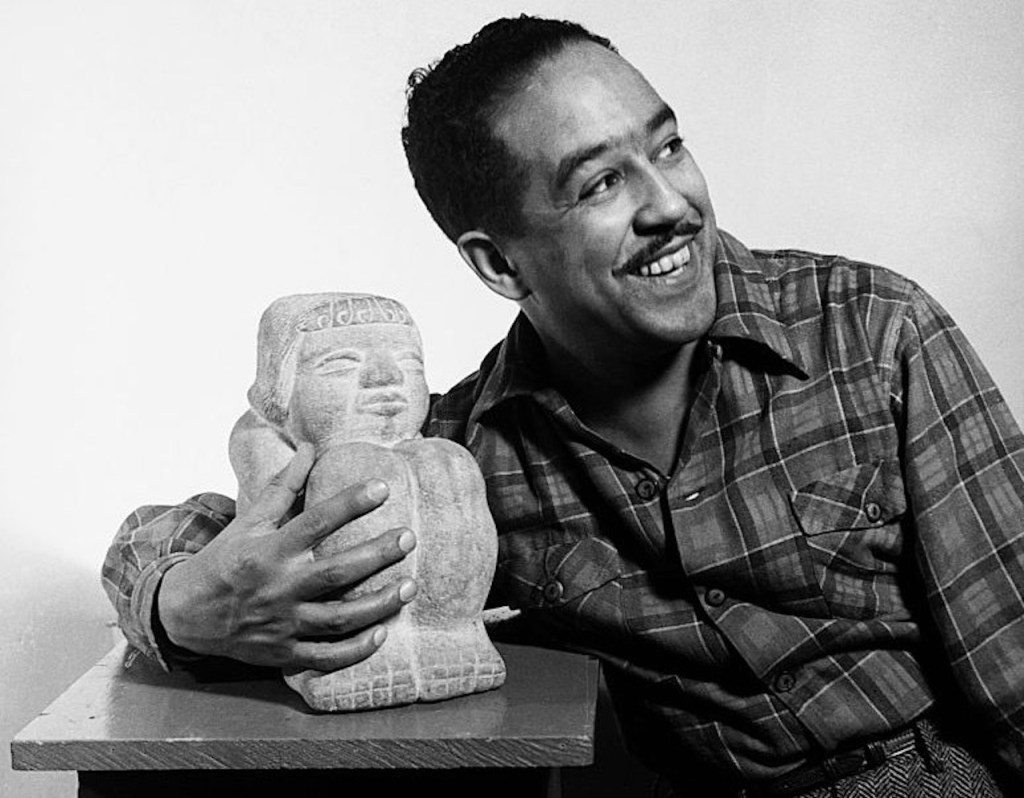
    Image:  Langston Hughes.  Library of Congress. Photographer Gordon Parks 

    Langston Hughes’ “The Negro Speaks of Rivers”

    Langston Hughes’ speaker in “The Negro Speaks of Rivers” displays his message in five versagraphic movements, thematically exploring his soul experience with a “cosmic voice,” which includes and unites all of humanity.

    Introduction and Text of “The Negro Speaks of Rivers”

    Langston Hughes’ speaker in “The Negro Speaks of Rivers” displays his message with a “cosmic voice,” which includes and unites all of humanity.  The poem plays out in five versagraphic movements, focusing on the theme of soul exploration.

    The Cosmic Voice in Poetry

    Writers, especially poets, often employ the “cosmic voice” in order to provide a deep and wide view of historical events and vast swaths of space.  A device called the omniscient speaker is often used in fiction; that voice is similar to the cosmic voice but much more limited.

    Time and space may stretch or contract as needed as the cosmic seer narrates what he experiences.  The “cosmic voice” may come to a poet through a vivid imagination; however, it transcends the imagination as a truth teller.   Only a few poets have been blessed with such a voice; examples are Emily Dickinson, Rabindranath Tagore, Paramahansa Yogananda, and to a limited degree Walt Whitman.

    The cosmic voice imparts truth through deep intuition.  The soul of the speaker employing the cosmic voice is, even if only temporarily as is the case with Langston Hughes, becomes aware of its vast and profound knowledge.  The cosmic voice speaks from a place far beyond ordinary sense awareness.  

    Individuals who comprehend the cosmic voice are bequeathed a consciousness far beyond their own sense awareness and thus comprehend the unity of all created things.  Those individuals are heralded into the realm of the Cosmic Creator and often remain transformed beings for having experienced that Sacred Locus.

    Langston Hughes and the Cosmic Voice

    The voice employed in “The Negro Speaks of Rivers” is not a whining, complaining one so often heard in the protest voices of activists; instead Hughes is employing the cosmic voice—the voice of the soul that knows itself to be a divine entity.  That voice speaks with inherent authority; it reports its intuitions so that others might hear and regain their own experiences through its guidance.

    Langston Hughes’ speaker in “The Negro Speaks of Rivers” imparts his discourse in five versagraphic movements.  His theme explores with the cosmic voice that unites all of humanity.  

    The vital lines that serve as a refrain—”I’ve known rivers” and “My soul has grown deep like the rivers”—work like a chant, instilling in the listener the truth that the speaker wishes to impart.  That Langston Hughes was able to employ a cosmic voice in a poem at age seventeen is quite remarkable.  

    Although some of his later work, even as much of it remained important and very entertaining, descended into the banal and at times even slipshod, no one can deny his marvelous accomplishment with this early poem in which he speaks as a master craftsman.

    The Negro Speaks of Rivers 

    I’ve known rivers:
    I’ve known rivers ancient as the world and older than the flow
    of human blood in human veins.

    My soul has grown deep like the rivers.

    I bathed in the Euphrates when dawns were young.
    I built my hut near the Congo and it lulled me to sleep.
    I looked upon the Nile and raised the pyramids above it.
    I heard the singing of the Mississippi when Abe Lincoln
         went down to New Orleans, and I’ve seen its muddy
         bosom turn all golden in the sunset.

    I’ve known rivers:
    Ancient, dusky rivers.

    My soul has grown deep like the rivers.

    Reading:   Langston Hughes reads his poem “The Negro Speaks of Rivers”

    Commentary on “The Negro Speaks of Rivers”

    Langston Hughes’ speaker in “The Negro Speaks of Rivers” stands as high testimony to the poet’s ability to craft genuine, heartfelt poetry.  To have composed such a profound piece of art at such an early age bespeaks a literary marvel.

    First Movement:  The River as a Symbol

    I’ve known rivers:
    I’ve known rivers ancient as the world and older than the flow
    of human blood in human veins.

    The poem opens with the speaker remarking rather nonchalantly that he has experienced the natural phenomenon known as “rivers.”  He has no doubt observed rivers flowing in their channels, and he has become aware that rivers flow through the earth as blood flows through the veins of human beings.  

    Both flowing rivers and flowing blood must be ancient, but the speaker intuits that the flow of the rivers surely predates that of the appearance of the human being upon the planet. The river image becomes a symbol linking all of humanity from the pre-historic era to the present day.   

    As the “river” has served to carry the physical encasements (bodies) and mental bodies over the rough terrain of land and rocks, the symbolic river carries the soul on its Divine journey.   Readers and listeners will easily intuit the significance of the speaker’s focus as it ranges far beyond the boundaries of the physical, material universe.

    Second Movement:  Intuitive Awareness

    My soul has grown deep like the rivers.

    This line indicates that the speaker has become aware that through his own soul he can intuit historical events, places, and people, who have existed from the beginning to time.  The line becomes a refrain and will be encountered again in the poem because of its great importance.  

    It becomes quite obvious that the speaker would not have been able to know literally the rivers of antiquity that he claims to “know.”  However, through his soul, or mystical awareness, he can.  Thus, he again employs the cosmic, thus mystical, voice to fashion his assertion.

    Third Movement: Historical Unity

    I bathed in the Euphrates when dawns were young.
    I built my hut near the Congo and it lulled me to sleep.
    I looked upon the Nile and raised the pyramids above it.
    I heard the singing of the Mississippi when Abe Lincoln
         went down to New Orleans, and I’ve seen its muddy
         bosom turn all golden in the sunset.

    The speaker claims that he “bathed in the Euphrates” at the dawning of Western civilization.  From the Euphrates to the Mississippi Rivers, the speaker offers a huge expansion of time and place.  

    In biblical times to present time, he lays claim to knowledge, again impossible except for soul consciousness. Awareness through the soul is unlimited, unlike the limitations of body and mind.  The speaker could not have experienced the Euphrates when “dawns were young.”  

    But the cosmic voice of the speaker can place itself at any point along the time line of civilization or cosmic creation. In claiming to have built his “hut near the Congo,” the speaker continues his cosmic, mystically inspired journey.  He “looked upon the Nile”  and “raised the pyramids” only as a cosmic-voiced speaker.

    People of all times and climes have been influenced by the river experience.  The speaker can thus unite all races, nationalities, creeds, and religions in his gathering of historic experiences within which all those peoples have lived.   And he accomplishes this feat through employment of the symbolic force of the “river.” 

    Emphasizing the American experience, the speaker claims to have “heard the singing of the Mississippi when Abe Lincoln / went / down to New Orleans . . . .”   The allusion to President Abraham Lincoln reminds the reader of the process of slave emancipation.

    As with all the rivers mentioned, the Mississippi River, an American river, stands as a symbol of the blood of the human race—not naturally segregated into color and national categories. The American Mississippi River, as the earlier mention of rivers has done, symbolizes the human blood of the human race—the only race that scientifically exists.

    Fourth Movement:  A Soul Chant

    I’ve known rivers:
    Ancient, dusky rivers.

    Because of the importance of the “river” as a symbol, the speaker repeats the line, “I’ve known rivers.”  Like the line, “My soul has grown deep like the rivers,” this one also  serves as a refrain.   If the speaker had chanted the line many more times, the poem’s delightful charm would have even been enhanced—that line is that crucial!

    The soul, the river, the depth of the soul and the river—all force history to yield a mighty blessing on those who have “known rivers,”  and whose souls have grown deep like those rivers. 

    Thus the speaker offers a brief description of how those river appear:  they are extremely old, and they are mystically dark, a measure that alludes to the dark-skinned race with graceful precision, even as it holds all races as having experienced the nature of the mystic river.

    Fifth Movement: Life Force and the Symbol of the River

    My soul has grown deep like the rivers.

    The speaker’s soul has grown profoundly deep like the rivers and along with the rivers.  Civilizations have grown up and grown deep along rivers all over Planet Earth. The soul that possesses the body is the life force informing and maintaining that body. 

    Likewise, rivers streaming through the earth give life force to civilizations and also assist in maintaining those civilization with the products and supplies that river travel has allowed over the centuries.

    The speaker is taking his own identity from the energetic force of the soul and the river force of the earth.  The children of the Divine Creative Reality (God) all spring forth from a common ancestry, a symbolic set of original parents.   It has always been rivers that link all of those ancestors as the blood in their veins links them into one family—the Human Race.

    The cosmic voice of a young poet—who happened possess the darker hue of skin along the color spectrum—has rendered a statement that could enlighten and reconnect all peoples if only they could listen with their own cosmic awareness.  

    At the soul level, all human beings remain eternally linked as children of the Great Divine River King (God). That River God flows in the blood of His offspring. And that same River God flows in the rivers of the planet on which they find themselves too often segregated by ignorance of their own common being as sparks of the Divine.

    Instead of identifying with the perishable body and changeable mind that too often rule, the simple act of identifying with their own cosmic nature would allow individuals to experience the cosmic voice of their own soul. The simple poet named Langston Hughes has offered a useful template for viewing the world through a cosmic lens in his nearly perfect poem.

    🕉

    You are welcome to join me on the following social media:
    TruthSocial, Locals, Gettr, X, Bluesky, Facebook, Pinterest 

    🕉

    Share

  • Rabindranath Tagore’s “Light the Lamp of Thy Love”

    Image: Rabindranath Tagore – Portrait by William Rothenstein

    Rabindranath Tagore’s “Light the Lamp of Thy Love”

    Rabindranath Tagore’s poem “Light the Lamp of Thy Love” is a devotional lyric that expresses the speaker’s longing for self-realization. Through colorful imagery, the poem explores themes of transformation, redemption, and the transcendence of human limitation through spiritual awakening.

    Introduction and Text of “Light the Lamp of Thy Love”

    Rabindranath Tagore, a Nobel laureate poet and philosopher, often infused his works with spiritual depth and mysticism. His lyric “Light the Lamp of Thy Love” offers a prayerful plea for divine intervention, as the speaker implores a higher power to dispel darkness and replace it with enlightenment. 

    The poem’s structure follows a gathering movement from supplication to transformation, resulting in the profound realization of divine presence, also known as self-realization or God-union. Tagore employs vivid metaphors—lamps, light, and gold—to symbolize the process of spiritual purification. 

    The repetition of phrases reinforces the urgency of the speaker’s plea, while the invocation of touch underscores the immediacy of divine grace. The poem’s universal theme of seeking enlightenment resonates beyond religious confines, making it a poignant reflection on the human soul’s yearning for transcendence.

    Paramahansa Yogananda refashioned this poem into a chant that is performed at SRF meditation gatherings and ceremonies.  Immediately below the poem, there is a video of the SRF monks chanting the piece at one of SRF’s World Convocations.

    Light the Lamp of Thy Love

    In my house, with Thine own hands,
    Light the lamp of Thy love!
    Thy transmuting lamp entrancing,
    Wondrous are its rays.
    Change my darkness to Thy light, Lord!
    Change my darkness to Thy light.
    And my evil into good.
    Touch me but once and I will change,
    All my clay into Thy gold
    All the sense lamps that I did light
    Sooted into worries
    Sitting at the door of my soul,
    Light Thy resurrecting lamp!

    Commentary on “Light the Lamp of Thy Love”

    Rabindranath Tagore’s poem “Light the Lamp of Thy Love” serves a prayer for divine illumination or God-union (also known as self-realization), reflecting an intense spiritual longing. The speaker acknowledges human frailty and desires transformation through divine grace. Each movement of the poem builds upon the preceding one, deepening the speaker’s surrender to the divine will.

    First Movement: Invocation of Divine Light

    In my house, with Thine own hands,
    Light the lamp of Thy love!

    The speaker begins with a direct appeal to the divine, requesting illumination within his own “house,” a metaphor for the soul. The imagery of the divine hand lighting the lamp suggests an intimate and personal act of grace. 

    This scenario establishes the poem’s central theme of spiritual awakening as a force intervening in the speaker’s internal world. The use of the imperative conveys urgency as well as personal familiarity, emphasizing human dependency on divine intervention for enlightenment.  This evocative opening sets the tone for the poem’s progression from entreaty to transformation.

    Second Movement: Transformation through Divine Light

    Thy transmuting lamp entrancing,
    Wondrous are its rays.
    Change my darkness to Thy light, Lord!
    Change my darkness to Thy light.
    And my evil into good.

    In the second movement, the speaker acknowledges the power of divine enlightenment, describing it as “entrancing” and “wondrous.” The repetition of “Change my darkness to Thy light” underscores the urgency and necessity of divine transformation. Darkness symbolizes ignorance, sin, and suffering, while light represents wisdom, virtue, and divine grace. 

    The explicit plea to change evil into good reflects Tagore’s vision of spiritual evolution, wherein the divine presence purges human flaws.   This movement portrays transformation as both passive and active—the speaker submits to divine will while the divine force actively reshapes his essence. The imagery of light as a catalyst for moral and spiritual purification aligns with Tagore’s broader philosophical themes of unity between the self and the divine.

    Third Movement: Spiritual Alchemy

    Touch me but once and I will change,
    All my clay into Thy gold

    The speaker then expresses absolute faith in divine transformation, emphasizing the power of a single divine touch. The contrast between “clay” and “gold” serves as a metaphor for spiritual alchemy—earthly, flawed existence is refined into something pure and incorruptible. 

    This suggestion reflects the Upanishadic tenet that the soul has potential to merge with the divine.   The phrase “but once” highlights the immediacy and sufficiency of divine intervention, reinforcing the idea that enlightenment is not a gradual process but an instantaneous, transcendent experience, after conditions become aligned.

    Fourth Movement: Renunciation of Material Attachments

    All the sense lamps that I did light
    Sooted into worries
    Sitting at the door of my soul,
    Light Thy resurrecting lamp!

    In this final movement, the speaker reflects on past attempts to find light through worldly means, represented by “sense lamps.” These artificial lights, linked to sensory experiences, have only resulted in “worries,” suggesting that material pursuits lead to disillusionment. 

    The speaker, becoming aware that the Divine Reality is “sitting at the door of my soul,” finds himself in a precarious position, awaiting true illumination. The plea for the “resurrecting lamp” signifies the desire for rebirth through divine grace. 

    This conclusion emphasizes the contrast between self-induced, transient sources of light and the enduring illumination provided by the Divine. Tagore’s imagery addresses surrender and renewal, resulting in the speaker’s complete reliance on divine intervention for enlightenment.

    A Philosophy of Divine Love

    “Light the Lamp of Thy Love” encapsulates Tagore’s philosophy of divine love as the ultimate source of transformation. The poem progresses from invocation to surrender, illustrating the speaker’s deepening spiritual realization.   Tagore employs symbolic imagery—light, lamps, gold—to depict the process of transcendence, wherein the divine presence eradicates darkness and imparts purity. 

    The repetition of phrases reinforces the speaker’s desperation for enlightenment, while the shift from self-lit lamps to the resurrecting lamp signifies the futility of worldly pursuits in comparison to divine grace. 

    The interplay between passivity and divine action suggests that while human effort is insufficient for true transformation, surrender to divine will results in ultimate fulfillment.

    Tagore’s devotional lyric aligns with the Bhakti tradition, where longing for divine presence is central. However, its universal message extends beyond religious boundaries, addressing the fundamental human desire for meaning, clarity, and redemption.  The poem’s cyclical structure, resulting in divine illumination, parallels the spiritual journey from ignorance to wisdom. 

    By portraying the speaker’s progression from a seeker to one awaiting divine grace, Tagore underscores the idea that true enlightenment is not self-generated but received through divine compassion.  Ultimately, “Light the Lamp of Thy Love” serves as a meditation on the transformative power of divine love and its ability to guide the human soul toward transcendence.

    Image: Rabindranath Tagore – Portrait by Unknown Artist