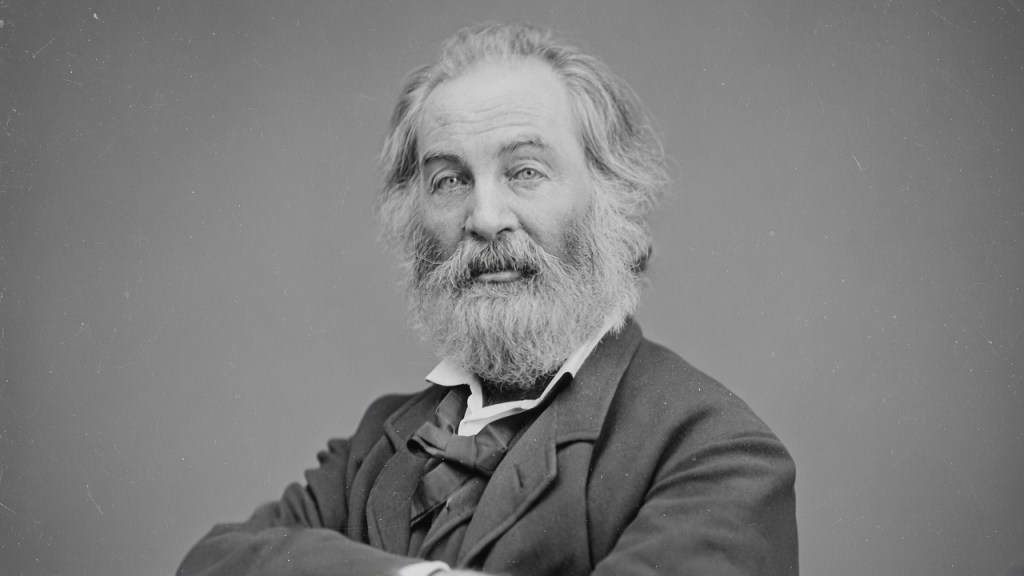
Walt Whitman remains one of the most important poets in American history. He has influenced every generation of poets since he first began to publish. He is rightly credited for leading American poetry into modernity. His long-lined, sprawling style is always easily recognized.
Early Life, Education, Early Career
Walter Whitman, Jr., was born on May 31, 1819, in West Hills, Long Island, New York, to Walter Whitman, Sr., and Louisa Van Velsor Whitman, a lower middle class family [1]. Walt, Jr’s early life greatly influenced his idiosyncratic world-view and artistic outlook. He became known as “Bard of Democracy” [2] because of his liberating employment of his cosmic, singular poetic voice.
His working-class parents worked hard to meet expenses, and the family changed residences often during Walt’s early years, in order to find better employment. These frequent new locations exposed the future poet to various environments, giving him an expansive outlook on life, as he experienced many different people from various backgrounds.
Walt was the second of nine Whitman children, and similar to the TV family “The Waltons,” the Whitman family often encountered scarce resources and many hardships as the parents labored to meet the needs of a family of eleven.
The poet’s father worked as a carpenter and as a farmer, but his laboring efforts never led to prosperity. This family dynamic led Walt to entering the workforce at an early age in order to help with family stay afloat financially.
The ancestors of the Whitman family had arrived in America as early as the 17th century, which rooted the family’s affection for their country very deeply, as the future poet would so often express in his works.
The poet remained close to his mother for his whole life. Louisa was a very affectionate and compassionate human being, and her positive attitude toward life proved to be a great influence on the life of her son. The poet could always count on his mother for unconditional love and support throughout his life.
Walt Whitman’s experience with formal schooling was virtually nil: he abandoned formal education after he turned eleven years old [3]. After a short stint in the public school system in Brooklyn, he made a swift departure because he family needed him to work and earn money to assist with family finances.
Despite leaving the formal schooling of the public eduction system, Walt continued to read, study, think deeply for the rest of his life. He pursued knowledge as assiduously as a bird seeks its daily nutritional intake. He maintained a life-long, insatiable thirst for knowledge.
After abandoning public education, Walt took a job as an office boy in Brooklyn [4]. After serving as an office boy, he became a printer’s apprentice, eagerly learning the craft of print- and typesetting. Such on-the-job experience brought Walt in contact with literary composition through manipulation of words, making them ready to publish.
Whitman later engaged in school teaching in a number of rural schools on Long Island. The sensationalism of a rumor has it that Whitman was tarred and feathered and chased out of the town of Southold for committing sodomy [5] on a student.
The likelihood of that particular rumor being true is virtually nil, because it has not been clearly established that Whitman ever taught in Southold. Whitman simply abandoned teaching because he found the work stultifying.
Work in the Field of Journalism
Whitman’s actual career in journalism began in the late 1830s [6]. He founded and edited the Long Islander newspaper in Huntington. His early experience in the field of journalism allowed him to develop his writing skills and engage in public discourse.
At age 23, Whitman became the chief editor of the New York Aurora. By September of 1845, four months after turning 26 years of age, he had newspaper experience from working for at least a dozen newspapers.
He flitted from one newspaper to the next, often holding editorial duties. Whitman worked for several different papers in Brooklyn and New York City, including the Daily Aurora and the Brooklyn Eagle. His time as an editor sharpened his skills in crafting clear, concise prose. He also learned to handle deadlines.
Whitman’s experience in the field of journalism afforded him a stage upon which to elucidate his opinions and insight into political as well as social. issues. He became a staunch advocate for democratic principles and often broached topics such as abolition and temperance. His many editorials revealed his growing social awareness and reformist consciousness.
Dedication to Poetry
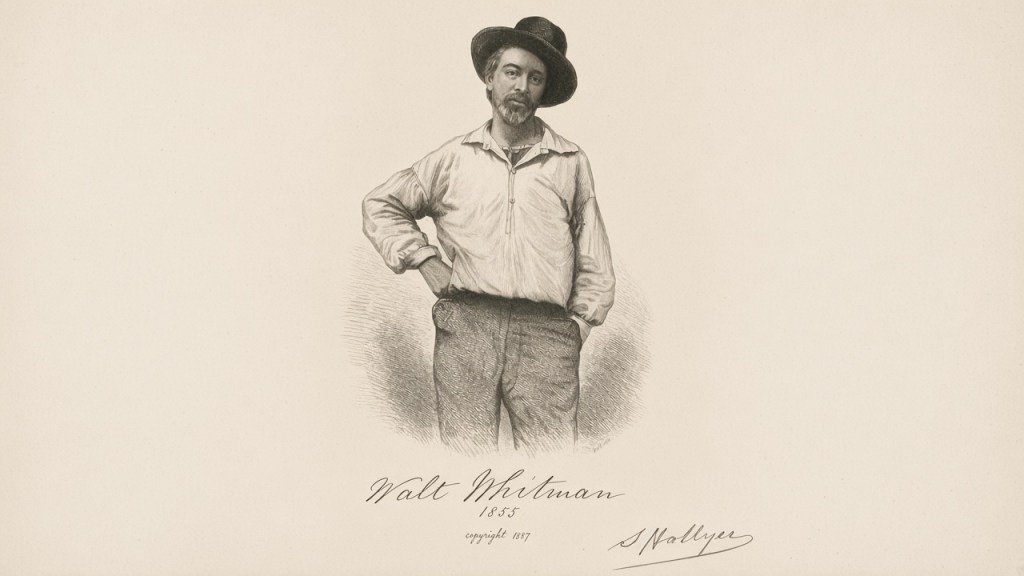
The publication of Leaves of Grass in 1855 [7], heralded a new era in American literature. Whitman self-published the first edition, which contained only twelve untitled poems. This innovative work defied conventional ideas of poetry, as it brazenly put on display free verse and non-traditional subject matter.
Famously, Whitman continued to revise and expand Leaves of Grass throughout his entire life, producing multiple editions. Each new revision revealed Whitman’s continuing artistic growth as well as the changing social worldviews and mores. The manuscript through its ever widening scope seemed to reflect the very growth of the nation itself.
His poetic style played out in a sweeping scope and direct address, all in celebration of the individual and the everyday person. Whitman wrapped his mind and heart around the entire spectrum of human experience—from the ordinary to the extraordinary, from the mundane to the transcendent. Within his poetry, Whitman strove to include all of America and all of what Americans had to offer the world.
Civil War and Humanitarian Work
The American Civil War (1861—1865) had a profound impact on the poet [8]. He diverted his intensity from writing to humanitarian efforts. He went to Washington, D.C., in 1862 after his brother George was wounded in battle. This experience showed the poet first hand the immense suffering caused by the war.
Whitman then became devoted to giving care to wounded soldiers in the military hospitals of Washington. He spent many hours calming and comforting the ill and dying.
Whitman helped the recovering soldiers write letters, and he even dressed their wounds, which was greatly appreciated by the overworked doctors and nurses. These selfless compassionate duties became the cardinal core of Whitman’s identity as a human being, as well as an expansive poet.
Whitman’s war-years experiences greatly affected his later poetry, particularly in works such as Drum-Taps and Memories of President Lincoln. He bore witness to the grim realities of conflict but also to the resilience of the human spirit. The war profoundly contributed to his understanding of the American identity.
Later Life
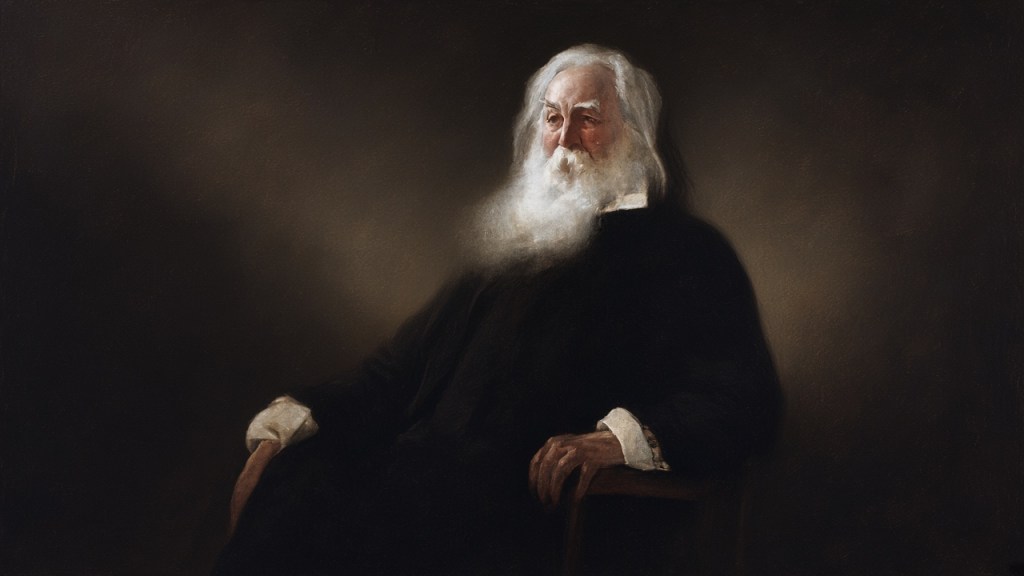
Following the war, Whitman continued working in government offices, even as his health began to suffer. In 1873, he was afflicted by a paralytic stroke, severely limiting his ability to walk. Despite his physical health issues, he continued his writing and revising Leaves of Grass.
Whitman relocated to Camden, New Jersey and spent his final years in that city [9]. In Camden, he received visitors from around the world [10] who sought out the beloved poet. His home became a pilgrimage site for admirers of his innovative and influential works that focused on democratic ideals.
Walt Whitman died on March 26, 1892 [11], leaving an exceptional literary legacy. His Leaves of Grass remains a monumental achievement, influencing the course of American poetry for generations. The poet remains a towering, renowned personality in world of literature and literary studies, celebrated for his creativity, individualism, and originality.
Legacy
Whitman’s influence [12] has extended far beyond the field of poetry; it has continued to attract successive generations of poets, essayist, journalists, and thinkers. Whitman’s celebration of democratic principles, individualism, as well as the interconnectedness of all things continues to find positive responses from new readers.
The Whitman legacy, similar to that of Ella Wheeler Wilcox, can serve as a mollifying corrective to the obstructive impact that postmodernism has inflicted upon the poetry world. Decade upon decade, Walt Whitman’s poetry and prose, as well as his fascinating life story, continue to offer testimony to the power and influence of a truly unique voice.
Sources
[1] Editors. “Walt Whitman.” Family Search. Accessed September 19, 2026.
[2] Curators. “Walt Whitman: Bard of Democracy.” The Morgan Library an Museum. Accessed June 2, 2025.
[3] Ed Folsom and Kenneth M. Price. “Self-Education.” Walt Whitman Archive. Accessed June 2, 2025.
[4] Editors. “Walt Whitman.” Biography. Updated: September 14, 2022.
[5] Editors. “Schoolteaching Years.” Walt Whitman Archive. Accessed September 19, 2026.
[6] Philip Eil. “On Walt Whitman, Unsung Newspaperman.” Literary Hub. May 29, 2019.
[7] Editors. “Leaves of Grass, 1855-1861.” Library of Congress. Accessed September 19, 2026.
[8] Editors. “Walt Whitman and the Civil War.” PBS. Accessed September 19, 2026.
[9] Curators. “Walt Whitman.” The Historical Marker Database. Accessed September 19, 2026.
[10] Curators. “Welcome.” The Walt Whitman House. Accessed September 19, 2026.
[11] Rhys Griffiths. “Death of Walt Whitman.” History Today. March 3, 2017.
[12] Curators. “The Powerful Influence of Walt Whitman.” Crystal Bridges Museum of American Art. April 27, 2017.
Recommended Print Sources for Walt Whitman
- Gay Wilson Allen. The Solitary Singer: A Critical Biography of Walt Whitman. New York: The Macmillan Company. 1955.
- James E. Miller, Jr., editor. Complete Poetry and Selected Prose by Walt Whitman. Boston: Houghton Mifflin Company. Riverside Editions. 1959.
Walt Whitman. Leaves of Grass: The Deathbed Edition. New York: Simon & Schuster. 1992.
Commentaries on Walt Whitman Poems
- When I Heard the Learn’d Astronomer
- Patroling Barnegat
- Reconciliation
- Passage to India
- When Lilacs Last in the Dooryard Bloom’d
 Linda's Literary Home