Linda's Literary Home

Tag: Walt Whitman

  • Walt Whitman’s “When I Heard the Learn’d Astronomer”

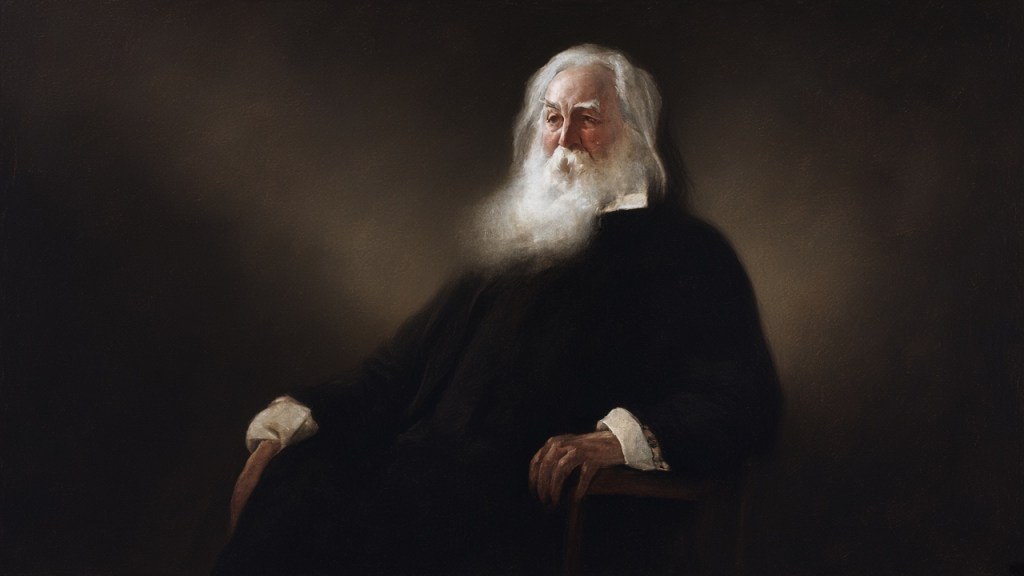
    Image c:  Portrait of Walt Whitman (1819-1892) by John White Alexander https://www.metmuseum.org/art/collection/search/10068 The Met
    Image c:  Portrait of Walt Whitman (1819-1892) by John White Alexander – The Met

    Walt Whitman’s “When I Heard the Learn’d Astronomer”

    Walt Whitman’s sprawling eight-line poem showcases the poet’s freewheeling style while dramatizing the wildly romantic world view portrayed in almost all of his poems.

    Introduction and Text “When I Heard the Learn’d Astronomer”

    Whitman’s “When I Heard the Learn’d Astronomer” provides a study in contrasts between science and poetry.  The speaker makes his preference known that he favors looking at the stars over studying them.  The speaker is a transcendentalist-romantic individual who is more interested in the life of the senses than the life of the mind.   

    Interestingly, however, this speaker demonstrates that, in certain instances, the senses can lead to a more spiritual experience than the mind.  The speaker prefers to indulge his fancy rather than pay attention to the measured distances between heavenly bodies. 

    When I Heard the Learn’d Astronomer

    When I heard the learn’d astronomer,
    When the proofs, the figures, were ranged in columns before me,
    When I was shown the charts and diagrams, to add, divide, and measure them,
    When I sitting heard the astronomer where he lectured with much applause in the lecture-room,
    How soon unaccountable I became tired and sick,
    Till rising and gliding out I wander’d off by myself,
    In the mystical moist night-air, and from time to time,
    Look’d up in perfect silence at the stars.

    Reading:  

    Commentary on ““When I Heard the Learn’d Astronomer”

    Walt Whitman’s sprawling eight-line poem showcases the poet’s freewheeling style while dramatizing the wildly romantic world view portrayed in almost all of his poems.

    First Movement:   When vs After

    When I heard the learn’d astronomer,
    When the proofs, the figures, were ranged in columns before me,
    When I was shown the charts and diagrams, to add, divide, and measure them,
    When I sitting heard the astronomer where he lectured with much applause in the lecture-room

    The first movement of Whitman’s influential poem consists of four adverbial clauses beginning with “when”:  

    1.  when he listened to the lecture,
    2.  when the numbers were presented,
    3.  when “the charts and the diagrams” were shown,
    4.  when he heard the audience’s cheer the “learn’d astronomer.” 

    A fascinating riddle poses the question:  “When the man jumped off the building, where was he?”

    Possible answers:  —Until he hit the ground, he was in the air—
    What’s wrong with that answer?  That was “after” he jumped.

    Then the person riddled might respond: —still standing on the top of the building— Wrong because, that was “before” he jumped.

    This riddle is instructive for language use especially use in poetry.  The adverb “when” is a flabby word, causing the ambiguity of unclarity as associated with an action.  Thus if  possible, one needs to consider whether the action occurred “before” or “after” the first event.

    Whitman was such an astute observer of both events and language, but this poem could use one last revision changing the “when” clauses to “after” clauses because that is the accurate time frames for each of the actions that he mentions.

    The reader will note that is was, actually, “after” all the following that he became “tired and sick” and determined to get up and leave: 

    1.  after he had heard the scientist
    2.  after he had seen the stats and numbers
    3.  after he had been presented the charts
    4.  after he had heard the other audience members applauding the astronomer.

    Second Movement:  After Growing Sick and Tired

    How soon unaccountable I became tired and sick,
    Till rising and gliding out I wander’d off by myself,
    In the mystical moist night-air, and from time to time,
    Look’d up in perfect silence at the stars.

    After the speaker had listened to a portion of the lecture, he gets up and leaves the lecture hall, goes out into the refreshing night air and looks up at the stars.  The event is simple, but the speaker’s dramatic portrayal of his actions enhances the act and makes it so much more interesting and meaningful than the mere event. 

    For example, the use of the word “unaccountable” contrasts with all the counting that was going on by the lecturer. The speaker is simply remarking that he grew “tired and sick” while listening, but he does not know why. 

    The speaker seems to have no reason for this reaction. He is cleverly leaving that reasoning up the reader to discern, after he paints his portrait of natural beauty in the final three lines, in which reports that he rose from his seat, moved out into the night alone, and then off and on gazed upward to the heavens where he was treated to the “perfect silence at the stars.” 

    Those final lines contrast the stuffy lecture hall with the lushness of the great outdoors; they contrast the enjoyment of being alone as opposed to being surrounded by people in the stuffy lecture hall. The night air is “mystical”—the speaker is carried to a transcendental height by the simple “moist night-air.” 

    And the best of all the observant speaker saves for the last; in contrast to the steady pace of the lecture, he leisurely “from time to time”—no hurry, no schedule, no following someone else’s line of thought—gazes up into the heavens and observes the brilliance of the stars themselves, instead of merely hearing about them through charts, diagrams, and numbers.
  • Dreams and Days

    191a Image-Created by Grok inspired by the poem.jpg
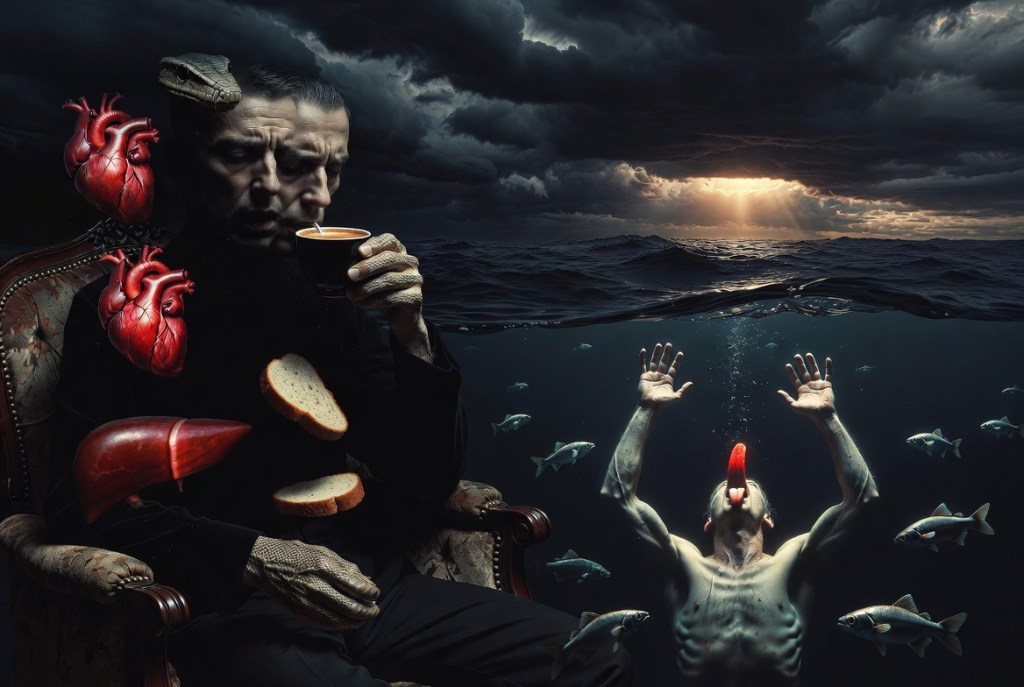
    Image: Created by Grok inspired by the poem

    Dreams and Days

    “His tongue cuts / Slices of meat / From the hearts / And livers / Of those / Who would love him . . . ”       –from “Between Slices of Bread” in Linda Sue Grimes’ At the End of the Road 

    I quote myself, well then,
    I quote myself —
    I include multitudes —
    Uncle Walt taught me that much.

    The man in the poem
    Cannot bring himself to say
    Or to pray about his own lividness
    He shuts out spaces and commas
    Lives in his own irrelevance.

    He murders his own children
    With his viper attitude
    And nibbles the ankles
    Of prostitutes
    Who erase his will to power on.

    You have seen him
    Perhaps did not recognize him —
    He has sat in your parlor
    Sipping your coffee
    Dusting off his duplicitous moves —

    He fears death but not yours
    He imagines you at the bottom
    Of a cold, black ocean
    Your tongue bait for the fishes
    His Bolshevik brain conjures.

    Your freedom is a fantasy
    If you remain too close to his heat
    Get your life back – get your love back
    Where God made you in His image
    And you are close to seeing it.

  • Emily Dickinson’s “We lose – because we win”

    Image: Emily Dickinson – Amherst College – Daguerrotype of the poet at age 17, circa 1847 – likely the only authentic, extant likeness of the poet

    Emily Dickinson’s “We lose – because we win”

    Emily Dickinson’s “We lose – because we win,” exemplifies a short, quirky observation,  which makes a statement about human behavior that has become compulsive.

    Introduction and Text of “We lose – because we win”

    Emily Dickinson’s “We lose – because we win” features characteristics of a versanelle, a short, usually 20 lines or fewer, dramatic narration that comments on human nature or behavior and may employ any of the usual poetic devices.  I coined this term to designate certain heretofore unclassifiable poems of Robert Frost, Stephen Crane, M. M. Sedam, and others.

    The versanelle remains a natural, philosophical outlet for the poet who entertains a philosophical bent, as most poets do. From Walt Whitman to T. S. Eliot, many American poets from time to time are motivated to fashion a short observations regarding humankind into a poetic drama.

    We lose – because we win

    We lose – because we win –
    Gamblers – recollecting which
    Toss their dice again!

    Commentary on “We lose – because we win”

    Each line of a versanelle exudes thoughts whose meanings in the hand of a less masterful craftsman might take many lines to express.

    First Line:   A Puzzling Paradox

    We lose – because we win –

    The speaker in Dickinson’s three-line versanelle has observed that humankind can become addicted to certain acts.  Thus she chooses the act of winning to state her perceived notion.  

    She states the introduction to her conclusion in a paradox.  At first, the statement seems non-sensical because it seems to contradict itself.  One is tempted to query, how can we lose if she has won?  Are the two not mutually exclusive.  At first blush, it seems that the speaker has placed the acts of losing and winning in the same time frame.  And if that were the case, the statement would have been ludicrous.

    For example, if you placed your bet and won $1,000, no one can dispute that you gambled and won.  In order to remain a winner, however, you must walk away with your winnings.

    Thus the paradox is elucidated by the remaining two lines, which broaden the time frame.  The speaker is not only referring to the short period of time after winning, but she is also encompassing the many years, perhaps, that may follow that unfortunate win that leads to loss.

    Second Line:  Gamblers Remember

    Gamblers – recollecting which

    Thus”Gamblers” do not take their money and walk away.  They become intoxicated by the win, and the memory of winning becomes implanted in their brains.  The pleasure of winning that money has urged the “gambler” to make further choices that will again bring that pleasure.

    Third Line:   Lose After Winning

    Toss their dice again!

    In the attempt to regain the pleasurable feeling of having won that thousand dollars, the “gambler” must gamble again.  And even if he wins, a second time, he will only strengthen the desire to keep winning.

    But as those hooked on the notion of winning continue to “toss their dice,” they will invariably begin to lose.  And it becomes abundantly clear that they will lose many more thousands than they have ever won.  Just ask members of Gamblers Anonymous!

    And not only will the continuation of gambling lead to financial ruin, the seriously addicted gambler may lose his job, family, and friends, along with his self-respect and possibly his life.

    A Broader Application

    While the Dickinson versanelle can be understood to refer to the literal “gambler,” there is no doubt that her speaker wishes to offer a far more wide-ranging application of this adage.  Thus the observation can include any human activity that leads to habitual repetition of an act that leads to negative instead of positive outcomes. 

    Such activities might include those that lead to addiction to alcohol, those that lead to unhealthy eating, those that lead to unwholesome engagement in sex, and also those that lead to psychological malfunction.   

    The human mind and heart are capable of turning a heaven into a hell merely with thoughts that ultimately lead to depravity.  Experiencing a delight in any unhealthy, unwholesome act must be rooted out before it can become habitual.  

    The mood junky can become like a gambler who continues to roll the dice, expecting to experience that happy win again, yet finds himself unable to climb out of his nasty mood because he has come to rely on it, perhaps using it as an excuse for failures that are simply the result of lack of effort.