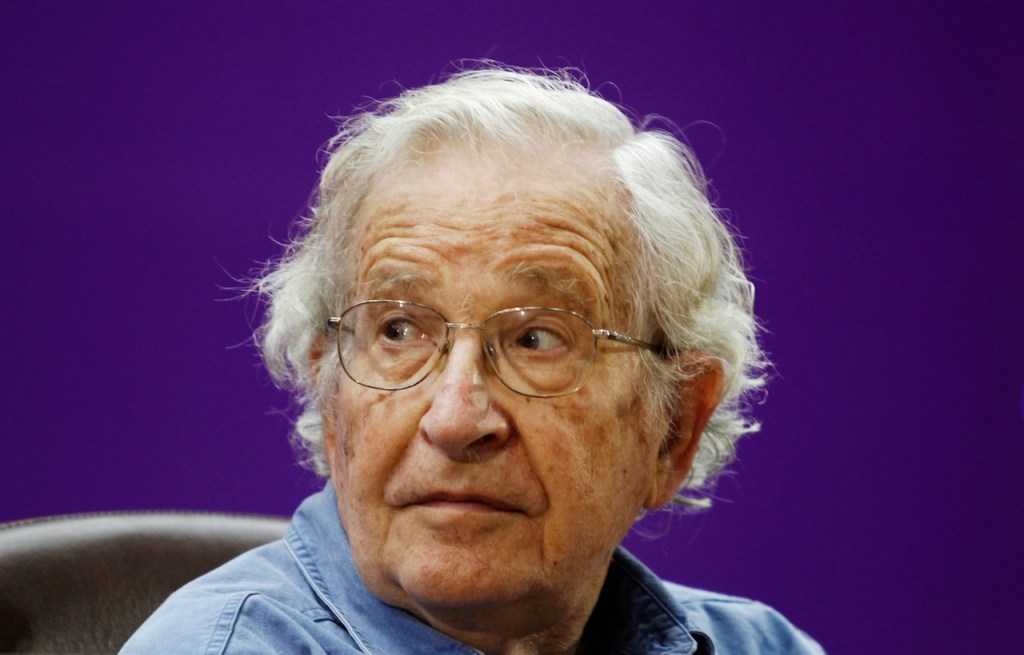
Image: Noam Chomsky
Noam Chomsky, Jeffrey Epstein, and the Problem of Judgment
Since the mid-1960s, the name Noam Chomsky has exerted a great deal of influence on American dissident political thought [1]. Chiefly known for his critiques of U.S. foreign policy and media power, Chomsky has often been regarded as a moral voice of dissent, despite the fact that his opposition has made a convincing case refuting that status.
Currently, recent revelations about his relationship with Jeffrey Epstein further challenge that reputation. These disclosures impose a broader question: do Chomsky’s past political positions, such as his association with Epstein, reflect a recurring pattern of poor judgment?
The Epstein Relationship
Public scrutiny of Chomsky, who labels his political leanings “anarcho-syndicalist and libertarian socialist,” has intensified after newly released emails and financial records show that Chomsky maintained a relationship with Epstein years after Epstein’s 2008 conviction for sex crimes involving a minor.
According to multiple reports, the two men met repeatedly and remained in contact well into the 2010s [2]. Chomsky himself admitted that Epstein assisted him with a financial matter involving roughly $270,000 [3], which was transferred through Epstein’s network. More recent disclosures suggest the relationship went well beyond that single transaction.
Emails reveal Chomsky describing his interactions with Epstein as “a most valuable experience,” and he maintained “regular contact” with Epstein even after Epstein’s criminal conviction was widely known [4][5]. In addition to emails, Epstein’s personal calendar and correspondence show that meetings, dinners, and travel plans were arranged between the two [6].
Even more telling are reports revealing that Chomsky offered Epstein advice on how to handle negative media coverage. In a 2019 email, Chomsky suggested to Epstein that he avoid public attention and characterized press scrutiny as excessive or “horrible” [7][8]. Again, by 2019, Epstein’s crimes had been widely reported for over a decade.
Even Chomsky’s supporters have acknowledged his poor judgment. A 2025 analysis in The Nation noted that Chomsky has historically been inclined to treat “fools, knaves, and criminals too lightly,” suggesting that Epstein may fit into a broader pattern rather than an unfortunate but isolated lapse [9]. More recently, Chomsky’s own wife publicly described their association with Epstein as a “serious error in judgment,” attributing it in part to misplaced trust [10].
A Pattern of Intellectual Leniency
To understand whether this episode is unique, it is useful to analyze Chomsky’s earlier political positions. Critics have long argued that Chomsky’s worldview often leads him to downplay or reinterpret wrongdoing by figures who align—directly or indirectly—with his broader negative criticism of Western power.
The Cambodia case is the most extensively documented example. In their 1977 article “Distortions at Fourth Hand” [11], Noam Chomsky and Edward S. Herman urged caution toward refugee testimony and criticized what they saw as exaggerated media reporting on Khmer Rouge atrocities. This position drew sustained criticism from later scholars and analysts, who argued that Chomsky’s skepticism led him to downplay credible evidence of mass violence and to rely on selectively favorable sources.
Political scientist Stephen J. Morris [12], for example, accused Chomsky of minimizing repression and misrepresenting available evidence, while later analyses by writers such as Bruce Sharp [13] identified methodological flaws and omissions in his treatment of the Cambodian record. Survivors and scholars, including Sophal Ear [14], have likewise criticized Western intellectuals who appeared to discount or reinterpret the scale of Khmer Rouge atrocities.
Chomsky’s defenders argue that he never flatly denied the atrocities, and that his primary target was Western double standards rather than the Khmer Rouge itself. That defense has some merit, but it does not resolve the central problem: the asymmetry of scrutiny.
The same 1977 article that urged skepticism toward refugee accounts of Khmer Rouge mass killings offered no comparable skepticism toward the pro-Khmer Rouge book Cambodia: Starvation and Revolution by Gareth Porter and George Hildebrand [15]—a volume that, as Chomsky and Herman themselves noted, did not contain a single sentence critical of the regime.
Yet, they gave the book their implicit endorsement, contrasting with sources they attacked. The pattern, in short, was not neutrality. It was the application of a demanding critical standard to evidence of atrocities by U.S.-opposed regimes, and a conspicuously lighter touch toward sources that minimized those atrocities.
Similarly, Chomsky has often pitted authoritarian governments in the Global South against U.S. imperialism in his ongoing critique of the West. While this perspective has been influential in academic and activist circles, Chomskyan challengers argue that such a view often leads to moral asymmetry—judging and viewing Western actions harshly while applying a more forgiving lens to others.
The Epstein case appears to fit into a similar pattern of Chomskyan readiness to bracket or relativize serious abuses when they cannot be comfortably assigned to the actors and structures he regards as primary villains. Epstein was not a political figure, but he occupied a position within elite networks that Chomsky has often harshly berated. Instead of maintaining distance, Chomsky engaged with Epstein, accepted financial assistance, and even offered reputational advice. The gap between Chomsky’s theoretical critique of elite power and his personal association with a disgraced financier remains impossible to ignore.
The Role of Personal Trust
One possible exculpatory excuse for this pattern is Chomsky’s intellectual disposition. Some supporters describe him as principled but also unusually willing to engage with a wide range of individuals, including controversial ones.
Other supporters point out that this disposition has led him not only to cultivate relationships with ideological allies but also to defend the institutional rights of his adversaries—for example, insisting in 1969 that Walt Rostow, a chief architect of the Vietnam War, must be allowed to teach at MIT in the name of academic freedom, despite Chomsky’s own fierce opposition to Rostow’s policies. Such openness can be interpreted as a strength—an unwillingness to adopt simplistic moral binaries, but it may also leave him vulnerable to manipulation.
From a number of reports, it can be gleaned that Epstein specialized in cultivating relationships with influential figures; this specialty accounts for the many references to Donald Trump. Epstein presented himself as a philanthropist and intellectual patron, often targeting academics, scientists, and well-known business figures. In this sense, Chomsky’s association with Epstein may be interpreted not as ideological alignment but as a failure to recognize manipulation.
However, this explanation does not withstand close analysis. Epstein’s criminal record was publicly known long before many of these interactions occurred. Continued engagement under such conditions suggests not merely naïveté, but a willingness to overlook serious moral concerns.
It should be noted that the Donald Trump-Epstein relationship [16] contrasts in important ways with that of Chomsky-Epstein. Donald Trump’s relationship with Jeffrey Epstein was a pre-conviction social friendship from the late 1980s to early 2000s that ended abruptly around 2004–2007.
Reports and legal filings have been used to argue that Trump banned Epstein from Mar-a-Lago after news of inappropriate behavior toward a teenage girl there, publicly distanced himself well before Epstein’s 2008 conviction, called him “not a fan” in later years, and alerted authorities to concerns about Epstein’s conduct as early as 2006.
None of this news about the Chomsky-Epstein relationship suggests that Chomsky engaged in any of the crimes associated with Epstein. However, reports of that close relationship remain troubling even if not shocking to Chomsky’s oppositional critics.
Implications for Chomsky’s Legacy
The significance of this controversy extends well beyond a Chomskyan personal reputation. Noam Chomsky has long derived authority from his claim to moral clarity—his insistence on exposing hypocrisy, power abuse, and ethical double standards. The Epstein relationship undermines that claim in a direct way.
Maintaining contact with a convicted sex offender, accepting financial assistance routed through Epstein, and offering reputational advice cannot be dismissed as mere eccentricity or intellectual openness. These acts remain conscious choices made in the presence of widely known facts. Such behavior indicates a failure not only of understanding, but also of a moral disposition to prioritize relativistic sensibilities.
This pattern aligns with earlier criticisms of Chomsky’s political judgment. His inclination to approach Western wrongdoing with extreme contempt, while failing to apply any harsh evaluation of other cultures, has long been observed and criticized.
In the Epstein case, that same instinct appears redirected into the personal sphere: a willingness to discount or compartmentalize serious wrongdoing when it does not fit neatly into his established framework of critique. That decision does not reflect neutrality; it clearly demonstrates selective judgment.
Reassessing Intellectual Authority
It is also worth reconsidering the broader assumption that Chomsky’s stature in one field secures his authority in others. While his early contributions to linguistics—particularly in generative grammar—were influential, they have been seriously debated and, in many areas, revised or challenged by subsequent research.
His reputation in linguistics rests on the claim that he transformed the field from simple description into a genuine science. That claim has been strongly challenged. What he actually produced was a highly abstract, internally shifting framework that substitutes theory for empirical accountability. His reputation as an unassailable intellectual figure has been challenged and even refuted by well-respected linguists [17][18][19].
More importantly, even successful intellectual achievement does not excuse poor judgment in ethical or practical matters. The Epstein association demonstrates that analytical sharpness in abstract domains does not necessarily translate into sound decision-making in real-world contexts. If anything, Chomsky’s case illustrates how intellectual confidence can coexist with, and perhaps even enable, serious lapses in judgment.
Chomskyan Accountability
The evidence surrounding Chomsky’s relationship with Jeffrey Epstein should not be treated as an isolated misstep. It is better understood as part of a broader pattern in which moral evaluation becomes inconsistent and, at times, selectively applied. This pattern, therefore, requires a more critical and less deferential reading of his work.
For readers, the takeaway is straightforward: authority must be continually tested against behavior. Chomsky’s career demonstrates that prominence and forceful critique do not guarantee reliability in judgment. In this instance, the failure is not subtle—it is clear, documented, and consequential.
Sources
[1] Robert F. Barsky. Noam Chomsky: A Life of Dissent. MIT Press. 1997.
[2] Maya Yang. “Noam Chomsky and Bard College President Had Financial Dealings with Jeffrey Epstein.” The Guardian. May 17, 2023.
[3] Staff. “New Documents Show Jeffrey Epstein Had Regular Meetings with Noam Chomsky.” Democracy Now. May 4, 2023.
[4] Staff. “Noam Chomsky Called Exchanges with Jeffrey Epstein ‘Valuable.’” NDTV. November 23, 2025 .
[5] Christine Willmsen. “Emails Show Close Connection Between Epstein and Chomsky.” WBUR. November 20, 2025.
[6] Sarah Do Couto. “Jeffrey Epstein Scheduled Meetings with Noam Chomsky.” Global News. May 1, 2023.
[7] Issam Ahmed. “Chomsky Sympathized with Epstein Over ‘Horrible’ Press Treatment.” NBC Right Now. Feb 3, 2026 – Updated Feb 4, 2026
[8] Kayla Epstein. “Epstein Asked Chomsky Advice Over Media Coverage.” BBC News. February 7, 2026.
[9] Greg Grandin. “What the Noam Chomsky–Jeffrey Epstein Emails Tell Us.” The Nation. December 15, 2025.
[10] Hillel Italie. “Valeria Chomsky Admits ‘Serious Errors in Judgment’ Over Epstein Ties.” Associated Press. February 11, 2026.
[11] Noam Chomsky and Edward S. Herman. “Distortions at Fourth Hand.” The Nation. June 25, 1977, pp. 789–790. Also available at chomsky.info/19770625/.
[12] Stephen J. Morris. “Whitewashing Dictatorship in Vietnam and Cambodia.” The Anti-Chomsky Reader. Encounter Books. 2004.
[13] Bruce Sharp. “Averaging Wrong Answers: Noam Chomsky and the Cambodian Controversy.” Mekong Network, 2003, updated 2023.
[14] Sophal Ear. Aid Dependence in Cambodia: How Foreign Assistance Undermines Democracy. Columbia University Press. 2013.
[15] George C Hildebrand and Gareth Porter. Cambodia: Starvation and Revolution. Monthly Review Press, 1976.
[16] Ali Rogin. “The Facts and Timeline of Trump and Epstein’s Falling Out.” PBS News. July 31, 2025.
[17] Nicholas Evans and Stephen C. Levinson. “The Myth of Language Universals: Language Diversity and Its Importance for Cognitive Science.” Behavioral and Brain Sciences, vol. 32, no. 5, Oct. 2009, pp. 429–448.
[18] Paul Ibbotson & Michael Tomasello. “Evidence Rebuts Chomsky’s Theory of Language Learning.” Scientific American. September 7, 2016.
[19] Steven Piantadosi. “Modern Language Models Refute Chomsky’s Approach to Language.” From Fieldwork to Linguistic Theory: A Tribute to Dan Everett. Eds.Edward Gibson and Moshe Poliak, Language Science Press. 2023, pp. 353-414. Published online July 5, 2024 .
 Linda's Literary Home
Good faith questions and comments welcome!