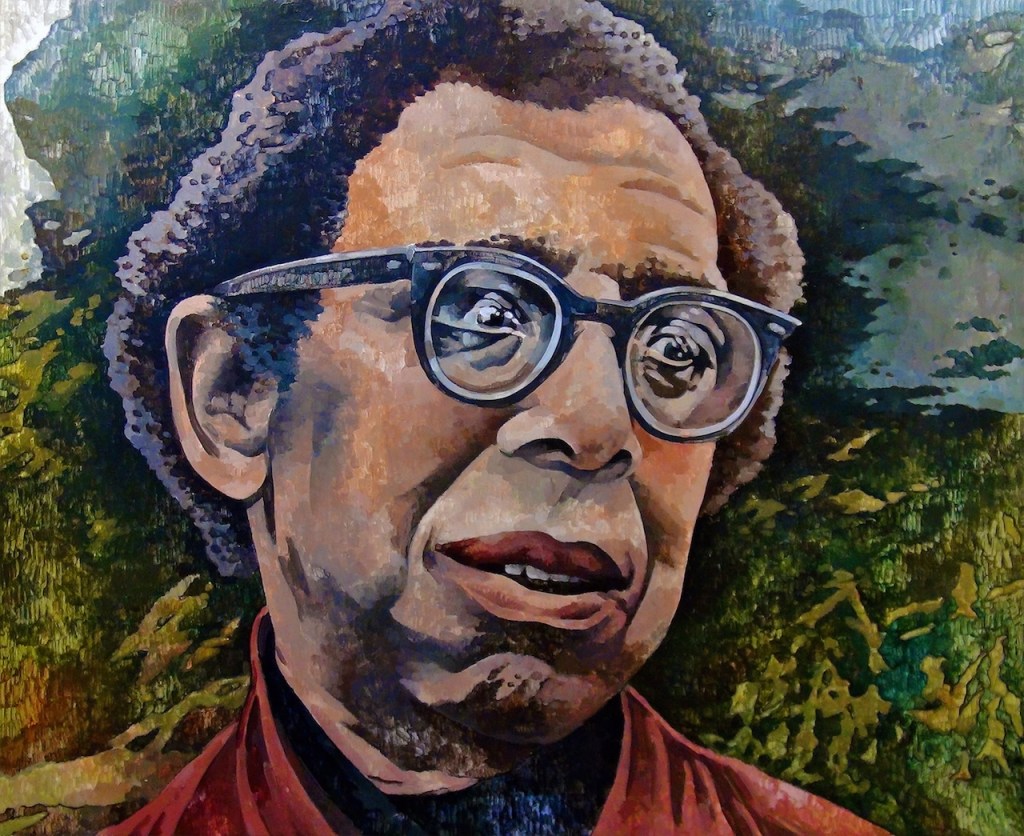
Image: Robert Hayden – Portrait by Nicole MacDonald
Robert Hayden’s “Those Winter Sundays”
Robert Hayden’s “Those Winter Sundays” is an American (Innovative) sonnet, and it is one of the best poems written in the English language, particularly in the American vernacular.
Introduction and Text of “Those Winter Sundays”
Robert Hayden’s speaker in this nearly perfect innovative sonnet “Those Winter Sundays” is a man reflecting on his attitude and behavior during his childhood. Specifically, the speaker is remembering and dramatizing an event that involved his father. He comes to the conclusion that he should have behaved more kindly and respectfully toward his father who did so much for him.
Looking back at childish ways often reveals immature attitudes and behaviors. Such reminiscing can lead to feelings of guilt and recrimination for the immature behavior and selfish attitudes that are so common to youth. But those feelings prompted by contrasting an adult’s understanding to a child’s understanding need to be assuaged by forgiveness and knowledge of the human condition.
The speaker in this poem shows a mature, well-balanced attitude regarding his younger self that corrects the human tendency to castigate that younger self. He realizes that if he had known better he would have behaved better.
Those Winter Sundays
Sundays too my father got up early
and put his clothes on in the blueblack cold,
then with cracked hands that ached
from labor in the weekday weather made
banked fires blaze. No one ever thanked him.
I’d wake and hear the cold splintering, breaking.
When the rooms were warm, he’d call,
and slowly I would rise and dress,
fearing the chronic angers of that house,
Speaking indifferently to him,
who had driven out the cold
and polished my good shoes as well.
What did I know, what did I know
of love’s austere and lonely offices?
Robert Hayden reading “Those Winter Sundays”
Commentary on “Those Winter Sundays”
This excellent sonnet “Those Winter Sundays” is one of the best poems written in the English language, and Robert Hayden is one the finest poets writing in the American vernacular.
First Stanza: The Plain Truth
Sundays too my father got up early
and put his clothes on in the blueblack cold,
then with cracked hands that ached
from labor in the weekday weather made
banked fires blaze. No one ever thanked him.
The speaker begins by reporting the unvarnished fact that even on Sundays, the day that most people are apt to sleep in, his father as usual “got up early.” The father got up early and put on his clothes in a very cold house. The father then built the fire in the stove that would warm the rooms to make it comfortable for the rest of the family to rise without suffering the cold that the father had done.
The speaker refers to the kind of cold that the house experienced as “blueblack.” That descriptor provides an intense image that renders that cold as biting and bitter. That the cold was so intense further strengthens the love and affection that the father felt for his family, and the misery he was willing to suffer in order to make life more comfortable for his loved ones.
Even though the father had worked hard during the week to the point of having to suffer “cracked hands” from all his hard labor, the father still without pause got up even on Sundays to assure that his family’s comfort was provided. The image “made / banked fires blaze” arises from the custom of piling up wood inside the stove or fireplace to keep a low-level fire smoldering for long periods of time, such as over night.
This procedure then makes it easier for the wood to blaze into full flames faster than its would have done without the banking. Thus, the fire is made faster and more easily in the morning when it is most necessary. The poet has created a speaker whose freshness of language infuses his message with all of the characteristics of a dramatic masterpiece. The images build, dramatizing as well as relaying information, implying attitudes as well as stating them.
The poet’s skill has created a well-placed infusion of feeling, as he has his speaker plainly claim, referring to the father, “No one ever thanked him.” The speaker’s remorse is revealed; he makes it clear that he wishes he had thanked his father for his sacrifices, but alas, he did not. Furthermore, no one did, and that omission now grieves the adult as he looks back on the situation.
Second Stanza: The Duties of a Father
I’d wake and hear the cold splintering, breaking.
When the rooms were warm, he’d call,
and slowly I would rise and dress,
fearing the chronic angers of that house,
Because of the father’s loving attention, the speaker could stay in bed warm and snug until the house was no longer suffering that “blueblack” cold but instead was all toasty warm. After the speaker wakes up but while still in bed, he can hear the cold being driven out of the house. He describes what he hears as “splintering, breaking.”
Again, the poet has infused a marvelous set of images that intensifies the meaning and skillfully dramatizes the events of this nearly perfect sonnet. What the speaker hears literally is his father chopping up wood, but to the child-speaker’s ears, it seemed as though the cold were literally being cracked and broken.
After the father had heated the house, he would call for his son to get up and get dressed. The speaker would do so, although “slowly.” Even though he was only a child, he always seemed to remain aware of the “chronic angers of that house.” The line “fearing the chronic angers of that house” seems to leave open some frightening possibilities for interpretation, and as might be expected, some critics have assumed that those angers signal an abusive father.
But such an interpretation makes no sense, however, unless one has overlooked the main message of the poem. The speaker would not likely be focusing on thanking the father, if he were testifying that the father had been an abuser. The “angers of the house” more likely refer to the house itself.
It likely had other issues beside the morning cold, for example, it might have had broken windows, leaky or noisy pipes, rodents, shabby furniture, or perhaps the floor-boards creaked when walked upon, or the roof leaked when it rained. After all, the speaker does designate that those angers belonged to the “house,” not to his father or to any other family member or resident of the house.
If meaning in a poem is derived from the poet’s biography, the poet’s actual meaning in the poem can become skewed. Readers must always look first and foremost to the poem for its meaning, not at the biography of the poet.
Third Stanza: The Indifference of Youth
Speaking indifferently to him,
who had driven out the cold
and polished my good shoes as well.
What did I know, what did I know
of love’s austere and lonely offices?
In the final stanza, the speaker demonstrates that he now understands the sacrifices his father made for him and the rest of the family. Undeniably, the speaker feels shame that he often spoke so “indifferently” to this father. The speaker thus suggests that if he could go back and correct that mistake, he would speak to his father with the love and devotion that he now realizes the father deserved.
Not only had the father “driven out the cold” for him and the rest of the family, but he had also polished the speaker’s shoes. These tokens of love become symbols for all of the other duties that the father must have performed for the family. It is quite likely that the father also cooked breakfast of this son, drove him to church or school, or to wherever the son needed to go.
The speaker then asserts his all important remark, framing it as a question: “What did I know, what did I know / of love’s austere and lonely offices?” Far from excusing his childhood behavior, the speaker is, instead, very eloquently explaining it: he was just a child. And as a child, he did not have the maturity to perceive that his father was performing selfless acts. Few, if any, children are ever blessed with such foresight.
Because the speaker repeats the question “what did I know?,” he is emphasizing his childhood lack of awareness. The speaker simply did not know what it was like to be a father, with the responsibilities of caring for children and running a household, of going to work each week-day to keep the family fed, clothed, and warm with a roof over their heads.
If the speaker had been capable of processing all of this complex, adult activity, he would have behaved differently—not “indifferently” toward his father. With his adult awareness though maturity, the speaker is now able to offer a corrective to all those who have experienced those same feelings of guilt for past childhood immaturity.
Why should any adult continue to suffer from the guilt and recrimination over childhood immaturity when it is so simple?: Children simply do not know any better. Children cannot behave in ways that remain out of their range of knowledge.
Once they do know better as mature adults, and though they may continue to wish they had done better, they should be able to leave off the abject guilt and get on with their lives. This poem’s spiritual level of thought and feeling renders it the marvelous, nearly perfect poem that it is.
The poet’s skill in crafting his dramatic sonnet filled with poignant memories that offer universal succor to readers elevates its stature to the nearly sublime. Such a poetic achievement remains rare in 20th century secular poetry, so thoroughly infused with the postmodern muck of unprompted anger and the inability to recognize and accept truth.
 Linda's Literary Home
Good faith questions and comments welcome!