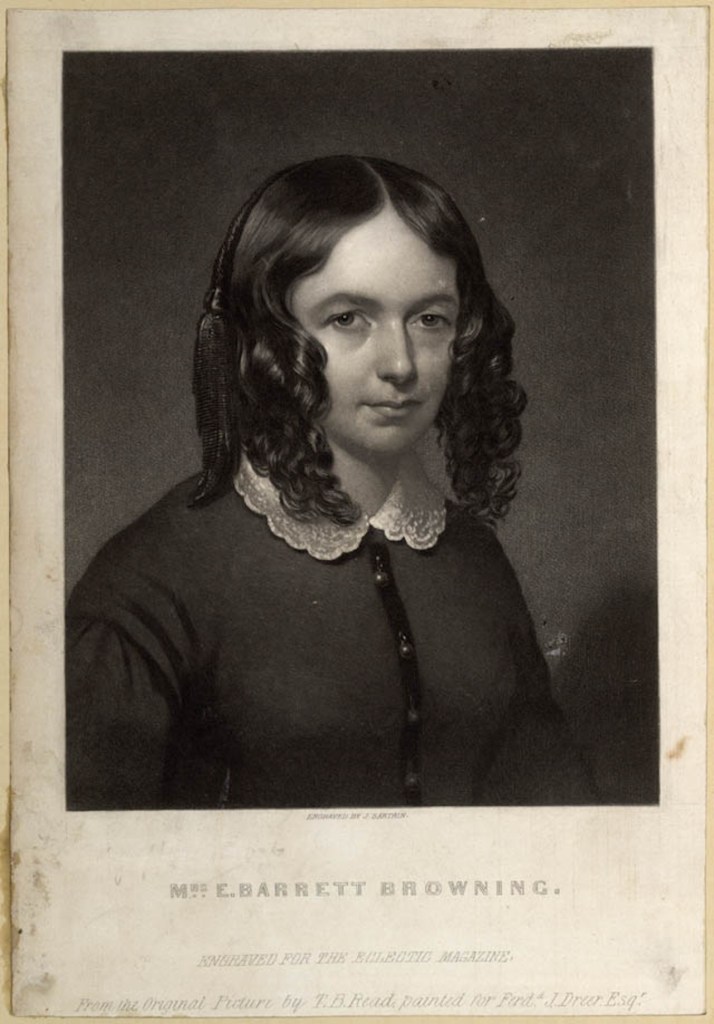
Elizabeth Barrett Browning’s Sonnet 11 “And therefore if to love can be desert”
The speaker is still walking the path to self-acceptance, still looking for the courage to believe in her own good fortune at finding a love that she wants to deserve.
Introduction and Text of Sonnet 11: “And therefore if to love can be desert”
Elizabeth Barrett Browning’s sonnet 11 from Sonnets from the Portuguese features the continued philosophizing of the obsessed speaker as she falls in love while trying to justify that love to herself and to her belovèd.
Sonnet 11 “And therefore if to love can be desert”
And therefore if to love can be desert,
I am not all unworthy. Cheeks as pale
As these you see, and trembling knees that fail
To bear the burden of a heavy heart,—
This weary minstrel-life that once was girt
To climb Aornus, and can scarce avail
To pipe now ‘gainst the valley nightingale
A melancholy music,—why advert
To these things? O Belovèd, it is plain
I am not of thy worth nor for thy place!
And yet, because I love thee, I obtain
From that same love this vindicating grace,
To live on still in love, and yet in vain,—
To bless thee, yet renounce thee to thy face.
Reading
Commentary on Sonnet 11 “And therefore if to love can be desert”
The speaker remains reluctant to engage in her own self-acceptance. She is still looking for enough courage to accept her own good fortune in finding a love of which she desire to become deserving .
First Quatrain: Berating Her Own Value
And therefore if to love can be desert,
I am not all unworthy. Cheeks as pale
As these you see, and trembling knees that fail
To bear the burden of a heavy heart,
The speaker, who so often has devalued her own self worth, now continues to evolve toward accepting the idea that she might, in fact, be “not all unworthy.” She contends that if the ability to love can be deserved, as an award for goodness or service, she feels that it just might be possible for her to have enough importance to accept the love of one so obviously above her in status and accomplishments.
Again, however, she begins her litany of flaws; she has pale cheeks, and her knees tremble so that she can hardly “bear the burden of a heavy heart.” She continues her string of self-deprecations into the second quatrain and first tercet.
Second Quatrain: To Accomplish Great Things
This weary minstrel-life that once was girt
To climb Aornus, and can scarce avail
To pipe now ‘gainst the valley nightingale
A melancholy music,—why advert
The speaker has lived a “weary minstrel-life,” and while she once thought of accomplishing great things, as Alexander the Great had taken Aornus, she now finds herself barely able to compose a few melancholy poems. She finds it difficult even to compete “’gainst the valley nightingale.”
However, she has also decided, while both thinking of and obsessing over these negative aspects of the life, to reconsider her possibilities. She realizes that she is merely distracting herself from more important issues by continuing to retain negative thoughts about which she spends too much time obsessing.
First Tercet: Concentration on Negativity
To these things? O Belovèd, it is plain
I am not of thy worth nor for thy place!
And yet, because I love thee, I obtain
Thus the speaker asks herself, “why advert / / To these things?” Indeed, why concentrate on the past negativity, as such a glorious future has been heralded? She then directly addresses her suitor, claiming, “O Belovèd, it is plain / I am not of thy worth.”
She still insists on making it known how aware she is that she is not of her suitor’s status. However, she is now willing to consider that they might be able to grow a relationship.
Second Tercet: Advancing a Philosophical Position
From that same love this vindicating grace,
To live on still in love, and yet in vain,—
To bless thee, yet renounce thee to thy face.
The speaker advances an odd philosophical position that because she loves the man, that love will offer her “vindicating grace.” Thus, she can accept his love and love him while still allowing herself to believe that such a love is “in vain” and that she can still “bless” him with her love, while simultaneously she can “renounce [him] to [his] face.”
The speaker’s complex of accepting and rejecting allows her to continue to believe she is both worthy yet somehow not quite worthy of this love. She cannot forsake the notion that she can never be equal to him.
Yet, she can accept his love and the prospect that somehow, somewhere beyond her ability to grasp it is the possibility that despite all of her flaws, she ultimately is deserving of such a great and glorious love.
 Linda's Literary Home

Good faith questions and comments welcome!