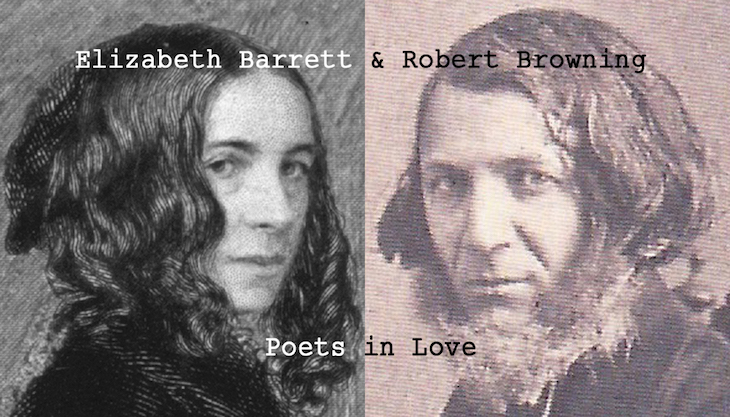
Elizabeth Barrett Browning’s Sonnet 12 “Indeed this very love which is my boast”
In sonnet 12 from Elizabeth Barrett Browning’s “Sonnets from the Portuguese,” her speaker is becoming more comfortable, realizing that she is truly loved by her suitor. Still she gives him all credit for her ability to love as deeply as she does.
Introduction with Text of Sonnet 12 “Indeed this very love which is my boast”
Elizabeth Barrett Browning’s sonnet 12 from Sonnets from the Portuguese portrays the speaker as she muses on the happiness of having fallen in love with one so illustrious and accomplished as is her suitor.
Sonnet 12 “Indeed this very love which is my boast”
Indeed this very love which is my boast,
And which, when rising up from breast to brow,
Doth crown me with a ruby large enow
To draw men’s eyes and prove the inner cost,—
This love even, all my worth, to the uttermost,
I should not love withal, unless that thou
Hadst set me an example, shown me how,
When first thine earnest eyes with mine were crossed,
And love called love. And thus, I cannot speak
Of love even, as a good thing of my own:
Thy soul hath snatched up mine all faint and weak,
And placed it by thee on a golden throne,—
And that I love (O soul, we must be meek!)
Is by thee only, whom I love alone.
Commentary on Sonnet 12 “Indeed this very love which is my boast”
Elizabeth Barrett Browning’s speaker in this sonnet is musing on her good fortune to have attracted the attention of a man, who is without doubt above her class status. And what is more important is that he has accomplished much and is recognized as a excellent poet.
First Quatrain: The Effects of Love
Indeed this very love which is my boast,
And which, when rising up from breast to brow,
Doth crown me with a ruby large enow
To draw men’s eyes and prove the inner cost,—
The speaker recognizes the effects of the love she is experiencing. She flushes red-cheeked as she muses on her good luck. She believes it entirely appropriate that she “boast” because of her good fortune. She thinks that whoever sees her can understand that she is glowing with love from “breast to brow” because of her wonderful, dynamic suitor.
The speaker reports that her heart has gained speed, rushing to her face the blood results in the blushing that announces to the world that she is in love. She no longer can keep private her joy at being loved. Her feelings have become too full, too great to contain with a neutral pose.
Second Quatrain: Learning Deep Love
This love even, all my worth, to the uttermost,
I should not love withal, unless that thou
Hadst set me an example, shown me how,
When first thine earnest eyes with mine were crossed,
Then the speaker declares something truly astonishing: she admits that without her beloved teaching her how to love at such a depth, she would not have been able to do so. Without his example, she would never have understood how love can completely engulf the heart and mind.
The speaker gradually little by little is coming to comprehend the importance of her burgeoning affection. She now begins to realize the glorious state of affairs that actually started as soon as their eyes first connected in their first love’s deep glance.
First Tercet: Naming the Emotion
And love called love. And thus, I cannot speak
Of love even, as a good thing of my own:
Thy soul hath snatched up mine all faint and weak,
The speaker realized for the first time the beauty of naming that magnificent emotion “love”—for it was then that for her, indeed, “love called love”—only at that momentous occasion when the pair of lovers first looked deeply into each other’s eyes.
Not only was the emotion labeled, but the feeling itself was also brought forth. The emotion resided within her deep heart; her beloved brought the emotion into her open consciousness.
She finds that she still “cannot speak” about love without acknowledging the existence, the existential presence, of her beloved. For her, love and her suitor are virtually synonymous because he “snatched up” her soul at a time that it was “all faint and weak.”
Second Tercet: Liberating a Weak Spirit
And placed it by thee on a golden throne,—
And that I love (O soul, we must be meek!)
Is by thee only, whom I love alone.
After liberating her faint, weak soul, her suitor raised her and set her beside him, “on a golden throne.” Metaphorically, she likens the bliss of his love to a royal asset of high value—an apt comparison because of all the many references to royalty she has employed to describe her suitor.
The speaker again bestows all credit to her suitor for the being able to love as profoundly as she does. She even tells her own soul that “we must be meek.” The speaker never wants to lose the humility she was blessed with. She never wants to forget that her own soul is the repository of all love.
 Linda's Literary Home
Good faith questions and comments welcome!