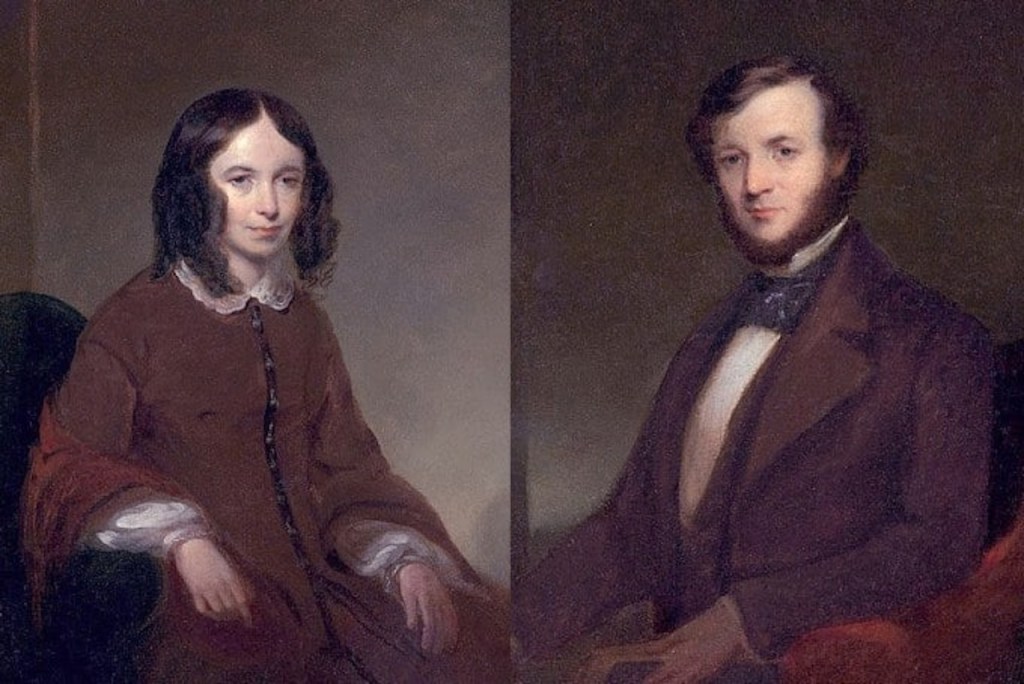
Elizabeth Barrett Browning’s Sonnet 18 “I never gave a lock of hair away”
In sonnet 18 “I never gave a lock of hair away” from Elizabeth Barrett Browning’s “Sonnets from the Portuguese,” the speaker dramatizes the simple act of giving a lock of her hair to her belovèd.
Introduction with Text of Sonnet 18 “I never gave a lock of hair away”
Sonnet 18 “I never gave a lock of hair away” from Elizabeth Barrett Browning’s Sonnets from the Portuguese reveals the speaker musing on her feelings as she affords her belovèd the gift of a lock of her hair, of which she emphasizes its purity in that no other man has touched it.
The tentative and lonely speaker continues to create little dramas in her developing relationship with her friend and belovèd, who happens to be a fellow poet. No doubt her lover appreciates her musing and feels a great sense of pride in having her composing for his benefit.
And the poet/speaker herself continues to develop from the shy individual whose countenance had thus far bespoken only melancholy, derived from much physical and mental suffering.
Sonnet 18 “I never gave a lock of hair away”
I never gave a lock of hair away
To a man, Dearest, except this to thee,
Which now upon my fingers thoughtfully,
I ring out to the full brown length and say
‘Take it.’ My day of youth went yesterday;
My hair no longer bounds to my foot’s glee,
Nor plant I it from rose or myrtle-tree,
As girls do, any more: it only may
Now shade on two pale cheeks the mark of tears,
Taught drooping from the head that hangs aside
Through sorrow’s trick. I thought the funeral-shears
Would take this first, but Love is justified,—
Take it thou,—finding pure, from all those years,
The kiss my mother left here when she died.
Commentary on Sonnet 18 “I never gave a lock of hair away”v
In sonnet 18 “I never gave a lock of hair away,” the speaker is dramatizing a little ritual of the simple act of giving a lock of her hair to her lover. Such gift giving was a common occurrence in that era, but to this speaker, it becomes a momentous event owing to her years of solitary confinement and physical as well a mental suffering.
First Quatrain: A Virgin Lock
I never gave a lock of hair away
To a man, Dearest, except this to thee,
Which now upon my fingers thoughtfully,
I ring out to the full brown length and say
The speaker begins by claiming that she has never given any other man a lock of her hair; it is, therefore, to her a particularly special act that she is now conferring on her lover this special lock.
She has excised a few strands that extend are the exact full length of her hair which she designates as brown in color, even though she later affirms that she is no longer a young woman.
The strands rest upon her “fingers” as she philosophically dramatizes the event by saying a few words over them. The object takes on a status of a sacred relic as she seems almost prayerful in handling them.
This speaker is almost always full of drama, from agonizing over her miseries to proclaiming her now vast and growing love and affection for her belovèd. Her life is the stuff and substance of her poetry, and she lives it in each and every moment.
This speaker’s intensity remains the very stuff of living life “deliberately” as promulgated by Barrett Browning’s contemporary, the American philosopher Henry David Thoreau, who affirmed, “I went to the woods because I wished to live deliberately.” This speaker, in nurturing a love relationship with a fellow poet, is living deliberately as she composes verses exploring and celebrating that relationship.
Second Quatrain: Justifying the Gift
‘Take it.’ My day of youth went yesterday;
My hair no longer bounds to my foot’s glee,
Nor plant I it from rose or myrtle-tree,
As girls do, any more: it only may
The speaker hands the hair to her lover and commands him, “Take it.” She then reveals the fact that she is no longer a young woman. She emphasizes that her youth has already passed her by. She no longer runs and jumps and skips thus causing her hair to jostle about as she did when she was a child.
The speaker no longer performs little rituals with it such as offering strands of her hair to birds to build their nests. She needs to justify giving away this lock of hair, just as her personality motivates her to justify everything she does and feels. Such justification remains part of her notion of living life through deliberate acts.
First Tercet: Covering Her Poor Cheeks
Now shade on two pale cheeks the mark of tears,
Taught drooping from the head that hangs aside
Through sorrow’s trick. I thought the funeral-shears
In the first tercet of the sestet, the speaker then divulges the use to which she has long put her locks of hair, and it is not surprising that that use would be bound closely to her sorrow with which has lived her entire life.
The speaker does not disappoint as she reveals that the only use for those locks of brown hair has been to cover her poor cheeks which are so often streaked with tears. She has shed tears so often and so profusely that she hardly recognizes herself without those streak running down her face.
Those locks of hair have simply hung down over those tear-stained cheeks, and they have learned to hide the sorrow that urges those tears. She has become habituated to tilting her head a certain way to encourage the hair to act as a curtain to shield her sadness.
This speaker’s framing of the rituals with simple strands of falling hair reveals the clever artist whose dramatic verse offers such colorful images that unfold the nature of her cloistered life. Such drama emphasizes the importance of her new relationship with the important belovèd, who can now help her release the past agony with which she has had to contend.
Second Tercet: Her Chaste Hair
Would take this first, but Love is justified,—
Take it thou,—finding pure, from all those years,
The kiss my mother left here when she died.
The speaker’s final dramatic pose reveals that she thought some mortician would be the one to cut her hair. This image again emphasizes the morbidity of the thoughts with which the speaker has had to grapple for so many empty years.
But now her lover has came along and “justified” her cutting it herself and presenting it to him. Her relief from the past morbid imagery becomes palpable. She is finally free to accept that happiness may actually become a central feature in the existence.
The speaker then emphasizes again that the hair is as pure as the day her mother left “the kiss” on it before she died. She is repeating and emphasizing her claim that no other man has had access to her chaste hair. The purity of this lock of hair becomes symbolic of the purity of the love relationship between the speaker and her belovèd.
 Linda's Literary Home
Good faith questions and comments welcome!