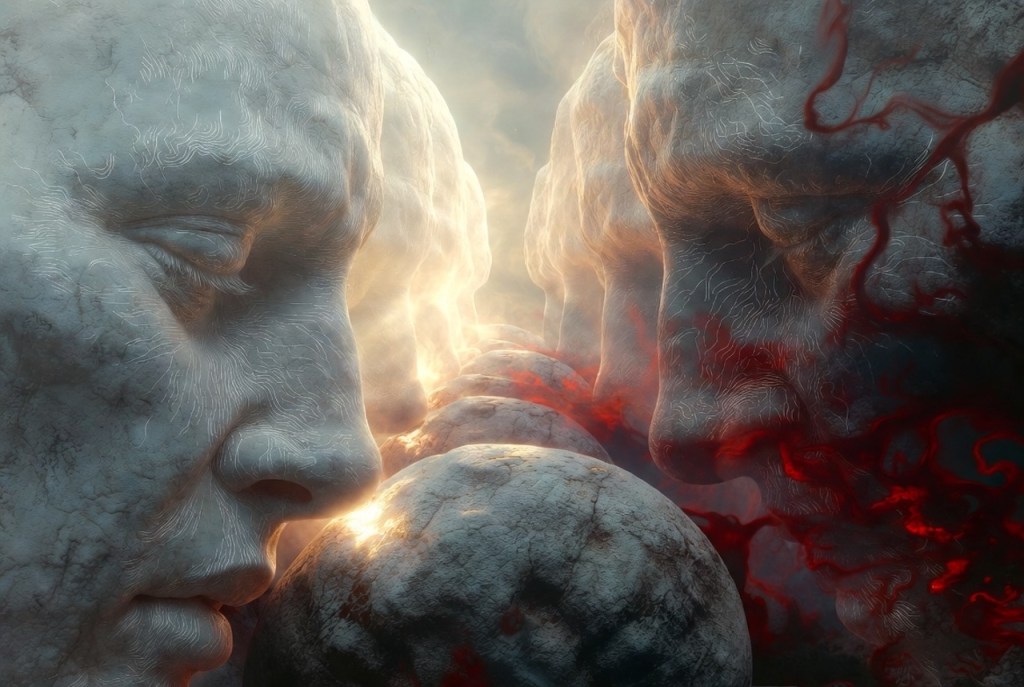
Faded Stones
The wise never turn away from fading.
They know the hands of time draw
White lines across the faces of pewter.
Silence brings light to the glory-bound.
The fever of desire sputters in the brain
Quarreling with the calm of true love.
Blood astonishes itself meandering
Through the veins of hope and stasis.
The skin that covers red speed never
Reveals its constant play of wheels
In motion toward an unstayed destiny.
Light tunnels through the endless mind.
The beams that drape our lips
Scald the soul that remains untouched
Though the weary heart breaks over rocks
Of creedless beasts and simpletons.
That stones regard the world a hard place
Takes the brut force to conquer ennui
In the glad morning of tempted faith
Where the head holds the heart in check.
A Prose Commentary on My Original Poem “Faded Stones”
In my poem “Faded Stones,” I have created a speaker who attempts to weave a tight musing on impermanence, inner conflict, and hard-won wisdom, employing the controlling metaphor of ancient, weathered stones—pewter-gray, etched by time to explore how the human spirit endures decay, desire, heartbreak, and existential boredom.
My speaker keeps the language dense, almost alchemical, blending the physical (stones, blood, skin, rocks) with the metaphysical (light, silence, mind, soul). Rather than offering easy consolation, the speaker insists on a stoic, clear acceptance of life’s hardness, where wisdom lies not in resistance but in quiet endurance and rational restraint.
My own philosophy inherent in the theme broached in this poem is influenced strongly by the teachings of Paramahansa Yogananda, who explains and emphasizes the operation of the pairs of opposite within the delusive force known as Maya or in the Judeo-Christian tradition Satan.
First Stanza: Impermanence and the Wisdom of Fading
In the opening lines, the speaker establishes the poem’s core philosophy, suggesting that “Fading” is not tragic but remains a natural process, one which the wise are able to embrace.
The speaker then again turns figurative, personifying time as an artist, who is etching “white lines” (wrinkles, cracks) on “pewter”—the dull, metallic gray that evokes aged stone or aged human skin turned ashen.
These stones become anthropomorphic faces, scarred yet dignified. This scenario is not a Romantic lament but a quiet affirmation: true wisdom accepts entropy, while ”Silence brings light to the glory-bound” completes the thought. Glory is never loud with triumph; it arrives through earned stillness.
The “glory-bound” are those who, like stones, endure without complaint. Silence becomes a pathway and a condition for illumination, contrasting the noisy fever of society at large. Thus acceptance of decay transforms itself into the gateway to inner light.
Second Stanza: The Struggle between Desire and Love
In the second stanza, the speaker shifts the focus inward to the body’s hidden wars. Desire is expressed as a metaphoric “fever”—restless, sputtering, irrational—while true love is “calm”—steady, ultimately monastic, even as the brain continues to rage as a virtual battlefield.
The speaker personifies the life force of blood as becoming astonished by its own path; it flows through opposing channels of “hope” (forward momentum) and “stasis” (lack of progress). Its central tension and vitality are both driven and trapped.
Here, the speaker expresses metaphorically my own personal deepest belief that the eternal human duel between passionate urgency and serene acceptance exist and battle together on the material level of being, where neither can ever be totally victorious.
Thus the imagery strikes out visceral even though it remains abstract—blood does not simply circulate; it “astonishes itself,” suggesting self-awareness but also shock at life’s contradictions.
Third Stanza: Hidden Motion beneath Still Surfaces
In this stanza, the speaker deepens and sharpens the stone metaphor: the body (skin) compares to the stone’s surface—opaque, concealing the “red speed” (blood’s rush, life’s urgency) and the “play of wheels” (mechanistic fate, karma, or the grinding gears of time). Even if on occasion outwardly still, inwardly the human being is a machine, hurtling toward an “unstayed destiny” (no brakes, no fixed end).
Yet, as yogic philosophy teaches, the light tunneling through the mind is the entity that offers transcendence. The mind is vast and cavernous (like stone tunnels), but on rare occasions, if one is successful in yogic practice, it will be pierced by sudden insight.
Thus the speaker is affirming that while the body is racing often quite blindly, the holiness of consciousness can affirm piercing clarity. There can always be an illusion of stillness, while everything is actually in motion at the molecular and atomic levels, but wisdom can perceive the light within the tunnel of motion.
Fourth Stanza: Scalding Light, Broken Hearts, and the Hard World
The speaker then keeps “Beams that drape our lips” somewhat ambiguous: the image could mean smiles (beams of light on the mouth) or rays of external light that force expression.
These smiles/lights “scald the soul”—they burn because they are superficial. The soul remains “untouched” (pure, uncompromised), while the heart—more vulnerable—shatters against the “rocks” of a cruel, unthinking world.
“Creedless beasts and simpletons” are the unfortunate people without depth of faith, driven primarily by brute instinct—for whom all compassionate individuals must pray.
The speaker has kept the imagery brutal yet precise. The heart does not break gently; it is smashed over jagged stones. This outcome remains the cost of authenticity in a shallow world, where outer composure hides inner scalding and breakage.
Fifth Stanza: Stones, Brute Force, and the Triumph of the Head
In the fifth stanza, the speaker returns to the title. Stones “regard the world a hard place; they know that reality is unyielding, yet they endure without caving in to illusion. Overcoming “ennui” (boredom but more tragically spiritual apathy) requires “brut force”—raw, almost animal willpower. (Please note the French spelling “brut,” akin to the English “brute” but in French means simply raw or unrefined).
This force operates “in the glad morning of tempted faith”—a fragile dawn where belief is tested, because remains uncertain. The resolution is cerebral: “the head holds the heart in check.” Reason must restrain emotion; intellect masters the weary heart. Such a stoic mastery through intellect and raw will does not deny pain but instead signals disciplined endurance.
 Linda's Literary Home
Good faith questions and comments welcome!