
My Summer Mind
Winter kept me bound
To the thought of warmer days.
My tongue remained frozen,
Figuring talk was later.
Heat was all I sought,
Waiting in rooms chilled with snow.
We did not burn each other
Or have the guts to move in a daze.
If we listened to the song,
We felt that nature would change us.
Love and knowledge may contradict
Each other in the wait of uneven things
But cold gives way to warm
As winter gives way to spring
And bodies of fire hang in the brain
Where turning feels right.
Still, it is my summer mind I seek
To keep in my heart its
Fuel to keep the arms and legs
Moving and the soul on fire.
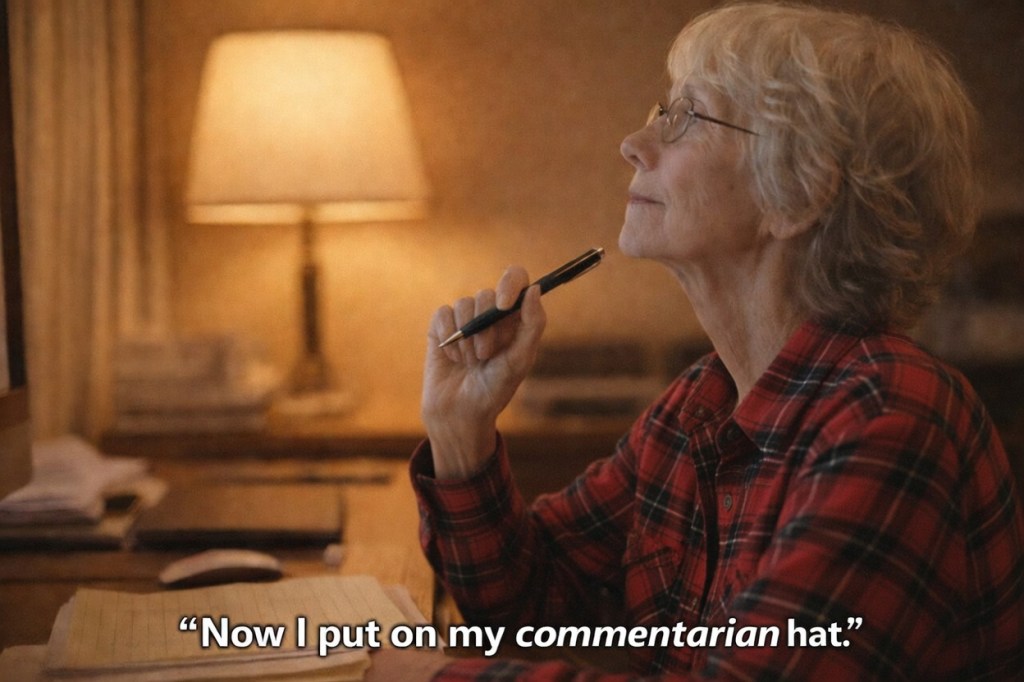
A Prose Commentary on My Original Poem “My Summer Mind”
In my poem “My Summer Mind,” I have created a speaker who is musing upon the tension between dormancy and vitality, hesitation and movement, using the seasonal opposition of winter and summer as a governing metaphor for interior states of being. The poem is less concerned with external climate than with the mind’s fluctuating capacity for warmth, courage, and animation.
Where “Some Bones” dwelt in fragmentation and arrested spiritual development, this poem turns toward the possibility—though not the certainty—of renewal. Yet the tone remains guarded. My speaker does not claim arrival but instead reveals a consciousness caught in transition, aware of warmth as an aspiration rather than a constant possession.
The imagery moves between cold and heat, stillness and motion, silence and expression. My speaker situates herself in a liminal condition: waiting, anticipating, and attempting to summon a more vital state of mind. The poem’s underlying concern is not merely seasonal change but the discipline required to sustain inner fire once it has been glimpsed.
First Stanza: Winter as Suspension
In the opening stanza, my speaker situates herself in winter, a season that “kept [her] bound / To the thought of warmer days.” The emphasis here is not simply on cold but on deferral. The speaker is oriented toward the future, toward warmth that has not yet arrived.
The frozen tongue is especially significant. Speech is postponed, withheld under the assumption that expression belongs to a more favorable time—“Figuring talk was later.” This suggests a psychological habit of delay, a reluctance to engage fully with the present moment.
The stanza’s middle lines intensify the sense of enclosure. The rooms are interior, insulated, yet still pervaded by cold. My speaker implies that external shelter does not guarantee internal warmth.
The line “We did not burn each other / Or have the guts to move in a daze” introduces relational hesitation. Passion is avoided; risk is deferred. Even confusion—“a daze”—is rejected, suggesting that the speaker prefers stasis over the vulnerability of imperfect action.
The stanza closes with a tentative openness: “If we listened to the song, / We felt that nature would change us.” Here, my speaker gestures toward a passive hope that transformation might occur through attunement rather than effort. The “song” of nature becomes a kind of external agency, one that might effect change without requiring decisive internal movement.
Second Stanza: The Friction of Love and Knowledge
The second stanza complicates the earlier passivity by introducing an intellectual and emotional tension. My speaker acknowledges that human experience is rarely harmonious; feeling and understanding often pull in opposing directions.
The phrase “the wait of uneven things” reinforces the earlier motif of delay while adding a sense of imbalance. Time passes, but it does not resolve contradiction. Instead, it sustains it.
Yet my speaker reintroduces the natural cycle as a form of reassurance: “cold gives way to warm / As winter gives way to spring.” This transformation is not a dramatic revelation but a steady, almost inevitable progression. The movement from winter to spring serves as both metaphor and quiet argument: change is embedded in the structure of existence.
The line “And bodies of fire hang in the brain / Where turning feels right” marks a subtle but important shift inward. The warmth the speaker seeks is no longer purely external; it exists as potential within the mind itself. These “bodies of fire” suggest ideas, impulses, or passions suspended in a state of readiness.
The phrase “Where turning feels right” implies that transformation involves choice or orientation. The speaker begins to recognize that movement toward warmth is not entirely dependent on external seasons but on an internal willingness to turn.
Third Movement: Aspiration toward the Summer Mind
The closing lines crystallize the poem’s central desire: “Still, it is my summer mind I seek.” The phrasing is deliberate—my speaker does not claim to possess this state but actively seeks it.
The “summer mind” functions as a metaphor for sustained vitality: warmth, clarity, motion, and perhaps courage. It is not merely a seasonal mood but a disciplined condition the speaker wishes to “keep in [her] heart.”
The emphasis on “fuel” extends the metaphor into the realm of energy and maintenance. Warmth must be sustained; it requires ongoing attention. My speaker understands that vitality is not self-perpetuating but must be actively preserved.
The final lines—“to keep the arms and legs / Moving and the soul on fire”—bring the poem into the realm of embodied action. Unlike the earlier stasis of winter, the summer mind enables motion. Physical movement becomes a sign of inner animation, while the “soul on fire” suggests the divine union of energy and purpose.
An Afterthought
In “My Summer Mind,” I have attempted to articulate a transition from passivity to intentional vitality, though that transition remains incomplete. The poem does not celebrate arrival but instead dwells in the act of seeking—a condition that is, in itself, both necessary and unstable.
My speaker’s awareness of seasonal change serves as both comfort and challenge. While nature guarantees transformation, the maintenance of an inner “summer” requires more than passive observation. It demands orientation, effort, and a willingness to risk movement even before warmth is fully secured.
In contrast to the disintegration explored in “Some Bones,” this poem suggests the possibility of coherence, though it stops short of confirming it. The speaker recognizes that without cultivating this “summer mind,”she risks remaining in cycles of delay and hesitation.
Ultimately, the poem proposes that vitality is not merely given but chosen—and that the sustaining of inner fire is an ongoing, deliberate act.
 Linda's Literary Home
Good faith questions and comments welcome!