Their splendor outdoes the dull shine of your flesh. That pink tint fixes itself, not like the blush that rippled down your jowl and around your fat neck, guardian of your worm- plagued Adam’s apple. That belly swore a greedy appetite— this won’t do. Give me your backbone straight-arrow, your ribcage circling birdless, your hipbones never swaggering a promise of a good pump they won’t keep. The click of my bony knuckles on your dry skull barks a sweeter tone than the chimes of your voice box. The beauty of your bones clacks a bare truth— your ripe flesh proved all I cracked it up to be.
After committing suicide, “Harold Arnett” confirms the futility of the act.
Introduction and Text of “Harold Arnett”
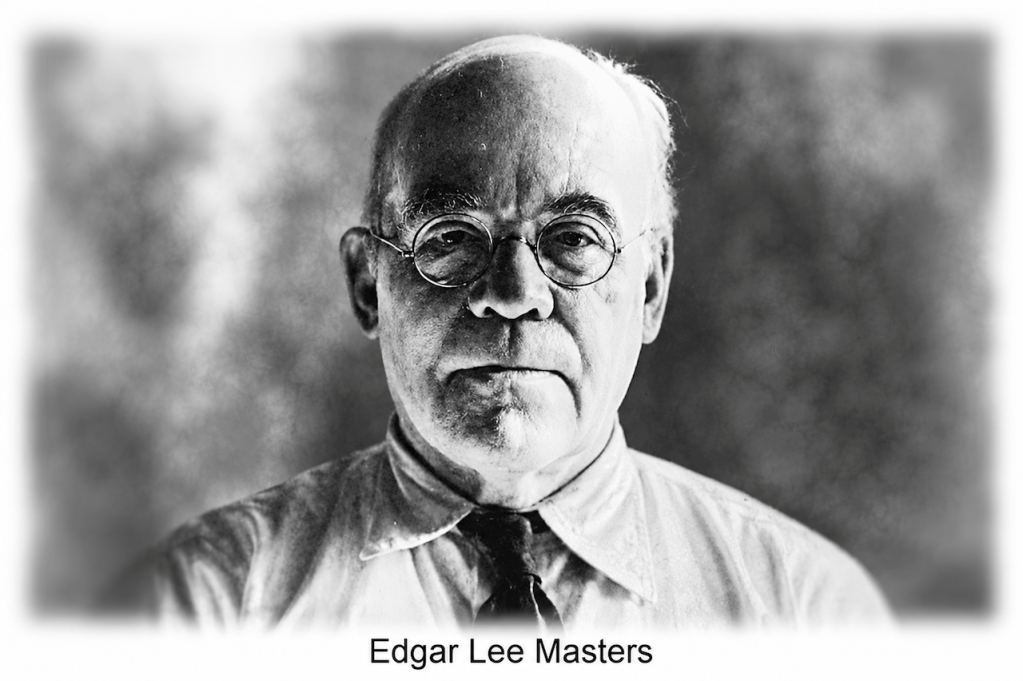
Edgar Lee Masters’ “Harold Arnett” from the poet’s American classic Spoon River Anthology portrays a character who learns that the duty of facing trials and tribulations does not end with merely leaving the physical world.
Harold Arnett
I leaned against the mantel, sick, sick, Thinking of my failure, looking into the abysm, Weak from the noon-day heat. A church bell sounded mournfully far away, I heard the cry of a baby, And the coughing of John Yarnell, Bed-ridden, feverish, feverish, dying, Then the violent voice of my wife: “Watch out, the potatoes are burning!” I smelled them … then there was irresistible disgust. I pulled the trigger … blackness … light… Unspeakable regret … fumbling for the world again. Too late! Thus I came here, With lungs for breathing … one cannot breathe here with lungs, Though one must breathe…. Of what use is it To rid one’s self of the world, When no soul may ever escape the eternal destiny of life?
Commentary on “Harold Arnett”
After committing suicide, Harold Arnett confirms the futility of the act.
First Movement: Mind on Failure
I leaned against the mantel, sick, sick, Thinking of my failure, looking into the abysm, Weak from the noon-day heat.
The speaker begins his dismal report by describing how he is feeling very sick as he “lean[s] against the mantel.” His mind was on something at which he has failed, but about which he never reveals any information. He continues, saying he was peering into some deep chasm, and the hot mid-day heat was making him feel weak.
Second Movement: Church Bell and Crying Baby
A church bell sounded mournfully far away, I heard the cry of a baby, And the coughing of John Yarnell, Bed-ridden, feverish, feverish, dying, Then the violent voice of my wife:
Arnett then reports that he hears the distant chiming of “a church bell,” and he also hears a baby crying. At first, the reader will take these to be actual sounds that Arnett is hearing as he indulges his melancholy at the fireplace.
But then Arnett adds that he hears John Yarnell coughing. Unless John Yarnell is a sick guest in Arnett’s home, it is likely that Arnett is hearing all of these sounds only in his memory’s ear and not literally. Arnett never clears up any of these vague strands of thought because they are not the focus of his soliloquy.
Third Movement: A Violent Voice
Then the violent voice of my wife: “Watch out, the potatoes are burning!” I smelled them … then there was irresistible disgust.
Arnett snaps the reader into the scene as he claims he hears “the violent voice of [his]wife.” That “violent voice,” the reader later realizes will be the last thing Arnett hears, and perhaps its implication for the personality of the wife adds to the motivation of Arnett’s own violent act.
That violent voice screeched out to Arnett, trying to alert him that the potatoes were on fire. Arnett then becomes aware of the burning stench and is filled with an “irresistible disgust.”
Fourth Movement: There Is no Unringing the Bell
I pulled the trigger … blackness … light… Unspeakable regret … fumbling for the world again.
With the sound of a “violent voice” and the disgusting smell of burning potatoes in his consciousness, Arnett “pulled the trigger,” killing himself. Immediately, he sees “blackness . . . light” and feels “unspeakable regret.”
Arnett then finds that he is “fumbling for the world again.” After Arnett had pulled the trigger, his next reflex was to attempt to unpull it. He immediately feels regretful of his impulsive act and tries, in vain, to get back to his life.
Fifth Movement: Moving Toward Destiny
Too late! Thus I came here, With lungs for breathing … one cannot breathe here with lungs, Though one must breathe….
However, Arnett’s “fumbling,” of course, fails. He reports, “Too late!” Therefore he says he “came here.” Instead of being taken to his grave, Arnett claims he “came” to it, sounding as if he simply leisurely gave up and walked into death instead of having been forced into it.
Arnett then focuses on the very physical, human act of “breathing.” As he entered death, he entered with “lungs for breathing,” but the very dreadful truth is that in the grave, or simply in the state beyond life, “one cannot breathe with lungs.”
Arnett’s emphasis on lungs and breathing demonstrates the strong connection between breathing and remaining in the physical body. Although Arnett’s physical body still possessed lungs, they became useless to him in the after-life state, and he is frustrated by that conundrum; he says, “one must breathe.”
Sixth Movement: The Futility of Suicide
… Of what use is it To rid one’s self of the world, When no soul may ever escape the eternal destiny of life?
Arnett’s conclusion demonstrates the futility of suicide. Framed as a question, Arnett’s final reaction emphasizes that souls cannot escape from their well-earned karma by simply ridding themselves of their physical bodies. Arnett asks, “what use is it,” to leave the world behind, when the soul still continues to be affected by its own “destiny of life,” another name for which is karma.
I envy morning that breaks over his strong chest. I envy noon that calls him to lunch. I envy evening that sees his eyes grow tired from screening, and night—I envy her arms, her bed linen enfolding his warm limbs while he sleeps. I envy his car: rear view mirror catching his glances, gear-shift knob responding to his warm hand, clutch knowing the pressure of his foot, ignition accepting his key. I envy the route his car takes to work and the other drivers who might catch a glimpse of him as he goes. and I envy the music he listens to, and I envy the clothes that rub against his toned body, and I envy all of his co-workers who see his bright face lighting up from cheery banter. I envy his coffee cup, his fork, and spoon, and the table under which his legs rest while he dines— most of all: I envy the waitress with whom he flirts, glimpsing her breasts, wondering how they would feel in his hands and on his naked chest, and how she would sound moving under him.
Image: Emily Dickinson – Amherst College – Daguerrotype of the poet at age 17, circa 1847 – likely the only authentic, extant likeness of the poet
Emily Dickinson’s “Delayed till she had ceased to know”
Emily Dickinson’s “Delayed till she had ceased to know” explores the tragic irony of fulfillment arriving only after the recipient has surrendered consciousness, while its spiritual implications echo Paramahansa Yogananda’s emphasis on inner realization, perseverance, and the danger of abandoning the search for divine fulfillment too soon.
Introduction and Text of “Delayed till she had ceased to know”
In my earlier essays on Dickinsonian poems, I have discussed the speaker’s tendency to privilege inward experience over outward appearances. In “Delayed till she had ceased to know,” the speaker turns that concern toward the painful consequences of mistimed fulfillment.
The poem presents a woman who dies only an hour before the arrival of some long-awaited joy or victory. The terrible irony is not merely that fulfillment comes too late, but that it comes so close to her death that the knowledge of its approach might have enabled her to continue living.
This idea has a meaningful parallel in the teachings of Paramahansa Yogananda, who repeatedly emphasizes that genuine fulfillment must ultimately be discovered within rather than dependent upon changing external circumstances.
From that perspective, the poem’s tragedy can be understood not simply as the loss of an earthly reward, but as the surrender of hope immediately before the possibility of fulfillment becomes apparent.
The speaker does not explicitly identify the anticipated “bliss” as divine realization, and the poem wisely leaves its nature uncertain. Nevertheless, Yogananda’s spiritual emphasis on perseverance and inner awareness provides a useful lens through which to consider the speaker’s haunting question: What if the defeated soul had known how near the victory really was?
Delayed till she had ceased to know
Delayed till she had ceased to know – Delayed till in its vest of snow Her loving bosom lay – An hour behind the fleeting breath – Later by just an hour than Death – Oh lagging Yesterday!
Could she have guessed that it would be – Could but a crier of the joy Have climbed the distant hill – Had not the bliss so slow a pace Who knows but this surrendered face Were undefeated still?
Oh if there may departing be Any forgot by Victory In her imperial round – Show them this meek appareled thing That could not stop to be a king – Doubtful if it be crowned!
Commentary on “Delayed till she had ceased to know”
Emily Dickinson’s “Delayed till she had ceased to know” examines the poignant consequences of a victory or blessing that arrives only after the person who longed for it has passed beyond the ability to receive it.
First Movement: “Delayed till she had ceased to know”
Delayed till she had ceased to know – Delayed till in its vest of snow Her loving bosom lay – An hour behind the fleeting breath – Later by just an hour than Death – Oh lagging Yesterday!
The speaker begins with the stark repetition of the word “Delayed.” The repetition immediately establishes the central grievance: something desirable was coming, but it came too late.
The woman has “ceased to know” before the anticipated joy arrives, suggesting that the tragedy involves not simply physical death but the loss of consciousness necessary to experience fulfillment.
The speaker then places the woman’s “loving bosom” within a “vest of snow.” The image of snow suggests both physical burial and emotional stillness. The warmth associated with the “loving bosom” has been overcome by the cold finality of death.
The contrast between love and snow emphasizes the gulf between the woman’s former vitality and her present condition. The precise measurement of time makes the tragedy especially painful: “An hour behind the fleeting breath – / Later by just an hour than Death –.”
The speaker could have described the reward as arriving long after the woman’s death, but instead the poem specifies “an hour.” The narrow interval intensifies the sense of missed possibility. The desired fulfillment was not impossibly distant; it was almost within reach. Death simply arrived first.
The closing apostrophe—“Oh lagging Yesterday!”—personifies the past as something capable of moving too slowly. Yesterday itself seems responsible for the delay. Time, rather than simply passing, has become an adversary that has failed the woman at the precise moment when she needed it to move differently.
From Yogananda’s perspective, the passage can also suggest the spiritual danger of allowing external circumstances to determine one’s inner state. Yogananda repeatedly taught that lasting peace and fulfillment are not ultimately dependent upon the changing conditions of the material world.
The woman, however, appears to have reached a point at which the external arrival of bliss matters desperately because she has no evidence that it is coming. The tragedy therefore lies partly in the absence of inward assurance.
If the soul could remain convinced of an approaching fulfillment even when outward circumstances offered no confirmation, surrender might be postponed. The first movement thus establishes the poem’s fundamental irony: fulfillment was not necessarily impossible; it was simply not known to be coming before death intervened.
Second Movement: “Could she have guessed that it would be”
Could she have guessed that it would be – Could but a crier of the joy Have climbed the distant hill – Had not the bliss so slow a pace Who knows but this surrendered face Were undefeated still?
The second movement shifts from certainty about death to speculation about what might have happened differently. The speaker asks whether the woman could have survived if she had somehow known that joy was approaching.
The image of a “crier of the joy” is especially significant. A crier is a herald, someone who announces important news before the event itself occurs. The speaker imagines such a messenger appearing on a distant hill, carrying evidence that fulfillment is approaching. The joy itself might still be far away, but knowledge of its arrival could have provided the hope necessary to endure.
The distance of the hill is important as well. The messenger is not yet at the woman’s side. The desired event remains separated from her by space and time. Nevertheless, even an announcement of its approach might have changed her decision to surrender.
This possibility resonates particularly strongly with Yogananda’s emphasis on perseverance in spiritual life. His teachings repeatedly encourage the seeker not to abandon the inward quest merely because the desired realization has not yet appeared.
Spiritual progress may remain invisible for a considerable period before its results become apparent. In that sense, the speaker’s “distant hill” can be read metaphorically as the place from which the first evidence of approaching fulfillment might appear.
Yet the speaker is more uncertain than a straightforward spiritual teaching would be. The poem does not say that the woman would certainly have survived. Instead, the speaker asks: “Who knows but this surrendered face / Were undefeated still?”
The phrase “Who knows” preserves the poem’s mystery. The speaker can imagine another outcome but cannot prove it. The woman’s surrender may have been premature, but the poem cannot determine whether knowledge of the approaching bliss would actually have saved her.
The word “surrendered” nevertheless connects physical death with spiritual defeat. The woman’s face has yielded because hope apparently arrived too late. Yogananda’s teachings provide an illuminating counterpoint here: the spiritual seeker must continue looking inward even when external circumstances seem to announce defeat. Inner awareness can sustain perseverance precisely when visible evidence is absent or contrary.
The tragedy, then, is not simply that the woman died. It is that the poem leaves readers wondering whether she died one hour before she needed to, because the knowledge of impending joy might have given her the strength to continue.
Third Movement: “Oh if there may departing be”
Oh if there may departing be Any forgot by Victory In her imperial round – Show them this meek appareled thing That could not stop to be a king – Doubtful if it be crowned!
In the final movement, the speaker broadens the poem from the fate of one woman to the larger question of those whom Victory overlooks. Victory is personified as a powerful imperial figure moving through the world in a triumphant procession: “Any forgot by Victory / In her imperial round –.”
The language of “imperial” introduces images of conquest, authority, and worldly power. Victory seems almost like a monarch distributing crowns to those who have succeeded.
Yet the speaker asks that, if Victory ever forgets anyone along her grand procession, she should be shown this particular woman. The contrast between imperial grandeur and personal humility becomes especially striking in: “Show them this meek appareled thing”
The woman is not dressed in the outward symbols of power. She is “meek,” apparently possessing none of the conventional magnificence associated with victory. Yet the speaker asks that Victory recognize her nonetheless. The next line deepens the irony “That could not stop to be a king –.”
The woman did not live long enough to claim the triumph that may have been approaching. The word “king” continues the poem’s imagery of crowns, imperial power, and worldly recognition.
Yet the speaker’s phrasing also makes conventional victory seem strangely inadequate. The woman who could not become a “king” may possess a worth that does not depend upon earthly status.
Here again, Yogananda’s distinction between external achievement and inward realization offers a useful parallel. The world’s definition of victory depends upon visible accomplishment, recognition, and the attainment of desired circumstances. Spiritual realization, by contrast, is inward. A person may appear externally defeated while possessing an inner consciousness that is untouched by worldly failure.
The woman occupies precisely this ambiguous position. Outwardly, she has lost. She has died before receiving the anticipated joy. She has not become a “king,” and she does not receive an obvious crown. Yet the speaker refuses to reduce her to defeat. That refusal becomes most powerful in the final line: “Doubtful if it be crowned!”
The speaker does not resolve the question by declaring that the woman ultimately receives a spiritual crown. Instead, the speaker leaves her status uncertain. The uncertainty is essential. The woman may have missed worldly victory, but perhaps worldly victory was never the highest measure of her worth.
Yogananda’s spiritual philosophy can therefore deepen, rather than settle, the poem’s ambiguity. If true fulfillment is inward, then the external delay of victory need not determine the ultimate condition of the soul.
Yet the speaker refuses to reveal whether such an inward victory was actually achieved. The final “Doubtful” keeps the poem suspended between tragedy and transcendence.
Ultimately, “Delayed till she had ceased to know” is a poem about the cruel importance of timing, but it is also a poem about the relationship between outward circumstances and inward endurance.
The speaker presents fulfillment as something that may exist only a moment beyond the reach of the person who desires it. The poem’s deepest tragedy is that the woman might have endured had she known how near the promised joy had become.
Read alongside Paramahansa Yogananda’s teachings, the poem acquires an additional spiritual dimension. Yogananda’s emphasis on inner realization suggests that the seeker should not measure ultimate fulfillment solely by external events or abandon the inward search because visible victory has been delayed.
The speaker, however, remains deliberately less certain. The poem does not assure us that the woman possessed such inward certainty, nor does it identify the delayed bliss as explicitly divine. Instead, the speaker leaves her audience with the haunting possibility that the woman surrendered at the very threshold of fulfillment.
By placing the “meek appareled thing” before the personified figure of Victory, the speaker finally questions whether conventional victory can adequately measure human worth. The woman may never have received her earthly crown, but perhaps the absence of that crown does not constitute the final truth about her.
In the space between surrender and victory, between death and delayed bliss, the speaker leaves readers to contemplate a question that Yogananda’s spiritual teachings likewise encourage us to consider: How can we know how close we may be to fulfillment when outward circumstances give us no evidence that it is near?
The speaker in the epitaph “Jacob Goodpasture” is lamenting the outbreak of the American Civil War (1861-8165). He considers the war unjustified, and he has lost his son, who served as a soldier in the war.
Introduction and Text of “Jacob Goodpasture”
In Edgar Lee Masters’ “Jacob Goodpasture” from Masters’ American classic Spoon River Anthology, the speaker disparages his own long life as he parallels it with the condition of his country.
As Jacob Goodpasture laments the outbreak of the American Civil War 1861-8165 [1], he makes it clear that he believes the war to be unjustified. He suggests that freedom itself is belong lost in an unnecessary war, and he is no doubt speaking from the position of a father in mourning; he lost his soldier son to the war effort.
Jacob Goodpasture
When Fort Sumter fell and the war came I cried out in bitterness of soul: “O glorious republic now no more!” When they buried my soldier son To the call of trumpets and the sound of drums My heart broke beneath the weight Of eighty years, and I cried: “Oh, son who died in a cause unjust! In the strife of Freedom slain!” And I crept here under the grass. And now from the battlements of time, behold: Thrice thirty million souls being bound together In the love of larger truth, Rapt in the expectation of the birth Of a new Beauty, Sprung from Brotherhood and Wisdom. I with eyes of spirit see the Transfiguration Before you see it. But ye infinite brood of golden eagles nesting ever higher, Wheeling ever higher, the sun-light wooing Of lofty places of Thought, Forgive the blindness of the departed owl.
Commentary on “Jacob Goodpasture”
Jacob Goodpasture is one of the epitaph speakers who is suffering the pangs of life. He laments having lived during wartime and losing a son to the war effort. But he also offers a prediction about the republic, as well as an apology for his generation’s failure.
First Movement: A Father’s Grief
When Fort Sumter fell and the war came I cried out in bitterness of soul: “O glorious republic now no more!”
As a grieving father, Goodpasture commences his lamentation, exclaiming in deep agony that as the war began with the firing on Fort Sumter, his pain and anguish caused him to believe that the end of the republic had been foisted upon the citizens.
Goodpasture begins his epitaph looking back from a position sometime in the future. But he appears to conflate his own death with that future time; thus his time-line remains somewhat muddled.
Second Movement: An “Unjust” War
When they buried my soldier son To the call of trumpets and the sound of drums My heart broke beneath the weight Of eighty years, and I cried: “Oh, son who died in a cause unjust! In the strife of Freedom slain!”
Goodpasture is suffering after the death of his son, who has become a casualty of the war. Goodpasture deems the war “unjust.” His suffering became intense as he listened to the trumpets and heard the sound of the drums beating for his son’s military funeral.
The eighty-year-old Goodpasture senses the heavy burden of his long life; he is unable to find any comfort in having his son give his life for the protection of his freedom. Goodpasture is decrying the death of his son, but he is also insisting that even freedom itself was “slain” in the unjust war.
That Goodpasture seems to suggest he was eighty years old when his son dies adds a puzzling quirk to the narrative. Eighty years old seems a bit old have a son die in war; perhaps a grandson or even a great-grandson would be more likely. Soldiers going off the fight in the Civil War were, of course, all ages, but the majority of them were likely in the twenties.
On the other hand, Goodpasture could be implying that it was much later that his “heart broke” at the sound of the military funeral, although the juxtaposition of his claims places his age and his death at the same time and contingent upon the death of his son.
Third Movement: Foreseeing a New Golden Age
And I crept here under the grass. And now from the battlements of time, behold: Thrice thirty million souls being bound together In the love of larger truth, Rapt in the expectation of the birth Of a new Beauty, Sprung from Brotherhood and Wisdom. I with eyes of spirit see the Transfiguration Before you see it. But ye infinite brood of golden eagles nesting ever higher, Wheeling ever higher, the sun-light wooing Of lofty places of Thought, Forgive the blindness of the departed owl.
Goodpasture dramatizes his emotion, signifying this own death by remarking dramatically, “I crept here under the grass.” Goodpasture then asserts an outrageous claim that he perceives truths that others fail to see. He makes a prediction about his country, the United States, after its population has tripled in size: “thrice thirty million.”
The U.S. population, indeed, was about 32 million [2] at the outset of the Civil War years. Goodpasture offers his prediction that the 90 million American souls will unite in “the love of larger truth.” He suggests that “a new Beauty” will come to fruition in “Brotherhood and Wisdom.”
The U.S.A. reached that 90,000,000 mark in 1909, less than a decade before it became embroiled in War War I, as Jim Crow Laws and Black Codes [3] were still blighting the American South.
Also, it was close to six decades before enactment of the Civil Rights Act of 1964 [4] that finally demanded American blacks be able to enjoy their full citizenship as originally granted by the 13th, 14th, and 15th Amendments. Thus Goodpasture’s prediction was less than stellar.
Despite the fact that Goodpasture labels the war “unjust” and not needed, he somehow remains optimistic that later generations will benefit from the true goal of this supposed unjust conflict.
Of course, the very purpose of the war was do just what Goodpasture thinks will happen in future. As the speaker is reporting from a state of mourning, he is likely attempting to assuage his own pain, so his predictions miss the mark by several decades.
Goodpasture asserts that he can know the future of his country before the living residents perceive it. He metaphorically compares the coming generation to “golden eagles,” asking them to forgive his war-mongering generation, which resembles a blind owl that has now left the picture.
Uncertain Time-Frame
The timing of Goodpasture’s prediction raises problematic issues. The reader may gather that he died around age eighty. But it remains unclear if he was, in fact, age eighty at the outbreak of the war.
If Goodpasture has lived around twenty years after the war, he likely could have seen certain results of the war effort. Yet in order to brag up his prediction, he has to be asserting that he possessed the foresight to predict those war results.
Goodpasture’s patriotism seems to be aligned with the death of his son; yet he is lamenting the son’s death as well as his opinion that the war has caused also the death of freedom.
Goodpasture seems to be trying to have it both ways—the war caused the death of freedom, yet in future he seems to perceive the rise of freedom; in his prediction, however, he was off by about six decades and one million in population: a semblance of that golden age he seems to predict came as the population reach 191 million rather than the 90 million he claims to foresee.
Listening to the Oldies Station on a Saturday Afternoon
In my early teens, I thought rock & roll was God’s own message of love, no sacrifice of guitar fingers piano feet, or drum ears. Radio stations were far off from where I grew up, but I listened until the watts they turned off faded the music, and it was time for bed anyway.
And now they call me baby boomer and because there are so many of us, some radio stations devote all their airwaves to our own class of rock & roll, which is now classic, you see, and they sell us all the things we need to keep us young,
but I don’t need those things. I have a new sound that moves me through the music that blinds the young and confounds the old. Let’s just say, “well, that was good—let’s listen again like we did last summer.”
Image: Emily Dickinson – Amherst College – Daguerrotype of the poet at age 17, circa 1847 – likely the only authentic, extant likeness of the poet
Emily Dickinson’s “To venerate the simple days”
Emily Dickinson’s “To venerate the simple days” demonstrates the speaker’s contemplative musing on time, honoring ordinary moments, and framing human physical death as merely a minor threshold.
Introduction and Text of “To venerate the simple days”
Emily Dickinson’s “To venerate the simple days” offers a concise reflection on the fleeting nature of earthly existence. In my earlier essays on Dickinsonian poems, I have discussed the speaker’s habit of privileging inner evidence over public display. The speaker calls for a quiet reverence toward ordinary time.
The poem consists of a single six-line stanza utilizing short lines, delicate cadence, and slant rime. Through this brief structure, the speaker reminds humanity that mortal life passes swiftly; yet, physical death remains a minor event when viewed through the enduring, timeless perspective of spiritual reality and soul consciousness.
To venerate the simple days
To venerate the simple days Which lead the seasons by, Needs but to remember That from you or I, They may take the trifle Termed mortality!
Commentary on “To venerate the simple days”
Emily Dickinson’s “To venerate the simple days” presents a profound observation on honoring daily life while maintaining a detached perspective toward physical departure.
First Movement: “To venerate the simple days”
To venerate the simple days Which lead the seasons by,
The speaker opens by encouraging readers to honor the unassuming, ordinary moments of daily existence. These moments quietly guide the passing seasons forward. Rather than seeking grand public displays or dramatic events, the speaker suggests that profound spiritual value resides within unassuming routine.
In my earlier essays on Dickinsonian poems, I have discussed the speaker’s habit of finding sacred truth within common natural occurrences. These daily routines shape human experience as seasons march steadily onward.
Every passing moment carries quiet dignity. Honoring each humble day allows the mind to achieve inner calm and spiritual perspective. Daily life provides the setting for spiritual growth.
Paramahansa Yogananda explains in his teachings that living with conscious awareness transforms ordinary daily activities into avenues for divine perception. By recognizing the sanctity inherent in simple routines, one cultivates a deep reverence for life. The speaker urges an appreciation for time itself.
Second Movement: “Needs but to remember”
Needs but to remember That from you or I, They may take the trifle Termed mortality!
The speaker provides the motivation for this daily reverence, noting that remembering life’s brevity restores proper perspective. Time eventually eclipses physical existence.
Yet, the speaker boldly labels human physical death as merely a “trifle,” reducing its perceived terror to an insignificant detail.
In my earlier essays on Dickinsonian poems, I have discussed the speaker’s habit of viewing physical mortality as an illusory boundary rather than an ultimate end. The departure from the physical body does not touch the essential nature of the enduring soul. Eternity transcends temporal limits.
Paramahansa Yogananda explains that physical death is merely a transition, as the indestructible soul remains entirely untouched by the body’s dissolution. By viewing mortality as a mere trifle, the speaker inspires freedom from fear. Understanding this truth allows one to cherish each simple day fully.
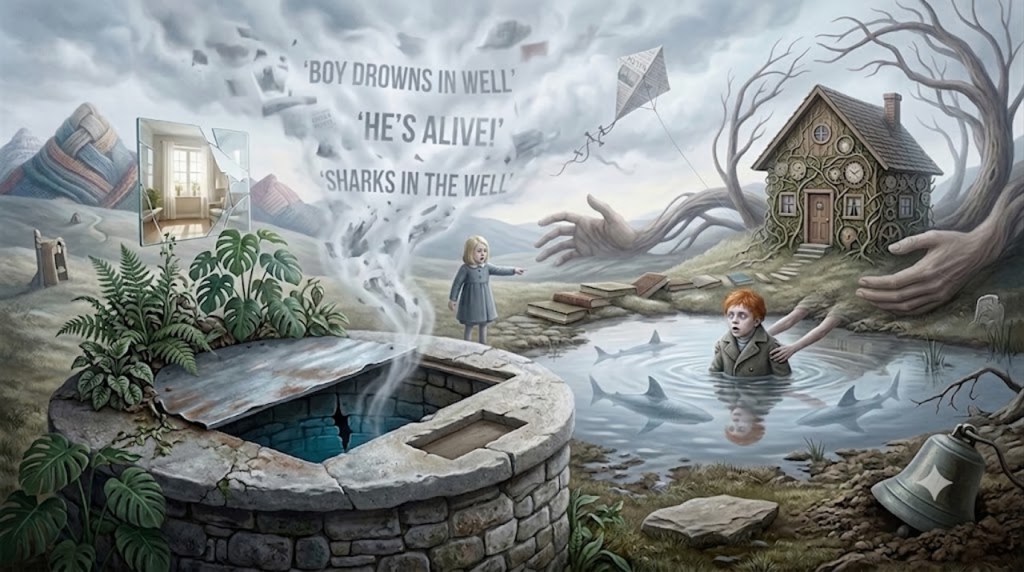
an American-Innovative villanelle inspired by my little story “No Sharks” from my memoirMy Life in Little Stories
The flat rock had gone missing from the sheet metal covering the well. I saw it but then turned it from my mind— Then a headline flashed my thoughts, “Boy drowns in well.”
On a cold March day to Granny’s we visited for a spell. Rodney and Kelly ran to play in the cold March wind. The flat rock had gone missing from the sheet metal covering the well.
Granny’s houseplants held us talking, so much to tell. I heard a thump, guessed a ball had hit the house behind? Then a headline flashed my thoughts, “Boy drowns in well.”
I ran outside, not knowing what I’d find. Kelly stood a few feet from the well looking stunned. The flat rock had gone missing from the sheet metal covering the well.
“Where’s Rodney?” She pointed; I ran and nearly fell. I lifted the metal, saw pale eyes; the worst stabbed my mind: Again, the headline flashed my thoughts, “Boy drowns in well.”
Granny screamed, “He’s alive!” She held my legs. I pulled from him from the well. No water in his lungs! no injury him befell!— His only fear was that sharks might dwell In the big pond he thought was connected to the well.
In Edgar Lee Masters’ “Nicholas Bindle,” the speaker vents his outrage at the town’s citizenry for continuing to harass him for charitable offerings while his financial situation was not strong.
Introduction and Text of “Nicholas Bindle”
In Edgar Lee Masters’ “Nicholas Bindle” from Masters’ American classic Spoon River Anthology, the speaker is expressing his outrage at the town’s citizenry for continuing to harass him for charitable offerings while his financial situation was not strong.
Nicholas also demonstrates his disgust that Deacon Rhodes was acquitted of bank fraud. This poem’s speaker begins with a question for his fellow citizens who, he feels, should be ashamed for their role in urging him to donate.
Nicholas’ opening question reveals his own beliefs about the situation and therefore is rhetorical in nature. Of course, he wants them to feel shame as he is berating them. The speaker concludes his tirade also with a question that again reveals his own disgust at how unfairly he thinks he was treated.
Nicholas Bindle condenses his tirade into a mere eleven lines that bellow his deep displeasure from the grave. Nicholas Bindle is one of the extremely unhappy deceased who use their epitaph to castigate their fellow citizens with sharp, critical words.
Bindle expresses deep contempt for the citizens of Spoon River. He is one of the many unhappy dead who have unkind words for the citizens of Spoon River.
Nicholas Bindle
Were you not ashamed, fellow citizens, When my estate was probated and everyone knew How small a fortune I left?— You who hounded me in life, To give, give, give to the churches, to the poor, To the village!—me who had already given much. And think you not I did not know That the pipe-organ, which I gave to the church, Played its christening songs when Deacon Rhodes, Who broke the bank and all but ruined me, Worshipped for the first time after his acquittal?
The speaker in “Nicholas Bindle” declares himself an innocent man destroyed by the guilt of others—a common theme with these reporters from the graveyard.
First Movement: Chiding for Charity
Were you not ashamed, fellow citizens, When my estate was probated and everyone knew How small a fortune I left?—
The speaker Nicholas Bindle chides his “fellow citizens” for begging him to give to charity. He needles them as he asked if they were “not ashamed” when they became aware that his estate was so meager.
After Nicholas’ death, his estate was “probated” in the courts, and the size of his holdings would have been exposed. Of course, he is implying that his generosity in giving to charities has depleted his funds. Nicholas knows that those citizens understand “how small a fortune [he] left” behind, and he wants to vent his anger and frustration over the issue.
Second Movement: Begging for More
You who hounded me in life, To give, give, give to the churches, to the poor, To the village!—me who had already given much.
Nicholas continues his rant, accusing the citizens of “hound[ing]” him to “give, give, give.” They constantly implored him to donate to church and the support the poverty stricken, as well as to the town in general.
Indignantly, the speaker claims that he had indeed given quite a bit of fortune, yet they continued to badger him to contribute even more. Nicholas wants to make sure his fellow citizens understand the deep frustration their pleading for charitable offerings has engendered in him.
Third Movement: Guilt That Goes Unpunished
And think you not I did not know That the pipe-organ, which I gave to the church, Played its christening songs when Deacon Rhodes, Who broke the bank and all but ruined me, Worshipped for the first time after his acquittal?
Finally, Nicholas does reveal that he actually did provide some bounty: he gave the church a pipe-organ. But instead of taking any comfort in his giving, he is outraged because “Deacon Rhodes” had been in attendance when the pipe-organ first “played its christening songs.”
In an earlier poem/epitaph, the reader learned about Deacon Rhodes, who won his acquittal through some legal chicanery. The unfairness of this situation rankles the frustrated Nicholas as he derides those who caused it to happen.
Although Nicholas does not allude to those specific circumstances, because he probably does not know the details, he is obsessed because Rhodes’ guilt went unpunished. Nicholas along with other citizens would have experienced financial hardship and even ruin because of old Thomas Rhodes breaking the bank.
Nicholas expresses his outrage as he compares his own situation to those whom he believes bear guilt, while he is an innocent man hounded by the busy-body citizens of Spoon River.