Linda's Literary Home

Author: Linda Sue Grimes

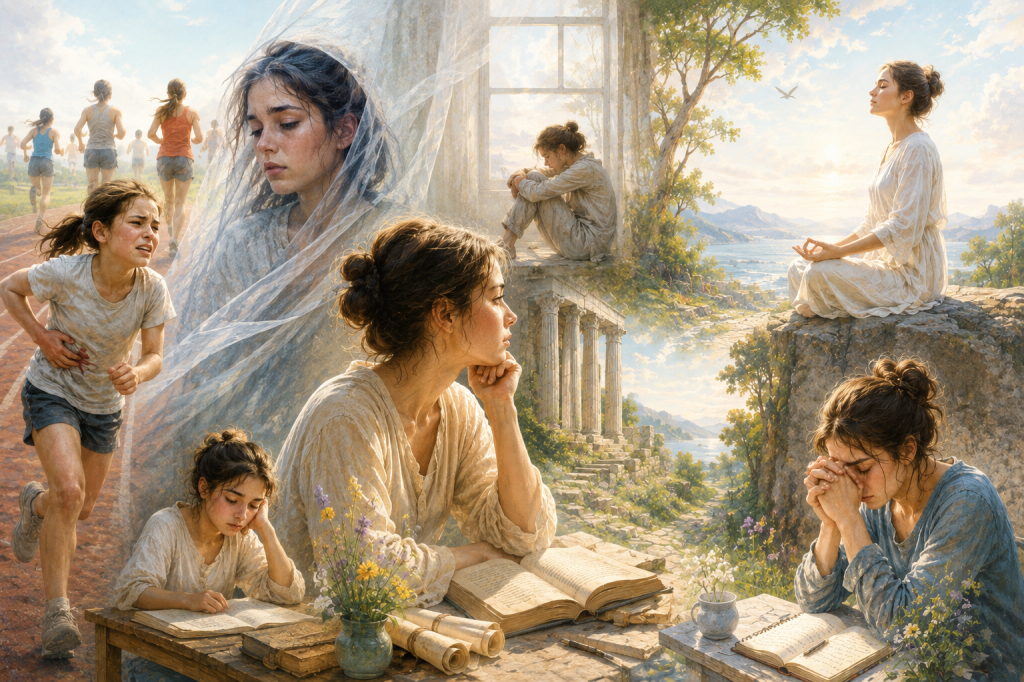
  • The Naughty Child 

    Image created by ChatGPT inspired by "Naughty Child"
    Image: Created by ChatGPT inspired by “Naughty Child”

    The Naughty Child 

    —after “Divine Mother’s Song to the Devotee”

    Divine Mother:  O my child, what do you want now?

    Naughty Child:  O dear Mother Divine, I want nothing but Thy love and care!

    Divine Mother:   But dear child of mine, I cannot give those to you; I would lose myself in your little ways.

    Naughty Child:  O Mother Divine, what may I ask from Thee, then?

    Divine Mother:   Ask me to save you from your little cares.  Ask me for salvation, but don’t ask me for my love and devotion.  I would become poor without them.

    Naughty Child:  O Mother Divine!  I already have your salvation!  Do not play Thy games of tit for tat, this for that.  Thou canst not save me lest Thou lovest me.

    Divine Mother:   Funny little child of mine.  You are beginning to understand.  Let’s sit and watch the Eternal Sun in the East, and you will know and feel all you wish, all your little heart’s desires will be fulfilled.

    Naughty Child:  O Mother Divine!  I bow at Thy feet again and again.  Set Thy blue lotus feet upon my brow as Thou wilt.  Aum!  Peace!  Amen!

  • Emily Dickinson’s “Morns like these – we parted”

    Image: Emily Dickinson – Amherst College – Daguerrotype of the poet at age 17, circa 1847 – likely the only authentic, extant likeness of the poet

    Emily Dickinson’s “Morns like these – we parted”

    Emily Dickinson loved nature, and birds appear often in her poems, her spiritual garden. She also was quite fond of mystery and riddles. This poem offers an accumulation of evidence that she has observed a bird and then poof! one human act and the bird takes wing!

    Introduction and Text of “Morns like these – we parted”

    Emily Dickinson’s speaker in her riddle-poem, “Morns like these – we parted,” is creating a drama from the act of bird-watching, as the act covers a single day from the time of morning when one bird and she parted company to the act of evening drawing the curtains, simultaneously hearing the bird fly off to its own abode or to wherever it may be taking for its destination.

    The mental gymnastics of the speaker reveals a special gift of qualifying the experience of the human mind, intrigued by the bird’s ability to fly in the freedom of the open skies, indicating that this drama has often played out in the speaker’s mind. 

    Morns like these – we parted

    Morns like these – we parted –
    Noons like these – she rose –
    Fluttering first – then firmer
    To her fair repose.

    Never did she lisp it –
    It was not for me–
    She – was mute from transport –
    I – from agony –

    Till – the evening nearing
    One the curtains drew –
    Quick! A sharper rustling!
    And this linnet flew!


    Commentary on “Morns like these – we parted”

    Emily Dickinson’s “Morns like these – we parted” offers an accumulation of evidence that the speaker has observed a bird and then poof! one human act and the bird takes wing!

    First Stanza:  Observing a Bird

    Morns like these – we parted –
    Noons like these – she rose –
    Fluttering first – then firmer
    To her fair repose.

    Observing the behavior of feathered friends, the speaker reports that on certain mornings she has watched as a bird makes its way heavenward, leaving her earthbound but astounded by the ability of an earth creature to fly through the sky. 

    In addition to morning flights, she has experienced the magic also around noontime.  The creature with wings first may seem to merely “flutter[ ],” but then suddenly with more determined gait glided to its chosen destination.

    Second Stanza:  Experiencing Awe

    Never did she lisp it –
    It was not for me–
    She – was mute from transport –
    I – from agony –

    As the bird begins its magical journey, it does not communicate vocally in song or chirp to the speaker’s presence.  Having nothing to impart to its observer, it merely begins its flight.  The speaker assumes that the bird’s silence is caused merely by her “transport” of the felicity of light.  

    The speaker remains “mute” merely from “agony”—the sudden awareness that one will remain earthbound while this marvelous creature will ascend and vanish skyward.  The earth-bound creatures can only watch, think, muse, and then attempt to recreate the feathered, flying creatures actions in a written composition. 

    Third Stanza:  The Close of a Drama

    Till – the evening nearing
    One the curtains drew –
    Quick! A sharper rustling!
    And this linnet flew!

    All of this drama of observation and bird flight goes on from morning to evening, nigh to which someone in the home closes the curtains at the window.  From without comes the “rustling” sound, which is quick and sharp, as the bird—now identified as a “linnet” flies off to parts unknown to the speaker/observer, but likely known well to the bird.  

    The speaker’s attention has been suddenly snipped by this final sudden movement of the flying creature which she has so patiently watched in wonder.  The speaker’s mind has flown with the bird, waited as the bird waited, now drops its object as the bird has rustled its feathers for the last time that day and flown off to God only knows whither.

  • Sipping Dew-Drops of Celestial Wine

    Image accompanying the poem “Sipping Dew-Drops of Celestial Wine”
    Image: Creataed by ChatGPT inspired by the poem

    Sipping Dew-Drops of Celestial Wine

    —after “I Am the Sky”

    My soul goes on spreading across this land.
    Across the sea, my boundless soul goes on
    Expanding beyond this earth,
    Beyond the moon and sun—
    Frolicking from planet to planet
    Nipping off rays from heavenly bodies,
    Sipping dew-drops of celestial wine
    From the myriad goblet-stars.

    Across the sky, my soul melts and stretches,
    Frozen no more in this little body,
    Frozen no more in this caged mind,
    Frozen no more, this soul expands
    Throughout Infinity, throughout Eternity
    In Bliss! Bliss! Ever more Bliss!

    A slightly different version of this poem appears in my collection Singing in Soul Silence: Voices of FaithThe original last line was “In joy, joy, ever more joy!”

  • Emily Dickinson’s “She slept beneath a tree” and “It’s all I have to bring today”

    Image: Emily Dickinson – Amherst College – Daguerrotype of the poet at age 17, circa 1847 – likely the only authentic, extant likeness of the poet

    Emily Dickinson’s “She slept beneath a tree” and “It’s all I have to bring today”

    These two Dickinson poems seem to grow out of a singular event on a certain day, likely in early spring, when nature is waking up bringing its flowered and bird-song beauty to the eyes and ears.  No one is better prepared to report on that beauty than Emily Dickinson.

    Introduction and Text of  “She slept beneath a tree” and “It’s all I have to bring today”

    The first installment of this mini-series, “She slept beneath a tree,” offers up one of those famous Dickinson riddles.  She only describes her subject but never names it, leaving that up to her readers to guess.  

    The second installment, “It’s all I have to bring today,” sounds almost as if she is offering a continuation of the first offering.  One can imagine that the “it” in the first line refers to the subject of the “She slept beneath a tree.”   It offers an interesting contrast to read the second in tandem with the first as opposed to reading it as standing alone.  

    Thomas H. Johnson returned Emily Dickinson’s poems to a closer facsimile of their original.  Other editors of Dickinson had given her poems titles and regularized her idiosyncratic style, such as the liberal spray of dashes, capitalizations, and many other grammatical ellipses.

    In an earlier edition of the Dickinson poems, “She slept beneath a tree” was given the title “The Tulip.”  Dickinson would not have approved of this titling, because the poem is one of her obvious riddles, which leaves the subject of the poem up to the reader to suss out.  

    The reading of the poem in the video below uses the mistitled version of the poem; still the sense of the piece can be appreciated by the reading, even though the printed form of the poem varies from the Johnson version, which offers Emily’s original and intended style.

    She slept beneath a tree  

    She slept beneath a tree –
    Remembered but by me.
    I touched her Cradle mute –
    She recognized the foot –
    Put on her carmine suit
    And see!

    Reading of “She slept beneath a tree” 

    It’s all I have to bring today

    It’s all I have to bring today –
    This, and my heart beside –
    This, and my heart, and all the fields –
    And all the meadows wide –
    Be sure you count – should I forget
    Some one the sum could tell –
    This, and my heart, and all the Bees
    Which in the Clover dwell.

    Reading of “It’s all I have to bring today”  

    Commentary on  “She slept beneath a tree”

    This riddle poem “She slept beneath a tree” remains mysteriously vague, as the speaker plays with the reader’s sensibilities.  While the subject of the riddle might be interesting, more important is the effect that child of nature has on the speaker.

    First Movement:   A Riddle

    She slept beneath a tree –
    Remembered but by me.
    I touched her Cradle mute –

    The speaker reports that the subject of her riddle had been sleeping at the foot of tree.  No one had remembered or taken note of the subject except for the speaker, who visits the subject and “touched her Cradle.”  The cradle was mute or perhaps it was the speaker who remained mute.  By allowing the ambiguity, the speaker amplifies the impact of the riddle.

    Second Movement:  Remarkable Claim

    She recognized the foot –
    Put on her carmine suit
    And see!

    The speaker then makes a remarkable claim, reporting that her subject was aware of the speaker’s identity because of the sound of her football.  The speaker is now playing with her readers, telling them that she, in fact, is the one who was able to remember and spot the subject.

    Even more remarkable and cagey of the speaker is that after the subject of her discourse recognizes the speaker, the subject dresses herself out in a “carmine suit.”  The dark red coloring of the subject might offer a clue to her identity, but it might also obfuscate that identify.

    The speaker then excitedly cries, “And see!”  She is pointing to the subject, telling her companion, who may be real or imagined, to observe the fascinating, unusual color of the subject.  

    The speaker makes little known about the subject itself; her description seems to cover more than uncover, yet it reveals much about the speaker, who has demonstrated her joy, even glee, at the opportunity to discover and visit this nature’s child who sleeps beneath a tree and then turns red at the mere presence of the speaker’s aura.

    So who is this child of nature sleeping beneath and tree?  The speaker does not name the subject of this riddle poem, because she wants her audience to participate in wonder and amazement as they try to suss out exactly who that entity is.

    Reading of “It’s all I have to bring today”  

    Commentary on “It’s all I have to bring today”

    The poem begins in humble recognition of a humble offering but then expands to include all the speaker’s circumference.

    First Movement:  A Blooming Statement

    It’s all I have to bring today –
    This, and my heart beside –
    This, and my heart, and all the fields –
    And all the meadows wide –

    The speaker begins small with a statement that sounds quite limiting.  She apparently is porting something and says that’s all she has brought today.  But she seems immediately to contradict that limiting statement by opening up to a whole wide world of other things she is bringing.

    In addition to the object she has brought, she is also bringing “her heart,” “all the fields,” as well as “all the meadows.”  Her statement seems to fan out like one of those Japanese folding fans that folds up and then spreads out for use in moving the air about one’s face.

    Second Movement:  Reckoning God

    Be sure you count – should I forget
    Some one the sum could tell –
    This, and my heart, and all the Bees
    Which in the Clover dwell.

    To her audience, the speaker then commands that they also include God, that is, “some one the sum could tell.”  Only God is able to reckon all the creation that the speaker has chosen to allude to in her expanding report.

    The speaker then reiterates that she is bringing “this” along with her heart and then expands further by including “all the Bees” that live in the clover.  She has gone from bringing only a seeming token to bringing all that her eyes can detect or all that he mind can discern.  

    This humble speaker is simply offering all that she is, all that she sees, and all that she knows to the Blessèd Creator, Who has fashioned all of this magnificent nature that she adores with her heart, mind, and soul.

    Taken Together: An Alternative View

    Looking at each installment of this mini-series individually returns a commingling of two slightly differing views as described in the commentaries above.  But a slightly different view may be taken by using a small adjustment.

    If one interprets the “it” in the second part of the series as referring to the subject of the first installment, then the speaker seems to have plucked the tulip and is now offering it at her altar for her meditation and prayer.

    Actually, everything else remains the same; her humble offering to God has caused her mind to expand from simple awareness of the tulip to acknowledgment of all God’s creation–including her heart, the fields, the meadows, and, of course, all the bees in the clover.

    Thomas H. Johnson's The Complete Poems of Emily Dickinson - The text of Dickinson poems that i use for my commentaries on her poems
    Image: Thomas H. Johnson’s The Complete Poems of Emily Dickinson

  • From Dream to Dream

    Image: Created by ChatGPT inspired by “From Dream to Dream”

    From Dream to Dream

    —after “From This Sleep, Lord”

    Blessèd Lord,
    Wake me from this worldly delusion.
    From dream to dream I move
    In the sea of a million things.

    Blessèd Lord,
    Wake me from this world of pain.
    Allow me to enter the golden kingdom
    Of light where all things are real.

    From dream to dream,
    From sleeping blindness
    Clear my thoughts,
    Clear my eyes.

    Lead me into Thy sacred sea
    Where I rise dripping
    Awake in Thy golden dream
    Awake in Thy pure loving Love.

    A slightly different version of this poem appears in my collection Singing in Soul Silence: Voices of Faith.

  • Emily Dickinson’s “There is a morn by men unseen”

    Image: Emily Dickinson – Amherst College – Daguerrotype of the poet at age 17, circa 1847 – likely the only authentic, extant likeness of the poet

    Emily Dickinson’s “There is a morn by men unseen”

    The speaker in Emily Dickinson’s “There is a morn by men unseen” is looking at a scene behind the mystic curtain that divides the ordinary world from the extraordinary world, where spirits dwell and have their being.

    Introduction and  Excerpt from “There is a morn by men unseen”

    The speaker of Emily Dickinson’s “There is morn by men unseen” has likely been observing the beauty of a morning in May, when the greening of earth is becoming lush with new brightness.  

    This exceptional beauty motivates the speaker to intuit that even brighter mornings exist beyond the confines of this earth where the souls of departed loved ones are celebrating in their own way, just as she is celebrating the beauty of this earthly spring morning.

    There is a morn by men unseen

    There is a morn by men unseen –
    Whose maids upon remoter green
    Keep their Seraphic May –
    And all day long, with dance and game,
    And gambol I may never name –
    Employ their holiday.

    Here to light measure, move the feet
    Which walk no more the village street –
    Nor by the wood are found –
    Here are the birds that sought the sun
    When last year’s distaff idle hung
    And summer’s brows were bound.

    Ne’er saw I such a wondrous scene –
    Ne’er such a ring on such a green –
    Nor so serene array –
    As if the stars some summer night
    Should swing their cups of Chrysolite –
    And revel till the day –

    Like thee to dance – like thee to sing –
    People upon the mystic green –
    I ask, each new May Morn.
    I wait thy far, fantastic bells –
    Announcing me in other dells –
    Unto the different dawn!

    Commentary on “There is a morn by men unseen”

    The speaker of this Dickinson poem is observing and reporting on a scene that she intuits which exists behind the mystic curtain dividing the ordinary world from the extraordinary world, where souls dwell and have their being.

    First Stanza:  Not an Ordinary Scene

    There is a morn by men unseen –
    Whose maids upon remoter green
    Keep their Seraphic May –
    And all day long, with dance and game,
    And gambol I may never name –
    Employ their holiday.

    The speaker hints that she will be describing a locus out of this world because ordinary, day to day folks have not seen it.  In this fabulous place, the young women frolic upon a “green” that is far removed from that of the ordinary existence.  These beings observe  their “holiday” with “dance and game,” and their weather remains perfect, a “Seraphic May.” 

    The speaker avers that these beings also employ activities that she is not privy to “name.”  The reader will note that she does not say that she does not know what those activities are, but just that she cannot put a label on them.

    Second Stanza:  Beyond the Ordinary

    Here to light measure, move the feet
    Which walk no more the village street –
    Nor by the wood are found –
    Here are the birds that sought the sun
    When last year’s distaff idle hung
    And summer’s brows were bound.

    The speaker makes it quite clear that the scene and the people she is describing are no longer part of this world; thus she offers the strong suggestion they have departed this earth, that is, their souls have left their bodies through death.  

    The lines, “move the feet / Which walk no more the village street – / Nor by the wood are found,” report the fact that those about whom she speaks no longer inhabit this mud ball of planet earth.

    At the same time, the speaker is making it clear that she is not setting up a dichotomy between the city and country.  Those feet that no  longer “walk the village street” also no longer walk in the “wood.”  

    She then reports that the souls of birds who have departed the earth are also here.  While on earth they had “sought the sun” after summer had relinquished its short lease on time.

    Third Stanza:  Mysticism of the Stars

    Ne’er saw I such a wondrous scene –
    Ne’er such a ring on such a green –
    Nor so serene array –
    As if the stars some summer night
    Should swing their cups of Chrysolite –
    And revel till the day –

    The speaker then remarks about the uniqueness of this fantastic scene, for never before has she observed such a “wondrous scene” with mystic activities continuing on such a phosphorescent color of beings and movements.  The serenity of the scene also strikes the speaker with its stature of uniqueness.

    The speaker then attempts to compare the scene she has observed to what it might look like if upon any given “summer night” the stars were to be seen frolicking and “swing[ing] their cups of Chrysolite,” or offering up toasts as noisy, happy, party revelers are wont to do. 

    The employment of the heavenly bodies offers the strong hint that the speaker has engaged her considerable mystic vision in order to describe a scene that she has only intuited but not directly experienced.

    Fourth Stanza:  Awaiting Her Own Arrival

    Like thee to dance – like thee to sing –
    People upon the mystic green –
    I ask, each new May Morn.
    I wait thy far, fantastic bells –
    Announcing me in other dells –
    Unto the different dawn!

    The speaker then addresses the Divine Reality or God, declaring that these “People upon the mystic green” are singing and dancing as the Divine does.  She then becomes confident enough to remark that she too expects to dance and sing upon such a “mystic green.” 

    The speaker reveals that she prays “each new May Morn,” as she continues to wait with anticipation to hear the ringing of God’s “fantastic bells,” which seem “far,” as she remains upon the material level of earth.

    But the speaker expects to hear these bells calling her as they announce her arrival in those “other dells,” and at a different kind of dawn.  The speaker has likely been motivated to intuit the mystic scene by the natural beauty of a May morning, which has spirited her mind away to a holy place where the dearly departed now reside, play, and take their celebratory being.

  • Image of Brahma

    Image of Brahma

    —after “Deliver Us from Delusion”

    The Guru leads us
    From darkness to light.
    We grow gratitude for Him
    Deep in our heart’s core.

    The Guru ferries us
    Across the river of delusion.
    We thank Him in the silent
    Deep core of the brain.

    He delivers us from evil.
    His brilliance puts the white rose
    To shame in the sanctuary
    Of Divine Love.

    We bow to Thee,
    O great Guru,
    Image of Brahma,
    We bow to Thee.

  • Stephen Crane’s “The Wayfarer” and Other Versanelles

    Image: Stephen Crane Literary Theory and Criticism

    Stephen Crane’s “The Wayfarer” and Other Versanelles

    One of novelist Stephen Crane’s most admired versanelles, “The Wayfarer,” makes a profound statement about how rarely the path to “truth” is traveled. The three other versanelles offer interesting though less profound themes.

    Introduction: Three Versanelles by Stephen Crane

    Stephen Crane is most widely noted for his important American Civil War (1861-1865) novel, The Red Badge of Courage. He is credited with the founding of the Naturalist Movement in novel writing through this second novel.  About Crane’s literary talent, novelist Ralph Ellison has famously remarked,

    The important point is that between Twain and the emergence of the driving honesty and social responsibility of Faulkner, no artist of Crane’s caliber looked so steadily at the wholeness of American life and discovered such far-reaching symbolic equivalents for its unceasing state of civil war. Crane’s work remains fresh today because he was a great artist, but perhaps he became a great artist because under conditions of pressure and panic he stuck to his guns.

    Writing in several diverse fields, Crane began his writing career as a journalist, earning the highest salary ever afforded newspaper correspondents for his reporting from Cuba.

    In addition to his novel, Red Badge of Courage, he brought out two collections of poems, The Black Riders and Other Lines, published by Copeland & Day in 1895 and War Is Kind published by Frederick A. Stokes in 1899.  Cornell University Press published The Complete Poems of Stephen Crane in 1972.

    While Crane’s prowess as a novelist has earned him a permanent place in American literary history, his poems do not reach any exalted level. These little dramas are interesting and useful in their ideational configuration, but ultimately they do not bring forth any moment of rare observation.

    When a novelist (or even a playwright) tries his hand as poetry, the result is often lackluster, as also may be observed in the poetry of novelist D. H. Lawrence and playwright Tennessee Williams. A notable exception to this rule is the Shakespeare writer, who penned both classic plays as well as poetry.

    The Poetry Device “Versanelle”

    The versanelle, a term that I coined for use in my commentaries about poems, is usually quite short, twenty lines or fewer; it gathers to an enigmatic punch line that implies an observation about human behavior.  It often describes a scene as it tells its very short tale, sometimes quite mysterious and tantalizing, yet often something quite mundane.

    It may use ordinary poetic devices such as metaphor, image, personification, metonymy, and simile, or it may simply rely on other colorful language.

    Stephen Crane’s Three Important Versanelles

    The novelist’s little sequence of poems that appeared in Edmund Clarence Stedman’s An American Anthology demonstrates the useful form, versanelle, that poets from time to time engage.

    First Versanelle:  “The Wayfarer”

    The wayfarer
    Perceiving the pathway to truth,
    Was struck with astonishment.
    It was thickly grown with weeds.
    “Ha,” he said,
    “I see that none has passed here
    In a long time.”
    Later he saw that each weed
    Was a singular knife.
    “Well,” he mumbled at last,
    “Doubtless there are other roads.”

    Reading of “The Wayfarer” 

    Commentary on “The Wayfarer”

    In novelist Stephen Crane’s much anthologized “The Wayfarer,” the speaker imparts a little tale about a traveler who sets out to travel down the “pathway to truth.” The traveler is at once “struck with astonishment” that the pathway is overgrown with weeds.

    So the traveler remarks that obviously nobody has traveled down this path for quite some time. Then he notices that each weed is actually “a singular knife.” It is at this point that the traveler decides he will also abandon this pathway to truth and look for another road.

    The implication of this scenario is that like all the others who have tried and then abandoned the way to truth, this traveler will not get to truth either, because he would prefer to travel an easier path.

    While the implication remains fascinating and holds a certain amount of accuracy—the pathway to truth seems to be lightly trodden—the reason for this particular traveler to abandon this pathway seems quite prudent. If each weed were a “knife,” he likely could not have reached his goal without considerable damage or even death.

    Even though the way to truth may often be difficult, it surely does not offer such a means to damage and death. Only the ignorant would be likely to follow such a path. Obviously, Crane’s philosophical powers met with obstacles of distraction as he attempted to structure his thought into drama.

    Second Versanelle:  “There was a land where lived no violets”

    There was a land where lived no violets.
    A traveller at once demanded: “Why?”
    The people told him:
    “Once the violets of this place spoke thus:
    ‘Until some woman freely gives her lover
    To another woman
    We will fight in bloody scuffle.’”
    Sadly the people added:
    “There are no violets here.”

    Reading of “The Violets”:

    Commentary on “There was a land where lived no violets”

    In “There was a land where lived no violets,” the speaker relates a tale that accounts for there being no violets growing in a certain location.  A traveler asks the residents why there are no violets in the area.  

    They tell him that violets used to proliferate there, but then once upon a time the violets made the odd announcement, “Until some woman freely gives her lover / To another woman / We will fight in bloody scuffle.”

    The local residents therefore professed, “There are no violets here.”  The absence of violets demonstrated that the violets fought a bloody battle, and the battle continued until the last violet was dead, and thus no more existed to reproduce.  Clearly, not all of Crane’s versanelles can be judged a total success!

    Third Versanelle:  “‘Scaped” (“Once I knew a fine song”)

     Once I knew a fine song,
    —It is true, believe me,—
    It was all of birds,
    And I held them in a basket;
    When I opened the wicket,
    Heavens! they all flew away.
    I cried, “Come back, Little Thoughts!”
    But they only laughed.
    They flew on
    Until they were as sand
    Thrown between me and the sky. 

    Reading of “‘Scaped”

    Commentary on “‘Scaped” (“Once I knew a fine song”)

    In Stephen Crane’s versanelle titled, “‘Scaped,” (also titled “Once I knew a fine song”), the speaker reports that he used to know a “fine song.”  He interjects to demand that the listener believe him because “It is true.”  He continues, “It was all of birds.”  He kept them “in a basket,” and surprisingly, when he opened the basket door, all the birds “flew away.”

    The speaker demanded of them, “Come back, Little Thoughts!”  But of course, they just “laughed” at him and continued on their flight.  Then they suddenly transformed into “sand” that seemed to be, “Thrown between [himself] and the sky.”

    Instead of protecting the “fine song” that might have lived in perpetuity in his wonderful mind, he let the grace notes escape, and they devolved into meaninglessness.

    Image: Stephen Crane – Britannica
  • Emily Dickinson’s “We lose – because we win”

    Image: Emily Dickinson – Amherst College – Daguerrotype of the poet at age 17, circa 1847 – likely the only authentic, extant likeness of the poet

    Emily Dickinson’s “We lose – because we win”

    Emily Dickinson’s “We lose – because we win,” exemplifies a short, quirky observation,  which makes a statement about human behavior that has become compulsive.

    Introduction and Text of “We lose – because we win”

    Emily Dickinson’s “We lose – because we win” features characteristics of a versanelle, a short, usually 20 lines or fewer, dramatic narration that comments on human nature or behavior and may employ any of the usual poetic devices.  I coined this term to designate certain heretofore unclassifiable poems of Robert Frost, Stephen Crane, M. M. Sedam, and others.

    The versanelle remains a natural, philosophical outlet for the poet who entertains a philosophical bent, as most poets do. From Walt Whitman to T. S. Eliot, many American poets from time to time are motivated to fashion a short observations regarding humankind into a poetic drama.

    We lose – because we win

    We lose – because we win –
    Gamblers – recollecting which
    Toss their dice again!

    Commentary on “We lose – because we win”

    Each line of a versanelle exudes thoughts whose meanings in the hand of a less masterful craftsman might take many lines to express.

    First Line:   A Puzzling Paradox

    We lose – because we win –

    The speaker in Dickinson’s three-line versanelle has observed that humankind can become addicted to certain acts.  Thus she chooses the act of winning to state her perceived notion.  

    She states the introduction to her conclusion in a paradox.  At first, the statement seems non-sensical because it seems to contradict itself.  One is tempted to query, how can we lose if she has won?  Are the two not mutually exclusive.  At first blush, it seems that the speaker has placed the acts of losing and winning in the same time frame.  And if that were the case, the statement would have been ludicrous.

    For example, if you placed your bet and won $1,000, no one can dispute that you gambled and won.  In order to remain a winner, however, you must walk away with your winnings.

    Thus the paradox is elucidated by the remaining two lines, which broaden the time frame.  The speaker is not only referring to the short period of time after winning, but she is also encompassing the many years, perhaps, that may follow that unfortunate win that leads to loss.

    Second Line:  Gamblers Remember

    Gamblers – recollecting which

    Thus”Gamblers” do not take their money and walk away.  They become intoxicated by the win, and the memory of winning becomes implanted in their brains.  The pleasure of winning that money has urged the “gambler” to make further choices that will again bring that pleasure.

    Third Line:   Lose After Winning

    Toss their dice again!

    In the attempt to regain the pleasurable feeling of having won that thousand dollars, the “gambler” must gamble again.  And even if he wins, a second time, he will only strengthen the desire to keep winning.

    But as those hooked on the notion of winning continue to “toss their dice,” they will invariably begin to lose.  And it becomes abundantly clear that they will lose many more thousands than they have ever won.  Just ask members of Gamblers Anonymous!

    And not only will the continuation of gambling lead to financial ruin, the seriously addicted gambler may lose his job, family, and friends, along with his self-respect and possibly his life.

    A Broader Application

    While the Dickinson versanelle can be understood to refer to the literal “gambler,” there is no doubt that her speaker wishes to offer a far more wide-ranging application of this adage.  Thus the observation can include any human activity that leads to habitual repetition of an act that leads to negative instead of positive outcomes. 

    Such activities might include those that lead to addiction to alcohol, those that lead to unhealthy eating, those that lead to unwholesome engagement in sex, and also those that lead to psychological malfunction.   

    The human mind and heart are capable of turning a heaven into a hell merely with thoughts that ultimately lead to depravity.  Experiencing a delight in any unhealthy, unwholesome act must be rooted out before it can become habitual.  

    The mood junky can become like a gambler who continues to roll the dice, expecting to experience that happy win again, yet finds himself unable to climb out of his nasty mood because he has come to rely on it, perhaps using it as an excuse for failures that are simply the result of lack of effort.

  • Aum! Aum! Aum!

    Image: Created by ChatGPT inspired by the poem

    Aum! Aum! Aum!

    —after “Dawn Chant”

    Waking for meditation,
    I energize, stretch for Kriya,
    Sit, and begin.

    In the asana of mediation,
    With the opening dawn,
    I wake for the work of the day.

    O, children, O brain cells,
    O body, O mind—
    Keep all attention

    On the chant of chants,
    Aum, Aum, Aum,
    Aum, Aum, Aum,
    Aum, Aum, Aum . . .

    Image: OM symbol – created by ChatGPT from prompt by poet
    Image: Om Morning Meditation-Created by Grok inspired by the poem