—inspired by Paramahansa Yogananda’s “In the Land Beyond My Dreams”
The earth is not our home. Thou hast created us for better realms. We have tied our souls With strings of desires And draped a veil of Maya Over the only eye that truly sees.
The earth’s treasures Cannot satisfy our souls With their temporary pleasures. Thou dost play hide & seek with our senses Those clowns that entertain for a moment Then vanish into dust as if they had never been.
This earth and all its peoples Cannot add one inch of stature To each shining, perfect soul And though the brave and strong Are often cowed by the weak and wrong, Each Karma will correct each erring course In time, in love with Thee.
This earth’s frenetic playground Features folly and excitement That each soul eventually must exorcise From its ground of being. While we play, life ebbs day by day. Would that we learn to pray in the silence Deep and pregnant with Thy essence Until this phantom earth’s ills begin to fade away.
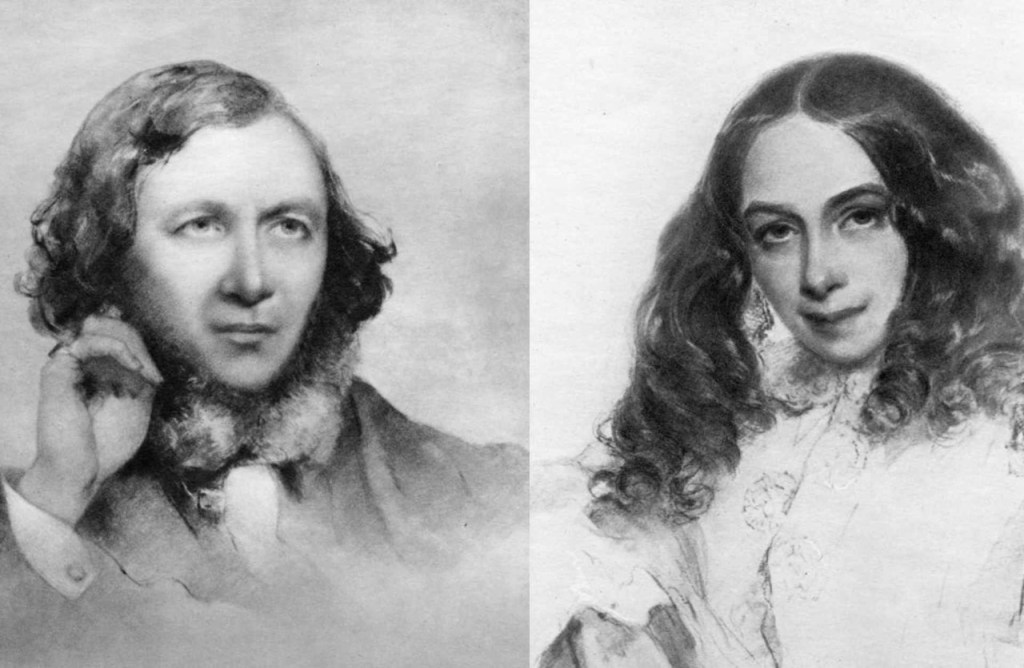
Elizabeth Barrett Browning’s Sonnet 32 “The first time that the sun rose on thine oath”
The speaker in Elizabeth Barrett Browning’s sonnet 32 finds her confidence first expanding and then shrinking again on her journey through her adventure to love.
Introduction and Text of Sonnet 32 “The first time that the sun rose on thine oath”
In Elizabeth Barrett Browning’s sonnet 32, the speaker once more struggles with her persistent lack of self-worth. However, the speaker finally decides that by choosing to devalue her own self-worth, at the same time, she is also assigning less value to her belovèd, an intolerable idea that she then attempts mightily to immediately correct.
Sonnet 32 “The first time that the sun rose on thine oath”
The first time that the sun rose on thine oath To love me, I looked forward to the moon To slacken all those bonds which seemed too soon And quickly tied to make a lasting troth. Quick-loving hearts, I thought, may quickly loathe; And, looking on myself, I seemed not one For such man’s love;—more like an out-of-tune Worn viol, a good singer would be wroth To spoil his song with, and which, snatched in haste, Is laid down at the first ill-sounding note. I did not wrong myself so, but I placed A wrong on thee. For perfect strains may float ’Neath master-hands, from instruments defaced,— And great souls, at one stroke, may do and doat.
Commentary on Sonnet 32 “The first time that the sun rose on thine oath”
The speaker in sonnet 32 finds her confidence first increasing and then shrinking again on her journey to her adventures in love.
First Quatrain: To Soon to Endure
The first time that the sun rose on thine oath To love me, I looked forward to the moon To slacken all those bonds which seemed too soon And quickly tied to make a lasting troth.
The first quatrain finds the speaker announcing that after her belovèd first pronounced his love for her, she became lodged in the sorrowful thought that this love might have come “too soon / And quickly tied” to endure for long.
The ensuing vow of love which was completed with the rising sun caused her to “look forward” to night time and the moon. She assumed that time of day would abstract her weakened possession of her new love situation.
This speaker is, of course, again doubting her ability to bring out such a love from this high-stationed man. The powerful feelings of negative self-worth seem to be permeating and leading her heart’s feelings and her head’s thought processes.
Second Quatrain: Come Quickly, Leave Quickly
Quick-loving hearts, I thought, may quickly loathe; And, looking on myself, I seemed not one For such man’s love;—more like an out-of-tune Worn viol, a good singer would be wroth
The speaker believes that if love comes too quickly, it will then be apt to leave just as quickly. She thus also emphasizes her sad thought that she does not believe she is entirely worthy of “such man’s love.” The speaker then likens herself to some “out-of-tune / Worn viol,” which implies that she possesses not enough gifts to play along side such “a good singer.”
The speaker deems that the good singer, represented in her accomplished poet/suitor, “would be wroth,” to let her accompany him. She suspects that her own lack of talent would besmirch that of her lover’s brilliant talents.
First Tercet: An Out-of-Tune Instrument
To spoil his song with, and which, snatched in haste, Is laid down at the first ill-sounding note. I did not wrong myself so, but I placed
The speaker therefore suggests that her belovèd might have made a rash decision in picking her as his partner; thus, she thinks that she will be sent away, “at the first ill-sounding note.” However, the speaker then immediately shifts her gaze.
As the speaker still clings to her assessment of herself as an “out-of-tuned viol,” she goes on to maintain that she has not incorrectly evaluated herself, but she does believe that she has been mistaken about her belovèd’s possessions of knowledge, strength, and capability.
Second Tercet: Clinging to Inferiority
A wrong on thee. For perfect strains may float ’Neath master-hands, from instruments defaced,— And great souls, at one stroke, may do and doat.
Despite the fact that the speaker may be an out-of-tune musical instrument, her belovèd, who is a skillful master may possess the delicious ability of heralding forth from her damaged instrument, “perfect strains.”
The speaker’s belovèd after all possesses “master-hands.” She determines her acceptance, with a sufficient and thoroughly axiomatic bit of wit, as she states that, “great souls, at one stroke, may do and dote.”
The speaker’s timid thought and evaluation of her own inferiority remains so entrenched that she always seems to manage to cling to it. She implies that the great souls, who are capable of achieving great things, also possess the talent for “doat[ing]” on the things they love, despite any lack of worthiness those things may possess.
“We cannot choose what we are free to love.” —from W. H. Auden’s “Canzone”
And now you breathe no more, And hear her beating heart no more. She continues writing her soul In the mirror you held up— A reflection easily shaken by the wind.
She revisions the winter you spent together, Dragging your hearts through the snow, A white play land where your poems Pushed against one another, And each bright sunlit day filled Her mouth with fresh words of love That she would write to you years later.
But after she wrote them, You could not answer Having moved to that place Where fear catches in the throat, And stops the screams, And stops the sighs, And stops the love, Before its tone turns sound.
Where are you? Where are you? She has cried, she saw you, she listened To your words, she touched your face— You, you, a rugged vision she loved, loved.
Elizabeth Barrett Browning’s Sonnet 31 “Thou comest! all is said without a word”
Elizabeth Barrett Browning’s speaker in sonnet 31 “Thou comest! all is said without a word” continues to explore her self-doubt, as she seems to be reverting to her old melancholy ways of thinking.
Introduction and Text of Sonnet 31 “Thou comest! all is said without a word”
The speaker in Elizabeth Barrett Browning’s sonnet 31 “Thou comest! all is said without a word” from Sonnets from the Portuguese seems to be backsliding into her earlier cloud of self-doubt. Again, she seems to be questioning her good fortune at attracting such a fine belovèd suitor.
This always musing speaker has grown so accustomed to indulging in sorrow and melancholy that she continues to find it difficult to accept that she can now breathe the fresh air of love, faith, hope, and happiness. The speaker thus is continuing to examine her plight, and self-doubt seems to return to haunt her without relief.
Sonnet 31 “Thou comest! all is said without a word”
Thou comest! all is said without a word. I sit beneath thy looks as children do In the noon-sun, with souls that tremble through Their happy eyelids from an unaverred Yet prodigal inward joy. Behold, I erred In that last doubt! and yet I cannot rue The sin most, but the occasion—that we two Should for a moment stand unministered By a mutual presence. Ah, keep near and close, Thou dovelike help! and, when my fears would rise, With thy broad heart serenely interpose: Brood down with thy divine sufficiencies These thoughts which tremble when bereft of those, Like callow birds left desert to the skies.
Commentary on Sonnet 31 “Thou comest! all is said without a word”
The speaker in sonnet 31 “Thou comest! all is said without a word” is again exploring her self-doubt and sorrowful life. It does seem that melancholy must remain a part of her existence.
First Quatrain: Returning to Melancholy
Thou comest! all is said without a word. I sit beneath thy looks as children do In the noon-sun, with souls that tremble through Their happy eyelids from an unaverred
The speaker in sonnet 31 “Thou comest! all is said without a word” again finds herself rethinking one of her earlier episodes of doubt that return to her from time to time despite her growing confidence in the love of her belovèd suitor.
The speaker excitedly exclaims, “Thou comest!”—as if she is utterly surprised that he should return. She reports that neither speaks, and she sits in his gaze somewhat as children would do “in the noon-sun.”
Their souls are engaged and “tremble” at the “inward joy,” even though they hardly understand the meaning or eventual consequences of that joy. As is often the case with this speaker, she is somewhat taken aback by her own emotions.
Second Quatrain: Feeling Like a Prodigal
Yet prodigal inward joy. Behold, I erred In that last doubt! and yet I cannot rue The sin most, but the occasion—that we two Should for a moment stand unministered
The speaker feels as “prodigal” now as she has felt quite early in this budding relationship. As the reader has seen many times before, the speaker’s confidence waxes and wanes. First, she trusts the strength of this new love and then again a “doubt” will creep into her mind.
The speaker has begun to employ code words that hint of a marriage ceremony which she, no doubt, has difficulty believing will ever come to fruition. The speaker, indeed, wonders if the two of them will ever stand and take the vows of husband and wife.
First Tercet: A Pathetic Plea
By a mutual presence. Ah, keep near and close, Thou dovelike help! and, when my fears would rise, With thy broad heart serenely interpose:
The half-sorrowful speaker offers a pathetic plea, half to her belovèd and half to her own pride, begging that his love remain “near and close,” as she calls his assistance “dovelike.” The speaker now understands, however, that she will continue to experience those doubts, and likely her “fears would rise” repeatedly.
The speaker continues to assert that her belovèd has a “broad heart,” and she believes in his ability to remain stable, an eventuality which seems to give her a feeling of steadiness. The doubting speaker cannot trust her own ability to trust, but she can keep faith that her belovèd will remain strong enough to lift her out of her slough of constant doubt.
Second Tercet: The Simple Knowledge of Being Loved
Brood down with thy divine sufficiencies These thoughts which tremble when bereft of those, Like callow birds left desert to the skies.
Taking comfort in her belovèd’s strength and endurance, the speaker asserts that she will be able to endure life in the simple knowledge of being loved by such a strong soul. Again, speaking half to her belovèd and half to her own soul, the speaker likens her own soul to baby birds that have been left “to the skies.”
But as those “callow birds” are nurtured by “divine sufficiencies,” the speaker determines to strive to attain and keep the faith that will eventually lead her to her own self-sufficiency.
But the speaker will also continue to implore and glorify the relationship with her belovèd, in whose glow she will continue to bask as she proceeds on her journey toward love and fulfillment.
for Brother Ishtananda, who chanted: “I am not this body, which changes and passes away. I am not this mind, which knows nothing but change. I am the immortal, blissful soul, ever one with Thee.”
The body changes day by day From fresh youth to decaying age. Loss of hair, weakened teeth thus dismay As slower legs amble across the stage. I am not that body.
The mind knows nothing but constant swirling As with the body it forms—emerging from the womb And through many countless events twirling To weaken, to sicken, to pass on to the tomb. I am not that mind.
The soul remains ever one with Immortality— Ever a new bubble of Bliss on the Sea of Infinity— Never to be lost throughout all of Eternity— The only Changeless, transcending finality. I am that soul.
Elizabeth Barrett Browning’s Sonnet 30 “I see thine image through my tears to-night”
The speaker in Elizabeth Barrett Browning’s sonnet 30 “I see thine image through my tears to-night” is indulging herself in doubts as she contemplates the thought that her belovèd is little more than a fantasy.
Introduction and Text of Sonnet 30 “I see thine image through my tears to-night”
Elizabeth Barrett Browning’s sonnet 30 “I see thine image through my tears to-night” from Sonnets from the Portuguese dramatizes the regression of the speaker as she wonders if she has merely created dreamlike the love of her belovèd.
Sonnet 30 “I see thine image through my tears to-night” gives the speaker the space to indulge in doubts. She allows herself to go backward to her earlier stage of melancholy. To her distress, she is now contemplating the possibility, and to her the likelihood, that her lover is little more than a fantasy without a shred of reality.
Sonnet 30 “I see thine image through my tears to-night”
I see thine image through my tears to-night, And yet to-day I saw thee smiling. How Refer the cause?—Beloved, is it thou Or I, who makes me sad? The acolyte Amid the chanted joy and thankful rite May so fall flat, with pale insensate brow, On the altar-stair. I hear thy voice and vow, Perplexed, uncertain, since thou art out of sight, As he, in his swooning ears, the choir’s Amen. Beloved, dost thou love? or did I see all The glory as I dreamed, and fainted when Too vehement light dilated my ideal, For my soul’s eyes? Will that light come again, As now these tears come—falling hot and real?
Commentary on Sonnet 30 “I see thine image through my tears to-night”
The speaker is indulging herself in doubts as she contemplates the thought that her belovèd is little more than a fantasy. She is finding it difficult again to maintain her posture of happiness because her habit for sorrow.
First Quatrain: Remembering An Earlier Visit
I see thine image through my tears to-night, And yet to-day I saw thee smiling. How Refer the cause?—Beloved, is it thou Or I, who makes me sad? The acolyte
The speaker remarks that she is shedding tears as she appears to be looking at his picture or perhaps just visualizing him as in a dream. The now sorrowful speaker ponders the cause of her tears, addressing her belovèd with a question regarding the origin of her tears.
She asks him if she is the cause of her sadness or if he is the origin. With a strange juxtaposition, the speaker then begins to imagine a ceremony, perhaps, the wedding of her belovèd and herself.
Second Quatrain: A Dream-State Visualization
Amid the chanted joy and thankful rite May so fall flat, with pale insensate brow, On the altar-stair. I hear thy voice and vow, Perplexed, uncertain, since thou art out of sight,
In her dream-state, the speaker visualizes an attendant to the service, and “the acolyte” stumbles and falls “flat” “[o]n the altar-stair.” Such an unexpected accident provides not only a comic outrage but also a farcical intrusion into such the solemn occasion.
The speaker’s imagination is allowing her to hallucinate; no doubt such a nightmare comes from the hypersensitive nature of the speaker. The reader is aware of the intensity of this speaker’s emotions as she has gone from a nearly complete recluse with feelings of abandonment to the betrothed of a suitor, whom she deems much above her class in society.
The speaker then asserts that she “hear[s his] voice and vow.” But his voice and vow are “perplexed” and “uncertain.” And he is “out of sight.” Again, the reader detects those old feelings of doubt that the speaker has suffered since the beginning of these adventures in romance.
First Tercet: Contemplating Possibilities
As he, in his swooning ears, the choir’s Amen. Beloved, dost thou love? or did I see all The glory as I dreamed, and fainted when
The speaker wonders if the stumbling attendant has been overwhelmed by “the choir’s Amen.” And then she contemplates the possibility that she is dreaming this love that has become so important to her, and thus she questions, “Belovèd, dost thou love?” Or perhaps, the agitated speaker has, in fact, dreamed it all, for she wonders, “did I see all / The glory as I dreamed?”
If it is nothing but a dream, it would be quite natural for her to stumble and fall; thus, it was not an assistant but the speaker herself who has stumbled and fallen upon those altar steps.
Second Tercet: To Believe Good Fortune
Too vehement light dilated my ideal, For my soul’s eyes? Will that light come again, As now these tears come—falling hot and real?
The speaker considers the possibility that again she has allowed herself to believe in the good fortune of finding a loving mate as brilliant as her belovèd suitor seems to be. And now the fact may be that it was all a fantasy; perhaps, the glow from her suitor has been exaggerated in her own mine.
The speaker cannot help but wonder and therefore she puts to him the question, “Will that light come again?” And the desperate speaker then compares that urgency to “these tears” that she now emphasizes are “falling hot and real?”
Image: Emily Dickinson – Amherst College – Daguerrotype of the poet at age 17, circa 1847 – likely the only authentic, extant likeness of the poet
Emily Dickinson’s “Joy to have merited the Pain”
Emily Dickinson’s speaker declares then elucidates her declaration that having seriously earned, or “merited” pain, is a marvelous, soul-enriching experience, leading to ultimate liberation into Spirit.
Introduction and Text of “Joy to have merited the Pain”
On first reflection, it is unlikely that the notion of earned pain is ever welcome to the human mind and heart or that any pain can ever be accepted. But on second thought and possibly after some delving into the nature of Spirit and Its relationship to a fallen world, the idea becomes well founded and completely comprehensible.
The mind and heart crave pure solace but find achieving that exalted state fraught with obstructions. This speaker offers her hard won experience with that journey as she dramatizes the thrill of seeking and the ultimate winning of that goal. Her mystical proclivities enhance her skills as she offers consolation on every level of spiritual awareness.
Joy to have merited the Pain
Joy to have merited the Pain– To merit the Release– Joy to have perished every step– To Compass Paradise–
Pardon–to look upon thy face– With these old fashioned Eyes– Better than new–could be–for that– Though bought in Paradise–
Because they looked on thee before– And thou hast looked on them– Prove Me–My Hazel Witnesses The features are the same–
So fleet thou wert, when present– So infinite–when gone– An Orient’s Apparition– Remanded of the Morn–
The Height I recollect– ‘Twas even with the Hills– The Depth upon my Soul was notched– As Floods–on Whites of Wheels–
To Haunt–till Time have dropped His last Decade away, And Haunting actualize–to last At least–Eternity–
Commentary on “Joy to have merited the Pain”
Emily Dickinson’s speaker announces and then elucidates her declaration that the act of having earned (“merited”) pain, is a marvelous, soul-enriching experience, which leads ultimately to liberation into Spirit.
Stanza 1: Joy Eliminates Pain
Joy to have merited the Pain– To merit the Release– Joy to have perished every step– To Compass Paradise–
The speaker is affirming that earned pain fades into joy. It gains a vivid, long liberation of the soul. At every step of the transitioning process from lack of vision to full sight, the joy seems to dissolve the soul in a marvelous unity–Spirit and soul becoming one.
Of course, the individual soul and the Over-Soul are always locked in an unbreakable unity, but the curse of delusion or Maya placed on a fallen world renders the human mind incapable of comprehending that unity until it regains that vision through inner stillness and concentration.
The burden of living in a fallen world weighs heavy on each perfect soul, situated in a physical encasement and a mental body that remain in a state of perdition, neither comprehending its perfection, nor for some even being intellectually aware that it possesses such perfection. Paradise will remain on the horizon, though, until the seeker takes notice and begins that journey toward its goal.
Stanza 2: The Ephemeral Becomes Concrete
Pardon–to look upon thy face– With these old fashioned Eyes– Better than new–could be–for that– Though bought in Paradise–
The speaker now affirms that she has become aware of her eyes growing strong, after she has been absolved from certain errors of thought and behavior. She is now capable of peering into the ancient eye with her own “old fashioned eyes.”
The speaker’s transformation has improved her ability to discern certain worldly ways, and she will not long brook those wrong manners that limit her ability to adopt new spiritual steps.
The speaker is becoming aware that she can realize perfectly, that Paradise can become and remain a tangible place. That seemingly ephemeral place can become as concrete as the streets of the city, or the hills of the country.
Stanza 3: From Dim Glimpses of the Past
Because they looked on thee before– And thou hast looked on them– Prove Me–My Hazel Witnesses The features are the same–
The speaker confirms that she has, in fact, in the dim past glimpsed the face of the Divine Reality, and that glimpse has already atoned for the fallen state, in which she now finds herself.
She has now become completely in possession of the knowledge that her “Hazel” eyes were, in fact, witnesses to the great unity for which she now urgently seeks reentry. The sacred sight of the Divine Seer and the practicing, advancing devotee are one and the same.
This knowledge delights the speaker who has already admitted that it was indeed “Pain” that nudged her on to seeking final relief. The human heart and mind crave on every level of being the final elimination of both physical and mental pain and suffering. When a soul finds itself transitioning from the fallen world to the uplifted world of “Paradise,” it can do no less than sing praises of worship.
Stanza 4: The Consummation of the Infinite
So fleet thou wert, when present– So infinite–when gone– An Orient’s Apparition–vRemanded of the Morn–
The speaker avers that the Divine Belovèd forever consumes all time, as It continues to remain infinitely present. The Blessèd One never strays, though Its creation may stray far and wide.
Just as the sun rises in the East to explain morning to the day, the rising from having fallen provides a soothing balm of gladness to the human heart and mind living under a cloud of doubt and fear.
Each soul that has earned its liberation through great pain can offer testimony to the sanctity of having regained the “Paradise” that was lost, despite the temporary nature of all that went before.
Stanza 5: Highest Level of Awareness
The Height I recollect– ‘Twas even with the Hills– The Depth upon my Soul was notched– As Floods–on Whites of Wheels–
The speaker now reveals that she has evoked the highest level of awareness, that is, she has determined that she will pursue the ultimate range of vision. She compares the highest sight to the “Hills,” finding that they are “even.” And the valley below that had “notched” her soul seemed to flood her consciousness, as water does as it splashes upon the wheels of a carriage.
Still the speaker is aware that her own voice can speak inside the darkest shadow that earth life has to reflect. She determines not only to be a spectator of events but to fully interact with all that might bring her closer to her goal.
This observant speaker knows that she has the ability to comprehend the nature of fallen earth creations, but she also continues to be stung by the facile observations that only limit each soul and denigrate each thought that would seek to alleviate the misery and tainted status of the fallen mind.
Stanza 6: Transcending Space and Time
To Haunt–till Time have dropped His last Decade away, And Haunting actualize–to last At least–Eternity–
The speaker continues her effort to transcend spiritually all space and time. Each year drops eternally into the ghost-day and feather-night. And, of course, they all are on their individual journeys through that space and time.
The speaker has taken the task of “Haunting” all the unselfrealized minds and hearts that cross her path, whether by night or day. As the decades speed by, she intends to ride each moment into the utmost reality until it yields that creature whose head is toward eternity, like those horses in, “Because I could not stop for Death.”
Elizabeth Barrett Browning’s Sonnet 29 “I think of thee!—my thoughts do twine and bud”
Elizabeth Barrett Browning’s speaker in sonnet 29 “I think of thee!—my thoughts do twine and bud” allows her thoughts to create a tether that is ultimately unnecessary for two lovers who share such a unique bond.
Introduction and Text of Sonnet 29 “I think of thee!—my thoughts do twine and bud”
Elizabeth Barrett Browning’s sonnet 29 “I think of thee!—my thoughts do twine and bud” from Sonnets from the Portuguese dramatizes the closeness of the speaker with her belovèd. Even as her thoughts encircle him, she insists that ultimately she is so closely united with him that she need not think of him at all.
The speaker and her illustrious suitor share a special closeness that keeps them together. The speaker of this sonnet permits her thoughts to create a drama featuring a tether that will bind the two lovers into a unique bond.
Sonnet 29 “I think of thee!—my thoughts do twine and bud”
I think of thee!—my thoughts do twine and bud About thee, as wild vines, about a tree, Put out broad leaves, and soon there’s nought to see Except the straggling green which hides the wood. Yet, O my palm-tree, be it understood I will not have my thoughts instead of thee Who art dearer, better! Rather, instantly Renew thy presence; as a strong tree should, Rustle thy boughs and set thy trunk all bare, And let these bands of greenery which insphere thee Drop heavily down,—burst, shattered, everywhere! Because, in this deep joy to see and hear thee And breathe within thy shadow a new air, I do not think of thee—I am too near thee.
Commentary on Sonnet 29 “I think of thee!—my thoughts do twine and bud”
The speaker in sonnet 29 “I think of thee!—my thoughts do twine and bud”is now allowing her thoughts to create a tether that is ultimately unnecessary for two lovers who share such a unique bond.
First Quatrain: Vining Thoughts
I think of thee!—my thoughts do twine and bud About thee, as wild vines, about a tree, Put out broad leaves, and soon there’s nought to see Except the straggling green which hides the wood.
The speaker addresses her belovèd, telling him that she thinks of him. She then goes on to describe the scene that her thoughts of him create. The speaker’s thoughts seem to resemble a vine that grows up wrapping itself around him as a Morning Glory vine would do—growing up to encircle a tree or fence post.
The speaker likens her foliage-thoughts to that vine wrapping around a tree or a post, and as it grows up the structure, it grows large, lush leaves. These leaves soon cover the tree until there is nothing visible except the vine. The wood of the tree has completely vanished under the cover of the vine.
Second Quatrain: Better than Her Thoughts
Yet, O my palm-tree, be it understood I will not have my thoughts instead of thee Who art dearer, better! Rather, instantly Renew thy presence; as a strong tree should,
The speaker then shrieks in horror that her thoughts have obliterated her belovèd, for she does not wish for that to happen. The speaker then exclaims, addressing him, “O, my palm-tree,” and insisting that she does not intend for her thoughts to obliterate him. She asserts that she cherishes him much more than she does her thoughts of him.
The enraptured speaker then commands him to dislodge himself from her thoughts, so that he will once again shine through. He is as strong as a tree is strong, and the wood of the tree should always shine through the obtrusive vines, regardless of how prolific their foliage.
First Tercet: A Living Presence
Rustle thy boughs and set thy trunk all bare, And let these bands of greenery which insphere thee Drop heavily down,—burst, shattered, everywhere!
The speaker continues her command, insisting that he remain a physical presence, complete and whole, uncovered by her misty thoughts. She wants him to extricate himself from her thoughts and become the living presence that she so adores.
The excited speaker then insists that he break those imaginary bonds of green foliage that she has concocted and that have encircled him, so that the greenery will fall in a heavy heap, as they split apart in their zeal to reveal him. The speaker’s little drama succinctly reveals the heated passion of her love for her belovèd suitor.
Second Tercet: Affirming Passion
Because, in this deep joy to see and hear thee And breathe within thy shadow a new air, I do not think of thee—I am too near thee.
Finally, the speaker affirms her passion by revealing how desirous she is of merely being able to “breath” within the same environment where her belovèd remains. Her thoughts that wrap and cover her belovèd merely represent the closeness she enjoys with him.
She remains so close to him that she need not think of him at all, because she insists, “I am too near thee.” It is a closeness that she reveres as she revels in the magic of its ability to engender in her feelings of deep love and devotion.
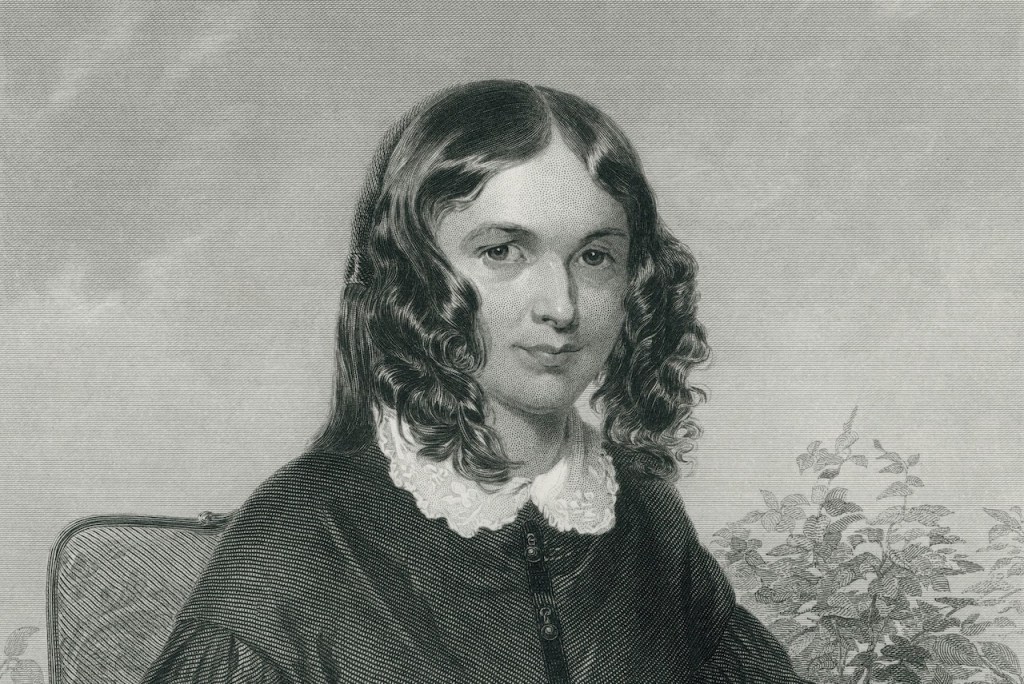
Image: Elizabeth Barrett Browning – Engraving from original Painting by Chappel, 1872. (Photo by: Universal History Archive/Universal Images Group via Getty Images)
Elizabeth Barrett Browning’s Sonnet 28 “My letters! all dead paper, mute and white!”
In Elizabeth Barrett Browning’s sonnet 28 “My letters! all dead paper, mute and white!,” the speaker reacts to each stage of the growing love relationship, while she is looking through a bundle of love letters.
Introduction and Text of Sonnet 28 “My letters! all dead paper, mute and white!“
Elizabeth Barrett Browning’s sonnet 28 “My letters! all dead paper, mute and white!” from Sonnets from the Portuguese is dramatizing the speaker’s uncomplicated activity of perusing a bunch of her love letters.
She loosens the cord that binds them and then begins to report certain significant details from each missive. Each one, on which the decides to report, unveils a stage in the maturing relationship of the two lovers from friend to soul-mate.
Sonnet 28 “My letters! all dead paper, mute and white!”
My letters! all dead paper, mute and white! And yet they seem alive and quivering Against my tremulous hands which lose the string And let them drop down on my knee to-night. This said,—he wished to have me in his sight Once, as a friend: this fixed a day in spring To come and touch my hand … a simple thing, Yet I wept for it!—this, … the paper’s light … Said, Dear, I love thee; and I sank and quailed As if God’s future thundered on my past. This said, I am thine—and so its ink has paled With lying at my heart that beat too fast. And this … O Love, thy words have ill availed If, what this said, I dared repeat at last!
Commentary on Sonnet 28 “My letters! all dead paper, mute and white!”
The speaker in Elizabeth Barrett Browning’s Sonnet 28 “My letters! all dead paper, mute and white!” is looking at the love letters from her beloved suitor and reacting to each step in the growth of their love relationship.
First Quatrain: Letters That Live
My letters! all dead paper, mute and white! And yet they seem alive and quivering Against my tremulous hands which lose the string And let them drop down on my knee to-night.
The speaker begins by exclaiming “My letters!” She sits with a bundle of her letters in her hands and commences to muse aloud her response to fact that they even exist. She insists that they are actually nothing more than “dead paper, mute and white!” But because she is aware of the story that they contain, she claims that they seem to be “alive and quivering.”
Of course, it is the trembling of her hands that causes them to “quiver.” She has untied the cord that binds the letters together in a bunch, and her “tremulous hands” then permit those letters to “drop down on her knee.”
Second Quatrain: Each Letter a Pronouncement
This said,—he wished to have me in his sight Once, as a friend: this fixed a day in spring To come and touch my hand … a simple thing, Yet I wept for it!—this, … the paper’s light …
The speaker, in the second quatrain, commences her report on what each letter pronounces. The first one that she selects is telling her that her suitor at first desired to visit her for the purpose of friendship.
After all they are both poets, and poets are likely to enjoy friendship with other poets. Thus, at the outset, the two poets experienced friendship, and she was pleasantly surprised that he even wished to visit her.
In the next missive she on which she focuses, he informs her her that he would like to visit and hold her hand; appropriately and timely, that day was a spring day. The romance inherent in these image choices is full of possibilities; yet, she regards the event “a simple thing.” Still, even though it may be simple, it brings tears to her eyes.
First Tercet: What God Judges
Said, Dear, I love thee; and I sank and quailed As if God’s future thundered on my past. This said, I am thine—and so its ink has paled
The next epistle with paper that is “light” informs her, “Dear, I love thee.” To this astonishing avowal, she exerts a passionate and extreme reaction. She sinks back in her seat with a startled cry for she felt as if God had declared some momentous decree on her past life.
As this sonnet sequence has progressively revealed, this speaker has passed quite a solitary and painfully sorrowful life. However, her past now is being put in judgment by God, and God is proclaiming that her future will not be replicating her sad past.
Second Tercet: Next to a Fast-Beating Heart
With lying at my heart that beat too fast. And this … O Love, thy words have ill availed If, what this said, I dared repeat at last!
The next letter avows to her that he belongs to her. The speaker has so treasured this letter that she has caused the ink to become pale from holding it to her fast-beating heart. The speaker has figuratively held this letter to her fast-beating heart, and that holding has metaphorically caused the ink to lighten.
The last epistle inflames her so much that she cannot allow herself to voice any of it nor even offer a hint of what it announces. Nevertheless, the continuing progress of the sonnet sequence allows the reader to remain perfectly satisfied with what might be a unsatisfying because inconclusive conclusion because the speaker chose to reveal nothing from the final letter’s contents.