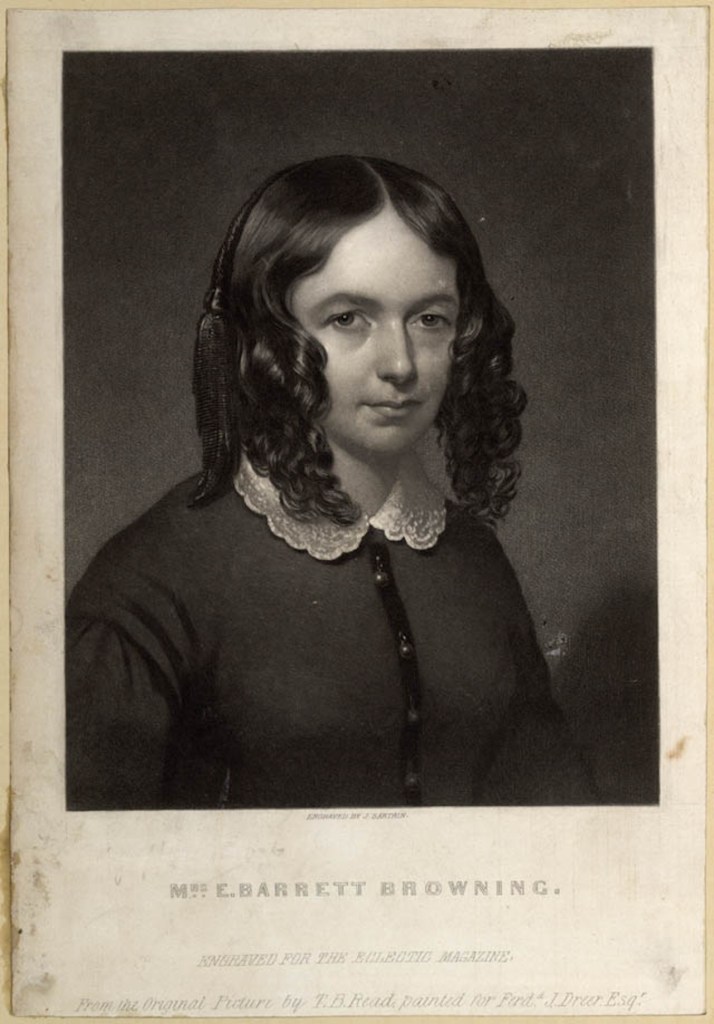
The first sonnet in Elizabeth Barrett Browning’s Sonnets from the Portuguese features a speaker who is expressing the futility of concentrating on death and the melancholy such musing too often may create.
Introduction with Text of Sonnet 1 “I thought once how Theocritus had sung”
Elizabeth Barrett Browning’s Sonnets from the Portuguese unveil a marvelous testimony to the love and respect that the poet fostered for her suitor and future husband Robert Browning. Robert Browning’s stature as a poet rendered him one of the most noted and respected poets of Western culture.
Robert Browning’s fame and influence in literary studies has spread over the globe, and his wife’s reputation has also been enhanced by his noteworthiness as well as her own mastercraftmanship as a sonneteer.
In the dramatic renderings of the sonnet sequence, as the relationship between the poets continues to flower, Elizabeth worries that it might not long endure. She thus has created a speaker who muses on and voices the insecurities experienced by the poet.
Sonnet 1 “I thought once how Theocritus had sung”
I thought once how Theocritus had sung Of the sweet years, the dear and wished for years, Who each one in a gracious hand appears To bear a gift for mortals, old or young: And, as I mused it in his antique tongue, I saw, in gradual vision through my tears, The sweet, sad years, the melancholy years, Those of my own life, who by turns had flung A shadow across me. Straightway I was ‘ware, So weeping, how a mystic Shape did move Behind me, and drew me backward by the hair, And a voice said in mastery, while I strove, … Guess now who holds thee?’—Death,’ I said. But there, The silver answer rang … Not Death, but Love.’
Reading
Commentary on Sonnet 1 “I thought once how Theocritus had sung”
Sonnet 1 “I thought once how Theocritus had sung” in Elizabeth Barrett Browning’s classic work, Sonnets from the Portuguese, opens as the speaker is musing on the pressure created by melancholy.
First Quatrain: The Bucolic Classical Poetry of Theocritus
I thought once how Theocritus had sung Of the sweet years, the dear and wished-for years, Who each one in a gracious hand appears To bear a gift for mortals, old or young:
The speaker begins the dramatization of her musing by reporting that she has perused the pastoral poetry of the ancient classical poet, Theocritus. She reveals that that classical Greek poet put into song the nature of the time of life when the young are full of hope and wishes—such desire renders those years sweet.
The speaker has garnered the notion from the poem’s insightful knowledge that every year bestows on each mortal “a gift”; the elderly and the youthful are both able to accept those magnificent and eternal blessings.
The speaker’s own melancholy and sadness have prompted her to seek out answers for questions that have troubled her, answers to important issue such as the very purpose of life on this planet.
The speaker appropriately and with gratitude has been turning to the ancient thinkers because she understand that they have bestowed wisdom and encouragement to each of the succeeding generations.
Second Quatrain: Finding Her Own Life in Poetry
And, as I mused it in his antique tongue, I saw, in gradual vision through my tears, The sweet, sad years, the melancholy years, Those of my own life, who by turns had flung
After a significant period of time spent in musing on the words of Theocritus, the speaker has come to comprehend the important ideas presented by those words, and their gravity brings tears to her eyes. It is, thus, through those emotional tears that the speaker seems to be able to view her “own life.”
She becomes well aware that her own years have not rendered to her any special kindness. Her own years have been filled with pain and sadness. Those gifts presented by time are not always useful or pleasant ones to the recipient. But that is how life is.
Each person’s individual karma remains responsible for the specific events that occur in each life. One can remain assured that one will always reap what one sows. But each individual is not required to be happy or even satisfied with the results; thus, one becomes motivated to strive to change former karmic patterns by improving one’s thoughts and behavior.
Barrett Browning’s ability to understand the original Greek text is critical in her ability to feel the profound emotional impact of those thoughts. Fraudulent “translators” such a Robert Bly, who was not fluent in the languages of the texts he supposedly translated, could not faithfully render emotion expressed in the original.
As poet Stephen Kessler has averred: “The major problem with [Robert Bly’s] translations (often from languages he didn’t know, by way of other English versions) was that he made every poet, from García Lorca to Mirabai, sound like Robert Bly.” But Barrett Browning was fluent in the languages which she read and studied, and thus she could translate accurately and render in her speaker unique, genuine emotion.
First Tercet: Life Beneath a Shadow
A shadow across me. Straightway I was ‘ware, So weeping, how a mystic Shape did move Behind me, and drew me backward by the hair,
The speaker then reveals that her own life has been passed under a “shadow.” A dark cloud has moved “across [her],” and she has suddenly become cognizant that she is weeping.
She feels as if she is being dragged backward by someone or something. Some being seems to be pulling her by the hair into some “mystic Shape.” Unfortunately, she remains unable to ascertain just what that strange creature is who seems to be tugging at her.
Second Tercet: A Correcting Voice
And a voice said in mastery, while I strove, … Guess now who holds thee?’—Death,’ I said. But there, The silver answer rang … Not Death, but Love.’
As she tries to right herself, she then becomes aware of what seems to be a voice—a “voice of mastery.” That strange voice poses a question to her; it asks her to take a guess regarding who “holds [her].” The speaker then suddenly responds fatalistically, “Death.” However, she is then relieved to hear a surprising retort, correcting her fatalism: “Not Death, but Love.”
An Inspiring Love Story
The love story of Robert and Elizabeth Barrett Browning has become and has remained a subject for research and exploration as well as admiration in the literary world, especially in the poetry branch of that world.
In her Sonnets from the Portuguese, Mrs. Browning crafts and portrays a speaker who dramatizes the poet’s moments of sorrow and melancholy as well as her painful doubt-filled hours.
Her speaker becomes elated at times that a man as accomplished and noteworthy as Robert Browning would take note of her and even desire to spend time with her. But then her mood will change, and she will grow doubtful that the relationship could ever blossom into a lasting, true love.
Readers who explore the sonnets will become pleasantly captivated by her amazing growth from skepticism and doubt to deep awareness and faith that the couple’s love is genuine and sustained by the Divine Belovèd Creator (God). Uniquely told in sonnets, the Brownings’ courtship leading to their marriage remains a truly inspiring love story.
Brief Life Sketch of Elizabeth Barrett Browning and Introduction to Sonnets from the Portuguese
Elizabeth Barrett Browning’s classic work Sonnets from the Portuguese is the poet’s most anthologized and widely published work, studied by students in secondary schools, colleges, and universities and appreciated by the general poetry lover.
Two Poets in Love
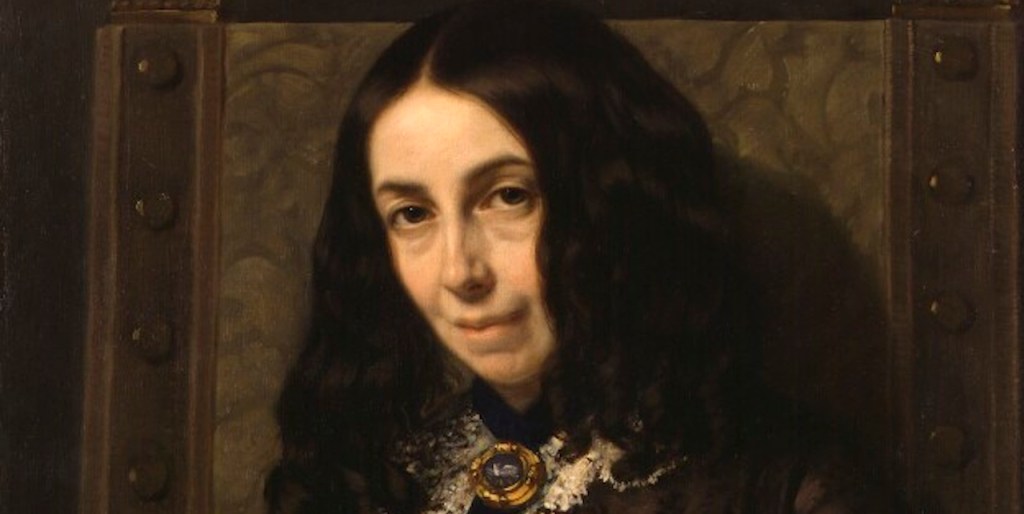
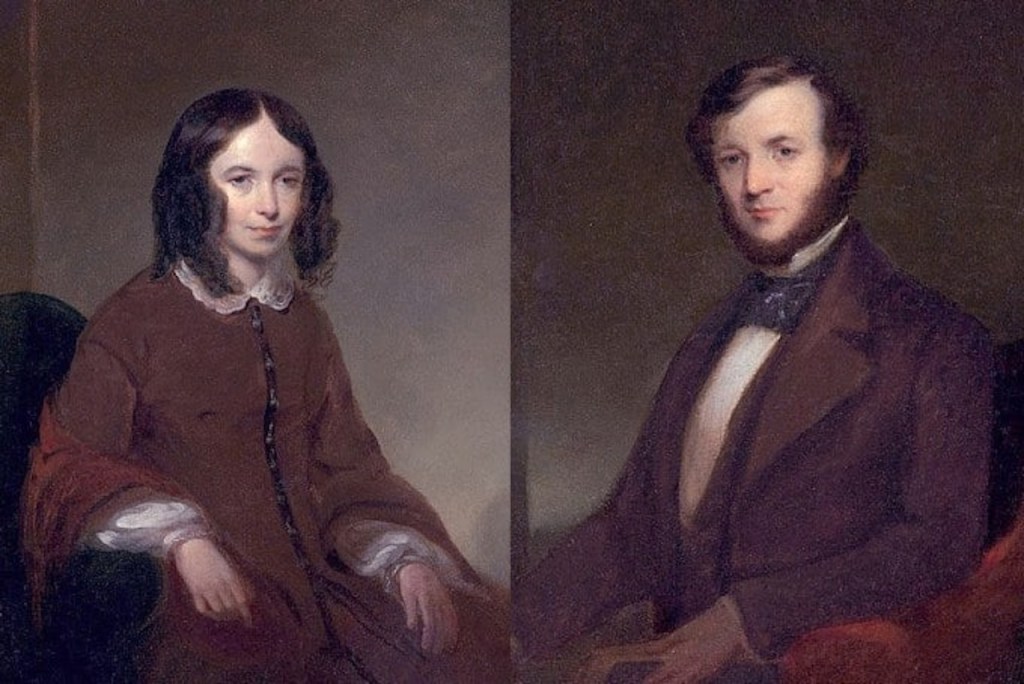
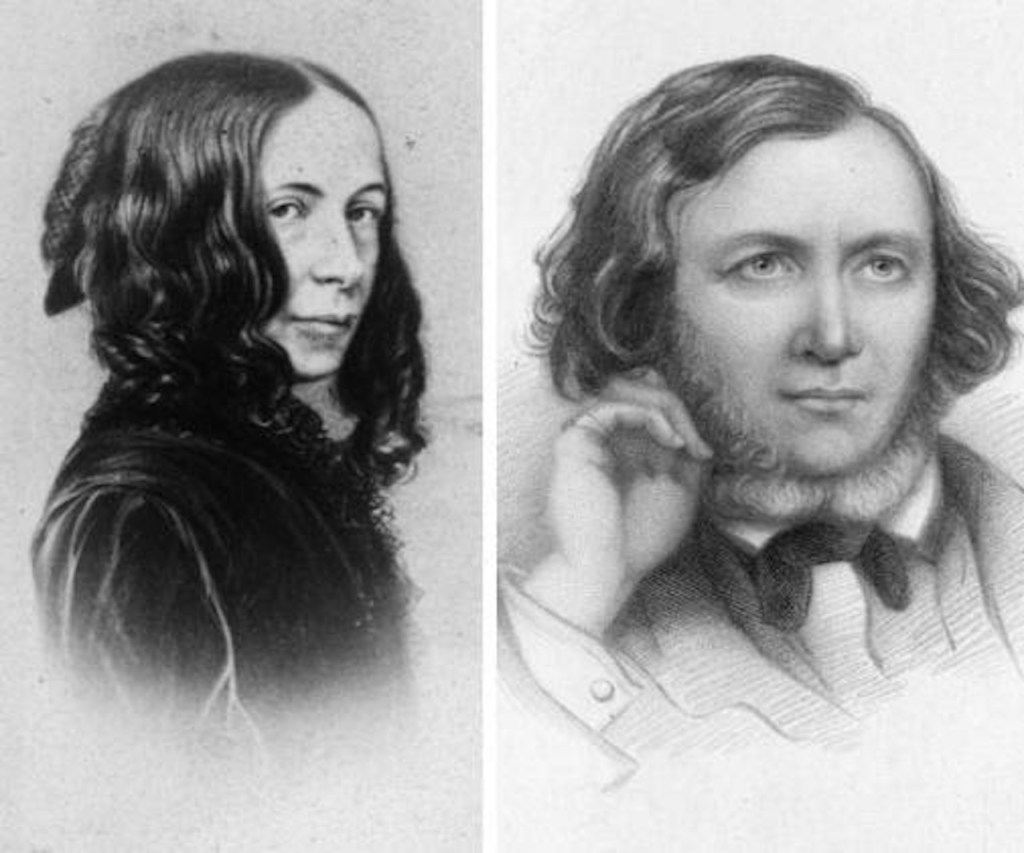
Robert Browning, while wooing Elizabeth Barrett, referred to his sweetheart lovingly by the nickname he had given her: “my little Portuguese” [1]. He chose that nickname for her because of her dark complexion. Elizabeth Barrett then quite consequentially titled her sonnet sequence Sonnets from the Portuguese.
Since its publication, Elizabeth Barrett Browning’s Sonnets from the Portuguese has become a beloved, often anthologized, and widely studied sonnet sequence. With this 44-sonnet sequence, Barrett Browning puts on display her mastery of the Petrarchan (Italian) sonnet form.
Throughout the sequence, Barrett Browning creates a speaker who develops the theme of the romantic relationship between Elizabeth Barrett and fellow poet, Robert Browning, the man whom she will ultimately marry.
As their relationship begins, the speaker is continually beset with deep doubts. She has little confidence that she can keep the affection of such an accomplished, world-renowned poet as Robert Browning [2].
The speaker, therefore, continues to dramatize her deep skepticism that the relationship will withstand their differences. The speaker is continually musing on her insecure nature and doubts as she even magnifies them. Her exploration and examination of her situation causes her much consternation. Likely, the poet’s prior experience with love relationships influences her hesitancy in engaging in a relationship with Robert Browning:
Much of E.B.B.’s hesitation came from knowing that love can bring injury as well as boon. She had suffered such injury. With great pain did she finally recognise that her father’s strangely heartless affection would have buried her sickroom, for how else could she interpret his squelching of her plan to travel south for health in 1846, when doctors practically ordered the journey to Italy as a last hope?
E.B.B. had had previous experience of one-sided affection, as we see in her diary of 1831-3, which concerns her relationship with the Greek scholar H.S. Boyd.For a year her entries calculate the bitter difference between his regard and her own, and she wonders if she can ever hope for reciprocation. In fact she finds her womanly capacity for feeling a liability and wishes she could feel less — “I am not of a cold nature, & cannot bear to be treated coldly. When cold water is thrown upon a hot iron, the iron hisses. I wish that water wd. make that iron as cold as self.” [3]
Elizabeth Barrett’s poor health is often emphasized in the many biographies of the poet. Few biographers have offered any speculations regarding the origin of the poet’s illness; nor have they attempted to name the disease from which the poet suffered.
However, Anne Buchanan, who is a research assistant in anthropology, has suggested that Elizabeth Barrett suffered from hypokalemic periodic paralysis (HKPP), a muscle disorder [4]. Buchanan’s daughter suffers from that same disease, which “causes blood levels of potassium to fall because potassium becomes trapped in muscle cells.”
Buchanan and her daughter Ellen Buchanan Weiss observed that the descriptions of Barrett Browning’s malady resembled closely those of the daughter. The Buchanans have thus suggested that a cold, moist climate often intensifies the pain associated with HKPP.
Throughout Barrett Browning’s lifetime, London’s cold, damp climate had exacerbated the poet’s health problems, and whatever the title of the disease, escaping the London’s weather was a Godsend to her.
Thus, her marriage to Robert Browning enhanced her health as well as her mental state because the coupled relocated to Italy, where they enjoyed the warm climate, which was amenable to Elizabeth’s health.
Because of Robert Browning, Elizabeth Barrett not only enjoyed a soulmate to love her, but she also found one who would protect her health and allow her live her remaining years more comfortably and productively.
The Petrarchan (Italian) Sonnet Form
The Petrarchan sonnet is named after the 14 century Italian poet, Francesco Petrarch [5]. It is also known as the Italian sonnet. The Petrarchan/Italian sonnet displays an eight-line octave and a six-line sestet. The octave contains two quatrains (four lines each), and the sestet contains two tercets (three lines each). The traditional rime scheme of the Petrarchan/Italian sonnet is ABBAABBA in the octave and CDCDCD in the sestet.
Poets, however, often display a variation on the sestet rime scheme, transforming it from CDCDCD to CDECDE. Many other poets vary the octave as well as create other schemes for the sestet. But Barrett Browning never varies the rime scheme; she retains the traditional rime scheme ABBAABBACDCDCD throughout the entire 44-sonnet sequence.
Following such a tight, restricted form that the poet chose to follow as she composed 44 sonnets magnifies her skill and her mastery of that sonnet form. The poet’s choice of the Petrarchan sonnet also reveals her deep affinity for the original Petrarchan theme, as she muses upon the relationship between herself and her belovèd as well as the relationship between the Divine Creator-Father and His human children.
According to Robert Stanley Martin, Petrarch “reimagined the conventions of love poetry in the most profound way: love for the idealized lady was the path towards learning how to properly love God . . .”:
[Petrarch’s] poems investigate the connection between love and chastity in the foreground of a political landscape, though many of them are also driven by emotion and sentimentality. Critic Robert Stanley Martin writes that Petrarch “reimagined the conventions of love poetry in the most profound way: love for the idealized lady was the path towards learning how to properly love God . . . .” [6]
Each sonnet in this sequence is displayed in only one stanza with its octave and sestet. However, engaging the sonnet’s quatrains and sestets separately allows the commentarian a clearer focus in concentrating on each line unit.
Elizabeth Barrett Browning’s sonnet sequence offered the poet a remarkably open field as well as the imaginative opportunity for discovery of her true feelings. The poet’s life had become steeped in melancholy, as a result of her poor health and her family’s inability to understand and appreciate her abilities and sensibilities. Especially problematic was her difficult relationship with her father.
As the poet through her speaker navigates through the sonnet sequence, she demonstrates a change of mood. The speaker of the sequence grows from an individual holding the desperate thought that only death would remain her consort to one who could finally experience joy.
After her doubts that she and such a man of the world as Robert Browning could have a true relationship are finally removed, she finds life to be very different from what she has earlier experienced.
The confident, sophisticated Robert Browning brought Miss Barrett a happiness that genuinely gave her life meaning. The two poets’ relationship had to struggle against a host of trials and tribulations, but their love story results in one that remains one for the ages. The world is more acquainted with these two lover-poets than it would have otherwise been without their loving relationship:
In addition to being celebrated for their literary talents, Elizabeth and Robert are remembered as people who were deeply in love. As Sir Frederic Kenyon wrote, Elizabeth and Robert “gave the most beautiful example of [love] in their own lives.” The marriage of Elizabeth Barrett Browning and Robert Browning required courage and sacrifice, and they were willing to do whatever it took to build a beautiful life together. [7]
Barrett Browning’s 44-sonnets sequence recounts the journey of a poet who begins with many doubts. But she examines and muses upon the origins of those doubts and then finally blossoms into a joyous, creative individual after she accepts and engages with the love that Robert Browning had so generously and genuinely offered her. The story of the love relationship between these two poets has a become one of most inspirational stories in the literary world—or, for that matter, in any world.
The Psychological Narrative within Elizabeth Barrett Browning’s Sonnets from the Portuguese
Elizabeth Barrett Browning’s 44 Petrarchan sonnets in Sonnets from the Portuguese suggest a subtle sequence within a psychological narrative framework.
Composed during her courtship with Robert Browning, the sequence presents an evolution from despair, low self-esteem, and self-doubt toward acceptance of love, reframing of self-awareness, and final, faithful and faith-based commitment. The sequence sections itself into the following emotional stages:
1. Musing on Despair and Resistance (Sonnets 1–8)
The sequence begins with a speaker who feels emotionally exhausted, physically fragile, convinced she could never marry, especially because her father had dictated that none of his children would ever be allowed to marry. Also her illness had enfeebled her so dramatically that she likely had little energy and strength for beginning and maintaining a loving relationship and family of her own.
The main themes of this segment of sonnets are memory of suffering, expectation of death rather than love, and suspicion that the new affection cannot last.
In the first sonnet, the speaker senses being drawn away from concentration on death by an unanticipated presence, which can only be interpreted as Robert Browning entering her life.
2. Exploring the Fear of Being Unworthy of Love (Sonnets 9–15)
The next group focuses on a persistent anxiety: she feels that her beloved deserves someone stronger and happier. She believes she is too weak, ill, and melancholy to respond as she should to his affection; she feels she is near death. He insists that he loves her deeply, and that they will have a future together.
The tension that drives this segment of sonnets creates a suggestion that she may be arguing against the relationship, even though it is quite clear that in her heart of hearts she is strongly wishing for it to success.
3. Examining the Strength of the Lover’s Devotion (Sonnets 16–24)
Here the tone changes. The speaker begins to examine the lover’s commitment more carefully. She wonders if he merely pities her, or if the love may be only temporary, or if he does in face love her for the right reasons.
She insists that love must not rest on changeable qualities such as her smile, her voice, or her appearance. She insists that love must remain constant even as those qualities dim with time.
4. Gradual Recognition of Genuine Love (Sonnets 25–36)
Gradually, the speaker is beginning to accept that the suitor’s devotion is real. The sonnets in this segment focus on memories of shared moments, reflections on spiritual companionship, and growing emotional trust. She is beginning to sense a mutual affection which is eroding the painful doubt that has plagued her.
5. Final Acceptance and Joy (Sonnets 37–44)
In the final segment, her resistance has largely disappeared. She now accepts her suitor’s love, sensing that it us utterly transformative and refreshingly life-giving. The tone has changed from ingrained doubt to joyous confidence, a healing gratitude, and spiritual cohesiveness.
The widely anthologized sonnet 43—“How do I love thee? Let me count the ways”—belongs to this final stage and expresses love in multiple dimensions: depth, breadth, height, and moral and spiritual devotion.
The final sonnet 44 “Belovèd, thou hast brought me many flowers” presents the couple’s love as an entity that will live on beyond death, as it testifies to a spiritual faith. Such a faith transcends all mortal doubt, affords the speaker a truly new Weltanschauung.
Image: SRF Mother Center Lotus – Photo by Ron W. G.
My Spiritual Sanctuary
My spiritual journey began in earnest in 1978, when I became a devotee of Paramahansa Yogananda’s teachings and a member of his organization Self-Realization Fellowship. As a Kriyaban since 1979, I have completed the four Kriya Initiations, and I continue to study the teachings and practice the yoga techniques as taught by the great spiritual leader, who is considered to be the “Father of Yoga in the West.”
I practice the chants taught by the great guru accompanying myself on the harmonium and serve at the local SRF Meditation Group as one of the chant leaders.
“By ignoble whips of pain, man is driven at last into the Infinite Presence, whose beauty alone should lure him.” –a wandering sadhu, quoted in Autobiography of a Yogi by Paramahansa Yogananda
Salvation Is a Personal Responsibility
I am a Self-Realization Yogi because the teachings of Paramahansa Yogananda, who in 1920 founded Self-Realization Fellowship, make sense to me. Paramahansa Yogananda teaches that we are immortal souls, already connected to the Divine Reality, but we have to “realize” that divine connection.
Knowing the Great Spirit (God) is not dependent upon merely claiming to believe in a divine personage, or even merely following the precepts of a religion such as the Ten Commandments.
Knowing the Creator is dependent upon “realizing” that the soul is united with that Creator. To achieve that realization we have to develop our physical, mental, and spiritual bodies through exercise, scientific techniques, and meditation.
There are many good theorists who can help us understand why proper behavior is important for our lives and society, but Paramahansa Yogananda’s teachings offer definite, scientific techniques that we practice in order to realize our oneness with the Divine Power or God.
It makes sense to me that my salvation should be primarily my own responsibility.
No Religious Tradition
I did not grow up with a religious tradition. My mother was a Baptist, who claimed that at one time she felt she was saved, but then she backslid. I learned some hymns from my mother. But she never connected behavior with religion.
My father was forced to attend church when he was young, and he complained that his church clothes were uncomfortable as was sitting on the hard pews.
My father disbelieved in the miracles of Jesus, and he poked fun at people who claimed to have seen Jesus “in the bean rows.” My mother would not have doubted that a person might see Jesus, because she saw her father after he had died.
My mother characterized my father as agnostic, and she lived like an agnostic, but deep down I think she was a believer after the Baptist faith.
Here’s a little story that demonstrates how ignorant about religion I was as a child: When I was in first or second grade, I had a friend. At recess one day at the swings, she wanted to confide something to me, and she wanted me to keep it secret.
She said I probably wouldn’t believe it, but she still wanted to tell me. I encouraged her to tell me; it seemed exciting to be getting some kind of secret information. So she whispered in my ear, “I am a Quaker.”
I had no idea what that was. I thought she was saying she was magic like a fairy or an elf or something. So I said, “Well, do something to prove it.” It was my friend’s turn to be confused then.
She just looked very solemn. So I asked her to do something else to prove it. I can’t remember the rest of this, but the point is that I was so ignorant about religion.
The Void in My Life and My First Trauma
Looking back on my life as a child, teenager, young adult, and adult up to the age of 32, I realize that the lack of a religious tradition left a great void in my life. Although my father was on the fence regarding religion, he would listen to Billy Graham preach on TV.
I hated it whenever Billy Graham was preaching on TV. His message scared me. Something like the way I felt when my father’s mother would come and visit us, and when my father would let out a “Goddam” or other such swear word, Granny would say he was going to hell for talking that way.
I was afraid for my father. And Billy Graham made me afraid for myself and all of us because we did not attend church. I never believed that things like swearing and masturbation could send a soul to hell. But then back then I had no concept of “soul” or “hell.” I believed it was wrong to kill, steal, and to lie. But I’m not sure how these proscripts were taught to me.
I guess by example. It seems that I had no real need for God and spirituality until I was around thirty years old.
My life went fairly smoothly except for two major traumas before age thirty. The first trauma was experiencing a broken heart at age eighteen and then undergoing a failed marriage, after which I thought I would never find a mate to love me. But I did meet a wonderful soulmate when I was 27.
Heretofore I had thought finding the proper marriage partner would solve all my problems, but I learned that my difficulties were very personal and at the level where we are all totally alone, despite any outward relationships.
The Second Trauma
A second trauma that added to my confusion was being fired twice from the same job at ages 22 and 27. By age 27 things started to make no sense. And it started to bother me intensely that things made no sense.
I had always been a good student in grade school and high school, and I was fairly good in college, graduating from Miami University with a 3.0 average. That grade point average bothered me because I thought I was better than that, but I guess I was wrong.
But then not being able to keep my teaching job and not being able to find another one after I had lost it very much confused me. It seemed that I had lost touch with the world. School had been my world, and my teachers and professors had expected great things from me. But there I was at age 27 and couldn’t get connected to school again.
Feminism and Zen
I began reading feminist literature starting with Betty Friedan’s Feminine Mystique, continuing with Ms. Magazine, and many others. The result of taking in the feminist creed led me to believe that I had someone to blame for my failure—men; men had caused the world to be arranged so that women cannot succeed outside the home.
I began writing again, an endeavor I have sporadically engaged in most of my life from about age sixteen.
I decided to apply for a graduate assistantship in English at Ball State University, feeling that I was ready to get out in the man’s world and show it what a woman could do. I felt confident that I could succeed now that I knew what the problem was. But that didn’t work out either.
I finished the year without a master’s degree in English, and then there I was, confused again, and still searching for something that made sense.
I had heard about the Eastern philosophy known as “Zen” at Ball State, and I started reading a lot about that philosophy. Zen helped me realize that men were not the problem, attitude was. I kept on writing, accumulating many poems, some of which I still admire.
And I kept reading Zen, especially Alan Watts, but after a while the same ideas just kept reappearing with no real resolution, that is, even though the Zen philosophy did help me understand the world better, it was not really enough. I got the sense that only I could control my life, but just how to control it was still pretty much a mystery.
Autobiography of a Yogi
In 1977, my husband Ron and I went on one of our book shopping trips. I spied a book, Paramahansa Yogananda’s “Autobiography of a Yogi,” and I recommended it to Ron because he liked biographies. Strangely, I said to him about the man on the cover: “He’s a good guy!” Strange, because I had no idea if the individual was a good guy or not, being the first time I ever saw him. So, we purchased poetry books, and we also purchased the autobiography for him.
Ron did not get around to reading it right away, but I did, and I was totally amazed at what I read. It all made sense to me; it was such a scholarly book, clear and compelling. There was not one claim made in the entire 500 plus pages that made me say “what?” or even feel any uncertainty that this writer knew exactly whereof he spoke.
Paramahansa Yogananda was speaking directly to me, at my level, where I was in my life, and he was connecting with my mind in a way that no writer had ever done. For example, the book offers copious notes, references, and scientific evidence that academics will recognize as thorough research.
This period of time was before I had written a PhD dissertation, but all of my years of schooling including the writing of many academic papers for college classes had taught me that making claims and backing them up with explanation, analysis, evidence, and authoritative sources were necessary for competent, persuasive, and legitimate exposition.
Paramahansa Yogananda’s autobiography contained all that could appeal to an academic and much more because of the topic he was addressing. As the great spiritual leader recounted his own journey to self-realization, he was able to elucidate the meanings of ancient texts whose ideas have remained misunderstood for many decades and even centuries.
The book contained a postcard that invited the reader to send for lessons that teach the techniques for becoming self-realized. I sent for them, studied them, and I have been practicing them since 1978. They do, indeed, hold the answer to every human problem.
I know it is difficult for most educated people to believe that all human problems can be solved, but that’s because they get stuck in the thought that they cannot.
If you believe that you can never really know something, then you can’t, because if you believe that you can never really know something, you won’t try to know it.
Yogananda gives a map with directions to reaching God, and realizing that one’s soul is united with God brings about the end of all sorrow and the beginning of all joy.
Just knowing the precepts intellectually does not cause this realization, but it goes a long way toward eliminating much suffering.
The faith that we can overcome all suffering is a great comfort, even if we are not there yet. I realize that God is knowable, but most important is that I know I am the only one who can connect my soul to God—and that is the spiritual journey I am now on.
An Orphic Oath: To Enshrine a Standard of Excellence for Poets
Beginning poets should be required to take a vow equivalent of the medical “Hippocratic Oath.” If poets could be held to a standard of excellence, less doggerel would plague the literary world.
A Hippocratic-Style Oath for Poets
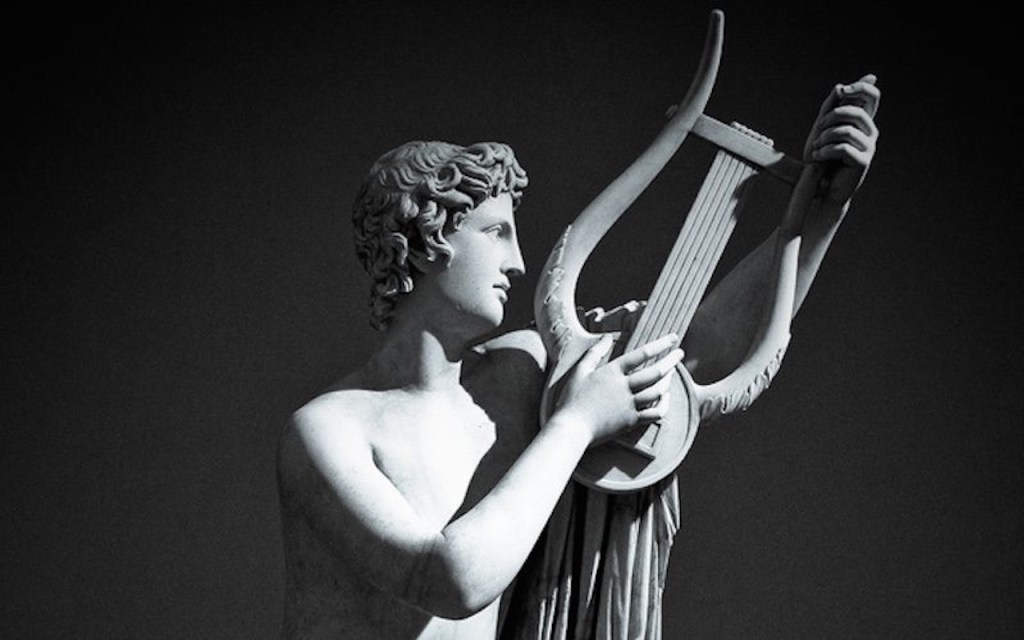
The Hippocratic Oath [1] is a covenant between the beginning physician and his profession regarding his conduct with patients. Perhaps such an oath for poets could be called an “Orphic Oath,” after Orpheus [2], the mythical father of music and poetry, who descended into Hades and then returned to Earth.
If beginning poets were required to take a vow equivalent of the medical “Hippocratic Oath” and, therefore, could be held to a standard of excellence, less doggerel would plague the literary world.
While all poets, established or aspiring, could benefit by adhering to a standard of excellence, it is the beginning poet who could most benefit from taking an artistic equivalent to the physicians’ famed “Hippocratic Oath.”
Does Poetry Make Sense?
Poets require standards. Many novice poets believe that anything that occurs to them to spew across the page in lines shorter than prose should be regarded as poetry. And many novices are convinced that poetry does not make sense and should not.
They think that words in poems always have altered meanings: light never means light, dark never means dark, smile never means smile—but must be interpreted or translated into some meaning that never approaches the literal meaning of the word.
For far too many beginning wordsmiths, words in poems take on a magic spell that renders them so other worldly that only the expert poetry reader or teacher can ever really understand them.
During my stint at Ball State University as an assistant professor teaching English composition, I discovered that some students thought of poetry as a discourse that could mean anything they wanted it to mean. And others believed that only the teacher could tell them what it meant; most students believed that as students could never figure it out for themselves.
As I was walking across the Ball State University campus, outside Bracken library, I heard a young woman remark about her composition professor, “She says my writing doesn’t make sense. But I write poetry and it’s not supposed to make sense.”
That remark told me a lot about many students’ attitude toward poetry. Many students begin with notion that poetry is “not supposed to make sense,” while others believe that somehow it might make sense to a teacher.
Aspiring Poets Need to Know Better
It is understandable for general studies students to begin with inaccurate beliefs about poetry, but by the time a young person has decided to write poetry, it seems that that aspiring poet would know better.
One wonders which poets such future poets admire. But the sad fact is that many would-be poets likely do not admire any poets, because they have never actually read and studied any poets or poems.
Another immature yet wide-spread belief about poetry usually held by those who have moved to a mid-level stage but who have not yet learned enough to remain humble is that to explicate, analyze, or otherwise comment upon a poem is to diminish its value as a poem.
That mistaken idea also stems from the notion that words in a poem always mean other than their literal meaning. These mid-level beginners hold that critical commentary on a poem turns out the light that mystically shines from the poem left unscrutinized.
If you are a beginning poet, or a mid-level beginner—even seasoned, published poets could benefit from this oath—you might do well to consider the following oath, which I have refashioned, based on the Hippocratic Oath to which physicians swear at the beginning of their careers:
As I [state your name] engage in my career as a poet, I solemnly swear to remain faithful to the tenets of the following covenant to the best of my ability:
I will respect and study the significant artistic achievements of those poets who precede me, and I will humbly share my knowledge with those who seek my advice. I will dedicate myself to my craft using all my talent while avoiding those two evils of (1) effusiveness of self-indulgence and (2) pontification on degradation and nihilism.
I will remember that there is a science to poetry as well as an art, and that spirituality, peace, and love always eclipse metaphors and similes. I will not bring shame to my art by pretending to knowledge I do not have, and I will not cut off the legs of colleagues that I may appear taller.
I will respect readers and ever be aware that not all readers are as well-versed in literary matters as I am. I will not take advantage of their ignorance by writing nonsense and then pretending it is the reader’s fault for not understanding my disingenuity. Regardless of the level of fame and fortune I reach, I will remain humble and grateful, not arrogant nor condescending.
I will remember that poetry requires revision and close attention; it does not just pour out of me onto the page, as if opening a vein and letting it drip. Writing poetry requires thinking as well as feeling.
I will continue to educate myself in areas other than poetry so that I may know a fair amount about history, geography, science, math, philosophy, foreign language, religion, economics, sociology, politics, and other fields of endeavor that result in bodies of knowledge.
I will remember that I am no better than prose writers, songwriters, musicians, or politicians; all human beings deserve respect as well as scrutiny as they perform their unique duties, whether artist or artisan.
I will not rewrite English translations of those who have already successfully translated and pretend that I too am a translator. I will not translate any poem that I cannot read and comprehend in the original.
If young poets treat their art as a trust between themselves and all they hold sacred, they will gladly follow this covenant and represent their chosen art gracefully and successfully.
Supporting Yourself by Writing Poetry
Aspiring poets needs to be aware that making a living solely by writing poetry is unlikely. They will, therefore, need to support themselves by other means, at least until they can ultimately parlay their literary reputations into full-time writing. An example of a contemporary poet who was able to parlay that reputation is Dana Gioia [3].
Sources
[1] Editors. “The Hippocratic Oath.” Greek Medicine. National Library of Medicine. First published: September 16, 2002. Last updated: February 7, 2012.
[2] Editors. “Orpheus.” GreekMythology.com. Accessed September 29, 2023.
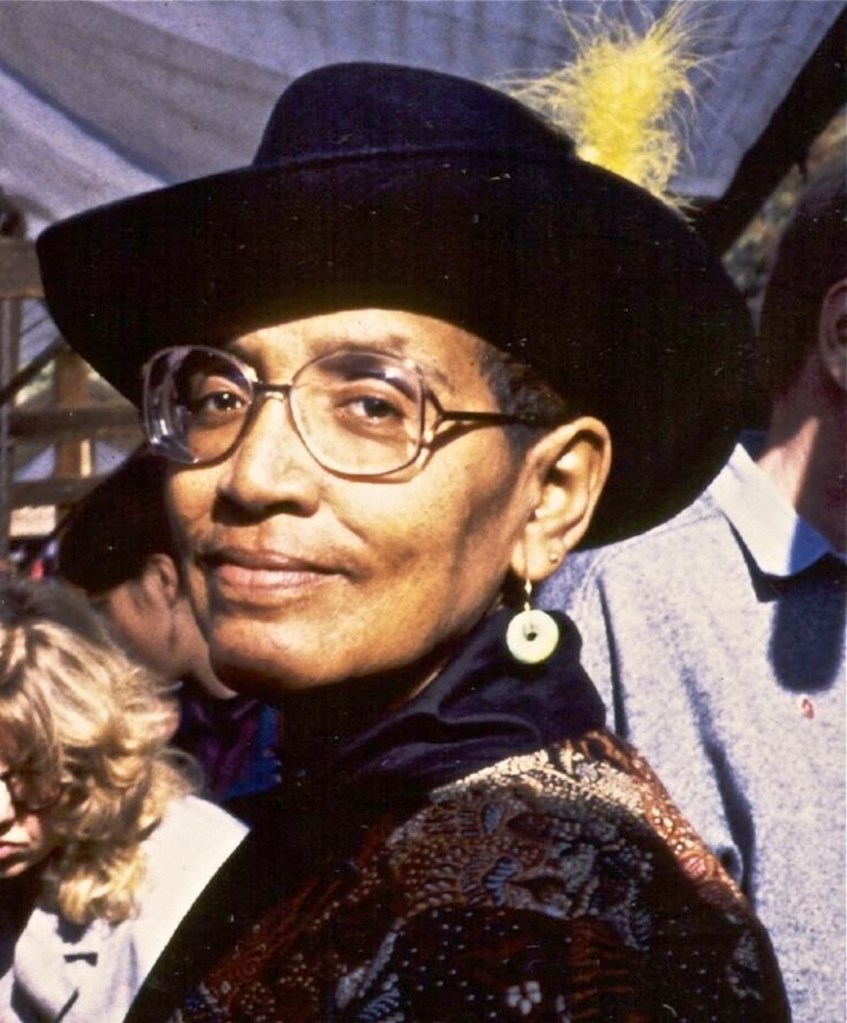
In Audre Lorde’s “Father Son and Holy Ghost,” the speaker revisits memories of a beloved father, who has died and who served as a rôle model for moral and ethical behavior. The speaker reveals her deep affection for her late father as she relives special features of her father’s behavior and her reaction to them.
Introduction with Text of “Father Son and Holy Ghost”
Although Audre Lorde is well known as a black lesbian poet, who wrote on issues of identity, she also wrote more personal pieces that address themes common to all of humanity. The death of a father is one such theme.
In her elegy “Father Son and Holy Ghost,” Lorde creates a speaker, who is remembering various aspects of her father’s behavior while he was alive. But she begins by strangely emphasizing that she has not as yet visited her father’s grave.
That admission alerts the reader that the poem is focusing on earlier memories. While that first impression prompts questions in the reader’s mind, answers begin to form in the second movement. Another question might be begged regarding the title and what it implies.
By invoking the Christian Holy Trinity, the speaker is implying that the spiritual nature of her memory will include three levels of understanding of the father: he was the progenitor of the speaker (Father), he lived a life of consistent, respectable, and moral behavior (Son), and he revered his wife, the mother of his children (Holy Ghost).
Her admiration for her father is displayed in a Dickinsonian, elliptical style; the poet has not added any unnecessary word to her drama.
For example, instead of merely stating that her father arrived home in the evening, grasped the doorknob, and entered the home, she shrinks all of that information in “our evening doorknobs.”
Because doorknobs remain the same whether it be morning, noon, evening, or night, the speaker metaphorically places the time of her father’s arrival by describing the doorknob by the time of day of his arrival.
Father Son and Holy Ghost
I have not ever seen my father’s grave.
Not that his judgment eyes have been forgotten nor his great hands’ print on our evening doorknobs one half turn each night and he would come drabbled with the world’s business massive and silent as the whole day’s wish ready to redefine each of our shapes but now the evening doorknobs wait and do not recognize us as we pass.
Each week a different woman regular as his one quick glass each evening pulls up the grass his stillness grows calling it weed. Each week a different woman has my mother’s face and he who time has changeless must be amazed who knew and loved but one.
My father died in silence loving creation and well-defined response he lived still judgments on familiar things and died knowing a January 15th that year me.
Lest I go into dust I have not ever seen my father’s grave.
Commentary on “Father Son and Holy Ghost”
In her elegy to her father’s memory, the speaker is offering a tribute the demonstrates a special love and affection, along with her deep admiration for his fine qualities.
First Movement: An Unusual Admission
The speaker begins by reporting that she has never visited her father’s grave. This startling suggestion has to wait for explanation, but the possibilities for the speaker’s reasons assert themselves for the reader immediately.
Because seeing the grave of a deceased loved one is customarily part of the funeral experience, it seems anomalous that the speaker would have skipped that part of the ceremony.
On the other hand, because she does not tell the reader otherwise, she might have skipped the funeral entirely. But whether the failure to visit the grave is associated with a close or distant relationship with the father remains to be experienced.
And oddly, either situation could be prompting that failure to visit the grave or attend the funeral: if there is resentment at the parent, one might fail to visit in order to avoid those feelings.
Or if there is deep pain because of a close, loving relationship with the parent, then seeing the grave would remind the bereft that that relationship has been severed.
By choosing not to explain or even assert certain facts, the speaker points only to the facts and events that are important for her purpose. And her purpose, as the title alerts, will be to associate her father’s death with profundity and devotion stemming from his deep religious dedication.
Second Movement: Not Forgotten
The speaker now asserts that just because she had not visited his grave does not mean that she has forgotten her father’s characteristics; she still remembers his “judgment eyes.”
Her father demonstrated the ability to guide and guard his family through his ability to see the outcome of certain situations, likely retaining the ability to encourage positive results. He was able to steers his children in the right direction.
She also remembers his arriving home from work in the evenings, turning the doorknobs just a “half turn.” It was likely it was the sound of that doorknob that alerted the speaker that her father was home.
The father’s work has left him “drabbled,” but he was a large man and remained “silent,” indicating that he was a thoughtful man, who likely entertained a “whole day’s wish” to return home to his family.
He apparently paid attention to his children, likely instructing them to “shape” up, assisting them in becoming the respectable people he knew they could be.
Now, those same “evening doorknobs” that sounded out under the grasp of her father’s large hand simply “wait,” for he will no longer be grasping them and entering his home every evening.
Oddly, those doorknobs can no longer sense the household members as they pass them. This personification of “doorknobs” indicates that the speaker is asserting that anyone seeing those family members would see a changed lot of people—changed because of the absence of a father.
Third Movement: Consistency of Behavior
The speaker then reports that her father brought home a “different woman” every week, and his act of bringing home that different woman was always the same. He also remained consistent in taking only one glass of liquor and a small amount of marijuana.
That the father grew in “stillness” suggests that he took the alcohol and weed simply to calm his nerves from the day’s work, not to simply get high.
The speaker seems to be suggesting that those women supplied the “weed,” pulling a bag of the herbage up out of their bags. (The terms “grass” and “weed” are slang labels for marijuana, along with “pot” and “Mary Jane,” and many others.) That the women suppled the weed is in perfect alignment with the father’s character: he likely kept legal alcohol in his home but not illegal products like “weed.”
That the father took only one drink and a limited amount of “grass” or “weed” becomes a characteristic to be understood and admired, even emulated. His consistency has made a positive impression upon the speaker, and she remains content in observing with respect his even-tempered behavior.
Repeating the claim of a “different woman” every week, the speaker remarks that each woman had her “mother’s face.” She then asserts the reason for the women with her mother’s face is that her father “knew and loved / but one.”
She is likely employing the term “knew” in the biblical sense; thus she may be implying that her father’s relationship with those women remained platonic. The speaker remains cognizant of the father’s consistent personality and behavior.
While it may be expected that a man would engage with other women after his wife’s death, that he remained attached to his wife’s visage and engaged sexually only with his wife because he loved only her remains unusual and makes its mark on the speaker’s memory. Her father’s respectability and morality have caught the speaker’s attention and those qualities remain in her memory of his behavior.
Fourth Movement: A Well-Lived Life
The speaker says that her father “died in silence.” She asserts that he loved “creation,” and he lived in a way that appropriately corresponded with that love.
Because of the positive, admirable aspects of her father’s personality and behavior, she understands the appropriateness of his “judgments” especially “on familiar things.” As he judged his family, he was able to guide them in appropriate and uplifting ways.
That he died on “January 15th” signals that everything he knew about his daughter stopped on that date, and the speaker/daughter knows that anything she accomplishes after that date will remain unknown to her father. Likely, she is saddened, knowing this limit will remain, and she has no way of controlling that situation.
Fifth Movement: Life’s Fulfillment
The speaker then asserts again that she has never visited her father’s grave, but in concluding, she claims that she had never done so because it might make her “go into dust.” The biblical passage in Genesis 3:19 asserts,
In the sweat of thy face shalt thou eat bread, till thou return unto the ground; for out of it wast thou taken: for dust thou art, and unto dust shalt thou return.
The speaker seems to imply that she fears her strong reaction to visiting her father’s grave might result in her own death. And while she may also be remembering the Longfellow quatrain from “A Psalm of Life,” featuring the assertion, “‘Dust thou art, to dust returnest’, / Was not spoken of the soul,” she is not ready to leave her physical encasement just yet.
The ultimate atmosphere of the poem “Father Son and Holy Ghost” suggests a certain understated fulfillment in the father’s life: he strived to live a moral, well-balanced, consistent life, which the speaker can contemplate in loving memory, even if she may not be able to celebrate openly by visiting his grave.
Audre Lorde was born on February 18, 1934, in New York City to Frederic and Linda Lorde, who came to the USA from Grenada. Her father was a carpenter and real estate agent, and her mother had been a teacher in Grenada. Frederic Lorde was known for his nature as a well-disciplined man of great ambition.
Their daughter Audre became a prominent American poet. Her works are filled with passion, making her lyrical verses a riot of emotion. But she also took an interest in social issues, seeking justice for the marginalized members of society.
Lorde began writing poems as a high school student; she published her first poem [1] while still in school. After high school, she attended Hunter College, earning a B.A. degree in 1959. She then went on to study at Columbia University and completed an MLS degree in 1961.
Publication
Audre Lorde’s first collection of poems, The First Cities, was published in 1968 [2]. Critics have described her voice as one that has developed though profound introspection, as she examines themes focusing on identity, the nature of memory, and how all things are affected by mortality.
She followed up The First Cities in 1970 with Cables to Rage. Three years later she published From a Land Where Other People Live. Then in 1974, she brought out the cleverly titled New York Head Shop and Museum.
Lorde continued to focus on personal musings as she broadened her scope with criticism of cultural injustice. She often created speakers who run up against unfair modes of behavior. She also touches on issues that reveal the nature of individual sensuality and the power of inner fortitude in struggles with life’s trials and tribulations.
In her first mainstream published collection titled Coal, which she brought out in 1976, she experimented with formal expressions. In 1978, her collection, The Black Unicorn, earned for the poet her greatest recognition as critics and scholars labeled the work a masterpiece in poetry.
In her masterpiece, Lorde employed African myths [3], coupled with tenets from feminism’s most widely acclaimed accomplishments. She also gave a nod to spirituality as she seemed to strive for a more universal flavor in her works.
Legacy and Death
Audre Lorde’s work has received many prestigious awards, including the Walt Whitman Citation of Merit. She also earned a fellowship from the National Endowment for the Arts. She served as poet laureate of New York from 1919 until her death.
Lorde died of breast cancer on November 17, 1992, in St. Croix, Virgin Islands, where she and her partner Gloria Joseph had been residing since 1986. Lorde’s physical enactment was cremated, and her ashes were scattered over the ocean [4] around St. Croix.
Sources for Life Sketch
[1] Editors. “Audre Lorde.” Poetry Foundation. Accessed June 29, 2025
[4] Curators. “Audre Lorde.” Find a Grave. Accessed June 29, 2025.
Tricky Lines
As Robert Frost admitted that his poem “The Road Not Taken” was very tricky and admonished readers “to be careful with that one,” the following lines of the third movement from Audre Lorde’s poem “Father Son and Holy Ghost” have proved tricky:
Each week a different woman regular as his one quick glass each evening pulls up the grass his stillness grows calling it weed. Each week a different woman has my mother’s face and he who time has changeless must be amazed who knew and loved but one.
Scouring the Internet for analyses of Lorde’s poem, one finds a particularly absurd interpretation of those lines has taken hold. That misreading states that every week a different woman comes to the father’s grave to pull up weeds, thereby keeping the gravesite neat, and each woman’s face reminds the speaker of her mother.
However, that reading misses the mark for several reasons:
Misreading of the Terms “Grass” and “Weed”
It is quite obvious that the terms “grass” and “weed” are not literally referring to the botanical herbage, growing in abundance on the soil virtually everywhere, but are slang terms for marijuana.
Notice that the terms are used in juxtaposition to the father’s having “one quick glass,” an obvious reference to an alcoholic beverage. Also note that the speaker uses the term “weed” not “weeds” which would be the plants excised to keep a gravesite neat.
2. Misreading the Time-Frame
The speaker is looking back to when the father was alive and how he behaved. The different women pulling weeds (“weed”) at a grave jumps forward to the father being dead and in his grave.
But the speaker is reporting that the father brought home a different woman each week, have one small drink, and engage a small amount of marijuana—all while he was alive.
3. Forgetting the Speaker’s First Claim
The speaker begins by stating that she has never seen her father’s grave. There is no way she could have seen these different women pulling up weeds (“weed”) at his grave if she has never been there.
4. Misreading or Forgetting the Setting
All of the images in the poem point to the speaker’s setting the poem in the home, not at his gravesite. For example, “evening doorknobs,” “one quick glass each evening,” and “his stillness grows” all place the father in the home, not in a cemetery.
Stillness in this sense after death is an absolute, not a situation in which stillness can grow. If anything the decaying body might be thought of as the opposite of stillness with the activity of bacterial organisms ravaging the flesh.
It bears repeating because it must be remembered that the speaker has claimed she has never seen her father’s grave; so reporting on any activity at a his gravesite is impossible.
5. Father-Daughter Relationship
According to Jerome Brooks, Frederick Lorde, Audre’s father, was, in fact, “a vital presence in her life.” Her father provided “the solid ‘intellectual and moral’ vision that centered her sense of the world.”
Unfortunately, feminist critics have so overemphasized Audre Lorde’s identity as a “black lesbian” that they can assume only a railing against the patriarchy for the poet. Her true personal feelings for the first man in her life must blocked in order to hoist the poet onto the anti-patriarchal standard.
But as Brooks has contended,
In Zami, Lorde implies that her father, who shared his decisionmaking power with his wife when tradition dictated it was his alone, was profoundly moral. She also felt most identified with and supported by him as she writes in Inheritance—His: “I owe you my Dahomian jaw/ the free high school for gifted girls/ no one else thought I should attend/ and the darkness we share.”
Reading vs Appreciating a Poem
Reading and appreciating a poem are two distinctive activities. While it may be unfair to claim absolute correctness in any interpretation, still some readings can clearly be flawed because poems can remain Frostian “tricky.” It would seem that it is difficult if not impossible to appreciate a poem if one accepts a clearly inaccurate reading of the poem.
Still, it is up to each reader to determine which interpretation he will accept. And the acceptance will most likely be based on experience both in life and in literary study.
As a life-long creative writer, I have dabbled in many forms: poems, songs, short stories, flash fiction, memoir, and essays that focus on a variety of topics including history and politics, and philosophical issues. I also create vegetarian/vegan recipes.
This page is dedicated to providing links to a sampling of my songs; to sample some of my poems, please visit my “Original Poems.” Other works are forthcoming.
What I owe you I must pay. The love that tried its young shoots Between our concrete hearts Will try again in a distant life Far from the rough clods we used to be.
Between us is a whirlwind — We have no fairies to blame. We feed our fires with our own fantasies. I have seen the lighted match in your eyes.
You have seen my hand tremble on the doorknob. We have spoken of the storm that topples empires. Nobody claims losses such as ours As we walk away from the heart of our heat.
Between us is a whirlwind — The gyres are wont to play love our graves.
Love dropped me naked in the middle of this riddle And when like a fat tick, I fell from the hound of life, My bloodless mother and soulless father Became statues in the hall of questions.
Love dropped me naked in the heat of possession And when like a ripe melon I grew a belly and rounded the cape of womanhood, My gutless husband became a mindless boil On the ass of marriage.
Love dropped me naked in a wax of indifference And when like a sculptor I shaped my opinion, Rage convinced my heart To feed upon itself in a birdless cage.
II.
Love leads my hand through pages of lore Where ageless wisdom plants seeds of knowledge. I pluck weeds of doubt by the light of Thy smile: I water tender shoots of Truth with the rain of Thy care.
Love tilts my head to look to the stars Where eternity plays its game of light and dark. I feed on echoes That remind me that I am a soul—timeless, deathless.
Love tempts my heart with the passion of passions Where blood is quickened by divine ardor. I sing only to glorify Thine image To magnify Thine image Thou hast fashioned in me.
after the gift of our friendship when I am alone to see myself for what I am, how slow was my awakening –Malcolm M. Sedam, “Poem to My Father”
So I finally came to know that failing to be grateful for the gift our fathers give us, we fail to live.
In Memoriam: Bert Richardson January 12, 1913 – August 5, 2000
Each human heart beats for love In the ever-new-time-place of Now— My father gave his heart’s love And I began to search God’s gifts For I was slow to awaken to giving.
Passing this world off to offspring Takes a fearless, mature being. Pain endures in sorrow’s valley Where age eludes wisdom Where each brush with pride
Engraves a puffed up chest. Waiting to hear the footsteps He followed to the river of doubt To the sea that forced its silence On the day that bore me,
I had only tears to purify my past— God bestows the gift on beings Who erect monuments to love’s legacy To keep the child’s growth fixed For eternity and focused on nobility.






 Linda's Literary Home