Linda's Literary Home

Category: Emily Dickinson

  • Emily Dickinson’s “Awake ye muses nine, sing me a strain divine”

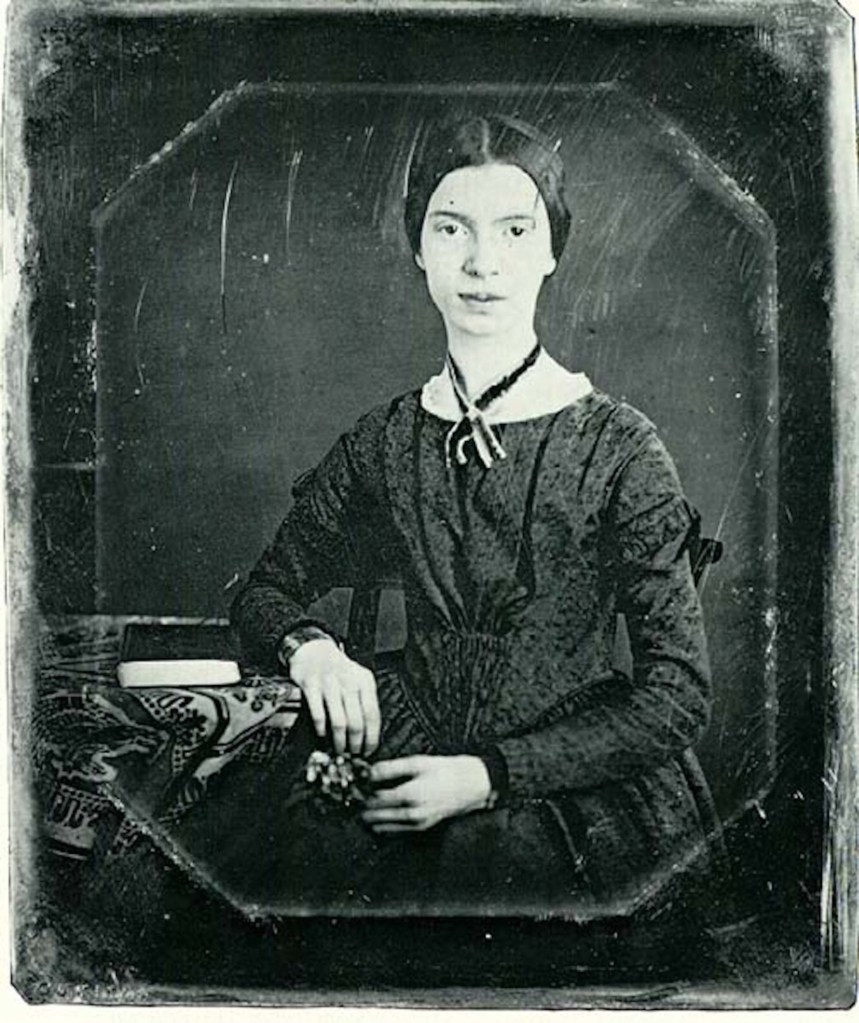
    Image: Emily Dickinson – Amherst College – Daguerrotype of the poet at age 17, circa 1847 – likely the only authentic, extant likeness of the poet

    Emily Dickinson’s “Awake ye muses nine, sing me a strain divine”

    The first poem in  Thomas H. Johnson’s The Complete Poems of Emily Dickinson is a Valentine aimed at persuading a young man to marry and is quite atypical of the poet’s style in her canon of 1,775 poems.

    Introduction with Text of “Awake ye muses nine, sing me a strain divine”

    In The Complete Poems of Emily Dickinson, edited and returned to Dickinson’s idiosyncratic style by Thomas H. Johnson, the first poem sports a whopping 40 lines of 20 riming couplets.   It is Dickinson’s longest published poem and departs in style greatly from the remaining 1,774 in the volume.

    Emily Dickinson’s “Awake ye muses nine, sing me a strain divine” begins with a traditional invocation to the muses; however, instead of displaying in  quatrains, as most of the poet’s poems do, it rests as a single lump chunk down the page.  

    The poet’s Germanic influenced capitalization of nouns and her many sprinklings of dashes are missing; yet, she does insert two dashes into the last three lines. Dickinson’s speaker addresses a young man, urging him to choose a young lady and propose marriage to her.  

    The central theme of this piece plays out in a similar manner to the Shakespeare “Marriage Sonnets,” in which the speaker is exhorting a young man to marry and produce beautiful offspring.   However, the Dickinson poem remains a playful piece focusing on the Valentine season, while the Shakespeare “Marriage Sonnets” remain quite serious in their urgency.

    Richard B. Sewall’s The Life of Emily Dickinson has asserted that the young gentleman addressed in this poem is Elbridge Bowdoin, a partner in the Dickinson father’s law firm.  

    The poet’s Valentine was sent in 1850 in a book that she was returning to Bowdoin.   The poem seems to be quite flirtatious. Bowdoin, nevertheless, did not appear to take notice. It seems he snubbed the advice in the poem by remaining a life-long bachelor.

    Awake ye muses nine, sing me a strain divine

    Awake ye muses nine, sing me a strain divine,
    Unwind the solemn twine, and tie my Valentine!

    Oh the Earth was made for lovers, for damsel, and hopeless swain,
    For sighing, and gentle whispering, and unity made of twain.
    All things do go a courting, in earth, or sea, or air,
    God hath made nothing single but thee in His world so fair!
    The bride, and then the bridegroom, the two, and then the one,
    Adam, and Eve, his consort, the moon, and then the sun;
    The life doth prove the precept, who obey shall happy be,
    Who will not serve the sovereign, be hanged on fatal tree.
    The high do seek the lowly, the great do seek the small,
    None cannot find who seeketh, on this terrestrial ball;
    The bee doth court the flower, the flower his suit receives,
    And they make merry wedding, whose guests are hundred leaves;
    The wind doth woo the branches, the branches they are won,
    And the father fond demandeth the maiden for his son.
    The storm doth walk the seashore humming a mournful tune,
    The wave with eye so pensive, looketh to see the moon,
    Their spirits meet together, they make their solemn vows,
    No more he singeth mournful, her sadness she doth lose.
    The worm doth woo the mortal, death claims a living bride,
    Night unto day is married, morn unto eventide;
    Earth is a merry damsel, and heaven a knight so true,
    And Earth is quite coquettish, and beseemeth in vain to sue.
    Now to the application, to the reading of the roll,
    To bringing thee to justice, and marshalling thy soul:
    Thou art a human solo, a being cold, and lone,
    Wilt have no kind companion, thou reap’st what thou hast sown.
    Hast never silent hours, and minutes all too long,
    And a deal of sad reflection, and wailing instead of song?
    There’s Sarah, and Eliza, and Emeline so fair,
    And Harriet, and Susan, and she with curling hair!
    Thine eyes are sadly blinded, but yet thou mayest see
    Six true, and comely maidens sitting upon the tree;
    Approach that tree with caution, then up it boldly climb,
    And seize the one thou lovest, nor care for space, or time!
    Then bear her to the greenwood, and build for her a bower,
    And give her what she asketh, jewel, or bird, or flower –
    And bring the fife, and trumpet, and beat upon the drum –
    And bid the world Goodmorrow, and go to glory home!

    Commentary on “Awake ye muses nine, sing me a strain divine”

    The first poem in Emily Dickinson’s Complete Poems is a Valentine aimed at persuading a young man to marry and is quite atypical of the poet’s style in her canon of 1,775 poems.

    First Movement:  Invocation to the Muses

    Awake ye muses nine, sing me a strain divine,
    Unwind the solemn twine, and tie my Valentine!

    Oh the Earth was made for lovers, for damsel, and hopeless swain,
    For sighing, and gentle whispering, and unity made of twain.

    The ancient epics of Homer and Virgil begin with an invocation to the muse, wherein the speaker asks for guidance as he narrates his tales of adventure.   In her Valentine poem, Emily Dickinson has playfully added an invocation to all nine muses to help her with her little drama aimed at the young man for the Valentine season.

    Dickinson has her speaker command all nine muses to wake up and sing her a little ditty that she may relay to inflame her Valentine’s heart to do as she requests.  She then begins by describing how things of the earth all come in pairs.  

    One part of the pair seeks and unites with the other: the damsel is courted by the “hopeless swain” and there is whispering and sighing as a “unity” brings the “twain” together.

    Second Movement:   Earth Creatures Pair Up

    All things do go a courting, in earth, or sea, or air,
    God hath made nothing single but thee in His world so fair!
    The bride, and then the bridegroom, the two, and then the one,
    Adam, and Eve, his consort, the moon, and then the sun;
    The life doth prove the precept, who obey shall happy be,
    Who will not serve the sovereign, be hanged on fatal tree.
    The high do seek the lowly, the great do seek the small,
    None cannot find who seeketh, on this terrestrial ball;
    The bee doth court the flower, the flower his suit receives,
    And they make merry wedding, whose guests are hundred leaves;
    The wind doth woo the branches, the branches they are won,
    And the father fond demandeth the maiden for his son.
    The storm doth walk the seashore humming a mournful tune,
    The wave with eye so pensive, looketh to see the moon,
    Their spirits meet together, they make their solemn vows,
    No more he singeth mournful, her sadness she doth lose.
    The worm doth woo the mortal, death claims a living bride,
    Night unto day is married, morn unto eventide;
    Earth is a merry damsel, and heaven a knight so true,
    And Earth is quite coquettish, and beseemeth in vain to sue.

    After alluding to a human pair, the speaker then narrates her observation that everything on this earth seems to be courting its mate, not only on dry land but also in the “sea, or air.”  In the next twenty or so lines, she supplies an abundant sampling of things of the earth that pair up.  

    She exaggerates for comedic affect that God has made nothing in the world “single” except for the target of her discourse, who is the young man. The speaker then tells the young man that the bride and bridegroom pair up and become one.  Adam and Eve represent the first pair, and then there is the heavenly united pair, the sun and the moon.  

    And those who follow the precept of coupling live happily, while those who avoid this natural act end up “hanged on fatal tree.”  Again, she is exaggerating for the fun of it! The speaker then assures the young man that no one who looks will not find.  After all, the earth as she has said, was “made for lovers.”  

    She then begins her catalogue of earth things that make up the two part of a unified whole:  the bee and flower marry and are celebrated by a “hundred leaves.”  In two masterful lines, the speaker creates a metaphorical and symbolic wedding of bee and flower:   “The bee doth court the flower, the flower his suit receives, / And they make merry wedding, whose guests are hundred leaves.”

    The speaker continues the catalogue of earth things that make up a unified pair:  the wind and the boughs, the storm and the seashore, the wave and the moon, night and day.  

    She sprinkles in references to the human realm with such lines as, “the father fond demandeth the maiden for his son,” “The worm doth woo the mortal, death claims a living bride,” and “Earth is a merry damsel, and heaven a knight so true.”

    With the line regarding the worm wooing the mortal, the speaker, similar to the Shakespearean speaker, is reminding her target that life on this planet does not last forever, and each human physical encasement is subject to death and decay.   It is because of this plight that she is urging the young man not to allow his life to speed by without fulfilling his duty as part of a unified couple.

    Third Movement:  Thus It Follows That

    Now to the application, to the reading of the roll,
    To bringing thee to justice, and marshalling thy soul:
    Thou art a human solo, a being cold, and lone,
    Wilt have no kind companion, thou reap’st what thou hast sown.
    Hast never silent hours, and minutes all too long,
    And a deal of sad reflection, and wailing instead of song?

    Now, the speaker announces what has to happen because of her description of  the way life goes “on this terrestrial ball.”  The single man must be brought to justice.    The speaker then remarks bluntly, “Thou art a human solo,” along with a melancholy description of unhappiness that being alone can bring.  She rhetorically asks if he does not spend many hours and sad minutes of reflecting on this situation.

    Of course, she is implying that she knows he does wallow in this sorrowful state, and thus she has the antidote for eliminating all the miserable melancholy.  She will turn his melancholic “wailing” back into “song.”  If only he will follow her sage advice, he will become the happy soul he wishes to be.

    Fourth Movement:   A Shakespearean Command

    There’s Sarah, and Eliza, and Emeline so fair,
    And Harriet, and Susan, and she with curling hair!
    Thine eyes are sadly blinded, but yet thou mayest see
    Six true, and comely maidens sitting upon the tree;
    Approach that tree with caution, then up it boldly climb,
    And seize the one thou lovest, nor care for space, or time!
    Then bear her to the greenwood, and build for her a bower,
    And give her what she asketh, jewel, or bird, or flower —
    And bring the fife, and trumpet, and beat upon the drum —
    And bid the world Goodmorrow, and go to glory home!

    The speaker now names six young damsels—Sarah, Eliza, Emeline, Harriet, and Susan; she refers to the sixth young damsel—herself—without naming her, only that she is “she with curling hair.”  

    The speaker opines that any one of these young ladies is fit to become a valuable partner for her solo, sad, single young man. The speaker commands the young bachelor to choose one and take her home to be his wife.  

    In order to make that demand, she creates a little drama by having the ladies situated up in a tree. She commands the young man to climb the tree boldly but with caution, paying no attention to “space, or time.”

    The young man then is to select his love and run off to the forest and build her a “bower” and lavish upon her what she wishes, “jewel, or bird, or flower.”  After a wedding of much music and dancing, he and his bride will flit away in glory as they head home.
  • Emily Dickinson’s “Winter is good – his Hoar Delights”

    Image: Emily Dickinson – Amherst College – Daguerrotype of the poet at age 17, circa 1847 – likely the only authentic, extant likeness of the poet

    Emily Dickinson’s “Winter is good – his Hoar Delights”

    For Emily Dickinson, the seasons offered ample opportunities for verse creation, and her love for all of the seasons is quite evident in her poems.  However, her poetic dramas become especially deep and profound in her winter poems.

    First Winter Poem: “Winter is good – his Hoar Delights”

    Emily Dickinson creates speakers who are every bit as a tricky as Robert Frost’s tricky speakers. Her two-stanza, eight-line lyric announcing, “Winter is good” attests to the poet’s skill of seemingly praising while showing disdain in the same breath.

    The rime scheme of “Winter is good – his Hoar Delights” enforces the slant rime predilection with the ABAB approximation in each stanza.  All of the rimes are near or  slant in the first stanza, while the second boasts a perfect rime in Rose/goes.

    Winter is good – his Hoar Delights

    Winter is good – his Hoar Delights
    Italic flavor yield –
    To Intellects inebriate
    With Summer, or the World –

    Generic as a Quarry
    And hearty – as a Rose –
    Invited with Asperity
    But welcome when he goes.

    Commentary on “Winter is good – his Hoar Delights”

    Emily Dickinson loved all of the seasons, and she found them inspiringly colorful in their many differing attributes.  These seasonal characteristics gave this observant poet much material for her creative little dramas.

    First Stanza: Winter’s Buried Charms

    Winter is good – his Hoar Delights
    Italic flavor yield –
    To Intellects inebriate
    With Summer, or the World –

    The speaker claims rather blandly that “Winter is good” but quickly adds not so plainly that his frost is delightful. That winter’s frost would delight one, however, depends on the individual’s ability to achieve a level of drunkenness with “Summer” or “the World.” 

    For those who fancy summer and become “inebriat[ed]” with the warm season’s charms, winter takes some digging to unearth its buried charm.  And the speaker knows that most folks will never bother to attempt to find anything charming about the season they least favor.

    But those frozen frosts will “yield” their “Italic flavor” to those who are perceptive and desirous enough to pursue any “Delights” that may be held there.  The warmth of the Italian climate renders the summer flavors a madness held in check by an other-worldliness provided by the northern climes.

    The speaker’s knowledge of the climate of Italy need be only superficial to assist in making the implications this speaker makes.  Becoming drunk with winter, therefore, is a very different sport from finding oneself inebriated with summer, which can be, especially with Dickinson, akin to spiritual intoxication.

    Second Stanza: Repository of Fine Qualities

    Generic as a Quarry
    And hearty – as a Rose –
    Invited with Asperity
    But welcome when he goes.

    Nevertheless, the speaker, before her hard-hitting yet softly-applied critique, makes it clear that winter holds much to be honored; after all, the season is “Generic as a Quarry / And hearty – as a Rose.”  It generates enough genuine qualities to be considered a repository like a stone quarry that can be mined for all types of valuable rocks, gems, and granite.

    The season is “hearty” in the same manner that a lovely flower is “hearty.” The rose, although it can be a fickle and finicky plant to cultivate, provides a strength of beauty that rivals other blossoms.    That the freezing season is replete with beauty and its motivating natural elements render it a fertile time for the fertile mind of the poet.

    But despite the useful and luxuriant possibilities of winter, even the mind that is perceptive enough to appreciate its magnanimity has to be relieved when that frozen season leaves the premises or as the speaker so refreshingly puts it, he is “welcome when he goes.” The paradox of being “welcome” when “he goes” offers an apt conclusion to this tongue-in-cheek, left-handed praise of the coldest season.  

    The speaker leaves the reader assured that although she recognizes and even loves winter, she can well do without his more stark realities as she welcomes spring and welcomes saying good-bye to the winter months.

    Full Image: Emily Dickinson – Amherst College – Daguerrotype of the poet at age 17, circa 1847 – likely the only authentic, extant likeness of the poet
  • Emily Dickinson’s “Joy to have merited the Pain”

    Image: Emily Dickinson – Amherst College – Daguerrotype of the poet at age 17, circa 1847 – likely the only authentic, extant likeness of the poet

    Emily Dickinson’s “Joy to have merited the Pain”

    Emily Dickinson’s speaker declares then elucidates her declaration that having seriously earned, or “merited” pain, is a marvelous, soul-enriching experience, leading to ultimate liberation into Spirit. 

    Introduction and Text of “Joy to have merited the Pain”

    On first reflection, it is unlikely that the notion of earned pain is ever welcome to the human mind and heart or that any pain can ever be accepted.  But on second thought and possibly after some delving into the nature of Spirit and Its relationship to a fallen world, the idea becomes well founded and completely comprehensible.

    The mind and heart crave pure solace but find achieving that exalted state fraught with obstructions.  This speaker offers her hard won experience with that journey as she dramatizes the thrill of seeking and the ultimate winning of that goal.  Her mystical proclivities enhance her skills as she offers consolation on every level of spiritual awareness.

    Joy to have merited the Pain

    Joy to have merited the Pain–
    To merit the Release–
    Joy to have perished every step–
    To Compass Paradise–

    Pardon–to look upon thy face–
    With these old fashioned Eyes–
    Better than new–could be–for that–
    Though bought in Paradise–

    Because they looked on thee before–
    And thou hast looked on them–
    Prove Me–My Hazel Witnesses
    The features are the same–

    So fleet thou wert, when present–
    So infinite–when gone–
    An Orient’s Apparition–
    Remanded of the Morn–

    The Height I recollect–
    ‘Twas even with the Hills–
    The Depth upon my Soul was notched–
    As Floods–on Whites of Wheels–

    To Haunt–till Time have dropped
    His last Decade away,
    And Haunting actualize–to last
    At least–Eternity–

    Commentary on “Joy to have merited the Pain”

    Emily Dickinson’s speaker announces and then elucidates her declaration that the act of having earned (“merited”) pain, is a marvelous, soul-enriching experience, which leads ultimately to liberation into Spirit.

    Stanza 1:  Joy Eliminates Pain

    Joy to have merited the Pain–
    To merit the Release–
    Joy to have perished every step–
    To Compass Paradise–

    The speaker is affirming that earned pain fades into joy.  It gains a vivid, long liberation of the soul.  At every step of the transitioning process from lack of vision to full sight, the joy seems to dissolve the soul in a marvelous unity–Spirit and soul becoming one.

    Of course, the individual soul and the Over-Soul are always locked in an unbreakable unity, but the curse of delusion or Maya placed on a fallen world renders the human mind incapable of comprehending that unity until it regains that vision through inner stillness and concentration.  

    The burden of living in a fallen world weighs heavy on each perfect soul, situated in a physical encasement and a mental body that remain in a state of perdition, neither comprehending its perfection, nor for some even being intellectually aware that it possesses such perfection.  Paradise will remain on the horizon, though, until the seeker takes notice and begins that journey toward its goal.

    Stanza 2:  The Ephemeral Becomes Concrete

    Pardon–to look upon thy face–
    With these old fashioned Eyes–
    Better than new–could be–for that–
    Though bought in Paradise–

    The speaker now affirms that she has become aware of her eyes growing strong, after she has been absolved from certain errors of thought and behavior. She is now capable of peering into the ancient eye with her own “old fashioned eyes.” 

    The speaker’s transformation has improved her ability to discern certain worldly ways, and she will not long brook those wrong manners that limit her ability to adopt new spiritual steps.

    The speaker is becoming aware that she can realize perfectly, that Paradise can become and remain a tangible place.  That seemingly ephemeral place can become as concrete as the streets of the city, or the hills of the country.

    Stanza 3:  From Dim Glimpses of the Past

    Because they looked on thee before–
    And thou hast looked on them–
    Prove Me–My Hazel Witnesses
    The features are the same–

    The speaker confirms that she has, in fact, in the dim past glimpsed the face of the Divine Reality, and that glimpse has already atoned for the fallen state, in which she now finds herself.

    She has now become completely in possession of the knowledge that her “Hazel” eyes were, in fact, witnesses to the great unity for which she now urgently seeks reentry.  The sacred sight of the Divine Seer and the practicing, advancing devotee are one and the same.

    This knowledge delights the speaker who has already admitted that it was indeed “Pain” that nudged her on to seeking final relief.   The human heart and mind crave on every level of being the final elimination of both physical and mental pain and suffering. When a soul finds itself transitioning from the fallen world to the uplifted world of “Paradise,” it can do no less than sing praises of worship.

    Stanza 4:  The Consummation of the Infinite

    So fleet thou wert, when present–
    So infinite–when gone–
    An Orient’s Apparition–vRemanded of the Morn–

    The speaker avers that the Divine Belovèd forever consumes all time, as It continues to remain infinitely present.  The Blessèd One never strays, though Its creation may stray far and wide.

    Just as the sun rises in the East to explain morning to the day, the rising from having fallen provides a soothing balm of gladness to the human heart and mind living under a cloud of doubt and fear.  

    Each soul that has earned its liberation through great pain can offer testimony to the sanctity of having regained the “Paradise” that was lost, despite the temporary nature of all that went before.

    Stanza 5:  Highest Level of Awareness

    The Height I recollect–
    ‘Twas even with the Hills–
    The Depth upon my Soul was notched–
    As Floods–on Whites of Wheels–

    The speaker now reveals that she has evoked the highest level of awareness, that is, she has determined that she will pursue the ultimate range of vision.  She compares the highest sight to the “Hills,” finding that they are “even.”  And the valley below that had “notched” her soul seemed to flood her consciousness, as water does as it splashes upon the wheels of a carriage.

    Still the speaker is aware that her own voice can speak inside the darkest shadow that earth life has to reflect.  She determines not only to be a spectator of events but to fully interact with all that might bring her closer to her goal.

    This observant speaker knows that she has the ability to comprehend the nature of fallen earth creations, but she also continues to be stung by the facile observations that only limit each soul and denigrate each thought that would seek to alleviate the misery and tainted status of the fallen mind.

    Stanza 6:  Transcending Space and Time

    To Haunt–till Time have dropped
    His last Decade away,
    And Haunting actualize–to last
    At least–Eternity–

    The speaker continues her effort to transcend spiritually all space and time.  Each year drops eternally into the ghost-day and feather-night.  And, of course, they all are on their individual journeys through  that space and time.

    The speaker has taken the task of “Haunting” all the unselfrealized minds and hearts that cross her path, whether by night or day.  As the decades speed by, she intends to ride each moment into the utmost reality until it yields that creature whose head is toward eternity, like those horses in, “Because I could not stop for Death.”

  • Emily Dickinson’s “I had a guinea golden”

    Image: Emily Dickinson – Amherst College – Daguerrotype of the poet at age 17, circa 1847 – likely the only authentic, extant likeness of the poet

    The speaker in Emily Dickinson’s “I had a guinea golden” is expressing melancholy at the loss of a friend, whom she describes metaphorically in terms of three dear objects: a guinea, a robin, and a star.

    Introduction with Text of “I had a guinea golden”

    This fascinating Emily Dickinson poem of loss offers quite a tricky subversion of thought.  The first three stanzas seem to explain the loss of three separate loved ones. 
    Then the final stanza packs a wallop unloading on only one “missing friend,” who has caused the speaker to create this “mournful ditty” with tears in her eyes.

    This poem demonstrates the depth of Dickinson’s education as she employs metaphors of the British coinage system and allusions to Greek mythology, which has been further employed by the science of astronomy to name stars. 

    Not only did Dickinson study widely in many subject areas, she possessed the ability to employ her learning in creative ways to fashion those beautiful flowers, allowing them to grow in her garden of verse.

    I had a guinea golden

    I had a guinea golden –
    I lost it in the sand –
    And tho’ the sum was simple
    And pounds were in the land –
    Still, had it such a value
    Unto my frugal eye –
    That when I could not find it –
    I sat me down to sigh.

    I had a crimson Robin –
    Who sang full many a day
    But when the woods were painted,
    He, too, did fly away –
    Time brought me other Robins –
    Their ballads were the same –
    Still, for my missing Troubador
    I kept the “house at hame.”

    I had a star in heaven –
    One “Pleiad” was its name –
    And when I was not heeding,
    It wandered from the same.
    And tho’ the skies are crowded –
    And all the night ashine –
    I do not care about it –
    Since none of them are mine.

    My story has a moral –
    I have a missing friend –
    “Pleiad” its name, and Robin,
    And guinea in the sand.
    And when this mournful ditty
    Accompanied with tear –
    Shall meet the eye of traitor
    In country far from here –
    Grant that repentance solemn
    May seize upon his mind –
    And he no consolation
    Beneath the sun may find.

    Reading 

    Commentary on “I had a guinea golden”

    Each stanza builds to a magnificent crescendo of outrage that allows the speaker to lavish affection as well as harsh rebuke to the one leaving her in a state of melancholy.

    First Stanza:  The Value of Small Things

    I had a guinea golden –
    I lost it in the sand –
    And tho’ the sum was simple
    And pounds were in the land –
    Still, had it such a value
    Unto my frugal eye –
    That when I could not find it –
    I sat me down to sigh.

    The speaker begins by referring to the coin “guinea,” which was a British coin manufactured with the gold from the African nation of Guinea.  The coin was worth 21 shillings and ceased circulating in 1813.   The speaker maintains the British monetary metaphor by referring also to “pounds” in the fourth line of the poem.

    Metaphorically, the speaker is calling her lost friend a “golden” coin, which she lost “in the sand.”  She then admits that it was a small loss for much more valuable moneys—”pounds”—were all about her.   Nevertheless, to her, because of her frugality, the value of the small coin was huge, and because it was lost to her, she just “sat down to sigh.”

    Second Stanza:  Missing the Music

    I had a crimson Robin –
    Who sang full many a day
    But when the woods were painted,
    He, too, did fly away –
    Time brought me other Robins –
    Their ballads were the same –
    Still, for my missing Troubador
    I kept the “house at hame.”

    The speaker then employs the metaphor of “crimson Robin.”  This time she is likening her friend to the singing robin who “sang full many a day.”  But when the autumn of the year came around, she loses this friend also.

    Just as other moneys were abounding after the loss of a simple guinea, other robins presented themselves to the speaker after she lost her robin.  But even though they sang the same songs as her lost robin, it just was not the same for the speaker.   She continues to mourn the loss of her robin; thus she kept herself harnessed to her house, likely in case her own robin should show up again.

    Third Stanza:  The Mythology of Science

    I had a star in heaven –
    One “Pleiad” was its name –
    And when I was not heeding,
    It wandered from the same.
    And tho’ the skies are crowded –
    And all the night ashine –
    I do not care about it –
    Since none of them are mine.

    The speaker then finds herself once again mourning the loss of a loved one.  This one she labels “Pleiad.”  Pleiad is an allusion to Greek mythology but also a reference to astronomy.  

    In Greek mythology, the seven daughters of Atlas went into hiding up in the sky among the stars to escape being pursued by Orion.  One the seven seems to disappear perhaps out of shame or grief.  

    In the science of astronomy, the constellation known as Taurus features a group of seven stars, but oddly enough only six can be seen, resulting in the same “Lost Pleiad” as exists in the Greek myth.

    Dickinson, who studied widely the subjects of mythology, history, and science thus alludes to the myth of the “Lost Pleiad” to again elucidate the nature of her third lost beloved.   She has now experienced the loss of money, a bird, and now a star–each more precious than the last.

    The speaker loses the star as she was being heedless–not paying attention.  In her negligent state, her star wanders away from her.  Again, although the sky is full of other stars, they just don’t measure up because “none of them are mine.”

    Fourth Stanza:  Admonishing a Traitor

    My story has a moral –
    I have a missing friend –
    “Pleiad” its name, and Robin,
    And guinea in the sand.
    And when this mournful ditty
    Accompanied with tear –
    Shall meet the eye of traitor
    In country far from here –
    Grant that repentance solemn
    May seize upon his mind –
    And he no consolation
    Beneath the sun may find.

    While wildly famous for her riddles, Dickinson often breaks the riddle’s force by actually naming the object described.  In the final stanza, she blatantly confesses that her little story “has a moral.”  She then blurts out, “I have a missing friend.”  

    It is now that the reader understands the loss is not three different loved ones, but only one.  She has thus been describing that “missing friend” using three different metaphoric images.

    Now, however, she has a message for this friend whose description has revealed multiple times how much she misses the friend and laments the loss.   After again rather baldly admitting her sorrow told in “this mournful ditty” and even “[a]ccompanied with tear,” she refers to that missing friend as a “traitor.”

    If this friend who has betrayed her happens to see this “mournful ditty,” she hopes that it will grab that individual’s mind so that the person will experience “repentance solemn.”  Furthermore, she wishes that the friend be unable to find any solace for the individual’s contrition no matter where that friend goes.

  • Emily Dickinson’s “The Soul selects her own Society”

    Image: Emily Dickinson – Amherst College – Daguerrotype of the poet at age 17, circa 1847 – likely the only authentic, extant likeness of the poet

    Emily Dickinson’s “The Soul selects her own Society”

    Emily Dickinson’s “The Soul selects her own Society” portrays the nature of individual self-sufficiency, spiritual power, and the deliberate choice of isolation over social engagement.  The result is a positive statement that the strength of the soul remains ascendent, despite a world of chaos.

    Introduction and Text of “The Soul selects her own Society”

    In only three innovative quatrains, Emily Dickinson’s poem, “The Soul selects her own Society,” reveals the power of the soul’s skill in selecting its companions and rejecting external influences.  

    This profound theme is one of many that similarly focus on issues of individuality in Dickinson’s 1775 span of poems. The poet grappled with questions of personal autonomy and the inner life by creating speakers who address those inquiries in unique, strong voices.

    Emily Dickinson’s themes, poetic techniques, as well as the cultural and philosophical contexts that inform her poems all lend heft to the notion that the poet remained steadfast in her determination to live deliberately and independently.

    The claims that Dickinson’s speaker makes about the soul’s choices illuminate this poem’s celebration of individuality, and those claims offer a subtle critique of societal pressures. This important theme can be found in a number of Dickinson’s poems. The poet continued to create speakers who share her love of privacy.

    The Soul selects her own Society –

    The Soul selects her own Society –
    Then – shuts the Door –
    To her divine Majority –
    Present no more –

    Unmoved – she notes the Chariots – pausing –
    At her low Gate –
    Unmoved – an Emperor be kneeling
    Upon her Mat –

    I’ve known her – from an ample nation –
    Choose One –
    Then – close the Valves of her attention –
    Like Stone –

    Commentary on “The Soul selects her own Society”

    Emily Dickinson’s “The Soul selects her own Society” stands as the emblematic poem for not only the poet’s entire oeuvre but also for her life choice of isolation as well.  She continued to create speakers, whose voices remain strong and unique.  Her elliptical, minimalist expressions demonstrate an economy of language use seldom experienced to such a high degree.

    First Stanza: The Soul’s Decision

    The Soul selects her own Society –
    Then – shuts the Door –
    To her divine Majority –
    Present no more –

    The first stanza establishes the soul’s autonomy and power as the target of the poem. Dickinson’s speaker is personifying the soul as a feminine being, a choice that comports with her frequent portrayal of the self as an introspective consciousness. 

    The verb “selects” remains essential in distinguishing a deliberate act of choice. Unlike passive acceptance or arbitrary selection, the soul’s decision to choose its “Society” reflects a profound exercise of individual agency and strength. 

    The capitalization of “Soul” and “Society” ennobles these terms, attesting to spiritual and metaphysical power.  “Society” indicates a selected group of companions that the soul deems worthy of its attention.

    The second line, “Then – shuts the Door,” introduces an intense metaphor of exclusion. The act of shutting the door symbolizes the rejection of all that lies outside the soul’s chosen circle. 

    This exclusionary image invokes both physical and psychological barriers, making clear that the soul’s decision is not merely a preference but instead remains a absolute act of isolation. 

    The door, a boundary between the inner and outer worlds, becomes an instrument of both inclusion and exclusion, emphasizing the soul’s desire for control over its environment.

    The phrase “divine Majority” in the third line refers to a spiritual unity, such as a divine assembly representing the will of a Higher Power, and the soul accepts that “Majority” and its divinity as evidence of its own affirmative judgment. 

    The “divine Majority” also includes tangentially certain members of the broader societal collective–family and friends–on the earth plane, implying that the soul dismisses the opinions or expectations of the masses but accepts willingly and graciously all those who understand and respect the choices of the speaker.   

    The adjective “divine” imbues this majority with a sacred quality that it must possess, if the speaker is to sanction it.  The final line, “Present no more,” reinforces the irrevocability of this decision. The soul’s chosen society is now its sole focus, and all others are rendered absent, both physically and metaphysically.

    Interestingly, the word “present” can be interpreted as either an adjective or a verb, but either interpretation results in the same meaning of the phrase in this context.  As a verb, it is a command, “Offer no more suggestions for my perusal.”   As an adjective, the speaker is making the simple statement that other than her chosen “divine Majority,” no further admittance is allowed; her group remains complete.

    Dickinson’s use of her liberal spray of dashes throughout the stanza creates a spacing  rhythm, mirroring the deliberate and measured nature of the soul’s actions. These pauses invite readers or listeners to linger on each phrase, reflecting the weight of the soul’s choices. 

    The stanza’s brevity and syntactic compression further enhance its impact, distilling complex ideas into a few carefully chosen words. By framing the soul’s selection as both an act of inclusion and exclusion, the speaker has set the stage for the poem’s expression of individualism and its consequences.

    Second Stanza: Resisting External Influence

    Unmoved – she notes the Chariots – pausing –
    At her low Gate –
    Unmoved – an Emperor be kneeling
    Upon her Mat –

    The second stanza shifts its focus from it affirmative declaration to the soul’s unwavering stance in the face of external temptations, reinforcing the theme of absolute individual sovereignty. 

    The repetition of “Unmoved” at the beginning of the first and third lines serves as a rhetorical anchor, emphasizing the soul’s emotional detachment and unchanging resolve. 

    This word choice suggests not only indifference but also a deliberate refusal to be swayed by external grandeur or authority. The soul’s ability to remain “unmoved” underscores its inner strength, positioning it as a self-sustaining entity invulnerable to worldly, earthly allure.

    The imagery of “Chariots – pausing – / At her low Gate” heralds a scene of pomp and power, seeking entry. Chariots, often associated with military might or royal processions, symbolize societal prestige and influence. 

    This chariots pausing at the soul’s “low Gate” creates a striking contrast between the grandeur of the material world-at-large and the humility of the soul’s inner mystical domain. 

    The adjective “low” suggests simplicity and humility—qualities that perfectly align with Dickinson’s speakers’ recurring portrayal of the self as unpretentious yet profoundly self-aware.  The gate, like the door in the first stanza, functions as a boundary, reinforcing the soul’s control over who may enter its realm.

    The second image of “an Emperor be kneeling / Upon her Mat” magnifies this contrast. The emperor, a figure of supreme authority, is portrayed in a position of supplication—”kneeling” on the soul’s humble mat. 

    This inversion of power dynamics is astonishing: the soul—humble, modest, and tranquil—commands the respect of even the most powerful figures.  The mat, a simple household item, further emphasizes  the soul’s unassuming nature, yet its presence in this context elevates it to a symbol of the soul’s complete sovereignty. 

    The emperor’s kneeling suggests not only deference but also a recognition of the soul’s authority, which transcends all worldly hierarchies. Dickinson’s traditional, abundant splash of dashes in this stanza furthers the pauses, mirroring the soul’s contemplative resistance. Each dash invites the reader to pause and consider the significance of the soul’s indifference to such potent symbols of power. 

    The stanza’s structure, with its parallel clauses beginning with “Unmoved,” reinforces the soul’s consistency and resolve. By juxtaposing the soul’s simplicity with the grandeur of chariots and emperors, the speaker celebrates the power of inner conviction over external splendor, a theme that resonates with the Dickinsonian broader critique of societal conformity.

    Third Stanza: The Final Choice

    I’ve known her – from an ample nation –
    Choose One –
    Then – close the Valves of her attention –
    Like Stone –

    The third stanza shifts to a personal perspective, as the speaker reveals intimate knowledge of the soul’s behavior with the phrase “I’ve known her.” This shift to the first person opens up her deep familiarity, confirming the speaker’s own experience as one who often chooses solitude over societal engagement. 

    The phrase “from an ample nation” implies a vast array of potential companions, whether individuals, ideas, or influences. The word “ample” denotes abundance, yet the soul’s choice is singular and exclusive, as it selects only “One.”  This act of choosing remains both deliberate as well as reductive, narrowing the soul’s focus to a single entity or ideal.

    The metaphor of closing “the Valves of her attention” is particularly salient. The term “Valves” introduces a mechanical image, indicating a controlled and deliberate mechanism for regulating attention.  Unlike the organic imagery of doors or gates, valves imply precision and finality, as if the soul is sealing off its consciousness with mechanical efficacy. 

    The simile, “Like Stone,” further emphasizes this irrevocability, vouchsafing an unyielding, determined state. Stone is nearly immutable and enduring, indicating that the soul’s decision is permanent and secure against change.  This image also carries a sense of weight and stillness, contrasting with the dynamic imagery of chariots and emperors in the previous stanza.

    The stanza’s brevity enhances its impact, as each line dramatically builds toward the final, evocative image of stone. The dashes keep their rhythm punctuating the lines, creating the important pauses that reflect the gravity of the soul’s withdrawal. 

    By framing the soul’s choice as selective—inclusive as well as exclusive—the speaker emphasizes the result of such individual autonomy: the soul expresses its sovereignty, and the less important connection with the broader world is exposed and laid to rest. 

    A Resolute Act of Agency

    Emily Dickinson’s “The Soul selects her own Society” is a masterful exploration of individuality, autonomy, and the consequences of deliberate isolation. Through its three quatrains, the poem traces the soul’s journey from selection to rejection to final withdrawal, each stage completed by a resolute act of agency. 

    The first stanza establishes the soul’s sovereignty through its careful selection of companions, while the second illustrates its resistance to external temptations, and the third underscores the finality of its withdrawal. 

    Dickinson’s use of vivid imagery–doors, gates, chariots, emperors, valves, and stone–creates a rich tapestry of meaning, inviting readers to contemplate the power and cost of personal choice.  The poem’s formal elements, including its concise structure, halting rhythm, and strategic use of dashes, enhance its thematic depth. 

    The dashes, in particular, serve as a stylistic hallmark, creating pauses that mirror the soul’s contemplative resolve and invite readers to engage with the text on a deeper level.

    The capitalization of key terms, such as “Soul,” “Society,” and “Majority,” imbues them with metaphysical significance, elevating the poem’s exploration of individuality to a universal plane.

    Contextually, the poem reflects Dickinson’s own life as a poet who chose solitude over societal engagement. Living in Amherst, Massachusetts, Dickinson maintained a reclusive lifestyle, corresponding with a select few while withdrawing from public life.  This personal context informs the poem’s celebration of inner conviction, as well as its acknowledgment of the isolation that such conviction entails. 

    Philosophically, the poem aligns with transcendentalist ideas of self-reliance, as espoused by contemporaries like Ralph Waldo Emerson, though Dickinson’s perspective is more introspective and less optimistic about the individual’s connection to the broader world.

    Ultimately, “The Soul selects her own Society” is a testament to Dickinson’s ability to distill complex ideas into concise, evocative verse. The poem invites readers to reflect on the nature of choice, the value of autonomy, and the delicate balance between connection and solitude. 

    By portraying the soul as a sovereign entity capable of shaping its own destiny, Dickinson’s speaker has affirmed the power of individuality while acknowledging the profound solitude that accompanies such freedom.

  • Emily Dickinson’s “All these my banners be”

    Image: Emily Dickinson – Amherst College – Daguerrotype of the poet at age 17, circa 1847 – likely the only authentic, extant likeness of the poet

    Emily Dickinson’s “All these my banners be”

    The speaker celebrates the beauty of wildflowers, which metaphorically represent their mystical counterpart in the spiritual garden, created by the speaker’s powerful and fertile imagination.

    Introduction with Text of “All these my banners be”

    Like a garden or landscape imbued with numerous colorful wildflowers, the poetic garden that Emily Dickinson’s speaker is creating holds all of the poet’s numerous, colorful poems.  She celebrates those natural wildflowers as she showcases the permanence of her own creations.

    This speaker, like the Shakespearean speaker, has planted her flag in the ever-existing land of creativity.  In that special spiritual garden, she can plant any flower she chooses and in places where she knows they will continue to shed their perfume to noses and their beauty to eyes, as well as their music to ears.

    All these my banners be

    All these my banners be.
    I sow my pageantry
    In May –
    It rises train by train –
    Then sleeps in state again –
    My chancel – all the plain
    Today.

    To lose – if one can find again –
    To miss – if one shall meet –
    The Burglar cannot rob – then –
    The Broker cannot cheat.
    So build the hillocks gaily
    Thou little spade of mine
    Leaving nooks for Daisy
    And for Columbine –
    You and I the secret
    Of the Crocus know –
    Let us chant it softly –
    “There is no more snow!”

    To him who keeps an Orchis’ heart –
    The swamps are pink with June.

    Reading of “All these my banners be” 

    Commentary on “All these my banners be”

    The speaker is celebrating her spiritual garden of verse, wherein like the beauty of literal wildflowers, the beauty of her poems retain the delicious ability to remain ever existing.

    First Stanza:  Planting Flags of Sacred Beauty

    All these my banners be.
    I sow my pageantry
    In May –
    It rises train by train –
    Then sleeps in state again –
    My chancel – all the plain
    Today.

    On the literal level, the speaker is celebrating wildflowers, claiming them as her nation or state, and implying that she is planting them as one would plant a flag to possess a territory or mark the discovery of some formerly distant land. 

    One may be put in mind of the moon-landing at which time the American astronauts planted the flag of the USA on the moon. Thus, she begins by asserting that all of these flowers are her “banners” or flags.  

    Interestingly, there is a type of Daylily that sports the nickname “Grand Old Flag,” or as my mother referred to them as “Flags.”  These wildflowers grow abundantly along rivers, old country roads, and even along busy highways.  They are quite hardy, so hardy, in fact, that some folks actually disdain their presence and seek to halt their spreading abundance.

    This speaker adores her expanse of wildflowers.  After claiming them as her “banners,” she claims that she is sowing these, her “pageantry,” in the late spring month of May. She colorfully reports that they come shooting up through the earth like trains with a long string of cars that continue to move until they “sleep in state again” or halt from their journey.  

    The speaker then remarks that this bannered, colorful, and divine expanse of land—”all the land”—is her “chancel” today.  Her love and devotion rise to the spiritual level as she calls that “land” metaphorically a “chancel.”

    Second Stanza:  Creating a Mystical Garden

    To lose – if one can find again –
    To miss – if one shall meet –
    The Burglar cannot rob – then –
    The Broker cannot cheat.
    So build the hillocks gaily
    Thou little spade of mine
    Leaving nooks for Daisy
    And for Columbine –
    You and I the secret
    Of the Crocus know –
    Let us chant it softly –
    “There is no more snow!”

    As she eases into the metaphoric level, the speaker first waxes philosophical about losing and missing things—a state of consciousness that refers to the changing of the seasons.

    Seasons with their abundant lush growth on the landscape are routinely followed by seasons in which no growth occurs, and the observer then finds she has lost something that she misses.  

    It remains the duty of this highly creative and talented speaker to eliminate all those pesky periods of losing, and she can do that metaphorically by creating her own sacred, spiritual garden filled with the flowers that are her poems.  

    In her mystically created garden, no “Burglar” can “rob,” and no “Broker” can “cheat.”  Thus, the various flowers named in the stanza stand both for themselves as well as serving as a metaphoric flower representing her poems. 

    The speaker then commands her poetic ability, represented metonymically by the “little spade” which becomes a symbol for her writing, to “build the hillock gaily” or get on with creating these marvelous little dramas that keep her enthralled.  

    That “little spade” carves out “nooks for Daisy” and “for Columbine”—a colorful, fascinating way of asserting that her writing ability produces poems that stand as strong, colorful, and divinely beautiful as those flowers that she names—”Daisy” and “Columbine.”

    The speaker intimates to her “little spade” that they two are privy to the same secret known by “the Crocus,” and she insists that they “chant it softly” in that delicious atmosphere in which “There is no more snow!”  

    The speaker would desire “no more snow” for the simple reason that literal flowers do not spring up in winter.  Thus, she is robbed of their beauty, and she misses them.  And thus the “no more snow” season for her writing has the power to encompass all the seasons, wherein those objects of beauty can continue to grow and flourish and provide beauty.

    Third Stanza:  Perpetual June

    To him who keeps an Orchis’ heart –
    The swamps are pink with June.

    The speaker then again waxes philosophical about her spiritual garden of flowers.  It is an attitude that prevails to cause one to be able to accept the mystical level of being as more alluring and even more beautiful than the physical level that points to it.  

    As the physical level of being, which is created out of atoms and molecules, contains beauty but that beauty fades and is never permanent, the mystical level, which is created out of inextinguishable light, can remain eternally.  

    For the earth-bound human being, the concept of and desire for things to exist eternally remain instilled in the heart, mind, and soul.  For the mystically inclined individual, the “swamps” remain eternally “pink” as though it were always “June.”

    In other words, the individual steeped in spiritual, mystic ardor and filled with creative juices needs only to create a spiritual garden—mystical world—in which permanence does reign eternally.

    Video:  Orange Daylily

  • Emily Dickinson’s “Summer for thee, grant I may be”

    Image: Emily Dickinson – Amherst College – Daguerrotype of the poet at age 17, circa 1847 – likely the only authentic, extant likeness of the poet

    Emily Dickinson’s “Summer for thee, grant I may be”

    Addressing the Divine Belovèd, Emily Dickinson’s speaker prays to remain a special musical and visual spark in the creation of everlasting, eternal, immortal Bliss.

    Introduction with Text of “Summer for thee, grant I may be”

    Many of Emily Dickinson’s poems prominently feature humble prayers to the Blessèd Creator.  As she adored nature’s many sounds and varieties of colors, she sought to feel her connection through the spiritual level of being to all that makes up the created world.  Her favorite season of summer often served as the resplendent muse that allowed her entry into the mystical nature of sound and sight.  

    Although, on their physical level, those sense-tinged images are beautiful and inspiring, Dickinson created characters to demonstrate the profound awareness that a deeper, even more beautiful and inspiring level of existence could be intuited.   As her speakers approach the ineffable, the language grows more intensely mystical, requiring that special reading that all poetry requires but on an ever deeper level.

    Summer for thee, grant I may be

    Summer for thee, grant I may be
    When Summer days are flown!
    Thy music still, when Whipporwill
    And Oriole – are done!

    For thee to bloom, I’ll skip the tomb
    And row my blossoms o’er!
    Pray gather me –
             Anemone –
    Thy flower – forevermore!

    Reading

    Commentary on “Summer for thee, grant I may be”

    Emily Dickinson’s speaker is addressing her Creator, her Heavenly Father (God), praying to retain her special knowledge of musical and visual imagery that have been especially brought into existence for understanding creation through the art of poetry. 

    First Stanza:  Mystical Metaphors

    Summer for thee, grant I may be
    When Summer days are flown!
    Thy music still, when Whippoorwill
    And Oriole – are done!  

    The speaker begins by addressing the Divine Belovèd, imploring the Heavenly Father to allow her continued mystical existence even after the beautiful summer season’s glowing days “are flown!” 

    The inspiration in which she has reveled is exemplified in the music of the “Whippoorwill” and the “Oriole.”   Both the music of the bird songs and the warmth and beauty of a summer day are contained in the mere reference in the half line “Thy music still . . . .”  

    The use of the familiar second person pronouns, thee and thy, hint that the speaker is addressing God.  Only God, the Heavenly Reality, the Over-Soul, is close enough to the individual soul to require such a personally familiar pronoun in the Dickinsonian era of common parlance, as well as in that of present day English. 

    Dickinson’s innate ability to intuit from nature the creative power of the Creator urged the poet in her to build entirely new worlds in which she mentally resided, as her soul overflowed with ever new bliss of knowledge.    Such knowledge did not arrive in pairs of opposites as earthly knowledge does, but rather that state of knowing afforded her direct perception of truth and reality.

    Thus, she employed metaphor as readily as a child employs new and special ways of putting into language concepts he/she has never before encountered.  A useful example of this child-metaphor engagement can be observed when hearing little toddler girl call a hangnail a string.  

    The toddler who had experienced a hangnail but had no name for it still manages to communicate the reality of the hangnail because she does know the nature of both the finger condition and what a string looks like.   Although Dickinson is communicating well beyond earthly reality, she can produce a metaphor for the ineffable as easily as a child can name a hangnail a string.

    Second Stanza:  Rowing in Bliss

    For thee to bloom, I’ll skip the tomb
    And row my blossoms o’er!
    Pray gather me –
             Anemone –
    Thy flower – forevermore!  

    The speaker then offers a very cheeky remark in claiming she will “skip the tomb.”  But she can do so because she has already just revealed the reason for such an ability. The Divine Reality has been blossoming in her.

    She can tout her connection and continued existence through Immortality because she knows her soul is everliving, everlasting, and remains a spark of ever-new power. The speaker then rows her immortal sea craft–the soul–which blooms eternally like the most beautiful flowers that earth has to offer.  

    But even with such knowledge of such power, she remains humble, praying that the Divine Belovèd continues to “gather [her]” as bouquets of other earthly flowers are gathered.  She then names the beautiful flower which metaphorically represents her blossoming soul, “Anemone.” 

    The flower’s musical name as well as variety of colors play in the minds and hearts of readers, as perfect metaphorical representations of the ineffable entity–the ever blissful soul. The minimalism of the Dickinson canon speaks volumes–more than any voluminous text could do.  

    Such an accomplishment belongs to the wisdom of the ages and to the musing, meditative mind that enters the hallways of reality on the astral and causal levels of existence where artists find their most profound inspiration.  

    Those who can turn those inspirations into words will always find an audience down through the centuries as long as this plane of earthly existence continues its twirl through space.

    🕉

    You are welcome to join me on the following social media:
    TruthSocial, Locals, Gettr, X, Bluesky, Facebook, Pinterest 

    🕉

    Share

  • Emily Dickinson’s “There’s been a Death, in the Opposite House”

    Image: Emily Dickinson – Amherst College – Daguerrotype of the poet at age 17, circa 1847 – likely the only authentic, extant likeness of the poet

    Emily Dickinson’s “There’s been a Death, in the Opposite House”

    Emily Dickinson’s “There’s been a Death, in the Opposite House” features a glimpse at the skill of this poet as she speaks through a created character—an adult male looking back at the daunting experience of becoming aware that a neighbor had died.

    Introduction with Text of “There’s been a Death, in the Opposite House”

    The following version of Emily Dickinson’s “There’s been a Death, in the Opposite House” in Thomas Johnson’s The Complete Poems of Emily Dickinson displays the poem as the poet wrote it.  

    Some editors have tinkered with Dickinson’s texts over the years to make her poems look more “normal,” i.e., without so many dashes, capitalizations, and seemingly odd spacing, and in this poem, they convert the fifth stanza into a perfect quatrain.

    Dickinson’s poems, however, actually depend on her odd form to express her exact meaning.  Editors who tinker with her oddities fritter away the poet’s actual achievement.

    There’s been a Death, in the Opposite House

    There’s been a Death, in the Opposite House,
    As lately as Today –
    I know it, by the numb look
    Such Houses have – alway –

    The Neighbors rustle in and out –
    The Doctor – drives away –
    A Window opens like a Pod –
    Abrupt – mechanically –

    Somebody flings a Mattress out –
    The Children hurry by –
    They wonder if it died – on that –
    I used to – when a Boy –

    The Minister – goes stiffly in –
    As if the House were His –
    And He owned all the Mourners – now –
    And little Boys – besides –

    And then the Milliner – and the Man
    Of the Appalling Trade –
    To take the measure of the House –

    There’ll be that Dark Parade –

    Of Tassels – and of Coaches – soon –
    It’s easy as a Sign –
    The Intuition of the News –
    In just a Country Town –

    Reading 

    Commentary on “There’s been a Death, in the Opposite House”

    This poem offers much food for thought: Dickinson’s use of a male character and the perfidy of editors who regularize her text, as well as the events depicted in the narrative.

    Stanza 1:   The House Speaks of Death

    There’s been a Death, in the Opposite House,
    As lately as Today –
    I know it, by the numb look
    Such Houses have – alway –

    The speaker announces that he can tell that a death has occurred in the house just across the street from where he lives.  He then explains that he can tell by the “numb look” the house has, and he intuits that the death has taken place quite recently.

    Note that I have designated that the speaker is male as I call him “he.”  In stanza 3, it will be revealed that the speaker is indeed an adult male, who mentions what he wondered about “when a Boy.”   Thus it becomes apparent that Dickinson is speaking through a character she has created specifically for this little drama.

    Stanza 2:  The Comings and Goings

    The Neighbors rustle in and out –
    The Doctor – drives away –
    A Window opens like a Pod –
    Abrupt – mechanically –

    The speaker then continues to describe the scene he has observed which offers further evidence that a death has recently occurred in that opposite house.  He sees neighbors coming and going.  He sees a physician leave the house, and then suddenly someone opens a window, and the speaker claims that the person abruptly “mechanically” opens the window.

    Stanza 3:  The Death Bed

    Somebody flings a Mattress out –
    The Children hurry by –
    They wonder if it died – on that –
    I used to – when a Boy –

    The speaker then sees why the window was opened: someone then throws out a mattress.  Then gruesomely he adds that it is likely that the person died on that mattress, and the children who are scurrying past the house likely wonder if that is why the mattress was tossed out.  The speaker then reveals that he used to wonder that same thing when he was a boy.

    Stanza 4:  The Mourners Are Owned by Clergy

    The Minister – goes stiffly in –
    As if the House were His –
    And He owned all the Mourners – now –
    And little Boys – besides –

    Continuing to describe the macabre events occurring across the street, the speaker then reports seeing “the Minister” enter the house.  It seems to the speaker that the minister behaves as if he must take possession of everything even “the Mourners”—and the speaker adds that the minister also owns the “little Boys” as well.

    Stanza 5:   That Eerie Funeral Procession

    And then the Milliner – and the Man
    Of the Appalling Trade –
    To take the measure of the House –

    There’ll be that Dark Parade –

    The speaker then reports that the milliner, who will dress the body, has arrived.  Then finally the mortician, who will measure both the corpse and the house for the coffin.  The speaker finds the mortician’s “Trade” to be “Appalling.”

    The line “There’ll be that Dark Parade –” is separated from the first three lines of the stanza.  This placement adds a nuance of meaning as it imitates what will happen:  the funeral procession, “Dark Parade,” will separate from the house.  And the line departing from the rest of the stanza demonstrates that action quite concretely and literally.  (More on this below in “Regularizing Emily Dickinson’s Text”)

    Stanza 6:   Intuition Spells News

    Of Tassels – and of Coaches – soon –
    It’s easy as a Sign –
    The Intuition of the News –
    In just a Country Town –

    The speaker then finishes his description of the “Dark Parade” with its “Tassels” and “Coaches” and finally concludes by remarking how easy it is to spot a house whose residents have become mourners.  All those people and events elaborated by the speaker add up to “Intuition of the News” in the simple “Country Town.”

    The Created Character

    The poet has offered a genuine depiction of what is occurring in present time as well as what occurred in the past. And she is doing so using the character of an adult male who is looking back to his memories of seeing such a sight as a child.

    The authenticity of a woman speaking though a male voice demonstrates the mystic as well as poetic skill of this poet to put herself in the persona of the opposite sex in order to create a dramatic event. Poets, however, need not be mystically inclined to achieve this level of authenticity, but certainly not all poets can pull off such a feat.  

    For example, Langston Hughes created a mixed race character in his poem “Cross” and spoke in first person, but his depiction remains questionable as he assigned feelings to a person not of his own ethnicity based solely on stereotypes. 

    Dickinson’s character is offering insights into an event that are not limited to the observations of one sex; a little girl could make those same observations.   Dickinson’s reason for creating a male character to report this event remains unknown, but it is likely she simply felt a more compelling drama could be achieved if her character were a little boy.

    Regularizing Emily Dickinson’s Text

    One of the many arguments over the reclusive 19th century American poet, Emily Dickinson, includes the one directed at editors who regularize Dickinson’s idiosyncratic style—her many dashes, her seemingly haphazard capitalization, and her sometimes irregular use of spacing.

    One can sympathize with those editors who wish to make Emily Dickinson’s poems more palatable for readers, but now and then one can find instances in which the editor’s regularization has limited the poet’s meaning.  That limitation occurs in this poem, “There has been a Death, in the Opposite House.” 

    Poetry textbook editors Louis Simpson (Introduction to Poetry) and Robert N. Linscott (Selected Poems and Letters of Emily Dickinson) alter the text of this Dickinson’s poem in a way that weakens the total impact of the poem. 

    The widely noted textbook editor Laurence Perrine employed that altered form until the ninth edition of his Sound and Sense: An Introduction to Poetry, when he changed it to reflect Dickinson’s meaning more accurately, after reading my explication of the poem in The Explicator

    (Thomas Arp, Perrine’s coeditor, related to me that that change was Perrine’s last editorial decision before turning over the editorship to Arp.)

    Limiting Meaning

    That slight alteration is the omission of the empty line separating the last line of the fifth stanza from the preceding three.  That omission regularizes the stanza, resulting in a poem of six four-line stanzas.   Closing up stanza five gives the poem a uniform appearance but limits Dickinson’s meaning. 

    Considering the meaning of the line that Dickinson separated from the rest of the stanza, I suggest that she had a specific reason for the separation.  The line “There’ll be that Dark Parade” indicates that a funeral procession will soon be seen.  

    The lines preceding this one state that various persons who serve the dead will be appearing, including the “Man / Of the Appalling Trade – / To take the measure of the House.” 

    The funeral procession “that Dark Parade” will occur after the measurement of the house and will literally separate itself from the house; and Dickinson, to show this progression concretely, separated the line from the rest of the stanza, whose last word is “House.” By regularizing Dickinson’s stanza, the editors make her poem look neater, but they eliminate the special nuance of meaning that Dickinson achieved in her original.

    In Thomas H. Johnson’s The Complete Poems of Emily Dickinson, the line is not attached to the previous three, as shown above in the text of the poem.  Johnson restored Dickinson’s poems to their original forms, without intrusions that would change meaning.  

    He did make quiet changes in spelling such as “visiter” to “visitor” and repositioned misplaced apostrophes such as “does’nt” to “doesn’t.” Dickinson’s own handwritten version of the poem can be seen in R. W. Franklin’s The Manuscript Books of Emily Dickinson or on theEmily Dickinson Archive site that clearly shows the poet’s intension that the line be separated from the rest of the stanza.

  • Emily Dickinson’s “The feet of people walking home”

    Image: Emily Dickinson – Amherst College – Daguerrotype of the poet at age 17, circa 1847 – likely the only authentic, extant likeness of the poet

    Emily Dickinson’s “The feet of people walking home”

    In a uniquely dramatic way, Dickinson’s speaker reveals the simple truth that people are happier when they are on their way home.

    Introduction with Text of “The feet of people walking home”

    Emily Dickinson’s “The feet of people walking home” plays out its little drama in three octaves or eight-line stanzas.  Instead of the literal meaning of the word, “home,” this poem employs the figurative meaning as in the old hymn lyric “This World Is Not My Home.”  This Dickinson poem features highly symbolic imagery, while at times seeming to point to things of this physical world. 

    Every image works in service of supporting the claim that each human soul wears “gayer sandals” as it strides toward its permanent “home” in the abode of the Divine Creator.  Again, the Dickinsonian mysticism provides the poet’s speaker with an abundance of mystic meaning garnered from that “Bird” of hers that ventures out and returns with new melodies.

    The feet of people walking home

    The feet of people walking home
    With gayer sandals go  –
    The Crocus  – till she rises
    The Vassal of the snow  –
    The lips at Hallelujah
    Long years of practise bore
    Till bye and bye these Bargemen
    Walked singing on the shore.

    Pearls are the Diver’s farthings
    Extorted from the Sea  –
    Pinions  – the Seraph’s wagon
    Pedestrian once  – as we  –
    Night is the morning’s Canvas
    Larceny  – legacy  –
    Death, but our rapt attention
    To Immortality.

    My figures fail to tell me
    How far the Village lies  –
    Whose peasants are the angels  –
    Whose Cantons dot the skies  –
    My Classics vail their faces  –
    My faith that Dark adores  –
    Which from its solemn abbeys
    Such resurrection pours.

    Reading: 

    Commentary on “The feet of people walking home”

    In a uniquely dramatic way, Dickinson’s speaker reveals the simple truth that people are happier when they are on their way home–especially as they are making progress toward their Divine Abode.

    First Stanza:  Happier on the Way Home

    The feet of people walking home
    With gayer sandals go  –
    The Crocus  – till she rises
    The Vassal of the snow  –
    The lips at Hallelujah
    Long years of practise bore
    Till bye and bye these Bargemen
    Walked singing on the shore.

    A paraphrase of the first two lines of Dickinson’s “The feet of people walking home” might be:  People are happier when they are on their way back to the abode of the Divine Creator.  The physical earthly place called “home” serves as a metaphor for Heaven or the Divine Place where the belovèd Lord resides.  

    That “Divine Place” is ineffable, and therefore has no earthly counterpart, but for most human beings and especially for Emily Dickinson, home is the nearest thing on earth, that is, in this world to the spiritual level of being known as “Heaven.”    So according to this speaker even the shoes of people who are on their way “home” are “gayer,” happier, more peaceful, filled with delight.  

    The speaker then begins to offer support for her claim: the flower exemplified by the “Crocus” is restrained by the “snow” until it pushes up through the ground and displays it marvelous colors.   Similarly, the human soul remains restrained by maya delusion until it pushes up through the dirt of this world to reveal its true colors in God.  

    Those who have practiced meditating on the name of the Divine for many years ultimately find themselves walking and “singing on the shore” like “Bargemen,” who have come ashore after a long haul of work.

    Second Stanza:  The Value of Commodities

    Pearls are the Diver’s farthings
    Extorted from the Sea  –
    Pinions  – the Seraph’s wagon
    Pedestrian once  – as we  –
    Night is the morning’s Canvas
    Larceny  – legacy  –
    Death, but our rapt attention
    To Immortality.

    Further examples of those who are going “home” are divers for pearls who are able to “extort” those valuable commodities “from the sea.”  Again, highly symbolic is the act of diving for pearls.  The meditating devotee is diving for the pearls of love and wisdom that only the Blessed Creator provides his striving children.  

    This image is comparable to the line in the chant by Paramahansa Yogananda “Today My Mind Has Dived”:  “Today my mind has dived deep in Thee / for Thy pearls of love from my depthless sea.”  

    The metaphoric diving for pearls enlivens and strengthens the message regarding the spiritual seeker’s search for God’s wisdom and love.  In both discourses, the “sea” serves as a metaphor for the Divine.   

    The “Seraph” before getting his wings once was confined to walking, not riding in a wagon.  His wings or pinions now serve him as a useful vehicle to alleviate his need to take the shoe-leather express.  “Night” serves the “morning” as a “canvas” on which can be painted taking and giving.  

    If in dreams, the poet can see herself as a channel for providing mystic truths, she will be leaving a “legacy,” but if she has envisioned only selfish wish fulfillment, she will be committing “larceny.”   

    Therefore, as night serves morning, morning serves the soul as it allows expression to blossom.   “Death” is not the end of life, not the life of the soul, because the soul is immortal; therefore, the only purpose for death is to focus the human being’s mind on the ultimate fact of “Immortality.”  Without the duality of death vs immortality, the latter could not be grasped in the physical world on the material plane.

    Third Stanza:  Ultimate Home in Heaven

    My figures fail to tell me
    How far the Village lies  –
    Whose peasants are the angels  –
    Whose Cantons dot the skies  –
    My Classics vail their faces  –
    My faith that Dark adores  –
    Which from its solemn abbeys
    Such resurrection pours.

    The speaker now admits that she has no idea how far away the “Village” is, that is, how far or how long it will take to reach her Ultimate Home in Heaven.   But she then makes sure that her audience knows that she is indeed referring to Heaven when she asserts that Heaven’s “peasants are the angels.”  

    The souls that have already entered that Kingdom of Ineffable Reality have joined the angels.  The speaker then refers to the stars calling them “Cantons” that “dot the skies.”   The speaker is implying that the “Village” she speaks of is full of light, and the only earthly comparison is the stars in the sky.  The speaker reports that her old, established expressions have hidden themselves, as her faith remains cloistered and “solemn.”

    But from those “abbeys” of her faith, she senses that the “resurrection” of her soul is certain, as the pouring out of sunshine from a dark cloud that divides to reveal those marvelous, warm rays.

    Dickinson’s Grammar/Spelling Errors

    Some of Dickinson’s poems contain grammatical and/or spelling errors; for example, in “The feet of people walking home” in line 6,”Long years of practise bore,” she employs the British spelling—a verb form—instead of the noun form “practice,” which is actually required in this phrase.  

    Interestingly, while American English currently uses “practice” for both noun and verb, the British forms use “practice” to function as a noun and “practise” as a verb. It remains unclear why editor Thomas H. Johnson did not quietly correct that error, because he reports in the introduction to his The Complete Poems of Emily Dickinson

    I have silently corrected obvious misspelling (witheld, visiter, etc), and misplaced apostrophes (does’nt).

    However, those errors do tend to give her work a human flavor that perfection would not have rendered.

    The Metaphor of Divinity

    The impossibility of expressing the ineffable has scooped up poets of all ages.   The poet who intuits that only the Divine exists and that all Creation is simply a plethora of manifestations emanating from that Ultimate Reality has always been motivated to express that intuition.  

    But putting into words that which is beyond words remains a daunting task.   Because Dickinson was blessed with a mystic’s vision, she was able to express metaphorically her intuition that the soul of the human being is immortal, even though her sometimes awkward expressions seem to lurch forward in fits and starts.   But many of her best efforts feature the divine drama, which she often plays out in her poems.

  • Emily Dickinson’s “Frequently the woods are pink”

    Image: Emily Dickinson – Amherst College – Daguerrotype of the poet at age 17, circa 1847 – likely the only authentic, extant likeness of the poet

    Emily Dickinson’s “Frequently the woods are pink”

    Emily Dickinson’s “Frequently the woods are pink” offers a fanciful jaunt around the Sun. 

    Introduction with Text of “Frequently the woods are pink “

    Emily Dickinson’s “Frequently the woods are pink” plays out in three quatrains.  Each quatrain presents a unique movement of the poem’s theme which sets out to reveal a changing landscape from spring to winter.

    The unfortunate error in terminology may likely be excused.  The terms “rotation” and “revolution” for the movement of the Earth have become interchangeable in modern parlance.  Dickinson’s  poem seems to reveal that the same interchangeable usage was in effect in her day and age.

    Frequently the woods are pink

    Frequently the woods are pink –
    Frequently are brown.
    Frequently the hills undress
    Behind my native town.
    Oft a head is crested
    I was wont to see –
    And as oft a cranny
    Where it used to be –
    And the Earth – they tell me –
    On its Axis turned!
    Wonderful Rotation!
    By but twelve performed!

    Reading  

    Commentary on “Frequently the woods are pink”

    The observant speaker is reporting her observations, focusing first on the varied colorings that appears in the woods “behind my native town.”   But she does more than that by taking her audience through the year in twelve lines.

    The twelve-line journey takes the speaker and her audience around the Sun, or through a year’s worth of changes in the landscape, one of Dickinson’s favorite subjects.

    First Movement:  The Colorful Woods

    Frequently the woods are pink –
    Frequently are brown.
    Frequently the hills undress
    Behind my native town.

    The speaker in Emily Dickinson’s “Frequently the woods are pink” begins by reporting that often the woods behind where she lives look pink.  The color pink, no doubt, indicates spring with trees, such as the redbud, that open up in the springtime into blossoms and then moving into summer replace their blossoms with leaves.

    Then later the leaves turn brown, and after they leave the trees, that is, the trees “undress” in autumn, they reveal further brown because only the tree trunks and naked branches are visible.

    Second Movement:  Observing a Bird

    Oft a head is crested
    I was wont to see –
    And as oft a cranny
    Where it used to be –

    The speaker reveals that she has frequently observed a bird’s head as she peered into the frequently changing woods.  But then later when she looked, she could detect merely a “cranny” or empty space where that bird’s head had been appearing.  

    The word “crested” identifies the head as bird’s head without the speaker having the employ the word, bird.  The word, “cranny,” indicates how small a space the head of a bird would have occupied.  The report of the viewing a bird’s head and then viewing its former space moves the poem’s theme from merely a seasons poem.    The speaker could likely observe birds in the woods anytime of year.

    Third Movement:  The Reason for the Changes

    And the Earth – they tell me –
    On its Axis turned!
    Wonderful Rotation!
    By but twelve performed!

    In the final movement, the speaker reports the reason for the change in her view, particularly the fact that at times the woods are pink and at other times brown.  The Earth has moved through the year changing seasons as it goes; it has revolved around the Sun and completed one revolution, which causes certain areas of the Earth to experience changing landscape.

    The speaker is in awe of this marvelous change as the Earth has turned, “On its Axis.”  She calls this turn “wonderful.”  And then she claims that only “twelve” had performed this wonderful feat.  

    Of course, those twelve are the twelve months of the year–through that twelve-month period, she has been given the gift of observing a changing landscape that thrills her adventurous soul.

    Regarding the scientific error:  The Earth rotates on its axis once in 24 hours; it revolves around the Sun once in 12 months.  Thus, to be scientifically factual the “Wonderful Rotation!” should be “Wonderful Revolution!”

    Interestingly, the term “revolution” here in conjunction with “wonderful” might sound political in nature.  It is quite possible that Dickinson was satisfied with a slight scientific error to avoid the possibility of being misconstrued.


    A musical rendition of “Frequently the woods are pink”