Linda's Literary Home

Category: Emily Dickinson

  • Emily Dickinson’s “Adrift!  A little boat adrift!”

    Image: Emily Dickinson – Amherst College – Daguerrotype of the poet at age 17, circa 1847 – likely the only authentic, extant likeness of the poet

    Emily Dickinson’s “Adrift!  A little boat adrift!”

    In Emily Dickinson’s skilled employment of paradox and metaphor in her poem “Adrift!  A little boat adrift!,” the speaker offers a complex drama played out seemingly on an earthly ocean but actually performed on the mystical sea, where life remains immortal and eternal.

    Introduction and Text of “Adrift! A little boat adrift!”

    Emily Dickinson enjoyed the riddle essence of poetry.  She often employed that riddle essence in which she implies or directly asks a question.  Other times, she simply offers her rather detailed description and allows the reader to answer.  In this little drama, she elides the physical universe with the spiritual universe.  

    Metaphorically comparing the human being to a “little boat” floating without a guide on the sea of life, she deliberately sinks that boat before resurrecting that drowned life through the agency of the human soul, which cannot be drowned but which possesses all the power of its Creator to demolish all human suffering.

    Adrift! A little boat adrift!

    Adrift! A little boat adrift!
    And night is coming down!
    Will no one guide a little boat
    Unto the nearest town?

    So Sailors say – on yesterday –
    Just as the dusk was brown
    One little boat gave up its strife
    And gurgled down and down.

    So angels say – on yesterday –
    Just as the dawn was red
    One little boat – o’erspent with gales –
    Retrimmed its masts – redecked its sails –
    And shot – exultant on!

    Commentary on “Adrift! A little boat adrift!”

    This little drama offers a useful example of Dickinson’s most intense style, featuring her use of the riddle and her mystic appraisal of the human mind and heart, influenced by the human soul, whose guidance may seem rudderless, until that guidance becomes crucial.

    First Stanza:  Report of Danger

    Adrift! A little boat adrift!
    And night is coming down!
    Will no one guide a little boat
    Unto the nearest town?

    The speaker begins with an exclamation revealing that danger is on the horizon in the form of a small watercraft floating about unguided by a knowing pilot.  Such a situation alerts the reader/listener that all sorts of calamity could ensue. 

    To make matters worse, nightfall is fast approaching.  An unguided vessel drifting into the nighttime brings down a veil of fright and concern.  Again the speaker is exclaiming for again she places the exclamation mark at the end of her brief outcry!

    The speaker then cries for assistance for the little drifting sea craft, but instead of a command, she frames the cry as a question with a negative emphasis, “[w]ill no one . . . ?”  She demonstrates that she suspects there is no one who will chaperone and usher this little vessel to a safe harbor, such as to “the nearest town.”

    The painful negativity suggested by the speaker early on in her little drama foreshadows the ultimate outcome in her conclusion.  She alerts her listeners that a likely catastrophe is on the horizon.  

    But truly alert readers/listeners will suspend judgment until the conclusion is revealed, for Emily Dickinson can be as tricky as any poet writing.  She can out-trick Robert Frost by miles and miles

    Second Stanza:  Disaster

    So Sailors say – on yesterday –
    Just as the dusk was brown
    One little boat gave up its strife
    And gurgled down and down.

    The speaker continues her report of the disastrous fate of this “little boat.”  It has been reported by “Sailors,” those who would know, that this little sea vessel that so valiantly struggled nevertheless gave up the ghost and let the sea take it down into its depths.

    The time of this sinking was dusk when the color of sunset spread its brown, saddening haze upon the land and sea.  The sailors have reported that the vessel simply “gave up” because it could not overcome its “strife.”  

    It gave up its life, its cargo, all that was precious within it.  It gave up and then went down with gurgling sounds–the sound of a living throat taking on water that will ultimately drown it.

    The speaker has created a scenario of such pain and suffering that can only be assuaged with extraordinary finesse.  The sinking of a little boat remains a sorrowful image, and the speaker has seared that painful image into the inner sight of her listeners/readers.  She has dramatized the events surrounding that image in such a way as to heighten the pain and anguish experienced by her audience.

    Third Stanza:  Safety at Last

    So angels say – on yesterday –
    Just as the dawn was red
    One little boat – o’erspent with gales –
    Retrimmed its masts – redecked its sails –
    And shot – exultant on!

    Finally, the speaker quickly pulls the readers/listeners minds from the earthly tragedy on the physical level of existence on which the sinking of a sea craft causes pain and suffering.  Despite what the “Sailors” have reported, there is another report by higher beings that will impart a different engagement, a different outcome of this earthly event.

    Now, the report is brought by “angels.”  The higher, mystical beings are reporting that this event happened the same day as the earthly report “yesterday.”  But the time was early morning when “dawn was red,” setting up a dichotomy from yesterday when “dusk was brown.”

    Instead of merely going down “gurgl[ing],” this little vessel when faced with ferocious “gales,” fought valiantly:  it transformed itself by reshaping it “masts” and reinstalling stronger and better sea-worthy “sails.”  

    And after it completed those repairs, it sped past all earthy danger and triumphantly entered into the realm of mystic life (Christians call it “Heaven”) where no water can drown, no storm can toss, and no pain and suffering can stifle.

    Paradox and Metaphor

    Upon first encounter, the reader will detect what seems to be a contradiction or impossibility because of a reversal of two time periods.  In the second stanza, it is reported that the little boat sank yesterday at “dusk.”  But then in the third stanza, it is reported that the little boat encountered its difficulty yesterday at “dawn.”  

    The resolution of this paradox is accomplished through the realization that on the spiritual, mystical level of being, time remains eminently malleable.  At the time the “little boat” experienced it difficulty, it realized its immortal, eternal aspect.

    It became aware that it is, in fact, a spark of the Eternal, and therefore nothing can harm it.  It realized that stature at dawn, thus by the time dusk had arrived to take its physical form, its mystic/spiritual form–or soul–had moved on.

    This poem may be considered one of Emily Dickinson’s riddle poems. Although it does not seem to call for answering a riddle question, readers cannot fail to grasp that the “little boat” is a metaphor for a human being. 

    This metaphor becomes obvious, however, only after the angels offer their report.  The “little boat” then is revealed to possess the human ability to realize its special power, its mystical spark, and its ability to transcend earthly trials and tribulations.
  • Emily Dickinson’s “If those I loved were lost”

    Image: Emily Dickinson – Amherst College – Daguerrotype of the poet at age 17, circa 1847 – likely the only authentic, extant likeness of the poet

    Emily Dickinson’s “If those I loved were lost”

    The speaker in Emily Dickinson’s “If those I loved were lost” is emphasizing the value she places on her loved ones.  She likens their importance to significant events from the community level to the world stage, where bells ring to announce important happenings.

    Introduction and Text of “If those I loved were lost” 

    Emily Dickinson’s “If those I loved were lost” features two stanzas, each with two movements.  The speaker’s musing targets how the speaker would react to both losing and finding loved ones.  Her emotions and behaviors signal the importance of those loved ones to her.  The value she places on these individuals can only be suggested and not directly stated.

    If those I loved were lost 

    If those I loved were lost
    The Crier’s voice would tell me –
    If those I loved were found
    The bells of Ghent would ring –

    Did those I loved repose
    The Daisy would impel me.
    Philip – when bewildered
    Bore his riddle in!

    Commentary on “If those I loved were lost” 

    This highly allusive poem takes readers from life in a small village to the world stage, on which famous bells herald momentous events.  The allusions emphasize the significance the speaker places on those to whom she refers. 

    First Movement:   An Important Announcement 

    If those I loved were lost
    The Crier’s voice would tell me –

    The speaker is speculating about her emotions and behaviors after having lost a loved one, and then she adds a speculative note about those emotions and behavior as she suddenly has found a beloved. 

    The first movement finds the speaker claiming that the loss of a loved one would herald a “Crier” to announce the event.  In earlier times, a “town crier” was employed to spread local news events on the streets of small villages.   

    The town crier’s position was noticeable because of his manner and elaborate dress:  such a crier might be adorned in bright colors, a coat of red and gold with white pants, a three-cornered hat (tricon), and black boots.  He usually carried a bell that he would ring to attract attention of the citizens.  He often would begin his announcement with the cry, “Oyez!  Oyez!  Oyez!” 

    By making this simple claim that a “crier” would be letting her know about the loss of a loved one, the speaker is elevating the importance of everyone she loves to the status of a noted official or famous name in the community.  

    Second Movement:  The Significance of Loss 

    If those I loved were found
    The bells of Ghent would ring – 

    The speaker then alludes to the famous Ghent Belfry, whose construction began in 1313 with ringing bells to announce religious events, later employed to signal other important occurrences.    

    The inscription on the belfry tower indicates the historical and legendary important of the construction:   “My name is Roland. When I toll there is fire. /  When I ring there is victory in the land.” 

    Dickinson was likely aware of Henry Wadsworth Longfellow’s lines, “Till the bell of Ghent responded o’er lagoon and dike of sand, I am Roland! I am Roland! there is victory in the land!”   

    Because the famous bells ring to herald important events, the speaker assigns great importance to the fact that she has found a loved one.  Thus the speaker has molded her losing and finding those she loves into great and momentous events. 

    Third Movement:  Daisy and Death 

    Did those I loved repose
    The Daisy would impel me.

    The speaker then speculates about her reaction to the death of her loved ones.  She refers to the flower, the “Daisy,” stating that it would “impel her.”  The employment of the Daisy is likely prompted by the flower’s association with growing on graves as in Keats’ reference in the following excerpt from one of his letter to a friend:  

    I shall soon be laid in the quiet grave – thank God for the quiet grave – O! I can feel the cold earth upon me – the daisies growing over me – O for this quiet – it will be my first. 

    And, too, there is the old expression, “pushing up daisies,” of which Dickinson was, no doubt, aware.  The flower would drive her to some of kind reaction which she fails to describe but only hints at.  Although she simply suggests her reaction, she leaves a significant clue in the next movement, as she alludes again to Ghent, this time the leader named Philip.

    Fourth Movement:  The Riddle of Loss

    Philip – when bewildered
    Bore his riddle in!

    The speaker is then alluding to Philip van Artevelde (1340–82), who was a popular Flemish leader. He led a successful battle against the count of Flanders, but later met defeat and death.  The Dickinson household library contained a book with a play that featured Philip’s last words before dying, “What have I done?  Why such a death?  Why thus?”

    Thus the speaker makes it known that she would have many questions as she struggles with the death of a loved one.  She would, like Philip, be overcome, having to bear such a “riddle.” 

    The speaker has shown how important and necessary her loved ones are to her, and she has also demonstrated that their loss would be devastating, and she has done all this through suggestions and hints, without any direct statement of pain and anguish.  All of the sorrow is merely suggested by the high level of importance she is assigning to her loved ones.  

  • Emily Dickinson’s “So has a Daisy vanished”

    Image: Emily Dickinson – Amherst College – Daguerrotype of the poet at age 17, circa 1847 – likely the only authentic, extant likeness of the poet

    Emily Dickinson’s “So has a Daisy vanished”

    The speaker in Emily Dickinson’s “So has a Daisy vanished” wonders if the dead Daisy and other departing plant creatures of the field have gone off to be “with God.” 

    Introduction and Text of “So has a Daisy vanished”

    The speaker of Emily Dickinson’s “So has a Daisy vanished,” who has a keen ability to observe her natural surroundings, has been moved to wonder about the soul of “a Daisy” and many other “slipper[s]” who have given up their physical encasements of beautiful blooms and glorious green stems and simply vanished.  She wonders where they went, as she dramatizes their final days of earthly glory.

    So has a Daisy vanished

    So has a Daisy vanished
    From the fields today –
    So tiptoed many a slipper
    To Paradise away –

    Oozed so in crimson bubbles
    Day’s departing tide –
    Blooming – tripping – flowing
    Are ye then with God?

    Commentary on “So has a Daisy vanished”

    The speaker in this brief drama wonders if the dead Daisy and other departing plant creatures of the field have gone off to be “with God.”

    First Stanza:  A Flower in Heaven

    So has a Daisy vanished
    From the fields today –
    So tiptoed many a slipper
    To Paradise away –

    The speaker begins with a statement informing her readers and listeners that a lovely flower has gone, disappeared “from the fields today.”  She begins with the conjunctive adverb “so,” seeming to indicate that she is merely taking up a thought that began somewhere else and at an earlier interval.   

    Then again employing the telling “so,” the speaker adds that many other flowers have also tripped off to “Paradise.”  Along with the lovely “Daisy,” the other “slipper[s]” have all gone missing, but the speaker suggests that they have metaphorically died and gone to Heaven.  While the “Daisy” has rather generically “vanished,” the others have “tiptoed” off “to Paradise.”

    The speaker is playing with the language of loss, which almost always produces a melancholy in the very sensitive hearts of keen observers.  Instead of merely dying, the flowers vanish from the fields and tiptoe away.  

    That they all have metaphorically gone on to “Paradise” demonstrates that the faith and courage of the sensitive heart of this deep observer are fully operational.  That the speaker allows that these creatures of nature have gone to Heaven or Paradise shows that she has a firm grasp on the existence of the soul as a permanent life force that plants as well as animals possess. 

    This speaker understands that all life is divinely endowed.  The flowers leave behind their physical encasements, but they take their soul encasement and then scurry off to the astral world, from where they will likely return to the Earth or some other planet to continue working out their karma–an eventuality that informs the procedure for the animal kingdom as well.

    Second Stanza:  To Be with the Divine Creator

    Oozed so in crimson bubbles
    Day’s departing tide –
    Blooming – tripping – flowing
    Are ye then with God?

    While the speaker remains aware that plant life force is as eternal as that of the animal kingdom, she is not so sure about where each individual plant goes after its demise.  Thus she wonders if they are “with God.”  

    Likely influenced by the Christian concepts of Heaven and Hell, the speaker no doubt wonders if plant behavior while on Earth may require a reckoning that leads to Heaven or Hell.  That she asks in the more affirmative mood demonstrates her optimistic sensitivity.

    Paramahansa Yogananda has likened life on Earth to vanishing bubbles.  He has explained that many deep thinking philosophers, sages, and poets have realized that the things of this world are like bubbles in the ocean; those individual things such as stars, flowers, animals, and people suddenly appear, experience a life only for a brief period of time, and then they disappear as swiftly as they appeared.

    In his poem, “Vanishing Bubbles,” the great yogi dramatizes that brief earthly sojourn of the myriad life forms, as he unearths the solution for those sensitive minds and hearts that grieve after the loss of those individuals whom they had loved and who yet must vanish like bubbles. 

    And that solution is the simple knowledge that although the physical encasement of each individual has indeed vanished, the soul of each individual continues to exist; therefore, there is no actual vanishing or death.

    The speaker in Dickinson’s poem is suggesting that she is aware of the eternal, everlasting nature of the soul.  After the lovely bloom has been maneuvered into the world on “crimson bubbles,” it will live its brief life, prancing about with the breeze, and then with the “departing tide,” its day will come to an end,  but only for its physical encasement, which it will leave behind.  

    The speaker knows that its soul–its life force–will continue, and she wonders if those souls of all those lovely flowers she has been enjoying will then be “with God.”  That she would ask hints that she believes the answer is yes.

  • Emily Dickinson’s “Morns like these – we parted”

    Image: Emily Dickinson – Amherst College – Daguerrotype of the poet at age 17, circa 1847 – likely the only authentic, extant likeness of the poet

    Emily Dickinson’s “Morns like these – we parted”

    Emily Dickinson loved nature, and birds appear often in her poems, her spiritual garden. She also was quite fond of mystery and riddles. This poem offers an accumulation of evidence that she has observed a bird and then poof! one human act and the bird takes wing!

    Introduction and Text of “Morns like these – we parted”

    Emily Dickinson’s speaker in her riddle-poem, “Morns like these – we parted,” is creating a drama from the act of bird-watching, as the act covers a single day from the time of morning when one bird and she parted company to the act of evening drawing the curtains, simultaneously hearing the bird fly off to its own abode or to wherever it may be taking for its destination.

    The mental gymnastics of the speaker reveals a special gift of qualifying the experience of the human mind, intrigued by the bird’s ability to fly in the freedom of the open skies, indicating that this drama has often played out in the speaker’s mind. 

    Morns like these – we parted

    Morns like these – we parted –
    Noons like these – she rose –
    Fluttering first – then firmer
    To her fair repose.

    Never did she lisp it –
    It was not for me–
    She – was mute from transport –
    I – from agony –

    Till – the evening nearing
    One the curtains drew –
    Quick! A sharper rustling!
    And this linnet flew!


    Commentary on “Morns like these – we parted”

    Emily Dickinson’s “Morns like these – we parted” offers an accumulation of evidence that the speaker has observed a bird and then poof! one human act and the bird takes wing!

    First Stanza:  Observing a Bird

    Morns like these – we parted –
    Noons like these – she rose –
    Fluttering first – then firmer
    To her fair repose.

    Observing the behavior of feathered friends, the speaker reports that on certain mornings she has watched as a bird makes its way heavenward, leaving her earthbound but astounded by the ability of an earth creature to fly through the sky. 

    In addition to morning flights, she has experienced the magic also around noontime.  The creature with wings first may seem to merely “flutter[ ],” but then suddenly with more determined gait glided to its chosen destination.

    Second Stanza:  Experiencing Awe

    Never did she lisp it –
    It was not for me–
    She – was mute from transport –
    I – from agony –

    As the bird begins its magical journey, it does not communicate vocally in song or chirp to the speaker’s presence.  Having nothing to impart to its observer, it merely begins its flight.  The speaker assumes that the bird’s silence is caused merely by her “transport” of the felicity of light.  

    The speaker remains “mute” merely from “agony”—the sudden awareness that one will remain earthbound while this marvelous creature will ascend and vanish skyward.  The earth-bound creatures can only watch, think, muse, and then attempt to recreate the feathered, flying creatures actions in a written composition. 

    Third Stanza:  The Close of a Drama

    Till – the evening nearing
    One the curtains drew –
    Quick! A sharper rustling!
    And this linnet flew!

    All of this drama of observation and bird flight goes on from morning to evening, nigh to which someone in the home closes the curtains at the window.  From without comes the “rustling” sound, which is quick and sharp, as the bird—now identified as a “linnet” flies off to parts unknown to the speaker/observer, but likely known well to the bird.  

    The speaker’s attention has been suddenly snipped by this final sudden movement of the flying creature which she has so patiently watched in wonder.  The speaker’s mind has flown with the bird, waited as the bird waited, now drops its object as the bird has rustled its feathers for the last time that day and flown off to God only knows whither.

  • Emily Dickinson’s “There is a morn by men unseen”

    Image: Emily Dickinson – Amherst College – Daguerrotype of the poet at age 17, circa 1847 – likely the only authentic, extant likeness of the poet

    Emily Dickinson’s “There is a morn by men unseen”

    The speaker in Emily Dickinson’s “There is a morn by men unseen” is looking at a scene behind the mystic curtain that divides the ordinary world from the extraordinary world, where spirits dwell and have their being.

    Introduction and  Excerpt from “There is a morn by men unseen”

    The speaker of Emily Dickinson’s “There is morn by men unseen” has likely been observing the beauty of a morning in May, when the greening of earth is becoming lush with new brightness.  

    This exceptional beauty motivates the speaker to intuit that even brighter mornings exist beyond the confines of this earth where the souls of departed loved ones are celebrating in their own way, just as she is celebrating the beauty of this earthly spring morning.

    There is a morn by men unseen

    There is a morn by men unseen –
    Whose maids upon remoter green
    Keep their Seraphic May –
    And all day long, with dance and game,
    And gambol I may never name –
    Employ their holiday.

    Here to light measure, move the feet
    Which walk no more the village street –
    Nor by the wood are found –
    Here are the birds that sought the sun
    When last year’s distaff idle hung
    And summer’s brows were bound.

    Ne’er saw I such a wondrous scene –
    Ne’er such a ring on such a green –
    Nor so serene array –
    As if the stars some summer night
    Should swing their cups of Chrysolite –
    And revel till the day –

    Like thee to dance – like thee to sing –
    People upon the mystic green –
    I ask, each new May Morn.
    I wait thy far, fantastic bells –
    Announcing me in other dells –
    Unto the different dawn!

    Commentary on “There is a morn by men unseen”

    The speaker of this Dickinson poem is observing and reporting on a scene that she intuits which exists behind the mystic curtain dividing the ordinary world from the extraordinary world, where souls dwell and have their being.

    First Stanza:  Not an Ordinary Scene

    There is a morn by men unseen –
    Whose maids upon remoter green
    Keep their Seraphic May –
    And all day long, with dance and game,
    And gambol I may never name –
    Employ their holiday.

    The speaker hints that she will be describing a locus out of this world because ordinary, day to day folks have not seen it.  In this fabulous place, the young women frolic upon a “green” that is far removed from that of the ordinary existence.  These beings observe  their “holiday” with “dance and game,” and their weather remains perfect, a “Seraphic May.” 

    The speaker avers that these beings also employ activities that she is not privy to “name.”  The reader will note that she does not say that she does not know what those activities are, but just that she cannot put a label on them.

    Second Stanza:  Beyond the Ordinary

    Here to light measure, move the feet
    Which walk no more the village street –
    Nor by the wood are found –
    Here are the birds that sought the sun
    When last year’s distaff idle hung
    And summer’s brows were bound.

    The speaker makes it quite clear that the scene and the people she is describing are no longer part of this world; thus she offers the strong suggestion they have departed this earth, that is, their souls have left their bodies through death.  

    The lines, “move the feet / Which walk no more the village street – / Nor by the wood are found,” report the fact that those about whom she speaks no longer inhabit this mud ball of planet earth.

    At the same time, the speaker is making it clear that she is not setting up a dichotomy between the city and country.  Those feet that no  longer “walk the village street” also no longer walk in the “wood.”  

    She then reports that the souls of birds who have departed the earth are also here.  While on earth they had “sought the sun” after summer had relinquished its short lease on time.

    Third Stanza:  Mysticism of the Stars

    Ne’er saw I such a wondrous scene –
    Ne’er such a ring on such a green –
    Nor so serene array –
    As if the stars some summer night
    Should swing their cups of Chrysolite –
    And revel till the day –

    The speaker then remarks about the uniqueness of this fantastic scene, for never before has she observed such a “wondrous scene” with mystic activities continuing on such a phosphorescent color of beings and movements.  The serenity of the scene also strikes the speaker with its stature of uniqueness.

    The speaker then attempts to compare the scene she has observed to what it might look like if upon any given “summer night” the stars were to be seen frolicking and “swing[ing] their cups of Chrysolite,” or offering up toasts as noisy, happy, party revelers are wont to do. 

    The employment of the heavenly bodies offers the strong hint that the speaker has engaged her considerable mystic vision in order to describe a scene that she has only intuited but not directly experienced.

    Fourth Stanza:  Awaiting Her Own Arrival

    Like thee to dance – like thee to sing –
    People upon the mystic green –
    I ask, each new May Morn.
    I wait thy far, fantastic bells –
    Announcing me in other dells –
    Unto the different dawn!

    The speaker then addresses the Divine Reality or God, declaring that these “People upon the mystic green” are singing and dancing as the Divine does.  She then becomes confident enough to remark that she too expects to dance and sing upon such a “mystic green.” 

    The speaker reveals that she prays “each new May Morn,” as she continues to wait with anticipation to hear the ringing of God’s “fantastic bells,” which seem “far,” as she remains upon the material level of earth.

    But the speaker expects to hear these bells calling her as they announce her arrival in those “other dells,” and at a different kind of dawn.  The speaker has likely been motivated to intuit the mystic scene by the natural beauty of a May morning, which has spirited her mind away to a holy place where the dearly departed now reside, play, and take their celebratory being.

  • Emily Dickinson’s “We lose – because we win”

    Image: Emily Dickinson – Amherst College – Daguerrotype of the poet at age 17, circa 1847 – likely the only authentic, extant likeness of the poet

    Emily Dickinson’s “We lose – because we win”

    Emily Dickinson’s “We lose – because we win,” exemplifies a short, quirky observation,  which makes a statement about human behavior that has become compulsive.

    Introduction and Text of “We lose – because we win”

    Emily Dickinson’s “We lose – because we win” features characteristics of a versanelle, a short, usually 20 lines or fewer, dramatic narration that comments on human nature or behavior and may employ any of the usual poetic devices.  I coined this term to designate certain heretofore unclassifiable poems of Robert Frost, Stephen Crane, M. M. Sedam, and others.

    The versanelle remains a natural, philosophical outlet for the poet who entertains a philosophical bent, as most poets do. From Walt Whitman to T. S. Eliot, many American poets from time to time are motivated to fashion a short observations regarding humankind into a poetic drama.

    We lose – because we win

    We lose – because we win –
    Gamblers – recollecting which
    Toss their dice again!

    Commentary on “We lose – because we win”

    Each line of a versanelle exudes thoughts whose meanings in the hand of a less masterful craftsman might take many lines to express.

    First Line:   A Puzzling Paradox

    We lose – because we win –

    The speaker in Dickinson’s three-line versanelle has observed that humankind can become addicted to certain acts.  Thus she chooses the act of winning to state her perceived notion.  

    She states the introduction to her conclusion in a paradox.  At first, the statement seems non-sensical because it seems to contradict itself.  One is tempted to query, how can we lose if she has won?  Are the two not mutually exclusive.  At first blush, it seems that the speaker has placed the acts of losing and winning in the same time frame.  And if that were the case, the statement would have been ludicrous.

    For example, if you placed your bet and won $1,000, no one can dispute that you gambled and won.  In order to remain a winner, however, you must walk away with your winnings.

    Thus the paradox is elucidated by the remaining two lines, which broaden the time frame.  The speaker is not only referring to the short period of time after winning, but she is also encompassing the many years, perhaps, that may follow that unfortunate win that leads to loss.

    Second Line:  Gamblers Remember

    Gamblers – recollecting which

    Thus”Gamblers” do not take their money and walk away.  They become intoxicated by the win, and the memory of winning becomes implanted in their brains.  The pleasure of winning that money has urged the “gambler” to make further choices that will again bring that pleasure.

    Third Line:   Lose After Winning

    Toss their dice again!

    In the attempt to regain the pleasurable feeling of having won that thousand dollars, the “gambler” must gamble again.  And even if he wins, a second time, he will only strengthen the desire to keep winning.

    But as those hooked on the notion of winning continue to “toss their dice,” they will invariably begin to lose.  And it becomes abundantly clear that they will lose many more thousands than they have ever won.  Just ask members of Gamblers Anonymous!

    And not only will the continuation of gambling lead to financial ruin, the seriously addicted gambler may lose his job, family, and friends, along with his self-respect and possibly his life.

    A Broader Application

    While the Dickinson versanelle can be understood to refer to the literal “gambler,” there is no doubt that her speaker wishes to offer a far more wide-ranging application of this adage.  Thus the observation can include any human activity that leads to habitual repetition of an act that leads to negative instead of positive outcomes. 

    Such activities might include those that lead to addiction to alcohol, those that lead to unhealthy eating, those that lead to unwholesome engagement in sex, and also those that lead to psychological malfunction.   

    The human mind and heart are capable of turning a heaven into a hell merely with thoughts that ultimately lead to depravity.  Experiencing a delight in any unhealthy, unwholesome act must be rooted out before it can become habitual.  

    The mood junky can become like a gambler who continues to roll the dice, expecting to experience that happy win again, yet finds himself unable to climb out of his nasty mood because he has come to rely on it, perhaps using it as an excuse for failures that are simply the result of lack of effort.

  • Emily Dickinson’s “Distrustful of the Gentian”

    Image: Emily Dickinson – Amherst College – Daguerrotype of the poet at age 17, circa 1847 – likely the only authentic, extant likeness of the poet

    Emily Dickinson’s “Distrustful of the Gentian”

    In Emily Dickinson’s “Distrustful of the Gentian,” the speaker creates a fascinating little drama to explore the melancholy the erupts in her heart at the closing of summer.

    Introduction and Text of “Distrustful of the Gentian”

    Although it seems that a very important word has been omitted from the poem, the drama continues unabated.  It would make an interesting study to add a guessed-at word and then see how it might change the outcome of the poem’s force.  I will venture the guess that the word she meant to supply referred to her mood.  

    Likely she thought, “Weary for my mood,” sounded too ordinary, too mundane, so she meant to come back and add a more dramatic term.  But then alas! she either never found the time nor the term, so it gets left double dashed, imposing a quizzical conundrum on her future audience.

    Distrustful of the Gentian

    Distrustful of the Gentian –
    And just to turn away,
    The fluttering of her fringes
    Chid my perfidy –
    Weary for my –––
    I will singing go –
    I shall not feel the sleet – then –
    I shall not fear the snow.

    Flees so the phantom meadow
    Before the breathless Bee –
    So bubble brooks in deserts
    On Ears that dying lie –
    Burn so the Evening Spires
    To Eyes that Closing go –
    Hangs so distant Heaven –
    To a hand below.

    Commentary on “Distrustful of the Gentian”

    The speaker in Dickinson’s “Distrustful of the Gentian” is lamenting the end of summer—a theme that the poet returns to again and again.  Her love of each season motivated her to address the phenomena in poem after poem.

    First Stanza:  A Mysterious Weariness

    Distrustful of the Gentian –
    And just to turn away,
    The fluttering of her fringes
    Chid my perfidy –
    Weary for my –––
    I will singing go –
    I shall not feel the sleet – then –
    I shall not fear the snow.

    The first issue that accosts a reader of this poem is that it appears the poet failed to supply the object in the prepositional phrase “for my –––” in the fifth line but instead had simply placed a longer dash placeholder.  It does seem that she intended to come back and add a word but perhaps never got around to it.  

    On her handwritten version appear along side the place-holding long dash what appear to  be the letters “a n o w,” but those letters could have been placed there by an editor.  The handwriting does not seem to be that of the poet.

    The speaker begins by professing her distrust of the gentian flower; her distrust causes her to turn from the flower.  And she says that those fluttering fringes of the gentian rebuked her own untrustworthiness, likely for her admission of distrust of the flower.  

    This mutual lack of trust between the speaker and the flower causes the speaker to become “weary,” but because she did not state the object other weariness, the reader must guess what is specifically causing the weariness.

    The speaker with this unspecified weariness claims that she will continue on, and she will do so “singing.”  This singing indicates that she will enliven her mood and keep it high through this cheerful act.  

    She then asserts that through this act of singing she will not experience the negativity of “sleet,” indicating the season of winter.  To further the winter implication, she adds that she will “not fear the snow.”

    The speaker in this little drama is fashioning her preparation for the end of nice, warm summer weather as she tries to ease herself into readying her mind and heart for the onset of a cold, hard winter.

    Second Stanza:  Losing a Favored Season

    Flees so the phantom meadow
    Before the breathless Bee –
    So bubble brooks in deserts
    On Ears that dying lie –
    Burn so the Evening Spires
    To Eyes that Closing go –
    Hangs so distant Heaven –
    To a hand below.

    The second stanza continues to find the speaker painting the end of summer with masterful strokes.  She reports that the meadow is “flee[ing],” and the bee has become “breathless” at the event.  Of course, the meadow is a simple metonymy for all that the the meadow holds in terms of green grasses, colorful flowers, and wild-life such as bees and birds.  

    All those fresh, summer colors will soon turn to a winter brown, and essentially be gone because it will have changed so much.  The meadow is thus phantom-like because its qualities will seem to become mere ghosts of themselves as they can no longer remain full-bodied as in her beloved summer.

    The speaker finds her happy summer-self dying like one who is thirsting in a desert while phantom brooks seem to bubble nearby.  The desert mirage has presented itself, and the poor traveler lies dying with the sound of a babbling water stream flowing through her field of hearing.  

    And for the eyes, those eyes that are “closing,” the spires of evening seem to burn all the more bright.  That time of day when shadows loom becomes more engulfed in darkness as those shadows loom larger in fall and winter.

    The speaker then avers that to those on earth “Heaven” seems so distant, too distant for the hand to grasp. As summer continues to fade, the speaker becomes painfully aware that the next summer is quite far off.  Indeed, it is another fall, winter, and spring away.

    The speaker has focused heavily on the sense of sight in this little drama, but she has also included the sense of sound with the image of the bee and the brook.  She also includes the act of grasping with a hand.  

    As she reaches out her hand to touch the beauty of the seasons, she finds the dying of summer a particularly poignant event; thus she has again created her little drama to play out her melancholy of losing that favored season.

  • Emily Dickinson’s “A sepal, petal, and a thorn”

    Image: Emily Dickinson – Amherst College – Daguerrotype of the poet at age 17, circa 1847 – likely the only authentic, extant likeness of the poet

    Emily Dickinson’s “A sepal, petal, and a thorn”

    Emily Dickinson’s short poem, “A sepal, petal, and a thorn,” consists of only one cinquain, but its five lines pack a prayerful punch into its deceptive shortness.

    Introduction and Text of “A sepal, petal, and a thorn”

    Emily Dickinson’s short poem “A sepal, petal, and a thorn” begins as a riddle but concludes by identifying the speaker and subject of her narrative.  The speaker of this cinquain offers a brief description of a special environment observed by a seemingly outside observer.  However, the observer becomes clear when she is named and identified in the final surprising line.

    A sepal, petal, and a thorn

    A sepal, petal, and a thorn
    Upon a common summer’s morn –
    A flask of Dew – A Bee or two –
    A Breeze – a caper in the trees –
    And I’m a Rose!

    Commentary on “A sepal, petal, and a thorn”

    This awe-inspiring little drama demonstrates the poet’s amazing ability to observe fine details and then create finely crafted poems.

    First Movement:  The Crowds of Summer

    A sepal, petal, and a thorn
    Upon a common summer’s morn –

    The speaker begins her announcement by focusing on key elements in a special environment which include the parts of a flowering plant.  Most, if not all flowers, possess a physical part called a “sepal” or the green supporting element that holds the bloom and protects it as it keeps the flower of the plant intact.

    The speaker then adds the important part of the flower called the “petal.”  The petals conjoined make up the distinct flower itself. It provides the particular shape and coloring that each flower affords to offer its beauty to the human eye.

    The speaker then offers what at first seems to be an odd member of this group, when she adds “thorn.” Not many flowers possess thorns, but the mind of the audience is not permitted to dwell upon this odd addition, for the speaker adds the marvelous and pleasurable descriptor involving the time element for her announcement:  it is summer and the speaker frames the time as containing all that has been described, and then she places them together, “[u]pon a common summer’s morn.”

    Thus far, the speaker has offered only two parts of a flowering plant with the addition of the strange and dangerous sounding element, the thorn.  But she has mitigated her simple list by placing those flowering parts at the wonderful time of year known a summer, and further beautified the environment by making it during the early part of the day or “morn[ing].”

    Second Movement:  Unity in Rime

    A flask of Dew – A Bee or two –
    A Breeze – a caper in the trees –

    The second movement of this marvelously simple, yet complicated, narration continues the catalogue-like listing of natural elements:  dew, bee, breeze, trees.  But to her drama she has added a fantastically adept rime-scheme that holds the element fast together in an almost divine unity.

    The “dew” is held in a “flask”; thus she pronounces her creation, “[a] flask of Dew.”  A flask is a simple bottle-like container, usually associated with alcoholic beverages.  The speaker’s employment of such a container instead of “glass” or “cup” quite deliberately contributes to the intoxication of the beauty and unity of such a summer morning, which has motivated the speaker to enumerate the fine details upon which she is concentrating. 

    The second half of this line, “A Bee or two” completes the rime unification that sparks her observation, which yields the intoxication caused by the beauty of the natural elements; therefore, arises, “A flask of Dew – A Bee or two –,” whose pleasurable rime rings in the mind as it presents the image of a couple of bees hovering over a beautiful flowering plant early in the day.

    The second line of the movement presents an almost uncanny repetition of force through its image and rime as the first line:  again, the speaker has created a pleasurable rime that unifies the elements with the sparks of divine unity, “A Breeze – a caper in the trees.”  As “Dew” and “two” offered a perfect riming set, so do “Breeze” and “trees.”

    The second movement then creates a little drama that could almost stand alone because it has offered an image that implies a flower, calling it a “flash of Dew” over which hover a pair of bees, set in an area where a breeze is blowing and whipping up a “caper” in the surrounding trees.  The employment of the term “caper” offers a magically wonderful element of mischief that the speaker infuses into her drama of a simple flower.

    Third Movement:  Rose Reporting

    And I’m a Rose!

    In the final movement, the speaker announces her identity.  She is a “Rose.”  Little wonder that the accuracy and fidelity to detail have been so brilliantly portrayed; it has been the flower herself who is reporting. Unlike so many of Dickinson’s riddle poems in which she never condescends to name the subject of the riddle, this one proudly announces who the speaker is in direct terms.

    After describing her environment of finely crafted elements–sepal, petal, morn, dew, bees, breeze, trees–the speaker then affords her audience the ultimate unity by stating directly and unequivocally who she is.  With this revelation, the mystery of the “thorn” in the first line is solved.

    This masterfully crafted little drama offers the Dickinson canon one of its main features that demonstrate the ability of the poet to observe and create little masterful dramas out of her observations.  Her ability to make words dance as well as fill out images remains a staple in the Dickinson tool-kit of poetic expression.

  • Emily Dickinson’s “Baffled for just a day or two”

    Image: Emily Dickinson – Amherst College – Daguerrotype of the poet at age 17, circa 1847 – likely the only authentic, extant likeness of the poet

    Emily Dickinson’s “Baffled for just a day or two”

    This poem, “Baffled for just a day or two,” is one of Emily Dickinson’s most puzzling riddles, and like many of her poems, it begs multiple level interpretations from a flower in her garden to the eruption in a garden mind of a new type of poem.

    Introduction and Text of “Baffled for just a day or two”

    Depending on who is being described as “baffled” and “embarrassed,” the poem reveals a chance “encounter” with some unexpected, but likely not completely unknown entity.  Because the location is the speaker’s “garden,” a flower may be presumed.  

    But if “garden” refers to the mythological garden of the poet’s poetry, as mentioned in the poem, “There is another sky,” in which the speaker invites her brother, “Prithee, my brother, / Into my garden come!,” the strange, “unexpected Maid,” may turn out to be a poem.

    Baffled for just a day or two

    Baffled for just a day or two –
    Embarrassed – not afraid –
    Encounter in my garden
    An unexpected Maid.

    She beckons, and the woods start –
    She nods, and all begin –
    Surely, such a country
    I was never in!

    Commentary on “Baffled for just a day or two”

    Emily Dickinson’s metaphysical garden includes many varieties of flowering poems, even those that might have startled her upon first appearance.

    First Stanza:  Some Stranger in Her Garden Has Appeared

    Baffled for just a day or two –
    Embarrassed – not afraid –
    Encounter in my garden
    An unexpected Maid.

    The speaker begins with an odd remark, indicating that someone or some entity was confused and perhaps struggling to emerge, as a flower pushing itself up through the soil might do.  The entity remained in the situation for only a couple of days.  Because of its struggle, which likely looked awkward, it was “embarrassed,” but it struggled on without fear.

    This event happened in the speaker’s garden, where she “encounter[ed]” “an unexpected Maid.”  The speaker never reveals explicitly who or what this “Maid” is.  She leaves it up to the reader to take as much from her riddle/poem as possible.  And it is likely that she thinks of this poem as so deeply personal that she will remain blissfully unconcerned even if no one ever grasps her exact reference.

    Second Stanza:  From Some Hitherto Unvisited Metaphysical Plane

    She beckons, and the woods start –
    She nods, and all begin –
    Surely, such a country
    I was never in!

    This important “Maid,” who has made her appearance, then gestures enticingly, and that coaxing invitation causes the “woods” to begin moving toward her.  The “Maid” then “nods” and things begin to happen.  What begins to happen, the speaker is not divulging.

    The speaker then asserts another odd remark, saying that she “was never” in “such a country.”  That claim baffles the reader, for surely the speaker cannot be saying she was never in her garden, whether it refers to her literal, physical garden or to her figurative, metaphysical garden.

    But ah, knowing Dickinson, how mystically inclined her mind worked, her speaker could, in fact, be exaggerating because after the flower appeared, its beauty was beyond the gardener-speaker’s expectations.

    Or if the “Maid” is a poem, the speaker is revealing that the poem was so new, fresh, and profound that she feels she has never before encountered such a piece, and therefore it must come from a “country” or place in her mind/soul in which she, up to this point, has never visited.

    The poem works well on either the physical (Maid as flower) or the metaphysical (Maid as poem), as all great poetry does.  And while a reader might choose to accept the physical, readers who choose the metaphysical are likely to become more in tune with the Dickinsonian way of thinking.

    The Dickinson Mind

    Emily Dickinson was a poetic genius, as her reputation clearly affirms.  Her poems have delighted audiences since her works became widely disseminated.  Her poems reveal a mind that paid close attention to details.  The details that surrounded her in her home and the details of nature outside her home which she had the privilege of observing became her material for creating her little poetic dramas.


    However, the Dickinson mind was not content to merely describe the minutia of everyday life or even of living a New England life.  Emily Dickinson grasped early on that the world was filled with meaning.  The life she was living and the lives which all of her contemporaries were living sustained a meaning that only suggested itself to the individuals.

    But for Dickinson that suggestion remained a guiding force, urging her to know all she could know.  Her mind was a hungry, fierce animal that stalked it prey with a vengeance; it prey was that suggestion of meaning that resided in every created thing.

    God has created an untold number of things, and each and every one of those things holds untold levels of meaning.  Interestingly, it seems that only God’s things known as human beings are capable of wondering about the meaning of things, the meaning of life, the meaning of living a proper life.

    Also interesting, it also seems that only a new of those human beings have noticed that all God’s creation contains things with meaning.  Most individuals grasp the fact that things are useful, and in employing hat usefulness, reason and wonder often take a backseat.  People seem to leave the thinking of profound subjects for simply getting through another day with enough shelter, food, and raiment to sustain life.

    Emily Dickinson was of the few who take life so seriously that they contemplate, gather the fruits of their contemplations, and then create little dramas out of them.  Her life-long amazement that existence existed motivated her to continue creating her little garden and her world that thrived under “another sky.”

    The Dickinsonian mind is itself a thing of wonder.  Her depth of peering into something so simple as a flower remains a curiosity.  Her poems are testimonies to the amazing quality of her thinking.  While her depth and force may be especially extraordinary, they, nevertheless, are part and parcel of every human mind.

    All human minds possess the same capabilities that the Dickinsonian mind possessed.  The only difference is in their execution.  Dickinson gave in to urge to know everything she could about everything she encountered.  Any limiting factors standing in the way of her progress became mountains that she gladly climbed, and at the top of each mount, she sat gleefully composing the details of her journey upward.

  • Emily Dickinson’s “I would distal a cup”

    Image: Emily Dickinson – Amherst College – Daguerrotype of the poet at age 17, circa 1847 – likely the only authentic, extant likeness of the poet

    Emily Dickinson’s “I would distal a cup”

    Emily Dickinson’s “I would distal a cup” mimics a toast to a departing friend.  It appears in a letter to newspaper editor Samuel Bowles, a family friend.

    Introduction and Text of “I would distil a cup”

    The text of Emily Dickinson’s “I would distal a cup” in prose form appears in a letter to Samuel Bowles, editor of the Springfield Republican, the most influential newspaper in New England around 1858.  The letter begins with the writer thanking Mr. Bowles for sending her a pamphlet.  She expresses uncertainly that he is the actual sender but thanks him in case he is.

    The rest of the letter finds the writer communicating her famous claim that her friends are her “estate,” and celebrating the notion that friendship enlivens her, keeping her on her toes.  The letter bears the date August 1858 and she remarks that the workers are gathering the “second Hay.”  

    Thus the summer season is winding down.  It is at this point in the letter that she states, “I would distil a cup, and bear to all my friends, drinking to her no more astir, by beck, or burn, or moor!”

    Apparently, Dickinson thought enough of this sentence to include it as a full-fledged poem in one of the many  fascicles that Thomas H. Johnson later edited for publication in his The Complete Poems of Emily Dickinson, the groundbreaking work that restored Dickinson’s poems to their original forms.  

    In the letter, Dickinson’s sentence-turned-poem seems to jump up out the verbiage as a toast at a gala dinner party, wherein one would rise, raise a cup, and offer the toast to one being recognized.

    I would distil a cup

    I would distil a cup,
    And bear to all my friends,
    Drinking to her no more astir,
    By beck, or burn, or moor!

    Commentary on “I would distal a cup”

    In a letter to Samuel Bowels, Emily Dickinson puts on display her colorful, chatty conversational ability, including this original prose-statement, which later became a finished poem.

    First Movement:  Creating, Rising, and Offering

    I would distil a cup,
    And bear to all my friends,

    The speaker, as if rising to offer a toast at some gathering of friends, imparts that she wishes to offer a toast “to all [her] friends.”  The drink is likely a fine whiskey; thus the speaker conflated the manufacture of the drink with her lifting the cup.  

    She makes herself more important to the creation of the drink than she, or anyone offering a toast, would deserve.  But the exaggeration simply implies her devotion to her friends, who are by the way, her “estate.”  Not only is she offering a toast, but she is also creating the drink in order to offer it.

    Then after the speaker had created this distilled beverage, she lifts her cup and bears its contents to all of her friends.  At the point that poem appears in her letter to Bowles, she had made it clear that she can make chatty conversation.  

    She has claimed that she wishes to be forgiven for hoarding her friends.  She has surmised that those who were once poor have a very different view of gold than those who have never suffered poverty.

    The letter writer even invokes God, saying He does not worry so much as we or else he would “give us no friends, lest we forget him.”  Playing on the expression, “A bird in the hand is worth two in the bush,” she compares what one might anticipate in “Heaven” as opposed to what one experiences on earth and finds the latter more appealing.

    However, the speaker then abruptly tells Bowles that, “Summer stopped since you were here,” after which she mourns the loss of summer with several acerbic witticisms.  She offers Bowles some paraphrases from her “Pastor,” who has dismissed humanity as nothing but a “Worm.”  

    Then she poses the question to Bowles:  “Do you think we shall ‘see God’?”  This abrupt inquiry likely startled Bowles, which is no doubt the writer’s purpose.  But then she moves on to the image of “Abraham” “strolling” with God “in genial promenade,” seemingly answering her own startling question.

    Second Movement:  As Summer Abandons the Streams and Meadows

    Drinking to her no more astir,
    By beck, or burn, or moor!

    After having distilled the fine liquor, poured it into her cup, she lifts it and offers her toast to the one who is in the process of departing—her beloved summer.  The summer season is no longer “astir” in the streams or on the meadows.  

    She employs the colorful terms “beck” and “burn” (bourne) to refer to streams of water.  And then she refers to fields, heaths, or meadows as “moor,” likely also for its colorful, exotic texture.

    Immediately after the toasting sentence in the letter, the letter writer abruptly bids Mr. Bowles, “Good night,” but she still has more to say and proceeds to say it.  She then claims that “this is what they say who come back in the morning.”  

    She seems to be identifying with summer who is saying good-bye but only to return “in the morning.”  But her certainty that “Confidence in Daybreak modifiers Dusk,” allows her to accept the pair of opposites that continually blight her world.

    The speaker has difficulty even saying good-night or good-bye to a friend once she has opened the conversation. But she knows she must wind down, just a summer has done; thus she wishes blessings for Bowles’ wife and children, even going to far as to send kisses for lips of the little ones.  

    She then tells Bowles that she and the rest of the Dickinson family remain eager to visit with him again.  And she will dispense with “familiar truths,” for his sake.

    Emily Dickinson and at the Exotic

    Emily Dickinson’s penchant for exoticisms likely enamored her of some of the more cryptic expressions placed in her letters.  That penchant allowed her be so cheeky as to select certain expressions and later present them in a fascicle as a poem.  

    It also explains her employment of terms for ordinary nouns such a field, river, creek, or meadow.  She kept her dictionary handy and made abundant use of it. Luckily, her intuitive perception and ability with language kept her from suffering the clownish terminology often detected by users of a thesaurus.

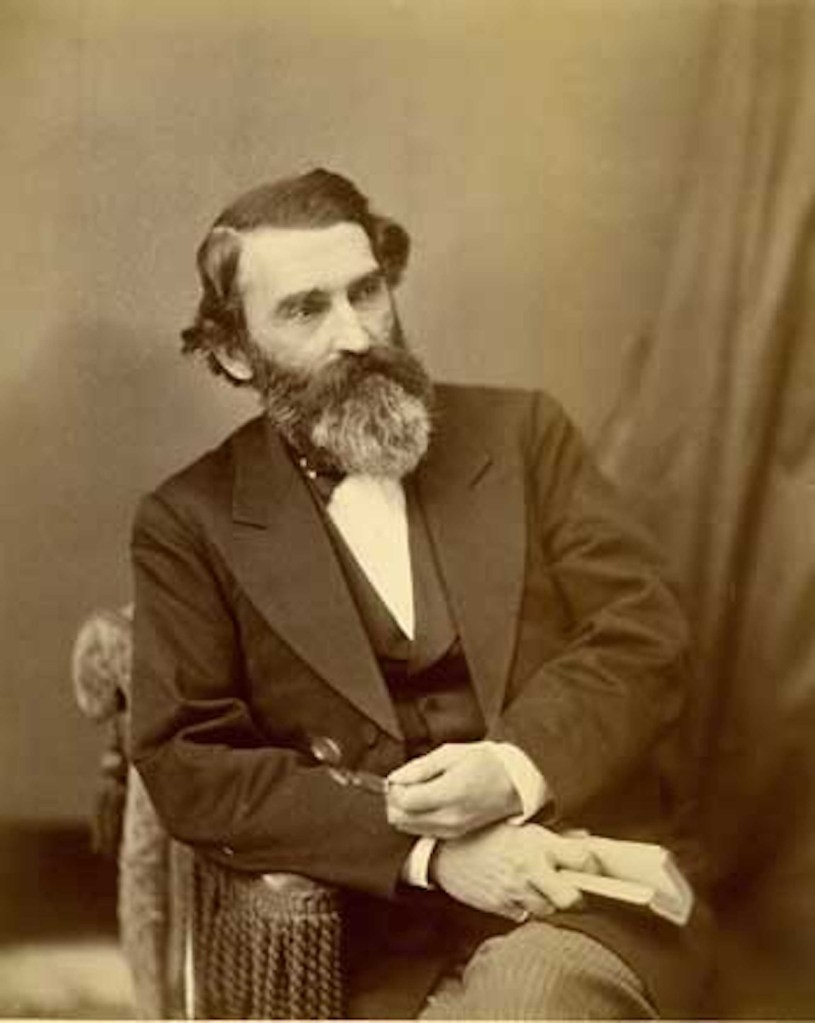
    Image b: Samuel Bowles – Emily Dickinson Museum