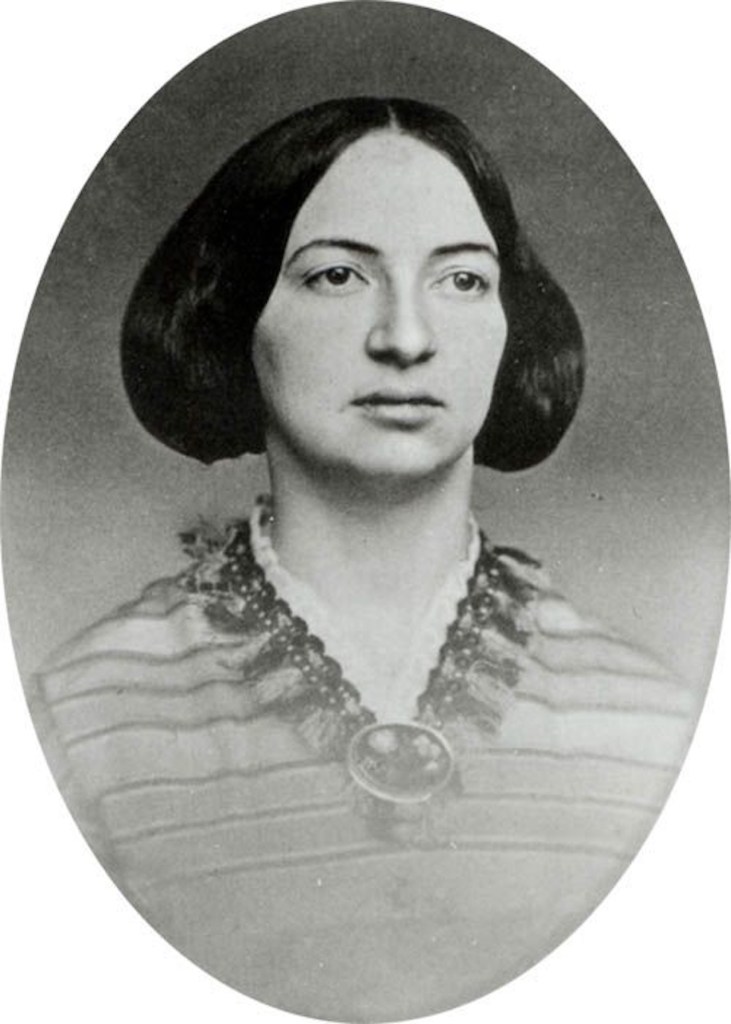
Image: Emily Dickinson – Amherst College – Daguerrotype of the poet at age 17, circa 1847 – likely the only authentic, extant likeness of the poet
Emily Dickinson’s “The Guest is gold and crimson”
Emily Dickinson’s “The Guest is gold and crimson” dramatizes sunset as a guest who visits every door, every day. This poem functions as a riddle, as the speaker never names the subject she is describing.
Introduction and Text of “The Guest is gold and crimson”
Within her collection of some 1,775 poems, Emily Dickinson has included at least 22 that focus on the diurnal phenomena known as “sunset.” So fascinated by the act was the poet that she creates speakers to dramatize it in many colorful outpourings.
In “The Guest is gold and crimson,” the speaker personifies “sunset” as a visitor who comes to town “at nightfall,” and he visits everyone in town as he “stops at every door.” And then the speaker follows the guest as though he were a bird moving beyond her own town and territory to other shores.
The Guest is gold and crimson
The Guest is gold and crimson – An Opal guest and gray – Of Ermine is his doublet – His Capuchin gay –
He reaches town at nightfall – He stops at every door – Who looks for him at morning I pray him too – explore The Lark’s pure territory – Or the Lapwing’s shore!
The speaker in Emily Dickinson’s “The Guest is gold and crimson” is dramatizing sunset as a guest who visits every door, every day. This poem functions as a riddle, as the speaker never names the subject she is describing.
First Movement: Elemental Coloration in the Heavens
The Guest is gold and crimson – An Opal guest and gray –
The speaker describes the subject of her drama by stating the colors of sunset. Readers will immediately recognize the colors of “gold and crimson” as the remarkable duo of hues that accompany the onset of the setting of the sun.
Of course, depending upon the atmospheric accumulation of elements, those golds and crimsons may blend in outrageous ways that may put the viewer in mind of classic paintings by famous artists.
That those golds and crimsons come against the background of the sky results in an accompanying guest who is “Opal” as well as “gray.” The blue of the sky is influenced by the golds and appears opalescent against a darkening or graying out appearance.
At the opening scene, the speaker does not intrude upon her drama, except to state in definitive descriptors what she has actually observed from her own point of view. As she colorizes the scene, she offers her audience the room to blend those colors to their own experiences.
Second Movement: A Dandy Caller
Of Ermine is his doublet – His Capuchin gay –
The speaker continues her description of the guest, who now resembles a gentleman caller, wearing a close-cropped jacket with a fur trim, and over it all he sports a lively colored cape. Thus, sunset has now been identified as a guest, who is a man dressed rather dandily.
Again, the textures along with colors allow her audience to envision the broad sky turning all mixtures of hues as the sun begins to close its eye on the speaker’s part of the earth. The speaker’s world is becoming dark, but not without a dramatic play of wild and glorious events happening all around the daystar as it takes its leave at nightfall.
Third Movement: An Virtually Omnipresent Visitor
He reaches town at nightfall – He stops at every door –
Now this gentleman caller, this magnificently dressed guest, appears at nightfall. This guest has a delicious yet totally variant habit of not only visiting people in the town whom he knows, but he also visits every household as he “stops at every door.”
The marvelously arrayed guest is visible to everyone, everyday. The speaker must be so enthralled to describe such a magnanimous and generous visitor. This fine gentleman appears all gloriously decked out and performs his drama for all to enjoy.
Fourth Movement: Funny Speculation
Who looks for him at morning I pray him too – explore
The speaker then offers a humorous speculation regarding someone who would be foolish enough to try to see this guest in the morning; such a thought is, of course, silly because this guest appears only at night. However, the speaker thus encourages such a person who has gone looking for this guest in the morning to continue looking, that is, keep “explor[ing].”
Fifth Movement: The Other Side of the Planet
The Lark’s pure territory – Or the Lapwing’s shore!
If one by chance, after much exploration, happens upon the “Lark’s pure territory,” or around the Australian continent, one might catch a glimpse of this quest. Morning in Australia is, of course, nighttime in USA New England.
But the speaker’s ultimate recommendation is simply to look for this guest on the “Lapwing’s shore,” likely where she has observed him. Do not go looking for such a remarkable, colorful event anywhere but where you are. And as you find him at nightfall, you will find him to be a constant visitor, who will always astound you with his dramatic appearance.
Image: Emily Dickinson – Amherst College – Daguerrotype of the poet at age 17, circa 1847 – likely the only authentic, extant likeness of the poet
Emily Dickinson’s “One Sister have I in our house”
Emily Dickinson’s “One Sister have I in our house” is a tribute to her sister-in-law Susan Gilbert Dickinson, who married Emily’s brother Austin.
Introduction and Text of “One Sister have I in our house”
Susan Gilbert Dickinson became Emily Dickinson’s sister-in-law, but she also served Emily’s poetic talent by advising Emily about books to read and ideas to consider. Susan thus played an important rôle in Emily’s pursuit of empirical knowledge.
Susan had traveled extensively and had lived outside of Emily’s New England bubble; thus she was able to help Emily broaden her horizons regarding worldly knowledge.
While the Austin Dickinson home, the “Evergreens,” became the locus of tragedy, and likely Emily did not know the extent to which her adoptive sister might have shared in the blame for some of that discord, Emily remained beholden to Susan for the many useful and important aspects of art that Susan brought into Emily’s life.
Emily possessed the wherewithal to look on the bright side of life and celebrate it, even in the face of adversity. Thus the following poem is Emily’s tribute to her second sister, who lived “a hedge away.”
One Sister have I in our house
One Sister have I in our house, And one, a hedge away. There’s only one recorded, But both belong to me.
One came the road that I came – And wore my last year’s gown – The other, as a bird her nest, Builded our hearts among.
She did not sing as we did – It was a different tune – Herself to her a music As Bumble bee of June.
Today is far from Childhood – But up and down the hills I held her hand the tighter – Which shortened all the miles –
And still her hum The years among, Deceives the Butterfly; Still in her Eye The Violets lie Mouldered this many May.
I spilt the dew – But took the morn –I chose this single star From out the wide night’s numbers – Sue – forevermore!
Emily Dickinson’s “One Sister have I in our house” is a tribute to her sister-in-law Susan Gilbert Dickinson, who married Emily’s brother Austin.
First Stanza: Two Sisters
One Sister have I in our house, And one, a hedge away. There’s only one recorded, But both belong to me.
The speaker begins by stating colorfully that she has two sisters: one lives in the same building as the speaker, while the other one resides in a nearby edifice that is “a hedge away.” She then states that one sister is legally hers having been “recorded” as such, but she recognizes them both as her siblings.
Dickinson in this poem is once again employing her riddle-like style, but she never names her legal sister with whom she resides, while in the final line, she does reveal the name of the sister who lives nearby: “Sue – forevermore!”
“Sue” is Susan Gilbert whom Dickinson had known for many years, and who married Austin Dickinson, Emily’s only brother. Emily adored her brother and she then came to love her sister-in-law and accepted her as a sister, as this poem portrays the tribute to Sue Gilbert.
Second Stanza: Contrasting Sisters
One came the road that I came – And wore my last year’s gown – The other, as a bird her nest, Builded our hearts among.
Continuing to contrast the differences that exist between the two “sisters” whom the speaker is claiming, the speaker reveals that she is a bit older than her natural-birth sister by saying that that sister was able to fit into the garments that the speaker had outgrown, “last year’s gown.” And the natural, legal sister has traveled the same “road” that the speaker has traveled.
The adopted sister came into their lives like a bird that builds its nest among the leaves. But this sister claimed their hearts, and thus the speaker can now feel comfortable calling her sister.
Third Stanza: Seeing New Englandly
She did not sing as we did – It was a different tune – Herself to her a music As Bumble bee of June.
The new sister also has a somewhat different style of viewing life as well as a different way of speaking from the Dickinson’s. Emily once said “I see–New Englandly–.” And she, of course, spoke New Englandly.
While Susan Gilbert was born in Massachusetts, she was raised from age 5 in New York; thus she would not have acquired the same Massachusetts (New England) accent that the Dickinson’s would have employed.
Nevertheless, the speaker has enjoyed the speaking, singing of the newly added sister, as she compares that new sister’s accent to the June bumble bee. That sound at first stings the mind but becomes a welcome sound because it means that summer is here.
Fourth Stanza: A Pleasant Trek
Today is far from Childhood – But up and down the hills I held her hand the tighter – Which shortened all the miles –
The speaker now reveals that she is reporting from a period of time that has moved them all way beyond “Childhood.” And the speaker thus reports that having trekked through the landscape with her new sister and “held her hand” even tighter as the years have flown by has made the speaker’s life more pleasant.
The miles of travel through life can become long and tedious, but having a pleasant companion can make those miles seem less long and tedious. The new sister has done that for the speaker, and thus this tribute to that sister.
Fifth Stanza: Retaining an Eye for Beauty
And still her hum The years among, Deceives the Butterfly; Still in her Eye The Violets lie Mouldered this many May.
The speaker continues to remark about the sister’s speaking. That sister has the ability to fit in to the New England way of things remarkably well. She is so well suited to the New England way that the natives may even think she grew up a New England resident.
The speaker then reports that although many months of May have come and gone, the sister’s eye for detecting the natural beauty in flowers or little violet blooms remains in tact; the “Violet” thus becomes a symbol for all of nature in these lines.
Sixth Stanza: Achieving Harmony and Balance
I spilt the dew – But took the morn – I chose this single star From out the wide night’s numbers – Sue – forevermore!
The speaker finally reports that she became aware of her great admiration for her adoptive sister as morning seemed to overtake her in thought that was as gentle and wet as the “dew.” These thoughts that watered her growing plant of musing caused the speaker to pick out this remarkable friend who has served the speaker’s life like a sister.
The speaker calls that new sister a “star” for the light of knowledge the sister has provided the speaker. The appreciative speaker vows to continue to respect and honor that relationship that has grown between the two writers.
Susan Gilbert Dickinson was also a writer and had advised Emily on a wide variety of topics important to poets. Emily once quipped to Susan, “With the exception of Shakespeare, you have told me of more knowledge than any one living.”
Emily also called such praise strange, yet poets know that knowledge is a priceless gift, and they understand that honoring the giver of such gifts is necessary for a balanced life. Dickinson was completely aware of the necessity of striving for and achieving harmony in her life, and she took every precaution to arrive safely on the shores of harmony and balance.
Image: Emily Dickinson – Amherst College – Daguerrotype of the poet at age 17, circa 1847 – likely the only authentic, extant likeness of the poet
Emily Dickinson’s “Sleep is supposed to be”
Dickinson’s “Sleep is supposed to be” redefines two common terms employed daily but, to the speaker’s mind, remain misidentified.
Introduction with Text of “Sleep is supposed to be”
While the speaker in “The morns are meeker than they were” offers a playful riddle in order to elaborate on the beauty of the fall season, the speaker of “Sleep is supposed to be” has a very different purpose; this speaker disputes the common conception of “sleep” and “morning.”
The speaker then offers the common notion about what sleep and morning are understood to be and contrasts it with a different level of awakening. She is referring to the spiritual awakening, when the soul and the Oversoul become one. Dickinson often describes those states of awareness that transcend the physical level of existence.
Sleep is supposed to be
Sleep is supposed to be By souls of sanity The shutting of the eye.
Sleep is the station grand Down which, on either hand The hosts of witness stand!
Morn is supposed to be By people of degree The breaking of the day.
Morning has not occurred!
That shall Aurora be – East of Eternity – One with the banner gay – One in the red array – That is the break of Day.
Reading of “Sleep is supposed to be”
Commentary on “Sleep is supposed to be”
The speaker wants to redefine a term that by her reasoning has been mischaracterized.
First Stanza: Normal Sleep
Sleep is supposed to be By souls of sanity The shutting of the eye.
The speaker begins by stating that normally folks think of sleep as the act when people shut their eyes. Those normal people are just everyday folk who go about their day waking, eating, working, playing, procreating, and of course shutting their eyes to sleep, before the next day finds them doing those ordinary things again.
Those individuals are the “sane” souls because they all agree on the common definition of “sleep.” For them there is no other definition of “sleep”; thus the speaker must now enlighten them.
Second Stanza: Opening Up a Mystic Paradise
Sleep is the station grand Down which, on either hand The hosts of witness stand!
After asserting that the normal, sane folks of the world have defined “sleep” a certain way, the speaker must now insert a new definition into the lexicon of society’s manners and language. Instead of being merely a “shutting of the eye,” this speaker has discovered that sleep also allows a new world to emerge—one that is “grand.”
This world is a mystic paradise, where the angels appear everywhere. They appear as “hosts” who give witness that this seemingly unusual realm exists. The speaker has thus elevated the common activity in which all creatures worldwide engage to a metaphysical activity that she can be sure very few have experienced.
The speaker therefore likely knows that what she is reporting will be understood by very few folks, but by dramatizing it in a poem she may reach some on some intuitive level. And even if they think she is merely describing dreams, well, that is better than continuing to devalue sleep as merely “shutting of the eye.”
Third Stanza: Considering Morning
Morn is supposed to be By people of degree The breaking of the day.
The speaker now moves on to the second term which she is urged to redefine for humanity—”Morn” or morning. As with “sleep,” she tells her readers/listeners what people who deem themselves knowledgeable consider “morn” to be. Those illustrious but limited folks consider morning to be merely the time that day begins, that time between the “shutting of the eye” and the “breaking of the day .”
Fourth Stanza: Morning Every Morning
Morning has not occurred!
The speaker then startles her readers/listeners by boldly asserting with emphasis, placing her announcement in one line, in order to draw maximum attention to its content.
This speaker insists that, in fact, there has been no “Morning” yet. Despite the thinking of those smart people that morning is simply the time that day breaks, she courageously declares that “Morning has not occurred!” Such a startling statement throws open all the windows of the mind. What could the speaker be thinking? After all morning occurs every morning, does it not?
Fifth Stanza: The True Morning
That shall Aurora be – East of Eternity – One with the banner gay – One in the red array – That is the break of Day.
The speaker then describes what a true “Morning” is. A true morning is the time that the souls greets their Maker. A great light appears that spreads from the forehead (“East”) out into that Heaven beyond the physical cosmos.
That union of soul and Oversoul is a time that is marked by a brilliant flag, marked by spreading of the brightest light beyond all physical light and sight.
The speaker then concludes: “That is the break of Day.” (Or “That is the break of Day.”) She emphasizes her description by emphasizing the word, “That.” Modern-day type-script uses italics; Dickinson underlined the word, as is necessary without modern-day technological advances with the use of word processing.
Image: Emily Dickinson – Amherst College – Daguerrotype of the poet at age 17, circa 1847 – likely the only authentic, extant likeness of the poet
Emily Dickinson’s “The morns are meeker than they were”
Emily Dickinson’s “The morns are meeker than they were” is one of the poet’s riddle poems; it is focusing on the phenomenon of how mornings change with the season.
Introduction with Text of “The morns are meeker than they were”
Emily Dickinson’s speaker in “The morns are meeker than they were” is observing the natural features surrounding her. She has begun to detect a transformation in how morning is now behaving.
She then remarks about the behavior of the trees and eventually focuses a comment on the “field.” Finally, she reveals how all these alterations will influence her own behavior.
This poem presents itself as one of Emily Dickinson’s riddles, in which she describes the subject but does not name it; thus she allows her audience to figure out the answer to the riddle.
The morns are meeker than they were –
The morns are meeker than they were – The nuts are getting brown – The berry’s cheek is plumper – The Rose is out of town.
The Maple wears a gayer scarf – The field a scarlet gown – Lest I should be old fashioned I’ll put a trinket on.
Reading of “The morns are meeker than they were”
Commentary on “The morns are meeker than they were”
Mornings change with the season.
First Stanza: The Rose Has Flown
The morns are meeker than they were – The nuts are getting brown – The berry’s cheek is plumper – The Rose is out of town.
The speaker observes that mornings have become more sedate and quiet than they had been. At this point, readers/listeners have no idea why the behavior of morning should have become “meeker.”
The second line, however, begins to open up the answer to a riddle, as she begins to drop hints about her subject. She describes the browning of the nuts, and the plumping of the “cheek” of the berry.
And by the final line, which reports that the roses have gone away, no longer decorating the summer day, the reader can be sure that the speaker is describing the onset of the autumn season, a season Dickinson loved and found unusually inspiring for her poetic musings.
Second Stanza: A Trinket for the New Fashion
The Maple wears a gayer scarf – The field a scarlet gown – Lest I should be old fashioned I’ll put a trinket on.
The speaker now offers further clues about her subject. Maple trees are now decked out in leaves that look more varied and that seem more merry than the simple summer green they had hitherto adorned. Even the meadow now dons a colorful dress. Replacing its summer green attire is a bold “scarlet gown.”
After reporting on all the changes the speaker has observed in the behavior of morning, the coloring of the nuts, the fattening of the berries, the absence of the roses, the maple leaves turning all colorful.
And the meadow is sporting a bright red dress. The speaker now announces that she will begin wearing some “trinket,” in order to keep up with all the modern day apparel.
She does not want to be caught dressed for summer and appear “old fashioned” among the newly minted, colorful styles being sported by the beings that constitute her “society” of creatures during this new and exciting season.
Image: Emily Dickinson – Amherst College – Daguerrotype of the poet at age 17, circa 1847 – likely the only authentic, extant likeness of the poet
Emily Dickinson’s “I never told the buried gold”
In Emily Dickinson’s “I never told the buried gold,” the speaker has made an amazing discovery; she then creates a little drama in which she muses on whether to reveal that discovery.
Introduction with Text of “I never told the buried gold”
The speaker in Emily Dickinson’s “I never told the buried gold” seems to be sharing a secret, but it is a secret so bizarre that she must couch it deeply in mystery.
She has realized a possession that is buried so deep in her psyche that she must dramatize it by creating a parable-like discourse, and she yet remains so ambivalent about revealing it that she seems to continue to waver as her drama unfolds.
I never told the buried gold
I never told the buried gold Upon the hill – that lies – I saw the sun – his plunder done Crouch low to guard his prize.
He stood as near As stood you here – A pace had been between – Did but a snake bisect the brake My life had forfeit been.
That was a wondrous booty – I hope ’twas honest gained. Those were the fairest ingots That ever kissed the spade!
Whether to keep the secret – Whether to reveal – Whether as I ponder Kidd will sudden sail –
Could a shrewd advise me We might e’en divide – Should a shrewd betray me – Atropos decide!
Commentary on “I never told the buried gold”
The speaker is dramatizing her process of decision-making involving a recent discovery.
First Stanza: Revealing a Secret
I never told the buried gold Upon the hill – that lies – I saw the sun – his plunder done Crouch low to guard his prize.
The speaker begins by reporting that she has never told anyone about this treasure that she possesses. Then immediately she begins to liken it to the valuable metal, “gold.” She places that gold upon a hill where the sun is guarding it. This gold belongs to the sun in the same way that her possession belongs to her.
The sun seems to “plunder” as it moves about in its shining rays over the landscape, and it then stoops over the hill where the gold is buried; in stealth, the sun watches over its treasure. The speaker has observed this odd behavior of the heavenly orb.
Thus, she likens her own guarding of her “prize” to that of the sun guarding the gold. The speaker intends to guard her prize because of its unusual nature, but the sun will continue to keep its prize safe out of sheer natural necessity.
Second Stanza: The Shock of Recognition
He stood as near As stood you here – A pace had been between – Did but a snake bisect the brake My life had forfeit been.
The speaker now has the sun standing near her, as near as the imaginary audience she is addressing. There is, however, “a pace” between them.
And then a snake slithers through the thicket, dividing the foliage as it is wont to do. (This image is reminiscent of the line, “The Grass divides as with a Comb,” in Dickinson’s riddle poem, “A narrow Fellow in the Grass.”)
The speaker then makes the odd claim that her life had been forfeited, suggesting that for an instant she likely gave out a gasp of fear before regaining her equilibrium enough to continue living, thinking, and creating her drama. The snake supplies the impetus for the notion of life forfeiting.
While the speaker suddenly experiences the epiphany that she was in possession of this magnificent, golden gift, she also experiences a shock that unsettled her for at least a brief moment.
Third Stanza: Desire to be Worthy
That was a wondrous booty – I hope ’twas honest gained. Those were the fairest ingots That ever kissed the spade!
The speaker now admits that what she has realized about herself is tantamount to coming into the possession of large storehouse of amazing gifts or treasure. She calls her treasure “wondrous booty,” and then she indicates that she hopes she has earned this amazing treasure-trove, and not merely stolen it or been given it willy-nilly, or inexplicably.
The speaker then sizes up the value of this mysterious possession, by continuing the “gold” metaphor. Now calling her possession “ingots,” she estimates their value as the “fairest” “that ever kissed the spade.”
Of course, ingots must be dug out of the ground, and when they are found by the excavating shovel, those ingots meet the metal of the “spade” with resounding touch, which the speaker calls a “kiss.”
Fourth Stanza: Whether to Reveal the Secret
Whether to keep the secret – Whether to reveal – Whether as I ponder Kidd will sudden sail –
Again, the speaker becomes ambivalent about revealing this amazing “secret.” She lists her toggling of the mind that cannot decide if she should keep hidden this new knowledge or whether she ought to announce it.
As the speaker muses on the issue—whether to tell or not, she reckons that Captain Kidd might just be sailing to retrieve his own booty of treasure, which by legend he had buried in the Caribbean.
This clever employment of “Kidd” and the allusion that it implies deepens the “gold” and treasure metaphor, continuing the revelation of the value the speaker has placed on this mysterious treasure of which she has become aware.
Fifth Stanza: Leaving the Mystery to Eternity
Could a shrewd advise me We might e’en divide – Should a shrewd betray me – Atropos decide!
The speaker then makes a hilarious admission. If someone who is smart enough to know whether she should reveal her treasure should let her know what is appropriate, she would be willing to give that person part of her treasure.
But she does not know if there is such a knowledgeable person who is trustworthy. If she reveals her secret to the wrong “shrewd,” she might live to regret it. She could be ridiculed and left to suffer much betrayal.
By calling her potential advisor a “shrewd,” the speaker is making fun of such individuals whom she thinks might believe they are, in fact, capable of advising her. But because she allows that a “shrewd” could likely betray her confidence, she remains ambivalent about seeking their advice.
Instead of making a definite decision about whether to seek counsel from one of those shrewds, the speaker decides not to decide. She will leave the decision to “Atropos,” one of the Greek Fates, who is responsible for deciding the exact time for the end of each human life. Atropos held the scissors that cut the thread of life.
The speaker thus decides to leave her decision to the ultimate decision-maker, one whose decision is not only final but made without equivocation. The speaker will remain in humble possession of her knowledge that she owns a mystic, creative soul that will from now on guide her in her creation of little dramas on her pathway through life.
Without having revealed her secret to the wide, gaping yet eyeless majority of the world, the speaker has revealed her secret only to those who will understand. It is in that respect that the speaker’s poem is like a parable of Lord Jesus the Christ, who spoke through that form only to those who had ears to hear.
Image: Emily Dickinson – Amherst College – Daguerrotype of the poet at age 17, circa 1847 – likely the only authentic, extant likeness of the poet
Emily Dickinson’s “My wheel is in the dark!”
The speaker in Emily Dickinson’s “My wheel is in the dark!” is making a statement about knowing without sense perception. This subject especially interested the poet, who was specifically concerned with issues such as immortality and life after death.
Introduction and Text of “My wheel is in the dark!”
Despite the grammatical error in the last line of Emily Dickinson’s “My wheel is in the dark!,” the speaker’s revelation shines through clearly and offers a unique perspective about the nature of understanding and explaining the ineffable.
My wheel is in the dark!
My wheel is in the dark! I cannot see a spoke Yet know its dripping feet Go round and round.
My foot in on the Tide! An unfrequented road – Yet have all roads A clearing in the end –
Some have resigned the Loom – Some in the busy tomb Find a quaint employ –
Some with new – stately feet – Pass royal through the gate – Flinging the problem back At you and I!
Commentary on “My wheel is in the dark!”
Rendering information about the ineffable level of being is virtually impossible, but through use of poetic devices and other literary language that rendering becomes somewhat meaningful and therefore understandable to the mind and heart.
First Stanza: Vision by Implication
My wheel is in the dark! I cannot see a spoke Yet know its dripping feet Go round and round.
The speaker reports that she is capable of knowing that the spoke on a wheel moves in a circular motion as it drips water even though there is no light on the wheel. She is revealing that she, as all human beings are, is able to infer information without direct sense perception that might otherwise reveal such knowledge.
Human beings prefer to rely on what they can “see” or “hear.” But sometimes seeing and hearing are not possible. For example, human beings are convinced that love and hate both exist, even though they cannot see the concepts to which those nouns refer.
The ultimate argument ensues from the issue of whether God exists. Some will argue that because he cannot “see” God, then God must not exist. The argument runs further as the atheist insists that he also cannot hear, feel, taste, or touch God—and what cannot be experienced through the senses, therefore, does not exist.
The speaker in “My wheel is in the dark!” thus counters such an argument by demonstrating that not only is metaphysical knowledge based on intuition and inference but also simple knowledge about things like wet wheels that go round and round in the dark.
Second Stanza: An Uncharted Path
My foot in on the Tide! An unfrequented road – Yet have all roads A clearing in the end –
The speaker continues with her comparison stating that she is walking an uncharted path, but she knows, again by intuition and inference, that this road will eventually lead to “a clearing.”
Despite the danger, such as would be experienced by having one’s foot “on the Tide,” the speaker can, with fairly great certainty, be assured that all the danger and complexity of the road she walks will end, and all will be understandable when she moves into that landscape which features clarity.
The speaker places that clarity at the end, which is at the end of her life, a time at which she will come to the end of the path and enter the “clearing.” Her “unfrequented road” is unique as is each road each soul must frequent as it passes through life on the physical level of being.
Third Stanza t: Resigning the Loom
Some have resigned the Loom – Some in the busy tomb Find a quaint employ –
The speaker now reports that others have departed from this world. She indicates that departure by referring to their occupation while alive. She colorfully claims that some of the folks who have died simply “resigned the Loom.”
But she does not offer a catalogue or list of what resigners have resigned. By mentioning one earthly occupation only, she implies that that “Loom” not only refers to the occupation of weaving but also to the fabric that exists as life itself.
Thus those “some” that have “resigned” from the fabric of life find a different way to engage their time and effort “in the busy tomb”; she claims that they “find a quaint employ.”
The speaker is reporting from her intuition that after death the soul will continue its engagements, even though its engagements after leaving the physical encasement will be different. They nevertheless will be “quaint,” an obviously optimistic claim.
Fourth Stanza: Remaining Mum about the Afterlife
Some with new – stately feet – Pass royal through the gate – Flinging the problem back At you and I!
Those souls who will remain busy with quaint engagements, however, are not the only class of souls that the speaker intuits. In addition to those who engage in the those quaint pursuits, there are those who will become similar to royalty. They will possess “stately feet” and enter the kingdom of heaven on those stately feet.
The speaker then returns to the world but without any definitive answer about what the real differences are between life and afterlife. When those of the royal, stately feet pass through that gate into paradise, they will not reveal their new experiences; they will simply be “flinging the problem” into the faces of those left watching for wheels “in the dark” and walking “on the Tide.”
Only those who have actually passed through that heavenly gate will understand what that experience offers. Thus we–”you and I”–will continue to speculate about that experience, as the speaker has done in this poem and the many more that are to come.
Dickinson and Grammar
As Dickinson’s readers discover, the poet often misspelled words and left her grammatical constructions a little cockeyed. Thomas H. Johnson, the editor of The Complete Poems of Emily Dickinson, who restored her poems to their near originals, has revealed that he did correct some misspellings.
And it remains unclear why he left the inaccurate grammatical construction, “At you and I!”; the correct pronoun form in that prepositional phrase is “me” instead of “I”—the objective case is required after a preposition.
A reason for leaving such an error could be to complete a rime scheme, but that is not the case with this line. As a matter of fact, by inserting “me” instead of “I,” a partial rime would be achieved: “feet” would become a partial rime with “me.” Nevertheless, this problem remains a slight one. No meaning is lost despite the grammatical error. Such errors may interfere with the total enjoyment of a poem.
However, readers need not become alarmed about them unless they interfere with understanding. Luckily, this error does not confound meaning, and comprehension of the poem remains clear and unobstructed, despite the slight distraction that inaccurate pronoun inflicts.
Image: Emily Dickinson – Amherst College – Daguerrotype of the poet at age 17, circa 1847 – likely the only authentic, extant likeness of the poet
Emily Dickinson’s “Through lane it lay – through bramble”
Emily Dickinson’s speaker employs an extended metaphor that likens the human’s path through life on a troubled planet to a simple walk through the woods—a woods that is, however, anything but ordinary.
Introduction and Text of “Through lane it lay – through bramble”
The speaker in Dickinson’s “Through lane it lay – through bramble” takes her audience through an imaginary journey that on the superficial level remains a journey of fantasy filled with danger, as it is colorfully allusive to mythological creatures attempting to attack a flock of children as they venture home.
But Dickinson never leaves her readers moving gleefully from the adventure story stage; thus, her simple adventure is actually performing as an extended metaphor likening the life of human beings on this earth to a dangerous journey through a mythological forest.
Through lane it lay – through bramble
Through lane it lay – through bramble – Through clearing and through wood – Banditti often passed us Upon the lonely road.
The wolf came peering curious – The owl looked puzzled down – The serpent’s satin figure Glid stealthily along –
The tempests touched our garments – The lightning’s poinards gleamed – Fierce from the Crag above us The hungry Vulture screamed –
The satyr’s fingers beckoned – The valley murmured “Come” – These were the mates – This was the road Those children fluttered home.
Commentary on “Through lane it lay – through bramble”
The speaker in “Through lane it lay – through bramble” is using an extended metaphor, likening the human life-path on a distressed planet to a simple walk through a woodland; however, this woodland is quite extraordinary.
First Stanza: Another Jaunty Riddle
Through lane it lay – through bramble – Through clearing and through wood – Banditti often passed us Upon the lonely road.
In the opening stanza, the speaker begins rather quietly and again almost hinting that this poem will be another jaunty riddle. She inserts that nebulous “it,” only stating where it “lay” and led: in a lane and rambled through “bramble”; it also ran through a “clearing” and also through a “wood.”
The speaker then identifies the “it” as a “lonely road,” in the same breath as asserting that the little group of folks was often passed by marauding robber gangs, or “banditti.” She employs the rare spelling for “bandits.”
One can imagine the poet running upon that word and laying it away for later use in a poem. Dickinson did enjoy the appearance of cosmopolitanism; she was amused by the charm of worldly engagement, even as she peered intensely into the ultra personal, the ultimate individual soul.
Second Stanza: The Fantastic Journey
The wolf came peering curious – The owl looked puzzled down – The serpent’s satin figure Glid stealthily along –
The speaker continues the fantastic journey. After describing the “lonely road” on which the travelers are traveling, she now describes animals that the group encounters. Wolves that seem quite nosey come and stare at them. From up in trees, “puzzled” owls peer down at them. They even observe snakes slithering “stealthily along.”
The speaker skillfully now begins to drop hints that this is no ordinary walk through the woods. After providing imagery that has thus far remained quite literally earthly, she employs the term “serpent” for snake.
The term “serpent” adds heft to the image of the creature that simply glides upon the earth because that term immediately identifies that creature as the creature from the biblical Genesis–that evil one who tempted the first pair of human beings to ignore the only commandment placed upon them by their Creator-God.
Third Stanza: No Ordinary Journey
The tempests touched our garments – The lightning’s poinards gleamed – Fierce from the Crag above us The hungry Vulture screamed –
The speaker continues to deviate her description from an ordinary jaunt through the woods. Now she asserts that their clothes were disheveled by “tempests” – not merely did a storm blow up and get them wet.
The storms were “tempests,” or many violent storms, a term which again increases the severity the situation and likely alludes to the Shakespeare play, “The Tempest,” which featured a convoluted tale of intrigue and romance, in other words, a simulacrum of the world with its trials and tribulations along with intrigue and romance.
As the speaker describes the lightning from these “tempests,” she employs the term “poinards.” That French term “poignard” means dagger. When anglicized, the correct spelling of the term is “poniard.”
Yet for some reason Dickinson has once again baffled her readers with an obvious departure from the accurate spelling of the term. And again one wonders why Thomas H. Johnson, the editor who restored Dickinson’s poems to the forms that more closely represent her originals, did not quietly correct that spelling.
Regardless of the reasoning behind the spelling “poinards,” the speaker uses the term for the continued purpose of supporting the extended metaphor of a treacherous journey through life on earth. Just as the storms are “tempests,” the lightning gleams in daggers.
The claims of the scenarios must remain somewhat exaggerated in order to deepen and widen the metaphor from simple journey through the woods to complex journey on the path of life through a threatening world.
The speaker thus continues to transport her audience from that simply walk through the woods to the journey on the path of life through a menacing world.
Fourth Stanza: The Allure of Lust
The satyr’s fingers beckoned – The valley murmured “Come” – These were the mates – This was the road Those children fluttered home.
The final movement finds the speaker addressing the issue of human lust. Just as the first pair was hassled by the serpent and urged to commit the one sin that would banish them from their garden paradise, all of the children resulting from that pair’s falling are hassled and urged to commit that same sin repeatedly.
This “road’ through life is replete with the fingers of lust luring, “beckon[ing]” the children to “come” into that “valley” of lustful pleasure. The not-so-subtle images of “fingers” and “valley” complete the metaphor and remind the audience that those “mates” on this road have caused “those children” the misery of having to “flutter” on their way home.
The only bright and optimistic hope is that those children are, in fact, on their way home, and that they will finally begin to realize that those satyr “fingers” plunging into those “valleys” only beckon one to death, not to the pleasure promised by those liars.
Image: Emily Dickinson – Amherst College – Daguerrotype of the poet at age 17, circa 1847 – likely the only authentic, extant likeness of the poet
Emily Dickinson’s “There is a word”
Emily Dickinson’s “There is a word” features one of the poet’s many poems that may qualify as riddles. She keeps the reader guessing until the end when she finally reveals the “word” that “bears a sword.”
Introduction and Text of “There is a word”
Many of Emily Dickinson’s riddle poems never mention the word or thing her speaker is describing. Examples of two of those mentionless riddles are, “It sifts from Leaden Sieves,” and “I like to see it lap the Miles.”
While Dickinson’s “There is a word” does begin as a riddle, it only remains so until the final line, in which the speaker does reveal what word it is that she is finding so troublesome.
There is a word
There is a word Which bears a sword Can pierce an armed man – It hurls its barbed syllables And is mute again – But where it fell The saved will tell On patriotic day, Some epauletted Brother Gave his breath away.
Wherever runs the breathless sun – Wherever roams the day – There is its noiseless onset – There is its victory! Behold the keenest marksman! The most accomplished shot! Time’s sublimest target Is a soul “forgot!”
Commentary on “There is a word”
This poem is one of the poet’s many poems that may qualify as a riddle. She keeps her audience guessing about the word she is describing until the end when she finally reveals the “word” that “bears a sword.”
First Movement: The Riddle Begins
There is a word Which bears a sword Can pierce an armed man – It hurls its barbed syllables And is mute again –
The speaker begins with what seems to be a riddle by asserting that a certain word exists that carries “a sword.” This word must be very sharp indeed because it can “pierce an armed man.” This sharp word has “barbed syllables,” and after it “hurls” those sharp syllables, it returns to silence.
The first movement then has set up a scenario in which a certain “word” is dramatized with the unsavory characteristic of a weapon. This claim might offer a contradiction to the little ditty that goes, “Sticks and stones may break my bones, but words can never hurt me.”
The “sticks and stone” claim used to be offered to children to assist them in dealing with a bully. It was meant to deflect the child’s mind from taking the bullying as a personal affront.
If someone breaks your bones with a weapon, you have little recourse but to allow time to heal your broken bones. If someone hurls painful rhetoric at you, you have the option of not keeping your mind focused on that rhetoric and thus, you are not hurt.
However, there is a school of thought that has always found the “sticks and stones” advice wanting, claiming that words can definitely hurt one. And of course, both schools of thought have their merits.
A sharp, weaponized “word” hurled even at an “armed man” can pierce the psyche and render untold damage, if the victim finds it difficult to place her mind on other things.
Second Movement: A Metaphorical Weapon
But where it fell The saved will tell On patriotic day, Some epauletted Brother Gave his breath away.
In the second movement, the speaker metaphorically likens a fallen victim of some weaponized word to a martyr to the cause of patriotism. Like an “epauletted Brother” who fights to protect the citizens of his nation, who willingly gives “his breath away,” the victim of this sharp word will be praised by those the brother saved.
This speaker is demonstrating that she is referring to words that hurt the psyche, not necessarily the bones or the flesh. But in order to dramatize the scenario, she metaphorically paints the images in military terms, which she continues through the remaining two movements.
Third Movement: An Astounding Notion
Wherever runs the breathless sun – Wherever roams the day – There is its noiseless onset – There is its victory!
That the sun may be considered “breathless” is an astounding notion. But that notion along with the roaming of the day places the entire scene beyond the physical level of being. The “noiseless onset” is the space wherein that weaponized word has failed to penetrate.
Had that failure of penetration continued, there would have been a great “victory.” But that victory does not materialize. It cannot as it is placed in an impossible location where the sun runs breathless and where the day may be understood to have the ability to “roam.”
Without breath, the human being cannot utter any word, weaponized or not. And that silent space of time remains a blessed opposition to the battleground where pain and suffering occur.
Beyond that battleground, that is, beyond the physical level of existence, those who have achieved the status of “breathless sun” will achieve their victory over those weaponized words.
Fourth Movement: Again, the Military Metaphor
Behold the keenest marksman! The most accomplished shot! Time’s sublimest target Is a soul “forgot!”
Again, employing the military metaphor, the speaker commands her listener/reader to observe and consider the “keenest marksman,” who has accomplished the highest level of shooting ability.
Finally, the speaker reveals that word that she finds to be the one that “bears a sword.” That word is the simple word “forgot.” But she has framed that word by claiming it is “Time’s sublimest target” which is, “a soul” “forgot!”
The exclamation point following the word “forgot” is vital to the total meaning of the poem. By placing that punctuation mark outside the quotation marks, the emphasis on the word is removed.
The ambiguity of the following two-line sentence continues to keep the poem a riddle:
Time’s sublimest target Is a soul “forgot!”
That sentence can be understood two ways:
The most difficult thing for any human being is that her mind has forgotten that she is a soul.
The hardest thing for a person to hear is that she has been forgotten by someone else.
Interestingly, the ambiguity of those final two lines, that is, the two alternate interpretations give the poem its depth of meaning. The result of anything that has been “forgot” remains a disfiguring absence to any human being—physically, mentally, or spiritually.
When the two instances of forgetting are bound up into one painful event, even the “armed man” who has been shot by the “keenest marksman” will fall victim and suffer from the barbed syllables hurled at him.
Image: Emily Dickinson – Amherst College – Daguerrotype of the poet at age 17, circa 1847 – likely the only authentic, extant likeness of the poet
Emily Dickinson’s “On this wondrous sea”
In the first movement of Dickinson’s “On this wondrous sea,” the speaker addresses God as the metaphorical pilot of a metaphorical seafaring vessel; in the second movement, the speaker allows that “pilot” to speak as He answers her supplicating question.
Introduction and Text of “On this wondrous sea”
Emily Dickinson’s fourth poem in Thomas H. Johnson’s The Complete Poems of Emily Dickinson may be thought of as the beginning of her true style and content. The first three poems feature two Valentine messages ( “Awake ye muses nine, sing me a strain divine” and “Sic transit gloria mundi“) and an invitation (“There is another sky”) to her brother, Austin, to come and experience the new world she is creating with her poetry.
In contrast to the first three entries in Dickinson’s complete poems, “On this wondrous sea” sets out on a journey of poetry creation that will involve her belovèd Creator, whom she will beseech and at times even argue with in her zeal to substantiate truth and beauty in her other “sky.”
In a very real sense, the Dickinson speaker is performing a set of little dramas that resemble that of the speaker of the Shakespeare sonnets. The Shakespeare sonneteer was interested only in preserving truth, beauty, and love in his creations for future generations.
In the course of those sonnets, especially the section known as “The Muse Sonnets,” the Shakespeare writer expresses his desire repeatedly to present only truth, beauty, and love in his works, in contrast to the slathering on of tinsel and meaningless blather sent out by non-serious artist wannabes, known as poetasters.
The Dickinson speaker demonstrates the same proclivities, and it also becomes evident that she shows a keen ability to observe the tiniest detail in her environment. Yet, even as she focuses on those details, her vision never lowers from her mystic sight.
It is in that focus that Dickinson differs dramatically from the Shakespearean sonneteer. While he reveals his devout awareness of the mystical in his life, he remains a mere observer compared to the active mysticism of the Dickinson speaker.
Emily Dickinson’s rare ability to communicate the ineffable has earned her a place in American letters that no other literary figure in the English language has been able to outpace.
On this wondrous sea
On this wondrous sea Sailing silently, Ho! Pilot, ho! Knowest thou the shore Where no breakers roar — Where the storm is o’er?
In the peaceful west Many the sails at rest — The anchors fast — Thither I pilot thee — Land Ho! Eternity! Ashore at last!
Commentary on “On this wondrous sea”
The whole physical world becomes an ocean on which the speaker finds herself tossed and wondering if she will ever be returned to the safety of land.
First Movement: The Sea as Metaphor
The speaker begins by creating a metaphor for the physical level of being, this wide world, in which she finds herself tempest tossed and uncertain of the way to safety. Calling this world a “wondrous sea,” she reports that she is quietly sailing upon this ocean of chaos, then suddenly she cries out: “Ho! Pilot, ho!”
And then she demands of the pilot to know if he knows where there is safety, where there are no trials and tribulations, where one can find rest from the many upheavals and battles that continually confront each inhabitant of this world. Upon first encountering, it may seem that the speaker is addressing some sea captain as she rides in some maritime vessel.
But it quickly becomes apparent that the speaker is addressing the Creator of the universe, and she wants to know if the Creator of this seemingly confusing Creation knows where she can go to come out of “the storm.” As the “sea” is a metaphor for the world, the “Pilot” is the metaphor for the Creator (or God), Who directs and leads His children through this confusing place.
As a pilot would steer a ship, God steers the ship of life, the ship of this world that only He has created. Thus the speaker appeals to God for an answer to her question, is there anywhere that can offer peace to the poor soul who must navigate the churning waters of this world?
Second Movement: Where Peace Reigns Supreme
In the second stanza, the speaker shifts from the supplicant to the Blessèd Creator, Who bestows on the questioner the answer to her question. The storm is over where peace reigns supreme. Metaphorically, the speaker chooses to locate the peaceful place in the “west,” likely to rime it with “rest.”
In that peaceful west, one can cease the constant struggle with the dualities of this world. One can feel secure with “anchors fast,” unlike the constant heaving and tossing back and forth that the rough sea causes. The sails can be lowered and remain in that position because the journey has reached its destination.
The piloting Creator then assures His traveling, storm-tossed child that, in fact, He is taking her there as she speaks. The words, “Thither I pilot thee,” must ring in the ears of this supplicant as a true balm of heaven, comforting her every nervous inclination; she knows that she is safe with this “Pilot,” Who knows where to take her and is piloting her there now.
Then suddenly, the coveted land is in sight and the land is “Eternity.” The speaker now knows she is being guided safely and surely through her life by the One, Who can take her “ashore” and keep her secure throughout eternity. Immortality is hers and peace will be her existence in this eternal resting place where the soul resides with its Divine Over-Soul Creator.
Image: Emily Dickinson – Amherst College – Daguerrotype of the poet at age 17, circa 1847 – likely the only authentic, extant likeness of the poet
Emily Dickinson’s “Sic transit gloria mundi”
By Dickinsonian standards, “Sic transit gloria mundi” is quite long. Its tone and subject matter vary greatly from the Dickinson persona that will be on display in the majority of her poems.
Introduction and Text of “Sic transit gloria mundi”
Similar to poem #1 in Thomas H. Johnson’s The Complete Poem of Emily Dickinson, poem #3 “Sic transit gloria mundi,” stands as a rather lengthy poem by Dickinsonian standards, and it is also a Valentine, sent to William Howland, a law clerk in her father’s office.
This poem was published in the Springfield Republican on February 20, 1852. Two years earlier, she had sent a Valentine message, “Awake ye muses nine,” to her father’s law partner, Elbridge Bowdoin.
Sic transit gloria mundi
“Sic transit gloria mundi,” “How doth the busy bee,” “Dum vivimus vivamus,” I stay mine enemy! —
Oh “veni, vidi, vici!” Oh caput cap-a-pie! And oh “memento mori” When I am far from thee!
Hurrah for Peter Parley! Hurrah for Daniel Boone! Three cheers, sir, for the gentleman Who first observed the moon!
Peter, put up the sunshine; Pattie, arrange the stars; Tell Luna, tea is waiting, And call your brother Mars!
Put down the apple, Adam, And come away with me, So shalt thou have a pippin From off my father’s tree!
I climb the “Hill of Science,” I “view the landscape o’er;” Such transcendental prospect, I ne’er beheld before!
Unto the Legislature My country bids me go; I’ll take my india rubbers, In case the wind should blow!
During my education, It was announced to me That gravitation, stumbling Fell from an apple tree!
The earth upon an axis Was once supposed to turn, By way of a gymnastic In honor of the sun!
It was the brave Columbus, A sailing o’er the tide, Who notified the nations Of where I would reside!
Mortality is fatal— Gentility is fine, Rascality, heroic, Insolvency, sublime
Our Fathers being weary, Laid down on Bunker Hill; And tho’ full many a morning, Yet they are sleeping still,—
The trumpet, sir, shall wake them, In dreams I see them rise, Each with a solemn musket A marching to the skies!
A coward will remain, Sir, Until the fight is done; But an immortal hero Will take his hat, and run!
Good bye Sir, I am going; My country calleth me; Allow me, Sir, at parting, To wipe my weeping e’e.
In token of our friendship Accept this “Bonnie Doon,” And when the hand that plucked it Hath passed beyond the moon,
The memory of my ashes Will consolation be; Then farewell Tuscarora, And farewell, Sir, to thee!
Commentary on “Sic transit gloria mundi”
Emily Dickinson sent her poem “Sic transit gloria mundi” as a Valentine message to William Howland, who served as a law clerk in her father’s law office.
First Movement: A Fertile Mind on Display
“Sic transit gloria mundi,” “How doth the busy bee,” “Dum vivimus vivamus,” I stay mine enemy! —
Oh “veni, vidi, vici!” Oh caput cap-a-pie! And oh “memento mori” When I am far from thee!
Hurrah for Peter Parley! Hurrah for Daniel Boone! Three cheers, sir, for the gentleman Who first observed the moon!
Peter, put up the sunshine; Pattie, arrange the stars; Tell Luna, tea is waiting, And call your brother Mars!
The first stanza of the Valentine sounds like a jumble of unrelated thoughts as it begins with three allusive quotations: first, the Latin phrase, “Sic transit gloria mundi,” which translates into English as, “So passes away this world’s glory.”
The phrase is used in the ceremony of installing a Pope and likely originated with Thomas à Kempis’ “O quam cito transit gloria mundi” (Oh how soon passes away this world’s glory) from De Imitatione Christi (Translation to English The Imitation of Christ).
Second, the allusion to the Isaac Watts’ poem, “How doth the little busy bee,” whose second line finishes the question: “Improve each shining hour.”
And third, “Dum vivimus vivamus,” translation,”while we are alive, let’s live,” which is thought to serve as an epicurean motto and was employed as a motto by the Porcellian Club at Harvard.
The speaker then speaks for herself for the first time in the poem and declares she will stop her enemy, a claim that will leave her listeners a bit stunned.
But then the speaker offers a near repetition of the first stanza’s strategy with Latin phrases, along with one French phrase: First, “Oh ‘veni, vidi, vici!’,” which is the famous declaration made by Julius Caesar after he overcame Pharnaces of Pontus in the Battle of Zela.
Second, “Oh caput cap-a-pie!” with Latin “the head” and French “from head-to-toe.” And then the third, “And oh “memento mori,” Latin again for “remembering I must die,” which makes much sense clamped on to the following line, “When I am far from thee!”
Those first two stanzas of the Valentine demonstrate the varied education of the speaker; she has read and studied enough of Latin and perhaps French to be able to employ quotations from her reading. Likely the only purpose of those quotations is to show off as she flirts with the target of the Valentine.
The speaker then continues to demonstrate her book learning by alluding to a widely published author of the time period, who used the pseudonym, “Peter Parley.” Parley published a wide variety of informative tracts primarily for children in the subject areas of science, art, travel, biography, and natural history and geography.
The speaker gives a nod to the American explorer, Daniel Boone, who is most noted for having explored the state now known as Kentucky. The speaker finally offers “three cheer” for the man who first “observed the moon.”
This last seeming allusion, however, is ludicrous in its assertion; thus the speaker is making a joke which puts all of her earlier allusions in question.
Is she really just making fun of received knowledge? No doubt that is so. And her true purpose, of course, is simply to flirt with a law clerk in her father’s office, who likely possesses the ability to recognize many of those allusions and thus understand her little joke.
The final stanza in the first movement plays out in definite sarcastic hilarity, as she commands Peter to “put up the sunshine,” while Pattie must “arrange the stars,” while alerting “Luna” (the Latin term for “moon”) that tea is about to be served, and brother Mars, another heavenly body, should be called.
Thus the speaker has set the stage for a romp through her fertile mind that she hopes will impress a young man with her vast knowledge, all acquired through book learning, thus she can make fun of it, as if she were saying, look what I can do with bit and pieces of information that has passed before my very fecund imagination!
Second Movement: Continuing to Allude
Put down the apple, Adam, And come away with me, So shalt thou have a pippin From off my father’s tree!
I climb the “Hill of Science,” I “view the landscape o’er;” Such transcendental prospect, I ne’er beheld before!
Unto the Legislature My country bids me go; I’ll take my india rubbers, In case the wind should blow!
During my education, It was announced to me That gravitation, stumbling Fell from an apple tree!
In the second movement, the speaker continues her allusive jaunt, beginning with Genesis and Adam eating the metaphoric “apple.” She tells “Adam,” whom she likely is assigning identity with Mr. Howland, the law clerk, to forsake the “apple” that he is already eating and come with her to enjoy an apple from her father’s tree.
That “pippin” or dessert apple, which is sweeter than ordinary apples, refers to herself; thus, she is the offering from her father’s tree that she wishes to give to the target of the Valentine.
Next the speaker intimates that she has read Anna Lætitia Barbauld’s “The Hill of Science. A Vision,” and again offers a line from an Isaac Watt’s hymn, “There Is a Land of Pure Delight.”
The speaker then concocts the notion that she has been called to government service, but then immediately descends into a comment about the weather. Finally, she again makes a remark that her education has given her to believe that the man who discovered gravity, only did so because some crazy apple “stumbl[ed]” and “fell from an apple tree!”
It must have given her great delight to return again to the “apple” as she completed the second movement of her Valentine.
Third Movement: Astronomy and History
The earth upon an axis Was once supposed to turn, By way of a gymnastic In honor of the sun!
It was the brave Columbus, A sailing o’er the tide, Who notified the nations Of where I would reside!
Mortality is fatal— Gentility is fine, Rascality, heroic, Insolvency, sublime
Our Fathers being weary, Laid down on Bunker Hill; And tho’ full many a morning, Yet they are sleeping still,—
The trumpet, sir, shall wake them, In dreams I see them rise, Each with a solemn musket A marching to the skies!
The speaker now turns to astronomy to report the fact that the earth rotates, an activity that earlier, she opines, was considered to honor the sun. Of course, earthly gymnastics, she now knows, is simply a fact of a science. The sun, only in poetic terms, can be considered to feel honored by the rotating of the earth.
Moving on to some historical information, the speaker reports that Columbus, whom she finds to be brave, went sailing over the sea, and in doing so he let other nations know where the speaker “would reside.”
She then lists some definitions of terms: mortality=fatal, gentility=fine. But then she seems to go off track by stating that rascality is heroic, and insolvency is sublime. The two latter claims likely are allusions to the financial crisis known as the Panic of 1837, which resulted in a major recession that continued into the mid-1840s.
The speaker then continues with her nods to history, mentioning that their “Fathers” died on Bunker Hill and despite the fact morning still comes upon that hill, they remain sleeping there. But she envisions in a dream that a trumpet wakes those fathers, who rise and march heavenward with their muskets.
Fourth Movement: Bizarre Claim and Failed Valentine
A coward will remain, Sir, Until the fight is done; But an immortal hero Will take his hat, and run!
Good bye Sir, I am going; My country calleth me; Allow me, Sir, at parting, To wipe my weeping e’e.
In token of our friendship Accept this “Bonnie Doon,” And when the hand that plucked it Hath passed beyond the moon,
The memory of my ashes Will consolation be; Then farewell Tuscarora, And farewell, Sir, to thee!
In the final movement, the speaker’s opening stanza makes a bizarre claim that seems quite opposite of what tradition teaches. She asserts that it is the coward who stays and fights while those who grab their hats and run become the immortal heroes.
Likely, she is spoofing the notion that those who run away are more likely to remain above ground than those who remain in battle and continue to engage the enemy.
But before the reader can place much concentration on that thought, the speaker moves quickly on again to state that she must go and perform service to her country. She asks the target of her Valentine to permit her to shed a tear at leaving him behind. She then states that this Valentine is a “token of our friendship.” She asks him to accept this “Bonnie doon,” alluding to Robert Burns’ “The Banks O’ Doon,” which features a lament about being left by a sweetheart.
But the token of friendship, this “Bonnie Doon,” seems to become a flower as the speaker then asserts that once she is dead and her ashes have “passed beyond the moon,” the memory of those ashes will console the Valentine reader.
Then abruptly as she draws an end to her missive, by bidding farewell to “Tuscarora” and then to the target of the Valentine, calling him “Sir.”
Remembering the playful nature of the poem makes allusions such as Tuscarora, the American Indians, who originally resided in the North Carolina area and later were admitted into the New York federation of the Iroquois, a fertile field for varied interpretations.
Likely, she’s referring to the country and its earlier history, but also it is likely she is being ironic as she surely is when she is bidding farewell to the recipient of the Valentine.
Lifelong Bachelors
Both Valentine messages in the two poems “Awake ye muses nine” and “Sic transit gloria mundi” were serious although playful flirtations directed toward the young men to which she sent them.
The poet possibly hoped to engage each young man in courtship, but quite the contrary actually happened. Both men, Elbridge Bowdoin and William Howland, remained lifelong bachelors. And, of course, Emily never married either.


 Linda's Literary Home