Linda's Literary Home

Category: Original Poems

  • In the Fog of Memory

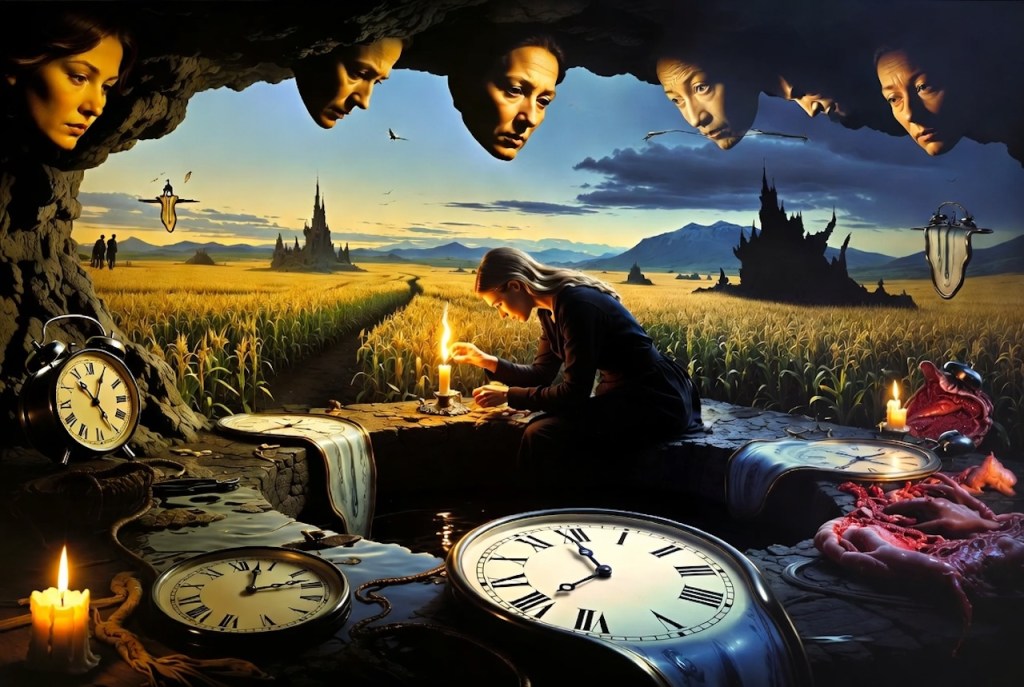
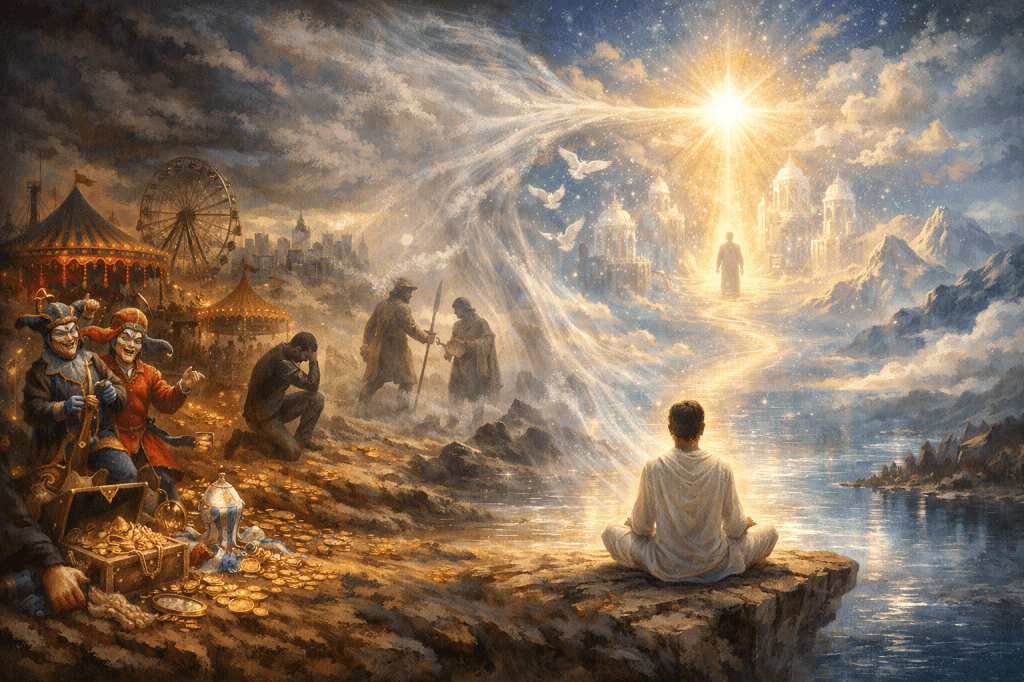
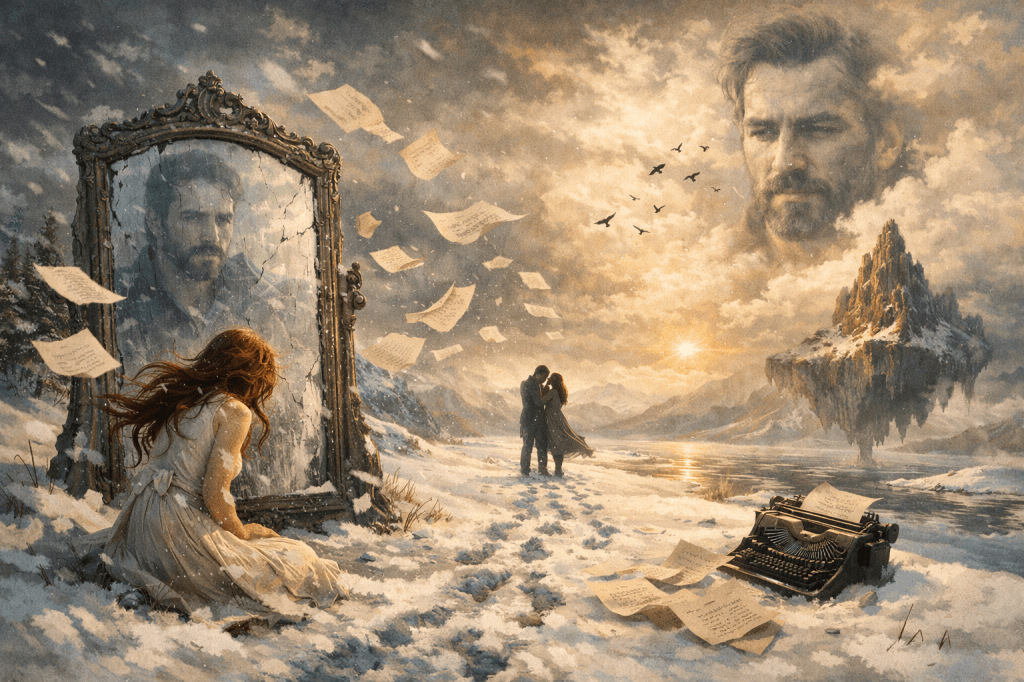
    Image:  Created by Grok inspired by the poem

    In the Fog of Memory

    Knowing that the soul lives eternal
    Gives the heart a glow, and the mind
    Rests on pillowed fluid dreams.
    Fields of fresh notions perfume
    The summer air, ripe with fervor.

    The silent morning plants fresh buds
    Of  rose-tinted possibilities, rare
    With the shining eagles of freedom.
    Flags planted by the sea wave
    In the noon-glowing sunshine.

    The salt of lovers’ tears sheds
    Its flavor in the savoring evening.
    Meditating on the Divine Belovèd,
    Chela bows listening for the music
    And the whir of the Celestial Motor. 

    Mighty armies of angelic forms
    Gather Chela in their gentle strength.
    Powerful healing flows into her being
    Spreading through body’s heart and limbs
    Making whole each ravished cell.

    Saving her soul becomes the Chela’s
    Only mission in this fallen world
    Where minions carve their names
    Upon unblinking stones to feign
    Recollection in the fog of memory.
    A Prose Commentary on My Original Poem “In the Fog of Memory”

    In my poem “In the Fog of Memory,” I construct a speaker who moves deliberately through shifting states of consciousness—memory, hope, devotion, and spiritual struggle—while maintaining a tone that is at once contemplative and quietly resolute. 

    The central tension lies between illusion and awakening, framed through a series of temporal landscapes: morning, noon, evening, and a final, darker awareness of the fallen world.

    My speaker relies heavily on imagery that remains fluid and atmospheric—fog, light, salt, music—contrasting with more fixed and symbolic elements such as stones, flags, and armies. 

    This interplay reflects my continued interest in the dual nature of reality: the ephemeral versus the enduring, the sensory versus the transcendent. As in my earlier work, I have tried to resist sentimentality, instead pressing toward a disciplined spirituality grounded in effort, perception, and inward listening.

    As is true with virtually all of my writings, philosophically, the poem draws again from yogic thought, particularly the idea of the chela (disciple) progressing through illusion (maya) toward union with the Divine. The speaker does not assume enlightenment but portrays it as a process—uneven, aspirational, and often shadowed by the persistent distortions of the material world.

    First Stanza: Memory as a Softened Gateway to Eternity

    In the opening stanza, my speaker presents memory not as a burden but as a kind of luminous fog—obscuring, yet gently illuminating. The assertion that “the soul lives eternal” provides the metaphysical anchor for what follows, allowing the heart to “glow” and the mind to recline in “pillowed fluid dreams.”

    Here, the speaker deliberately softens the language. Unlike the harsher textures of stone and blood in the earlier poem “Faded Stones,” this stanza breathes with ease and receptivity. “Fields of fresh notions” suggest a mind fertile with possibility, while the “summer air” evokes ripeness and fullness.

    Yet this status is not pure transcendence; it is a provisional state. Memory creates a space where eternity is intuited rather than realized—a comforting but potentially illusory reprieve. The fog both reveals and conceals.

    Second Stanza: The Morning of Possibility and the Symbolism of Freedom

    The second stanza shifts into morning imagery, reinforcing renewal and emergence. “Fresh buds” and “rose-tinted possibilities” suggest hope, but the speaker subtly qualifies this hope as “rare,” indicating its fragility.

    The introduction of “shining eagles of freedom” and flags by the sea broadens the scope from inward reflection to collective or even national symbolism. Freedom here operates on multiple levels—spiritual liberation, personal aspiration, and perhaps even political idealism.

    However, these flags, though vivid in the “noon-glowing sunshine,” are also subject to the same impermanence established earlier. They wave, they shine—but they do not endure unchanged. The speaker implies that even humanity’s highest ideals are part of the temporal flux.

    Third Stanza: Devotion and the Turn Inward

    In the third stanza, the tone deepens and becomes more explicitly devotional. The “salt of lovers’ tears” introduces a sacramental quality: suffering is not merely endured but tasted, absorbed, and transformed. Evening replaces morning, signaling introspection and withdrawal from outward activity.

    The figure of the Chela becomes central. Bowing in meditation, she listens “for the music / And the whir of the Celestial Motor.” This auditory imagery is crucial. Truth is not seen but heard—subtly, inwardly.

    The “Celestial Motor” clearly refers to the sound of “Om”; it suggests an underlying cosmic mechanism, a divine order that continues regardless of human confusion. The speaker affirms that through disciplined attention, one may begin to perceive this hidden rhythm. This marks a movement away from the soft illusions of memory toward a more intentional spiritual practice.

    Fourth Stanza: Grace, Healing, and the Intervention of the Divine

    The fourth stanza introduces a moment of grace. “Mighty armies of angelic forms” gather not as forces of destruction but of protection and healing. Their strength is “gentle,” an important paradox that reflects the nature of divine intervention in this poem.

    Healing flows through the Chela’s body, reaching “each ravished cell.” The word “ravished” carries dual implications—both violated and enraptured—suggesting that the body has been subject to suffering but is also capable of receiving profound restoration.

    This stanza represents a temporary resolution: the alignment of body, mind, and spirit under the influence of divine presence. Yet, consistent with the poem’s structure, this resolution is not final. It prepares the speaker for the harsher recognition that follows.

    Fifth Stanza: The Fallen World and the Illusion of Permanence

    In the final stanza, the tone shifts sharply. The Chela’s mission crystallizes: “Saving her soul becomes… / Only mission in this fallen world.” The earlier expansiveness narrows into necessity.

    The image of “minions” carving their names “upon unblinking stones” returns to a more severe symbolic register. These figures seek permanence through inscription, attempting to defy time and mortality. Yet the stones, though seemingly eternal, are “unblinking”—they do not witness, affirm, or remember.

    Thus, the act of carving becomes an illusion of legacy, an ego-driven attempt to assert significance within an indifferent material world. The speaker rejects this outward striving in favor of inward salvation.

    The poem ends without closure, intentionally so. The sentence itself breaks off, mirroring the incompleteness of the Chela’s journey. Enlightenment remains unfinished, and the world remains resistant.

    An After-Thought

    Across the poem, I trace a progression from soft, dreamlike awareness to disciplined spiritual focus, and finally to a stark recognition of worldly illusion. The Chela serves as both participant and observer, navigating states of grace and disillusionment.

    If “Faded Stone” affirmed endurance through hardness, this one explores endurance through devotion and perception. The central claim remains consistent: wisdom lies not in escaping the world, nor in inscribing oneself upon it, but in cultivating an inner clarity that can withstand both illusion and revelation.
  • Faded Stones

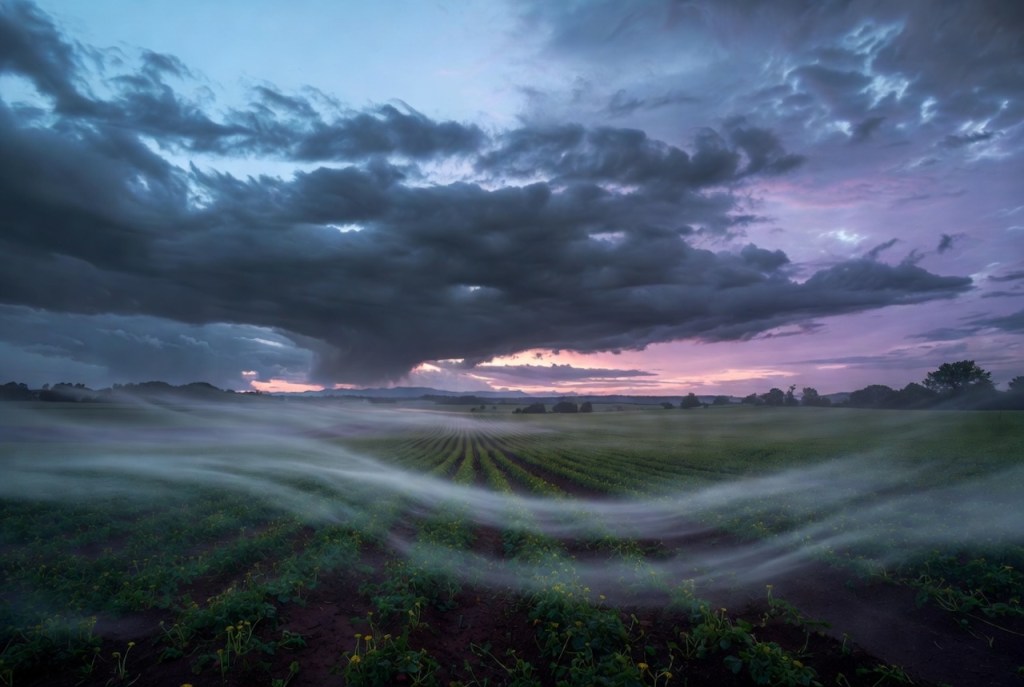
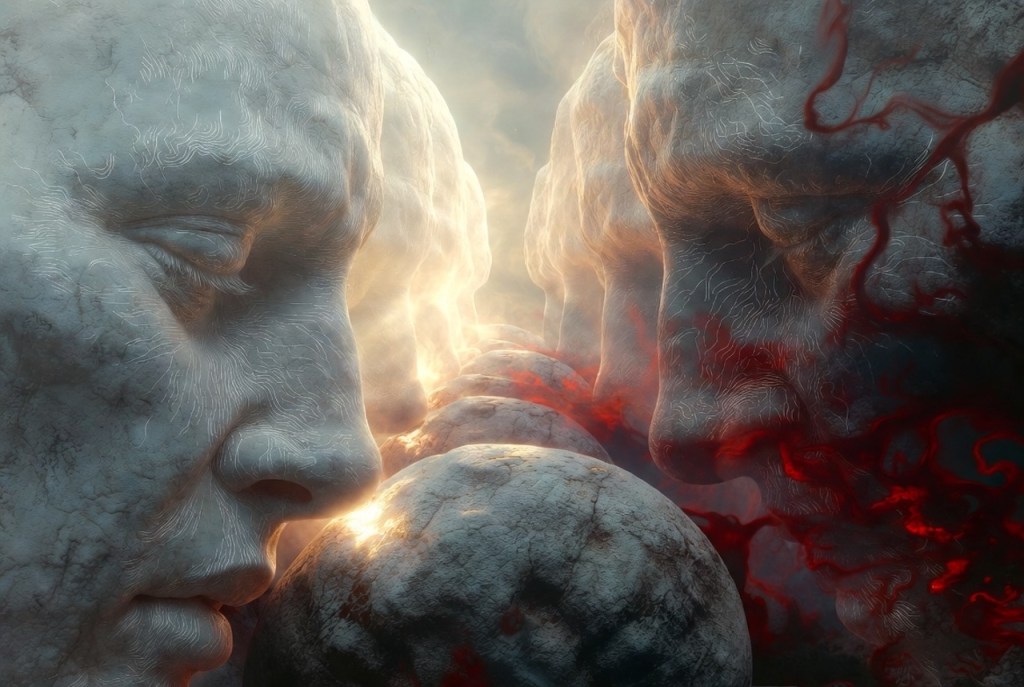
    Image: Created by Grok inspired by the poem

    Faded Stones

    The wise never turn away from fading.
    They know the hands of time draw 
    White lines across the faces of pewter.
    Silence brings light to the glory-bound.

    The fever of desire sputters in the brain
    Quarreling with the calm of true love.
    Blood astonishes itself meandering
    Through the veins of hope and stasis.

    The skin that covers red speed never
    Reveals its constant play of wheels
    In motion toward an unstayed destiny.
    Light tunnels through the endless mind.

    The beams that drape our lips
    Scald the soul that remains untouched
    Though the weary heart breaks over rocks
    Of creedless beasts and simpletons.

    That stones regard the world a hard place
    Takes the brut force to conquer ennui
    In the glad morning of tempted faith
    Where the head holds the heart in check.

    A Prose Commentary on My Original Poem “Faded Stones”

    In my poem “Faded Stones,” I have created a speaker who attempts to weave a tight musing on impermanence, inner conflict, and hard-won wisdom, employing the controlling metaphor of ancient, weathered stones—pewter-gray, etched by time to explore how the human spirit endures decay, desire, heartbreak, and existential boredom. 

    My speaker keeps the language dense, almost alchemical, blending the physical (stones, blood, skin, rocks) with the metaphysical (light, silence, mind, soul). Rather than offering easy consolation, the speaker insists on a stoic, clear acceptance of life’s hardness, where wisdom lies not in resistance but in quiet endurance and rational restraint.

    My own philosophy inherent in the theme broached in this poem is influenced strongly by the teachings of Paramahansa Yogananda, who explains and emphasizes the operation of the pairs of opposite within the delusive force known as Maya or in the Judeo-Christian tradition Satan.

    First Stanza: Impermanence and the Wisdom of Fading 

    In the opening lines, the speaker establishes the poem’s core philosophy, suggesting that “Fading” is not tragic but remains a natural process, one which the wise are able to embrace.  

    The speaker then again turns figurative, personifying time as an artist, who is etching “white lines” (wrinkles, cracks) on “pewter”—the dull, metallic gray that evokes aged stone or aged human skin turned ashen. 

    These stones become anthropomorphic faces, scarred yet dignified. This scenario is not a Romantic lament but a quiet affirmation: true wisdom accepts entropy, while ”Silence brings light to the glory-bound” completes the thought. Glory is never loud with triumph; it arrives through earned stillness. 

    The “glory-bound” are those who, like stones, endure without complaint. Silence becomes a pathway and a condition for illumination, contrasting the noisy fever of society at large. Thus acceptance of decay transforms itself into the gateway to inner light.

    Second Stanza:  The Struggle between Desire and Love

    In the second stanza, the speaker shifts the focus inward to the body’s hidden wars.  Desire is expressed as a metaphoric “fever”—restless, sputtering, irrational—while true love is “calm”—steady, ultimately monastic, even as the brain continues to rage as a virtual battlefield. 

    The speaker personifies the life force of blood as becoming astonished by its own path; it flows through opposing channels of “hope” (forward momentum) and “stasis” (lack of progress). Its central tension and vitality are both driven and trapped.

    Here, the speaker expresses metaphorically my own personal deepest belief that the eternal human duel between passionate urgency and serene acceptance exist and battle together on the material level of being, where neither can ever be totally victorious.

    Thus the imagery strikes out visceral even though it remains abstract—blood does not simply circulate; it “astonishes itself,” suggesting self-awareness but also shock at life’s contradictions.

    Third Stanza:  Hidden Motion beneath Still Surfaces

    In this stanza, the speaker deepens and sharpens the stone metaphor: the body (skin) compares to the stone’s surface—opaque, concealing the “red speed” (blood’s rush, life’s urgency) and the “play of wheels” (mechanistic fate, karma, or the grinding gears of time). Even if on occasion outwardly still, inwardly the human being is a machine, hurtling toward an “unstayed destiny” (no brakes, no fixed end).

    Yet, as yogic philosophy teaches, the light tunneling through the mind is the entity that offers transcendence. The mind is vast and cavernous (like stone tunnels), but on rare occasions, if one is successful in yogic practice, it will be pierced by sudden insight. 

    Thus the  speaker is affirming that while the body is racing often quite blindly, the holiness of consciousness can affirm piercing clarity.  There can always be an illusion of stillness, while everything is actually in motion at the molecular and atomic levels, but wisdom can perceive the light within the tunnel of motion.

    Fourth Stanza:  Scalding Light, Broken Hearts, and the Hard World 

    The speaker then keeps “Beams that drape our lips” somewhat ambiguous: the image could mean smiles (beams of light on the mouth) or rays of external light that force expression. 

    These smiles/lights “scald the soul”—they burn because they are superficial. The soul remains “untouched” (pure, uncompromised), while the heart—more vulnerable—shatters against the “rocks” of a cruel, unthinking world.

    “Creedless beasts and simpletons” are the unfortunate people without depth of faith, driven primarily by brute instinct—for whom all compassionate individuals must pray.

    The speaker has kept the imagery brutal yet precise. The heart does not break gently; it is smashed over jagged stones.  This outcome remains the cost of authenticity in a shallow world, where outer composure hides inner scalding and breakage.

    Fifth Stanza:  Stones, Brute Force, and the Triumph of the Head

    In the fifth stanza, the speaker returns to the title.  Stones “regard the world a hard place; they know that reality is unyielding, yet they endure without caving in to illusion. Overcoming “ennui” (boredom but more tragically spiritual apathy) requires “brut force”—raw, almost animal willpower. (Please note the French spelling “brut,” akin to the English “brute” but in French means simply raw or unrefined).

    This force operates “in the glad morning of tempted faith”—a fragile dawn where belief is tested, because remains uncertain. The resolution is cerebral: “the head holds the heart in check.” Reason must restrain emotion; intellect masters the weary heart. Such a stoic mastery through intellect and raw will does not deny pain but instead signals disciplined endurance.

  • Breathless, Dreamless Bliss

    Image: Created by Grok inspired by the poem

    Breathless, Dreamless Bliss

    She pondered the mystery
    Of paradise with blissful singing
    In the silent morning she prayed
    For the blessing of a silent night.

    Trains moving vast steel cars
    Along the long railways
    Between the cornfed towns
    Assaulted her ears and heart—

    Not that she longed to travel far
    Just that traveling far seemed
    A beacon to her staid soul
    In the fury of growth & discovery.

    For her the Celestial Face remained
    Hidden behind a marble curtain cloud
    Of suffering the trammels of childhood
    Which whirred behind her stalking.

    For her the Cosmic Lover was stretching
    Into her heart, crashing through the marble
    Curtained clouds of mundane aspiring
    To bring her to breathless, dreamless bliss.

  • In the Belly of Hell

    Image:  Created by Grok inspired by the poem

    In the Belly of Hell

    “The mountains cannot judge us when we lie.”W. H. Auden “In Time of War”

    Warm faces stream into the well of darkness.
    She lights a candle as dusk breathes deep.
    Her fruit has come to fruition in the cold
    Dank moment where hatred still burns.

    A poem dictates the next decade
    Into which she elopes with madness.
    Hearts of black villains scud her world,
    Tearing her keening into shrill scrubs.

    A basket of words for weaving in the cornfield
    Where deplorable brambles fold and mold
    On the slippery slope of mutated follies — 
    Crooked pork stands disgruntled in shadows.

    A dark stump eats at the gut of the lame.
    The enemy of time goes limp waiting
    In the insane crawl space of diverse skin.
    Her mind goes to seed in the brain-dead winter.

    Her feet move spring music straining to speak.
    Her dream falls from the ink pool into blank verse.
    A fish flops and springs off its slithering spawn
    Where morning looms in from the horizon.

    Walking in the dust she dictates the next poem
    Intensity blocking the manners of evil wishers.
    But the clocks still run and water still erodes.
    The sinews of pink muscles decay in droves.

    A warm face streams out of the well of darkness
    Her candle has extinguished the force of swill.
    The ill-gotten gain of the intruder will be spent
    In the belly of Hell, as soon as she puts up the fire.

  • Clinging to Darkness

    Image: Created by Grok inspired by the poem 

     Clinging to Darkness

    Spring clouds on the horizon
    Bring to mind the forfeit
    In cool nights of no return.

    The refrain of salad days
    Clings to the same past
    Where things were different—

    Different as what we allow
    Ourselves to believe
    About love, hate, and tears,

    Different as spring breezes
    In the morning before
    Noon brings the flowers—

    Before evening carries in
    The lost memories of resolution
    In the transparent rain,

    Before cucumbers can sprout
    In the garden of desire
    As if they could ever live.

    Spring clouds that bring wet
    Thoughts to the strawberry fields
    Cling to darkness unveiled.

  • Gay Birds Dancing 

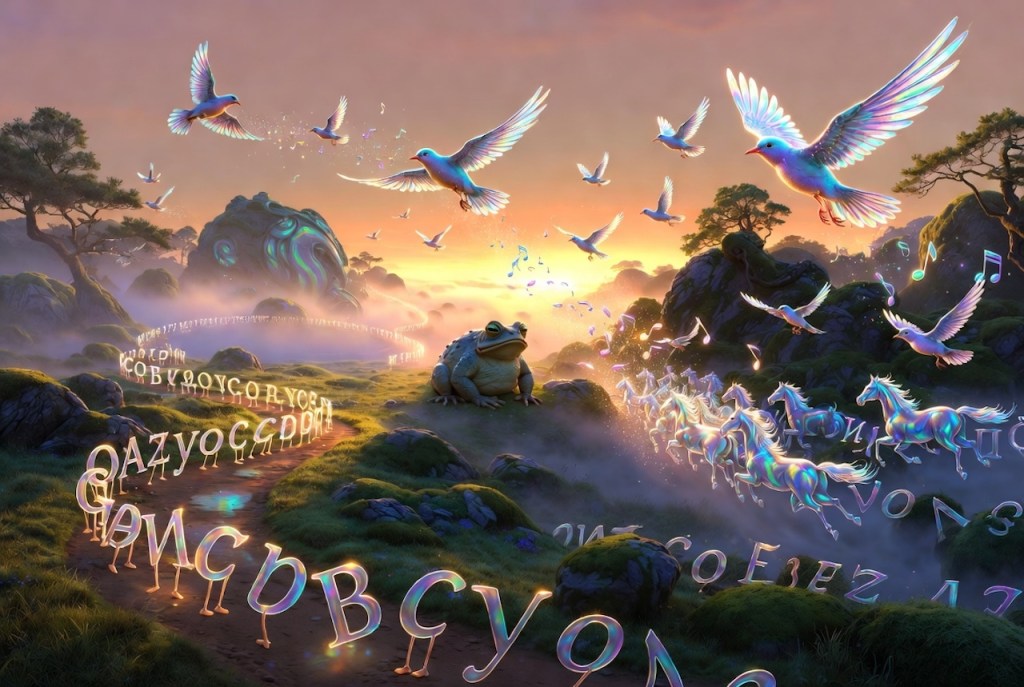
    Image:  Created by Grok inspired by “Gay Birds Dancing”

    Gay Birds Dancing 

    The feet of dancing words
    Tip lightly down the path
    Dawn sprayed and all new
    In their sheen of glory.

    Dapple dreams spill
    Luster on the day’s memory
    Of old rocks with brown moss
    Baking in celestial time. 

    Fog covers the toad
    And moistens the road
    To better nights
    Where glee dwells.

    The notions of gay birds
    Lay their folly like seed
    On the prancing herds
    Of free dancing words.

  • The Beautiful Mother

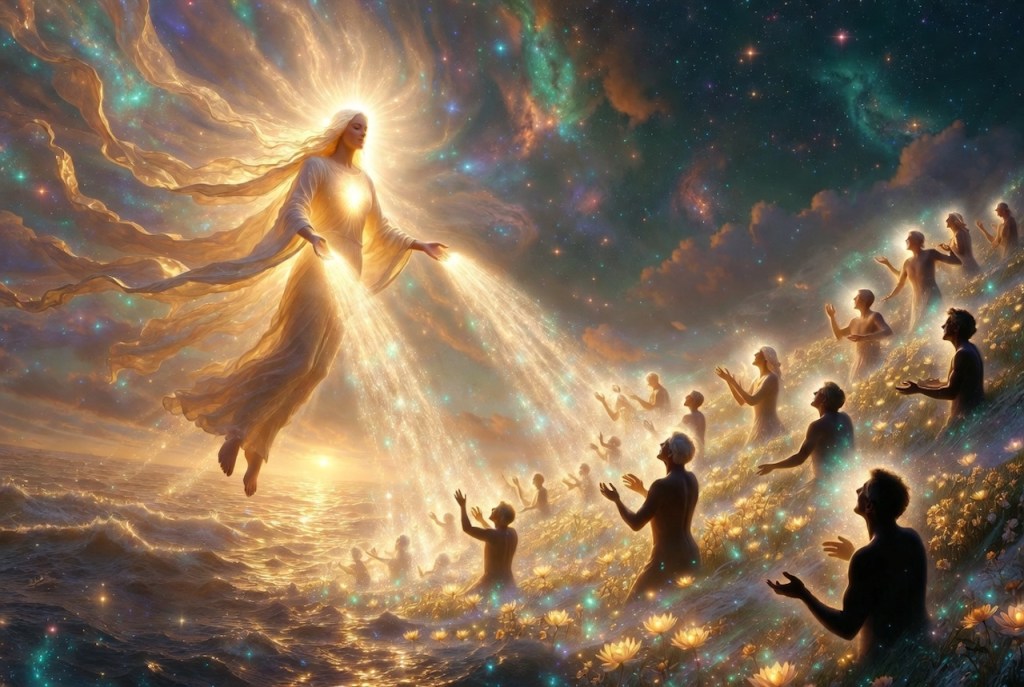
    Image: Created by Gemini inspired by the poem

    The Beautiful Mother

    I am Thy babe of eternity, safe in the cradle of Thine omnipresent bosom.” 
                                                                                      —Paramahansa Yogananda

    On this earth where dreams reign
    And the True is mocked and damned,
    The wide corridors of mirth shrink
    To a ribbon as revelers fumble
    And stumble, blindly seeking each
    Poison-laced thrill.  They frown and feint.

    Thou wilt hold them in Thine arms
    Until they can hold their own healed hearts.
    Thou wilt balm each burn, dry each drop
    Until they can walk in the sun of eternal smiles.
    Thou wilt bring to them the fountain 
    Of Thine all-quenching living waters 
    Where dreams turn all golden 
    In the joy of Thy laughter.
    Thou wilt spray their souls with eternal spring.

    Giving Thee all they own to purchase eternal Bliss,
    They will possess the Joy no tongue can pronounce.

  • The Exorcism

    Image: Created by ChatGPT inspired by the poem

    The Exorcism

    —inspired by Paramahansa Yogananda’s “In the Land Beyond My Dreams”

    The earth is not our home.
    Thou hast created us for better realms.
    We have tied our souls
    With strings of desires
    And draped a veil of Maya
    Over the only eye that truly sees.

    The earth’s treasures
    Cannot satisfy our souls
    With their temporary pleasures.
    Thou dost play hide & seek with our senses
    Those clowns that entertain for a moment
    Then vanish into dust as if they had never been.

    This earth and all its peoples
    Cannot add one inch of stature
    To each shining, perfect soul
    And though the brave and strong
    Are often cowed by the weak and wrong,
    Each Karma will correct each erring course
    In time, in love with Thee.

    This earth’s frenetic playground
    Features folly and excitement
    That each soul eventually must exorcise
    From its ground of being.
    While we play, life ebbs day by day.
    Would that we learn to pray in the silence
    Deep and pregnant with Thy essence
    Until this phantom earth’s ills begin to fade away.

  • A Rugged Vision She Loved, Loved

    Image:  Created by ChatGPT inspired by the poem

    A Rugged Vision She Loved, Loved

    “We cannot choose what we are free to love.”  —from W. H. Auden’s “Canzone”

    And now you breathe no more,
    And hear her beating heart no more.
    She continues writing her soul 
    In the mirror you held up—
    A reflection easily shaken by the wind.

    She revisions the winter you spent together,
    Dragging your hearts through the snow,
    A white play land where your poems
    Pushed against one another,
    And each bright sunlit day filled 
    Her mouth with fresh words of love
    That she would write to you years later.

    But after she wrote them,
    You could not answer
    Having moved to that place
    Where fear catches in the throat,
    And stops the screams,
    And stops the sighs,
    And stops the love,
    Before its tone turns sound.

    Where are you?  Where are you?
    She has cried, she saw you, she listened 
    To your words, she touched your face—
    You, you, a rugged vision she loved, loved.

  • The Only Changeless

    Image: Created by ChatGPT inspired by the poem

    The Only Changeless

    for Brother Ishtananda, who chanted:  “I am not this body, which changes and passes away.  I am not this mind, which knows nothing but change.  I am the immortal, blissful soul, ever one with Thee.”

    The body changes day by day
    From fresh youth to decaying age.
    Loss of hair, weakened teeth thus dismay
    As slower legs amble across the stage.
    I am not that body.

    The mind knows nothing but constant swirling
    As with the body it forms—emerging from the womb 
    And through many countless events twirling
    To weaken, to sicken, to pass on to the tomb.
    I am not that mind.

    The soul remains ever one with Immortality—
    Ever a new bubble of Bliss on the Sea of Infinity—
    Never to be lost throughout all of Eternity—
    The only Changeless, transcending finality.
    I am that soul.