It makes sense that she should tremble When she sees his face, Hears his voice—
She must wonder What her body will become If she never kisses him with a passionate mouth If she never feels his arms pull her to his heart.
How will her bones bear The yearning as they grow brittle? How will her heart beat The fire that leaps at the thought of his touch? How will her blood keep The liquid love that spills passion
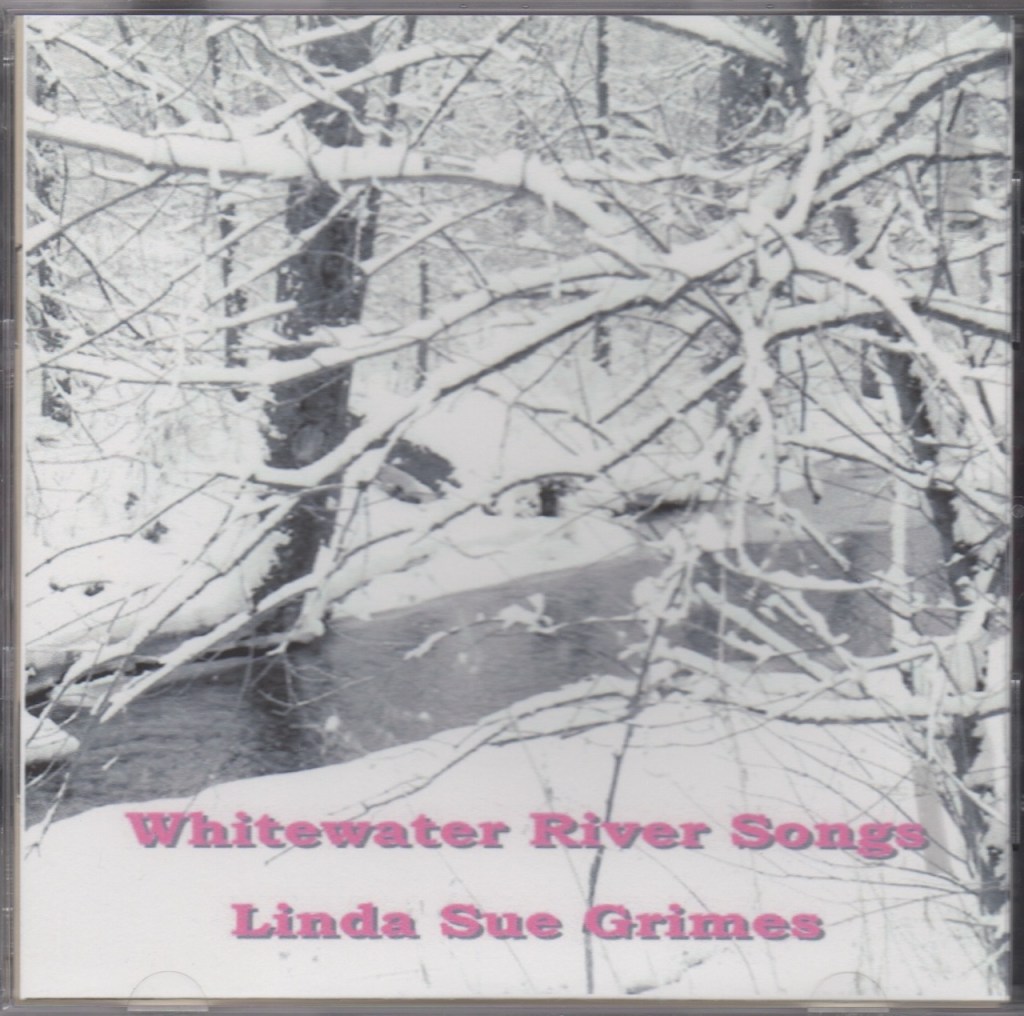
Image: “Whitewater River Songs – Album Cover” Photo by Ron W. G.
Original Song: “River Spirit” and Prose Commentary
I wrote “River Spirit” circa 1980 then made a homemade recording of it around 20 around 2004. In 2023, my husband Ron—whom I call “My Sweet Ron”—created the video featuring his own photos and videos selections along with the song.
Introduction to and Lyric of “River Spirit”
The lyric of “River Spirit” plays out in four stanzas of tercets, with one couplet appearing as the second stanza. It sports no traditional rime-scheme but does offer one set of perfect rime in “hand/sand” in the second and third lines. Other slant—or more accurately ghost rimes—appear in “water/before” in the couplet.
Ghost rimes also make an appearance with “bed/edge” and “changes/images.” The time frame begins in spring, as the singer begins to report what she sees along the river after the cold hard season of winter has given way to the warmth of spring.
The theme of the song is the mystery the singer feels at seeing that the landscape along the river has been radically transformed from what she had observed during the summer before this transforming winter had its sway. The singer poses questions about how the trees got uprooted and the path along the river has shifted, as even the stones are taking on new patterns.
The singer then announces what she had thought to be the agent of the transformations; however, she is ultimately revealing—in the title—that what she “guessed” back in the day, she now knows to be the work of the Divine Reality, the “River Spirit”—or God (see “Names for the Ineffable God”).
(Please note: Dr. Samuel Johnson introduced the form “rhyme” into English in the 18th century, mistakenly thinking that the term was a Greek derivative of “rythmos.” Thus “rhyme” is an etymological error. For my explanation for using only the original form “rime,” please see “Rime vs Rhyme: Dr. Samuel Johnson’s Error.”)
River Spirit
Every spring along the Whitewater River I saw that some mysterious hand Had rearranged the rocks and sand.
The path I followed the summer before Was slipping off into the water. I could not figure out whose force Could drive that water among the reeds & shift the river in its bed
Whose muscles uprooted those trees? Whose fingers patterned those stones Along the edge?
I guessed only that the spring thaw Conjured up the changes In those sleeping river images.
Commentary on “River Spirit”
The time frame is spring, as the singer begins to muse on what she observes along the river after the cold, hard season of winter has given way to the warmth of spring. Her earlier guess about that riverbank rearrangement has now become an article of faith, and she proclaims in the title the answer to her earlier inquiry.
First Movement: The Hand of Mystery
Every spring along the Whitewater River I saw that some mysterious hand Had rearranged the rocks and sand.
The singing narrator launches right into her story by making the claim that she observed a change in the pattern of stones and sand along the river’s edge, and she make this observation “every spring.” She had thus a recollection of having experiences these changes many times.
She colorfully attributes those rearrangements to “some mysterious hand.” At this point, it may sound a bit odd that a river walker would think a hand had been involved in what went on along the riverbank in her absence.
Second Movement: River Features Shifting
The path I followed the summer before Was slipping off into the water.
After setting the stage for mystery and rearrangement of river features, the singer offers a very specific change. She had walk along a path during the preceding summer, and now that path simply veered off into the river water. Such a change would likely be quite jarring for the hiker, who would necessarily be obliged to alter her walking pattern.
Third Movement: Puzzling over the Changes
I could not figure out whose force Could drive that water among the reeds & shift the river in its bed
The singer now inserts her puzzlement. She becomes curious as to how such changes could have occurred. She sees that the river has now shifted its course, plunging into the reeds along the bank.
The mere fact of the river shifting “in its bed” seems Herculean in prospect. The river is such a large body of moving water that the notion of it shifting surely requires a force that strikes the singer an unimaginable at this point.
Fourth Movement: Who Made Those Changes?
Whose muscles uprooted those trees? Whose fingers patterned those stones Along the edge?
The singer then again adds more specificity to her inquiry. She sees that trees have been “uprooted,” and she observes that the stones along the river’s edge have been rearranged in a different pattern from the summer before.
Again, she colorfully attributes those “changes” to a seemingly human agency of “muscles” and “fingers.” But behind those specific agents must lie some metaphysical force that at this point the singer cannot name, cannot even offer a guess about.
Fifth Movement: Guessing at the Conjuring
I guessed only that the spring thaw Conjured up the changes In those sleeping river images.
Now the singer offers what she thought to be an answer to her inquiry: Well, it was likely that not any hands, muscles, or fingers enforced all of these changes; it was simply the process of thawing out from the ice during the warming movements brought on by spring.
Sure, that’s it: the spring movements of thawing influenced those inert river features to alter themselves into differing patterns from the summer before. What else could it be? But the singer is understating what she really believes now. She “guessed” about the “spring thaw”—but that was then, this is now.
Thus the singer through anthropomorphic images of hands, muscles, fingers has proclaimed that a humanlike power has, in fact, mades these changes. Not an actual human being on its own however. But some power that retains in its Being the image of the human form, power, and ingenuity.
Simply, the title of the lyric has already stated what the singer pretends to guess about as she unfurls the song: God (as the “River Spirit”) has performed His magic on these “sleeping river images.” God has “conjured up” those alterations in those river images as they moved from a frozen, winter sleep to vital spring time awakening.
What I owe you I must pay. The love that tried its young shoots Between our concrete hearts Will try again in a distant life Far from the rough clods we used to be.
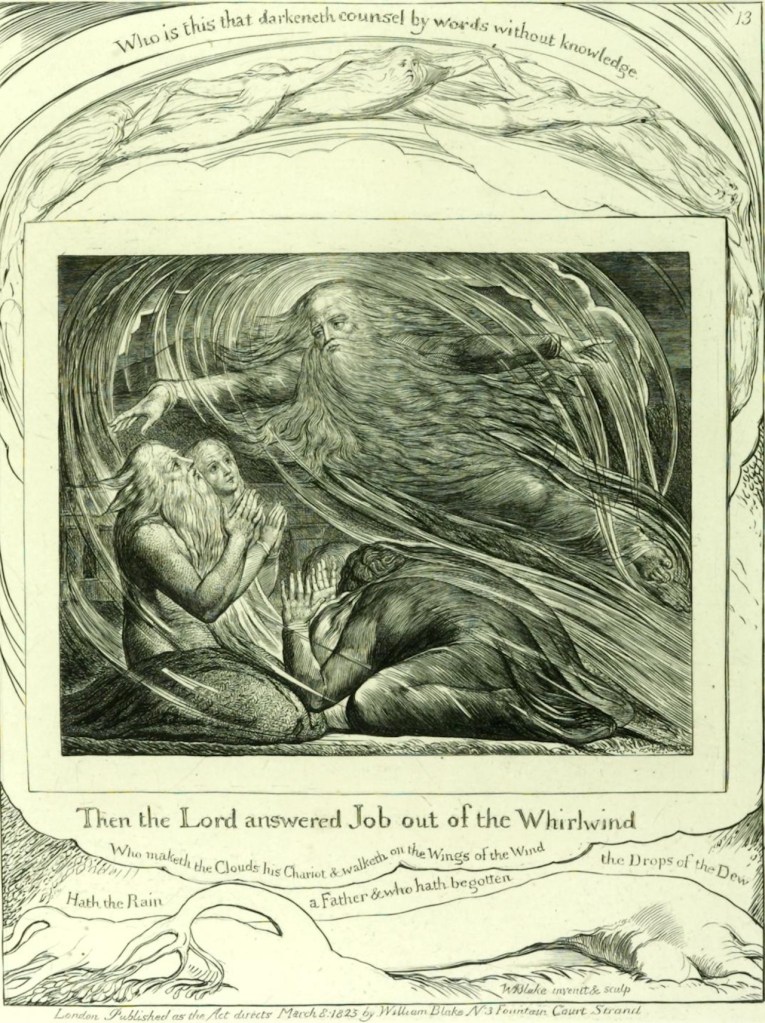
Between us is a whirlwind — We have no fairies to blame. We feed our fires with our own fantasies. I have seen the lighted match in your eyes.
You have seen my hand tremble on the doorknob. We have spoken of the storm that topples empires. Nobody claims losses such as ours As we walk away from the heart of our heat.
Between us is a whirlwind — The gyres are wont to play love our graves.
Love dropped me naked in the middle of this riddle And when like a fat tick, I fell from the hound of life, My bloodless mother and soulless father Became statues in the hall of questions.
Love dropped me naked in the heat of possession And when like a ripe melon I grew a belly and rounded the cape of womanhood, My gutless husband became a mindless boil On the ass of marriage.
Love dropped me naked in a wax of indifference And when like a sculptor I shaped my opinion, Rage convinced my heart To feed upon itself in a birdless cage.
II.
Love leads my hand through pages of lore Where ageless wisdom plants seeds of knowledge. I pluck weeds of doubt by the light of Thy smile: I water tender shoots of Truth with the rain of Thy care.
Love tilts my head to look to the stars Where eternity plays its game of light and dark. I feed on echoes That remind me that I am a soul—timeless, deathless.
Love tempts my heart with the passion of passions Where blood is quickened by divine ardor. I sing only to glorify Thine image To magnify Thine image Thou hast fashioned in me.
after the gift of our friendship when I am alone to see myself for what I am, how slow was my awakening –Malcolm M. Sedam, “Poem to My Father”
So I finally came to know that failing to be grateful for the gift our fathers give us, we fail to live.
In Memoriam: Bert Richardson January 12, 1913 – August 5, 2000
Each human heart beats for love In the ever-new-time-place of Now— My father gave his heart’s love And I began to search God’s gifts For I was slow to awaken to giving.
Passing this world off to offspring Takes a fearless, mature being. Pain endures in sorrow’s valley Where age eludes wisdom Where each brush with pride
Engraves a puffed up chest. Waiting to hear the footsteps He followed to the river of doubt To the sea that forced its silence On the day that bore me,
I had only tears to purify my past— God bestows the gift on beings Who erect monuments to love’s legacy To keep the child’s growth fixed For eternity and focused on nobility.
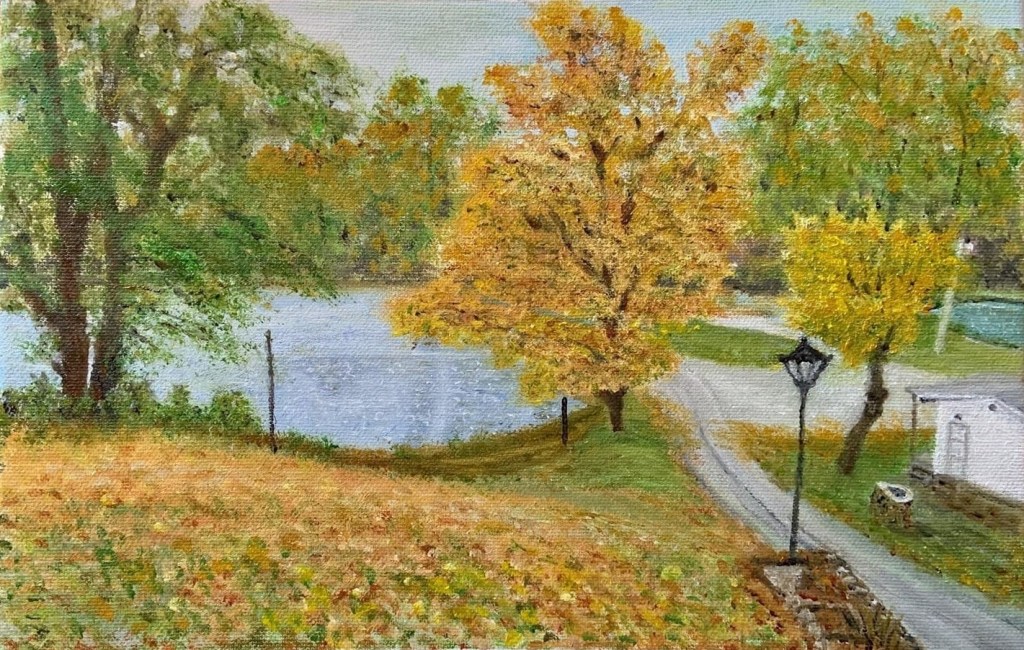
Image: The Old Homestead by Ron W. G. The image is a painting by my sweet husband, Ron, who relied on a photo taken by my sister, Carlene Craig, who still lives there. The old homestead is the place where I grew up—a place of beauty that holds many memories of a young girl growing up in the turbulent times of the 50s and 60s.
Welcome to My Original Poems
My literary focus remains primarily on poetry and songwriting, but as a life-long creative writer, I have also dabbled in many other forms: short stories, flash fiction, memoir.
I also compose literary and expository essays, focusing on a variety of topics including history and politics—even some science/medical issues, especially those that remain controversial.
This room in my literary home provides links to my original poems.
Literary art—somewhat like science—is never truly settled or complete; thus I will be continuing to add—and even to revise— material from time to time.
As a poet, I take the art of poetry very seriously and thus I swear to the following oath:
As I, Linda Sue Grimes, engage in my career as a poet, I solemnly swear to remain faithful to the tenets of the following covenant to the best of my ability:
I will respect and study the significant artistic achievements of those poets who precede me, and I will humbly share my knowledge with those who seek my advice. I will dedicate myself to my craft using all my talent while avoiding those two evils of (1) effusiveness of self-indulgence and (2) pontification on degradation and nihilism.
I will remember that there is a science to poetry as well as an art, and that spirituality, peace, and love always eclipse metaphors and similes. I will not bring shame to my art by pretending to knowledge I do not have, and I will not cut off the legs of colleagues that I may appear taller.
I will respect readers and ever be aware that not all readers are as well-versed in literary matters as I am. I will not take advantage of their ignorance by writing nonsense and then pretending it is the reader’s fault for not understanding my disingenuity. Regardless of the level of fame and fortune I reach, I will remain humble and grateful, not arrogant nor condescending.
I will remember that poetry requires revision and close attention; it does not just pour out of me onto the page, as if opening a vein and letting it drip. Writing poetry requires thinking as well as feeling.
I will continue to educate myself in areas other than poetry so that I may know a fair amount about history, geography, science, math, philosophy, foreign language, religion, economics, sociology, politics, and other fields of endeavor that result in bodies of knowledge.
I will remember that I am no better than prose writers, songwriters, musicians, or politicians; all human beings deserve respect as well as scrutiny as they perform their unique duties, whether artist or artisan.
I will not rewrite English translations of those who have already successfully translated and pretend that I too am a translator. I will not translate any poem that I cannot read and comprehend in the original.




 Linda's Literary Home