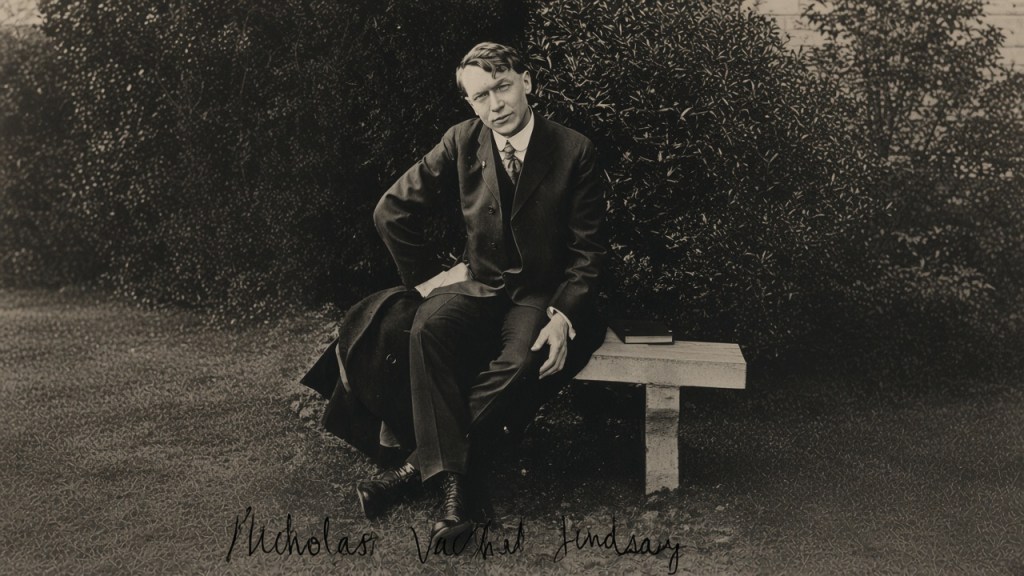
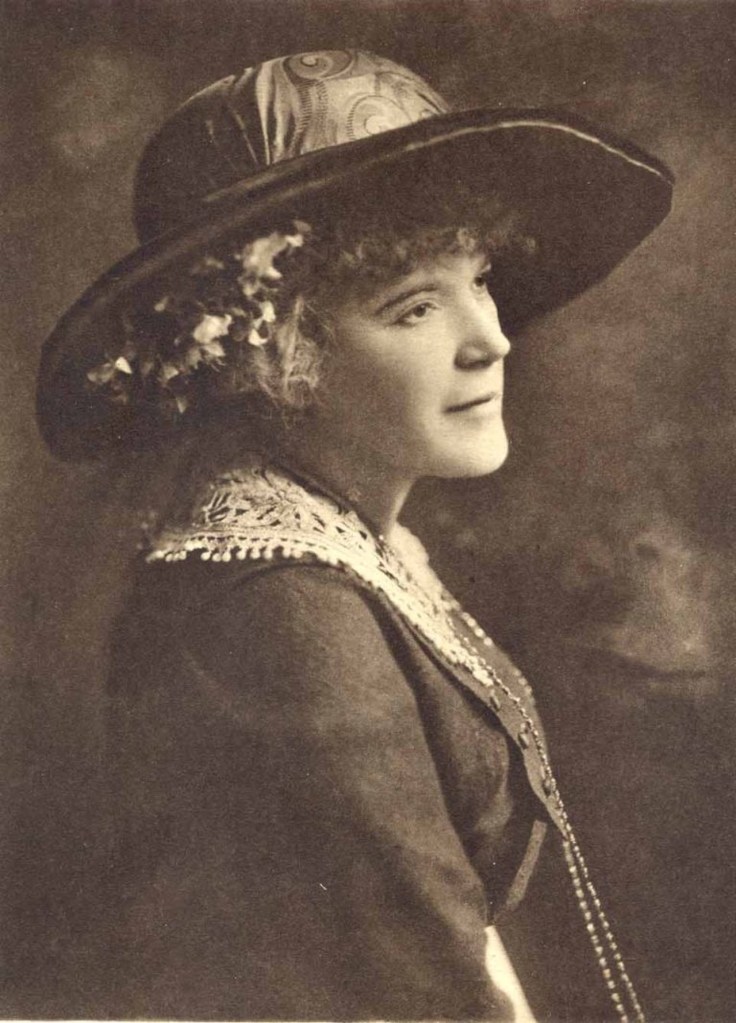
Image: Retouched by Grok photo of Vachel Lindsay – Original at internetpoem.Com
Vachel Lindsay’s “Abraham Lincoln Walks at Midnight’’
One of Vachel Lindsay’s most noted poems focuses Abraham Lincoln, the sixteenth American president. In this elegy, Lincoln strolls about “at Midnight” contemplating the tragedy of nations being in on the brink of a world war. The Civil War president wonders therefore about his own legacy.
Introduction and Text of “Abraham Lincoln Walks at Midnight’’
Vachel Lindsay’s father was a physician, who urged his son to study medicine, but the son discovered that he did not want to be a doctor. He dropped out of Hiram College and studied for a time at the Chicago Art Institute and later at the New York School of Art.
While in New York, Lindsay started poetry writing. He would print out copies of his poems and sell them on the street. He enjoyed a fairly high level of recognition for his writing, and particularly for his performances of his works. He believed that poetry was to be heard more than read, and his lively concerts brought him a wide audience.
One of his most noted poems focuses on the sixteenth president of the United States. Titled “Abraham Lincoln Walks at Midnight,” with the subtitle “In Springfield, Illinois,” the poem consists of eight stanzas each with the rime scheme ABCB and separates into four movements.
Abraham Lincoln Walks at Midnight
(In Springfield, Illinois)
It is portentous, and a thing of state That here at midnight, in our little town A mourning figure walks, and will not rest, Near the old court-house pacing up and down.
Or by his homestead, or in shadowed yards He lingers where his children used to play, Or through the market, on the well-worn stones He stalks until the dawn-stars burn away.
A bronzed, lank man! His suit of ancient black, A famous high top-hat and plain worn shawl Make him the quaint great figure that men love, The prairie-lawyer, master of us all.
He cannot sleep upon his hillside now. He is among us:—as in times before! And we who toss and lie awake for long Breathe deep, and start, to see him pass the door.
His head is bowed. He thinks on men and kings. Yea, when the sick world cries, how can he sleep? Too many peasants fight, they know not why, Too many homesteads in black terror weep.
The sins of all the war-lords burn his heart. He sees the dreadnaughts scouring every main. He carries on his shawl-wrapped shoulders now The bitterness, the folly and the pain.
He cannot rest until a spirit-dawn Shall come;—the shining hope of Europe free; The league of sober folk, the Workers’ Earth, Bringing long peace to Cornland, Alp and Sea.
It breaks his heart that kings must murder still, That all his hours of travail here for men Seem yet in vain. And who will bring white peace That he may sleep upon his hill again?
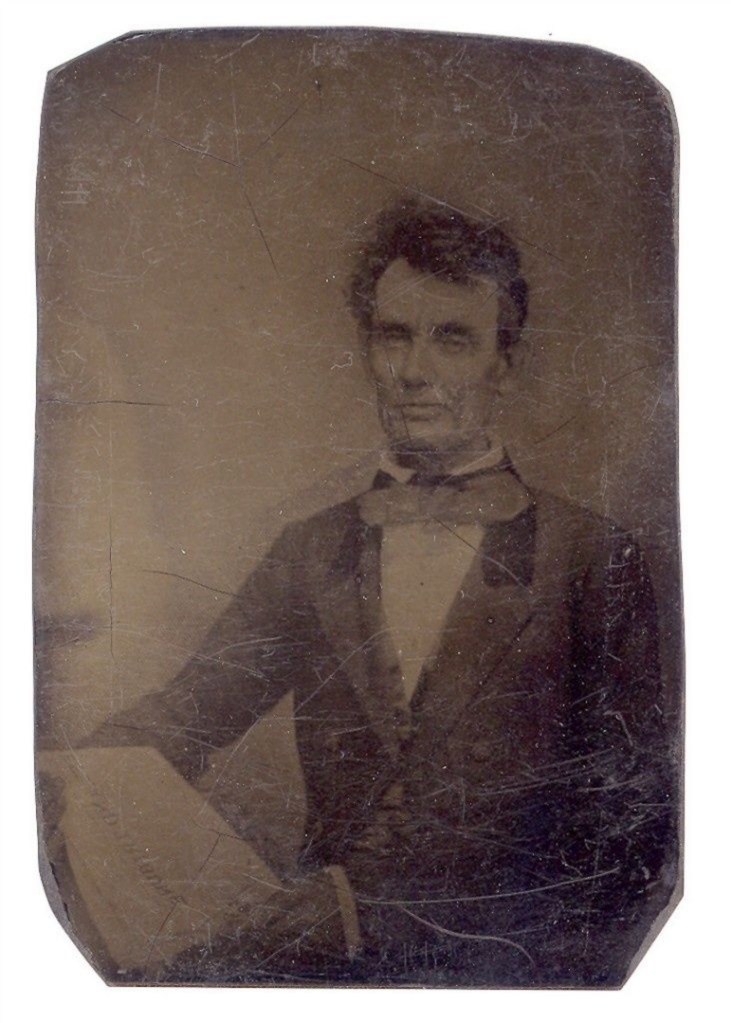
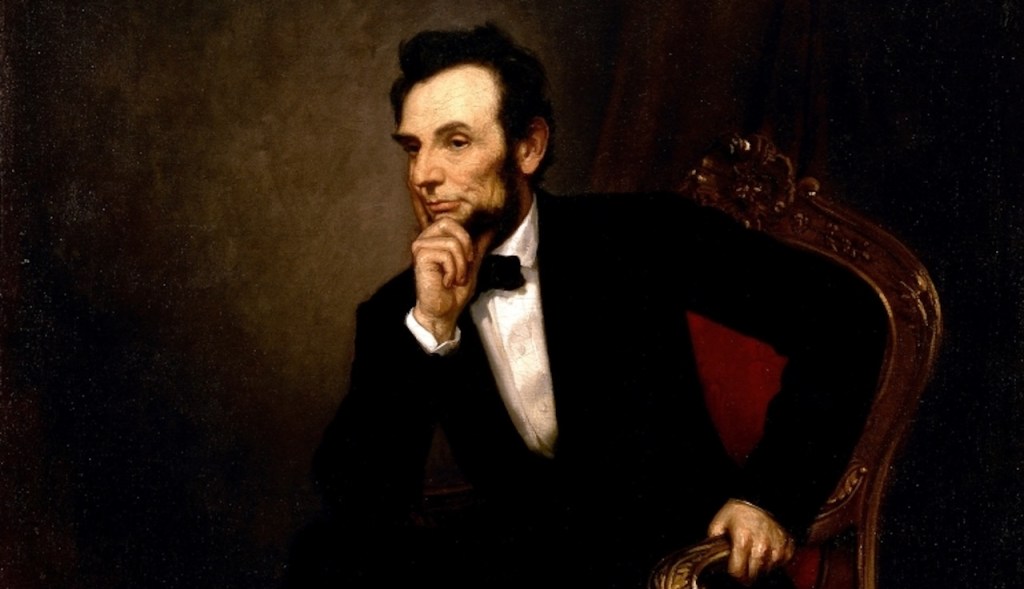
Image b: Abraham Lincoln – Civil War Talk -Daguerreotype image of Abraham Lincoln – earliest known photograph – 1846 – by Nicholas H. Shepherd
Commentary on “Abraham Lincoln Walks at Midnight’’
One of Vachel Lindsay’s most noted poems takes as its subject the sixteenth president of the United States, Abraham Lincoln, likely the most beloved president of all forty-five presidents.
(As of 2024, there have been a total of 45 US presidents. Grover Cleveland had two non-consecutive presidencies, #22 and #24, and after the 2024 presidential election Donald Trump has repeated that feat as #45 and #47; thus while there have been 47 presidencies, there have been only 45 presidents.)
First Movement: Reporting a Portentous Event
It is portentous, and a thing of state That here at midnight, in our little town A mourning figure walks, and will not rest, Near the old court-house pacing up and down.
Or by his homestead, or in shadowed yards He lingers where his children used to play, Or through the market, on the well-worn stones He stalks until the dawn-stars burn away.
In the opening stanza, the speaker declares that “a mourning figure walks” near the courthouse, and this is a “portentous” event that needs to be reported.
In the second stanza, the speaker enumerates other places where the figure has been seen walking: by the home where the figure once lived and where his children played, in the market place “on the well-worn stones.” And he “stalks until the dawn-stars burn away,” thus the title Lincoln “walks at midnight.”
Second Movement: Worries and Restless Roused from the Grave
A bronzed, lank man! His suit of ancient black, A famous high top-hat and plain worn shawl Make him the quaint great figure that men love, The prairie-lawyer, master of us all.
He cannot sleep upon his hillside now. He is among us:—as in times before! And we who toss and lie awake for long Breathe deep, and start, to see him pass the door.
The third stanza describes the figure’s appearance: bronze, lank, wearing a black suit and top-hat. These characteristics, the speaker claims, “make him the quaint great figure that men love.” And he adds that the figure is “The prairie-lawyer, master of us all.” This description makes it quite clear that the figure is Lincoln.
In the fourth stanza, the speaker surmises that Lincoln is worried and restless and cannot remain in his grave; he has to come join the other people of the town who also “toss and lie awake.” And because the restless living people are kept awake by worries, they see the long dead figure walking among them.
Third Movement: Concerned with World Conditions
His head is bowed. He thinks on men and kings. Yea, when the sick world cries, how can he sleep? Too many peasants fight, they know not why, Too many homesteads in black terror weep.
The sins of all the war-lords burn his heart. He sees the dreadnaughts scouring every main. He carries on his shawl-wrapped shoulders now The bitterness, the folly and the pain.
The speaker reckons that the president is worried and unable to sleep because he is cogitating over world conditions. Lincoln is likely thinking about “men and kings,” and he is distressed about the struggling poor people of the world and the “sins of all the war-lords.”
Lincoln paces in the town at midnight, with a load of worries that he knows are bothering this fellow citizens. The problems of the world he seems to carry on his own shoulders, including all the “folly and the pain.”
Fourth Movement: A Question of Peace
He cannot rest until a spirit-dawn Shall come;—the shining hope of Europe free; The league of sober folk, the Workers’ Earth, Bringing long peace to Cornland, Alp and Sea.
It breaks his heart that kings must murder still, That all his hours of travail here for men Seem yet in vain. And who will bring white peace That he may sleep upon his hill again?
In the final two stanzas, the speaker makes the startling claim that Lincoln will not be able to rest until peace comes to the world: until Europe is free, and people wise up and bring long-lasting peace the world over “to Cornland, Alp, and Sea.”
The speaker claims that Lincoln remains sorrowful because kings are still murdering, and all of his own former earthy endeavors seem to be “in vain.” He then concludes with the question about who will finally be the one to bring about peace on this earth, so that Abraham Lincoln’s soul may be at rest and his body lie “sleep[ing] upon his hill again?”
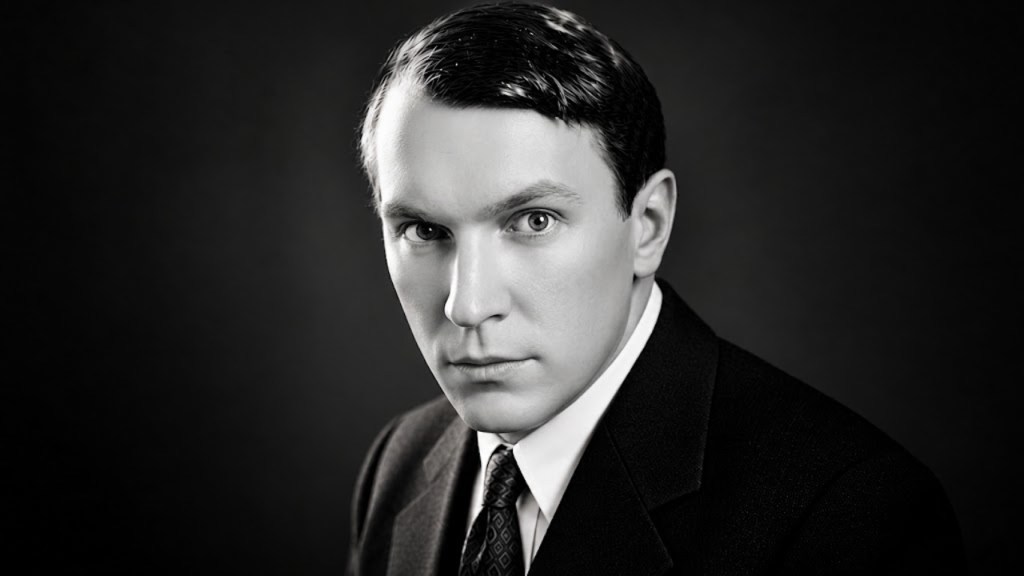
Image c: Retouched photo by Grok and Gemini of Vachel Lindsay – Original at Alchetron
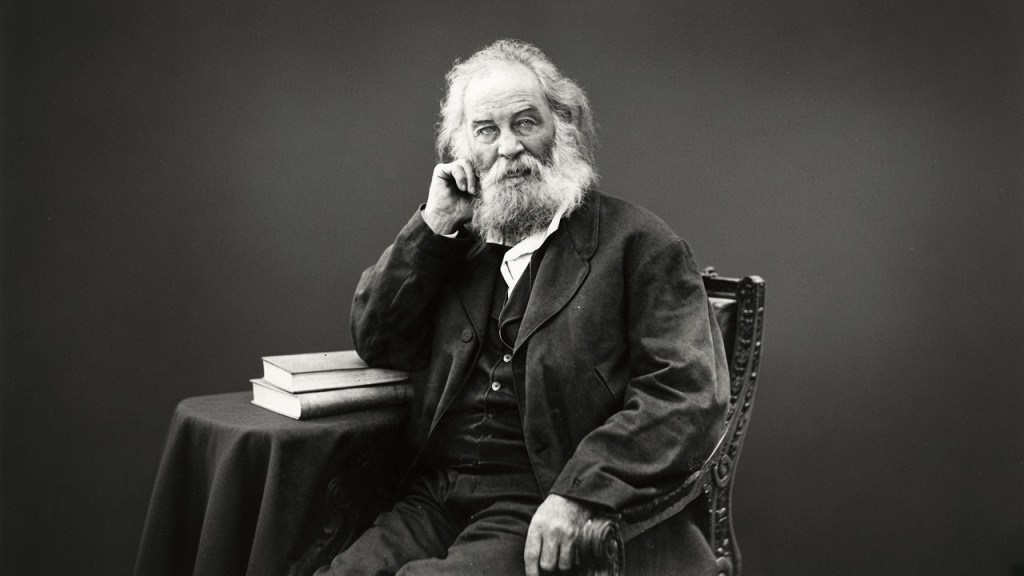
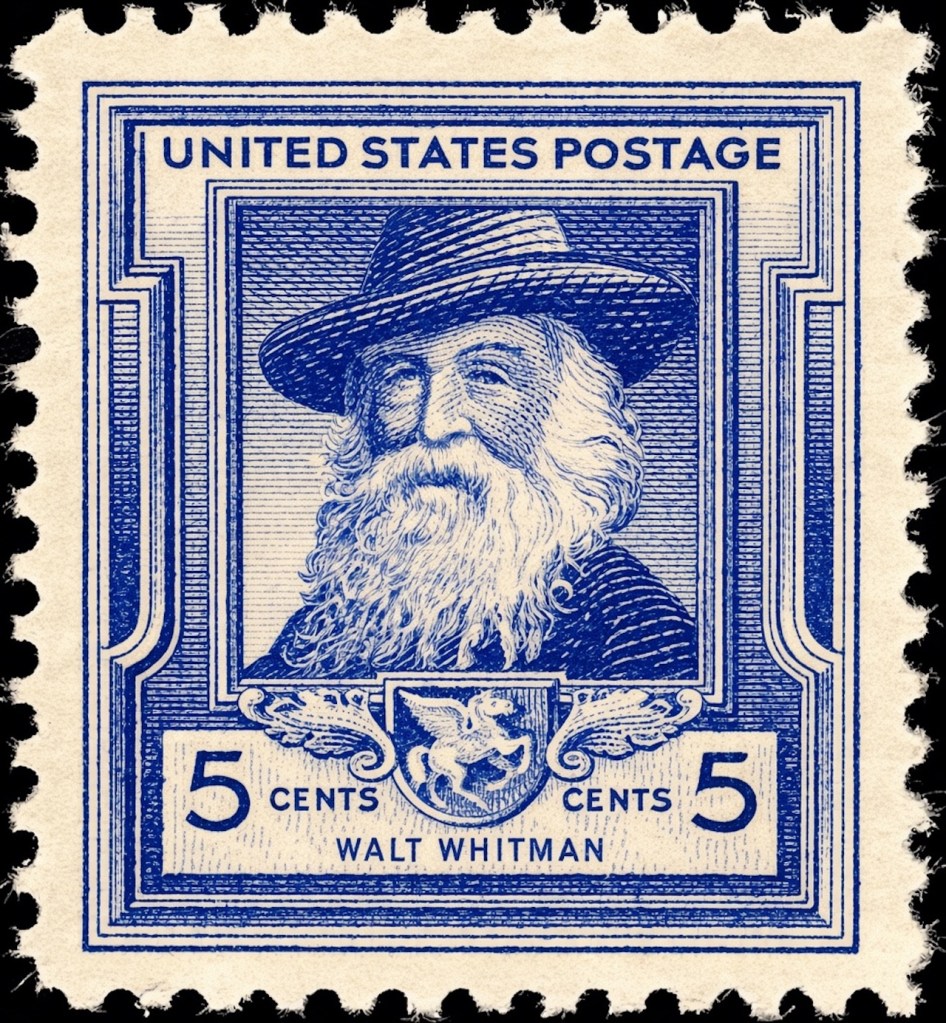
Image: Walt Whitman – Mathew Brady – Walt Whitman Archive
Walt Whitman’s “O Captain! My Captain!”
Walt Whitman’s “O Captain! My Captain!” is an elegy upon the death of Abraham Lincoln, who guided the Union through the terrible Civil War only to be assassinated after victory had been achieved. The speaker metaphorizes Lincoln into the fallen Captain of a victorious ship, creating Whitman’s most famous expression of national grief.
Introduction and Text of “O Captain! My Captain!”
In Walt Whitman’s “O Captain! My Captain!,” the speaker presents Abraham Lincoln as the Captain of a ship that has survived a fearful voyage and finally reached the safety of port.
The ship represents the Union, while the Captain represents Lincoln, whose leadership brought the nation through the Civil War. The Library of Congress identifies the poem specifically as Whitman’s 1865 dirge for Lincoln.
The poem becomes especially poignant because Lincoln dies at the very moment that the nation can celebrate victory. The ship has weathered every storm, the prize has been won, and the people are rejoicing, yet the Captain lies dead upon the deck. The public celebration and the speaker’s private grief therefore exist side by side.
Whitman wrote other elegies for Lincoln, most notably “When Lilacs Last in the Dooryard Bloom’d.” The two poems approach Lincoln’s death differently. “Lilacs” expands personal grief into a profound contemplation of death and national healing, while “O Captain! My Captain!” concentrates its emotional power upon the fallen leader and the terrible irony of his death at the moment of victory.
In my earlier essays on Whitman’s poems, I have discussed the speaker’s recognition that death is an integral part of life. That recognition becomes particularly painful here because Lincoln’s death occurs after his great national task has been accomplished. The Captain has brought the ship safely home, but he cannot step ashore to receive the honors prepared for him.
The poem was written in response to Lincoln’s assassination in April 1865 and first appeared later that year. Whitman subsequently placed it among his poems remembering Lincoln. The Walt Whitman Archive identifies the Captain as a symbolic representation of Lincoln and the ship as the Union that he had steered through the war.
Walt Whitman’s “O Captain! My Captain!”
O Captain! my Captain! our fearful trip is done, The ship has weather’d every rack, the prize we sought is won, The port is near, the bells I hear, the people all exulting, While follow eyes the steady keel, the vessel grim and daring; But O heart! heart! heart! O the bleeding drops of red, Where on the deck my Captain lies, Fallen cold and dead.
O Captain! my Captain! rise up and hear the bells; Rise up—for you the flag is flung—for you the bugle trills, For you bouquets and ribbon’d wreaths—for you the shores a-crowding, For you they call, the swaying mass, their eager faces turning; Here Captain! dear father! This arm beneath your head! It is some dream that on the deck, You’ve fallen cold and dead.
My Captain does not answer, his lips are pale and still, My father does not feel my arm, he has no pulse nor will, The ship is anchor’d safe and sound, its voyage closed and done, From fearful trip the victor ship comes in with object won; Exult O shores, and ring O bells! But I with mournful tread, Walk the deck my Captain lies, Fallen cold and dead.
Commentary on “O Captain! my Captain! ”
The speaker mourns Abraham Lincoln while confronting the painful irony of national victory accompanied by personal loss.
First Stanza: “O Captain! my Captain! our fearful trip is done”
O Captain! my Captain! our fearful trip is done, The ship has weather’d every rack, the prize we sought is won, The port is near, the bells I hear, the people all exulting, While follow eyes the steady keel, the vessel grim and daring; But O heart! heart! heart! O the bleeding drops of red, Where on the deck my Captain lies, Fallen cold and dead..
The first line announces the central irony of the entire elegy. The “fearful trip” is the Civil War, and the ship is the Union. The voyage has ended successfully because the Union has survived the conflict, but the Captain who guided the nation through the storm has been killed.
The phrase “the prize we sought is won” points directly toward the preservation of the Union. The ship has endured the terrible “rack,” or storm, and now approaches port. The historical reality behind the metaphor is therefore essential: the war has ended, victory has come, and Lincoln has been assassinated.
The speaker then creates a scene of national rejoicing. Bells ring, people celebrate, and eyes follow the victorious vessel as it approaches. These details suggest the immense public significance of the Union’s victory after four years of civil conflict.
But the speaker suddenly turns from public celebration to private anguish with “But O heart! heart! heart!” The repeated word “heart” seems almost to stop the celebration in its tracks. The speaker cannot participate in the rejoicing because his attention is fixed upon the blood appearing on the deck.
The “bleeding drops of red” transform the victorious ship into a place of death. The image is particularly powerful because Lincoln’s assassination occurred just as the national crisis represented by the voyage had reached its conclusion. Victory and death occupy the same physical space.
The Captain is therefore Abraham Lincoln, but the speaker never names him. This omission allows Lincoln to become both a historical individual and a symbolic national father. The Whitman Archive notes that Whitman grouped the poem with his other Lincoln poems under “Memories of President Lincoln.”
The speaker’s grief is made more poignant by the fact that Lincoln cannot enjoy the victory he helped achieve. The people on shore can celebrate because the voyage has ended; the speaker can only mourn because the Captain lies dead.
Second Stanza: “O Captain! my Captain! rise up and hear the bells”
O Captain! my Captain! rise up and hear the bells; Rise up—for you the flag is flung—for you the bugle trills, For you bouquets and ribbon’d wreaths—for you the shores a-crowding, For you they call, the swaying mass, their eager faces turning; Here Captain! dear father! This arm beneath your head! It is some dream that on the deck, You’ve fallen cold and dead.
The second stanza makes the speaker’s grief even more personal. He begs the Captain to rise because the entire nation is waiting to honor him. The flag is flying, the bugle is sounding, and the people are crowding the shores to welcome their victorious leader.
The repeated phrase “For you” emphasizes the tragic appropriateness of the celebration. Everything has been prepared for Lincoln. The people are celebrating the victory that his leadership helped secure, yet the person whom they have come to honor cannot hear their voices.
The speaker then calls him “dear father.” This expression is particularly significant in an elegy for Abraham Lincoln, whose public image after his assassination became associated with paternal leadership of a divided nation. The Captain is simultaneously the leader of the ship and the beloved father of the speaker.
The phrase “This arm beneath your head!” brings the historical tragedy into an intimate physical scene. The speaker holds Lincoln’s head in his arm as though the dead president were still capable of hearing and responding. The gesture makes the enormous national tragedy intensely personal.
The speaker then says, “It is some dream.” His mind resists what his eyes know. He has not merely lost a political leader; he has lost the Captain who has accompanied him through the fearful voyage.
The relationship between this poem and “When Lilacs Last in the Dooryard Bloom’d” becomes important here. In “Lilacs,” the speaker eventually moves from the immediate shock of Lincoln’s death toward an acceptance of death as part of a larger spiritual reality. “O Captain! My Captain!” remains much closer to the immediate wound.
Paramahansa Yogananda teaches that “Our real self, the soul, is immortal.” This spiritual reality is one the speaker, in his present deep state of mourning, is incapable of accepting, because he remains immersed in the human experience of loss.
The speaker cannot yet see beyond the physical body lying upon the deck. The suffering speaker can touch the Captain, but he cannot awaken him. The victory is real, but so is the terrible absence of the man who made that victory possible.
Third Stanza: “My Captain does not answer, his lips are pale and still”
My Captain does not answer, his lips are pale and still The ship is anchor’d safe and sound, its voyage closed and done, From fearful trip the victor ship comes in with object won; Exult O shores, and ring O bells! But I with mournful tread, Walk the deck my Captain lies, Fallen cold and dead.
The third stanza finally forces the speaker to acknowledge the physical reality of Lincoln’s death. The claim “My Captain does not answer” leaves no room for the dream that he might awaken. All color has gone from his lips and his pulse has ceased.
The speaker again uses “My father,” emphasizing the intimate attachment that has made Lincoln’s death so devastating. The historical president has become, within the speaker’s emotional world, a beloved father whose absence cannot be compensated for by public celebration.
The ship, meanwhile, has reached safety. The statement “The ship is anchor’d safe and sound” is a direct confirmation that the Union has survived the Civil War. The voyage is “closed and done,” and the “victor ship” has arrived with the object of its struggle won.
The tragic paradox is now complete. Lincoln has accomplished the task represented by the voyage, but he has been denied the opportunity to witness the peaceful arrival of the ship. The nation has won, but its leader has fallen.
The command “Exult O shores, and ring O bells!” acknowledges the legitimate joy of the nation. The speaker does not ask the people to stop celebrating. Instead, he separates himself from them with the word “But.” They may rejoice; he must mourn.
This distinction is central to the poem’s identity as an elegy for Abraham Lincoln. The poem does not simply lament a dead man. It dramatizes the strange emotional condition of a nation that has achieved victory while simultaneously losing the man who led it through the crisis.
In “When Lilacs Last in the Dooryard Bloom’d,” Whitman broadens Lincoln’s death into a contemplative musing upon universal mortality and the possibility of spiritual reconciliation.
The Library of Congress describes that poem as an elegy concerned with universal death and national healing, while “O Captain! My Captain!” concentrates more directly upon the public and personal grief surrounding Lincoln.
The final image returns to the deck. The speaker walks there with a “mournful tread,” remaining beside the body of the Captain while the nation celebrates. The physical movement is small, but emotionally it carries the full weight of the assassination.
The repetition of “Fallen cold and dead” gives the poem its final emotional blow. The Captain is not merely absent; he has fallen at the precise moment that the ship reaches safety. The repeated words therefore connect Lincoln’s death permanently with the nation’s victory.
Paramahansa Yogananda explains that death does not destroy the spiritual essence, stating that “the soul or spiritual essence of man is also indestructible.” Such a teaching provides a spiritual reality beyond the speaker’s immediate grief, although the speaker does not attempt to resolve his sorrow through such a doctrine at his point in his suffering.
Instead, the speaker remains upon the deck with Lincoln. The people on shore celebrate the end of the war, while the speaker remains emotionally attached to the fallen Captain. This separation gives the poem its extraordinary poignancy. The poem’s fame rests partly upon this directness.
The Library of Congress notes that it received immediate acclaim and became widely anthologized, while the Whitman Archive identifies it as Whitman’s most popular poem. Its enduring power comes from the simplicity with which it joins Lincoln’s national importance to the intimate sorrow of personal bereavement.
The speaker has created a Captain who is unmistakably Abraham Lincoln without ever naming him. The ship is the Union, the fearful voyage is the Civil War, the prize is victory, the port is peace, and the fallen Captain is the president, who did not live to enter that peaceful harbor.
Thus, “O Captain! My Captain!” remains Whitman’s most famous and perhaps his most immediately poignant elegy for Abraham Lincoln. “When Lilacs Last in the Dooryard Bloom’d” reaches toward universal death and spiritual healing, while this poem remains deliberately close to the heartbreaking image of Lincoln lying dead upon the deck of the victorious Union.
The final paradox is therefore the poem’s deepest truth: the Captain has succeeded, but he has not survived his success. The ship has reached the harbor, but the man who guided it there is dead. The bells ring for victory while the speaker walks alone beside his fallen Captain.
Image a: Walt Whitman – Mathew Brady – Walt Whitman Archive
Walt Whitman’s “When Lilacs Last in the Dooryard Bloom’d”
Walt Whitman’s admiration for President Lincoln is dramatized in the poet’s elegy “When Lilacs Last in the Dooryard Bloom’d,” mourning the death while celebrating the presidency of the sixteenth president, Abraham Lincoln.
Introduction and Text of “When Lilacs Last in the Dooryard Bloom’d”
In Walt Whitman’s “When Lilacs Last in the Dooryard Bloom’d,” the speaker laments the death of President Lincoln, but he does much more than merely offer his own sad and melancholy state of mind.
This speaker creates a sacred myth through which he not only offers a tribute to the fallen president but also creates a symbolic triad that will henceforth bring readers’ and listeners’ attention to the momentous event.
The speaker also composes a “Death Carol,” in which rests the irony of elevating death from the lamentation it usually brings for a celebrated friend whom all suffering humanity can afford the fealty of welcome.
It might be observed that poet Walt Whitman sectioned his elegy into 16 parts, symbolizing the fact that Abraham Lincoln, the heroic subject of the poem, had served as the sixteenth president of the United States.
When Lilacs Last in the Dooryard Bloom’d
1
When lilacs last in the dooryard bloom’d, And the great star early droop’d in the western sky in the night, I mourn’d, and yet shall mourn with ever-returning spring.
Ever-returning spring, trinity sure to me you bring, Lilac blooming perennial and drooping star in the west, And thought of him I love.
2
O powerful western fallen star! O shades of night—O moody, tearful night! O great star disappear’d—O the black murk that hides the star! O cruel hands that hold me powerless—O helpless soul of me! O harsh surrounding cloud that will not free my soul.
3 In the dooryard fronting an old farm-house near the white-wash’d palings, Stands the lilac-bush tall-growing with heart-shaped leaves of rich green, With many a pointed blossom rising delicate, with the perfume strong I love, With every leaf a miracle—and from this bush in the dooryard, With delicate-color’d blossoms and heart-shaped leaves of rich green, A sprig with its flower I break.
4
In the swamp in secluded recesses, A shy and hidden bird is warbling a song.
Solitary the thrush, The hermit withdrawn to himself, avoiding the settlements, Sings by himself a song.
Song of the bleeding throat, Death’s outlet song of life, (for well dear brother I know, If thou wast not granted to sing thou would’st surely die.)
5
Over the breast of the spring, the land, amid cities, Amid lanes and through old woods, where lately the violets peep’d from the ground, spotting the gray debris, Amid the grass in the fields each side of the lanes, passing the endless grass, Passing the yellow-spear’d wheat, every grain from its shroud in the dark-brown fields uprisen, Passing the apple-tree blows of white and pink in the orchards, Carrying a corpse to where it shall rest in the grave, Night and day journeys a coffin
6
Coffin that passes through lanes and streets, Through day and night with the great cloud darkening the land, With the pomp of the inloop’d flags with the cities draped in black, With the show of the States themselves as of crape-veil’d women standing, With processions long and winding and the flambeaus of the night, With the countless torches lit, with the silent sea of faces and the unbared heads, With the waiting depot, the arriving coffin, and the sombre faces, With dirges through the night, with the thousand voices rising strong and solemn, With all the mournful voices of the dirges pour’d around the coffin, The dim-lit churches and the shuddering organs—where amid these you journey, With the tolling tolling bells’ perpetual clang, Here, coffin that slowly passes, I give you my sprig of lilac.
7
(Nor for you, for one alone, Blossoms and branches green to coffins all I bring, For fresh as the morning, thus would I chant a song for you O sane and sacred death.
All over bouquets of roses, O death, I cover you over with roses and early lilies, But mostly and now the lilac that blooms the first, Copious I break, I break the sprigs from the bushes, With loaded arms I come, pouring for you, For you and the coffins all of you O death.)
8
O western orb sailing the heaven, Now I know what you must have meant as a month since I walk’d, As I walk’d in silence the transparent shadowy night, As I saw you had something to tell as you bent to me night after night, As you droop’d from the sky low down as if to my side, (while the other stars all look’d on,) As we wander’d together the solemn night, (for something I know not what kept me from sleep,) As the night advanced, and I saw on the rim of the west how full you were of woe, As I stood on the rising ground in the breeze in the cool transparent night, As I watch’d where you pass’d and was lost in the netherward black of the night, As my soul in its trouble dissatisfied sank, as where you sad orb, Concluded, dropt in the night, and was gone.
9
Sing on there in the swamp, O singer bashful and tender, I hear your notes, I hear your call, I hear, I come presently, I understand you, But a moment I linger, for the lustrous star has detain’d me, The star my departing comrade holds and detains me.
10
O how shall I warble myself for the dead one there I loved? And how shall I deck my song for the large sweet soul that has gone? And what shall my perfume be for the grave of him I love?
Sea-winds blown from east and west, Blown from the Eastern sea and blown from the Western sea, till there on the prairies meeting, These and with these and the breath of my chant, I’ll perfume the grave of him I love.
11
O what shall I hang on the chamber walls? And what shall the pictures be that I hang on the walls, To adorn the burial-house of him I love?
Pictures of growing spring and farms and homes, With the Fourth-month eve at sundown, and the gray smoke lucid and bright, With floods of the yellow gold of the gorgeous, indolent, sinking sun, burning, expanding the air, With the fresh sweet herbage under foot, and the pale green leaves of the trees prolific, In the distance the flowing glaze, the breast of the river, with a wind-dapple here and there, With ranging hills on the banks, with many a line against the sky, and shadows, And the city at hand with dwellings so dense, and stacks of chimneys, And all the scenes of life and the workshops, and the workmen homeward returning.
12
Lo, body and soul—this land, My own Manhattan with spires, and the sparkling and hurrying tides, and the ships, The varied and ample land, the South and the North in the light, Ohio’s shores and flashing Missouri, And ever the far-spreading prairies cover’d with grass and corn.
Lo, the most excellent sun so calm and haughty, The violet and purple morn with just-felt breezes, The gentle soft-born measureless light, The miracle spreading bathing all, the fulfill’d noon, The coming eve delicious, the welcome night and the stars, Over my cities shining all, enveloping man and land.
13
Sing on, sing on you gray-brown bird, Sing from the swamps, the recesses, pour your chant from the bushes, Limitless out of the dusk, out of the cedars and pines.
Sing on dearest brother, warble your reedy song, Loud human song, with voice of uttermost woe.
O liquid and free and tender! O wild and loose to my soul—O wondrous singer! You only I hear—yet the star holds me, (but will soon depart,) Yet the lilac with mastering odor holds me.
14
Now while I sat in the day and look’d forth, In the close of the day with its light and the fields of spring, and the farmers preparing their crops, In the large unconscious scenery of my land with its lakes and forests, In the heavenly aerial beauty, (after the perturb’d winds and the storms,) Under the arching heavens of the afternoon swift passing, and the voices of children and women, The many-moving sea-tides, and I saw the ships how they sail’d, And the summer approaching with richness, and the fields all busy with labor, And the infinite separate houses, how they all went on, each with its meals and minutia of daily usages, And the streets how their throbbings throbb’d, and the cities pent—lo, then and there, Falling upon them all and among them all, enveloping me with the rest, Appear’d the cloud, appear’d the long black trail, And I knew death, its thought, and the sacred knowledge of death.
Then with the knowledge of death as walking one side of me, And the thought of death close-walking the other side of me, And I in the middle as with companions, and as holding the hands of companions, I fled forth to the hiding receiving night that talks not, Down to the shores of the water, the path by the swamp in the dimness, To the solemn shadowy cedars and ghostly pines so still.
And the singer so shy to the rest receiv’d me, The gray-brown bird I know receiv’d us comrades three, And he sang the carol of death, and a verse for him I love.
From deep secluded recesses, From the fragrant cedars and the ghostly pines so still, Came the carol of the bird.
And the charm of the carol rapt me, As I held as if by their hands my comrades in the night, And the voice of my spirit tallied the song of the bird.
Death Carol
Come lovely and soothing death, Undulate round the world, serenely arriving, arriving, In the day, in the night, to all, to each, Sooner or later delicate death.
Prais’d be the fathomless universe, For life and joy, and for objects and knowledge curious, And for love, sweet love—but praise! praise! praise! For the sure-enwinding arms of cool-enfolding death.
Dark mother always gliding near with soft feet, Have none chanted for thee a chant of fullest welcome? Then I chant it for thee, I glorify thee above all, I bring thee a song that when thou must indeed come, come unfalteringly.
Approach strong deliveress, When it is so, when thou hast taken them I joyously sing the dead, Lost in the loving floating ocean of thee, Laved in the flood of thy bliss O death.
From me to thee glad serenades, Dances for thee I propose saluting thee, adornments and feastings for thee, And the sights of the open landscape and the high-spread sky are fitting, And life and the fields, and the huge and thoughtful night.
The night in silence under many a star, The ocean shore and the husky whispering wave whose voice I know, And the soul turning to thee O vast and well-veil’d death, And the body gratefully nestling close to thee.
Over the tree-tops I float thee a song, Over the rising and sinking waves, over the myriad fields and the prairies wide, Over the dense-pack’d cities all and the teeming wharves and ways, I float this carol with joy, with joy to thee O death.
15
To the tally of my soul, Loud and strong kept up the gray-brown bird, With pure deliberate notes spreading filling the night.
Loud in the pines and cedars dim, Clear in the freshness moist and the swamp-perfume, And I with my comrades there in the night.
While my sight that was bound in my eyes unclosed, As to long panoramas of visions.
And I saw askant the armies, I saw as in noiseless dreams hundreds of battle-flags, Borne through the smoke of the battles and pierc’d with missiles I saw them, And carried hither and yon through the smoke, and torn and bloody, And at last but a few shreds left on the staffs, (and all in silence,) And the staffs all splinter’d and broken.
I saw battle-corpses, myriads of them, And the white skeletons of young men, I saw them, I saw the debris and debris of all the slain soldiers of the war, But I saw they were not as was thought, They themselves were fully at rest, they suffer’d not, The living remain’d and suffer’d, the mother suffer’d, And the wife and the child and the musing comrade suffer’d, And the armies that remain’d suffer’d.
16
Passing the visions, passing the night Passing, unloosing the hold of my comrades’ hands, Passing the song of the hermit bird and the tallying song of my soul, Victorious song, death’s outlet song, yet varying ever-altering song, As low and wailing, yet clear the notes, rising and falling, flooding the night, Sadly sinking and fainting, as warning and warning, and yet again bursting with joy, Covering the earth and filling the spread of the heaven, As that powerful psalm in the night I heard from recesses, Passing, I leave thee lilac with heart-shaped leaves, I leave thee there in the door-yard, blooming, returning with spring.
I cease from my song for thee, From my gaze on thee in the west, fronting the west, communing with thee, O comrade lustrous with silver face in the night.
Yet each to keep and all, retrievements out of the night, The song, the wondrous chant of the gray-brown bird, And the tallying chant, the echo arous’d in my soul, With the lustrous and drooping star with the countenance full of woe, With the holders holding my hand nearing the call of the bird, Comrades mine and I in the midst, and their memory ever to keep, for the dead I loved so well, For the sweetest, wisest soul of all my days and lands—and this for his dear sake, Lilac and star and bird twined with the chant of my soul, There in the fragrant pines and the cedars dusk and dim.
Commentary on “When Lilacs Last in the Dooryard Bloom’d”
Walt Whitman was deeply affected by the assassination of President Lincoln on April 14, 1865. The poet’s admiration is dramatized in his elegy as it emphasizes three symbols: a lilac, a star, and a bird.
First Movement 1-6: Springtime when Lilacs Bloom
The speaker begins by setting the time frame in spring when lilacs bloom. He is in mourning and suggests that Americans will continue to mourn this time of year, when three events continue to come together: the lilacs bloom, the star Venus appears, and the speaker’s thoughts of the president he venerated return.
The lilacs and the star of Venus immediately become symbolic of the speaker’s feelings and the momentous event that has engendered them. In the second section of the first movement, the speaker offers a set of keening laments prefaced by “O”:
O powerful western fallen star! O shades of night—O moody, tearful night! O great star disappear’d—O the black murk that hides the star!
Each keen grows more intense as it progresses to the final, ” O hard surrounding cloud that will not free my soul.” He picks a sprig of lilac whose leaves are heart-shaped. This act indicates that the lilac will henceforth become symbolic for the speaker; the lilac will symbolize the love the speaker bears for the fallen president.
The speaker then introduces the singing hermit thrush whose song will elevate the bird to symbolic significance for the speaker, as well as the lilacs and star. In the final two sections of the first movement, the speaker describes the landscape through which President Lincoln’s casketed body moved to its final resting place in Illinois.
Second Movement 7: The Symbolic Offering
The second movement consists of a parenthetical offering of flowers to the casketed corpse of the president but also suggests that the speaker would overlay the coffins of all the war dead with roses and lilies, “But mostly and now the lilac that blooms the first.”
Again, the suggestion that the lilac will remain a symbol because it is the first flower to bloom every spring. While showering the coffins of the fallen, the speaker says he will “chant a song for you O sane and sacred death.”
Third Movement 8-9: The Star of Venus
The speaker now confronts the “western orb” that star of Venus that he had observed a month earlier. He imagines that the symbolic star had been speaking to him of the tragic events to come.
The star seemed to drop to the speaker’s side as the other stars watched. The speaker felt a sadness as the star “drops in the night, and was gone.” Now that the month has passed, the speaker feels that he was being forewarned by the symbolic star.
The speaker says that the “star of my departing comrade hold and detains me,” as he addresses the “singer bashful and tender,” that is, the hermit thrush who sings his solitary song from the covering of leaves.
Fourth Movement 10-13: A Personal Shrine to a Slain President
The speaker now muses on how he will be able to “warble . . . for the dead one there I loved.” He continues to lament but knows he must compose a “song for the large sweet soul that has gone.”
The speaker then considers what he will “hang on the chamber walls,” indicating he will erect a personal shrine to the slain president. He offers a number of items that he feels must decorate that shrine, as he catalogues them; for example, “Pictures of growing spring and farms and homes.”
The famous Whitman catalogue finds its way into several movements of this elegy. As it is the president of the country who has died, the speaker places scenes from the country in his elegy:
Lo, body and soul—this land, My own Manhattan with spires, and the sparkling and hurrying tides, and the ships, The varied and ample land, the South and the North in the light, Ohio’s shores and flashing Missouri, And ever the far-spreading prairies cover’d with grass and corn.
The speaker then commands the bird to sing as he prepares to offer a “Death Carol” in the next movement.
Fifth Movement 14: A Hymn to Death
The speaker creates a moving tribute to the president by replacing the sorrow of death with the dignity and necessity of death. Death becomes a friend who gives respite to the weary body—a fact often referenced by the “Father of Yoga in the West” Paramahansa Yogananda.
The speaker prefaces his “Death Carol” with a scene of himself walking between two friends: “knowledge of death” walked on one side of the speaker, and the “thought of death” occupied the other.
The “Death Carol” virtually lovingly addresses death, inviting it to “come lovely and soothing death.” He welcomes death to “undulate round the world.” He has almost fully accepted that death comes “in the day, in the night, to all, to each, / Sooner or later.”
The speaker’s lament has transformed death from a dreaded event to a sacred, sweet one to which he will float a song full of joy.
Sixth Movement 15-16: Entwining the Images and Symbols
The speaker credits the bird with the composition of the “Death Carol.” This crediting indicates that the speaker had become so closely in tune with the warbling bird that he cognizes a hymn from the singing.
The speaker then catalogues scenes that he had actually witnessed as he traveled the battlefields of the war during which time he had nursed the wounded and dying. He saw “battle-corpses, myriads of them.”
But he finally realizes something vital to the awareness of the reality of death: “. . . I saw they were not as was thought, / They themselves were fully at rest, they suffer’d not.” The speaker realized that it is the living who suffer the death of the deceased and not the deceased, who remained, “fully at rest.”
The speaker’s parting words offer his summation of the entwined images that now have become and will retain their symbolic significance for the speaker: “For the sweetest, wisest soul of all my days and lands—and this for his dear sake, / Lilac and star and bird twined with the chant of my soul.”
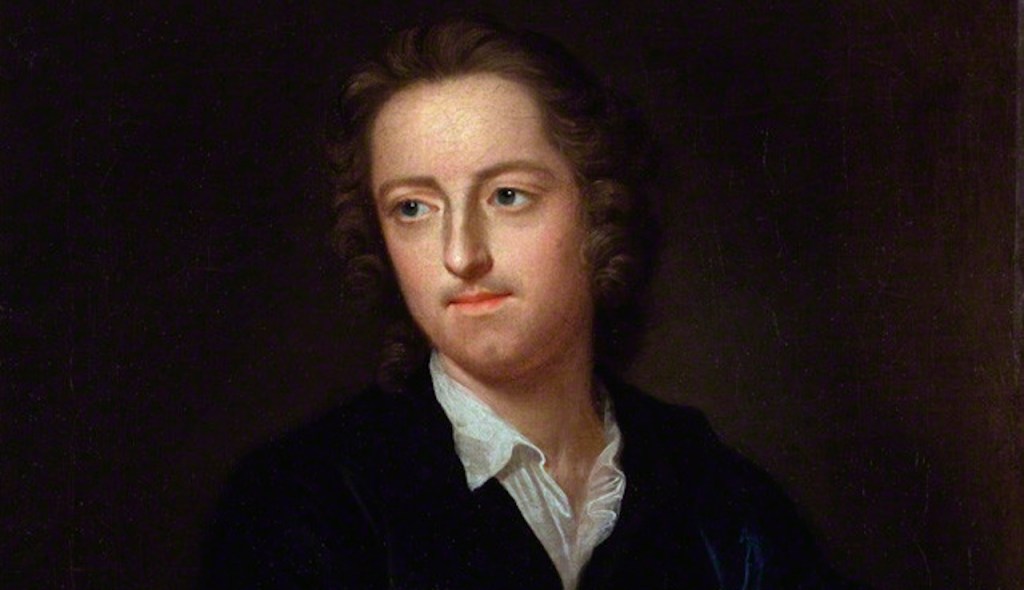
Image: Thomas Gray – Portrait by John Giles Eccardt, oil on canvas, 1747-1748
Thomas Gray’s “Elegy Written in a Country Churchyard”
Thomas Gray’s elegy describes a beautiful scene in the country landscape, as the speaker muses upon the life and death of rustic, simple folk in the pastoral setting.
Introduction and Text of “Elegy Written in a Country Churchyard”
Thomas Gray’s “Elegy Written in a Country Churchyard” features 32 quatrains that naturally separate into eight self-contained movements. The final movement is a lovely epitaph devoted to an unknown country youth.
Elegy Written in a Country Churchyard
The curfew tolls the knell of parting day, The lowing herd winds slowly o’er the lea, The plowman homeward plods his weary way, And leaves the world to darkness and to me.
Now fades the glimmering landscape on the sight, And all the air a solemn stillness holds, Save where the beetle wheels his droning flight, And drowsy tinklings lull the distant folds;
Save that from yonder ivy-mantled tower The moping owl does to the moon complain Of such, as wand’ring near her secret bower, Molest her ancient solitary reign.
Beneath those rugged elms, that yew-tree’s shade, Where heaves the turf in many a mold’ring heap, Each in his narrow cell for ever laid, The rude forefathers of the hamlet sleep.
The breezy call of incense-breathing morn The swallow twitt’ring from the straw-built shed, The cock’s shrill clarion, or the echoing horn, No more shall rouse them from their lowly bed.
For them no more the blazing hearth shall burn, Or busy housewife ply her evening care: No children run to lisp their sire’s return, Or climb his knees the envied kiss to share.
Oft did the harvest to their sickle yield, Their furrow oft the stubborn glebe has broke; How jocund did they drive their team afield! How bowed the woods beneath their sturdy stroke!
Let not ambition mock their useful toil, Their homely joys, and destiny obscure; Nor grandeur hear with a disdainful smile, The short and simple annals of the poor.
The boast of heraldry, the pomps of power, And all that beauty, all that wealth e’er gave, Await alike th’ inevitable hour. The paths of glory lead but to the grave.
Nor you, ye proud, impute to these the fault, If memory o’er their tomb no trophies raise, Where through the long-drawn aisle and fretted vault The pealing anthem swells the note of praise.
Can storied urn or animated bust Back to its mansion call the fleeting breath? Can honor’s voice provoke the silent dust, Or flattery soothe the dull cold ear of death?
Perhaps in this neglected spot is laid Some heart once pregnant with celestial fire; Hands that the rod of empire might have swayed, Or waked to ecstasy the living lyre.
But Knowledge to their eyes her ample page Rich with the spoils of time did ne’er unroll; Chill penury repressed their noble rage, And froze the genial current of the soul.
Full many a gem of purest ray serene, The dark unfathomed caves of ocean bear: Full many a flower is born to blush unseen, And waste its sweetness on the desert air.
Some village Hampden, that, with dauntless breast The little tyrant of his fields withstood; Some mute inglorious Milton here may rest, Some Cromwell guiltless of his country’s blood.
Th’ applause of listening senates to command, The threats of pain and ruin to despise, To scatter plenty o’er a smiling land, And read their history in a nation’s eyes,
Their lot forbade: nor circumscribed alone Their growing virtues, but their crimes confined; Forbade to wade through slaughter to a throne, And shut the gates of mercy on mankind.
The struggling pangs of conscious truth to hide, To quench the blushes of ingenuous shame, Or heap the shrine of luxury and pride With incense kindled at the muse’s flame.
Far from the madding crowd’s ignoble strife, Their sober wishes never learned to stray; Along the cool requestered vale of life They kept the noiseless tenor of their way.
Yet ev’n these bones from insult to protect Some frail memorial still erected nigh, With uncouth rimes and shapeless sculpture decked, Implores the passing tribute of a sigh.
Their name, their years, spelt by th’ unlettered muse, The place of fame and elegy supply: And many a holy text around she strews, That teach the rustic moralist to die.
For who to dumb forgetfulness a prey, This pleasing anxious being e’er resigned, Left the warm precincts of the cheerful day, Nor cast one longing ling’ring look behind?
On some fond breast the parting soul relies, Some pious drops the closing eye requires; Ev’n from the tomb the voice of Nature cries, Ev’n in our ashes live their wonted fires.
For thee, who mindful of th’ unhonored dead Dost in these lines their artless tale relate; If chance, by lonely contemplation led, Some kindred Spirit shall inquire thy fate,
Haply some hoary-headed swain may say, “Oft have we seen him at the peep of dawn Brushing with hasty steps the dews away To meet the sun upon the upland lawn.
“There at the foot of yonder nodding beech That wreathes its old fantastic roots so high, His listless length at noontide would he stretch, And pore upon the brook that babbles by.
“Hard by yon wood, now smiling as in scorn, Mutt’ring his wayward fancies he would rove, Now drooping, woeful wan, like one forlorn, Or crazed with care, or crossed in hopeless love.
“One morn I missed him on the customed hill, Along the heath and near his fav’rite tree; Another came; nor yet beside the rill, Nor up the lawn, nor at the wood was he;
“The next with dirges due in sad array Slow through the church-way path we saw him borne. Approach and read (for thou canst read) the lay Graved on the stone beneath yon aged thorn.”
The Epitaph
Here rests his head upon the lap of earth A youth, to fortune and to fame unknown; Fair science frown’d not on his humble birth, And melancholy mark’d him for her own.
Large was his bounty, and his soul sincere; Heaven did a recompense as largely send: He gave to misery all he had, a tear, He gain’d from heaven,’twas all he wish’d, a friend.
No farther seek his merits to disclose, Or draw his frailties from their dread abode, (There they alike in trembling hope repose,) The bosom of his father and his God.
Reading
Commentary on “Elegy Written in a Country Churchyard”
Thomas Gray’s speaker is offering a tribute to the simply folk who tended the land in this beautiful scene of country landscape. The speaker is musing upon the life and death of these rustic, simple folk in the pastoral, rustic setting.
First Movement: Serene Landscape
In the opening movement, the speaker describes the serene landscape surrounding the cemetery which he will be visiting. A herd of cows is moving slowly over the meadow. A farmer is leaving his plowing to head home, “leaving the world to darkness and to” the speaker.
It is dusk and the landscape seems to glimmer in the still air. Except for a few complaining beetles and an “moping owl,” all is quiet. The speaker approaches the graves of the village “forefathers,” who rest beneath “rugged elms.”
Second Movement: No More Cultivation
Those resting forefathers will never again be roused by the noise of the twitter of swallows or the call of the roosters. They will never again be experiencing their home life with “blazing hearth,” care of the wives, and interaction with their children. No longer will the land that they cultivated be turned by their plow. No more will the fields be tended by their careful, cheerful hands.
Third Movement: Simple Folk
These men were simple folk who did not seek ambition trade and fame. They lived, loved, farmed their land and enjoyed the rustic life. The speaker wishes to forestall any negative criticism of these simple farmers, as such folk are often looked down upon by city-folk, calling them rubes and provincials.
But the speaker makes it clear that no matter how high and mighty the ambitious become, they all end up in the same place as these simple folk because “The paths of glory lead but to the grave.”
The speaker speculates that among these country folk there might even be those who could have easily performed the tasks of emperors or that of talented lyre playing poets. And perhaps there were those who did harbor such ambitions.
Fourth Movement: Unspoiled by Social Ills
In the fourth movement, the speaker elaborates on his assertion from the third movement. Because these rustic men never became enamored by knowledge of seeking ambitious titles and such, they remained unspoiled by many of the ills of society.
They remained like uncultured gems and flowers that were never seen but flourished. There might have been those who could have performed as a Milton or a Cromwell, or who could have served in government, or even conquered lands, thus adding their names to the nation’s historical record.
Fifth Movement: The Life Within
The speaker now concedes that if among these gentle folk some dark tendencies prevailed, their way of life precluded their acting upon those evil tendencies. They were “Forbade to wade through slaughter to a throne.” Because they lived and moved “Far from the madding crowd’s ignoble strife,” they experienced a life wherein, “Their sober wishes never learned to stray.”
They were, in fact, protected. However, some of the grave markers profess “uncouth rimes and shapeless sculpture.” This fact, while not dismaying, does arouse a “sigh” in the passersby.
Sixth Movement: Honoring the Rustic Dead
The speaker has noted that some of the names of the interred have been displayed by the “unlettered,” meaning that they are misspelled. But the gravestone also contained many biblical passages which “teach the rustic moralist to die.”
These “unhonored dead,” however, deserve to be honored, at least, by a reverent thought or prayer. If their history must remain hidden, at least a thought or two sent their way would give them honor as “some kindred Spirit shall inquire” about their lives.
Seventh Movement: A Rustic Soliloquy
In the seventh movement, the speaker composes a likely soliloquy by “some hoary-headed swain,” who might share a brief summary of one of the rustic’s manner, where he had roamed, how he might behaved, what he might have thought as he made his way through his day.
Then the rustic was missed and replaced by another like him. The imaginary speaker reports that they bore his man “through the church-way path.” and the speaker asks his listener to read the song that is engraved on the man’s “stone beneath yon aged thorn.”
Eighth Movement: Simple Country Folk
The final three quatrains making up the final movement and titled, “The Epitaph,” is dedicated to “A youth, to fortune and to fame unknown.” The youth “rests his head upon the lap of earth.” He represents the simple country folk who are of “humble birth.”
He laughed, he cried, and he had a “soul sincere.” To honor him, one need only acknowledge his having existed and realize that he now rests upon the “bosom of his father and his God.”
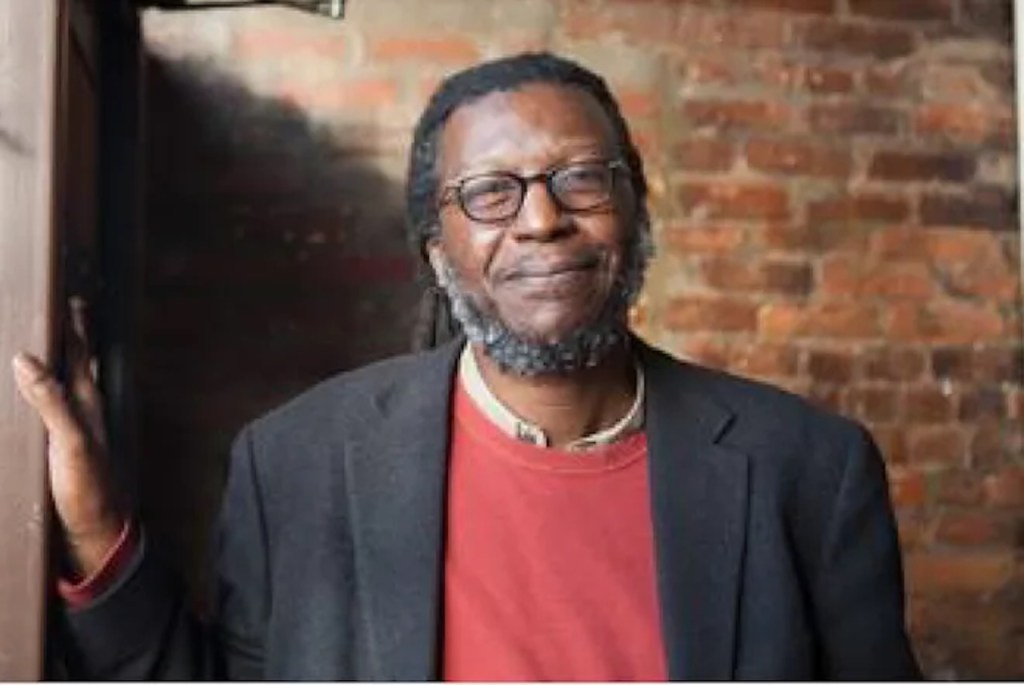
Cornelius Eady’s “Renée Nicole Good Is Murdered” attempts an elegy motivated by political propaganda instead of poetic insight. With clumsy imagery such as “melted from / The ice pack” and melodramatic effusions such as “see what fucking / With the bull gets you,” the piece descends into propaganda which fails to speak to the gravity of the event to which it refers.
Introduction and Text of “Renée Nicole Good Is Murdered”
Cornelius Eady is a fairly well-known American poet, whose work often exploits race and identity but also often focuses on music. Because the field of po-biz in its postmodern garb currently awards talentless and bombastic versifiers, who engage little more than identify politics, Eady can boast of having received Lamont and National Book Award nominations.
However, Eady’s 2026 piece “Renée Nicole Good Is Murdered” falls flat because it focuses on political propaganda; it shows no characteristic of an authentic elegy and no formal poetic craft.
Renée Nicole Good was a recent citizen of Minnesota, who, on January 7, 2026, was impeding the work of U.S. Immigration and Customs Enforcement agents as they engaged in their task of locating and arresting illegal migrants for deportation, many of whom had criminal records for murder, rape, and armed robbery.
As Good attempted to ram her Honda Pilot into an ICE agent, the agent shot and killed her. The event has sparked national attention, with political activists exploiting the sorrowful event to score political points. Democrats governor Tim Walz and mayor Jacob Frey have continued to gin up further violence, encouraging their citizens to continue to impede the ICE agents as those federal agents simply attempt to do their job.
An Elegy Goes Astray
It should be obvious that the subject to this “elegy” does not comport with the definition of a that form; the death of Renée Nicole Good is not a tragedy in the traditional, literary definition, but it is sorrowful event that we all mourn and wish desperately had not happened.
Good’s character flaw lay only in her failure to understand and/or accept the truth of the political turmoil that currently grips the nation, especially Trump Derangement Syndrome, a condition that dictates that anything happening under the Trump administration is evil and must fought against by any means necessary–including attempting to run down an ICS agent with two ton vehicle.
While Homeland Security secretary Kristi Noem’s labeling Good a “domestic terrorist” has received pushback, it does seem that the definition of that phrase clearly speaks to what Renée Good was doing that day:
Domestic terrorism in the United States is defined by federal statute in 18 U.S.C. § 2331(5), which states that it means activities that meet three criteria: (A) involve acts dangerous to human life that violate U.S. or state criminal laws; (B) appear intended to intimidate or coerce a civilian population, influence government policy by intimidation or coercion, or affect government conduct by mass destruction, assassination, or kidnapping; and (C) occur primarily within U.S. territorial jurisdiction. [my emphasis added: describing Good’s activism and actions]
Serious Matter Captured by Propaganda
The death of any individual causes concern and sorrow, especially when violence is involved, and the death of Renée Good is horrifying and remains particularly sad because she died because of the misguided urgings she believed from her fellow travelers—including the governor of her state and the mayor of her city.
Now comes the verse maker Cornelius Eady adding more dreck to the filth that has already been spewed about this horrific event. And this time the discourse is masquerading as an elegy—an elegy for an unfortunate, misguided woman whose action has been labeled domestic terrorism!
The subject matter is grave, but Eady’s treatment of it as a elegiac poem makes a mockery not only the human subject but the art of poetic elegy itself. The piece collapses into political sloganeering along with a clunky metaphor that undermines both elegiac seriousness and poetic craft.
Instead of focusing on complex human experience, the versifier substitutes caricatures for genuine people and emotion, such as a “dormant virus” and the “super cops”; these phrases ring in as contrived mountebanks rather than genuine images.
Instead of engaging with any nuanced reality of Good’s actual life and violent death, the piece’s political propaganda sorely diminishes the ability to even grieve, and it has no chance to illuminate.
The piece conflates contrived imagery of viral ice-packs with law enforcement as it inserts overt hostility (“see what fucking / With the bull gets you”). Eady’s obscene, flabby phrasing sacrifices reality for blunt political postering, yielding a piece of discourse that sadly falls flat as an elegy.
Renée Nicole Good Is Murdered
Up rides the super cops, The cancellation squad. A dormant virus, melted from The ice pack, And the conversation Is end-stopped when The shell cracks her Car window, does its Dumb duty, Brings silence To a poet’s mind.
The President says: You’re a terror bot If you don’t comply. Homeland security Puts on a ten gallon Texas size hat, Says see what fucking With the bull gets you. There is a picture of her Just before it tips rancid, Just before she’s dragged Into how they see her.
I wish I could read the words As they blaze their last, unsuspected Race through her skull. A language poem that ends on The word Impossible.
Commentary on “Renée Nicole Good Is Murdered”
The piece’s political sloganeering and awkward images undermine the gravity and craft of elegy, and diminish the gravity of the event it intends to mourn.
First Movement: “Up rides the super cops”
Up rides the super cops, The cancellation squad. A dormant virus, melted from The ice pack, And the conversation Is end-stopped when The shell cracks her Car window, does its Dumb duty, Brings silence To a poet’s mind.
When a piece offered as a poem begins with a bald-face lie in its title, what can one expect from the rest of the piece? The fact is that Renée Nicole Good was not “murdered.” She was killed by an ICE agent, acting in self-defense, as she appears to ram the agent with her two ton vehicle, a Honda Pilot.
The opening stanza attempts to set a dramatic scene with bold imagery: “Up rides the super cops” and “The cancellation squad.” The labeling of ICE agents as “super cops” is talky and unserious, and calling them the “cancellation squad” is equal as vapid. What’s with the grammatical error using a singular verb with a plural subject? That one might be overlooked and laid to an attempt at conversational dialect.
Quite the reverse is true about the “cancellation” notation; instead of canceling anything, ICE’s work entails removing crime and restoring the social order that works well for its citizens. The cartoonish labeling reveals more about the ignorance of real news, immaturity, and disingenuousness of the would-be poet than it does about the target of his ire.
The next line—“A dormant virus, melted from / The ice pack”—is even more asinine. There is no connection between a virus and the Minneapolis shooting of Good. The phrase hangs out like a concocted political conflation, intending to bring to mind the pandemic era as it critiques law enforcement actions as disease-like. Such a metaphor reduces real individuals to abstract threats and hazards.
Poetic metaphor and image require calibration: a powerful metaphor/image resonates with emotional truth. Here, the metaphors as well as the images feel arbitrary and jarring, unanchored to experience or sensation. It, therefore, becomes political propaganda rather than poetic reflection.
The speaker of the piece is undermining his thoughts by marginalizing them with clumsy syntax and incoherent imagery. Lines such as “The shell cracks her / Car window” attempt to point to violence but lack clarity or context, leaving the reader unsure whether the “shell” is literal or figurative.
These surreal pivots never come together to reveal any recognizable emotional reaction or narrative flavor. Abrupt shifts, awkward line breaks, and absurd references place the verse into the doggerel category rather than with crafted poetry.
Instead of exploring grief or loss, the imagery functions to flatten any complexity of thought in favor of bald assertion. As a result, the piece establishes a tone that bespeaks propaganda instead of elegy.
Second Movement: “The President says”
The President says: You’re a terror bot If you don’t comply. Homeland security Puts on a ten gallon Texas size hat, Says see what fucking With the bull gets you. There is a picture of her Just before it tips rancid, Just before she’s dragged Into how they see her.
The second movement intensifies these absurdities already presented in the first movement; it shifts into over-drive as is becomes pure political caricature. The claim about what the “President says” reads as hyperbolic ventriloquism rather than credible critique of actual quotation.
Effective elegy builds a sympathetic connection between public tragedy and private humanity, but this piece merely reduces the subject’s death to a cartoonish struggle between an imaginary oppressive state and a pathetically symbolic victim.
The reference to “Homeland security” donning a “ten gallon / Texas size hat” reduces would-be satire to stereotype, substituting fake bravado for engagement with real political language. DHS secretary Kristi Noem often dons Western style outfits, quite appropriately as the former governor of South Dakota.
Profanity-laden lines aim for shock but dislocate the tone of a piece intended to elegize its subject. This tonal imbalance further distances the piece from the contours of elegy. Even gestures toward tenderness—“There is a picture of her / Just before it tips rancid”—feel tacked on and tacky as they are aiming at rhetorical bluster.
Third Movement: “I wish I could read the words”
I wish I could read the words As they blaze their last, unsuspected Race through her skull. A language poem that ends on The word Impossible.
The final movement tries to offer some introspection by the speaker, but his attempt lapses into melodrama. Imagining words “blazing” as they “race through her skull” aestheticizes the violent act rather than honoring the dead.
The closing epigram—ending on the word “Impossible”—feels unconvincing because it sounds so completely contrived, lacking the emotional grounding so necessary for resonance.
Through its three movements, the piece substitutes forced metaphor/image, political sloganeering, and abstraction for specificity, empathy, genuine emotion, and reality itself.
Because of all of those weaknesses, the piece fails to meet the demands of a true elegy, instead it collapses into rhetorically heavy, emotionally shallow doggerel that neither illuminates the horrific event, nor does it pay tribute and honor its subject.
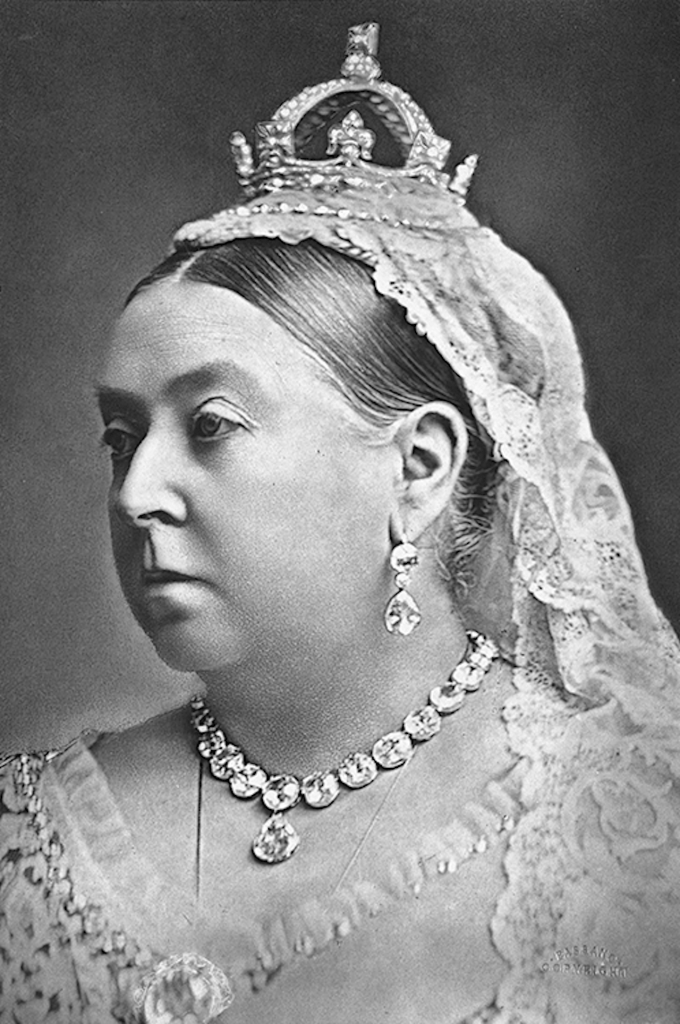
Image: Queen Victoria – National Portrait Gallery, London
Ella Wheeler Wilcox’s “The Queen’s Last Ride”
As the subtitle to the elegy reveals, the poet composed her poem “The Queen’s Last Ride” on the day of Queen Victoria’s funeral on February 2, 1901. The poem retains its special status and a tribute to the queen, whose reign influenced an era.
Introduction and Text of “The Queen’s Last Ride”
With its colorful imagery and a strict formal tone, Ella Wheeler Wilcox’s elegy “The Queen’s Last Ride” reveals the serious nature of the occasion. The poem furthermore presents clearly the results of the speaker’s having mused on the themes of mortality, a royal legacy, and spiritual transcendence from the physical level of being to the astral level of being.
The Queen’s Last Ride
(Written on the day of Queen Victoria’s funeral)
The Queen is taking a drive to-day, They have hung with purple the carriage-way, They have dressed with purple the royal track Where the Queen goes forth and never comes back.
Let no man labour as she goes by On her last appearance to mortal eye: With heads uncovered let all men wait For the Queen to pass, in her regal state.
Army and Navy shall lead the way For that wonderful coach of the Queen’s to-day. Kings and Princes and Lords of the land Shall ride behind her, a humble band; And over the city and over the world Shall the Flags of all Nations be half-mast-furled, For the silent lady of royal birth Who is riding away from the Courts of earth, Riding away from the world’s unrest To a mystical goal, on a secret quest.
Though in royal splendour she drives through town, Her robes are simple, she wears no crown: And yet she wears one, for, widowed no more, She is crowned with the love that has gone before, And crowned with the love she has left behind In the hidden depths of each mourner’s mind.
Bow low your heads—lift your hearts on high— The Queen in silence is driving by!
Reading of “The Queen’s Last Ride”
Commentary on “The Queen’s Last Ride”
On the same day as Queen Victoria’s funeral on February 2, 1901,Ella Wheeler Wilcox composed her most famous and likely most ambitious poem “The Queen’s Last Ride.” The poem is an elegy for the queen’s funeral procession, commingling sentiments of reverence as well as spirituality.
Stanza 1: A Metaphoric Drive
They have hung with purple the carriage-way, They have dressed with purple the royal track Where the Queen goes forth and never comes back.
The first stanza introduces the poem’s main metaphor: the queen’s funeral procession is portrayed as a “drive,” a term which lightens the formal nature of a royal, state funeral, while it grants the occasion an intimate, personal tone.
The repetition of “purple” in “They have hung with purple the carriage-way” and “They have dressed with purple the royal track” implies the color’s two-fold importance as a symbol of royalty and also as a symbol of spirituality [1].
In Victorian England, the color of purple was used to symbolize royal dignity [2]; that hue was often in evidence in ceremonies to signal authority but also to show reverence.
The color’s distinction in this poem emphasizes the grave and serious nature of the occasion; it utterly transforms the physical, earthly path of the procession into a symbolic “royal track” that leads to an eternal destination. The implication corresponds to the poem’s spiritual undertones.
The phrase “Where the Queen goes forth and never comes back” heralds the theme of finality, signaling that death remains an inevitable departure. The word “never” rings in a stark closure, which contrasts mightily with the gentleness suggested by use of the term “drive”; thus a balance of tenderness and inevitability is accomplished.
The speaker’s employment of the present tense—”The Queen is taking a drive to-day”—creates a feel of immediacy, connecting the poem to the historical moment of February 2, 1901, when the queen’s funeral procession actually took place [3].
This time-stamped anchoring invites readers to join and observe the event as it is occurring; this invitation encourages a shared sense of mourning. The stanza’s meter and rime scheme (AABB) parallels the orderly movement of the funeral procession, as it emphasizes the ceremonial tone.
Furthermore, the actions stated by “They have hung” and “They have dressed” suggest a shared effort. It is thus implied that the nation—or even the world—is, in fact, participating in arranging this sacred path.
That shared agency sets the stage for the poem’s broader exploration of shared grief and reverence; such common sharing places the queen’s act of leaving her physical encasement (death) as a special moment of world-wide importance.
The imagery of the “carriage-way” and “royal track” further reveals the Victorian fascination with ceremonial processions [4] as well as other public events.
Funerals of high-ranking official were very carefully orchestrated events; they were intended to mirror the social order of the community [5]. Wilcox’s speaker’s use of language clearly communicates the Victorian cultural customs.
Such subtle linguistic performance is responsible for transforming the physical route of funeral procession into a metaphorical, even metaphysical, journey from the earthly to the spiritual level of being.
Finally, this stanza sets forth the poem’s somber tone while firmly grounding it in the cultural and historical state of Queen Victoria’s unusually long occupation of the throne, which ran through six decades (63 years and 7 months, from June 20, 1837, to her death on January 22, 1901) and left an enduring influence on British identity.
Stanza 2: Setting Laboring Duties Aside
Let no man labour as she goes by On her last appearance to mortal eye: With heads uncovered let all men wait For the Queen to pass, in her regal state.
The second stanza moves from description to command: it calls for the ceasing of labor and the displaying of respect. No one should be giving attention to anything else as the queen passes by for the last time.
This command demonstrates the Victorian era’s stress on decorum, especially during moments of national mourning. The laying aside of work was a common practice during royal funerals. The cessation of labor and other everyday duties was for demonstrating a community pause for the purpose of honoring the deceased.
This command demonstrates the Victorian era’s stress on decorum, especially during moments of national mourning. The laying aside of work was a common practice during royal funerals. The cessation of labor and other everyday duties was for demonstrating a community pause for the purpose of honoring the deceased.
The speaker’s command to stand with “heads uncovered” calls forth a traditional gesture of respect. This custom became deeply ensconced in British customs of removing any head gear in the presence of royalty or during solemn occasions. This act of removing headgear also carries a democratic undertone, which suggests that all men, regardless of class, remain united in moments of homage.
The phrase “last appearance to mortal eye” deepens the poem’s musing on mortality; such musing frames death as a leaving off of human sense awareness. The word “mortal” emphasizes the Queen’s humanness, an act that strips away her royal status to concentrate on her shared vulnerability with all other member of humanity.
This universal gesture is representative of Wilcoxian poetry in general, which often explores themes of human connection and spiritual continuity. The stanza’s imperative tone—”Let no man labour” and “let all men wait”—creates a sense of common obligation, inviting readers to join in the ritual of mourning.
The regular rime and meter continue to parallel the orderly nature of the procession, while the repetition of “let” reinforces the speaker’s authority in guiding the reader’s response.
The second stanza also subtly critiques the busyness of modern life, a growing concern in Victorian literary arts. By calling for a pause in labor, the speaker elevates the queen’s passing above the everyday concerns of life, placing it as a moment of profound importance.
The phrase “her regal state” reinforces Victoria’s continued majesty, even in death, while the act of waiting suggests a open space between life and death, where the living honor those who have left their physical encasements.
This stanza thus serves as both a call to action and as a musing on the cultural practices that guided Victorian responses to death, particularly for a queen whose reign set the boundaries of an era.
Stanza 3: A World-Wide Tribute
Army and Navy shall lead the way For that wonderful coach of the Queen’s to-day. Kings and Princes and Lords of the land Shall ride behind her, a humble band; And over the city and over the world Shall the Flags of all Nations be half-mast-furled, For the silent lady of royal birth Who is riding away from the Courts of earth, Riding away from the world’s unrest To a mystical goal, on a secret quest.
The third stanza expands the poem’s reach to a world-wide scale; it depicts a grand procession led by the “Army and Navy,” followed by “Kings and Princes and Lords of the land.”
This imagery accurately portrays the historical reality of Queen Victoria’s funeral, which was a carefully orchestrated event, attended by foreign dignitaries, including other European royalty, and further punctuated with military honors.
Victoria’s rôle as the “grandmother (or godmother) of Europe” [6], with family ties to many royal houses, transformed her funeral as a diplomatic as well as a ceremonial occasion.
The speaker’s introduction of “Kings and Princes” emphasizes the international extent of her influence, while at the same time portraying the Queen as a unifying figure whose impact had been felt beyond national borders.
The image of “Flags of all Nations” at half-mast further emphasizes the international impact of Victoria’s death. The half-mast flag, a world-wide symbol of mourning, reveals the widespread grief that accompanied the end of her reign, which correlated with the height of British imperial power.
The speaker’s claim of “all Nations” suggests the joint act of homage, which reinforces the queen’s rôle as a symbol of stability in an era of rapid expansion of colonies and often uncertain international alliances.
The stanza’s language, with its expansive scope and formal diction, parallels the grandeur of the funeral itself, which was formal display of imperial power as well as national unity.
The latter half of the stanza introduces a spiritual element, as it describes the queen as a “silent lady of royal birth” who is “riding away from the Courts of earth” to a “mystical goal, on a secret quest.”
This move from earthly to astral realms corresponds to the Victorian interest in spirituality and the afterlife, a theme that can be observed in tWilcox’ oeuvre as well.
The word “silent” invokes both the solemn nature of the funeral and the ineffable nature of death, while “mystical goal” and “secret quest” suggest a transcendental purpose beyond human understanding.
These phrases subtly suffuse the queen’s final journey with an element of divine mystery, which places her death as a possible passage to a higher plane of existence. The stanza thus melds the specifics of history with universal themes, which reflects both the public exhibition of the funeral and the private, spiritual implications for immortality.
Stanza 4: Emphasizing Simplicity
Though in royal splendour she drives through town, Her robes are simple, she wears no crown: And yet she wears one, for, widowed no more, She is crowned with the love that has gone before, And crowned with the love she has left behind In the hidden depths of each mourner’s mind.
The fourth stanza juxtaposes the queen’s “royal splendour” with her simplicity, noting that “Her robes are simple, she wears no crown.” (Note the use of the British spelling “splendour.”)
This contrast furthermore demonstrates the historical portrayal of Victoria in her later years, especially after the death of her husband (consort) Prince Albert of Saxe-Coburg and Gotha in 1861, at which time she adopted a subdued public image; she often publicly appeared n simple black attire [7].
The speaker’s stress on simplicity humanizes the queen and signals that she remained humble. Humility was a Victorian ideal, especially in the facing of death. However, the speaker reimagines the crown by portraying it as a metaphorical one, “crowned with the love that has gone before” and “crowned with the love she has left behind.”
This two-fold crowning advances Victoria’s legacy well beyond any material wealth and speeds it on to an enduring emotional and spiritual force. The reference to “love that has gone before” likely alludes to Prince Albert, whose death profoundly influenced Victoria’s life as all as her reign. The “love she has left behind” reaches to the mourners, who remain carrying love in the “hidden depths of [their] mind.”
This phrase suggests a personal, introspective connection to the queen, emphasizing her rôle as a beloved figure, whose influence continues in shared memory. The imagery of a crown of love elevates the traditional symbol of royalty to a universal emblem of affection and loyalty, which emphasizes the poem’s theme of legacy.
The stanza’s language, with its emphasis on simplicity and emotional depth, reveals the poet’s skill in combining the personal and the public. The regular rime scheme continues to provide a sense of order, which parallels the structured and controlled nature of the funeral procession, while the shift to metaphorical imagery introduces a more introspective tone.
By focusing on the queen’s emotional legacy, the speaker emphasizes the human dimension of her passing, inviting readers to reflect on their own bond with the monarch.
Final Couplet 5: A Silent Farewell
Bow low your heads—lift your hearts on high— The Queen in silence is driving by!
The final couplet serves as a touching conclusion, urging readers to bow their heads as in prayer but also to take the occasion into their hearts with great feeling. This duality speaks to the poem’s balance of grief and hope, a distinctive feature of all successful elegiac poetry.
The act of bowing heads signifies humility, respect, and mourning, while lifting hearts suggests a transcendence of earthly, physical plane sorrow, joining with the spiritual undercurrents introduced earlier.
The phrase “The Queen in silence is driving by” reinforces the solemn nature of the moment, with “silence” symbolizing both the reverence of the mourners and the ineffable nature of death. The repetition of “driving” ties back to the first stanza, creating a cyclical structure that simulates the the motion of the procession’s journey.
The stanza’s commanding tone engages readers directly, inviting them to join in the shared act of mourning. This call to action reveals the Victorian practice of community grieving, where public displays of sorrow reinforced social continuity.
The upward gesture of lifting hearts also corresponds to the Christian tenet of resurrection and eternal life, which was cardinal to Victorian commemoration culture.
By concluding with this hopeful note, the speaker transforms the queen’s death into a moment of spiritual upliftment, an act which strongly suggests that her legacy will endure beyond the physical level of being.
Wilcox’s Mastery
Ella Wheeler Wilcox’s “The Queen’s Last Ride” remains a masterful elegy that explores the interaction between public presentation and private grief.
As both a historical, literary artifact and a timeless musing on death, “The Queen’s Last Ride” exemplifies Wilcox’s ability to blend individual emotional depth with public formal elegance, offering a fitting tribute to a queen whose reign influenced the culture and customs of an era.