Linda's Literary Home

Tag: history

  • Graveyard Whistler: A Political Poem Find,”Liberal Mud with Commentary”

    Image:  High Frontier

    Graveyard Whistler: A Political Poem Find,”Liberal Mud with Commentary”

    Graveyard Whistler unearths a piece of doggerel that nevertheless caught his fancy, as it presented, in his opinion, a much needed corrective to the misuse of a beloved term.

    Foreword from the Graveyard Whistler

    Let me make it clear right away: I despise politics.  National politics, hate it.  Local politics, hate it.  Office politics, hate it the worst.  So I rarely delve into issues that might lead me to the necessity of discussing politics.  However, as I have so often touted the treasure trove from my old, late buddy Stoney’s Stone Gulch Literary Arts, I feel the need to address some political issues that Stoney addressed.

    At first, my inclination was to simply avoid all of his political scribblings, but then after I actually read this offering, I realized I had actually learned something, which has changed my view about political issues.  You will notice that it’s not just a poem—actually, it’s a piece of doggerel, as Stoney called it—but it has a commentary that is well researched with sources.  I’m still not allowing myself to become immersed in those issues, but I don’t feel that avoiding them completely does me or anyone else any good.

    You see, I’ve always considered myself “liberal”—that is opposed to stuffy conservative thought that disavows all progress, including science and minority rights—and until encountering this piece called “Liberal Mud,” I did not realize the difference between “classical liberal” and “modern liberal.”  To me, liberal was liberal which was a good thing, always. Full stop.

    As usual, Stoney has not made it clear that he wrote this piece; it just kind of popped up at the bottom of a clipping of Stoney delivering a speech to a college assembly.  How I would love to include that image of Stoney speaking—but alas! when he gifted me with his site-full of writings, he insisted he remain anonymous, so any image or even Stoney’s real name will never appear in my writings.

    Without further ado, I present the piece of doggerel—and that’s what Stoney called it—for what it’s worth:

    “Liberal Mud with Commentary”

    This piece of doggerel titled, “Liberal Mud,” is brazenly political; it focuses on the nature of the much abused term, “liberalism,” which denotes freedom from the overreach of governmental restraints.  

    The term, “liberal,” has been much abused. For example, in contemporary American politics, the party that claims the label of liberal is the party whose policies are formulated to control every aspect of life of the citizens of the United States from healthcare to business practices to what each American is allowed to think. That party even seeks to quash freedom of religion, which was a major impetus leading to the founding the country.

    Under the guise of “liberalism,” that party claims large swaths of the citizenry who have fallen for the corrupt concept of “identity politics.” For example, the party claims huge numbers of African Americans, women, gays, and young voters. The party appeals to many of the uninformed/misinformed in those “groups” simply by offering them government largesse and claiming to represent their interests. 

    A common misconception is that the Democratic and Republican parties switched policies a few decades ago. That lie has been perpetuated by Democrat vote seekers because history reveals that the Republican Party has always been the party of freedom; it was, in fact, President Abraham Lincoln, the first Republican president, who issued the Emancipation Proclamation that freed the slaves during the American Civil War.

    As Rev. Wayne Perryman has averred: “Many believed the Democrats had a change of heart and fell in love with blacks. To the contrary, history reveals the Democrats didn’t fall in love with black folks, they fell in love with the black vote knowing this would be their ticket to the White House.” As they have experienced the result of luring the votes of black folks, Democrat politicians have worked the same old lie to get the votes of the other identity groups: women, gays, young voters.

    Originally, the term, “liberal,” indicated the positive quality of allowing freedom from government overreach, and generally those who wish to unleash themselves from harsh constraints on behavior that harms no one are, in fact, liberal. The American Founding Fathers were the liberals of that period of history. Those colonists who wished to remain tied to England, instead of seeking independence, were the conservatives.  In current, common parlance, there is a distinction between “classical liberal” and “modern liberal.”

    Whether an ideology is liberal or conservative depends entirely upon the status quo of the era. If a nation’s government status quo functions as a socialist/totalitarian structure and a group of citizens works to convert it to a republic, then that group would be the liberals, as was the case at the founding of the democratic republic of the United States of America. However, if a country’s governing status quo structure functions as a democratic republic, and a group of citizens struggles to change it into a socialist/totalitarian structure — a la Bernie Sanders, Hillary Clinton, Barack Obama, or any other current member of the Democratic Party — then that group would be the liberals, however, mistakenly that term would be when applied to such a stance.

    Conservatism is the desire to maintain the status quo despite the nature of that status quo, but then again it is necessary to delineate what that status quo is. If the status quo allows freedom, then it should be conserved; if it does not, it should be liberalized. It is unfortunate that those terms have become so flabby, but then that is the nature of political speak: the side that has the lesser argument will always seek to convert language, instead of converting their feckless policies.

    This piece hails forth in the current acceptance of a liberalism that is anything but liberal:  modern liberalism vs classical liberalism. The piece (doggerel) might well be titled “Totalitarian Mud.” But part of the point is to report the denatured use of the term, “liberal,” as it decries the effects of that denatured term.

    Liberal Mud

    Every soldier takes to battle
    His duty for survival
    Marching against the rival.

    The enemy muscles the air
    Against all that is fair
    Against putrid politics.

    Liberal dust smothering light,
    Converts gloom against the fight
    To save freedom from the sand.

    Liberal breath pollutes the way
    Through politics that betray
    Their fellows natural rights.

    Liberal thieves convert the vote
    To steal the sacred note
    As enemies rise from hell.

    Licking their wounds, their paws,
    Leaving the press no answer
    Save all the fake men of straws.

    No hypocrite gives more haste
    Than a mind without a compass.
    It remains a terrible waste

    To slime the brain’s red blood
    In the bog pond of liberal mud.

    Commentary on “Liberal Mud”

    The fight for freedom never ends.  True liberal thought that leads to fairness must continually be pursued to avoid its opposite, tyranny.

    First Tercet:  Fight for Freedom

    Every soldier takes to battle
    His duty for survival
    Marching against the rival.

    These particular soldiers represent the fight for what is right, correct, that which gives the most freedom to the most people.  Modern-day liberals would take away these soldiers, the fight, and the freedom and replace them with goose-stepping thugs who would enforce totalitarian rule.  One need only observe examples of the Democratic party  such as the Clintons, and how they mistreated the military to understand the verity of this observation. 

    Lt. Col. Robert Patterson reports in his book, Dereliction of Duty: Eyewitness Account of How Bill Clinton Compromised America’s National Security, that Clinton’s kick-the-can attitude toward taking out Al-Qaeda and Saddam Hussein’s nuclear facility convinced Patterson that Clinton was the “greatest security risk to the United States.”  

    In Ronald Kessler’s book, The First Family Detail: Secret Service Agents Reveal the Hidden Lives of the Presidents, Kessler recounts how a simple greeting of “Good Morning, ma’am” to the First Lady Hillary Clinton would provoke a reply of “F*ck off!” from that future failed Democratic presidential hopeful.

    The Obama White House managed to behave no better toward the men and women in uniform, as President Obama continued to downsize both the troop strength and the pay and pension of each troop.

    Second Tercet:   Vanity Leads to Loss

    The enemy muscles the air
    Against all that is fair
    Against putrid politics.

    The great example of this claim is the winning of the War in Iraq by President George W. Bush, only to be squandered and lost under the vain, tepid, backward responses of President Barack H. Obama.

    Thomas Sowell has summarized the situation accurately stating:

    Despite the mistakes that were made in Iraq, it was still a viable country until Barack Obama made the headstrong decision to pull out all the troops, ignoring his own military advisers, just so he could claim to have restored “peace,” when in fact he invited chaos and defeat.

    Third Tercet:   The Glass Eye of Dictatorship

    Liberal dust smothering light,
    Converts gloom against the fight
    To save freedom from the sand.

    The dust of liberal thinking covers all the furniture of a republic.  Gouging out the eyeballs of freedom, replacing them with the glass eye of dictatorship.  Suspending industry, encouraging the sex-crazed lazy to spend tax dollars on abortifacients.

    Fourth Tercet:   Lies, Deception, Obfuscation

    Liberal breath pollutes the way
    Through politics that betray
    Their fellows natural rights.

    But somehow the putrid politics of the Democratic Party breathe on, polluting the environment with lies, deceptions, obfuscations that kill and maim as society turns violent in the wake of lawlessness.

    Observe Democratic Baltimore Mayor Stephanie Rawlings-Blake offering looters “space to destroy” by commanding law enforcement to stand down. Of course, after making such a ludicrous remark, she then lies and says she didn’t say that.

    Fifth Tercet:  Leading from Behind Is not Leading 

    Liberal thieves convert the vote
    To steal the sacred note
    As enemies rise from hell.

    The Obamaniacs’ “lead from behind”— the likes of fake purple heart winner turned Secretary of State John Kerry accepts a deal with a terror sponsoring nation that will lead to the obliteration of a neighboring democracy and encourage other dictatorships to go nuclear.

    Sixth Tercet:  The Birth of Fake News

    Licking their wounds, their paws,
    Leaving the press no answer
    Save each fake man of straws.

    Everyone suffers the abominations, and the corrupt liberal press continues to fail to hold to account those who are steering their country into a poverty stricken mess, too weak to defend itself, too dependent on government to know how to earn its own living.

    Seventh Tercet:  Mindless, Rudderless, Moral Mess

    No hypocrite gives more haste
    Than a mind without a compass.
    It remains a terrible waste

    The moral compass of the country has been hacked into a pile of unworkable fragments.

    Final Couplet:  Lack of Moral Clarity

    To slime the brain’s red bloodIn the bog pond of liberal mud.

    The final two movements echo the adage: “A mind is a terrible thing to waste.” And the minds of so many young folks have been wasted in the dumpster of fake “liberal” ideology.

    Applying the Lessons of History

    Poetry and politics are uneasy bedfellows.  They struggle to fall asleep, often simply through mistrust, but often because the nature of beauty remains deeply personal, and politics, by its nature, must look outward.

    Unfortunately, or perhaps fortunately, depending upon how one looks at it, all that can be done about “politics” — identity and otherwise — is to continue to debate the merits of each policy that presents itself.  One would also continue to hope that those debaters know their history and have some skill in applying the lessons of that history as they analyze and scrutinize each policy.

    Sources

    Afterword from Graveyard Whistler

    I know this entry must have seemed like a bunch of mud to slog through, and I promise I will not be engaging in this kind of rhetoric very often—I’m not swearing off entirely because Stoney does have a few other pieces that I think might help light up the political landscape.

    Anyway, I do hope you can find some benefit from following such a piece.  Stoney has an interesting mind, an expansive mind, so I feel it would not be fair to him if I just leave out whole swaths of his views.  Plus his writing ability remains unique in the annals of the world of literary studies.  While I do believe that poetry and politics make strange if not impossible bedfellows, sometimes it is necessary to give both their due.

    Until next time, I remain

    Literarily yours,
    Belmonte Segwic
    aka Graveyard Whistler

  • Graveyard Whistler’s New Find: “The Irony of the Bones”

    Image: C. K. Walker:  Paleontologists Were We

    The Graveyard Whistler has found a new story with a complex of  irony. He is rethinking his profession as literary sleuth.  Captivated by the stories he finds, he remains conflicted about continuing with literature. Maybe he will give up and become a lawyer.

    Graveyard Whistler Offers Some Explanatory Remarks

    Hey, hey!  It’s been a while since I’ve posted.  

    The one titled “Literary History and the Art of Irony” brought me a ton of complaints from all the brothers and sisters who enjoy a beautiful, harmonious relationship and deeply resent that I would reveal a set of siblings who scratched at each other like cats in a clothes dryer.  

    My response was to delete that post, even though the subject was irony, the sibs just provided the example.  But hey, I’m not in the business of alienating readers, so I just let it go. The experience did give me some food for thought.

    So as I rethink my journey into the literary life, I am finding it discouraging that so many people can’t tell the difference between biography and fiction.  What I mean is, a writer creating fiction does not always reveal only what is in his heart and mind:  that’s why it’s called “fiction.”  

    The writer of fiction makes up stuff.  If a writer were limited to writing only what he felt and thought, there would be no murder mysteries because only murderers have the knowledge of what it feels like to kill and what thoughts are engendered by that deplorable act.

    So as I think though my dilemma, I take comfort in knowing that I will probably never become a creative writer:  I write no poetry, no short stories, no plays, no novels. I just write about what poets, fiction writers, playwrights, and novelist have already written.  

    As I have said, I am especially interested in irony as a literary form and that’s why I wrote about the dysfunctional sibling relationship because the piece I had found had dealt with irony.  

    The following piece that I found, not on the Internet, but in an ancient, dusty tome at the New Chesterfield Library in Cabot Cove, Maine, features a wacky sea captain and her crew of the Blarney Barnacle, a strange seafaring vessel that ranged up and down the East coast from Maine to Georgia, sometime after the Civil War in the 1870s.  

    It’s a long and complicated tale but I have excerpted a spot that I found particularly interesting.  It was quite a hassle having to type out text, made me very appreciative of the “cut and paste” function on modern word processors.

    Without further ado, I present the story to you warts and all—meaning I have not corrected spelling or grammar errors unless they interfered too much with meaning.

    The Irony of the Bones

    The seas was strictly calm the night that Elizabeth Wayneright ran off from her blackhearted husband.  

    She hid under the technical tarp on the starboard side and was not detected until we’s way down the coast nearing on Massachusetts.  

    Cap’n Jane Pickwick, who as you now know, ran a tight ship-shape shippe—actually we wasn’t a shippe, we more a oversize tub but big enough to hold a crew of 9 and sometimes we’d take on passengers who need to travel down the coast.

    We started out as usual, Capt. Janey, as we with affection called her, making her rounds, and her first mate, Lt. Maxine Stauttlemeyer, was checking out supplies then ran around the tub, as we with affection called our shippe.  Everything in order we start her moving on down the coast.  

    We’s almost to Massachusetts Bay when a storm busted through, starting to bluster us about something awful.  It wasn’t near so bad as it sounded, we’s all used to it and knew we’d be through it in an hour.  But the stowaway, Elizabeth Wayneright musta thought we’s headed to perdition. 

    She came busting out flailing her arms around screaming and yelling, “Oh, God!  Oh, God!  We’re going to die!  We’re going to die!  What have I done?  What have I done?”  

    First mate Maxy, as we with affection called her, arrived on the scene, grabbed Lizzy, as we later came to call her with affection, and got her settled own. 

    She brought Lizzy to Capt. Janey who asked Lizzy all manner of interrogatories, maybe taking hours on into the night.

    Capt. put Lizzy in a cabin that had a cot, gave her some tea, and told her that breakfast was at 600 hours.  We can only guess if Lizzy slept but next morning as we’s sailing the tub around Mass Bay, we stopped, spread out breakfast and then Lizzy told us her story.

    Elizabeth Wayneright was a wife and mother, citizen from a little fishing village about a mile north of Cabot Cove, Maine.  She wrote stories for newspapers and magazines.  She wrote stuff she just made up, not news reports or journalist-like stuff.  

    She said she was doing pretty good, making a few extra bucks to help out the family.  She had a husband who worked as a lumberjack and blacksmith, depending on what was busy at any given time.  

    They had one son, who was now grown, married, and living in Augusta, where he did some copyediting work for the state.  

    She said she worked as a waitress in the local pub while her son was growing up, and that’s how she got the idea to write made-up stories, listening to and talking to all the different types of folk who’d blow into town.

    She said she’d been writing her stories for about ten years, sending  them off to as far away as California. Said her stories had been published in the same magazine that published biggies like Samuel Clemens, aka Mark Twain.  

    We’s all really impressed, we hadn’t heard of her, but we did know the man Samuel Clemens, aka Mark Twain.

    Going on with her story, she said everything was fine, her money helped so that when her husband couldn’t get enough work, they didn’t ever have to fall into debt or go begging on the streets.  Then during a long stretch of workless days, her husband started rifling through the stories she had written. 

    At first, she was glad to see that he was taking an interest, something he had never done before.  She felt a little concerned however because he’d read and then the rest of day not say anything.  Then he’d read some more and seemed to get kind of mean toward her. 

    This went on for a week or so, and then he came busting into their bedroom where she sat writing, and he was shaking a magazine at her, and began to call her all sort of bad woman names, like bitch, whore, trollop.  

    She asked him what he’s taking about and he said it was all there in black and white.  She hated him, she had bedded every stranger who came into town, and now she was planning to kill him.  It was all there in black and white, he kept saying.

    She tried to explain to him that those were stories she made up, she said she got ideas for those stories from listening to folks who frequented the pub where she used to waitress.  

    She told him she never wrote any stories about him, herself or anyone else she knew.  They were all just fiction, stories she had made up.

    He was having none of it.  He stated ripping the pages out of the magazine, and throwing them at her.  She tried again to reason with him, but again he had the goods on her it was all there in black and white. 

    He kept this rant up for several days, and then one night as Lizzy was cooking supper, he blasted though the door into the kitchen brandishing a knife. Whore! Trollop!  What you think of this.  I’ll teach you to make a fool out of Roger Blassing Wayneright.  

    He struck at her, leaving deep wound in her left arm.  Lizzy held up her arm and sure enough a deep wound she said she wrapped up and then packed a little bag, and while Roger was sacked out after supper, she ran from their home and here she was.

    We all sat, amazed, by this tale this poor woman was telling. We all said we’d think of how we could help her.  She said she knew this tub went down the coast but didn’t know how far.  

    We told her it goes down to Savannah, Georgia.  She asked if she could stay with us until then.  We said we’s glad to help anyway we could.

    After pulling the tub into Savannah, Lizzy clutching her little bag left the shippe, and we never heard from her again.  We kept on sailing the Blarney Barnacle up and down the coast.  

    Then about thirty years after we’d encountered Lizzy, we all stepped out of our tub near Cabot Cove and went into the little diner where we planned to get a much needed, nearly home-cooked meal.

    The place was buzzing with a strange report that was spreading through the little village.  Near the old Wayneright place, some pigs has had been plugging into the dirt and unearthed a bunch of bones. 

    The local sheriff had sent the bones off to the capital for testing.  But what grabbed us was the rumors that was buzzing about.

    Some people was saying those bones was Roger Blassing Wayneright and that Elizabeth Wayneright had murdered her husband about three decade ago.  They was sure it was her that done the nasty deed because one night she went missing and soon after it was discovered that Roger was also missing.  

    But then other folks saw it different, they said it was Elizabeth’s bones and that Roger had done his wife in.  Both stories were floating around and we couldn’t tell which side was right, except for the fact that we’d carried Elizabeth Wayneright down to Savannah.  We heard her story, but maybe she left out somethin’?

    We had a meetin’ on the tub and tossed around the notion of telling the local authorities about seeing Elizabeth all those years ago.  We voted that we should tell and so next day, we fetched ourselves to the sheriff’s office and laid out our tale.  

    He shocked us though and said that Elizabeth Wayneright had come back to Cabot Cove and she and Roger had patched things up and had been living pretty much a quiet life for at least the past twenty years or so.

    So we asked him why the two sides of a story about those bones:  some thinking Lizzy killed Roger, and some thinking Roger killed Lizzy.  He said, that’s just what people in that town do.  There was a third group of folks who knew that both Waynerights had moved to Augusta to be near their grandchildren.  

    A friend of Elizabeth, fellow writer lady of Cabot Cove who wrote under the name of Janice Baines Longstreet had kept that third group in the know about Elizabeth.  So the sheriff could say for sure that those bones belonged to neither Wayneright.  And to cap it off, he had funeral notices for both Roger and Elizabeth from when they lived and then died in Augusta.

    We asked him why there could be three different version of the Wayneright story floating around this little village when at least two upstanding citizens knew the real skinny.  

    He just said, people gonna believe what they wanna believe. Don’t matter who says what.  Once they choose up a side they just won’t see the other side, no matter the evidence.

    Capt. Janey then put out the question we’s all wondering about.  How did Elizabeth ever convince her husband that her stories were just stuff she made u?  He cut her arm thinking she was going to kill him because of her stories.  

    The sheriff said that writer lady had a book that tried to answer that question.  But he said he thought because it was a novel, it might have fudged the details a bit.

    What he knew was that Elizabeth came back because she wanted to keep writing her stories and making money.  

    Roger had been down on his luck for quite a while, and had to depend on their son to even keep their home, and so when Elizabeth showed up, he knew he’d either have to accept her and her money or eventually sink to the poor house.  

    He knew their son who had a growing family couldn’t continue to support him.  The sheriff said, it’s simple, money talks, and Roger finally accepted the fact that if stories about adultery and murder could make money that was better then no money.

    We left again down the coast before the report about the bones came back, but we knew that once it did, no matter what the report said, those two sides would continue their rumors, and the third side, the one that knew the truth would just be so much whistling in the wind.

    Graveyard Whistler’s Final Remark on Dramatic/Situational Irony

    I asked a friend of mine to proofread this piece and he asked me what is ironic about the bones.  Well, at first the reader thinks they must be Roger’s because they know Elizabeth had traveled with the Barnacle crew after running away from him.

    Then it shifts to the possibility it could be Elizabeth’s because they learn that she went back to Roger.

    But then they finally know that the bones are not Roger or Elizabeth, and they never find whose they are.  

    It’s a complex of dramatic and situational irony instead of simple verbal irony because the irony is based on situation not just words and the audience does become aware of information that the people in the story will never know.

    Thanks for visiting.  Until next time, I remain

    Literarily yours,
    Belmonte Segwic
    aka “Graveyard Whistler”

  • Robert Frost’s  “And All We Call American”

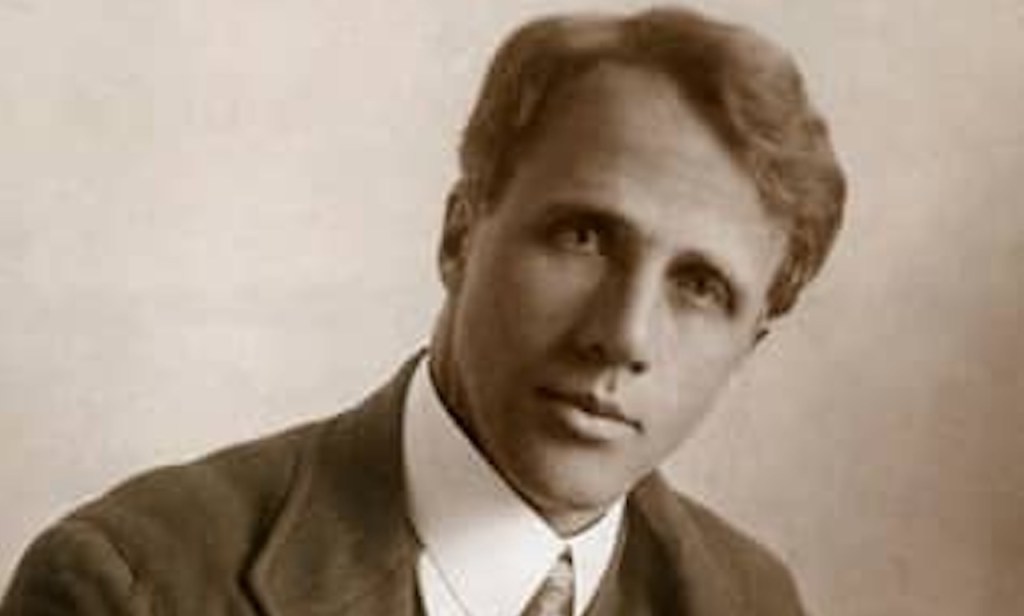
    Image: Robert Frost –  robertfrost.org

    Robert Frost’s  “And All We Call American”

    The speaker in Robert Frost’s “And All We Call American” attempts to play down the Columbian heroic status by castigating the great explorer for not having the ability to predict the future.

    Introduction and Text of “And All We Call American”

    The speaker in Robert Frost’s poem “And All We Call American” attempts a retelling of the familiar story of Christopher Columbus. In so doing,  he questions the legendary heroism of the explorer.

    No one can deny that the miscalculation of landing on what is now the North American continent instead of the South Asian country of the exploration’s intent—India—opens itself to a certain level of scrutiny.

    But the ultimate consequence of the discovery greatly outweighs the unintended nature of the discovery.  The importance of the North American continent, particularly the United States of America, for the world remains undeniable.  Despite the current failure to appreciate these Western values, those values continue to uplift cultures from the dire straits of physical and moral poverty. 

    Frostian Curmudgeonry

    Even as he took on the reputation of a belovèd poet of nature and human feeling, Robert Frost remained a life-long contrarian and a specialized curmudgeon.  Thus instead of celebrating the Columbian legendary figure who opened up the Old World to a New World, he has his speaker concentrate of the limitations of the explorer.

    That Columbus was not capable of imagining what the United States of America, Canada, and Mexico would become is not a particularly egregious failure.  Excepting clairvoyants, no one else of the time period would have been able to predict any better.

    While Frost has attempted to produce a poem that is both historical and philosophical

    by having his speaker employ the Columbian expedition, the poem’s cranky bitterness ultimately says more about the speaker/poet himself than about the objective nature of the significance of the voyage of Christopher Columbus.

    And All We Call American

    Columbus may have worked the wind
    A new and better way to Ind
    And also proved the world a ball,
    But how about the wherewithal?
    Not just for scientific news
    Had the  queen backed him for a cruise.

    Remember he had made the test
    Finding the East by sailing West.
    But had he found it ? Here he was
    Without one trinket from Ormuz
    To save the  queen from family censure
    For her investment in his future.

    There had been something strangely wrong
    With every coast he tried along.
    He could imagine nothing barrener.
    The trouble was with him the mariner.
    He wasn’t off a mere degree;
    His reckoning was off a sea.

    And to intensify the drama
    Another mariner Da Gama
    Came just then sailing into port
    From the same general resort,
    But with the gold in hand to show for
    His claim it was another Ophir.

    Had but Columbus known enough
    He might have boldly made the bluff
    That better than Da Gama’s gold
    He had been given to behold
    The race’s future trial place,
    A fresh start for the human race.

    He might have fooled them in Madrid.
    I was deceived by what he did.
    If I had had my way when young
    I should have had Columbus sung
    As a god who had given us
    A more than Moses’ exodus.

    But all he did was spread the room
    Of our enacting out the doom
    Of being in each other’s way,
    And so put off the weary day
    When we would have to put our mind
    On how to crowd but still be kind.

    For these none too apparent gains
    He got no more than dungeon chains
    And such small posthumous renown
    (A country named for him, a town,
    A holiday) as where he is
    He may not recognize as his.

    They say his flagship’s unlaid ghost
    Still probes and dents our rocky coast
    With animus approaching hate,
    And for not turning out a strait
    He has cursed every river mouth
    From fifty north to fifty south.

    Some day our navy I predict
    Will take in tow this derelict
    And lock him through Culebra Cut,
    His eyes as good (or bad) as shut
    To all the modern works of man
    And all we call American.

    America is hard to see.
    Less partial witnesses than he
    In book on book have testified
    They could not see it from outside —
    Or inside either for that matter.
    We know the literary chatter.

    Columbus, as I say, will miss
    All he owes to the artifice
    Of tractor-plow and motor-drill.
    To naught but his own force of will
    Or at most some Andean quake
    Will he ascribe this lucky break.

    High purpose makes the hero rude:
    He will not stop for gratitude.
    But let him show his haughty stern
    To what was never his concern
    Except as it denied him way
    To fortune-hunting in Cathay.

    He will be starting pretty late.
    He’ll find that Asiatic state
    Is about tired of being looted
    While having its beliefs disputed.
    His can be no such easy raid
    As Cortez on the Aztecs made.

    Commentary on Robert Frost’s “And All We Call American”

    The speaker in Robert Frost’s “And All We Call American” attempts to play down the Columbian heroic status by castigating the great explorer for not having the ability to predict the future.

    First Stanza: Promise vs Problem

    Columbus may have worked the wind
    A new and better way to Ind
    And also proved the world a ball,
    But how about the wherewithal?
    Not just for scientific news
    Had the  queen backed him for a cruise.

    In the opening stanza, the speaker refers to the  Columbian legendary mission that confirmed the scientific theory that Earth was round and that one could end up in the East by sailing West. 

    The speaker then throws shade at the feat by implying that not enough loot had been procured from the journey:  after all, the  queen was not especially interested in confirming a scientific theory; she wanted gold, spices, and other goods that usually took an arduous overland journey to reach her part of the world.

    At this point, the speaker has introduced a conflict, placing bold discovery against material possession.  Because that conflict is inherent in nearly every worldly endeavor, to complain about it, or even point it out, is somewhat naïve.

    Second Stanza: Discovery vs Disappointment

    Remember he had made the test
    Finding the East by sailing West.
    But had he found it ? Here he was
    Without one trinket from Ormuz
    To save the  queen from family censure
    For her investment in his future.

    In the second stanza, the speaker spotlights Columbus’ achievement of sailing west to get to the East. He then poses a question:  what did the explorer really find?  But then he jarringly shifts to the material possessions that the  queen was expecting by claiming that the explorer brought back not even “one trinket from Ormuz.”  

    The Ormuz trinket becomes a symbol for the Eastern wealth that the  queen had been counting on.  The speaker implies that the  queen’s family would not be happy with her for backing such an unprofitable “investment.”  

    Third Stanza: Columbus’ Miscalculation

    There had been something strangely wrong
    With every coast he tried along.
    He could imagine nothing barrener.
    The trouble was with him the mariner.
    He wasn’t off a mere degree;
    His reckoning was off a sea.

    The speaker now shows clear disdain for Columbus for not recognizing that he had not landed in India.  The speaker imagines that the mariner searching the barren coasts for the Indian riches and not finding them simply remains perplexed.

    The speaker emphasizes the fact that Columbus not only managed to be off by a degree or so, but that he was off by a whole ocean.  The speaker seems to take glee in revealing such an error by such a brave man, who has in fact sailed over a whole ocean and has now discovered a heretofore unknown land.  Thus the speaker’s lack of empathy and imagination are revealed more than the fact that the a brave sea-farer had failed to reach India.

    Fourth Stanza: Da Gama’s Success

    And to intensify the drama
    Another mariner Da Gama
    Came just then sailing into port
    From the same general resort,
    But with the gold in hand to show for
    His claim it was another Ophir.

    The speaker now doubles down on his Columbian criticism.  While Columbus returned home without riches in tow, the explorer Vasco da Gama came home with gold from Africa.

    The speaker’s harsh tone furthers his grift against the brave Columbus.  By concentrating on material wealth, he is sure he has a good case for humiliating the failed Columbus by playing up the success of da Gama.

    But that comparison in hindsight levels the criticism to failure, for the voyage of Columbus is much more widely known than that of da Gama.  The importance of da Gama’s gold pales in comparison to the importance of the Columbian discovery of a whole New World.

    Fifth Stanza: The Absurdity of a Missed Bluff

    Had but Columbus known enough
    He might have boldly made the bluff
    That better than Da Gama’s gold
    He had been given to behold
    The race’s future trial place,
    A fresh start for the human race.

    The speaker now presents the ridiculous notion that if Columbus had been smart enough, if could have told the queen and any others dejected by lack of material riches that he had discovered a place where the future of humanity might reside.

    Such a notion is patently absurd.  The speaker is looking back about five centuries, castigating a man for not realizing that a place called the United States of America would provide a “fresh start for the human race.”  

    The line if “Columbus [had] known enough” demonstrates a level of ignorance that borders on the profane:  In any endeavor, it is not necessarily the amount of knowing that is important; it is the nature of the knowledge.  He is decrying Columbus for not being prescient, a seer, a clairvoyant.

    To cover the fact that he is calling for Columbus to predict the future, the speaker positions the notion that the mariner could have used a “bluff” to suggest the future importance of his discovery.  Such a notion remains petty and irresponsible and again shows more about the speaker/poet’s mind than it does the reality of history.

    Sixth Stanza: A Youthful Misreading of Columbus

    He might have fooled them in Madrid.
    I was deceived by what he did.
    If I had had my way when young
    I should have had Columbus sung
    As a god who had given us
    A more than Moses’ exodus

    The speaker now inserts a phony self-deprecation.  He admits that he once upon a time thought of Columbus as a hero, but now he recognizes that since Columbus was not able to predict the value of the New World he had discovered, then credit for his accomplishment of actually finding that New World should be withdrawn. 

    The speaker is attempting a bait and switch operation.  By claiming that Columbus could have “fooled them in Madrid” the speaker is again referring to the “bluff” suggested in the preceding stanza.

    But he then seems to be confessing to being deceived by the Columbus legend.  The issue is not however that the speaker/poet was deceived; it is that now the speaker wishes to denigrate an Italian-American hero, and he is reaching beyond reality to form the basis for that derogatory image.

    Seventh Stanza: Room and Doom

    But all he did was spread the room
    Of our enacting out the doom
    Of being in each other’s way,
    And so put off the weary day
    When we would have to put our mind
    On how to crowd but still be kind.

    The speaker now goes completely off the rails. Adding to Columbus’ inability to predict the future is the idea that even if he had bluffed his peers about the future of a New World, what he actually did was just give the world population more room to spread out and be mean.

    Such a suggestion implies that if people had just remained in the Europe, Africa, and other reaches of the known world, they could have worked on learning to kind to one another as they continued to live in a “crowd.”

    Again, such a suggestion is not only naïve, but it does not take into account that human nature remains the same whether humans are spread out or in a crowd.  There is/was no such phenomenon that learning to be “kind” was postponed by the discovery of a New World.  Did the folks who remained in Old World learn to be “kind”?

    According to this line of thinking, they should have.  But again the speaker has come up with a notion this is absurd, while exposing his real purpose of smearing 15th century explorer.

    Eighth Stanza: Columbus’ Rewards

    For these none too apparent gains
    He got no more than dungeon chains
    And such small posthumous renown
    (A country named for him, a town,
    A holiday) as where he is
    He may not recognize as his.

    The speaker’s gross depiction of Columbus having been thrown in prison and receiving little attention crosses into the obscene.  First, through instrumentality of the corrupt Francisco de Bobadilla, Columbus was sent back to Castile in “chains.” 

    But the Bobadilla’s abject lies about the explorer became immediately obvious, and Columbus was released and restored to his earlier prominence.  And the claim of “small posthumous renown”—places named for him—is mind-numbing.   

    There are over 6000 places in the United States alone named after the explorer.   Virtually every state in the USA has a town, city, park, or some landmark named after Christopher Columbus: some “small posthumous renown”!

    Ninth Stanza: The Restless Ghost of Discovery

    They say his flagship’s unlaid ghost
    Still probes and dents our rocky coast
    With animus approaching hate,
    And for not turning out a strait
    He has cursed every river mouth
    From fifty north to fifty south.

    In this stanza, the speaker concocts sheer fantasy that would make today’s Columbus bashers proud.  Every creative writer has the unleashed opportunity to foist onto historical figures their own proclivities.

    The lame narrative in this stanza is immediately revealed with the vague “They say.”  Who are they?  How reliable are they?  Well, “they” are the demons living in the imagination of the curmudgeon infested brain of the speaker/poet.

    Tenth Stanza: Modern Discovery

    Some day our navy I predict
    Will take in tow this derelict
    And lock him through Culebra Cut,
    His eyes as good (or bad) as shut
    To all the modern works of man
    And all we call American.

    Here the speaker is not really predicting anything.  He is merely setting up another pin to bowl down with his castigation of a fifteenth century man being unable to see into the future.

    That Columbus could not image what the United States would look like in the 20th century is hardly an earthshaking discovery.  But the speaker is no doubt self-congratulatory for implying that if Columbus has thought to sail through the Panama Canal he would have been on his way to discovering the real India.

    Eleventh Stanza:  Elusive America

    America is hard to see.
    Less partial witnesses than he
    In book on book have testified
    They could not see it from outside —
    Or inside either for that matter.
    We know the literary chatter.

    The speaker then takes a dramatic shift from beating up on Columbus to asserting the daft opinion that “America is hard to see.”  Besides the flabby language, signifying less than nothing, it makes a brainless claim.  

    Because anything that extends for miles beyond human vision would be “hard to see,” one might as well say a railroad, New York, or the ocean— each is hard to see.  But the speaker seems to be trying to say that America is not only a place but is also a political entity that continues in a mysterious vortex.  Thus the “literary chatter” suggests that “America” cannot be expressed clearly in words.

    Twelfth Stanza: Columbus’ View of America’s Advancement

    Columbus, as I say, will miss
    All he owes to the artifice
    Of tractor-plow and motor-drill.
    To naught but his own force of will
    Or at most some Andean quake
    Will he ascribe this lucky break.

    The speaker now makes a delusional claim that Columbus’ selfishness would blind him to the genuine causes of America’s development—that is, if the explorer were able to see America in its current iteration.

    The speaker has no idea how Columbus would view the advances in the modern technological influence of “tractor-plow and motor-drill.”  That he would impute such an attitude to the explorer is beyond damnable.

    Thirteenth Stanza:  A Speaker’s Obtuseness

    High purpose makes the hero rude:
    He will not stop for gratitude.
    But let him show his haughty stern
    To what was never his concern
    Except as it denied him way
    To fortune-hunting in Cathay.

    This stanza again is just another putrid display of a speaker whose own jealousy is out of control.  Criticizing a historian figure through the lens of an contemporary set of scruples just does not work in a piece of discourse purporting to be a poem.

    Fourteenth Stanza: The Futility of Defaming Hero

    He will be starting pretty late.
    He’ll find that Asiatic state
    Is about tired of being looted
    While having its beliefs disputed.
    His can be no such easy raid
    As Cortez on the Aztecs made.

    The final stanza serves as a monument to the failure of the speaker’s position so eloquently laid throughout this piece of drivel masquerading as a poem, for in this stanza the speaker is pretending to predict the future.

    The future finds the explorer reaching Asia only to be rebuffed and rebuked because the Asias are tired being “looted” and “disrupted.”  And lastly, Columbus will be humiliated that Cortez was so successful in conquering the Aztecs.

    The sheer fantasy falls apart immediately because no such voyage was ever made by Christopher Columbus; therefore, he could not have been rebuffed and rebuked by people tired of being “looted” and “disrupted.”  

    In classical rhetoric such a concoction is called a straw man, fashioned solely for the purpose of burning it down.  The speaker fancies an exploration that never existed simply to ridicule it for having failed. If an event is never begun, it cannot be considered to have failed, just as it cannot be deemed to have succeeded.

    Robert Frost’s Worse Poem

    Robert Frost’s “And All We Call American” is without a parallel; it is Frost’s absolute worst poem.  The only quality that keeps this piece from being an contemptible piece of doggerel is the fact that it was composed one of the world’s most noted and beloved poets.  Taking as his subject Christopher Columbus, Frost creates a speaker who reveals a deficiency of thought that seems remarkably reminiscent of adolescent self-absorption.  

    Instead of celebrating the remarkable discoveries of the great explorer, this speaker chooses to downplay achievement, offering in its place ignorant criticism that Columbus living in the fifteenth century was unable to know what would take place the 20th century.

    When a fine, reputable poet throws out a stinker like this one, the only reason for studying such a piece is to understand the complex inconsistency of the human brain.    If a student or novice poetry reader begins a study of Frost with this one, that individual has in store a shocking experience in discovering Frost’s later works such “The Road Not Taken,” “Birches,” “Bereft,” “The Gift Outright,” and “Stopping by Woods on a Snowy Evening.”

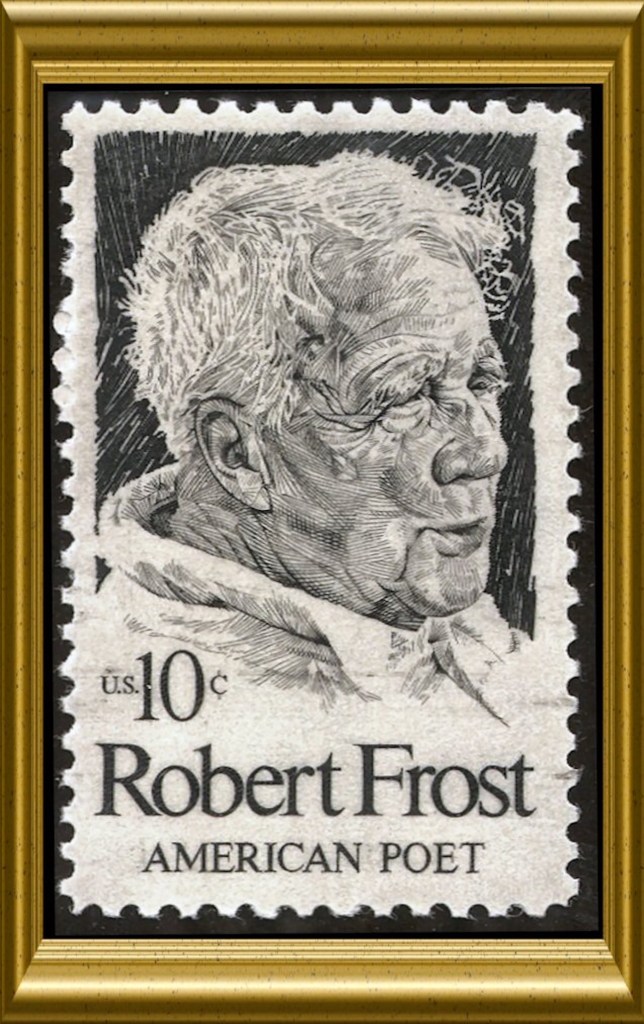
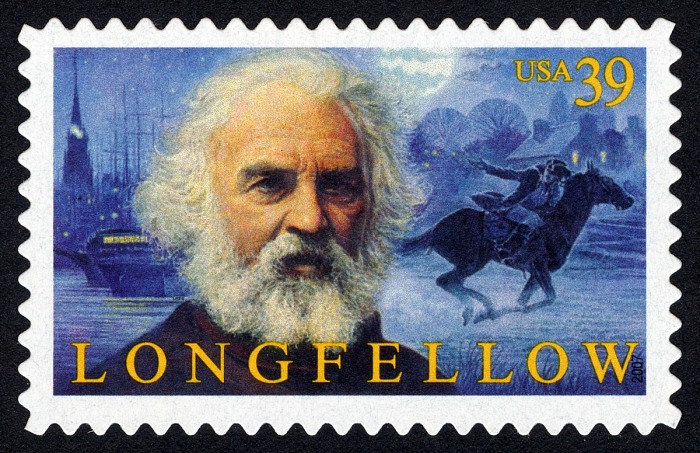
    Robert Frost – Commemorative Stamp
  • William Butler Yeats’ “Sailing to Byzantium”

    Image:  William Butler Yeats

    William Butler Yeats’ “Sailing to Byzantium”

    William Butler Yeats’ “Sailing to Byzantium” is a profound meditation on aging, art, and the quest for spiritual transcendence, despite his failure to clearly grasp the Eastern religious/philosophical concepts he strived to portray.

    Introduction and Excerpt from “Sailing to Byzantium”

    William Butler Yeats’ “Sailing to Byzantium” is a profound meditation on aging, art, and the quest for spiritual transcendence. However, despite Yeats’ deep engagement with Eastern religion and philosophy, his interpretation and application of these concepts in his poetry often reveal a “Romantic misunderstanding,” as T.S. Eliot astutely observed. 

    This misunderstanding is clearly evident in “Sailing to Byzantium,” especially in its fourth stanza, where Yeats’ vision of eternal existence through art diverges significantly from Eastern religious/philosophical principles.

    Yeats wrote “Sailing to Byzantium” in 1926, at the age of 61,  as a reflection on the aging process and the spiritual journey required to maintain vitality in the face of physical decline. 

    Sailing to Byzantium

    That is no country for old men. The young
    In one another’s arms, birds in the trees
    —Those dying generations—at their song,
    The salmon-falls, the mackerel-crowded seas,
    Fish, flesh, or fowl, commend all summer long
    Whatever is begotten, born, and dies.
    Caught in that sensual music all neglect
    Monuments of unageing intellect.

    An aged man is but a paltry thing,
    A tattered coat upon a stick, unless
    Soul clap its hands and sing, and louder sing
    For every tatter in its mortal dress,
    Nor is there singing school but studying
    Monuments of its own magnificence;
    And therefore I have sailed the seas and come
    To the holy city of Byzantium.

    O sages standing in God’s holy fire
    As in the gold mosaic of a wall,
    Come from the holy fire, perne in a gyre,
    And be the singing-masters of my soul.
    Consume my heart away; sick with desire
    And fastened to a dying animal
    It knows not what it is; and gather me
    Into the artifice of eternity.

    Once out of nature I shall never take
    My bodily form from any natural thing,
    But such a form as Grecian goldsmiths make
    Of hammered gold and gold enamelling
    To keep a drowsy Emperor awake;
    Or set upon a golden bough to sing
    To lords and ladies of Byzantium
    Of what is past, or passing, or to come.

    Commentary on “Sailing to Byzantium”

    The poem “Sailing to Byzantium” uses a journey to Byzantium (Constantinople now Istanbul,) as a metaphor for a spiritual quest, with the speaker seeking to transcend the limitations of the mortal body and achieve a form of immortality through art.

    First Stanza:  Contrasting Vividly

    That is no country for old men. The young
    In one another’s arms, birds in the trees
    —Those dying generations—at their song,
    The salmon-falls, the mackerel-crowded seas,
    Fish, flesh, or fowl, commend all summer long
    Whatever is begotten, born, and dies.
    Caught in that sensual music all neglect
    Monuments of unageing intellect.

    The opening stanza of “Sailing to Byzantium” presents a vivid contrast between the vitality of youth and the poet’s sense of alienation from the natural world as he ages. Yeats paints a picture of a country teeming with life, where “The young / In one another’s arms, birds in the trees” and “the mackerel-crowded seas” represent the cyclical nature of life and death. 

    The phrase “Those dying generations” underscores the transient nature of all living things, a concept that aligns with Eastern philosophy’s emphasis on impermanence.  However, Yeats’ reaction to this natural cycle reveals a departure from Eastern thought. 

    While Buddhism and Hinduism often advocate for acceptance of life’s impermanence, Yeats expresses a desire to escape it. His assertion that “all neglect / Monuments of unageing intellect” suggests a privileging of human intellect and art over the natural world, a distinctly Western perspective that contradicts the Eastern emphasis on harmony with nature.

    Second Stanza:  Aging and the Quest for Renewal

    An aged man is but a paltry thing,
    A tattered coat upon a stick, unless
    Soul clap its hands and sing, and louder sing
    For every tatter in its mortal dress,
    Nor is there singing school but studying
    Monuments of its own magnificence;
    And therefore I have sailed the seas and come
    To the holy city of Byzantium.

    In the second stanza, Yeats further develops the theme of aging and the quest for spiritual renewal. The image of an aged man as “a paltry thing, / A tattered coat upon a stick” vividly conveys the physical deterioration that comes with age. However, Yeats proposes that this decline can be transcended if the soul can “clap its hands and sing, and louder sing / For every tatter in its mortal dress.”

    This concept of the soul triumphing over bodily decay echoes certain Eastern philosophical ideas, particularly the Hindu concept of the soul, which is the eternal self, transcending the physical body. 

    However, Yeats’ emphasis on the soul’s need to “sing” and study “Monuments of its own magnificence” reveals a more Western, ego-centric approach to spiritual transcendence. In contrast, many Eastern philosophies advocate for the dissolution of the ego and the realization of the soul’s unity with the Divine Reality.

    Third Stanza:  The Concept of Transformation 

    O sages standing in God’s holy fire
    As in the gold mosaic of a wall,
    Come from the holy fire, perne in a gyre,
    And be the singing-masters of my soul.
    Consume my heart away; sick with desire
    And fastened to a dying animal
    It knows not what it is; and gather me
    Into the artifice of eternity.

    The third stanza introduces the “sages standing in God’s holy fire,” whom the speaker implores to be the “singing-masters of my soul.”  This imagery draws on both Western and Eastern concepts, blending Christian imagery of holy fire with the Eastern idea of spiritual masters or gurus. The speaker’s desire to have his heart consumed away and to be gathered into “the artifice of eternity” reflects a yearning for spiritual transformation.

    However, Yeats’ conception of this transformation as an “artifice” created by sages diverges from Eastern philosophical traditions.  In many Eastern spiritual practices, enlightenment or liberation is seen not as an artificial state created by external forces, but as the realization of one’s true nature, of uniting the individual soul with the Oversoul, or God.  Yeats’ portrayal suggests a more Western, interventionist approach to spiritual transformation.

    Fourth Stanza: Romantic Misunderstanding

    Once out of nature I shall never take
    My bodily form from any natural thing,
    But such a form as Grecian goldsmiths make
    Of hammered gold and gold enamelling
    To keep a drowsy Emperor awake;
    Or set upon a golden bough to sing
    To lords and ladies of Byzantium
    Of what is past, or passing, or to come.

    The final stanza of “Sailing to Byzantium” most clearly demonstrates Yeats’ “Romantic misunderstanding” of Eastern philosophy. Here, the speaker envisions his eternal form not as a dissolution into God-consciousness (self-realization), as many Eastern traditions insist, but as a golden artifact created by “Grecian goldsmiths.”  This vision of immortality through art is fundamentally at odds with Eastern concepts of liberation from the cycle of birth and death.

    Yeats’ desire to take a form “Of hammered gold and gold enamelling” to entertain “lords and ladies of Byzantium” reveals a distinctly Western preoccupation with individual identity and artistic legacy. This contrasts sharply with Eastern religious/philosophical concepts such as the Buddhist non-self upon entering nirvana or the Hindu idea of samadhi or liberation from cycles of death and rebirth.

    Furthermore, the speaker’s intention to “sing / To lords and ladies of Byzantium / Of what is past, or passing, or to come” suggests a linear view of time that is more aligned with Western thought than with the cyclical time concepts expounded in Eastern religion/philosophy.

    While “Sailing to Byzantium” is undoubtedly a masterpiece of poetic craft, it also reveals the limitations of Yeats’ understanding and application of Eastern philosophical concepts. 

    His vision of spiritual transcendence, particularly as expressed in the fourth stanza, remains rooted in Western ideas of individual immortality and artistic legacy, rather than the Eastern concepts of ego dissolution and unity with the Divine Creator. 

    This “Romantic misunderstanding” of Eastern philosophy, as Eliot termed it, is indeed on full display in this poem, showcasing both the brilliance of Yeats’ poetic vision and the cultural limitations that shaped his interpretation of Eastern thought.

    🕉

    You are welcome to join me on the following social media:
    TruthSocial, Locals, Gettr, X, Bluesky, Facebook, Pinterest 

    🕉

    Share

  • Langston Hughes’ “Goodbye, Christ”

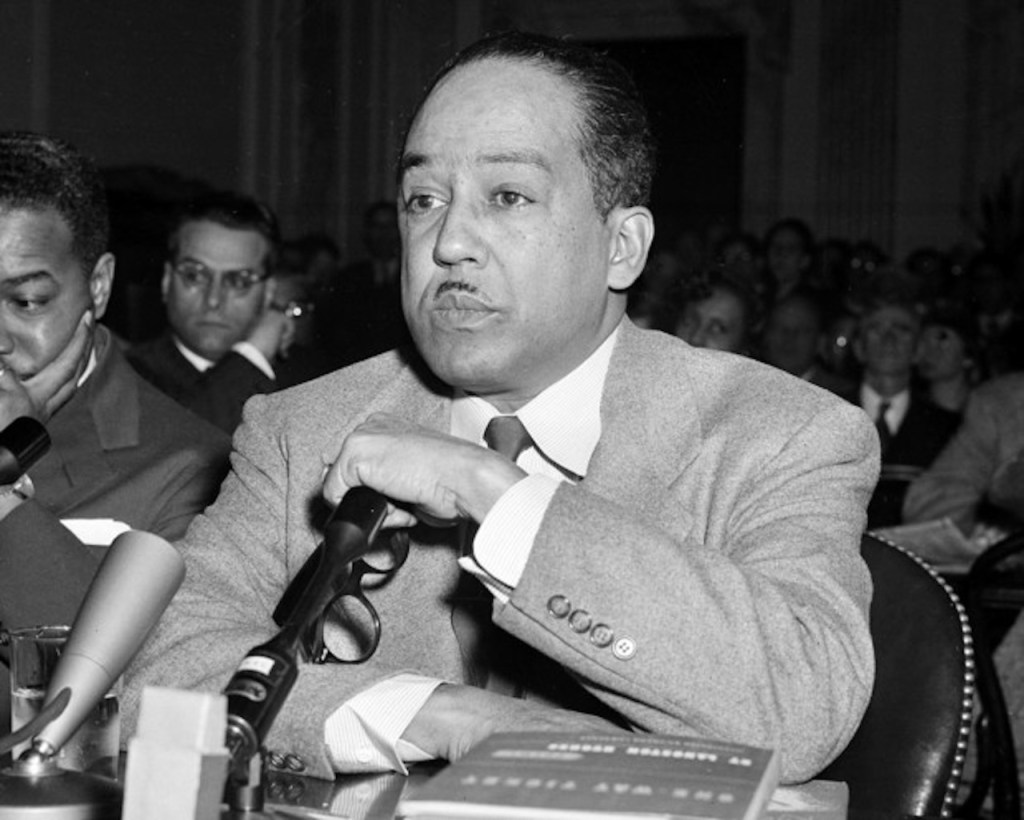
    Image:  Langston Hughes– Appearing before Joseph McCarthy’s Senate Permanent Subcommittee on Investigations – March 24, 1953

    Note on Term Usage:  Before the late 1980s in the United States, the terms “Negro,” “colored,” and “black” were accepted widely in American English parlance.   While the term “Negro” had started to lose it popularity in the 1960s, it wasn’t until 1988 that the Reverend Jesse Jackson began insisting that Americans adopt the phrase “African American.”  The earlier more accurate terms were the custom at the time that Langston Hughes was writing.

    Langston Hughes’ “Goodbye, Christ”

    Langston Hughes wrote “Goodbye, Christ” in 1931. It was published in a statist publication called “The Negro Worker” in 1932, but Hughes later withdrew it from publication.

    Introduction with Text of “Goodbye, Christ”

    Nine years after the publication of Langston Hughes’ “Goodbye, Christ,” on January 1, 1941, the poet was scheduled to deliver a talk about Negro folk songs at the Pasadena Hotel. Members of Aimee Semple McPherson’s Temple of the Four Square Gospel picketed the hotel with a sound truck playing “God Bless America.”   

    Likely those members of the McPherson temple became aware of the poem because McPherson is mentioned in it. The protestors passed out copies of Hughes’ poem, “Goodbye, Christ,” even though they had not secured permission to copy and distribute it. 

    A few weeks later, The Saturday Evening Post, heretofore no friend to black writers, also mentioned in the poem, also printed the poem without permission. The poem had received little attention until these two events.  

    But Hughes had been criticized for his “revolutionary” writings and apparent sympathy for the Soviet form of government. On March 24, 1953, Hughes was called to testify before the Joseph McCarthy’s Senate Permanent Subcommittee on Investigations.

    Goodbye, Christ

    Listen, Christ,
    You did alright in your day, I reckon-
    But that day’s gone now.
    They ghosted you up a swell story, too,
    Called it Bible-
    But it’s dead now,
    The popes and the preachers’ve
    Made too much money from it.
    They’ve sold you to too many
    Kings, generals, robbers, and killers-
    Even to the Tzar and the Cossacks,
    Even to Rockefeller’s Church,
    Even to THE SATURDAY EVENING POST.
    You ain’t no good no more.
    They’ve pawned you
    Till you’ve done wore out.
    Goodbye,
    Christ Jesus Lord God Jehova,
    Beat it on away from here now.
    Make way for a new guy with no religion at all-
    A real guy named
    Marx Communist Lenin Peasant Stalin Worker ME-
    I said, ME!
    Go ahead on now,
    You’re getting in the way of things, Lord.
    And please take Saint Gandhi with you when you go,
    And Saint Pope Pius,
    And Saint Aimee McPherson,
    And big black Saint Becton
    Of the Consecrated Dime.
    And step on the gas, Christ!
    Move!
    Don’t be so slow about movin?
    The world is mine from now on-
    And nobody’s gonna sell ME
    To a king, or a general,
    Or a millionaire.

    Commentary on “Goodbye, Christ”

    Langston Hughes’ poem “Goodbye, Christ” is a dramatic monologue. The speaker is addressing Christ, telling him to leave because He is no longer wanted. The speaker is employing irony and sarcasm to express his distrust and disapproval of the many people, including the clergy, who have used religion only for financial gain.

    Serving God or Mammon 

    In the first verse paragraph (versagraph), the speaker explains to Christ that things are different now from the way they were back in Christ’s day; the speaker figures that back then Christ’s presence might have been appreciated, but now “[t]he popes and the preachers’ve / Made too much money from [your story].”  

    And that complaint is addressed in the poem that certain individuals and organizations have used the name of Christ to make money: “They’ve pawned you / Till you’ve done wore out.”  

    The speaker makes it clear that it is not only Christianity that has been desecrated, for he also includes Hinduism when he tells Christ “please take Saint Gandhi with you when you go.”  It is not only white people like McPherson, but also “big black Saint Becton,” a charlatan preacher Hughes mentions in his autobiography, The Big Sea

    Hughes is, in no way, repudiating Jesus Christ and true religion. He is, however, excoriating those whom he considers charlatans, who have profited only financially without highlighting the true meaning of Christ’s (or other religions’) teachings. 

    Langston Hughes on “Goodbye, Christ” 

    In editor Faith Berry’s Good Morning Revolution: Uncollected Writing of Langston Hughes, Berry brings together a large collection of writings for which Hughes did not seek wide publication.  Some of his early politically statist-leaning poems, which had appeared in obscure publications, managed to circulate, and Hughes was labeled a Communist, which he always denied in his speeches. 

    About “Goodbye, Christ,” Hughes has explained that he had withdrawn the poem from publication, but it had appeared without his permission and knowledge.  Hughes also insisted that he had never been a member of the Communist Party.  He went so far as to say he wished Christ would return to save humanity, which was in dire need of saving, as it could not save itself. 

    Earlier in his immaturity, Hughes had believed that the communist form of government would be more favorable to black people, but he became aware that his VIP treatment in Russia was a ruse, calculated to make people of color think that communism was friendlier to them than capitalism while ultimately hoodwinking them just as the Democratic Party did later on in the century.  (Also see Carol Swain’s “The Inconvenient Truth about the Democratic Party”)

    In his senate committee testimony on March 24, 1953, Hughes makes his political inclinations clear that he had never read any book on the theory of socialism and communism.  Also, he had not delved into the stances of the Republican and Democrat parties in the United States.

    Hughes claimed that his interest in politics was prompted solely by his emotion.  Only through his own emotions had he glanced at what politics might have to offer him in figuring out personal issues with society.  So in “Goodbye, Christ,” the following versagraph likely defines the poet’s attitude at its emotional depths:

    Goodbye,
    Christ Jesus Lord God Jehova,
    Beat it on away from here now.
    Make way for a new guy with no religion at all—
    -A real guy named
    Marx Communist Lenin Peasant Stalin Worker ME—
    I said, ME!

    Hughes spent a year in Russia and came back to America writing glowing reports of the wonderful equalities enjoyed by all Russians, which many critics wrongly interpreted to indicate that Hughes became a communist.   On January 1, 1941, Hughes wrote the following clear-eyed explanation that should once and for all put to rest the notion that his poem was meant to serve blasphemous purposes:

    “Goodbye, Christ” does not represent my personal viewpoint.  It was long ago withdrawn from circulation and has been reprinted recently without my knowledge or consent.  I would not now use such a technique of approach since I feel that a mere poem is quite unable to compete in the power to shock with the current horrors of war and oppression abroad in the greater part of the world.

    I have never been a member of the Communist party.  Furthermore, I have come to believe that no system of ethics, religion, morals, or government is of permanent value which does not first start with and change the human heart.  Mortal frailty, greed, and error know no boundary lines.  

    The explosives of war do not care whose hand fashions them.  Certainly, both Marxists and Christians can be cruel.  Would that Christ came back to save us all. We do not know how to save ourselves. (my emphasis added) —from  Good Morning Revolution: Uncollected Writing of Langston Hughes, page 149.

    The Importance of Understanding the Irony in “Goodbye, Christ”

    While it may be difficult for devout Christians, who love Christ and his teachings, to read such seemingly blasphemous writing, it is important to distinguish between the literal and the figurative:  Hughes’ “Goodbye, Christ” must be read through the lens of irony and sarcasm, and realized as a statement against the financial usurpation of religion, and not a repudiation of Christ and the great spiritual masters of all religions.

    It should be remembered that Hughes’ seemingly blasphemous poem simply creates a character who was speaking ironically, even sarcastically, in order to call out the actual despicable blasphemers who desecrate true religion with duplicity and chicanery.

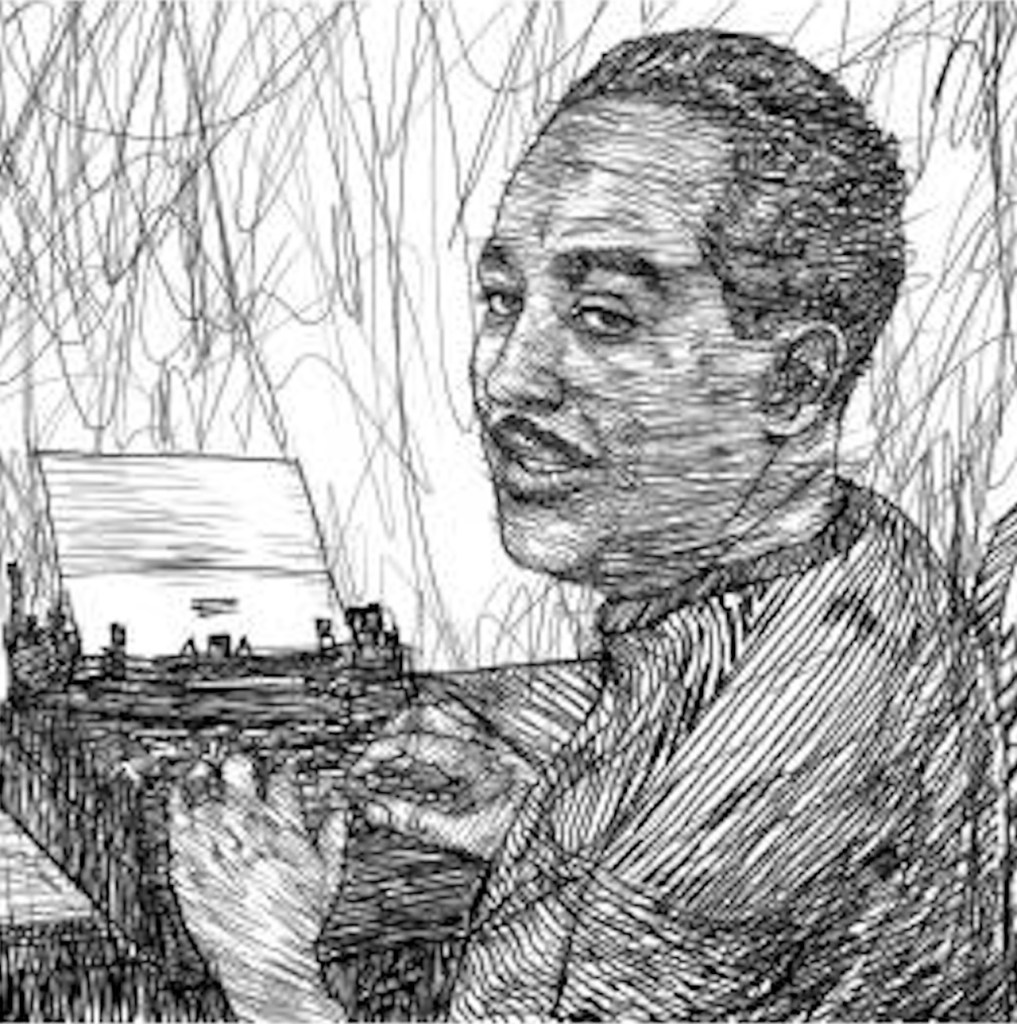
    Image:  Ink Drawing of Langston Hughes– Ink Portrait – Fabrizio Cassett

  • James Weldon Johnson

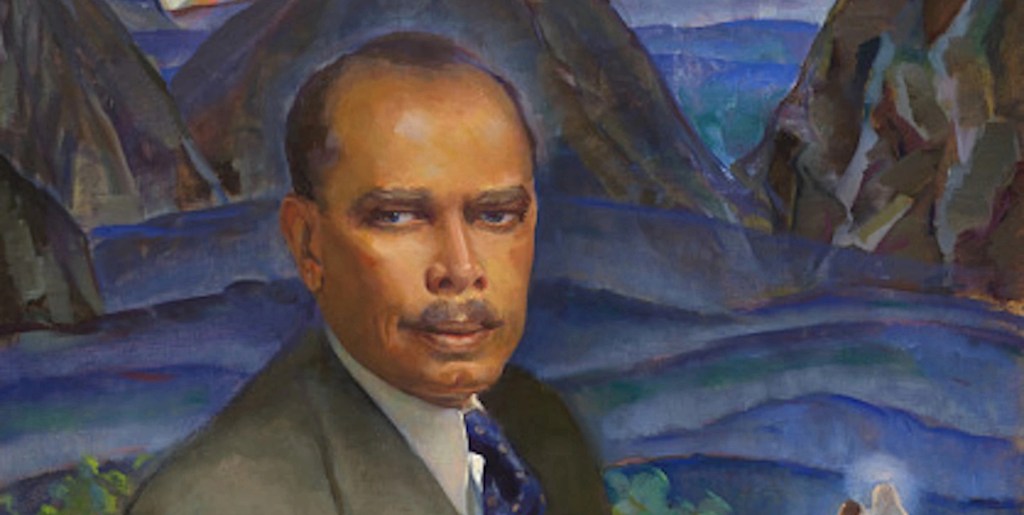
    Image:James Weldon Johnson – Portrait  by Laura Wheeler Waring

    Life Sketch of James Weldon Johnson

    A true “Renaissance man,” James Weldon Johnson wrote some the best spiritual poems and songs in the American literary canon.  He also held positions as attorney, diplomat, professor, and activist in a political party, fighting for the civil rights of black Americans.

    Note on Term Usage:  Before the late 1980s in the United States, the terms “Negro,” “colored,” and “black” were accepted widely in American English parlance.   While the term “Negro” had started to lose it popularity in the 1960s, it wasn’t until 1988 that the Reverend Jesse Jackson began insisting that Americans adopt the phrase “African American.”  The earlier more accurate terms were the custom at the time that James Weldon Johnson was writing.

    Early Life and Schooling

    James Weldon Johnson was born on June 17, 1871, in Jacksonville, Florida, [1] to James Johnson, of Virginia, who had held a position as headwaiter at a resort hotel, and Helen Louise Dillet, of the Bahamas, who had served as a teacher in Florida.  

    His parents raised James to be a strong, independent man.  The future poet became a free-thinker as his parents encouraged him to understand that he was capable of achieving all the success in life for which he sought to strive. 

    In 1894, after completing the bachelor’s degree at Atlanta University, he accepted a position as principal at the Edwin M. Stanton School.  His mother had taught at that school.  In his position as principal of Stanton, he made great improvements in the curriculum, adding grades 9 and 10.

    While serving at the Stanton school as principal, Johnson founded the newspaper, The Daily American.  The paper remained in publication for only a year, but it served as a lever for Johnson’s role as an activist, bringing him to the attention of Booker T. Washington and W.E.B. DuBois, two of the most influential activists of the civil rights movement.

    Johnson began the study of law in Thomas Ledwith’s law office in Jacksonville, Florida, in 1896 [2].  He passed the bar exam in 1898 and was admitted to the Florida bar.  He practiced law for several years and then decided to pursue other lines of work.

    From New York City to the Diplomatic Corp

    To engage a career in songwriting, in 1901 James and his brother Rosamond moved to New York City.  They became partners with Bob Cole and accepted a publishing contract which paid a $1200 monthly stipend.  That income amounted to a fortune in the early 20th century.  

    During the next half decade, the Johnson brothers wrote and produced a whopping 200 songs for both Broadway and for other formats.  Their substantial list of hits include titles such as  “Didn’t He Ramble,” “Under the Bamboo Tree,” and “The Old Flag Never Touched the Ground.”

    Along with Bob Cole, the Johnsons earned a outstanding reputation as a musical trio.   They became known affectionately as “Those Ebony Offenbachs.”  While they eschewed the artistry of the minstrel show stereotypes, they did agree to create simplified versions of black life of rustics for white audiences that seemed to relish such fare.  

    But their most important contribution includes a suite of six songs titled The Evolution of Ragtime, a documentary which has remained important for recording the black experience in contributing to music. Residing in New York also allowed Johnson the opportunity to attend Columbia University, where he engaged formally in the study literature and creative writing.  

    Johnson also began his civil rights activism in Republican Party politics.  While serving as the treasurer of New York’s Colored Republican Club, he wrote two songs for Theodore Roosevelt’s 1904 presidential campaign.  Roosevelt won that campaign, becoming the 26h president of the United States.

    The black national civil rights leadership divided into two factions: one remained traditional and was led by Booker T. Washington.  The other faction turned radical and was headed up by W.E.B. Du Bois.  Johnson chose to follow Washington and the traditionalists.  

    Washington’s leadership had offered the appropriate influence and had helped Roosevelt win the presidency.  Thus, Washington exerted his influence again to have Johnson appointed as the U.S. consulate to Venezuela.  

    Johnson’s stint in Venezuela afforded him time to create poetry. There he composed his magnificent, nearly perfect sonnet, “Mother Night,” during this time.  Also, during this three year period of service as consul on Venezuela, he was able to finish his novel, The Autobiography of an Ex-Coloured Man.  

    After Johnson’s service in Venezuela, he received a promotion that relocated him to Nicaragua. His job in Nicaragua became more demanding, allowing him less time for literary efforts.

    Back to New York and the Harlem Renaissance

    In 1900, Johnson composed the hymn “Lift Ev’ry Voice and Sing” for a school celebration of Abraham Lincoln’s birthday [3].  His brother Rosamond later added the melody to the lyric. In 1919, the National Association for Advancement of Colored People (NAACP) designated the song the “Negro National Hymn (Anthem).”

    In 1913, because of the inauguration of Woodrow Wilson, a Democrat, Johnson resigned his foreign service position and returned to the U.S.A.  In New York, Johnson began writing for New York’s prestigious black newspaper, the New York Age.  He wrote essays explaining and promoting the importance of the hard-work ethic and education.  

    Johnson’s traditionalism kept his position more in line with Booker T. Washington than with the radical militant W.E.B. Du Bois.  Despite those differences in ideologies, Johnson remained on good terms with both activists.

    In 1916, after Du Bois suggested the position to Johnson, he accepted the role as secretary in the NAACP.  In 1920, Johnson led the organization as president. Despite his many activist duties with the  NAACP, Johnson dedicated himself to writing full time. In 1917, he published his first collection of poems, Fifty Years and Other Poems.  That collection received great critical acclaim and established him as an important voice in the Harem Renaissance Movement.  

    Johnson continued writing and publishing; he also served as editor for numerous volumes of poetry, such as The Book of American Negro Poetry (1922), The Book of American Negro Spirituals (1925), and The Second Book of Negro Spirituals(1926).  

    In 1927, Johnson published his second book of poems God’s Trombones: Seven Negro Sermons in Verse [4]. Again, his collection received much praise from critics.  Dorothy Canfield Fisher, a best-selling author and activist for education reform, stated in a letter about Johnson’s style:

    . . . heart-shakingly beautiful and original, with the peculiar piercing tenderness and intimacy which seems to me special gifts of the Negro. It is a profound satisfaction to find those special qualities so exquisitely expressed.

    Back to Teaching

    After his retirement from the NAACP, Johnson continued writing.   He also served as professor  at New York University.  Johnson’s stellar reputation again preceded him; as he joined the NYU faculty, Deborah Shapiro testified:

    Dr. James Weldon Johnson was already a world-renowned poet, novelist, and educator when he arrived at the School of Education in 1934.  His faculty appointment was in the Department of Educational Sociology, yet Johnson’s influence did not end there.  As the first black professor at NYU, Johnson broke a crucial color barrier, inspiring further efforts toward racial equality both within and outside the boundaries of Washington Square.

    Death

    In 1938 at age 67, Johnson was killed in an automobile accident in Wiscasset, Maine, after a train crashed into the vehicle in which the poet was a passenger.  His funeral, held in Harlem, New York, was attended by over 2000 individuals.  

    Johnson’s creative power and activism rendered him a true “Renaissance man,” who lived a full life.  He penned some of the finest poetry and songs ever to appear on the American literary and music scenes. Johnson’s life creed bestows on the world an uplifting inspiration after which any individual might choose to chisel his life:

    I will not allow one prejudiced person or one million or one hundred million to blight my life. I will not let prejudice or any of its attendant humiliations and injustices bear me down to spiritual defeat. My inner life is mine, and I shall defend and maintain its integrity against all the powers of hell. [5]

    The poet’s body is interred in Green-Wood Cemetery in Brooklyn, New York [6]. In an unconventional final expression, his body has been arrayed in his favorite lounging cape, with his hands clutching a copy of his collection God’s Trombones.

    Sources

    [1] Editors. “James Weldon Johnson.”  Famous African Americans. Accessed January 27, 2023.

    [2] Malik Simba.  “Profile:  James Weldon Johnson (1871- 1938).”  Black Art Story.  Accessed January 27, 2023.

    [3] Editors. “The Story Behind the Black National Anthem.”  Black Excellence.  September 26, 2018.

    [4] Editors. “James Weldon Johnson.”  Poetry Foundation.  Accessed January 27, 2023.

    [5] Christine Weerts.  “How ‘Lift Every Voice And Sing’ Became A Song Of Hope For Generations.”  The Federalist.  February 12, 2021.

    [6] FindAGrave.  “James Weldon Johnson.”  Accessed January 27, 2023.

    Commentaries on Poems by James Weldon Johnson

    This room in my literary home holds links to poems written by James Weldon Johnson along with commentaries on the poems.  

    Poems with Commentaries

    1. Noah Built the Ark”
    2. “Go Down Death”
    3. “Sence You Went Away”
    4. “Fifty Years”
    5. “A Poet to His Baby Son”
    6. “Lift Every Voice and Sing”
    7. “Mother Night”
    8. “The Creation”
    9. “O Black and Unknown Bards”
    10. “My City”

    Full Image:James Weldon Johnson – Portrait  by Laura Wheeler Waring

  • The “Shakespeare” Writer

    Image – Edward de Vere, 17th Earl of Oxford

    Continued research seems to be confirming the claim by the Oxfordians that Edward de Vere, 17th Earl of Oxford—not Gulielmus Shakspere of Stratford-upon-Avon as insisted by the Stratfordians—wrote the canon of plays and poems left by the pseudonymous “William Shakespeare.”

    Who Is the Authentic “Shakespeare” Writer”?

    The mystery regarding the true identity of the writer traditionally known as “William Shakespeare” actually began in Elizabethan England, during the period in which most of the likely candidates for the position lived and wrote. 

    The controversy [1] has continued, and today there are two main groups that argue the point: the Oxfordians contend that the most likely writer of the Shakespeare canon is Edward de Vere, 17th Earl of Oxford.   Arguing the other side are the Stratfordians, who maintain that Gulielmus Shakspere of Stratford-upon-Avon, the traditionally held choice, remains the actual writer.

    The first biographical work on “William Shakespeare” appeared in 1769.   It focuses on Gulielmus Shakspere, the man from Stratford-upon-Avon in Warwickshire, traditionally hailed as the Shakespeare writer.  

    That same year, Herbert Lawrence in his work titled, The Life and Adventures of Common Sense, suggests the idea that “William Shakespeare” was likely the nom de plume of some other writer but not the Stratford man. 

    In 1780 a clergyman/scholar in Warwickshire, James Wilmot, examined records near and surrounding Stratford-upon-Avon, searching for data on William Shakespeare and the Shakespeare works.  Wilmot found nothing about the writer or his works.

    After Wilmot lacked success in locating any information leading to the identity of the Stratford man as the Shakespeare writer, he floated the notion that Francis Bacon using “William Shakespeare” nom de plume had written those plays and sonnets.  Wilmot, to the detriment of historical literary research, mandated that all of his research materials be burned upon his death.

    In 1857, Delia Bacon, an American short story writer and Shakespeare enthusiast, offered the suggestion that perhaps a committee and not just one individual had composed the Shakespeare canon.  For her suggested committee, Delia Bacon chose Edmund Spencer, Sir Walter Ralegh, and Edward de Vere; she placed Francis Bacon in the committee as its chairman.

    Since those early suggestions that an individual other than the Stratford man wrote the Shakespeare canon, the controversy has raged on.   Currently, the Oxfordians, who continue to gather evidence for Edward de Vere, 17th Earl of Oxford, as the Shakespeare writer are putting forth the strongest, most convincing argument.

    Literary scholars and critics are increasingly coming to the conclusion that the man from Stratford, Gulielmus Shakspere, widely held as the traditional Shakespeare, is the least qualified candidate for playing that authorial rôle.  From that conclusion emerges the likelihood that Edward de Vere, 17th Earl of Oxford, is the best candidate for consideration as the Shakespeare writer. 

    Walt Whitman, one of America’s greatest poets, agrees with the Oxfordians, who argue that the 17th Earl of Oxford is the actual author of the works published under the nom de plume, “William Shakespeare”: 

    Conceiv’d out of the fullest heat and pulse of European feudalism — personifying in unparalleled ways the medieval aristocracy, its towering spirit of ruthless and gigantic caste, with its own peculiar air and arrogance (no mere imitation) — only one of the “wolfish earls” so plenteous in the plays themselves, or some born descendant and knower, might seem to be the true author of those amazing works — works in some respects greater than anything else in recorded literature.  [2]

    From other respected writers such as Henry James and Ralph Waldo Emerson to actors such as Charlie Chaplin and Sir Derek Jacobi to supreme court justices such as Harry A. Blackmun and John Paul Stevens, famous individuals have expressed doubt about the tradition identification of the Shakespeare writer [3].

    Why the Oxfordians Are Likely Correct

    A study of the background of each man—Gulielmus Shakspere of Stratford-upon-Avon and Edward de Vere, 17th Earl of Oxford—reveals evidence that  suggests that only Oxford possessed the ability to have produced the complex, historically based, geographically accurate  works of the Shakespeare writer.

    Gulielmus Shakspere—”Stratford”—was semi-literate; his parents, his wife, and his children were all semi-literate.  He likely remained uneducated beyond age 14.  No records have been found that demonstrate that he wrote anything more complex than a list of beneficiaries in his last will and testament.

    But if the Stratfordians are correct, this semi-literate individual who traveled no farther than to London (if that far) and left no early writings just suddenly commenced the composition of complex historical dramas and perfectly modulated sonnets during the time period Shakespeare scholars call “Shakespeare’s Lost Years.” 

    In contrast, Edward de Vere—”Oxford”—had received a first class education, had traveled widely throughout the world, and had actually been known to be a writer of plays and poetry.

    It remains as unlikely that the man Gulielmus Shakspere could have composed any of the works attributed to “William Shakespeare,” as he could have invented the horseless carriage or discovered the Pacific Ocean.  

    Life Sketch of Gulielmus Shakspere:  Birth Date in Doubt

    The biographical documents of “William Shakespeare” are virtually blank pages, upon which scholars, critics, and enthusiasts have written versions of a life, for example, no record exists of the birth date of “William Shakespeare,” even under the name Gulielmus Shakspere.  Biographers, therefore, can only speculate [4]:

    William Shakespeare was born in Stratford-upon-Avon, England, in April 1564. The exact date of his birth is not recorded, but it is most often celebrated around the world on 23 April. . . . Shakespeare also died on 23 April; in 1616, when he was 52 years of age.

    And the speculation continues; the following represents a further example that is typical of any attempt to state when “William Shakespeare” was born:

    No birth records exist, but an old church record indicates that a William Shakespeare was baptized at Holy Trinity Church in Stratford-upon-Avon on April 26, 1564. 

    From this, it is believed he was born on or near April 23, 1564, and this is the date scholars acknowledge as Shakespeare’s birthday. [5]

    As would-be biographers speculate about the birth date and other details regarding the Shakespeare writer, they employ the nom de plume “William Shakespeare” instead of Gulielmus Shakspere, the name that appears on the man’s baptismal record.

    Remaining a nebulous figure, “William Shakespeare” as Gulielmus Shakspere has no actual day of birth.  His speculated birth date is April 23, 1564, as is his death date, April 23, 1616.    The fabulous coincidence of any man dying on his unknown birth date further suggests the vulnerability of the claim that Stratford is the actual Shakespeare writer.

    The Education of “William Shakespeare”

    While uncertainty abounds regarding the birth date of “William Shakespeare,” equal uncertainty persists regarding his education.  Again, no records [6] have been found to designate the level of education to which Stratford might have risen.

    Supposition and guess-work suggest that Stratford might have attended King Edward VI Grammar School between the ages of seven and fourteen.  After age fourteen, his formal education was finished.  However, speculation regarding Stratford’s education has been offered as actual biographical history: 

    Stratford enjoyed a grammar school of good quality, and the education there was free, the schoolmaster’s salary being paid by the borough. 

    No lists of the pupils who were at the school in the 16th century have survived, but it would be absurd to suppose the bailiff of the town did not send his son there. 

    The boy’s education would consist mostly of Latin studies—learning to read, write, and speak the language fairly well and studying some of the Classical historians, moralists, and poets. 

    Shakespeare did not go on to the university, and indeed it is unlikely that the scholarly round of logic, rhetoric, and other studies then followed there would have interested him. (my emphasis on “no lists of the pupils”) [7]

    It may seem absurd to deem that the Shakespearean father would not have insisted that his son attend an illustrious grammar school funded by the state.  In such a school,  the boy would have been immersed in Latin studies and the classics.  However, such deeming does not record that boy’s name in documents that reveal that he did actually attend such an illustrious grammar school.

    Also, if the son of the town’s bailiff had received such an excellent education and was taught to read and write Latin, which he did “fairly well,” one has to remain perplexed that Gulielmus Shakspere remained unable to write his own name and spell it consistently throughout his lifetime (see below “The Spelling of the Stratford’s Name”).

    The Importance of Education

    Although no documentation exists to validate the education of Stratford and only speculations are extant that he attended King Edward VI Grammar School in Stratford-upon-Avon, the educational record [8] for Edward de Vere is extensive.  

    Edward de Vere became a ward of the Crown and was educated by the Royal Court of Wards.  He attended Queen’s College, Cambridge, and later underwent training at Gray’s Inn in the study of law. 

    De Vere was early on considered a wunderkind; his mentor and tutor Laurence Nowell asserted in 1563, as de Vere turned 13 years old,  that his “work for the Earl of Oxford cannot be much longer required.”    By the next year, at age 14, de Vere had been awarded a Cambridge degree. In 1566, at age 16, he earned a master of arts degree from the universities of Oxford and Cambridge.

    Stratfordians like to emphasize the fact that genius can overcome station in life, but such is true only to a point.  The late Shakespeare scholar Daniel Wright [9] has elucidated the issue of education vs natural genius:

    A writer’s genius can elevate his or her poetry or prose beyond the mundane (indeed, in Shakespeare’s case, it endows his achievement with a magnificence that is almost transcendent in its resplendence), but it cannot of itself impart to any writer—not even to Shakespeare—a knowledge of particular facts. 

    Genius may animate the hand, but it does not do that which is not its office—it does not, for it cannot, supply the material with which the hand performs its work. Some things even a genius simply must be taught.

    The issue of education presents one of the best supports for the fact that Stratford would not have had knowledge of the facts needed to have written the Shakespeare canon.  Professor Wright has pointed out that “knowledge of particular facts” cannot come without the input of experience to the mind, even to a genius. 

    No evidence exists that Stratford had traveled even to London—only 100 miles from Stratford-upon-Avon—much less that he could have traveled a great deal in Italy.  Such a set of facts is necessary for the writer, who wrote the plays, to have experienced.   Despite natural talent and genius, an intimate knowledge of the Italian landscape cannot simply appear within the mind of said genius.

    “The Lost Years”

    The concept of “Lost years” in the lives of any biographical target provides a delicious opportunity to the biographer, who then has the opportunity to fill in those lost years.    Because “there is no documentary evidence of his life during this period of time,” suitable scenarios may be invented that have little or no relationship to real events.  Thus the would-be biographer is allowed to opine as he wishes, such as the following: 

    ‘The Lost Years’ refers to the period of Shakespeare’s life between the baptism of his twins, Hamnet and Judith in 1585 and his apparent arrival on the London theatre scene in 1592.

    We do not know when or why William Shakespeare left Stratford-upon-Avon for London, or what he was doing before becoming a professional actor and dramatist in the capital. There are various traditions and stories about the so-called ‘lost years’. 

    There is no documentary evidence of his life during this period of time.  A type of mythology has developed around these mysterious years, and many people have their favourite version of the story. (my emphasis added)  [10]

    These speculating Shakespearean biographers not only do not know “when or why” Stratford left Stratford-upon-Avon for London, but they also do not even know that he actually did make that trip to London.   That Stratford became “a professional actor and dramatist in the capital” remain likely one part of the confusion that has fused aspects from the lives of Stratford and Oxford.

    Further Evidence Oxford Is the Real “Shakespeare”

    In addition to the issue of the vast differences between the Stratford man and the Oxford earl in education, further issues advocate that Oxford continues to remain the better candidate for the real “Shakespeare” than Stratford.

    The Spelling of the Stratford’s Name

    The many variations in the spelling of the name “Shakspere” offer further evidence for the claim the Stratford could not have authored the Shakespeare canon.  Stratford could barely write his own name, much less a complex literary canon.  Stratford’s signature [11] varied, as he affixed his name with six different spellings in four legal documents:  

    1. deposition of the lawsuit, Bellott v Mountjoy (1612) 
    2. deed for a house sold in Blackfriars, London (1613)
    3. the mortgage document for a house acquired in Blackfriars (1613)
    4. a 3-page Last Will and Testament (1616), which he signed at the bottom of each page.

    Interestingly, none of the Stratford man’s many variations on the spelling of his name includes the spelling “Shakespeare” (12).

    Thomas Regnier on “Our Ever-Living Poet”

    Thomas Regnier, Shakespeare scholar and prominent Oxfordian, delineates the top “18 Reasons Why Edward de Vere, Earl of Oxford, Was “Shakespeare.”   Regnier’s Reason 18 clarifies the use of the phrase, “Our ever-living poet,” thus demonstrating that it refers to Oxford instead of Stratford:

    Shakespeare’s Sonnets were first published in 1609. There are indications on the dedication page that the author was no longer living at that time. 

    First, the dedication is signed by the publisher, Thomas Thorpe, not by the author, suggesting that the author was not alive to write the dedication. 

    More significantly, the dedication refers to the author as “ever-living.” This is a phrase that was used metaphorically to refer to a person who was no longer alive, but who would live on through his works in our minds and hearts. 

    The Earl of Oxford was no longer living in 1609, while the man from Stratford, who is usually credited with writing the works of Shakespeare, would live on for another seven years. Stratfordian scholars have never been able to explain why the phrase “ever-living” would have been applied to a living person.  [13]

    The controversy at the heart of the Stratford vs Oxford debate will likely continue because of the simple nature of the past, which perpetually remains in a kind of fog.   An unfortunate encumbrance that may interfere with the legitimacy of the debate to ultimately find the truth is that it might come to depend on which side affords the debaters greater financial and prestigious awards.  

    Questions that could use an airing are:  Do university grants go more often to those researchers who contend that Stratford is the real “William Shakespeare”?  Does Oxfordianism label one a royalist and an elitist while Stratfordianism offers the veneer of humbleness and dedication to the “little man”?

    The Stigma Attached to Oxfordianism

    The Stratfordians have in the past attached a stigma to the Oxfordians, for example, in 1920, J. Thomas Looney identified Oxford as the Shakespeare writer and offering the claim that “William Shakespeare” was a  pseudonym (pen name or nom de plume.)   While Looney’s name is pronounced with a long ō, stigmatizing Stratfordians engaging in the rhetorical fallacy called name-calling revels in calling Looney “loony” (14).

    Also if one entertains any lingering doubt that the Stratfordians have an equal argument to wield against the Oxfordians, one might want to have a look at the comments offered on amazon.com after Looney’s book, “Shakespeare” Identified,” a centenary edition edited by James Warren.  

    John Crowe Ransom’s New Criticism movement of the middle 20th century placed emphasis on the text above biography of the writer:  

    The central issue that new critical thought brought to literary studies is the emphasis on the text itself, rather than on the biography of the writer or the historical and societal circumstances in which the writer composed. While these issues may be considered overall, the first consideration must be the text itself. [15]

    Nevertheless, each scholar, critic, commentarian, or reader has to decided for himself which of the known facts are important and in which direction they point.  It is also important to remember that biography is only one portion of the information needed to understand and appreciate any work of literary art.

    My Personal View of the Shakespeare Controversy

    I have written commentaries on the 154 sonnets in the Shakespeare canon, and I have posted them on this site; thus I feel it necessary to make known my thoughts on the controversy and how they likely impact issues that I focus on in my sonnet commentaries.

    After studying the research of Oxfordians such as the late Professor Daniel Wright, Thomas Regnier, and many others, as well as the many who remain traditional Stratford supporters, I conclude that the Oxfordians have the far better argument, and the evidence is clear that the Shakespeare writer is most likely, if not in fact, Edward de Vere, 17th Earl of Oxford.

    I agree that the name “William Shakespeare” is most likely the pen name (nom de plume) of the Earl of Oxford.  I find no reason that Gulielmus Shakspere should have adopted a pen name, when as it has been fairly established the he seldom put pen to paper.

    Edward de Vere, as a ranking nobleman, needed to hide his association with the lower classes who engaged in writing and putting on plays.  Thus he did have the need for employing the use of a nom de plume, especially as he began to publish.  It is quiet easy to see that de Vere’s choice of a pen name “William Shakespeare” could be confused with the Stratford man’s name “Gulielmus Shakspere.”

    Because I find most compelling that argument that “William Shakespeare” is the nom de plume of Edward de Vere, 17th Earl of Oxford, I choose to refer to the works attributed to “William Shakespeare” as the “Shakespeare works” or the “Shakespeare sonnets,” instead of  “Shakespeare’s works” or “Shakespeare’s sonnets.”

    I suggest that ownership shown by the apostrophe should be reserved for a person, not a nom de plume.  In cases such a “Mark Twain” and “Lewis Carroll,” I relent because of their proximity to our contemporary world, and their identities are not in question.  In my opinion, however, the sonnets are Edward de Vere’s sonnets, but because they are published and traditionally known as “Shakespeare” sonnets, I refer to them as such.

    Sources

    [1]  Editors. “Controversy Timeline, Part 1.” Shakespeare Authorship Roundtable.  Accessed June 6, 2021.

    [2]  Walt Whitman.  “What Lurks Behind Shakspere’s Historical Plays?November Boughs. bartleby.com: Great Books Online. Accessed December 2020.

    [3]  Editors.  “Past Doubters.”  The Shakespeare Authorship Coalition.  Accessed September 27, 2024.

    [4] Editors.  “When Was Shakespeare Born?”  Shakespeare Birthplace Trust.  Accessed December 2020.

    [5]  Editors. “William Shakespeare Biography.”  Biography.  Updated: Dec 10, 2020. Original: Apr 24, 2015.

    [6]  Editors. “The Education of William Shakespeare.” Literary Genius. Accessed December 2020.

    [7]  David Bevington. “William Shakespeare.”  Britannica. November 4, 2020.

    [8] Curators.  “Chronology of Edward de Vere.”  The de Vere Society.  Accessed December 2020.

    [9] Daniel L. Wright.  “The Education of The 17th Earl of Oxford Mirrored in the Shakespeare Canon.”  Shakespeare Oxford Fellowship. May 1, 2006

    [10]  Editors. “Shakespeares’ Lost Years.” Shakespeare Birthplace Trust.  Accessed December 2020.

    [11]  Amanda Mabillard. “Playing Fast and Loose with Shakespeare’s Name.”  shakespeare online. July 20,  2011.

    [12]  Bryan H. Wildenthal.  “Reflections on Spelling and the Authorship Question.”  Shakespeare Oxford Fellowship.  August 9, 2018.

    (13)  Thomas Regnier.  “Top 18 Reasons Why Edward de Vere, Earl of Oxford, Was “Shakespeare.” Shakespeare Oxford Fellowship. August 18, 2019.

    [14]  Eve Siebert.  “Spot the Looney.”  Skeptical Humanities.  Accessed September 27, 2024.

    [15]  Linda Sue Grimes.  “The Fugitive-Agrarian Movement in Poetry.”  Linda’s Literary Home.  Updated November 17, 2025.  

    Edward de Vere, 17th Earl of Oxford – “William Shakespeare”

    Commentaries on the Shakespeare Sonnets 1—154

    1. The Marriage Sonnets 1—17

    2. The Muse Sonnets 18—126
        Part 1:  18—73
        Part 2:  74—126

    3. The Dark Lady Sonnets 127—154

  • Rabindranath Tagore

    Image: Rabindranath Tagore Beshara Magazine

    Life Sketch of Rabindranath Tagore

    In 1913, Rabindranath Tagore, Indian Nobel Laureate, won the literature prize for his prose translations of Gitanjali, Bengali for “song offerings.”  A true Renaissance man, he served as a poet, social reformer, and founder of a school.

    Early Life and Education

    Rabindranath Tagore, (in Bengali, Rabīndranāth Ṭhākur), was born May 7, 1861, Calcutta, India, to the religious reformer Debendranath Tagore (1817–1905) and Sarada Devi (1830–1875).  Sarada gave birth to fifteen children with Debendranath Tagore [1].  

    Rabindranath was the youngest of the children and was raised primarily by his oldest sister and servants.  His mother fell ill after giving birth to her last child, and she died when Rabindranath was only fourteen years of age.

    Tagore came to disdain formal education.  He was first enrolled in public education at the Oriental Seminary School in Calcutta.  At only seven years of age, he dropped out of school after attending for one month.  Students at the school were punished by being beaten with sticks.

    After enrolling in the school of Saint Xavier in 1876, he managed to attend for six months but then again left the institution.  However, he did retain some pleasant memories of his attendance at Saint Xavier and in 1927, he gifted the school with a statue of Jesus Christ from his personal collection.

    Saint Xavier values its relationship with Tagore, despite its brevity,  and commemorates his birthday anniversary, even holding their ceremony during the pandemic in 2021:

    The principal of the college, Father Dominic Savio, said: “We have decided to remember him on his birthday not only for paying tribute to a true Xaverian, who preached universal humanism but also to get inspiration from his writings, preaching and philosophy, particularly at this trying time”.[2]

    Tagore was richly homeschooled by his many accomplished siblings; his brother Hemendranath trained his younger brother in physical culture, having “Rabi” swim in the Ganges and hike through the surrounding hills. 

    Rabindranath also practiced gymnastics, wresting, and judo, under the watchful eye of his older brother.  With other siblings, Tagore studied history, geography, drawing, anatomy, mathematics.  Most importantly for his future writing career, he studied Sanskrit and English literature.

    Tagore’s contempt for formal schooling was on display when he enrolled in Presidency College but then spent only one day at the school.   His philosophy of teaching held that appropriate teaching included fueling curiosity not merely explaining situations.

    Founding His Own School

    Ironically, Tagore’s later interest in education led him to the founding of his own school in 1901 at Santiniketan (“Peaceful Abode”) in the bucolic countryside in West Bengal.    His school was established as an experimental educational institution, which would blend the best features of Eastern and Western traditions in education.

    Tagore relocated from Calcutta to reside permanently at his school.  In 1921, it became officially known as Visva-Bharati University, an important learning institution still flourishing today.  The following is from the school’s mission statement:


    The principal of the college, Father Dominic Savio, said: “We have decided to remember him on his birthday not only for paying tribute to a true Xaverian, who preached universal humanism but also to get inspiration from his writings, preaching and philosophy, particularly at this trying time”.[2]

    To bring into more intimate relation with one another, through patient study and research, the different cultures of the East on the basis of their underlying unity.

    To approach the West from the standpoint of such a unity of the life and thought of Asia.

    To seek to realize in a common fellowship of study the meeting of the East and the West, and thus ultimately to strengthen the fundamental conditions of world peace through the establishment of free communication of ideas between the two hemispheres.  [3]

    Tagore’s keen perception and deep understanding of the areas in which public education had become hopelessly corrupt prompted him to create a learning environment in which his vision of holistic learning could become a reality while continuing to grow and flourish.

    Image: Rabindranath Tagore – Nobel Prize

    Nobel Prize for Literature

    The English painter and art critic William Rothenstein [4] became deeply interested in the philosophy and writings of Rabindranath Tagore. The painter especially was attracted to Tagore’s prose poems from Gitanjali, Bengali for “song offerings.”    The beauty and charm of these poems compelled Rothenstein to suggest to Tagore that he translate them into English so people in the West could appreciate them.

    Tagore, following Rothenstein’s advice, translated his song offerings in Gitanjali into English prose renderings. In 1913, Rabindranath Tagore was awarded the Nobel Prize for literature primarily for this volume of poems.   Also in 1913, the publishing house Macmillan brought out the hardcover copy of Tagore’s prose translations of Gitanjali.   

    William Butler Yeats, the greatest Irish poet, also a Nobel Laureate (1923), penned the introduction to Gitanjali.    Yeats reports that this volume of poems “stirred [his] blood as nothing has for years.” About Indian culture in general, Yeats opines, “The work of a supreme culture, they yet appear as much the growth of the common soil as the grass and the rushes.”  

    Yeats’ interest and perusal of Eastern philosophy intensified, and he was particularly moved by Tagore’s spiritual writing.  Yeats avers that Tagore’s tradition was one wherein 

    poetry and religion are the same thing and that it has passed through the centuries, gathering from learned and unlearned metaphor and emotion, and carried back again to the multitude the thought of the scholar and of the noble.  [5]

    Yeats later composed many poems based on Eastern concepts, although their subtleties at times evaded him [6]. Nevertheless, Yeats deserves credit for advancing the West’s attention and interest in the spiritual essence of those concepts.    Yeats further asserts in his introductory piece to Gitanjali

    If our life was not a continual warfare, we would not have taste, we would not know what is good, we would not find hearers and readers. Four-fifths of our energy is spent in this quarrel with bad taste, whether in our own minds or in the minds of others. 

    Yeats’ decidedly severe appraisal of Western culture quite accurately reflects the mood of his era:  the Irish poet’s birth and death dates (1861-1939) sandwiches his life between two bloody Western wars, the American Civil War (1861–1965) and World War II (1939–1945).  

    Yeats also accurately speaks to Tagore’s achievement as he reports that Tagore’s songs “are not only respected and admired by scholars, but also they are sung in the fields by peasants.”  The Irish poet would have been astonished and delighted if his own poetic efforts had been accepted by such a wide spectrum of the populace. 

    In Yeats’ poem, “The Fisherman,” he creates a speaker who is asserting the need for such an organic, pastoral style of poetry.  He is calling for a poetry that will be meaningful for the common folk. 

    Yeats reveals his contempt for charlatans, while encouraging an ideal that he feels must guide culture and art. Yeats encouraged a style of art that he felt most closely appealed to the culture of the Irish.  Thus, the Irish poet comprehended the beauty and simplicity native to the concept of a poetry for the common folk.

    Image: Rabindranath Tagore

    Sample Poem from Gitanjali

    The following prose-poem rendering #7 is representative of the Gitanjali’s form and content: 

    My song has put off her adornments. She has no pride of dress and decoration. Ornaments would mar our union. They would come between thee and me. Their jingling would drown thy whispers. 

    My poet’s vanity dies in shame before thy sight. O Master Poet, I have sat down at thy feet. Only let me make my life simple and straight like a flute of reed for thee to fill with music. 

    This poem unveils a charm that remains humble: it is, in fact, a prayer to soften the poet’s heart to his Belovèd Master Poet (God), without unnecessary words and gestures.    A poet steeped in vanity produces only ego-centered poetry, but this guileless poet/devotee seeks only to be open to the simple humbleness of truth that only the Heavenly Father-Creator can bestow upon his soul. 

    As the Irish poet William Butler Yeats has averred, these songs emerge from a culture in which art and religion have become synonymous.  Thus, it comes as no surprise that the offerer of these humble songs is speaking directly to the Divine Belovèd (God) in song after song, and song rendering #7 remains a perfect example.   

    In the last line of song #7 is a subtle allusion [7] to Bhagavan Krishna. The great yogi/poet Paramahansa Yogananda elucidates the meaning: 

    Krishna is shown in Hindu art with a flute; on it he plays the enrapturing song that recalls to their true home the human souls wandering in delusion.

    Tagore’s employment of religious themes remains a subtle yet integral part of his works.  He seldom engages in overtly polemical exposition, only a natural, organic art that inspires even as it educates and entertains.

    Renaissance Man

    Rabindranath Tagore became an accomplished writer of poetry, essays, plays, and novels. And despite his early disagreeable relationship with schooling, he is also noted for becoming an educator and founder of Visva-Bharati University in Santiniketan, West Bengal, India.  

    Tagore’ many accomplishments renders him a perfect example of a Renaissance man, who is skilled in many fields of endeavor, including spiritual poetry.  Despite being a world traveler, Rabindranath Tagore lived most of his life in the same house in which he was born.  On August 7, 1941, he died in that same house, three months after his 80thbirthday.

    Sources

    [1]  Editors. “Rabindranath Tagore.”  Britannica.  Accessed February 17, 2022.

    [2]  Debraj Mitra.  “Rabindranath Tagore’s Birthday Celebrated at Xavier’s.”  The Telegraph Online.  October 5, 2021.

    [3] Official Website of Visva-Bharati University.  Accessed February 19, 2023.

    [4]  William Rothenstein. Rabindranath Tagore.  Imperfect Encounter : Letters of William Rothenstein and Rabindranath Tagore, 1911-1941.  Semantic Scholar. Accessed January 2, 2024.

    [5]  Malcolm Sen.  “Mythologising a ‘Mystic’:  W.B. Yeats on the Poetry of Rabindranath Tagore.”  History Ireland.  July/August 2010.

    [6]  Linda S. Grimes. “William Butler Yeats’ Transformations of Eastern Religious Concepts.” Dissertation Abstract.  Ball State University. Advisor: Thomas R. Thornburg. 1987.

    [7]  Paramahansa Yogananda.  “Chapter 15: The Cauliflower Robbery from Autobiography of a Yogi.”  Hinduwebsite.com.  Accessed February 17, 2022.

    🕉

    Commentaries on Rabindranath Tagore Poems

    • Rabindranath Tagore’s Gitanjali #48: “The morning sea of silence…”  Rabindranath Tagore’s poem elucidating a metaphorical and metaphysical journey is number 48 in his most noted collection titledGitanjali. The poet received the Nobel Prize for Literature in 1913, specifically for that collection.
    • Rabindranath Tagore’s “Light the Lamp of Thy Love”  Rabindranath Tagore’s poem “Light the Lamp of Thy Love” is a devotional lyric that expresses the speaker’s longing for self-realization. Through colorful imagery, the poem explores themes of transformation, redemption, and the transcendence of human limitation through spiritual awakening.
    • Rabindranath Tagore’s “The Last Bargain”  Rabindranath Tagore’s “The Last Bargain” focuses on what seems to be an quandary:  how is it that a child’s offering of “nothing” to a seeker becomes the “last bargain” as well as the best bargain?

  • Thomas Thornburg’s “Serving the South”

    Image: Thomas Thornburg 

    Thomas Thornburg’s “Serving the South”

    The irony in the title of Thomas Thornburg’s “Serving the South” serves the hatred spewed by a Northern bigot on a fancied journey through the Southland of the United States of America, as he engages stereotypes to disparage Southerners.

    Introduction with Text of  “Serving the South”

    The speaker in Thomas Thornburg’s “Serving the South” from his final published collection American Ballads: New and Selected Poems is a bigoted northerner who is ostensibly reporting his observations about his southern neighbors.  

    However, all he actually accomplishes is a warming up and reworking of a handful of worn out clichés and stereotypes about the American South.   An especially egregious example of these ignorant stereotypes plays out in the speaker’s deliberate misspelling of the word, “eccyclema” as “ekkuklema” [1]. 

    All those “k’s” and the replacement of the “y” with “u” is meant to trigger in the minds of readers an image of the KKK—Ku Klux Klan—which for many northerners like this speaker remains one of the few things they actually know about the American South.  The speaker comes across as a pathetic yet pedantic wielder of left-over 20th century animus of the North that continues to castigate the South for its culture.  

    And yet while no contemporary southerners believe that slavery represents a useful and gloried past to which they would gladly return, some northerners (along with some westerners and easterners) continue to tar the entire South with that broad brush of racism.  That tarring is most often done for political purposes.  This speaker is engaging in that atrocious act primarily for poetic drama.  

    Serving the South

    deadended on a siding in Midway, Alabama,
    stand 6.5 miles of RR cars.
    covered in kudzu and time, they stand,
    iron cheeks squaring their gothic mouths;
    they are Southern and Serve the South
    (hub-deep in red clay) this land,
    this ekkuklema of southern drama.
    still, it is Bike Week in Daytona,
    and the Lady is sold in yards from rucksacks
    where a tattooed mama fucks & sucks
    (her name is not Ramona).
    here will come no deus ex machina,
    this American South, this defeated dream.
    drunken, drugged, dolorous in their dementia,
    forbidden by Law to wear their colors,
    these cavaliers race their engines and scream
    where the marble figure in every square
    shielding his eyes as the century turns
    stands hillbilly stubborn and declares.
    heading back north having spent our earnings,
    honeyed and robbed we are fed on hatred
    cold as our dollar they cannot spurn,
    and we are in that confederate.

    “Serving the South,” from American Ballads: New and Selected Poems
    © Thomas Thornburg 2009

    Reading 

    Commentary on “Serving the South”

    A northern bigot looks down his nose at the people of the South. As he does so, his use of stereotypes reveals inaccuracies as well as his shallow understanding of his target.    Employment of mere stereotypes nearly always results in wrong-headedness and even gross but often wide-spread fabrications.

    Image 2:  Southern Serves the South

    First Movement:  Symbolizing of the South

    deadended on a siding in Midway, Alabama,
    stand 6.5 miles of RR cars.
    covered in kudzu and time, they stand,
    iron cheeks squaring their gothic mouths;
    they are Southern and Serve the South
    (hub-deep in red clay) this land,
    this ekkuklema of southern drama.

    The speaker begins his rant in what, at first, seems to be a mere description of a length of railroad cars that have been sitting in Midway, Alabama, unattended so long that kudzu is growing on them.  The cars have seemingly begun to sink into the “red clay”—(Northerners are often taken aback at the sight of southern “red clay.”)

    The drama that plays out in this opening movement reveals the bigotry and ignorance of this low-information speaker.  He employs the term “ekkuklema” to describe the railroad cars.  This usage could signal a useful metaphor, as the Greek term refers to the vehicle used in Greek dramas to assist in shifting scenes.  

    However, this speaker’s usage merely signals an attempt to focus readers on the despicable and now nearly defunct and everywhere debunked group that blackened the reputation of the South following the American Civil War.

    The traditional, anglicized spelling of this Greek term is “eccyclema” (pronounced ɛksɪˈkliːmə), but it does have an alternate spelling “ekkyklēma.”  However, no alternate spelling exists that replaces the “y” with a “u.”  This speaker has coined his own term, and for a very clever reason, he, no doubt, believes.

    In choosing to spell “eccyclema” as “ekkuklema,” the speaker points to the most heinous organizations that did, in fact, develop in the South, the Ku Klux Klan.   The organization served as an unofficial terror group for the Democratic Party [2], after the first Republican president, Abraham Lincoln, and the Civil War put an end to slavery.  

    The KKK attempted to dismantle the citizenship rights of former slaves through cross burnings, lynchings, and intimidation. The Klan also attempted to overthrow Republican governors by assassinating black leaders.

    With one simple, innocent word, this speaker has alluded to that despicable group that began in the South, specifically in Pulaski, Tennessee,  December 24, 1865.   The stone-throwers of the North like to pretend innocence in such ventures, but the KKK spread North, and by 1915, Indiana and many other northern states [3] could boast their own branches of the Klan.

    This speaker’s sole purpose in coining a new spelling for the Greek stage term is to remind readers of that Southern flaw, with which he hopes his readers will be instructed to believe that all southerners remain racists.

    As the railroad cars become a symbol of non-productive laziness—stuck in red clay—the speaker lays on the stereotype of racism as a quality of the South. The South is served by these railroad cars that go nowhere, having sat idle so long that kudzu is covering them, while they sink into the mud of “red clay.”

    Second Movement:  From Alabama on to Florida

    still, it is Bike Week in Daytona,
    and the Lady is sold in yards from rucksacks
    where a tattooed mama fucks & sucks
    (her name is not Ramona).

    The speaker has now moved on from Alabama to Florida, where it is “Bike Week in Daytona.”  His participation in Bike Week remains a mystery, but what he actually does pay attention to is most revealing:  he is after cocaine and c*nt.  

    The speaker reports that he can get cocaine, “White Lady,” or “Lady” from dealers anywhere selling from backpacks.   He seems especially interested in purchasing from a woman with tattoos from whom he can also receive sexual service because this “mama f*cks & sucks.”   The tattooed mama is not a looker, that is, she is not a “Ramona”—slang term for a very good-looking woman.  

    The speaker has done such a marvelous job of condemning the South in his first movement that he lets the second movement slide a bit, except for the fact that cocaine is flowing freely.   And ugly women with tattoos continue selling coke and c*nt during “Bike Week” in Daytona.  But what about the bikers?

    Third Movement:  The Colors

    here will come no deus ex machina,
    this American South, this defeated dream.
    drunken, drugged, dolorous in their dementia,
    forbidden by Law to wear their colors,
    these cavaliers race their engines and scream
    where the marble figure in every square
    shielding his eyes as the century turns
    stands hillbilly stubborn and declares.

    Indeed, there cannot be any happy ending involving this God-forsaken place.  No “god” is going to jump out of the “machine” called the South and save it from perdition, according to this stereotype-wielding bigot from the North.

    Now the speaker is ready let loose how he really feels about the American South:  it is a “defeated dream.”  Southerners are nothing but demented druggies and drunks.   His cleverly alliterative line-and-a-half reeks of desperation: “defeated dream. / drunken, drugged, dolorous in their dementia.”  

    The speaker then makes a huge error with the line, “forbidden by Law to wear their colors.”  Actually, there is no “Law” that forbids bikers to wear their patches or “colors.” The speaker is confusing the controversy that erupted in Florida and other states that resulted in many bars and restaurants refusing services to bikers wearing their club insignia.  

    There has been a decades-old movement [4] seeking legislation to end the unfair discrimination against bikers, as some areas continue to post signs demanding “No colors.  No guns.” 

    That demand violates both the first and second amendment rights of bikers:  wearing their club insignia is protected speech under the first amendment, and carrying a gun is protected by the second amendment.  

    The speaker then concocts an unseemly image of the bikers, whom he refers to as “cavaliers,” racing their engines and screaming under the statues of the Confederate war heroes, which the speaker places in “every square.”  Oddly, many of those bikers would not be southerners at all because bikers from all over the world attend events such as Daytona’s Bike Week. 

    The speaker further describes the men in the statues as covering their eyes and standing “hillbilly stubborn” at the turn of the century. According to the implications of this speaker, the dirty, dastardly southerners should be becoming more like their betters in the North.

    Fourth Movement:  Seriously Confederate

    heading back north having spent our earnings,
    honeyed and robbed we are fed on hatred
    cold as our dollar they cannot spurn,
    and we are in that confederate.

    Finally, this speaker reports that he and his group are “heading back north.”  They have spent all their money, but he calls the money “earnings,” leaving it a mystery whether he means the money they earned up North at their jobs, or money they might have earned wagering at the bike track.

    The speaker now blames the southerners he has encountered for his and his group’s spending all their money.  Southern flattery (“honeyed”) has motivated these savvy northerners to spend their money, but now he translates the act of voluntary spending into being “robbed.”  

    And what, in fact, did they buy—well, nothing, really, they were just “fed on hatred.”  This speaker would have his readers believe that southern hate is notorious for robbing innocent, white northerners who are just out to have a good time.

    Then the speaker offers a surprising revelation: the southerners could not spurn those northern dollars, even though those dollars were cold like the southern hatred that the speaker et al apparently experienced at every turn.  

    The speaker is subtly suggesting that southerners make up the bulk of that now iconic and famous Clintonian “basket of deplorables,” who are “racist, sexist, homophobic, xenophobic, Islamaphobic—you name it” [5].   The speaker then remarks that on the issue of money, or “earnings,” he, his group, and the southerners are “confederate,” or in agreement, or so it seems.  

    So money is after all the great leveler.  Everybody needs cash, is trying to secure cash—North, South, East, and West—all groups become “confederate” in their need for financial backing on this mud ball of a planet.

    But still the cliché dictates that when “other” people—in this case those deplorable southerners—work to get the money they need, they are still deplorable.  But when the virtuous northerner and his little group work for their cash, they are virtuous, and only “confederate” with those “others” in the mere fact that they need it.

    No doubt the speaker’s cuteness in thus employing the term “confederate” elicits from him a wild-eyed, wide-mouthed guffaw.  He and his group are, after all, heading home to the North, where things are sober, sane, and sympathetic to the political correctness that is flaying the world and turning stereotypes sprinkled with clichés into models for language and behavior.

    Sources

    [1]  Editors.  “Eccyclema.”  Britannica.  Accessed April 5, 2023.

    [2]  Editors.  “Ku Klux Klan.”  History.  Accessed April 5, 2023.

    [3]   Gail Schontzler.  “Bozeman’s Hidden History with the Ku Klux Klan.”  Bozeman Daily Chronicle.  September 17, 2017.

    [4]  Andrew Gant.  “Bikers Rally in Daytona Beach for End to Ban on Club Patches.”  The Daytona Beach News-Journal.  March 2, 2014.

    [5]  Rick Fuentes. “What’s in a Basket of Deplorables?American Thinker.  April 25, 2021.

  • Henry Wadsworth Longfellow’s “A Psalm of Life”

    Image: Henry Wadsworth Longfellow

    Henry Wadsworth Longfellow’s “A Psalm of Life”

    The speaker in Henry Wadsworth Longfellow’s “A Psalm of Life” is offering sage advice regarding the notion that each individual must face life with determination to be successful and fill one’s life with achievements.  The alternative renders the soul dead or simply slumbering without purpose.

    Introduction and Text of “A Psalm of Life”

    Henry Wadsworth Longfellow’s poetry was enormously popular and influential in his own lifetime. Today, most readers have heard his quotations so often that they have become “part of the culture.”

    For example, many readers will recognize the line, “Into each life some rain must fall,” and they will find that line in his poem called “The Rainy Day.” No doubt it is this Longfellow poem that helped spread the use of “rain” as a metaphor for the melancholy times in our lives.

    Longfellow was a careful scholar, and his poems reflect an intuition that allowed him to see into the heart and soul of his subject.  Critic and editor J. D. McClatchy says that Longfellow was “fluent in many languages,” and the poet translated such works as Dante’s The Divine Comedy.

    Other Longfellow translations include “The Good Shepherd” by Lope de Vega, “Santa Teresa’s Book-Mark” by Saint Teresa of Ávila, “The Sea Hath Its Pearls” by Heinrich Heine, and several selections by Michelangelo [1].

    The poet also achieved fame as a novelist with his novel Kavanaugh: A Tale. This work was touted by Ralph Waldo Emerson for its contribution to the development of the American novel.  Longfellow also excelled as an essayist with such works as “The Literary Spirit of Our Country,” “Table Talk,” and “Address on the Death of Washington Irving.”

    The poet’s highly spiritual poem “A Psalm of Life” offers a wise piece of advice regarding the issue of facing life with a proper positive attitude.  The alternative is to allow life to defeat one’s spirit which leads to failure and lack of achievement.  

    Longfellow has said that the poem is “a transcript of my thoughts and feelings at the time I wrote, and of the conviction therein expressed, that Life is something more than an idle dream” [2].

    A Psalm of Life

    What The Heart Of The Young Man Said To The Psalmist.

    Tell me not, in mournful numbers,
    Life is but an empty dream!
    For the soul is dead that slumbers,
    And things are not what they seem.

    Life is real! Life is earnest!
    And the grave is not its goal;
    Dust thou art, to dust returnest,
    Was not spoken of the soul.

    Not enjoyment, and not sorrow,
    Is our destined end or way;
    But to act, that each to-morrow
    Find us farther than to-day.

    Art is long, and Time is fleeting,
    And our hearts, though stout and brave,
    Still, like muffled drums, are beating
    Funeral marches to the grave.

    In the world’s broad field of battle,
    In the bivouac of Life,
    Be not like dumb, driven cattle!
    Be a hero in the strife!

    Trust no Future, howe’er pleasant!
    Let the dead Past bury its dead!
    Act,— act in the living Present!
    Heart within, and God o’erhead!

    Lives of great men all remind us
    We can make our lives sublime,
    And, departing, leave behind us
    Footprints on the sands of time;

    Footprints, that perhaps another,
    Sailing o’er life’s solemn main,
    A forlorn and shipwrecked brother,
    Seeing, shall take heart again.

    Let us, then, be up and doing,
    With a heart for any fate;
    Still achieving, still pursuing,
    Learn to labor and to wait.

    Sources for the Introduction

    [1] J. D. McClatchy, editor.  Longfellow: Poems and Other Writings. The Library of America. 2000.  Print.

    [2] Andrew Hilen, editor. The Letters of Henry Wadsworth Longfellow. Harvard University Press. 1966.

    Commentary on “A Psalm of Life”

    The speaker in Henry Wadsworth Longfellow’s “A Psalm of Life” presents life as an instrument for striving and achievement; he challenges individuals to think and peer beyond the certainty of death and to tirelessly work toward achieving worthwhile goals. 

    The poem urges readers to take inspiration from the lives of great men of high accomplishments, to act in the eternal now, and to leave behind a legacy (“footprints in the sands of time” ) that will inspire others to follow their own goals on their personal paths through life.

    First Stanza:  Confronting and Rebutting Pessimism

    Tell me not, in mournful numbers,
    Life is but an empty dream!
    For the soul is dead that slumbers,
    And things are not what they seem.

    In one of his most widely anthologized poems “A Psalm of Life,” Henry Wadsworth Longfellow creates a speaker who is openly and  directly confronting pessimism.  The command, “Tell me not, in mournful numbers,” immediately heralds a defiant tone, indicating that the speaker eschews the notion that life remains nothing more than an “empty dream.” 

    The speaker opines and asserts that a passive, slumbering soul is “dead” and that appearances can be deceiving—life’s true value is not found in relinquishment of duty or rolling over and playing dead.

    Second Stanza:  A Declaration of  Transcendental Life

    Life is real! Life is earnest!
    And the grave is not its goal;
    Dust thou art, to dust returnest,
    Was not spoken of the soul.

    In the second stanza, the speaker is declaring that life is real and earnest. He refutes the notion that the graveyard is life’s ultimate destinational goal.  By quoting the Biblical injunction, “dust thou art, to dust returnest,” he distinguishes an important, vital difference between the physical encasement and the eternal soul, which confirms that the true purpose of living the life of a human being is to transcend mortality.

    Third Stanza:  Defeating the Pairs of Opposites

    Not enjoyment, and not sorrow,
    Is our destined end or way;
    But to act, that each to-morrow
    Find us farther than to-day.

    The third stanza reveals that pleasure, sorrow, and other sense factors involving the pairs of opposites are also not the ultimate aim of existence. 

    Instead, the speaker calls for active duty and acceptance of responsibilities as the way to progressive evolution. Each day should fulfill some advancement in one’s goal, and not merely remain a repetition of mundane activities or a  stagnation of routine.

    Fourth Stanza:  Time Marches On, but Keep On Keeping On

    Art is long, and Time is fleeting,
    And our hearts, though stout and brave,
    Still, like muffled drums, are beating
    Funeral marches to the grave.

    The speaker then addresses the struggle between human desires and ambition and the relentless onslaught of time as it ticks on and on.  The metaphor of “muffled drums” beating “funeral marches to the grave” emphasizes drearily the inevitability that death continues to approach, yet the speaker continues to urge his fellow human beings to remain “stout and brave” despite these unsavory facts.

    Fifth Stanza:  Confronting the Battlefield of Life

    In the world’s broad field of battle,
    In the bivouac of Life,
    Be not like dumb, driven cattle!
    Be a hero in the strife!

    The speaker in the fifth stanza then turns to a military metaphor, likening life to a battlefield. He exhorts readers again not to remain passive or herd-like (“dumb, driven cattle”), but to always strive heroically as they meet life’s struggles and set-backs.

    Sixth Stanza:  The Importance of the Eternal Now

    Trust no Future, howe’er pleasant!
    Let the dead Past bury its dead!
    Act,— act in the living Present!
    Heart within, and God o’erhead!

    The speaker now is admonishing his fellows against both relying on the future or on dwelling on the past. The command to “act in the living Present” becomes cardinal to the poem’s message. 

    The phrase “Heart within, and God o’erhead!” states in no uncertain terms that inner determination and divine protection and guidance are major sources of the necessary strength required to meet all the challenges that life is apt to throw at the human mind and heart.

    Seventh Stanza:  Emulating the Example of Greatness

    Lives of great men all remind us
    We can make our lives sublime,
    And, departing, leave behind us
    Footprints on the sands of time;

    In the seventh stanza, the speaker is providing the example of great men to inspire the reader.  The lives of great men of the past and present clearly and convincingly demonstrate that it is possible for each human being to achieve greatness and to leave a lasting mark in the fields of endeavor to which they have been called.

    By keeping in clear sight worthy goals and determining to work assiduously to achieve those goal, any individual can surely succeed and leave “footprints on the sands of time.”   Those “footprints” are found in the histories of those great men and women who achieved their goals and gave to humankind tangible tools. 

    One thinks of such people as the Founding Fathers, who worked tirelessly to bestow on their country a document called the Constitution, which would allow the citizens to live in freedom instead of a monarchy or dictatorship.  Or one might bring to mind Thomas Edison with his inventions such as the light bulb that ordinary life uses on a daily basis. 

    Eighth Stanza:  Setting a Positive Example

    Footprints, that perhaps another,
    Sailing o’er life’s solemn main,
    A forlorn and shipwrecked brother,
    Seeing, shall take heart again.

    The speaker then expands on the idea of a life legacy to all others who may just need a boost to continue marching down their own chosen paths.  One need not aim for fame and renown to leave behind those “footprints.” 

    Whatever good one leaves behind can offer hope and encouragement to others who are struggling.  This notion emphasizes the importance of setting a positive example for others because one can never know who might benefit by learning about or seeing how hard we worked for our own goals.

    Ninth Stanza:  Perfecting a Stalwart Attitude 

    Let us, then, be up and doing,
    With a heart for any fate;
    Still achieving, still pursuing,
    Learn to labor and to wait.

    The speaker concludes his psalm with a solemn call to action. He urges his readers to remain focused on their goals and duties, and to remain resilient in facing adversity.  He wants his fellows to pursue their goal with great determination.

    He also wants humanity to nurture perseverance and patience.  He admonishes and urges his audience to be industrious and resilient, to pursue goals with determination, and to cultivate a stalwart attitude.  Each individual must”Learn to labor and to wait” as they continue to pursue and achieve.

    The Power of Longfellow’s Psalm

    Henry Wadsworth Longfellow’s “A Psalm of Life” remains a powerful musing on the human condition, as it performs its function through a pleasant meter, sophisticated rime-scheme, and motivating calls for action. 

    Longfellow’s psalm is not merely an harangue against mortality; it offers instead a set of instructions for deliberate living, as Henry David Thoreau insisted that we went to Walden’s Pond to learn to “live deliberately.”

    The psalm’s abiding appeal is that it has the ability to inspire readers to rise above despair and lethargy, to act courageously, and to hopefully leave a meaningful legacy of guideposts for coming generations.

    Image: Henry Wadsworth Longfellow   Commemorative Stamp