Linda's Literary Home

Tag: writing

  • Elizabeth Barrett Browning’s Sonnet 22 “When our two souls stand up erect and strong”

    Image: Elizabeth Barrett Browning – Getty Images

    Elizabeth Barrett Browning’s Sonnet 22 “When our two souls stand up erect and strong”

    The speaker in Elizabeth Barrett Browning’s sonnet 22 “When our two souls stand up erect and strong” from “Sonnets from the Portuguese” contrasts the heaven created by the soul force of the lovers with the contrary state of worldly existence.

    Introduction with Text of Sonnet 22 “When our two souls stand up erect and strong”

    The speaker in Elizabeth Barrett Browning’s sonnet 22 “When our two souls stand up erect and strong” from Sonnets from the Portuguese is drawing a contrast between the paradisiacal state effected in the relationship between her beloved and herself and the oppositional state that a worldly existence has erected around them. 

    In order to ennoble their growing relationship to its highest level, the speaker creates a description of the  melding of two souls. Instead of the mere, mundane marriage of minds and physical encasements as most ordinary human beings emphasize, this speaker is concerned with eternal verities. This speaker is engaged in creating a world within a world wherein the spiritual is more real than the material level of existence.

    Sonnet 22 “When our two souls stand up erect and strong”

    When our two souls stand up erect and strong,
    Face to face, silent, drawing nigh and nigher,
    Until the lengthening wings break into fire
    At either curvèd point,—what bitter wrong
    Can the earth do to us, that we should not long
    Be here contented? Think. In mounting higher,
    The angels would press on us and aspire
    To drop some golden orb of perfect song
    Into our deep, dear silence. Let us stay
    Rather on earth, Belovèd,—where the unfit
    Contrarious moods of men recoil away
    And isolate pure spirits, and permit
    A place to stand and love in for a day,
    With darkness and the death-hour rounding it.

    Commentary on Sonnet 22 “When our two souls stand up erect and strong”

    In sonnet 22 “When our two souls stand up erect and strong,” the speaker is waxing ever more fanciful, painting a safe harbor for herself and her beloved as a loving couple whose union is heightened by the power and force of their souls.

    First Quatrain:  Imagining a Wedding

    When our two souls stand up erect and strong,
    Face to face, silent, drawing nigh and nigher,
    Until the lengthening wings break into fire
    At either curvèd point,—what bitter wrong

    The speaker dramatizes the couple’s wedding, fancying that their souls are standing and meeting as they draw closer and closer together in the silence facing each other. The couple resembles two angels who will merge into one. But before they merge, she allows the tips of their wings to catch fire as they form a curve in touching.

    At first, the speaker’s other-worldly depiction seems to imply that she perceives that their love does not belong to this world, but the reader must remember that this speaker’s exaggeration often lowers expectations as much as it elevates them.  

    This speaker is convinced that the two lovers are soul-mates; thus, she would stage their marriage first at the soul level, where nothing on earth could ever detract from their union.

    Second Quatrain:  United by Soul

    Can the earth do to us, that we should not long
    Be here contented? Think. In mounting higher,
    The angels would press on us and aspire
    To drop some golden orb of perfect song

    The speaker then asks the question, what could anyone or anything earthly do to hamper their happiness? Because they are united through soul force, even on earth they can “be here contented.”  Indeed, they could be content anywhere, for as the marriage vow declares, “what God hath joined together, let not man put asunder” (Matthew 19:6).

    The speaker commands her belovèd to “think”; she wants him to reflect on the efficacy of remaining earth-bound in their love relationship.  If they allow themselves to ascend too high, then heavily beings might interfere with their engaging at the soul level with their beloved state of silence.  Silence at the soul level remains the best, most congenial locus for true love.

    If an angel-like being intrudes with even some lovely sounding song, that intrusion would be too much for the couple during the sacred moments wherein they are becoming joined as one.

    First Tercet:  Working out Karma

    Into our deep, dear silence. Let us stay
    Rather on earth, Belovèd,—where the unfit
    Contrarious moods of men recoil away
    And isolate pure spirits, and permit
    A place to stand and love in for a day,
    With darkness and the death-hour rounding it.

    The speaker implies that they are not ready for total perfection; they must remain earthbound and contend with whatever circumstances other individuals might cause.  The negative repercussions that society might place upon this couple will have to be strongly rebuked they the couple in the here and how.

    So they must remain earthbound and practical in order to put down any such rebellions against them.  However, the speaker is certain that the couple will be able to overcome all adversity offered by others, and their love will cause their adversaries to “recoil away.”

    Second Tercet:   Better Together

    And isolate pure spirits, and permit
    A place to stand and love in for a day,
    With darkness and the death-hour rounding it.

    The speaker’s faith in the united soul force of the two lovers deems them “pure spirits,” and they will endure like a strong, self-sustaining island.  Their love will be “a place to stand and love in for a day.” Even though around them the darkness of earthly, worldly existence will trudge on, for them their haven will endure indefinitely.

  • Elizabeth Barrett Browning’s Sonnet 20 “Beloved, my Beloved, when I think”

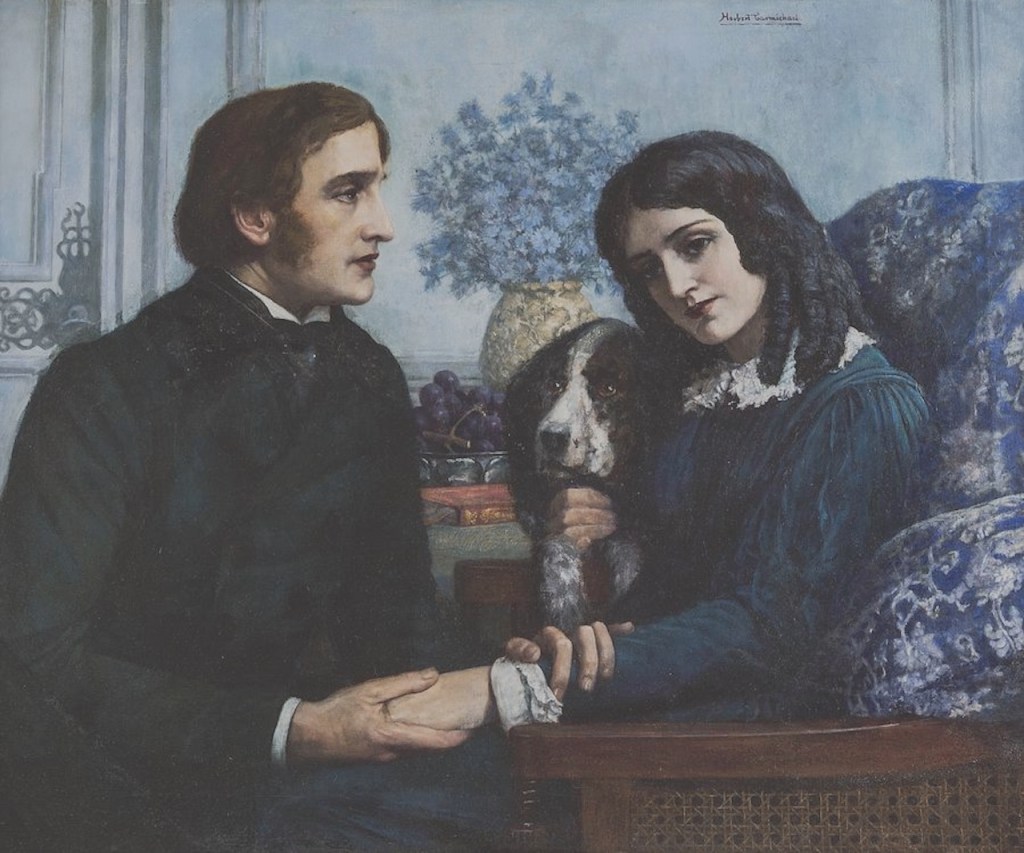
    Image:  Robert Browning visits Elizabeth Barrett at 50 Wimpole Street painting by Celestial Images

    Elizabeth Barrett Browning’s Sonnet 20 “Beloved, my Beloved, when I think”

    Sonnet 20 “Beloved, my Beloved, when I think” from Sonnets from the Portuguese finds the speaker in a pensive mood, dramatizing her awe at the difference a year has made in her life.

    Introduction with Text of Sonnet 20 “Beloved, my Beloved, when I think”

    The speaker in Elizabeth Barrett Browning’s sonnet 20 “Beloved, my Beloved, when I think” from Sonnets from the Portuguese remembers that just year ago she would not have been able to imagine that a love relationship with someone so important as her belovèd would break the chains of sorrow with which she has been bound for many years.

    This sonnet finds the speaker in a pensive mood, dramatizing her awe at the difference a year has made in her life.  The speaker is gaining confidence in her ability to attract and return the kind of love that she has yearned for but heretofore considered herself unworthy of possessing. 

    Sonnet 20 “Beloved, my Beloved, when I think”

    Beloved, my Beloved, when I think
    That thou wast in the world a year ago,
    What time I sate alone here in the snow
    And saw no footprint, heard the silence sink
    No moment at thy voice … but, link by link,
    Went counting all my chains, as if that so
    They never could fall off at any blow
    Struck by thy possible hand … why, thus I drink
    Of life’s great cup of wonder! Wonderful,
    Never to feel thee thrill the day or night
    With personal act or speech,—nor ever cull
    Some prescience of thee with the blossoms white
    Thou sawest growing! Atheists are as dull,
    Who cannot guess God’s presence out of sight.

    Commentary on Sonnet 20 “Beloved, my Beloved, when I think”

    Sonnet 20 “Beloved, my Beloved, when I think” finds the speaker in a pensive mood, dramatizing her awe at the difference a year has made in her life.

    First Quatrain:  The Difference a Year Makes

    Beloved, my Beloved, when I think
    That thou wast in the world a year ago,
    What time I sate alone here in the snow
    And saw no footprint, heard the silence sink 

    The speaker is reminiscing about her feelings “a year ago” before she had met her belovèd. She sat watching the snow that remained without his “footprint.” The silence surrounding her lingered without her hearing his voice. The speaker is structuring her remarks in when/then clauses; she will be saying, “when” this was true, “then” something else was true.

    In the first quatrain, she is thus beginning her clause with “when I think” and what she is thinking about is the time before her belovèd and she had met. She continues the “when” clause until the last line of the second quatrain.

    Second Quatrain:  Never to be Broken Chains

    No moment at thy voice … but, link by link,
    Went counting all my chains, as if that so
    They never could fall off at any blow
    Struck by thy possible hand … why, thus I drink 

    Continuing to recount what she did and how she felt before her ne love came into her life, she reminds her audience that she was bound by “all my chains” which she “went counting” and believing would never be broken.  The speaker makes it clear that her belovèd has, in fact, been responsible for breaking those chains of pain and sorrow that kept her bound and weeping.

    The speaker then moves into the “then” construction, averring that the arrival of her belovèd is, indeed, the reason that she can now look on the world as a place “of wonder.”  At this point, she is simply experiencing the awe of wonder that she should be so fortunate to have her belovèd strike those metaphorical blows against the chains of sorrow that kept her in misery.

    First Tercet:  Near Incredulous

    Of life’s great cup of wonder! Wonderful,
    Never to feel thee thrill the day or night
    With personal act or speech,—nor ever cull 

    The speaker then expounds on what she had not been able to foretell as she remained unable to experience the joy and thrill of living that her belovèd has now afforded her through his acts of kindness and his verbal expressions of affection.  The speaker is nearly incredulous that she could have remained without the love that has become so important to her.

    Second Tercet:  Dull as Atheists

    Some prescience of thee with the blossoms white
    Thou sawest growing! Atheists are as dull,
    Who cannot guess God’s presence out of sight.

    The speaker adds another part of her astonishing “wonder”: that she was not able to sense that such a being might actually be living and amenable to having a relationship with her.  She feels that she should have had some inkling of awareness that such might be the case.

    She sees now that she was “as dull” as “atheists,” those unimaginative souls, “who cannot guess God’s presence out of sight.”   The speaker’s belovèd is such a marvelous work of nature that she imbues him with a certain divine stature, and she considers herself somewhat “dull” for not being about to guess that such a one existed. 

    As atheists are unable to surmise of Supreme Intelligence guiding the ordered cosmos, she was incapable of imagining that one such as her belovèd would come along and free her from her self-induced coma of sadness.

  • Elizabeth Barrett Browning’s Sonnet 19 “The soul’s Rialto hath its merchandise”

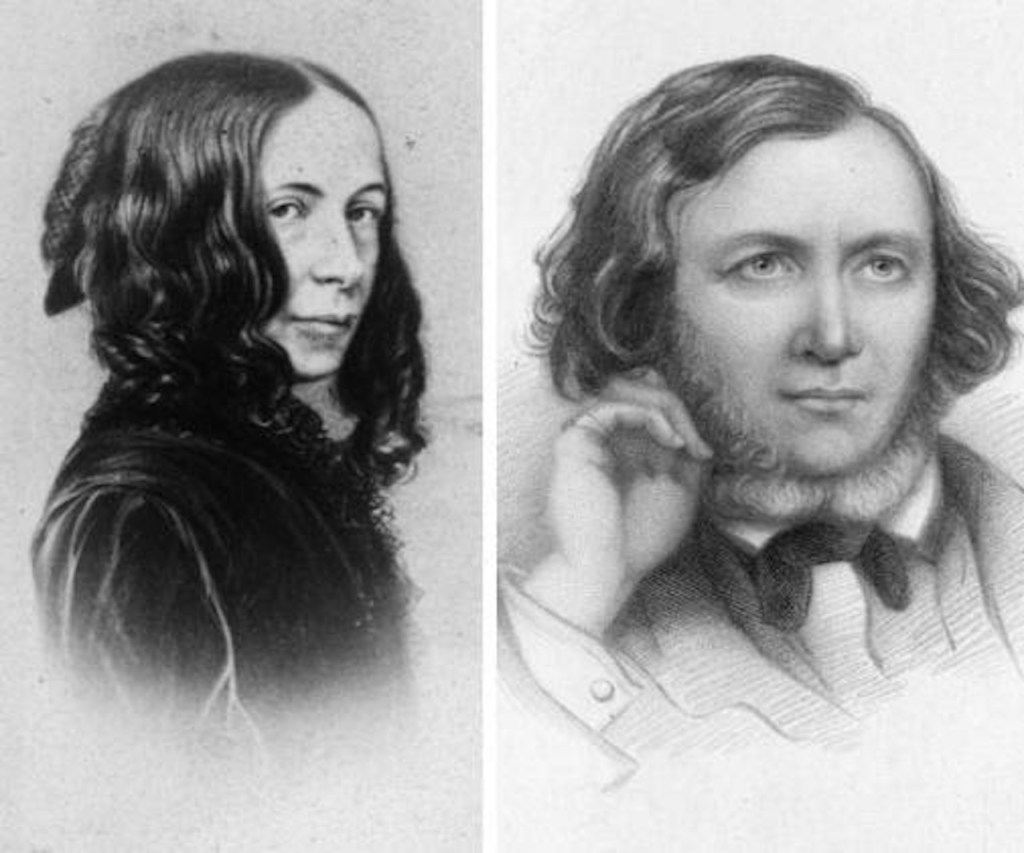
    Image: Elizabeth Barrett Browning and Robert Browning – Global Love Museum

    Elizabeth Barrett Browning’s Sonnet 19 “The soul’s Rialto hath its merchandise”

    The two lovers exchange locks of hair, and the speaker makes a ceremony of the exchange as she again emphasizes the royalty of her lover’s station and talent.

    Introduction with Text of Sonnet 19 “The soul’s Rialto hath its merchandise”

    In sonnet 18 “I never gave a lock of hair away” from Elizabeth Barrett Browning’s Sonnets from the Portuguese, the speaker dramatically celebrates giving a lock of her hair to her belovèd.

    The little drama continues with sonnet 19 “The soul’s Rialto hath its merchandise,” as she receives a lock from him.  The two lovers exchange their locks of hair, and the speaker dramatizes a ceremony of the exchange, as she again celebrates the royalty of her lover’s station and talent.

    Sonnet 19 “The soul’s Rialto hath its merchandise”

    The soul’s Rialto hath its merchandise;
    I barter curl for curl upon that mart,
    And from my poet’s forehead to my heart
    Receive this lock which outweighs argosies,—
    As purply black, as erst to Pindar’s eyes
    The dim purpureal tresses gloomed athwart
    The nine white Muse-brows. For this counterpart,
    The bay-crown’s shade, Belovèd, I surmise,
    Still lingers on thy curl, it is so black!
    Thus, with a fillet of smooth-kissing breath,
    I tie the shadows safe from gliding back,
    And lay the gift where nothing hindereth;
    Here on my heart, as on thy brow, to lack
    No natural heat till mine grows cold in death.

    Commentary on Sonnet 19 “The soul’s Rialto hath its merchandise”

    The two lovers exchange locks of hair, and the speaker makes a ceremony of the exchange as she again emphasizes the royalty of her lover’s station and talent.

    First Quatrain:  Oration and Commemoration

    The soul’s Rialto hath its merchandise;
    I barter curl for curl upon that mart,
    And from my poet’s forehead to my heart
    Receive this lock which outweighs argosies,—

    As in sonnet 18 “I never gave a lock of hair away,” the speaker offers a bit of an oration, commemorating the exchange of locks of hair between the two lovers. She metaphorically compares the soul to a marketplace, the Rialto, an important commercial district in Venice.  The speaker employs a commercial metaphor because of the trading of items that the two lovers are engaging in.

    The speaker then reveals that she is accepting the lock of hair from the head of her beloved with all the enthusiasm that an individual might express if she were presented with large loads of valuable cargoes from vast commercial sailing ships.

    The speaker enhances the value of that lock of hair by stating that it weighs even more than “argosies.” It is even more valuable than all the cargo arriving in vast commercial vessels that travel the seas.

    Second Quatrain:  Purple Black

    As purply black, as erst to Pindar’s eyes
    The dim purpureal tresses gloomed athwart
    The nine white Muse-brows. For this counterpart,
    The bay-crown’s shade, Belovèd, I surmise,

    In the second quatrain, the speaker emphasizes the blackness of her lover’s lock. The “curl,” she claims, is so black that it is “purply black.”  Again, she employs the color of royalty to distinguish the high station of her talented, handsome, accomplished lover.

    The speaker alludes to the ancient Greek poet Pindar, who is considered the greatest of the nine most famous ancient Greek poets, whom she references as “the nine white Muse-brows.”  The speaker’s lover’s lock is as significant because he is as important to the poetry world as those Greek poets are.

    First Tercet:  Pindar Allusion

    Still lingers on thy curl, it is so black!
    Thus, with a fillet of smooth-kissing breath,
    I tie the shadows safe from gliding back,

    The speaker voices her assumption that “the bay-crown’s shade, Beloved / / Still lingers on the curl.” The “bay-crown” refers to that most famous poet, Pindar, whose shadow-presence influences her lover’s talent through his “purpureal tresses.”

    The speaker insists that because of the high value she places on that black lock of hair, she will keep the lock close to her heart to keep it warm.  Likely, the speaker will place it in a locket, but she exaggerates her drama by saying she is binding it with her “smooth-kissing breath” and tying “the shadows safe from gliding back.”

    Second Tercet:  Ceremony of the Lock

    And lay the gift where nothing hindereth;
    Here on my heart, as on thy brow, to lack
    No natural heat till mine grows cold in death.

    In placing the lock next to her heart, the speaker is safe-guarding the “gift where nothing” can disturb it.  Close to the speaker’s heart, the lock will “lack / No natural heat” until, of course, the speaker “grows cold in death.”  The ceremony of the lock exchange is complete, and the love relationship will then progress to the next important stage.

  • Elizabeth Barrett Browning’s Sonnet 17 “My poet, thou canst touch on all the notes”

    Image: Elizabeth Barrett Browning – Getty Images

    Elizabeth Barrett Browning’s Sonnet 17 “My poet, thou canst touch on all the notes”

    In sonnet 17 “My poet, thou canst touch on all the notes,” the poet’s always melancholy speaker muses on the art of poetics in her relationship with her poet/lover.  She considers her role in his art and how they might in future employ imagination to continue to be creatively productive.

    Introduction withText of Sonnet 17 “My poet, thou canst touch on all the notes”

    In sonnet 17 from her classic work Sonnets from the Portuguese, Elizabeth Barrett Browning again allows her speaker to hint at melancholy as she continues her efforts to sustain and understand her new love relationship, and her always melancholy speaker is now musing on the poetics of her relationship with her poet/lover.

    Elizabeth Barrett Browning’s speaker will continue to include a place for doubt as she journeys through her sequence of love songs to her belovèd.   The speaker’s charm remains subtle while always tinged with the possibility of sorrow.  Even as that former sadness in which she dwelt so heavily subsides, its specter seems forever to simmer just below the surface of consciousness.

    Sonnet 17 “My poet, thou canst touch on all the notes”

    My poet, thou canst touch on all the notes
    God set between his After and Before,
    And strike up and strike off the general roar
    Of the rushing worlds a melody that floats
    In a serene air purely. Antidotes
    Of medicated music, answering for
    Mankind’s forlornest uses, thou canst pour
    From thence into their ears. God’s will devotes
    Thine to such ends, and mine to wait on thine.
    How, Dearest, wilt thou have me for most use?
    A hope, to sing by gladly ? or a fine
    Sad memory, with thy songs to interfuse?
    A shade, in which to sing—of palm or pine?
    A grave, on which to rest from singing ? Choose.

    Commentary on Sonnet 17  “My poet, thou canst touch on all the notes”

    In sonnet 17 “My poet, thou canst touch on all the notes,” the poet’s always melancholy speaker muses on the poetics involved in her relationship with her poet/lover. A serious relationship between two poets would necessarily involve the creation of poetry and its ability to bind the lovers in certain literary ways.

    First Quatrain:  Praise for Poetic Prowess

    My poet, thou canst touch on all the notes
    God set between his After and Before,
    And strike up and strike off the general roar
    Of the rushing worlds a melody that floats

    The speaker in Elizabeth Barrett Browning’s sonnet 17 “My poet, thou canst touch on all the notes”  from Sonnets from the Portuguese addresses her belovèd, asserting that he 

    has ability to range far and wide in broaching the music that plays between the two artist/lovers.   She is quietly suggesting that God is bringing the two together through whisper of love that has played in their souls from the time before they even met.

    The speaker’s high praise for her lover’s poetic prowess demonstrates a shift in her observation from her own lowly station to his art. Because the speaker herself is a poet, she has, no doubt, known that she must eventually address the issue that both she and her belovèd share the same avocation.   It might well be expected that she will elevate his while remaining humble about her own, and that expectation is fulfilled in this poetic offering.  

    The speaker credits her belovèd with the ability to create worlds that make the ineffable mystery understandable to the ordinary consciousness; he is able to herald celestial music that contends with the creation of whole worlds of emotion.   The “rushing worlds” may seek to drown love in its massive sound, but her poet/lover’s ability to tame those sound renders the cacophony into melodies that are easily accepts.

    Second Quatrain:   Curing Boredom

    In a serene air purely. Antidotes
    Of medicated music, answering for
    Mankind’s forlornest uses, thou canst pour
    From thence into their ears. God’s will devotes

    The melody glides easily through an atmosphere made pure and serene by the unique ability of her poet/love to convert all chaos into peace, as well as all sadness into contentedness.  Mankind will find his dramatization “medicated music,” which will cure the boredom of “mankind’s forlornest uses.” Her belovèd retains the unique marvelous, unique talent to spill his melodic strains “into their ears.”

    First Tercet:  A Drama Sanctioned by the Divine

    Thine to such ends, and mine to wait on thine.
    How, Dearest, wilt thou have me for most use?
    A hope, to sing by gladly ? or a fine

    The speaker asserts that her greatly talented lover’s drama is, indeed, sanctioned by the Divine, and she is motivated as she patiently expects his creations to flaunt their magic and music to her as well.

    The speaker puts a complicated question to her belovèd: “How, Dearest, wilt thou have me for most use?” In that the speaker would perfectly fulfill her position as muse, she makes clear that she will be right alongside him in his every effort to sustain his God-given abilities.  Regardless of the theme or subject, whether it be “a hope, to sing by gladly,” the speaker suggests that she will continue to praise where necessity takes her.

    Second Tercet:  Useful Powers of Sorrow

    Sad memory, with thy songs to interfuse?
    A shade, in which to sing–of palm or pine?
    A grave, on which to rest from singing ? Choose.

    This speaker is not yet ready to relinquish her references to melancholy; thus her question continues with a set of propositions: perhaps she will offer “a fine / Sad memory.” She will, therefore, not be surprised that her powers of sorrow may be useful to them both in their poetic pursuits.  But the speaker also wonders if death themes might intrude at some point: “A shade, in which to sing—of palm or pine? / A grave, on which to rest from singing?”  

    It just may be that they will both become so satisfied with their comfortable love that they will have to rely more on imagination than they had ever thought. Thus the speaker admonishes her poetically talented belovèd that at some poi

  • Langston Hughes’ “Theme for English B”

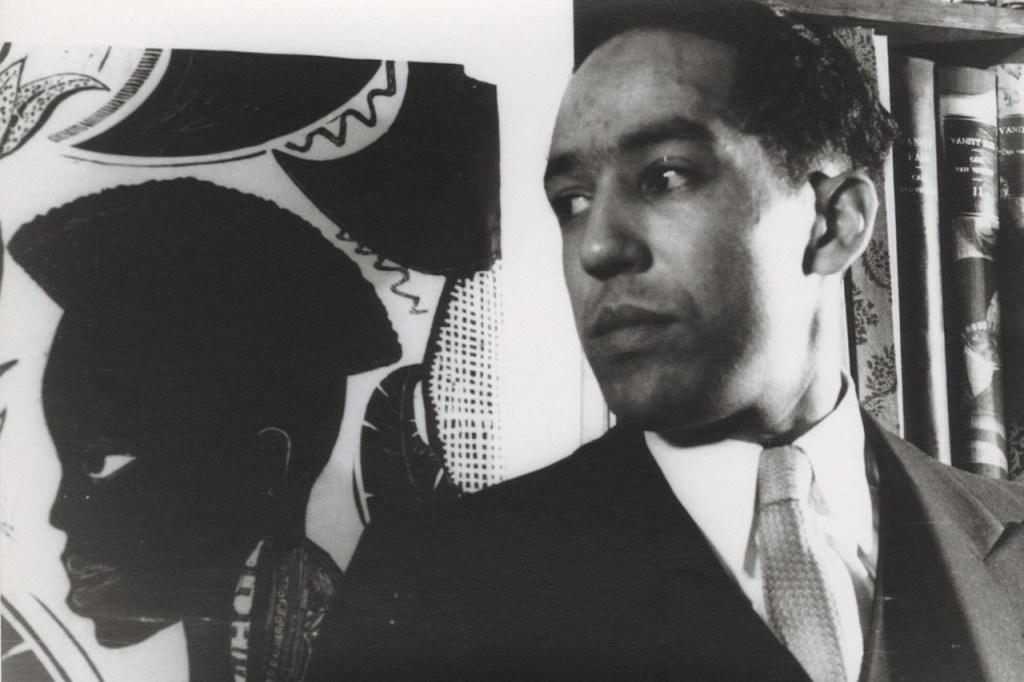
    Image: Langston Hughes – Poetry Foundation

    Langston Hughes’ “Theme for English B”

    Langston Hughes’ “Theme for English B” dramatizes the brainstorming session of a speaker who is a non-traditional college student.  He has been given the assignment to write a paper about himself that is true.  He muses on how to go about producing a page that the instructor will understand.

    Note on Usage: “Negro,” “Colored,” and “Black”: Before the late 1980s in the United States, the terms “Negro,” “colored,” and “black” were accepted widely in American English parlance.   While the term “Negro” had started to lose its popularity in the 1960s, it wasn’t until 1988 that the Reverend Jesse Jackson began insisting that Americans adopt the phrase “African American.”  The earlier, more accurate terms were the custom at the time that Langston Hughes was writing.

    Introduction with Text of “Theme for English B”

    The speaker is a non-traditional, older student in a college English class who has been given the assignment to write a paper that “come[s] out of you.” The instructor has insisted that the paper will be “true” if the student simply writes from his own heart, mind, and experience, but the speaker remains a bit skeptical of that claim, thinking that maybe he is unsure that it is “that simple.

    Theme for English B

    The instructor said,

        Go home and write
        a page tonight.
        And let that page come out of you—
        Then, it will be true.

    I wonder if it’s that simple?
    I am twenty-two, colored, born in Winston-Salem.
    I went to school there, then Durham, then here
    to this college on the hill above Harlem.
    I am the only colored student in my class.
    The steps from the hill lead down into Harlem,
    through a park, then I cross St. Nicholas,
    Eighth Avenue, Seventh, and I come to the Y,
    the Harlem Branch Y, where I take the elevator
    up to my room, sit down, and write this page:

    It’s not easy to know what is true for you or me
    at twenty-two, my age. But I guess I’m what
    I feel and see and hear, Harlem, I hear you:
    hear you, hear me—we two—you, me, talk on this page.
    (I hear New York, too.) Me—who?
    Well, I like to eat, sleep, drink, and be in love.
    I like to work, read, learn, and understand life.
    I like a pipe for a Christmas present,
    or records—Bessie, bop, or Bach.
    I guess being colored doesn’t make me not like
    the same things other folks like who are other races.
    So will my page be colored that I write?

    Being me, it will not be white.
    But it will be
    a part of you, instructor.
    You are white—
    yet a part of me, as I am a part of you.
    That’s American.
    Sometimes perhaps you don’t want to be a part of me.
    Nor do I often want to be a part of you.
    But we are, that’s true!
    As I learn from you,
    I guess you learn from me—
    although you’re older—and white—
    and somewhat more free.

    This is my page for English B.

    Reading of “Theme for English B” 

    Commentary on “Theme for English B”

    In Langston Hughes’ “Theme for English B,” the speaker is musing on how to write a college essay about himself, after receiving the instructor’s assignment in his English class. The issue of race intrudes on the speaker’s thoughts, and he offers his experienced observation about the supposed differences between the races.

    First Movement:  Not a Simple Assignment

    The instructor said,

        Go home and write
        a page tonight.
        And let that page come out of you—
        Then, it will be true.

    I wonder if it’s that simple?
    I am twenty-two, colored, born in Winston-Salem.
    I went to school there, then Durham, then here
    to this college on the hill above Harlem.
    I am the only colored student in my class.

    The speaker begins his musing by brainstorming, listing the reasons that the assignment may not be so simple as the instructor has made it sound. The student/speaker is only “twenty-two,” but he is older than most of the other students in his class.

    He was born in Winston-Salem, North Carolina, where he attended school until he moved to New York. The speaker is now attending college in Harlem. He is the only “colored” student in the class. Despite the fact that the majority of the population of Harlem was African American, it was still a time when few of them attended college.

    Second Movement:  A Brainstorming Tactic

    The steps from the hill lead down into Harlem,
    through a park, then I cross St. Nicholas,
    Eighth Avenue, Seventh, and I come to the Y,
    the Harlem Branch Y, where I take the elevator
    up to my room, sit down, and write this page:

    As the speaker begins to write, he traces the route that he takes from the college to his apartment. This step in his composition process seems to be a delaying tactic—a brainstorming activity just to get started thinking on the issue. He no doubt intuits that during the process of writing one thing leads to another, and he is thereby likely hoping that the trivial will lead to the profound.

    Third Movement:  Musing on What Is True

    It’s not easy to know what is true for you or me
    at twenty-two, my age. But I guess I’m what
    I feel and see and hear, Harlem, I hear you:
    hear you, hear me—we two—you, me, talk on this page.
    (I hear New York, too.) Me—who?

    Well, I like to eat, sleep, drink, and be in love.
    I like to work, read, learn, and understand life.
    I like a pipe for a Christmas present,
    or records—Bessie, bop, or Bach.

    The speaker then turns his attention to what might be “true” for himself and what might be “true” for a white instructor. It crosses his mind that the differences between them might be too great for the instructor to understand and appreciate a “colored” student’s experience.

    Nevertheless, the speaker begins to examine what he feels is genuine for himself. He then guesses that what he sees helps make him what he is—a brilliant recovery from what might have sounded only like stalling in the brainstorming session that began his composition.

    By tracing the route he takes to school, he has opened up the possibilities for what he sees and hears. What he sees and hears is Harlem as he somewhat awkwardly spills out his thinking.  He hears himself, he hears his instructor, and now he has to “talk on this page” to this instructor. He hears “New York,” but then he circles back to himself with a question, implying a query into who he actually is.

    The answer to his question is important because the assignment, after all, is to produce a piece of writing that tells the instructor who the student is, what he hopes for, and what is in his heart and mind.  The instructor has intimated that if the student writer will search his own heart and mind, he will then write what is “true,” that is, what is genuine and accurate without obfuscation and guile. The speaker then moves on to catalogue what he likes: sleeping, eating, drinking, and being in love.

    Furthermore, the speaker enjoys such activities as working, reading, learning, and he likes to “understand life”—all fine qualities that would likely impress a university instructor. He also likes to receive “a pipe for a Christmas present.”

    Finally, the speaker lists other items that he enjoys getting such as records for Christmas because he enjoys listening to music. His taste in music turns out to be rather eclectic from “Bessie, bop, or Bach.” He must be simply gleeful that his music preferences create an interesting sounding alliterative series of names.

    Fourth Movement:  Communication between Black and White

    I guess being colored doesn’t make me not like
    the same things other folks like who are other races.
    So will my page be colored that I write?

    The opening two lines of this movement present the observation that this young man has tentatively made in his life, so he frames that observation as a “guess”—he surmises that race does not dictate what an individual “likes.”

    Still as a young man, the speaker continues to wonder if how he feels and what he says will register with his white instructor. He, therefore, wonders if what he writes will be “colored.”

    The speaker is contemplating what he believes is genuine for himself as the instructor has suggested, but he remains unsure that he can be understood by a white instructor if his words reveal him as “colored.”

    Fifth Movement:   Racial Boundaries

    Being me, it will not be white.
    But it will be
    a part of you, instructor.
    You are white—
    yet a part of me, as I am a part of you.
    That’s American.
    Sometimes perhaps you don’t want to be a part of me.
    Nor do I often want to be a part of you.
    But we are, that’s true!
    As I learn from you,
    I guess you learn from me—
    although you’re older—and white—
    and somewhat more free.

    This is my page for English B.

    The speaker then insists that what he writes will “not be white.” Yet it must still be part of the instructor. Although he is black and the instructor is white, they are surely still part of each other because “That’s American.”

    Yet the speaker does remain aware that often whites do not want to be part of blacks, and he is also aware that the reverse is equally true. Despite those racial boundaries of separation, the speaker believes that they are still part of each other, whether they accept it or not.

    Finally, the speaker concludes with a very significant discernment: the black student learns from the white instructor, and the white instructor can also learn from the black student, even if the instructor is older, white, and “somewhat more free” than the black student.

    The speaker concludes by offering the explicit statement, “This is my page for English B.” He seems to feel that he has likely exhausted his exploration for the true, genuine, and accurate for this English assignment.

    The Speaker of the Poem

    Lest readers are tempted to take this poem as autobiography, a perusal of Hughes’ autobiographical work, The Big Sea, should disabuse them of that error.   In that first autobiography (his second was I Wonder as I Wander), the poet describes his college days at Lincoln University, located in “the rolling hills of Pennsylvania,” not “on the hill above Harlem.” 

    Hughes does not broach any subject as mundane as an English class assignment as he describes his rough and tumble days at Lincoln. Also, Hughes was born in Joplin, Missouri, not “Winston-Salem.”  

    It is useful to remember that poets seldom write autobiographical details; they often create characters, as playwrights do.  Hughes does take the opportunity in this piece to make a statement about race relations, a topic that he explored his whole life.  But the speaker of a poem and the poet are often not the same, and to understand and appreciate the poem that fact must be kept in mind.

    Controversy over the Phrase “African American”

    The controversy surrounding the appellation, “African American,” reached an important pinnacle after Teresa Heinz Kerry, Caucasian wife of the 2004 presidential candidate and former senator John Kerry, identified herself as “African American.”

    Teresa Heinz was born and raised in Mozambique, which is a country in Africa. Having been a resident of the USA since 1963, she qualifies most assuredly as an “African American.” The fact that she is white demonstrates the inaccuracy that Rev. Jackson foisted upon the black population of the United States of America, as he attempted to euphemize terms that need no euphemism.

    Sources

    Video:  Dramatic Interpretation of “Theme for English B”  

  • Elizabeth Barrett Browning’s Sonnet 8 “What can I give thee back, O liberal”

    Image: Elizabeth Barrett Browning – Getty Images

    Elizabeth Barrett Browning’s Sonnet 8 “What can I give thee back, O liberal”

    The speaker continues to deny her good fortune as she reveals her gratitude for the attention of her illustrious suitor; she begins to accept her lot but reluctantly.

    Introduction and Text of Sonnet 8 “What can I give thee back, O liberal”

    Sonnet 8 from Elizabeth Barrett Browning’s Sonnets from the Portuguese finds the speaker continuing to doubt and deny her great fortune in attracting such an accomplished and generous suitor.  However, she is slowly beginning to accept the possibility that this amazing man could have affection for her.

    Sonnet 8 “What can I give thee back, O liberal”

    What can I give thee back, O liberal
    And princely giver, who hast brought the gold
    And purple of thine heart, unstained, untold,
    And laid them on the outside of the wall
    For such as I to take or leave withal,
    In unexpected largesse? am I cold,
    Ungrateful, that for these most manifold
    High gifts, I render nothing back at all?
    Not so; not cold,—but very poor instead.
    Ask God who knows. For frequent tears have run
    The colors from my life, and left so dead
    And pale a stuff, it were not fitly done
    To give the same as pillow to thy head.
    Go farther! let it serve to trample on.

    Reading 

    Commentary on Sonnet 8 “What can I give thee back, O liberal”

    The speaker continues to deny her good fortune as she reveals her gratitude for the attention of her illustrious suitor; she begins to accept her lot but reluctantly.

    First Quatrain:  Baffled by Attention

    What can I give thee back, O liberal
    And princely giver, who hast brought the gold
    And purple of thine heart, unstained, untold,
    And laid them on the outside of the wall

    The speaker once again finds herself baffled by the attention she receives from one who is so much above her station in life. He has given her so much, being a “liberal / And princely giver.”  The term “liberal” here means openly generous.

    Her suitor has brought his valuable poetry to her along with his own upper-class qualities and manners. She metaphorically assigns all of those gifts to the status of “gold and purple,” the colors of royalty, and she locates them “outside the wall.”

    The suitor romances her by serenading her under her window, and she is astonished by the good fortune she is experiencing.  She cannot comprehend how one so delicate and lowly positioned as herself can merit the attention she continues to garner from this handsome, accomplished poet.

    Second Quatrain:  Rejecting or Accepting

    For such as I to take or leave withal,
    In unexpected largesse? am I cold,
    Ungrateful, that for these most manifold
    High gifts, I render nothing back at all? 

    The handsome suitor provides the speaker with the choice of taking his affections and attentions or rejecting them, and she is very grateful for all she receives even as she regrets that she has nothing to offer in return.  She declaims: “I render nothing back at all?”  She frames her lack into a question that answers itself, implying that even though she may seem “ungrateful,” nothing could be further from the truth.

    The rhetorical intensity achieved through dramatizing her feelings in a rhetorical question enhances not only the sonnet’s artistry but also adds dimension to those same feelings.  The rhetorical question device magnifies the emotion.  Instead of employing overused expressions along the lines of “definitely” or “very,” the speaker uses the rhetorical question  to fuse the poetic tools into a dramatic expression that fairly explodes with emotion.

    First Tercet:  No Lack of Passion

    Not so; not cold,—but very poor instead.
    Ask God who knows. For frequent tears have run
    The colors from my life, and left so dead

    The speaker, however, does not leave the question open to possible misinterpretation; she then quite starkly answers, “No so; not cold.” She does not lack passion about the gifts her suitor bestows upon her; she is merely “very poor instead.”

    She insists that it is “God who knows” the extent of her poverty as well as the depth of her gratitude. She then admits that through much shedding of tears, she has caused the details of her life to fade as clothing rinsed many times in water would become “pale a stuff.”

    Second Tercet:  Low Self Esteem

    And pale a stuff, it were not fitly done
    To give the same as pillow to thy head.
    Go farther! let it serve to trample on.

    The speaker’s lack of a colorful life, her lowly station, her simplicity of expression have all combined to make her denigrate herself before the higher class suitor with whom she feels compelled to contrast herself.

    She is still not able to reconcile her lack to his plenty, and again she wants to urge him to go from her because she feels her lack is worth so little that it might “serve to trample on.”  Her hopes and dreams she will keep hidden until they can override the reality of her personal lack of experience and life station.

  • Elizabeth Barrett Browning’s Sonnet 7 “The face of all the world is changed, I think”

    Image: Elizabeth Barrett Browning – Getty Images

    Elizabeth Barrett Browning’s Sonnet 7 “The face of all the world is changed, I think

    Elizabeth Barrett Browning’s sonnet 7, The face of all the world is changed, I think, offers a tribute to the speaker’s lover, who has wrought deep and lasting important changes in the speaker’s life.

    Introduction with Text of Sonnet 7 “The face of all the world is changed, I think”

    Elizabeth Barrett Browning’s sonnet #7, “The face of all the world is changed, I think,” from Sonnets from the Portuguese expresses the speaker’s astonishment and delight at a new awareness she is sensing.

    She has begun to notice that her situation is in the process of a unique transformation, and she, therefore, wishes to extend her gratitude to her belovèd suitor for these marvelous, soul-inspiring changes in her life.

    Sonnet 7 “The face of all the world is changed, I think”

    The face of all the world is changed, I think,
    Since first I heard the footsteps of thy soul
    Move still, oh, still, beside me, as they stole
    Betwixt me and the dreadful outer brink
    Of obvious death, where I, who thought to sink,
    Was caught up into love, and taught the whole
    Of life in a new rhythm. The cup of dole
    God gave for baptism, I am fain to drink,
    And praise its sweetness, Sweet, with thee anear.
    The names of country, heaven, are changed away
    For where thou art or shalt be, there or here;
    And this … this lute and song … loved yesterday,
    (The singing angels know) are only dear
    Because thy name moves right in what they say.

    Reading  

    Commentary on Sonnet 7 “The face of all the world is changed, I think”

    Elizabeth Barrett Browning’s sonnet 7, “The face of all the world is changed, I think,” focuses specifically on the tribute to the speaker’s belovèd partner in love, who has wrought deep and lasting important changes in her life.  

    In fact, the entire sonnet sequence performs the awe-inspiring task of recording the evolution of the poet’s life transformation after meeting and becoming the partner of her belovèd life mate.

    First Quatrain:  The Speaker’s Changing Environment

    The face of all the world is changed, I think,
    Since first I heard the footsteps of thy soul
    Move still, oh, still, beside me, as they stole
    Betwixt me and the dreadful outer brink

    The emotional speaker notes that all things in her environs have changed their appearance because of her new outlook after having become aware of her new love. Lovers traditionally begin to see the world through rose-colored glasses upon falling in love.  The happiness in the heart spreads like a lovely, fragrant flower garden throughout the lover’s whole being.

    Every ordinary object takes on a brilliant, rosy glow that flows like a gentle river from the happiness in the heart of the romantic lover.This deep-thinking speaker asserts that her lover has placed himself between her and the terrible “death.”

    Heretofore, she had sensed that all she had to look forward to was more misery and ultimately the act of leaving her physical body.  That mindset had continued to engulf her being her whole lifelong. 

    But now the “footsteps” of her belovèd suitor have been so gentle that they seemed to be the soft sounds of his soul approaching her.  His meaning for her has become deep and abiding, spreading meaning and joy in her life.

    Second Quatrain:   Doomed Without Love

    Of obvious death, where I, who thought to sink,
    Was caught up into love, and taught the whole
    Of life in a new rhythm. The cup of dole
    God gave for baptism, I am fain to drink,

    The speaker had been convinced that without such a love to save her she would be doomed to “obvious death.” She finds herself suddenly transported to a new world, a new “life in a new rhythm” with the arrival of her belovèd suitor. 

    She has been so mired in sadness that it seemed that she was being “baptized” in that mindset, as one drowning in one’s own fears and tears.However, the melancholy speaker finds herself reluctant to allow herself complete immersion in her newfound happiness, but still she has to admit that her new status is overcoming her prior terror.She is beginning slowly to change her doubts to delightful possibilities.

    First Tercet:   A Universal Change

    And praise its sweetness, Sweet, with thee anear.
    The names of country, heaven, are changed away
    For where thou art or shalt be, there or here;

    The speaker must extol the “sweetness” that she receives from her new belovèd swain. Because he is beside her, she has changed in a universal way—”names of country, heaven, are changed away.” 

    Nothing is the same, even the ordinary names of things seem altered and in a good way; all of her old cheerless, dreary life is transforming utterly, and she finally seems to become able to enjoy and appreciate this transformation.The more confident speaker is now willing to entertain the notion that he will remain by her side to delight her life permanently, throughout time and space.

    Second Tercet:  The Singing of Angels

    And this … this lute and song … loved yesterday,
    (The singing angels know) are only dear
    Because thy name moves right in what they say.

    The glad speaker hears the angels singing in the voice of her belovèd suitor.Even as she loved his poems and music before this new awakening of love between the two, she has now become even more enamored with those art forms after only a brief period of time has passed. His very name motivates the speaker in a heavenly manner.  As the angels sing and heavenly music delights her, she realizes that her belovèd has brought about her pleasant state of mind.

    The thankful speaker wants to give him all the tribute he deserves. She feels that she cannot exaggerate the magnitude  of his effect on her state of being and thinking.And everything she knows and feels now fills her heart and mind with new life.

    Earlier in her life, she had become convinced that she could never experience the joy and fulfillment that she sees herself heading into now because of this special, accomplished man.

    With such an important transformation, she now senses that she cannot say enough to express the value of such an vital act for her well-being and growth. She has only words of love to express her state of mind, and she works mightily to make those words the best, placed in the best order with as much emphasis as she can garner.

  • Emily Dickinson’s “I had a guinea golden”

    Image: Emily Dickinson – Amherst College – Daguerrotype of the poet at age 17, circa 1847 – likely the only authentic, extant likeness of the poet

    The speaker in Emily Dickinson’s “I had a guinea golden” is expressing melancholy at the loss of a friend, whom she describes metaphorically in terms of three dear objects: a guinea, a robin, and a star.

    Introduction with Text of “I had a guinea golden”

    This fascinating Emily Dickinson poem of loss offers quite a tricky subversion of thought.  The first three stanzas seem to explain the loss of three separate loved ones. 
    Then the final stanza packs a wallop unloading on only one “missing friend,” who has caused the speaker to create this “mournful ditty” with tears in her eyes.

    This poem demonstrates the depth of Dickinson’s education as she employs metaphors of the British coinage system and allusions to Greek mythology, which has been further employed by the science of astronomy to name stars. 

    Not only did Dickinson study widely in many subject areas, she possessed the ability to employ her learning in creative ways to fashion those beautiful flowers, allowing them to grow in her garden of verse.

    I had a guinea golden

    I had a guinea golden –
    I lost it in the sand –
    And tho’ the sum was simple
    And pounds were in the land –
    Still, had it such a value
    Unto my frugal eye –
    That when I could not find it –
    I sat me down to sigh.

    I had a crimson Robin –
    Who sang full many a day
    But when the woods were painted,
    He, too, did fly away –
    Time brought me other Robins –
    Their ballads were the same –
    Still, for my missing Troubador
    I kept the “house at hame.”

    I had a star in heaven –
    One “Pleiad” was its name –
    And when I was not heeding,
    It wandered from the same.
    And tho’ the skies are crowded –
    And all the night ashine –
    I do not care about it –
    Since none of them are mine.

    My story has a moral –
    I have a missing friend –
    “Pleiad” its name, and Robin,
    And guinea in the sand.
    And when this mournful ditty
    Accompanied with tear –
    Shall meet the eye of traitor
    In country far from here –
    Grant that repentance solemn
    May seize upon his mind –
    And he no consolation
    Beneath the sun may find.

    Reading 

    Commentary on “I had a guinea golden”

    Each stanza builds to a magnificent crescendo of outrage that allows the speaker to lavish affection as well as harsh rebuke to the one leaving her in a state of melancholy.

    First Stanza:  The Value of Small Things

    I had a guinea golden –
    I lost it in the sand –
    And tho’ the sum was simple
    And pounds were in the land –
    Still, had it such a value
    Unto my frugal eye –
    That when I could not find it –
    I sat me down to sigh.

    The speaker begins by referring to the coin “guinea,” which was a British coin manufactured with the gold from the African nation of Guinea.  The coin was worth 21 shillings and ceased circulating in 1813.   The speaker maintains the British monetary metaphor by referring also to “pounds” in the fourth line of the poem.

    Metaphorically, the speaker is calling her lost friend a “golden” coin, which she lost “in the sand.”  She then admits that it was a small loss for much more valuable moneys—”pounds”—were all about her.   Nevertheless, to her, because of her frugality, the value of the small coin was huge, and because it was lost to her, she just “sat down to sigh.”

    Second Stanza:  Missing the Music

    I had a crimson Robin –
    Who sang full many a day
    But when the woods were painted,
    He, too, did fly away –
    Time brought me other Robins –
    Their ballads were the same –
    Still, for my missing Troubador
    I kept the “house at hame.”

    The speaker then employs the metaphor of “crimson Robin.”  This time she is likening her friend to the singing robin who “sang full many a day.”  But when the autumn of the year came around, she loses this friend also.

    Just as other moneys were abounding after the loss of a simple guinea, other robins presented themselves to the speaker after she lost her robin.  But even though they sang the same songs as her lost robin, it just was not the same for the speaker.   She continues to mourn the loss of her robin; thus she kept herself harnessed to her house, likely in case her own robin should show up again.

    Third Stanza:  The Mythology of Science

    I had a star in heaven –
    One “Pleiad” was its name –
    And when I was not heeding,
    It wandered from the same.
    And tho’ the skies are crowded –
    And all the night ashine –
    I do not care about it –
    Since none of them are mine.

    The speaker then finds herself once again mourning the loss of a loved one.  This one she labels “Pleiad.”  Pleiad is an allusion to Greek mythology but also a reference to astronomy.  

    In Greek mythology, the seven daughters of Atlas went into hiding up in the sky among the stars to escape being pursued by Orion.  One the seven seems to disappear perhaps out of shame or grief.  

    In the science of astronomy, the constellation known as Taurus features a group of seven stars, but oddly enough only six can be seen, resulting in the same “Lost Pleiad” as exists in the Greek myth.

    Dickinson, who studied widely the subjects of mythology, history, and science thus alludes to the myth of the “Lost Pleiad” to again elucidate the nature of her third lost beloved.   She has now experienced the loss of money, a bird, and now a star–each more precious than the last.

    The speaker loses the star as she was being heedless–not paying attention.  In her negligent state, her star wanders away from her.  Again, although the sky is full of other stars, they just don’t measure up because “none of them are mine.”

    Fourth Stanza:  Admonishing a Traitor

    My story has a moral –
    I have a missing friend –
    “Pleiad” its name, and Robin,
    And guinea in the sand.
    And when this mournful ditty
    Accompanied with tear –
    Shall meet the eye of traitor
    In country far from here –
    Grant that repentance solemn
    May seize upon his mind –
    And he no consolation
    Beneath the sun may find.

    While wildly famous for her riddles, Dickinson often breaks the riddle’s force by actually naming the object described.  In the final stanza, she blatantly confesses that her little story “has a moral.”  She then blurts out, “I have a missing friend.”  

    It is now that the reader understands the loss is not three different loved ones, but only one.  She has thus been describing that “missing friend” using three different metaphoric images.

    Now, however, she has a message for this friend whose description has revealed multiple times how much she misses the friend and laments the loss.   After again rather baldly admitting her sorrow told in “this mournful ditty” and even “[a]ccompanied with tear,” she refers to that missing friend as a “traitor.”

    If this friend who has betrayed her happens to see this “mournful ditty,” she hopes that it will grab that individual’s mind so that the person will experience “repentance solemn.”  Furthermore, she wishes that the friend be unable to find any solace for the individual’s contrition no matter where that friend goes.

  • American Ballads

    Image: Thomas Thornburg, Back Book Cover American Ballads

    American Ballads

    Published by Author House, Bloomington IN, 2009

    Bag Ladies

    Bag ladies are this season wearing
    field-jackets gleaned from K-MART shoppers and
    KEDS cast off by charioteers
    on skateboards fleeing from the cops;
    hooded and rope-cinched at their waists
    (doomed matched pairs shuffling westward).
    vespers et matins in their quest
    they toss and comb the city’s trash,
    each empty can discovered, cash.
    Sometimes drunk they will confess it,
    and sometimes cough the alley retching
    pink spittle in their sad kermess.
    Sometimes we talk (they ask my pardon
    for sifting through these things discarded)
    for better homes and other gardens.

    Other Gardens

    When children, we dreamed
    Of sailing to Baghdad.
    Hoosier gardens teemed
    Like Iram; Kaikobad
    Led Persian cavalry
    Down to an inland sea.

    Those magic minarets
    Are with childhood hidden,
    Our children in the desert
    Killing children.

    Serving the South

    deadended on a siding in Midway, Alabama,
    stand 6.5 miles of RR cars.
    covered in kudzu and time, they stand,
    iron cheeks squaring their gothic mouths;
    they are Southern and Serve the South
    (hub-deep in red clay) this land,
    this ekkuklema of southern drama.
    still, it is Bike Week in Daytona,
    and the Lady is sold in yards from rucksacks
    where a tattooed mama fucks & sucks
    (her name is not Ramona).
    here will come no deus ex machina,
    this American South, this defeated dream.
    drunken, drugged, dolorous in their dementia,
    forbidden by Law to wear their colors,
    these cavaliers race their engines and scream
    where the marble figure in every square
    shielding his eyes as the century turns
    stands hillbilly stubborn and declares.
    heading back north having spent our earnings,
    honeyed and robbed we are fed on hatred
    cold as our dollar they cannot spurn,
    and we are in that confederate.

    For my commentary on this poem, please see my article “Thomas Thornburg’s ‘Serving the South’.”

    Twelve Clerihews and a Sketch

    Poor Eddie Poe
    collapsed in the snow
    and exhaled no more
    in old Baltimore

    Poor Mary Mallon
    wept o’er many a gallon
    of soapsuds, avoiding
    the cops, and typhoiding.

    W. B. Yeats
    believed in the fates,
    but on Sunday
    in Spiritus Mundi.

    . . .

    Koan

    Once in this journey, following the call
    I broke my bones falling
    Now I go hobbled to a distant star
    My shippe a heavy bar
    Friends come asking how we are
    My friends, my friends, we are alone.
    He who would know must break his own bones

    A Ballad of My Grandfather

    My grandfather was a Wobbly, sirs,
    And as such he was banned
    And blackballed from his daily bread
    Across your promised land.

    My grandfather polished metal, sirs,
    And ripped his skilly hands
    Whenever you allowed him to
    Across your promised land.

    My grandfather suffered somewhat, sirs,
    And worked till he could stand
    No more before your wheel; he loafs
    Beneath your promised land.

    My father walked a picket, sirs,
    In nineteen-forty-five,
    His son beside, and with them walked
    His father, man alive.

    That was a bitter solstice, sirs,
    The wind complained like ghosts,
    The cold struck home, the striker stood
    Frozen to their posts.

    The people in the city, sirs,
    Sequestered in their hate,
    Supped in communal kitchens there
    And massed at every gate.

    Consider all such service, sirs,
    Kindred to your time,
    A  long apprenticeship to cast
    Such mettle into rime:

    The pain these fathers weathered, sirs,
    The freedoms you forsook,
    Is polished into pickets here
    And winters in their book.

    to be continued, check back for updates

    Publication status of American Ballads

    Copies of American Ballads are readily available on Amazon and reasonably priced at $10.99, even offered as Prime.  This Amazon page features a commentary by the wife of the poet, who felt that the book deserved further description.