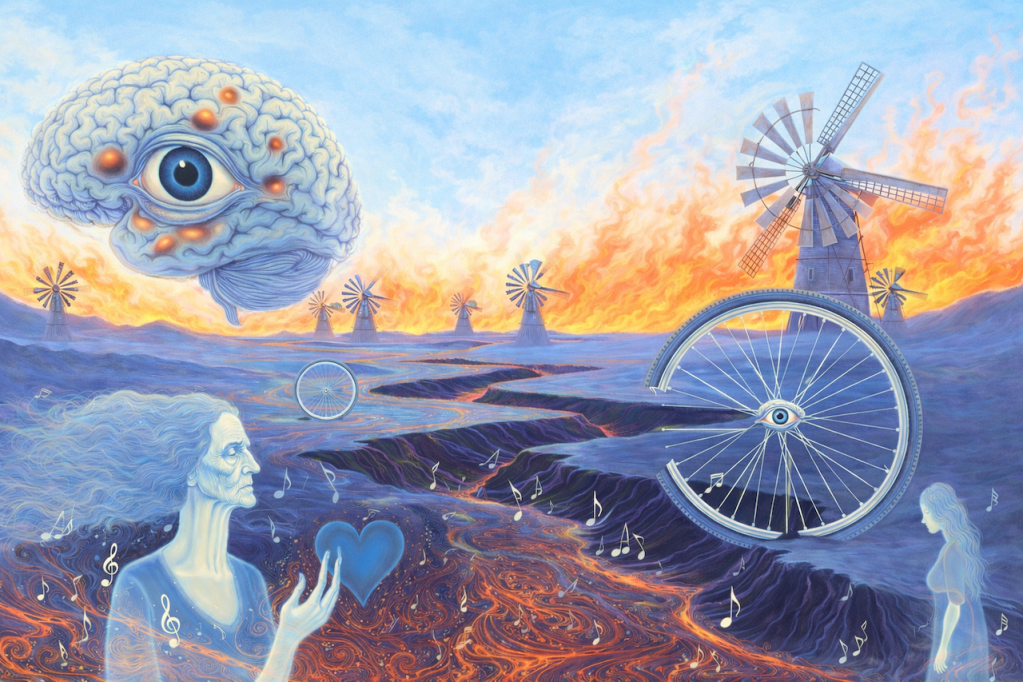
Image: Created by Grok and ChatGPT inspired by “Funky Notions”
Funky Notions
Nothing needs to come out of this blistered brain At least as far as the eye can see— Where is the ditch into which the wheel has dug?
Do I want three lines, or four, or more Is all the problem I can muster—Oh, how I must be Blessed to have such trivial incongruities? Where are the windmills when you need them?
No, I will not castigate this heart for this— It existed way before the lava in my mind began To gurgle on the rim of possibilities.
Hey, granny-woman—you could frimbulage your daughter Who has an eye for things you spew forth— No matter your heart be sanctuary for the downtrodden
The unmixed, the ultimately blessed—and wait! Where did you just go? No, I didn’t go there . . . Of course, you did, you (stops for a swig of lightning) . . .
Anyway, Love is such an all inclusive word . . . But then she confessed she did not know what Love is And you have always felt that Love is all you know Even if you fail along the trail that Love to show!
Little wonder she doesn’t get you or her own children Who must languish because you are afraid To offend with your funky . . . notions . . .
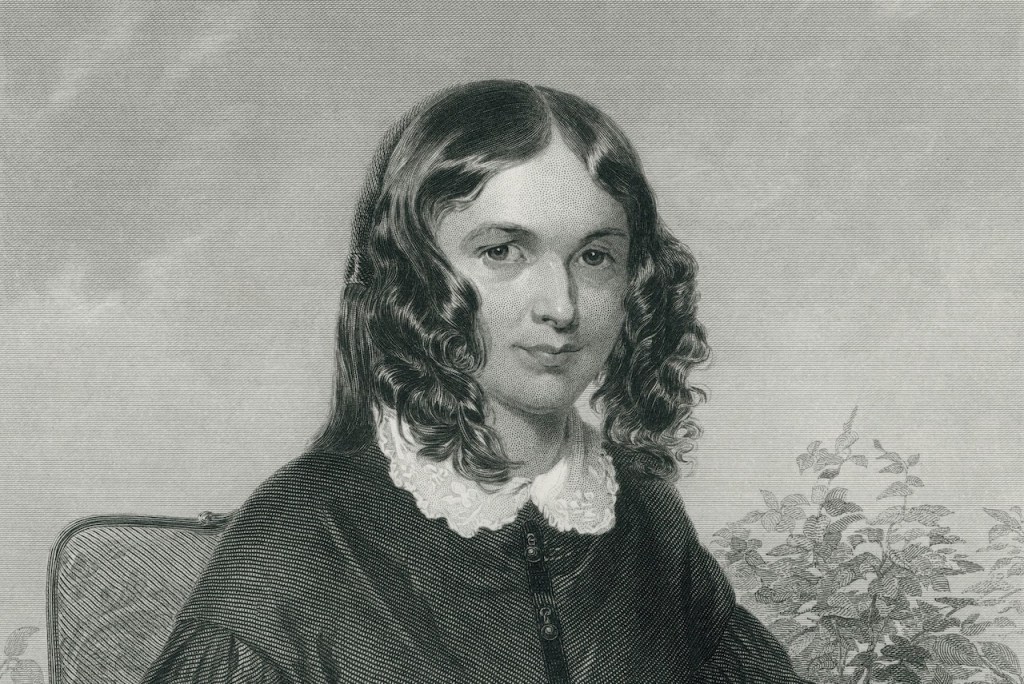
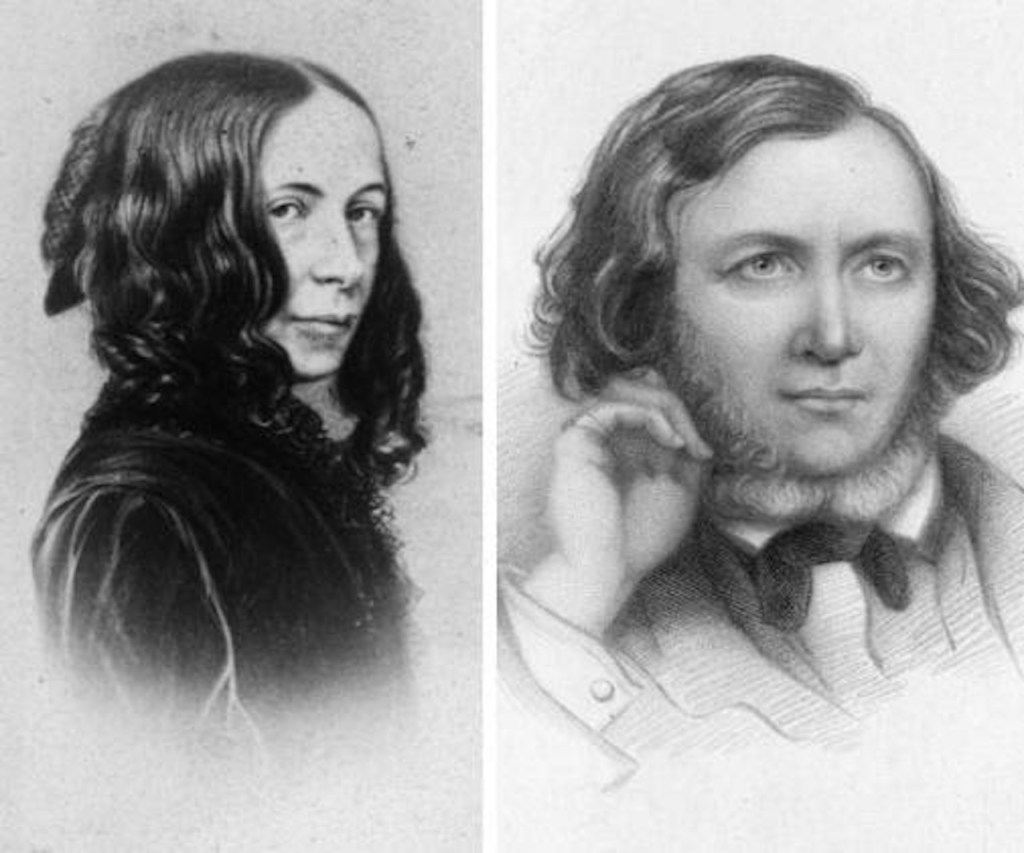
Image: Elizabeth Barrett Browning – Engraving from original Painting by Chappel, 1872. (Photo by: Universal History Archive/Universal Images Group via Getty Images)
Elizabeth Barrett Browning’s Sonnet 23 “Is it indeed so? If I lay here dead”
The speaker is responding to a sweet love letter from her dear belovèd fiancé. She concludes that instead of desiring the deliverance by death of her woes, she can remain an earth resident because of the love that has healed her melancholy.
Introduction and Text of Sonnet 23 “Is it indeed so? If I lay here dead”
In Elizabeth Barrett Browning’s sonnet 23 “Is it indeed so? If I lay here dead” from Sonnets from the Portuguese, the speaker dramatizes the ever-growing confidence and profound love the speaker is enjoying with her belovèd.
She is responding to a love letter from her lover with her usual dazzling, amazement that he can love her so genuinely. The speaker is finally accepting the still a bit unbelievable fact that she is loved very deeply by this incredible man, whom she still holds in such high esteem.
Sonnet 23 “Is it indeed so? If I lay here dead”
Is it indeed so? If I lay here dead, Wouldst thou miss any life in losing mine? And would the sun for thee more coldly shine Because of grave-damps falling round my head? I marvelled, my Beloved, when I read Thy thought so in the letter. I am thine— But . . . so much to thee? Can I pour thy wine While my hands tremble ? Then my soul, instead Of dreams of death, resumes life’s lower range. Then, love me, Love! look on me—breathe on me! As brighter ladies do not count it strange, For love, to give up acres and degree, I yield the grave for thy sake, and exchange My near sweet view of Heaven, for earth with thee!
Commentary on Sonnet 23: “Is it indeed so? If I lay here dead”
The speaker inElizabeth Barrett Browning’s sonnet 23 “Is it indeed so? If I lay here dead” is dramatizing her reaction to n affectionate love letter from her dear belovèd suitor.
First Quatrain: Framing a Question
Is it indeed so? If I lay here dead, Wouldst thou miss any life in losing mine? And would the sun for thee more coldly shine Because of grave-damps falling round my head?
Beginning with a simple, yet somewhat vague at first, question, the speaker asks if something is really true. Next, she supplies the idea that prompts her inquiry, but then appends two additional questions. She is asking her lover if it is really true that he would miss her if she died.
But the speaker dramatizes this simple notion by asking her questions in such a vivid manner. She wonders if for her belovèd, it would seem that the sun’s warmth had cooled. Because only cold dampness would be “falling round [her] head” as she lay in the grave, she senses that coldness would also become her lover’s sensibilities.
The speaker may be echoing her lover’s words, but she enhances them by placing them in question form. The eerie image of “grave-damps falling” around her head evokes the mighty contrast between her imagined situation in a coffin and her moving about live upon the earth.
Second Quatrain: Filled with Wonder
I marvelled, my Beloved, when I read Thy thought so in the letter. I am thine— But . . . so much to thee? Can I pour thy wine While my hands tremble ? Then my soul, instead
Directly addressing her belovèd, the speaker reveals that she was filled with wonder as she was reading the words communicating those very thoughts in a letter that she had received from him. Thus, the speaker then is creating her sonnet in response to her lover’s effusions in the love-letter, which reveals that the two are at the height of their passion.
The speaker has finally accepted that she is loved very deeply by this man, but she still can be overcome with emotion when he speaks to her from his heart. She repeats those long-wished-for, delicious words, “I am thine.”
However, the speaker then finds herself in awe that she could mean so much to this accomplished suitor. She lets him know that his admission has touched her so deeply that she is trembling, and thus she queries, wondering if she could even pour wine into a glass as her hands trembled so violently.
Again, the speaker dramatizes her avowal by placing it in a question. This emphasis assumes to communicate her still amazement at her good fortune in experiencing love with this wonderful mate.
First Tercet: Unique Love
Of dreams of death, resumes life’s lower range. Then, love me, Love! look on me—breathe on me! As brighter ladies do not count it strange,
The speaker, accepting that the answers to her questions are positive, reports that because of this unique love, she is touched to the soul and wants more than ever to live. Even though the speaker has dreamed of death to quell her misery, she now insists she will dream of life because now, her soul can move through life in a quieter atmosphere, where contentment can hold sway in her moods.
The speaker then effuses, “Then, love, Love! Look on me—breathe on me!” Her passion is rousing her language; she wants to make him know how strongly her ardor has become.
Second Tercet: Earthbound for the Sake of Love
For love, to give up acres and degree, I yield the grave for thy sake, and exchange My near sweet view of Heaven, for earth with thee!
The speaker then asserts that as those women, who are “brighter” than she is, are willing to give up possessions and station for love, she is willing to give up her desire for death to deliver her from her misery. She has held view that residing her her concept of heaven would be preferable to the life she has been assigned on earth.
However, now through the blessings of her love relationship with her suitor, she now wishes to give up those heavenly blessings for which she had yearned, and remain earthbound. She is willing to remain earthbound and keep her physical encasement for his sake.
Introduction to the Sonnet Sequence
Introduction to Elizabeth Barrett Browning’sSonnets from the Portuguese Elizabeth Barrett Browning’s classic work, Sonnets from the Portuguese, is the poet’s most anthologized and widely published work, studied by students in secondary schools, colleges, and universities and appreciated by the general poetry lover.
Elizabeth Barrett Browning’s Sonnet 22 “When our two souls stand up erect and strong”
The speaker in Elizabeth Barrett Browning’s sonnet 22 “When our two souls stand up erect and strong” from “Sonnets from the Portuguese” contrasts the heaven created by the soul force of the lovers with the contrary state of worldly existence.
Introduction with Text of Sonnet 22 “When our two souls stand up erect and strong”
The speaker in Elizabeth Barrett Browning’s sonnet 22 “When our two souls stand up erect and strong” from Sonnets from the Portuguese is drawing a contrast between the paradisiacal state effected in the relationship between her beloved and herself and the oppositional state that a worldly existence has erected around them.
In order to ennoble their growing relationship to its highest level, the speaker creates a description of the melding of two souls. Instead of the mere, mundane marriage of minds and physical encasements as most ordinary human beings emphasize, this speaker is concerned with eternal verities. This speaker is engaged in creating a world within a world wherein the spiritual is more real than the material level of existence.
Sonnet 22 “When our two souls stand up erect and strong”
When our two souls stand up erect and strong, Face to face, silent, drawing nigh and nigher, Until the lengthening wings break into fire At either curvèd point,—what bitter wrong Can the earth do to us, that we should not long Be here contented? Think. In mounting higher, The angels would press on us and aspire To drop some golden orb of perfect song Into our deep, dear silence. Let us stay Rather on earth, Belovèd,—where the unfit Contrarious moods of men recoil away And isolate pure spirits, and permit A place to stand and love in for a day, With darkness and the death-hour rounding it.
Commentary on Sonnet 22 “When our two souls stand up erect and strong”
In sonnet 22 “When our two souls stand up erect and strong,” the speaker is waxing ever more fanciful, painting a safe harbor for herself and her beloved as a loving couple whose union is heightened by the power and force of their souls.
First Quatrain: Imagining a Wedding
When our two souls stand up erect and strong, Face to face, silent, drawing nigh and nigher, Until the lengthening wings break into fire At either curvèd point,—what bitter wrong
The speaker dramatizes the couple’s wedding, fancying that their souls are standing and meeting as they draw closer and closer together in the silence facing each other. The couple resembles two angels who will merge into one. But before they merge, she allows the tips of their wings to catch fire as they form a curve in touching.
At first, the speaker’s other-worldly depiction seems to imply that she perceives that their love does not belong to this world, but the reader must remember that this speaker’s exaggeration often lowers expectations as much as it elevates them.
This speaker is convinced that the two lovers are soul-mates; thus, she would stage their marriage first at the soul level, where nothing on earth could ever detract from their union.
Second Quatrain: United by Soul
Can the earth do to us, that we should not long Be here contented? Think. In mounting higher, The angels would press on us and aspire To drop some golden orb of perfect song
The speaker then asks the question, what could anyone or anything earthly do to hamper their happiness? Because they are united through soul force, even on earth they can “be here contented.” Indeed, they could be content anywhere, for as the marriage vow declares, “what God hath joined together, let not man put asunder” (Matthew 19:6).
The speaker commands her belovèd to “think”; she wants him to reflect on the efficacy of remaining earth-bound in their love relationship. If they allow themselves to ascend too high, then heavily beings might interfere with their engaging at the soul level with their beloved state of silence. Silence at the soul level remains the best, most congenial locus for true love.
If an angel-like being intrudes with even some lovely sounding song, that intrusion would be too much for the couple during the sacred moments wherein they are becoming joined as one.
First Tercet: Working out Karma
Into our deep, dear silence. Let us stay Rather on earth, Belovèd,—where the unfit Contrarious moods of men recoil away And isolate pure spirits, and permit A place to stand and love in for a day, With darkness and the death-hour rounding it.
The speaker implies that they are not ready for total perfection; they must remain earthbound and contend with whatever circumstances other individuals might cause. The negative repercussions that society might place upon this couple will have to be strongly rebuked they the couple in the here and how.
So they must remain earthbound and practical in order to put down any such rebellions against them. However, the speaker is certain that the couple will be able to overcome all adversity offered by others, and their love will cause their adversaries to “recoil away.”
Second Tercet: Better Together
And isolate pure spirits, and permit A place to stand and love in for a day, With darkness and the death-hour rounding it.
The speaker’s faith in the united soul force of the two lovers deems them “pure spirits,” and they will endure like a strong, self-sustaining island. Their love will be “a place to stand and love in for a day.” Even though around them the darkness of earthly, worldly existence will trudge on, for them their haven will endure indefinitely.
Elizabeth Barrett Browning’s Sonnet 21 “Say over again, and yet once over again”
The speaker in Barrett Browning’s sonnet 21 “Say over again, and yet once over again” is becoming habituated to hearing her belovèd suitor tell her that he loves her. Thus she acquires the audacity to demand of him that he express to her repeatedly those beautiful, majestic words.
Introduction with Text of Sonnet 21 “Say over again, and yet once over again”
Elizabeth Barrett Browning’s speaker in sonnet 21 “Say over again, and yet once over again” from Sonnets from the Portuguese seems to be speaking in an uncharacteristic manner, as she is sounding somewhat giddy. The speaker is encouraging her belovèd to keep on repeating these delicious words that she has so long craved to hear.
She is in a long but steady process of reforming her attitudinal behavior from a timid, unhealthily woman to one of happiness, contentment, and self-assuredness. The speaker is becoming habituated to listening to her suitor say those magic words to her—”I love you.” Thus she is playfully commanding him to continue to repeat those beautiful words.
Sonnet 21 “Say over again, and yet once over again”
Say over again, and yet once over again, That thou dost love me. Though the word repeated Should seem “a cuckoo-song,” as thou dost treat it, Remember, never to the hill or plain, Valley and wood, without her cuckoo-strain Comes the fresh Spring in all her green completed. Belovèd, I, amid the darkness greeted By a doubtful spirit-voice, in that doubt’s pain Cry, “Speak once more—thou lovest!” Who can fear Too many stars, though each in heaven shall roll, Too many flowers, though each shall crown the year? Say thou dost love me, love me, love me—toll The silver iterance!—only minding, Dear, To love me also in silence with thy soul.
Commentary on Sonnet 21 “Say over again, and yet once over again”
The speaker getting used to hearing to her belovèd suitor tell her that he loves her, and therefore, she begins to playfully demand to hear those magic words repeatedly from the lips of her adored mate.
First Quatrain: Giddy with Love
Say over again, and yet once over again, That thou dost love me. Though the word repeated Should seem “a cuckoo-song,” as thou dost treat it, Remember, never to the hill or plain,
The speaker playfully and with utmost respect begins to command of her beloved suitor that he continue to repeat to her the words of love that she has so long craved to hear from a companion in a love relationship. She wants to hear him say he loves her “over again, and yet once over again.”
Although the speaker does admit that the repetition of the same words repeatedly over and over again may likely be thought of as a bit giddy and as vainly repetitious as the cuckoo bird’s outcries, she can justify her orders by insisting that nature itself is full of marvelous examples of repetition that is glorious.
The speaker then brings to mind for her belovèd and also for herself that the breathtaking beautiful season of spring never comes until the meadows and hills have become festooned and spread with the repetitions of the green that the woods and valleys also put on display and still further with the same silly cuckoo’s repetition of plaintive cries.
Second Quatrain: Human Nature’s Over-Sensitivity
Valley and wood, without her cuckoo-strain Comes the fresh Spring in all her green completed. Belovèd, I, amid the darkness greeted By a doubtful spirit-voice, in that doubt’s pain
The speaker is comparing the status of humanity to the machinations of nature in order to clarify and even rehabilitate human nature’s penchant for over-sensitivity. She in particular wishes to make right her own penchant for being too sensitive.
The speaker has become transformed by her feeling of delight in hearing her suitor declare his love for her repeatedly. She is finally acquiring the ability to accept and believe in the truth of his words.
The speaker then feels it need to continue expressing herself in her newly acquired giddy state. She feels justified in engaging in seeming frivolity to demand that her suitor keep on repeating his declarations of affection and love to her. She then abruptly lets him know that during the night her old melancholy and thought of gross negativity had accosted her and caused to return to doubt and sorrow.
Those returning doubts that caused pain have now motivated her to ask him to repeat his words that express his feelings for her. She yearns to hear those lovely words again and again. It is for this reason that she is so giddily adamant that he continue to repeat his words of love to her.
Likely, she feels that she must justify her seemingly erratic commands. Her doubts, thus, remain part of her behavior despite the fact that she seems to have completely accepted as fact that her suitor does love her very much and that he holds her dearly in his heart.
First Tercet: Too Many Stars or Flowers
Cry, “Speak once more—thou lovest!” Who can fear Too many stars, though each in heaven shall roll, Too many flowers, though each shall crown the year?
After her confession, the speaker positions an inquiry that further makes her feel more comfortable in repeating her demand to hear those words from the lips of her belovèd. She insists that people would not likely be against “too many stars” or even “too many flowers.”
It is thus that the speaker feels there is no problem with her asking him to repeat his declamation. She, in fact, wants to hear it repeatedly. As stars and flowers repeat their presence in the cosmos, her little demand will leave little intrusion.
Second Tercet: A Bold Request
Say thou dost love me, love me, love me—toll The silver iterance!—only minding, Dear, To love me also in silence with thy soul.
The second tercet finds the speaker dramatizing the repetition as she repeats it herself: “Say thou dost love me, love me, love me.” The speaker describes the repetition as a “silver iterance,” which asserts its quality as that of a bell. The speaker has come to strongly desire to hear the “toll” of her lover’s “silver iterance!”
The speaker then offers a startling yet supremely appropriate command. As much as she loves hearing aloud the words of love, she craves even more that her belovèd, “love me also in silence with thy soul.”
Without her lover also loving her quietly in his soul, that love would be like a husk of corn with the grain—somewhat protective yet nutritionally useless. Hearing the words is wonderful, but intuiting the love in the heart and soul is sublime.
Elizabeth Barrett Browning’s Sonnet 20 “Beloved, my Beloved, when I think”
Sonnet 20 “Beloved, my Beloved, when I think” from Sonnets from the Portuguese finds the speaker in a pensive mood, dramatizing her awe at the difference a year has made in her life.
Introduction with Text of Sonnet 20 “Beloved, my Beloved, when I think”
The speaker in Elizabeth Barrett Browning’s sonnet 20 “Beloved, my Beloved, when I think” from Sonnets from the Portuguese remembers that just year ago she would not have been able to imagine that a love relationship with someone so important as her belovèd would break the chains of sorrow with which she has been bound for many years.
This sonnet finds the speaker in a pensive mood, dramatizing her awe at the difference a year has made in her life. The speaker is gaining confidence in her ability to attract and return the kind of love that she has yearned for but heretofore considered herself unworthy of possessing.
Sonnet 20 “Beloved, my Beloved, when I think”
Beloved, my Beloved, when I think That thou wast in the world a year ago, What time I sate alone here in the snow And saw no footprint, heard the silence sink No moment at thy voice … but, link by link, Went counting all my chains, as if that so They never could fall off at any blow Struck by thy possible hand … why, thus I drink Of life’s great cup of wonder! Wonderful, Never to feel thee thrill the day or night With personal act or speech,—nor ever cull Some prescience of thee with the blossoms white Thou sawest growing! Atheists are as dull, Who cannot guess God’s presence out of sight.
Commentary on Sonnet 20 “Beloved, my Beloved, when I think”
Sonnet 20 “Beloved, my Beloved, when I think” finds the speaker in a pensive mood, dramatizing her awe at the difference a year has made in her life.
First Quatrain: The Difference a Year Makes
Beloved, my Beloved, when I think That thou wast in the world a year ago, What time I sate alone here in the snow And saw no footprint, heard the silence sink
The speaker is reminiscing about her feelings “a year ago” before she had met her belovèd. She sat watching the snow that remained without his “footprint.” The silence surrounding her lingered without her hearing his voice. The speaker is structuring her remarks in when/then clauses; she will be saying, “when” this was true, “then” something else was true.
In the first quatrain, she is thus beginning her clause with “when I think” and what she is thinking about is the time before her belovèd and she had met. She continues the “when” clause until the last line of the second quatrain.
Second Quatrain: Never to be Broken Chains
No moment at thy voice … but, link by link, Went counting all my chains, as if that so They never could fall off at any blow Struck by thy possible hand … why, thus I drink
Continuing to recount what she did and how she felt before her ne love came into her life, she reminds her audience that she was bound by “all my chains” which she “went counting” and believing would never be broken. The speaker makes it clear that her belovèd has, in fact, been responsible for breaking those chains of pain and sorrow that kept her bound and weeping.
The speaker then moves into the “then” construction, averring that the arrival of her belovèd is, indeed, the reason that she can now look on the world as a place “of wonder.” At this point, she is simply experiencing the awe of wonder that she should be so fortunate to have her belovèd strike those metaphorical blows against the chains of sorrow that kept her in misery.
First Tercet: Near Incredulous
Of life’s great cup of wonder! Wonderful, Never to feel thee thrill the day or night With personal act or speech,—nor ever cull
The speaker then expounds on what she had not been able to foretell as she remained unable to experience the joy and thrill of living that her belovèd has now afforded her through his acts of kindness and his verbal expressions of affection. The speaker is nearly incredulous that she could have remained without the love that has become so important to her.
Second Tercet: Dull as Atheists
Some prescience of thee with the blossoms white Thou sawest growing! Atheists are as dull, Who cannot guess God’s presence out of sight.
The speaker adds another part of her astonishing “wonder”: that she was not able to sense that such a being might actually be living and amenable to having a relationship with her. She feels that she should have had some inkling of awareness that such might be the case.
She sees now that she was “as dull” as “atheists,” those unimaginative souls, “who cannot guess God’s presence out of sight.” The speaker’s belovèd is such a marvelous work of nature that she imbues him with a certain divine stature, and she considers herself somewhat “dull” for not being about to guess that such a one existed.
As atheists are unable to surmise of Supreme Intelligence guiding the ordered cosmos, she was incapable of imagining that one such as her belovèd would come along and free her from her self-induced coma of sadness.
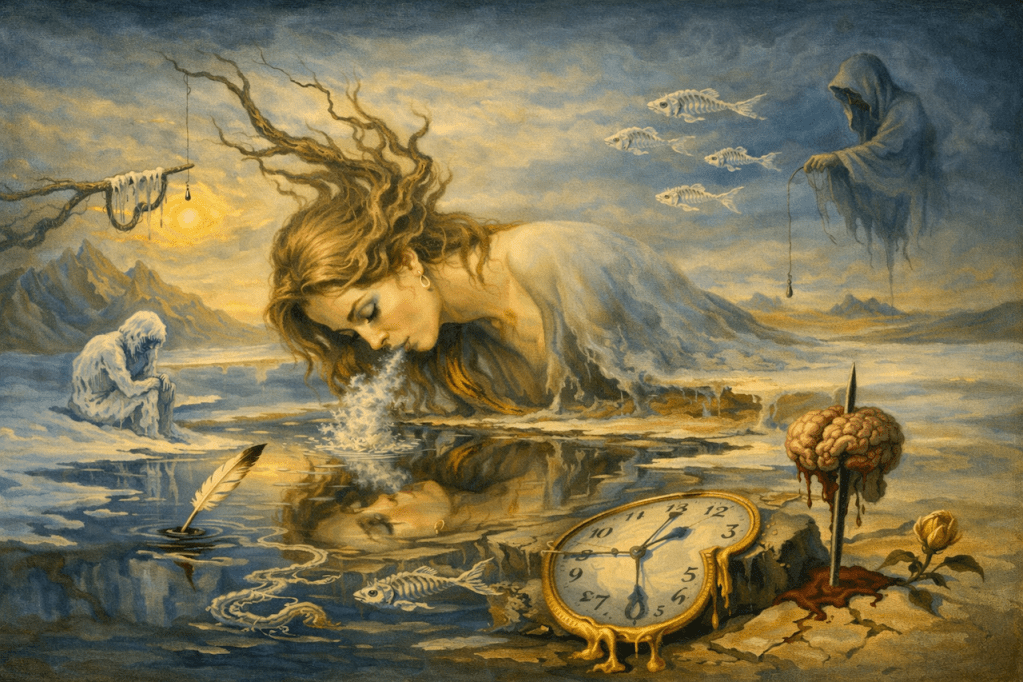
Image: Created by ChatGPT “Surreal Reflection in an Icy Realm” Inspired by “Time—Being Precious”
Time—Being Precious
“As Freezing persons, recollect the Snow – First – Chill – then Stupor – then the letting go” —Emily Dickinson, “After great pain”
likely Narcissus breathes on her mirror of self esteem prompting her to glean your pen across myth peers down nose at her— she spits you adulation (more than anything even!) but itches you not be you— Narcissus’ brain gorges on its own mind and heart—
you pray she move in joy and love— as she goes on angling your lake of words imagining schools of stinking thoughts spawning to spurn her, to scorn her, to snub her, to slight her!— freezing persons must let go the freeze— let her hooking your thoughts to spit at her stay mysterious— no more bootless musing— your time—being precious
Elizabeth Barrett Browning’s Sonnet 19 “The soul’s Rialto hath its merchandise”
The two lovers exchange locks of hair, and the speaker makes a ceremony of the exchange as she again emphasizes the royalty of her lover’s station and talent.
Introduction with Text of Sonnet 19 “The soul’s Rialto hath its merchandise”
In sonnet 18 “I never gave a lock of hair away” from Elizabeth Barrett Browning’s Sonnets from the Portuguese, the speaker dramatically celebrates giving a lock of her hair to her belovèd.
The little drama continues with sonnet 19 “The soul’s Rialto hath its merchandise,” as she receives a lock from him. The two lovers exchange their locks of hair, and the speaker dramatizes a ceremony of the exchange, as she again celebrates the royalty of her lover’s station and talent.
Sonnet 19 “The soul’s Rialto hath its merchandise”
The soul’s Rialto hath its merchandise; I barter curl for curl upon that mart, And from my poet’s forehead to my heart Receive this lock which outweighs argosies,— As purply black, as erst to Pindar’s eyes The dim purpureal tresses gloomed athwart The nine white Muse-brows. For this counterpart, The bay-crown’s shade, Belovèd, I surmise, Still lingers on thy curl, it is so black! Thus, with a fillet of smooth-kissing breath, I tie the shadows safe from gliding back, And lay the gift where nothing hindereth; Here on my heart, as on thy brow, to lack No natural heat till mine grows cold in death.
Commentary on Sonnet 19 “The soul’s Rialto hath its merchandise”
The two lovers exchange locks of hair, and the speaker makes a ceremony of the exchange as she again emphasizes the royalty of her lover’s station and talent.
First Quatrain: Oration and Commemoration
The soul’s Rialto hath its merchandise; I barter curl for curl upon that mart, And from my poet’s forehead to my heart Receive this lock which outweighs argosies,—
As in sonnet 18 “I never gave a lock of hair away,” the speaker offers a bit of an oration, commemorating the exchange of locks of hair between the two lovers. She metaphorically compares the soul to a marketplace, the Rialto, an important commercial district in Venice. The speaker employs a commercial metaphor because of the trading of items that the two lovers are engaging in.
The speaker then reveals that she is accepting the lock of hair from the head of her beloved with all the enthusiasm that an individual might express if she were presented with large loads of valuable cargoes from vast commercial sailing ships.
The speaker enhances the value of that lock of hair by stating that it weighs even more than “argosies.” It is even more valuable than all the cargo arriving in vast commercial vessels that travel the seas.
Second Quatrain: Purple Black
As purply black, as erst to Pindar’s eyes The dim purpureal tresses gloomed athwart The nine white Muse-brows. For this counterpart, The bay-crown’s shade, Belovèd, I surmise,
In the second quatrain, the speaker emphasizes the blackness of her lover’s lock. The “curl,” she claims, is so black that it is “purply black.” Again, she employs the color of royalty to distinguish the high station of her talented, handsome, accomplished lover.
The speaker alludes to the ancient Greek poet Pindar, who is considered the greatest of the nine most famous ancient Greek poets, whom she references as “the nine white Muse-brows.” The speaker’s lover’s lock is as significant because he is as important to the poetry world as those Greek poets are.
First Tercet: Pindar Allusion
Still lingers on thy curl, it is so black! Thus, with a fillet of smooth-kissing breath, I tie the shadows safe from gliding back,
The speaker voices her assumption that “the bay-crown’s shade, Beloved / / Still lingers on the curl.” The “bay-crown” refers to that most famous poet, Pindar, whose shadow-presence influences her lover’s talent through his “purpureal tresses.”
The speaker insists that because of the high value she places on that black lock of hair, she will keep the lock close to her heart to keep it warm. Likely, the speaker will place it in a locket, but she exaggerates her drama by saying she is binding it with her “smooth-kissing breath” and tying “the shadows safe from gliding back.”
Second Tercet: Ceremony of the Lock
And lay the gift where nothing hindereth; Here on my heart, as on thy brow, to lack No natural heat till mine grows cold in death.
In placing the lock next to her heart, the speaker is safe-guarding the “gift where nothing” can disturb it. Close to the speaker’s heart, the lock will “lack / No natural heat” until, of course, the speaker “grows cold in death.” The ceremony of the lock exchange is complete, and the love relationship will then progress to the next important stage.
Image: Created by Grok & ChatGPT Inspired by “In the Shelter of Thy Glory”
In the Shelter of Thy Glory
I am here At Thy call. I do not see Nor hear Thee, Lest Thou dost flee, Yet Thou dost flee, And I glide With illusion. But disillusion Will return me When at last I know I need rest.
I am feeble But Thou art stable. I am now humming Near Thy name. Touching the hymn Of Thy word, I will sing Thee into being, Calling Thee Father, Mother, Divine Friend. Resting in Thy love, My soul’s light grows In the shelter of Thy glory.





 Linda's Literary Home