Elizabeth Barrett Browning’s Sonnet 14 “If thou must love me, let it be for nought”
In sonnet 14, Elizabeth Barrett Browning’s speaker is insisting that her suitor love her only for the sake of love, not for her physical qualities such as her smiling lips or the soft manner in which she speaks.
Introduction with Text of Sonnet 14 “If thou must love me, let it be for nought”
The speaker in this sonnet from Elizabeth Barrett Browning’s classic Sonnets from the Portuguese is now graciously receiving her suitor’s affection. Nevertheless, she also feels it necessary to make him aware that she expects that their budding relationship should not only continue to grow but should become permanent. She therefore delineates the nature of the love she anticipates that the two will share.
Sonnet 14 “If thou must love me, let it be for nought”
If thou must love me, let it be for nought Except for love’s sake only. Do not say “I love her for her smile—her look—her way Of speaking gently,—for a trick of thought That falls in well with mine, and certes brought A sense of pleasant ease on such a day”— For these things in themselves, Belovèd, may Be changed, or change for thee,—and love, so wrought, May be unwrought so. Neither love me for Thine own dear pity’s wiping my cheeks dry,— A creature might forget to weep, who bore Thy comfort long, and lose thy love thereby! But love me for love’s sake, that evermore Thou mayst love on, through love’s eternity.
Commentary on Sonnet 14 “If thou must love me, let it be for nought”
The speaker insists that her beloved offer her affection only based on love and not for any physical qualities that she demonstrates, including the way she smiles or the manner in which she speaks.
First Quatrain: Continuing to Remain Somewhat Tentative
If thou must love me, let it be for nought Except for love’s sake only. Do not say “I love her for her smile—her look—her way Of speaking gently,—for a trick of thought
The speaker’s tentativeness continues, even though she seems to be contemplating the much desired joy of such a love relationship. Her continued procrastination remains as a shield for her heart, in case the relationship ends. She is signaling the likelihood of her acceptance by affirming, “If thou must love me,” but not with the oft-touted insulting phrase, if-you-really-love-me.
The uncomplicated, single term “must” declares that a change is in the offing. It demonstrates that she now realizes the true nature of this man’s love, although she cannot bring herself to have total faith that some feature in her nature could never assert itself and thus spoil such a love that seems to be so true.
The speaker is requesting pragmatically that he love her for love alone, and not because of the physical, therefore superficial, qualities that too often attract lovers. She does not desire that her lover to be in love merely with the physical qualities she possesses such as her smile and speaking manner.
Second Quatrain: Contempt for the Superficial
That falls in well with mine, and certes brought A sense of pleasant ease on such a day”— For these things in themselves, Belovèd, may Be changed, or change for thee,—and love, so wrought,
The speaker then is unveiling her reason for being dismayed by superficial kinds of attention that often engages lovers. Those qualities too often prove to be “a trick of thought.” Suppose that her smile be pleasant to him one day but not so much the next day. If he were fixed upon such a smile, she fears his feeling for her would diminish.
The speaker does not wish that her partner’s love to be guided only by mood. She suspects that if she offers him a pleasant glance but later offers a melancholy sorrow his love for her may become negatively affected.
Also, her speech to him may from time to time vary and not always offer him the same level of delight. She knows she will not always be able to engage in conversation that is brimming only with joyful pleasantries.
The speaker comprehends well that love based on change cannot maintain a lasting, steadfast love relationship. Thus she is letting him know that she is aware that the physical is very likely to change, but true love should not change; love should remain constant. She wants to let him know that she can only engage in an unconditional love that is founded on unchanging affection.
First Tercet: Accepting No Pity
May be unwrought so. Neither love me for Thine own dear pity’s wiping my cheeks dry,— A creature might forget to weep, who bore
The speaker is offering an additional demand that he not love her with pity in his heart. She has often explored the reaches of the melancholy that has caused her to shed tears often and for long periods of time. And if his love were tainted with pity and sympathy for her sorrowful lot, what would occur with that pity, were she to “forget to weep”?
She reasons that if or when she likely becomes a happily, contented woman, her beloved would then have one less reason to continue to love her, if he had allowed his love for her to include the negativity of pity and sympathy.
Second Tercet: Love for Love’s Sake Alone
Thy comfort long, and lose thy love thereby! But love me for love’s sake, that evermore Thou mayst love on, through love’s eternity.
The speaker deems it very important to make her paramour aware that she wants to be loved for no reason other than that she exists. If she is loved because of physical features, or because of the fact that she has deeply suffered and somehow now deserves to be content, true, lasting love could never continue to remain.
Therefore, if her beloved will love her as she requests and just love her for “love’s sake,” she is convinced that their love will exist “through love’s eternity.” She has weighed the calamity of false starts, and she makes it clear that she wishes to avoid the pain of a failed relationship.
Elizabeth Barrett Browning’s Sonnet 13 “And wilt thou have me fashion into speech“
The speaker in sonnet 13 muses on the idea of composing a verse about her newly found emotion but hesitates for fear of touching the grief she suffers.
Introduction with Text of Sonnet 13 “And wilt thou have me fashion into speech”
In Elizabeth Barrett Browning’s sonnet 13 from Sonnets from the Portuguese, the speaker attempts to respond to her suitor’s encouragement to transcribe her feelings for him in a poem, but she does not yet believe she is ready to plumb the depths of her feelings.
Sonnet 13 “And wilt thou have me fashion into speech”
And wilt thou have me fashion into speech The love I bear thee, finding words enough, And hold the torch out, while the winds are rough, Between our faces, to cast light on each? I drop it at thy feet. I cannot teach My hand to hold my spirit so far off From myself—me—that I should bring thee proof In words, of love hid in me out of reach. Nay, let the silence of my womanhood Commend my woman-love to thy belief,— Seeing that I stand unwon, however wooed, And rend the garment of my life, in brief, By a most dauntless, voiceless fortitude, Lest one touch of this heart convey its grief.
Commentary on Sonnet 13 “And wilt thou have me fashion into speech”
The speaker in sonnet 13 muses on the idea of composing a verse about her newly found emotion of love, but she hesitates for she fears touching the grief that still confronts her.
First Quatrain: Should She Express Her Love?
And wilt thou have me fashion into speech The love I bear thee, finding words enough, And hold the torch out, while the winds are rough, Between our faces, to cast light on each?
The speaker beseeches her beloved wondering if she should “fashion into speech” how she feels about him. She feels that she may not yet be ready to express verbally the feelings that are beginning to move her. Undoubtedly, she believes that outward verbal expression may hamper her unique emotions.
If she translated her feelings into words, she fears they would behave as a “torch” and would “cast light on each” of their faces. However, that would happen only if the wind did not blow out their fire.
She believes she must protect her increasing emotion from all outside forces; therefore, she opens with a question. She cannot be certain that remaining silent is any longer the proper way to behave.
Second Quatrain: Unsteadied by Emotion
I drop it at thy feet. I cannot teach My hand to hold my spirit so far off From myself—me—that I should bring thee proof In words, of love hid in me out of reach.
The speaker then dramatically asserts that she, “drop[s] at [his] feet”; she does this because she cannot remain steady in his presence, as she is overcome with emotion. She becomes so agitated with the notion of love, and she cannot calm down in order to write what might be coherent about her intense feelings.
The sonnet suggests that her beloved has asked the poet/speaker for a poem about her feelings for him; however, she believes that her love is so profoundly heartfelt that she may not be able to shapes its significance in words.
The speaker feels that she cannot perceive the appropriate images for they are, “hid in me out of reach.” She feels that she must wait for a time when she has found enough tranquility to be able to “fashion into speech” the complex, deep feelings she is experiencing because of her love for this man.
First Tercet: Remaining Self-Aware
Nay, let the silence of my womanhood Commend my woman-love to thy belief,— Seeing that I stand unwon, however wooed,
The speaker concludes therefore that “the silence of [her] womanhood” will have to function to persuade him that she does possess those deep feeling of love for him. She confesses that she has remained a bit distant from her beloved, when she says she is “unwon.”
Although he has “wooed” her, she feels that she must keep a portion of her self out of sight for very deeply personal reasons. She must make sure she stays present and connected in her own self.
Second Tercet: Dramatizing the Depth of Pain
And rend the garment of my life, in brief, By a most dauntless, voiceless fortitude, Lest one touch of this heart convey its grief.
The sonnet sequence has dramatized the depth of the pain and melancholy the speaker has endured her entire life-long. She is still suffering that same pain and sadness. She thus again reveals that if she too soon tries to place her feeling into a poem, she would perhaps only “convey [her heart’s] grief.”
The speaker remains fearful of the notion that “a most dauntless, voiceless fortitude” could impede the power with which she is being propelled toward completely accepting the current relationship with her new-found belovèd.
Image: Create by Grok inspired by “Serendipity on a Gentle Breeze”
Serendipity on a Gentle Breeze
Summer wears a smile all winter long Waiting in the wings for wings and things.
Spring poems fill their pockets with sharp Little stones, musical shells, and wispy feathers Of the tall grasses at the edge of the yard.
She will not go outside unless A cerulean garden calls her name & offers her hot peppers, Tomatoes, and squash.
Then she will fly the cloud flag of heaven As the blanching light of the sun Crosses the path around the rim Of the house where she resides Full of moonbeams Praying for constant brightness Less severity from her fellows & an autumn decked out in a riot Of rustic hues that flame to the touch Of the eye and rustle in the ear.
Now when winter burns, she will scorch Each word and torch her soul Back into the arms of paradise Waning in the world but waxing in her heart As a warm memory flows along the mind Like a balloon carried on a gentle breeze.
Elizabeth Barrett Browning’s Sonnet 12 “Indeed this very love which is my boast”
In sonnet 12 from Elizabeth Barrett Browning’s “Sonnets from the Portuguese,” her speaker is becoming more comfortable, realizing that she is truly loved by her suitor. Still she gives him all credit for her ability to love as deeply as she does.
Introduction with Text of Sonnet 12 “Indeed this very love which is my boast”
Elizabeth Barrett Browning’s sonnet 12 from Sonnets from the Portuguese portrays the speaker as she muses on the happiness of having fallen in love with one so illustrious and accomplished as is her suitor.
Sonnet 12 “Indeed this very love which is my boast”
Indeed this very love which is my boast, And which, when rising up from breast to brow, Doth crown me with a ruby large enow To draw men’s eyes and prove the inner cost,— This love even, all my worth, to the uttermost, I should not love withal, unless that thou Hadst set me an example, shown me how, When first thine earnest eyes with mine were crossed, And love called love. And thus, I cannot speak Of love even, as a good thing of my own: Thy soul hath snatched up mine all faint and weak, And placed it by thee on a golden throne,— And that I love (O soul, we must be meek!) Is by thee only, whom I love alone.
Commentary on Sonnet 12 “Indeed this very love which is my boast”
Elizabeth Barrett Browning’s speaker in this sonnet is musing on her good fortune to have attracted the attention of a man, who is without doubt above her class status. And what is more important is that he has accomplished much and is recognized as a excellent poet.
First Quatrain: The Effects of Love
Indeed this very love which is my boast, And which, when rising up from breast to brow, Doth crown me with a ruby large enow To draw men’s eyes and prove the inner cost,—
The speaker recognizes the effects of the love she is experiencing. She flushes red-cheeked as she muses on her good luck. She believes it entirely appropriate that she “boast” because of her good fortune. She thinks that whoever sees her can understand that she is glowing with love from “breast to brow” because of her wonderful, dynamic suitor.
The speaker reports that her heart has gained speed, rushing to her face the blood results in the blushing that announces to the world that she is in love. She no longer can keep private her joy at being loved. Her feelings have become too full, too great to contain with a neutral pose.
Second Quatrain: Learning Deep Love
This love even, all my worth, to the uttermost, I should not love withal, unless that thou Hadst set me an example, shown me how, When first thine earnest eyes with mine were crossed,
Then the speaker declares something truly astonishing: she admits that without her beloved teaching her how to love at such a depth, she would not have been able to do so. Without his example, she would never have understood how love can completely engulf the heart and mind.
The speaker gradually little by little is coming to comprehend the importance of her burgeoning affection. She now begins to realize the glorious state of affairs that actually started as soon as their eyes first connected in their first love’s deep glance.
First Tercet: Naming the Emotion
And love called love. And thus, I cannot speak Of love even, as a good thing of my own: Thy soul hath snatched up mine all faint and weak,
The speaker realized for the first time the beauty of naming that magnificent emotion “love”—for it was then that for her, indeed, “love called love”—only at that momentous occasion when the pair of lovers first looked deeply into each other’s eyes.
Not only was the emotion labeled, but the feeling itself was also brought forth. The emotion resided within her deep heart; her beloved brought the emotion into her open consciousness.
She finds that she still “cannot speak” about love without acknowledging the existence, the existential presence, of her beloved. For her, love and her suitor are virtually synonymous because he “snatched up” her soul at a time that it was “all faint and weak.”
Second Tercet: Liberating a Weak Spirit
And placed it by thee on a golden throne,— And that I love (O soul, we must be meek!) Is by thee only, whom I love alone.
After liberating her faint, weak soul, her suitor raised her and set her beside him, “on a golden throne.” Metaphorically, she likens the bliss of his love to a royal asset of high value—an apt comparison because of all the many references to royalty she has employed to describe her suitor.
The speaker again bestows all credit to her suitor for the being able to love as profoundly as she does. She even tells her own soul that “we must be meek.” The speaker never wants to lose the humility she was blessed with. She never wants to forget that her own soul is the repository of all love.
Image: Created by Grok inspired by “Lonely Offices”
Lonely Offices
“What did I know, what did I know of love’s austere and lonely offices?” —from Robert Hayden’s “Those Winter Sundays”
At her invitation, He appears in her dream Visiting the farm Where she was raised.
Years have separated their paths, Through schools of anxiety, And she is chasing a phantom Down the fog-dusted dreamscape.
He appears with briefcase in hand. Instead of facing her in conversation, He spreads a pile of papers over A large table, begins studying them.
Offhand, he asks her what she wants. Dream fog swallows her answer, But he empathically asserts, “Any response will cost $192,119.46!”
A price she equally emphatically Rejects as she gasps, Trying to grasp his proposal To prostitute himself.
Yet she knows she will never comprehend The offer and even if she had the cash, She would never hand it over. She picks up her guitar and walks forward
Saying, “I will sing some of my songs for you— For free.” He rejects the offer, stuffs his papers Into the briefcase, and without a word or gesture Of farewell, walks back into the fog of illusion.
Elizabeth Barrett Browning’s Sonnet 11 “And therefore if to love can be desert”
The speaker is still walking the path to self-acceptance, still looking for the courage to believe in her own good fortune at finding a love that she wants to deserve.
Introduction and Text of Sonnet 11: “And therefore if to love can be desert”
Elizabeth Barrett Browning’s sonnet 11 from Sonnets from the Portuguese features the continued philosophizing of the obsessed speaker as she falls in love while trying to justify that love to herself and to her belovèd.
Sonnet 11 “And therefore if to love can be desert”
And therefore if to love can be desert, I am not all unworthy. Cheeks as pale As these you see, and trembling knees that fail To bear the burden of a heavy heart,— This weary minstrel-life that once was girt To climb Aornus, and can scarce avail To pipe now ‘gainst the valley nightingale A melancholy music,—why advert To these things? O Belovèd, it is plain I am not of thy worth nor for thy place! And yet, because I love thee, I obtain From that same love this vindicating grace, To live on still in love, and yet in vain,— To bless thee, yet renounce thee to thy face.
Reading
Commentary on Sonnet 11 “And therefore if to love can be desert”
The speaker remains reluctant to engage in her own self-acceptance. She is still looking for enough courage to accept her own good fortune in finding a love of which she desire to become deserving .
First Quatrain: Berating Her Own Value
And therefore if to love can be desert, I am not all unworthy. Cheeks as pale As these you see, and trembling knees that fail To bear the burden of a heavy heart,
The speaker, who so often has devalued her own self worth, now continues to evolve toward accepting the idea that she might, in fact, be “not all unworthy.” She contends that if the ability to love can be deserved, as an award for goodness or service, she feels that it just might be possible for her to have enough importance to accept the love of one so obviously above her in status and accomplishments.
Again, however, she begins her litany of flaws; she has pale cheeks, and her knees tremble so that she can hardly “bear the burden of a heavy heart.” She continues her string of self-deprecations into the second quatrain and first tercet.
Second Quatrain: To Accomplish Great Things
This weary minstrel-life that once was girt To climb Aornus, and can scarce avail To pipe now ‘gainst the valley nightingale A melancholy music,—why advert
The speaker has lived a “weary minstrel-life,” and while she once thought of accomplishing great things, as Alexander the Great had taken Aornus, she now finds herself barely able to compose a few melancholy poems. She finds it difficult even to compete “’gainst the valley nightingale.”
However, she has also decided, while both thinking of and obsessing over these negative aspects of the life, to reconsider her possibilities. She realizes that she is merely distracting herself from more important issues by continuing to retain negative thoughts about which she spends too much time obsessing.
First Tercet: Concentration on Negativity
To these things? O Belovèd, it is plain I am not of thy worth nor for thy place! And yet, because I love thee, I obtain
Thus the speaker asks herself, “why advert / / To these things?” Indeed, why concentrate on the past negativity, as such a glorious future has been heralded? She then directly addresses her suitor, claiming, “O Belovèd, it is plain / I am not of thy worth.”
She still insists on making it known how aware she is that she is not of her suitor’s status. However, she is now willing to consider that they might be able to grow a relationship.
Second Tercet: Advancing a Philosophical Position
From that same love this vindicating grace, To live on still in love, and yet in vain,— To bless thee, yet renounce thee to thy face.
The speaker advances an odd philosophical position that because she loves the man, that love will offer her “vindicating grace.” Thus, she can accept his love and love him while still allowing herself to believe that such a love is “in vain” and that she can still “bless” him with her love, while simultaneously she can “renounce [him] to [his] face.”
The speaker’s complex of accepting and rejecting allows her to continue to believe she is both worthy yet somehow not quite worthy of this love. She cannot forsake the notion that she can never be equal to him.
Yet, she can accept his love and the prospect that somehow, somewhere beyond her ability to grasp it is the possibility that despite all of her flaws, she ultimately is deserving of such a great and glorious love.
Poet/essayist David Solway tackles the issue of global warming, a.k.a. “climate change,” employing a poet’s craftsmanship with language and an essayist’s incisive intelligence, maneuvering in facts. He demonstrates the facility with which a poet can master the machinations of politics.
Behind the Green Door
In David Solway’s essay, “What’s Behind the Green Door?” [1], the poet/essayist begins by referring to a 1950s era pop song titled “The Green Door.” The song dramatizes a speak-easy, a Prohibition era saloon, where insiders went to drink and carouse. Of course, the place was not open to the public, and the would-be entrant had to reveal a password.
The person desirous of entry, who is singing the song, tries his luck with, “Joe sent me.” But this attempt just drew laughs from the revelers behind the green door. Solway jumps to today by cleverly suggesting that the password would be, “Al sent me.”
Solway’s metaphor of the green door encompasses all the adherents to the wildly popular junk science [2] called Global Warming, a.k.a. Climate Change, widely popularized by global warming alarmist and failed president-wanna-be, Al Gore. Solway elucidates his thesis, which is supported by Czech President Vaclav Klaus [3], who spoke at the Second International Conference on Climate Change in New York in March 2009.
The Czech president described those global warming supporters by asserting that the alarmist are not interested in temperature, nor are they concerned with CO2, hard science, freedom, or markets. Instead, they are interested only in “their profits made with the help of politicians.”
Solway then explains that the warming alarmists stand to reap giant profits from government sources as they tout their untested beliefs, while covering those beliefs with the veil of science. The poet explains that “green” has become big business with “perks, awards, government subsidies, academic fellowships, scientific laurels, corporate subventions, and endowments and research grants.”
The alarmists remain on the government gravy train, while dismissing alternative climate theories. Practitioners of the hard sciences do not claim “consensus” while censoring opposition; genuine scientists employ the objective, scientific method that deems any theory workable only if it can be replicated. The true “science deniers” are the alarmists-junk-scientists who cancel and censor their opposition, instead of offering opposing arguments with data.
Dr. Václav Klaus [4], has furthermore stated that the human arrogance perpetuating the hoax of global warming, (a.k.a. “climate change”) “lives independently of the science of climatology.” He labels the current ideology “a set of beliefs, if not a religion.” He adds that the warming hoax does not involve disputes about temperature, but instead remains part of a “conflict of ideologies.”
The Green Door
The Iconic Polar Bear
Solway then cites the example of the polar bears. Al Gore and his ilk claim that the polar bear is becoming extinct because of global warming, but numerous scientists, including biologist Mitchell Taylor [5], have reported as much as a 25% increase in the polar bear population since 1970. The alarmist-environmentalists have relied on only one of the thirteen polar bear populations to make their claim.
According to Taylor, eleven of those populations are stable or increasing, and the one that shrank was caused by competition for food, which indicates that they were over populated. So virtually no polar bears have been lost because of global warming.
Ben Lieberman [6], senior fellow in environmental policy at the Competitive Enterprise Institute, has reported, “The state of Alaska . . . has noted that the bears’ global numbers have increased substantially, from an estimated 8,000-10,000 in 1965-1970 to 20,000-25,000 today.” Lieberman further states,
History also argues against any assertions that polar bears are fragile. While true that the Arctic is warmer today than 30 – 40 years ago and that sea ice extent has declined over that span, the region was nearly as warm if not warmer during the 1930s, and almost certainly warmer at earlier times. Yet polar bears have existed as a distinct species for at least 100,000 years.
Clearly, the exploitation of the polar bear has resulted in hide-the-decline [7] style statistics that remain well within the embrace of junk science, not legitimate, forensic, fact-based hard science [8].
David Solway – Global Warming: The Trials of an Unsettled Science
Solway’s Additional Writings on Climate Change
In addition to Solway’s seminal “Green Door” essay, his further writings on the subject continue the expand his argument. For example, his article, “Global Warming: Half Politics, Half Religion“[9], which he has broadened into an even more informative book, Global Warning: The Trials of an Unsettled Science broaches further problematic issues that need to be addressed regarding the issue of climate, particularly “global warming.” About Solway’s book, Bruce Bawer [10] has claimed, “Everything you need to know about the climate-change scam is in David Solway’s brilliant new book”
Nobel Laureate Smashes the Global Warming Hoax
Climate Scientism Replacing Marxism
Solway points out numerous errors [11] that have been detected but not reported. One such error occurred when an associate of the NASA Goddard Institute for Space Studies typed in September temperatures for October temperatures—an error that would obviously lead to the wrong conclusion.
Then there is the infamous incident of the National Snow and Ice Data Center at the University of Colorado, as well as the Goddard Institute [12], whose erroneous claims about the Arctic ice cap [13] had resulted from a faulty satellite sensor that reported a loss of 500,000 square kilometers of ice, when, in fact, later it was discovered that ice had increased by an area the size of Texas.
One of the most egregious misappropriation of climate science has been the “Climategate” [14] fiasco arising out of leaked emails of Phil Jones and his colleagues at the University of East Anglia’s Climatic Research Unit. This group of researchers lamented that the data was not supporting their desired findings; thus, they sought a way to “hide the decline” [15] in temperatures.
Despite all of these demonstrably false claims, data shifting, and outright cover-ups, the warming notion keeps claiming adherents. The environmentalists under the banner of a Climatocracy [16] have become the new Marxists, displaying a totalitarian mindset.
Solway quotes Philip Stott [17], professor emeritus of biogeography at the University of London, who says, “Global warming has become the grand political narrative of the age, replacing Marxism as a dominant force for controlling liberty and human choices.”
There has been no global warming for the last eighteen years and counting. Warmists like to call this quiescent period of zero net warming a “Pause,” but there is no evidence to suggest a double-digit hiatus in process. The word “Pause” is a palpable evasion intended to maintain an unproven contention. What we do know is that during the years in which apocalyptic claims of imminent catastrophe have been indefatigably circulated, the temperature has remained stable. There is no getting around the thermometer.
Despite the evidence, the dedicated warmists continue in their zeal, attempting to explain away the cooling that has begun to take place. Greenpeace’s Gerd Leipold had predicted that by 2030 there would be no ice left on the Arctic. Even as he attempts to justify his group’s earlier propaganda emotionalizing the issue, because of the recent cooling trend, he had to admit that he might have been mistaken.
Greenpeace Leader Admits Arctic Ice Exaggeration
Professor Emeritus Don Easterbrook [19] of Western Washington University has suggested that recent solar changes suggest the advent of a new cooling cycle which could be fairly severe. But the alarmists continue to ignore the recent decade-long lack of warming, which leads geologist David Gee, who chaired the 2008 International Geological Congress, to question [20]: “For how many years must the planet cool before we begin to understand that the planet is not warming?”
While it may remain a truism that politics makes for bad poetry [21], the fact that poets may become passionate about political issues guarantees the strength of the argument through the poet’s ability to analyze those issues.
Because of a poet’s intimacy with language and presenting accurately his own experience in words, it stands to reason that a poet interested in any issue—political, medical, scientific, legal, social, or otherwise—will likely be able to explain those issues with aplomb and accuracy.
Such is the case with the poet David Solway. His passionate interest has led to his deep understanding of the issue of “global warming,” and his skill in writing and analytic ability afford him the facility to explain clearly the problems involved in that alleged hoax [22].
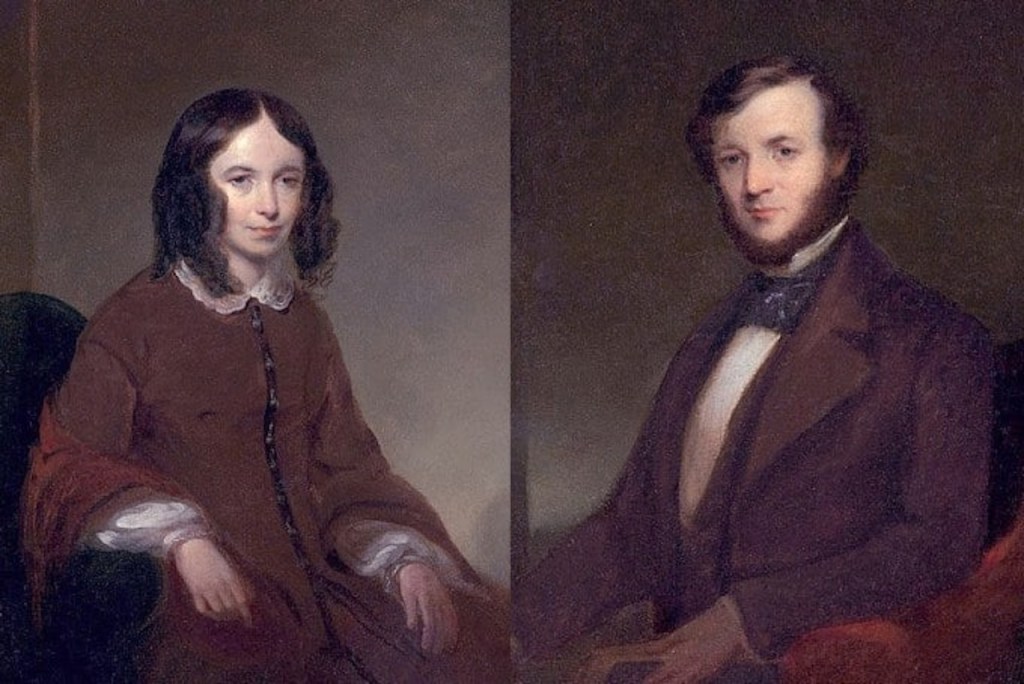
Image: Elizabeth Barrett Browning and Robert Browning – 1852. Portraits painted by Thomas Buchanan Read
Elizabeth Barrett Browning’s Sonnet 10 “Yet, love, mere love, is beautiful indeed”
The speaker of sonnet 10 is beginning to reason that despite her flaws, the transformative power of love can change her negative, dismissive attitude.
Introduction and Text of Sonnet 10 “Yet, love, mere love, is beautiful indeed”
Elizabeth Barrett Browning’s sonnet 10 from Sonnets from the Portuguese finds the speaker’s attitude slowly but surely evolving. She is now allowing herself to reason that if God can love his lowliest creatures, surely a man can love a flawed woman. Thus, through that magic power, those flaws may be overcome.
Sonnet 10 “Yet, love, mere love, is beautiful indeed”
Yet, love, mere love, is beautiful indeed And worthy of acceptation. Fire is bright, Let temple burn, or flax; an equal light Leaps in the flame from cedar-plank or weed: And love is fire. And when I say at need I love thee … mark! … I love thee—in thy sight I stand transfigured, glorified aright, With conscience of the new rays that proceed Out of my face toward thine. There’s nothing low In love, when love the lowest: meanest creatures Who love God, God accepts while loving so. And what I feel, across the inferior features Of what I am, doth flash itself, and show How that great work of Love enhances Nature’s.
Reading
Commentary on Sonnet 10 “Yet, love, mere love, is beautiful indeed”
The speaker of sonnet 10 is beginning to reason that despite her flaws, the transformative power of love can change her negative, dismissive attitude. As she begins to turn her negativity around, she puts on a brighter glow of enthusiasm.
First Quatrain: The Value of Love
Yet, love, mere love, is beautiful indeed And worthy of acceptation. Fire is bright, Let temple burn, or flax; an equal light Leaps in the flame from cedar-plank or weed:
The speaker begins to focus on the value of love, finding that emotion to be “beautiful” and even “worthy of acceptation.” She likens love to fire and finds love to be “bright” as love is also a flame in the heart and mind. She contends that the power of fire and the light it emits remains the same force regardless of the fuel that feeds it—whether it is “from cedar-plank” or even if it is from “weed.”
Thus, the melancholy speaker is beginning to believe that her suitor’s love can burn as bright even if she is the motivation, although she metaphorically considers herself to be the weed rather than the cedar-plank.
Second Quatrain: Fire and Love
And love is fire. And when I say at need I love thee … mark! … I love thee—in thy sight I stand transfigured, glorified aright, With conscience of the new rays that proceed
The speaker continues the metaphorical comparison of love to fire and boldly states that love is, indeed, fire. She audaciously proclaims her love for her suitor and contends that by saying she loves him, she transforms her lowly self, and thereby she can arise transformed and even reflect an honest kind of glory. The awareness of the vibrations of love that exude from her being causes her to be magnified and made better than she normally believes herself to be.
First Tercet: God’s Love
Out of my face toward thine. There’s nothing low In love, when love the lowest: meanest creatures Who love God, God accepts while loving so.
The speaker avers that there is nothing about love that is “low.” God loves all of his creatures, even the lowliest. The speaker is evolving toward true acceptance of her suitor’s attention and affection, but she has to convince her doubting mind that there exist sufficiently good reasons for her to change her negative outlook.
Obviously, the speaker has no intention of changing her beliefs in her own low station in life. She carries her past in the heart and mind, and all of her tears and sorrows have permanently tainted her own view of herself. But she can turn toward acceptance and allow herself to be loved, and through that love, she can, at least, bask in its joy as a chilled person would bask in sunshine.
Second Tercet: The Transformative Powers of Love
And what I feel, across the inferior features Of what I am, doth flash itself, and show How that great work of Love enhances Nature’s.
The speaker will continue to think of herself as inferior, but because she can now believe that one as illustrious as her suitor can love her, she is opening her heart and mind to the possibility of the transformative powers of love. She still insists on her inferiority, asserting that she possesses “inferior features.”
And she must “feel” her way across such ingrained realities. But she also can now affirm that the power of love is so great that it can enhance the qualities and feature of Nature itself. Such a power demands respect, and the speaker is awakening to that reality.
Robert Hayden’s “Those Winter Sundays” is an American (Innovative) sonnet, and it is one of the best poems written in the English language, particularly in the American vernacular.
Introduction and Text of “Those Winter Sundays”
Robert Hayden’s speaker in this nearly perfect innovative sonnet “Those Winter Sundays” is a man reflecting on his attitude and behavior during his childhood. Specifically, the speaker is remembering and dramatizing an event that involved his father. He comes to the conclusion that he should have behaved more kindly and respectfully toward his father who did so much for him.
Looking back at childish ways often reveals immature attitudes and behaviors. Such reminiscing can lead to feelings of guilt and recrimination for the immature behavior and selfish attitudes that are so common to youth. But those feelings prompted by contrasting an adult’s understanding to a child’s understanding need to be assuaged by forgiveness and knowledge of the human condition.
The speaker in this poem shows a mature, well-balanced attitude regarding his younger self that corrects the human tendency to castigate that younger self. He realizes that if he had known better he would have behaved better.
Those Winter Sundays
Sundays too my father got up early and put his clothes on in the blueblack cold, then with cracked hands that ached from labor in the weekday weather made banked fires blaze. No one ever thanked him.
I’d wake and hear the cold splintering, breaking. When the rooms were warm, he’d call, and slowly I would rise and dress, fearing the chronic angers of that house,
Speaking indifferently to him, who had driven out the cold and polished my good shoes as well. What did I know, what did I know of love’s austere and lonely offices?
Robert Hayden reading “Those Winter Sundays”
Commentary on “Those Winter Sundays”
This excellent sonnet “Those Winter Sundays” is one of the best poems written in the English language, and Robert Hayden is one the finest poets writing in the American vernacular.
First Stanza: The Plain Truth
Sundays too my father got up early and put his clothes on in the blueblack cold, then with cracked hands that ached from labor in the weekday weather made banked fires blaze. No one ever thanked him.
The speaker begins by reporting the unvarnished fact that even on Sundays, the day that most people are apt to sleep in, his father as usual “got up early.” The father got up early and put on his clothes in a very cold house. The father then built the fire in the stove that would warm the rooms to make it comfortable for the rest of the family to rise without suffering the cold that the father had done.
The speaker refers to the kind of cold that the house experienced as “blueblack.” That descriptor provides an intense image that renders that cold as biting and bitter. That the cold was so intense further strengthens the love and affection that the father felt for his family, and the misery he was willing to suffer in order to make life more comfortable for his loved ones.
Even though the father had worked hard during the week to the point of having to suffer “cracked hands” from all his hard labor, the father still without pause got up even on Sundays to assure that his family’s comfort was provided. The image “made / banked fires blaze” arises from the custom of piling up wood inside the stove or fireplace to keep a low-level fire smoldering for long periods of time, such as over night.
This procedure then makes it easier for the wood to blaze into full flames faster than its would have done without the banking. Thus, the fire is made faster and more easily in the morning when it is most necessary. The poet has created a speaker whose freshness of language infuses his message with all of the characteristics of a dramatic masterpiece. The images build, dramatizing as well as relaying information, implying attitudes as well as stating them.
The poet’s skill has created a well-placed infusion of feeling, as he has his speaker plainly claim, referring to the father, “No one ever thanked him.” The speaker’s remorse is revealed; he makes it clear that he wishes he had thanked his father for his sacrifices, but alas, he did not. Furthermore, no one did, and that omission now grieves the adult as he looks back on the situation.
Second Stanza: The Duties of a Father
I’d wake and hear the cold splintering, breaking. When the rooms were warm, he’d call, and slowly I would rise and dress, fearing the chronic angers of that house,
Because of the father’s loving attention, the speaker could stay in bed warm and snug until the house was no longer suffering that “blueblack” cold but instead was all toasty warm. After the speaker wakes up but while still in bed, he can hear the cold being driven out of the house. He describes what he hears as “splintering, breaking.”
Again, the poet has infused a marvelous set of images that intensifies the meaning and skillfully dramatizes the events of this nearly perfect sonnet. What the speaker hears literally is his father chopping up wood, but to the child-speaker’s ears, it seemed as though the cold were literally being cracked and broken.
After the father had heated the house, he would call for his son to get up and get dressed. The speaker would do so, although “slowly.” Even though he was only a child, he always seemed to remain aware of the “chronic angers of that house.” The line “fearing the chronic angers of that house” seems to leave open some frightening possibilities for interpretation, and as might be expected, some critics have assumed that those angers signal an abusive father.
But such an interpretation makes no sense, however, unless one has overlooked the main message of the poem. The speaker would not likely be focusing on thanking the father, if he were testifying that the father had been an abuser. The “angers of the house” more likely refer to the house itself.
It likely had other issues beside the morning cold, for example, it might have had broken windows, leaky or noisy pipes, rodents, shabby furniture, or perhaps the floor-boards creaked when walked upon, or the roof leaked when it rained. After all, the speaker does designate that those angers belonged to the “house,” not to his father or to any other family member or resident of the house.
If meaning in a poem is derived from the poet’s biography, the poet’s actual meaning in the poem can become skewed. Readers must always look first and foremost to the poem for its meaning, not at the biography of the poet.
Third Stanza: The Indifference of Youth
Speaking indifferently to him, who had driven out the cold and polished my good shoes as well. What did I know, what did I know of love’s austere and lonely offices?
In the final stanza, the speaker demonstrates that he now understands the sacrifices his father made for him and the rest of the family. Undeniably, the speaker feels shame that he often spoke so “indifferently” to this father. The speaker thus suggests that if he could go back and correct that mistake, he would speak to his father with the love and devotion that he now realizes the father deserved.
Not only had the father “driven out the cold” for him and the rest of the family, but he had also polished the speaker’s shoes. These tokens of love become symbols for all of the other duties that the father must have performed for the family. It is quite likely that the father also cooked breakfast of this son, drove him to church or school, or to wherever the son needed to go.
The speaker then asserts his all important remark, framing it as a question: “What did I know, what did I know / of love’s austere and lonely offices?” Far from excusing his childhood behavior, the speaker is, instead, very eloquently explaining it: he was just a child. And as a child, he did not have the maturity to perceive that his father was performing selfless acts. Few, if any, children are ever blessed with such foresight.
Because the speaker repeats the question “what did I know?,” he is emphasizing his childhood lack of awareness. The speaker simply did not know what it was like to be a father, with the responsibilities of caring for children and running a household, of going to work each week-day to keep the family fed, clothed, and warm with a roof over their heads.
If the speaker had been capable of processing all of this complex, adult activity, he would have behaved differently—not “indifferently” toward his father. With his adult awareness though maturity, the speaker is now able to offer a corrective to all those who have experienced those same feelings of guilt for past childhood immaturity.
Why should any adult continue to suffer from the guilt and recrimination over childhood immaturity when it is so simple?: Children simply do not know any better. Children cannot behave in ways that remain out of their range of knowledge.
Once they do know better as mature adults, and though they may continue to wish they had done better, they should be able to leave off the abject guilt and get on with their lives. This poem’s spiritual level of thought and feeling renders it the marvelous, nearly perfect poem that it is.
The poet’s skill in crafting his dramatic sonnet filled with poignant memories that offer universal succor to readers elevates its stature to the nearly sublime. Such a poetic achievement remains rare in 20th century secular poetry, so thoroughly infused with the postmodern muck of unprompted anger and the inability to recognize and accept truth.








 Linda's Literary Home
