Linda's Literary Home

Author: Linda Sue Grimes

  • Who Was Edward de Vere?

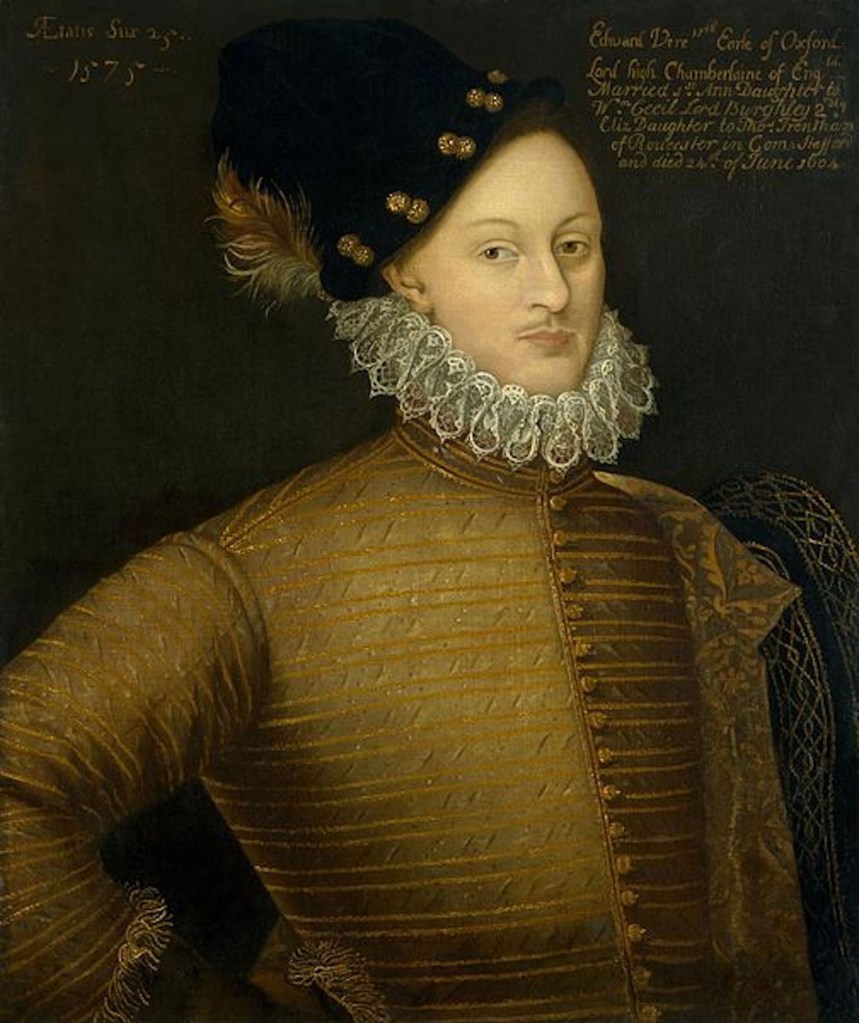
    Image: Edward de Vere, 17th Earl of Oxford

    Who Was Edward de Vere?

    by Professor Daniel Wright, Ph.D.
    Director, The Shakespeare Authorship Research Centre

    Although the date and circumstances of his birth are in some dispute amongst scholars, the official historical record tells us that in April of 1550, Edward de Vere, Viscount Bolebec and heir to the ancient earldom of Oxford, was born at his family’s ancestral home of Castle Hedingham in the county of Essex. He became the son and heir of John de Vere, the 16th earl of Oxford, a patron of the polemical dramatist John Bale and the patron of a major acting company (Oxford’s Men). John de Vere’s wife, Margery, the Countess of Oxford, was no less distinguished than her husband in her connection to the literary world, for she was the sister of Arthur Golding, the famous scholar and translator of Ovid’s Metamorphoses. Arthur Golding, as all Shakespeare scholars acknowledge, was a primary influence on the writer who, after many years of anonymous performance and publication of his works, eventually identified himself in two poems to the earl of Southampton as “William Shakespeare.”

    The maternal uncle of Edward de Vere was not the only leading influence on the writer the world would come to know as Shake-speare. The paternal uncle of Edward de Vere, Henry Howard, the 5th earl of Surrey, was the originator of the sonnet form that today is known as “Shakespearean” because of its association with the sonnet form popularized by the writer who, a generation after the death of Edward de Vere’s uncle, called himself Shakespeare.

    Following the death of his father in 1562, Edward de Vere, now the 17th earl of Oxford, became a royal ward and was sent to live with and study under the Queen’s Private Secretary (and later Lord Treasurer of England), William Cecil. Under Cecil’s tutelage and guidance, the new earl of Oxford became one of the best-educated subjects in the realm. He was privileged to study with the best minds of the English Renaissance, including such learnèd men as Laurence Nowell, the Dean of Litchfield; Bartholomew Clarke; Thomas Fowle and Sir Thomas Smith. He enjoyed access to Cecil’s library, one of Europe’s most remarkable and extensive collections of books and manuscripts. At Cecil House, or, as Joel Hurstfield of University College, London, has put it—”the best school for statesmen in Elizabethan England, perhaps in all Europe”—Edward de Vere received an education incomparable among his peers, exactly the kind one would expect of the writer who was destined to become Shakespeare: England’s greatest wordsmith—a writer whose achievements are dense in their allusions to and reliance upon works of classical antiquity, many of which had not been translated into English in Shakespeare’s day.

    In August 1564 and September 1566, Edward received degrees from both Cambridge University (B.A.) and Oxford University (M.A.), and in February 1567 he was sent by Cecil to study law at Gray’s Inn, one of the celebrated Inns of Court that, in addition to serving as a distinguished college of law, provided a site for many theatrical performances, including plays by William Shakespeare. (The Inns of Court probably provided Shakespeare with more than a setting for his plays, however, as Shakespeare’s ability to artfully and densely integrate examples of English case law, Continental civil law and the arcana of the world of legal scholarship into his plays and poems has prompted even the late orthodox scholar, Eric Sams, to concede that whoever Shakespeare was, “he surely studied law.”)

    In 1571, Edward de Vere took a step that ensured the Elizabethan State’s retention and intensification of its more than passing interest in him when he was betrothed (with apparent reluctance) to the fourteen year-old daughter of William Cecil. As Master of the Court of Wards who – by his arrangement of this marital bond between Oxford and his daughter in order to ennoble his family – William Cecil was duly elevated to the peerage as the first baron Burghley, and Edward de Vere became the son-in-law of the most powerful man in England. In ensuing years, after a difficult marriage and prior to an all-too-early death, Anne bore Oxford three daughters who survived to adulthood: Elizabeth—whose legitimacy, however, Oxford bitterly disputed—as well as Bridget and Susan. All three of Oxford’s daughters, very interestingly, either married or were proposed for marriage to the three men (the only three men) to whom the poems and plays of Shakespeare were dedicated—the earls of Southampton, Montgomery and Pembroke).

    Marriage, however, did not domesticate young Oxford. As a young man, he had become notorious for getting himself in trouble and provoking the indignation of his powerful father-in-law; as a youth, for example, de Vere had bandied at sword-point with, and killed, another man—Thomas Brinknell—although the jury that tried Oxford brought in a verdict acquitting him of any responsibility for the young man’s death. In 1573, some of the young earl’s companions (with Oxford reputedly in their company) waylaid travelers on the road from Gravesend to Rochester—an episode uncannily similar to the scene in Shakespeare’s Henry the Fourth, Part One where Falstaff and his companions assault the King’s receivers. Amazingly (or perhaps not so amazingly), the Shakespearean account includes detail of this assault that corresponds to the circumstances involving Oxford’s men down to the author’s placement of Falstaff and his bandits on the very road where Oxford’s men confronted the troupe ambushed in 1573. Oxford also was implicated in an abortive effort to free Thomas Howard, the Duke of Norfolk, from the Tower where Norfolk was awaiting execution for participating in the Ridolfi plot against the Queen. Oxford scandalously accused his wife of infidelity during one of his European sojourns, although he himself returned to England after an extended stay in Europe with a Venetian choirboy, Orazio Cuoco, in tow—an event that later led enemies of the earl to accuse him of pederasty, although no credible evidence was ever produced to support the accusations.

    In addition to his intellect and robust, often troublesome nature, Edward also developed a singular martial prowess, excelling in contests within the lists, contests restricted (along with sports such as falconry) almost exclusively to the nobility (detailed accounts and descriptions of which sports, moreover, that provide much of the narrative content, imagery, vocabulary and metaphor of the Shakespeare poems and plays). Moreover, Oxford conceived theatrical entertainment for the Queen at Whitehall, and he acquired the lease to the Blackfriars Theatre. He was a patron of many writers and several distinguished acting companies. He became one of the leading recipients of literary dedications and verses by writers such as John Lyly and Edmund Spenser and was himself widely regarded as one of England’s most excellent writers—acclaimed so even in his youth. However, by the time he was an adult, George Puttenham, in The Arte of English Poesie, confirmed not only that many writers at the Elizabethan Court were concealing themselves as writers (a custom of the age) but revealed that Oxford, in particular, amongst those courtiers, was masking his identity as a writer:

    And in her Majesty’s time that now is are sprung up another crew of Courtly makers [poets], noblemen and gentlemen of her Majesty’s own servants, who have written excellently well as it would appear if their doings could be found out and made public with the rest, of which number is first that noble gentleman, Edward earl of Oxford.

    Oxford journeyed extensively on the Continent. He traveled throughout France. In Italy, he visited almost all of the Italian locations, including Sicily, that later would provide the settings for Shakespeare’s Italian plays. He made a home for himself in Venice. His ship was attacked by pirates (who “dealt with [him] like thieves of mercy”[Hamlet IV.vi.20-21]) on his return voyage to England. A few years later, Oxford’s brother-in-law, Peregrine Bertie, Lord Willoughby, on embassy from Queen Elizabeth to the Danish court at Elsinore, reported upon his return to England that during the banqueting at Elsinore, “a whole volley of all the great shot of the castle discharged”; the account is remarkably similar to the declaration of Shakespeare’s King Claudius who pledges, “No jocund health that Denmark drinks today, / But that the great cannon to the clouds shall tell” (I.ii.125-26).

    In 1581, Queen Elizabeth, having discovered Oxford’s extra-marital flirtation with a Gentlewoman of the Queen’s Bedchamber, briefly confined Edward de Vere to the Tower, along with his mistress, Anne Vavasour, and their child. Shortly after Oxford’s release from imprisonment, Thomas Knyvet, a Groom of the Privy Chamber and an unforgiving uncle of Anne Vavasour, injured Oxford in a sword fight that followed a series of street brawls and affrays between Oxford’s men and Knyvet’s men—clashes of striking resemblance to the sometimes violent scuffles later to be depicted by Shakespeare in eruptions between the men of the houses of Montague and Capulet in Romeo and Juliet. Oxford was wounded, apparently in the leg, during one of these contretemps with Knyvet, and this injury may account for his oft-bemoaned lameness in later life.

    In 1587, the year after the Queen began to grant Oxford a £1000 annuity, evidence suggests that Thomas Kyd may have joined Oxford’s household. Kyd was a young man, some years Oxford’s junior, who today is credited with writing The Spanish Tragedy and frequently is alleged to have composed an early version of Hamlet (sometimes referred to as the Ur-Hamlet), as well as The Taming of a Shrew (a predecessor work to Shakespeare’s The Taming of the Shrew) and parts of Shakespeare’s Titus Andronicus. Interestingly, none of the plays that today are attributed to Kyd were, in his lifetime, ever published under his own name, nor was he in his own lifetime regarded as a dramatist.

    In 1588, Oxford’s wife, Anne, died. Oxford remarried a few years later, wedding Elizabeth Trentham. She bore him a son and heir, Henry, who, as the 18th earl of Oxford, in the 1620s, became a leading nobleman in a bold, anti-Spanish quadrumvirate — Protestant opponents of the Crown’s plan to wed the Prince of Wales to the Infanta of Spain. This opposition (organized, perhaps not coincidentally, at the same time as the First Folio was being prepared for publication) was composed of Henry de Vere and the very same noblemen to whom both Shakespeare’s poems and First Folio of Shakespeare’s plays had and would be dedicated: the 3rd earl of Southampton, the 4th earl of Pembroke, and the 1st earl of Montgomery.

    In 1598, after many years of anonymous performance and publication of such Shakespearean plays as Richard the Second, Titus Andronicus and Romeo and Juliet, the first quarto of a play to bear the name of William Shakespeare was published. In that same year, two months after the death of William Cecil, Francis Meres registered Palladis Tamia for publication in which “Shakespeare,” for the first time in any publication, was identified as a playwright, and Edward de Vere was acclaimed “[t]he best for comedy amongst us.”

    The 17th earl of Oxford reportedly died in 1604, early in the reign of King James I. Where he was buried we have no certain record, although his cousin, Percival Golding, wrote that his body eventually was interred at Westminster. If Golding is correct, and if Edward de Vere was the nobleman poet-playwright who called himself William Shakespeare, it is truly fitting that he—the greatest writer who ever lived—rests in the hallowed ground of England’s national church amongst the immortals of English letters.

    Professor Daniel Wright, Ph.D.
    Director, The Shakespeare Authorship Research Centre

  • The Shakespeare Authorship Controversy: The Case Summarily Stated

    The Shakespeare Authorship Controversy: The Case Summarily Stated

    by Professor Daniel L. Wright
    Director, The Shakespeare Authorship Research Centre

    Who wrote the works of Shakespeare? Tradition reports that the author was a tradesman from provincial Warwickshire who was baptized Gulielmus Shakspere, a man who, to the best of our knowledge, never had a day’s schooling, and yet we are told – and are expected to believe – that, in his twenties, this man began to publish (having written nothing before in the whole of his life!) the most erudite works of literature the world has ever seen. We are told by traditionalists that this man (who literally could not spell his own name the same way twice) wrote poems and plays that are dense in their reliance on the literature of classical antiquity as well as Continental verse and narrative which had not even been translated into English in Shakespeare’s day. We are told that this man, who never owned so much as a single book, wrote, without any education or apprenticeship in the literary and dramatic arts, poems and plays that invoke the legends of hundreds of figures from Greek and Roman mythology – poems and plays that demonstrate the writer’s easy familiarity with and competence in Latin, Greek, Italian and French – poems and plays demonstrative of a linguistic facility so agile and confident that he sometimes would compose (as in scenes such as Henry the Fifth III. iv) in languages other than English.

    When, where and from whom did this man who never traveled farther than London from his hometown, and who reputedly spent the years prior to his early marriage in apprenticeship to a butcher, supposedly learn all of this? In what educational domain did he acquire the ability to become the rarest of men: the chief wordsmith of the English language – a linguistic creator whose fecundity humbles Milton and overrides the Bible? How was it that he appeared in London, suddenly and with no preparation – like a genie from a lamp – an urbane, cultivated, accomplished, knowledgeable and unrivaled poet; a masterful practitioner of rhetoric; a scholar of his own and other nations’ literatures, histories, customs, painting and sculpture; a man intimately versed in the character of many ages’ political and religious disputes – both foreign and domestic? Where did he study astronomy, read Copernicus, become capable in the field of medicine, and demonstrate remarkable competence in and familiarity with English case law as well as Continental civil law? Where did he learn the arcane jargon of aristocratic sport and military command if all he did for the first half of his life was chop meat in a provincial and virtually bookless burg of perhaps forty families’ size (none of which families, incidentally, although they knew him well, ever acknowledged their townsman as a poet, playwright or even a writer)?

    Can anyone truly think the scenario likely? Is this – a process that defies everything we know about the development of literary creativity and skill – a credible explanation of how Shakespeare attained the highest achievements in literary art? Are we seriously to believe that a man of no education, who wrote no letters (nor received any from anyone [they must have known he couldn’t read]), who wrote absolutely nothing – not so much as a mundane shopping list (and who, though wealthy, owned no books even at the end of his life) – who had no journeyman experience in the literary arts, no apprenticeship or tutelage in the classics, no foundation in music, law, statecraft, theology, aristocratic sport or courtly custom – would sit down at a desk in his mid-twenties and, in his first foray into writing, compose the works of Shakespeare? Would such a man – the world’s greatest wordsmith and lover of language – not have taught his own family to read and write rather than leave them gaping illiterates? Would the only literate member of his extended family (his son-in-law) praise, in print, fellow Warwickshire poet Michael Drayton but never write a line acknowledging that his own father-in-law was England’s most accomplished poet-dramatist (or even a writer)? Would this Shakespeare not have been feted and received tributes like his peers-rather than fail in his own lifetime to be acknowledged as a poet or playwright by anyone in letters, memorandae, dedications or diary entries?

    If the writer who called himself Shakespeare were this rustic from Stratford-Upon-Avon, he is the most improbable person ever to have lived, and his story is the most implausible tale in history – one that, as Concordia University professors of psychological and educational theory Drs Kevin Simpson and Steven Steffens have demonstrated, utterly defies rational explanation and overthrows everything that learning theorists and psychologists of cognitive development know about how creative talents are cultivated and mature.

    How likely, therefore, is it that this man from Stratford-Upon-Avon – this man who, in his own day, no literary figure (not even Phillip Henslowe, the age’s chief diarist of the theatre) acknowledged as so much as an acquaintance – was the author of the works that bear the name of William Shakespeare? More scholars, each year, swell the ranks of those of us who say that whoever Shakespeare was, he was not this pedestrian merchant from Warwickshire for which there is no evidence of any kind of literary career – let alone any evidence for his being, in A.L. Rowse’s words, “the best-known dramatist” of the age.

    But if Shakespeare were not this man from Stratford-Upon-Avon, who was he? I would propose that the most probable candidate is Edward de Vere, the Lord Great Chamberlain of England and the 17th earl of Oxford – a brilliant poet and playwright who also was a favourite of the Queen as well as her ward and the son-in-law of her chief minister of state, William Cecil, the first Baron Burghley, Lord Treasurer of England.

    Unlike the butcher from Stratford, Edward de Vere was nurtured in the arts of poetry and stagecraft from his youth. Steeped in the art of the theatre, Edward and his father were the patrons of one of England’s earliest acting companies that performed under aristocratic patronage. Following his father’s death, the Queen directed that Edward be raised in the home of the man who owned the largest library in England. He was tutored by England’s finest scholars – men such as Lawrence Nowell (owner of the world’s only copy of the Beowulf manuscript) and Sir Thomas Smith (Regius Professor of Civil Law at Cambridge University and Ambassador to France); he was multi-lingual, a fluent speaker and writer of Latin, Italian and French. He traveled extensively on the European Continent (and to almost [and perhaps] all the Italian sites recorded in the Shakespeare plays – sojourns that, as Richard Roe has meticulously demonstrated in his book, The Shakespeare Guide to Italy: Retracing the Bard’s Unknown Travels, the Shakespeare writer had to have undertaken); he owned a house in Venice; John Lyly, the playwright, was his personal secretary (as was the dramatist, Anthony Munday). He received degrees from both Oxford University and Cambridge University before he was 17 years old. To study law, he matriculated at Gray’s Inn – one of the revered Inns of Court – and the Inn, incidentally, that was one of the principal sites of theatrical performance in late sixteenth-century London. He created lavish entertainment for the Queen and her Court, was a patron of writers

    and playwrights, and he held the lease to the Blackfriars Theatre, the principal private theatre in London. He was an acclaimed writer, poet and playwright in his own lifetime; indeed, he was recognized as the foremost writer of his age by Henry Peacham, declared the “most excellent” of all Elizabethan court poets by William Webbe and acknowledged by George Puttenham as the best of those Elizabethan writers who, as Puttenham revealed in The Arte of English Poesie, were publishing without appending their own names to their works.

    Oxford also received a host of literary dedications that distinguished him as pre-eminent among writers of the Elizabethan Age; Angel Day, for example, hailed him as a writer “sacred to the Muses”; Edmund Spenser praised him in The Fairie Queene, and John Brooke congratulated Cambridge University for its special recognition and commendation of Oxford’s “rare learning.” By contrast, to the man who supposedly brought the Renaissance to England – butcher-turned- poet and playwright Will Shakspere of Stratford-Upon-Avon – no one in his own lifetime ever dedicated a thing. Moreover, when Stratford Will died, he was buried in a grave that did not even bear his name but chewed out, instead, some doggerel curse against anyone who would disturb his corpse. His passing was not marked with any of the mourning and ceremony that attended the passing of far less notable (and now all-but-forgotten) writers of the day. Despite possessing wealth that, as Stratfordian Professor Stanley Wells has noted, made him the equivalent of a modern millionaire, he created no fellowships and (unlike the actor, Edward Alleyn, who founded Dulwich College), he endowed no colleges or universities (let alone the grammar school that stood directly across the street from his home); he founded no libraries nor supplied them; he patronized no scholars or writers, nor did he fund any legacies in arts or letters.

    The case for Edward de Vere as the pseudonymous author of the Shakespeare canon, of course, is one that requires more than a few summary statements for an adequate presentation. Massive and detailed scholarly investigations by some of America’s, Britain’s and Europe’s best scholars are available for study by those who may wish to join their efforts with others in order to help us attain a definitive resolution to the Shakespeare Authorship Question and impart to the true author of the works of Shakespeare the long-neglected distinction that is his due. To the pursuit of this end, an international convocation of scholars gathers each year to explore and share the latest research on the Authorship Question at Concordia University’s Shakespeare Authorship Studies Conference – an annual assembly, convened by the university’s Shakespeare Authorship Research Centre, to which all who are interested in seeing the Shakespeare Authorship Question debated, studied and resolved are invited.

    Professor Daniel Wright
    Director, The Shakespeare Authorship Research Centre
  • American Ballads

    Image: Thomas Thornburg, Back Book Cover American Ballads

    American Ballads

    Published by Author House, Bloomington IN, 2009

    Bag Ladies

    Bag ladies are this season wearing
    field-jackets gleaned from K-MART shoppers and
    KEDS cast off by charioteers
    on skateboards fleeing from the cops;
    hooded and rope-cinched at their waists
    (doomed matched pairs shuffling westward).
    vespers et matins in their quest
    they toss and comb the city’s trash,
    each empty can discovered, cash.
    Sometimes drunk they will confess it,
    and sometimes cough the alley retching
    pink spittle in their sad kermess.
    Sometimes we talk (they ask my pardon
    for sifting through these things discarded)
    for better homes and other gardens.

    Other Gardens

    When children, we dreamed
    Of sailing to Baghdad.
    Hoosier gardens teemed
    Like Iram; Kaikobad
    Led Persian cavalry
    Down to an inland sea.

    Those magic minarets
    Are with childhood hidden,
    Our children in the desert
    Killing children.

    Serving the South

    deadended on a siding in Midway, Alabama,
    stand 6.5 miles of RR cars.
    covered in kudzu and time, they stand,
    iron cheeks squaring their gothic mouths;
    they are Southern and Serve the South
    (hub-deep in red clay) this land,
    this ekkuklema of southern drama.
    still, it is Bike Week in Daytona,
    and the Lady is sold in yards from rucksacks
    where a tattooed mama fucks & sucks
    (her name is not Ramona).
    here will come no deus ex machina,
    this American South, this defeated dream.
    drunken, drugged, dolorous in their dementia,
    forbidden by Law to wear their colors,
    these cavaliers race their engines and scream
    where the marble figure in every square
    shielding his eyes as the century turns
    stands hillbilly stubborn and declares.
    heading back north having spent our earnings,
    honeyed and robbed we are fed on hatred
    cold as our dollar they cannot spurn,
    and we are in that confederate.

    For my commentary on this poem, please see my article “Thomas Thornburg’s ‘Serving the South’.”

    Twelve Clerihews and a Sketch

    Poor Eddie Poe
    collapsed in the snow
    and exhaled no more
    in old Baltimore

    Poor Mary Mallon
    wept o’er many a gallon
    of soapsuds, avoiding
    the cops, and typhoiding.

    W. B. Yeats
    believed in the fates,
    but on Sunday
    in Spiritus Mundi.

    . . .

    Koan

    Once in this journey, following the call
    I broke my bones falling
    Now I go hobbled to a distant star
    My shippe a heavy bar
    Friends come asking how we are
    My friends, my friends, we are alone.
    He who would know must break his own bones

    A Ballad of My Grandfather

    My grandfather was a Wobbly, sirs,
    And as such he was banned
    And blackballed from his daily bread
    Across your promised land.

    My grandfather polished metal, sirs,
    And ripped his skilly hands
    Whenever you allowed him to
    Across your promised land.

    My grandfather suffered somewhat, sirs,
    And worked till he could stand
    No more before your wheel; he loafs
    Beneath your promised land.

    My father walked a picket, sirs,
    In nineteen-forty-five,
    His son beside, and with them walked
    His father, man alive.

    That was a bitter solstice, sirs,
    The wind complained like ghosts,
    The cold struck home, the striker stood
    Frozen to their posts.

    The people in the city, sirs,
    Sequestered in their hate,
    Supped in communal kitchens there
    And massed at every gate.

    Consider all such service, sirs,
    Kindred to your time,
    A  long apprenticeship to cast
    Such mettle into rime:

    The pain these fathers weathered, sirs,
    The freedoms you forsook,
    Is polished into pickets here
    And winters in their book.

    to be continued, check back for updates

    Publication status of American Ballads

    Copies of American Ballads are readily available on Amazon and reasonably priced at $10.99, even offered as Prime.  This Amazon page features a commentary by the wife of the poet, who felt that the book deserved further description. 

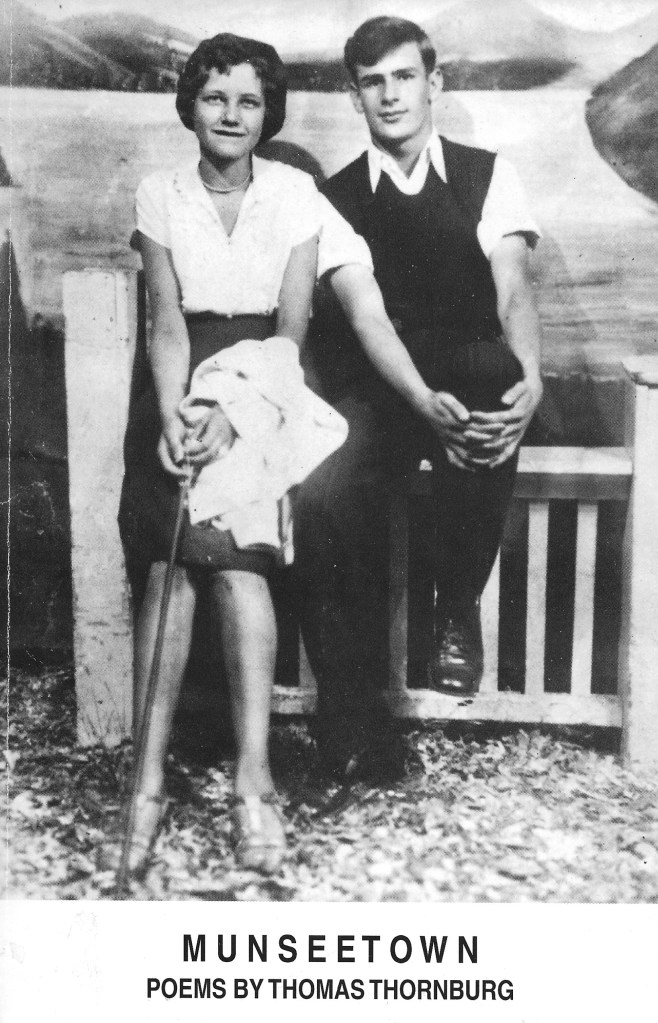
  • MUNSEETOWN: POEMS BY THOMAS THORNBURG

    Published by Two Magpies Press, Bozeman MT, 2001

    TAVERNA NOCTURNA

    (for Carol Kasparek)

    the sick cat in the clowder calls,
    (the little girl who loved her lost)
    wanders in the alley, falls
    and stiffens like a frozen coat;
    a powder of November palls
    on the despair of hunted dusks,
    a dumb husk of hares;
    that creature in the corner there
    sprawling in the drunken chair
    ringing silver on the table
    has no business being here
    and is in trouble.

    TETSUMARO HAYASHI

    When these feathered sing
    In fawdled magnolia
    It is truly spring.

    GILLESPIE TOWERS

    This winter sun again is centered
    Above Gillespie Towers where
    Each dawn discovers lights declaring
    Early risers there.
    Infirm and ill and some demented,
    Why do they rise in winder, staring
    When each in her cell might bask instead
    In summer dreams beneath the snows
    Of memory, secure and somnolent?
    The weak light rallies, and I know:
    A car awaits her who is newly dead.
    I must take leave of this, prepare my readings
    (Poems of death) for students, show
    Them the journey we must go.

    VALEDICTORY

    Not, if nothing else, a free
    Thing one spends his red time making,
    Fit words:  between you and me
    (One’s self abides though every shaking
    Star whipsaw on any side)
    This talk wrought for all your taking,
    This song, one’s self abides.
    There are lives no need to move to laughter
    One’s debtors dying as alone,
    To ink one’s name is writ in water:
    The polished stanza is a stone.

    Thus was this is, and this to be
    Horseman nor hearse in passing see,
    Or lovers in the quarreling world
    Read any but their now stones knurled;
    Nothing but poetry forgives
    Beauty for being so; we live
    Until we die, and die until,
    Rising like any spring a round us,
    God or godlessness unground us.

    to be continued, check back for updates

    Publication Status of Munseetown

    Currently, no copies of Munseetown are available anywhere on the Internet.  That status may change, and maybe even with some research, copies may be found. I will continue to search for copies.

  • ANCIENT LETTERS

    ANCIENT LETTERS

    Published by Barnwood Press, Daleville IN, 1987.

    Ancient Letters

    One wonders whom the next elected
    Criminal for these troubled times
    Will the feckless public, suspect,
    Lever in the long direction
    (Between the last war and the next)
    We take in our quotidian crimes;
    How long our matrons skirt the leering
    Lawless on main ways to market;
    How long our aged folk in fear
    Imprisoned at their portals peering
    On them convicted in their derring
    And that with such cocksureness wear
    The scutum of their darknesses,
    Petronius? (I pray you, burn these letters.) 

    Agrippina

    After the last trick had been turned in the game,
    The bumpers drunk, the galley fallen apart;
    The lying maid having drunk to a different name
    A cup for the journey, so to speak, at the start;
    One wonders whether that harried dame ever thought
    In terms of that fat man she and she father had wrought.
    Surely in knowing she would have aborted that plan
    Before it came forth in this world and assumed the shape of a man,
    Perhaps.  Nine gods were enough of a problem; she laid it on fate;
    She even exclaimed on how simple it was and absurd
    (She was dead for some time before they came to kill her, too late)
    To have birthed and been part of the proof and power of Hate.
    The guise it assumed and its manner have also endured:
    Took its place in the capitol, developed a merchant for fire,
    Was witty and sullen, hired artists to teach it the lyre,
    Gave games for the people, and like an innocent bird.

    Homage to Catullus

    1

    SWEET Lesbia,would you know the half
    of all my pleasure when your husband laughs
    delighted at your flyting and the flashing spite
    that lights your countenance when we two fight?
    watch out, my girl, your fat fool’s treasure,
    I may absent myself and rob the only pleasure
    he takes in both of us.  O, what frustration
    should I reave your table of my conversation—
    no, no, do not start up so hastily to weep;
    this is a lover’s promise not to keep.
    but still . . . his pleasure when your latest insult flies
    against me, and the room lights from your brilliant eyes
    as when I goad you fast between your thighs.

    2

    OCTAVIA, you bitch, when you deride
    me in the taverns, it is time you knew
    you build the envious world you hide in,
    and every drunkard there suspects the true.
    why is it now, fat forty, you should blame
    my cold pursuits at something you’d not give
    me years ago, now when you wear my best friends’s name?
    sweet Mercury, the weird world we live in!
    how you condemn me, now I am a poet
    who never knew you slim, nor know you fat,
    so stop pretending, dear, your friends all know it,
    even they know that.

    3

    FLAVIVS, do you know rising in the Forum,
    lisping your meums, tuums, how your colleagues
    snicker to one another common knowledge
    about your extra-curricular quorums?
    could you believe the pupils would not talk you
    in their graffiti in the public stalls?
    why have you let the praetors and plebeians mock your
    courses you offer on the taverns walls?
    O tempora, mores! we all know you, dear,
    each several senator and charioteer.

    to be continued, check back for updates

    Publication Status of Ancient Letters

    Amazon currently features one copy available at $7.00.  This copy does not feature the original book cover.  An additional option is offered by another seller, priced at $85.00 plus shipping.

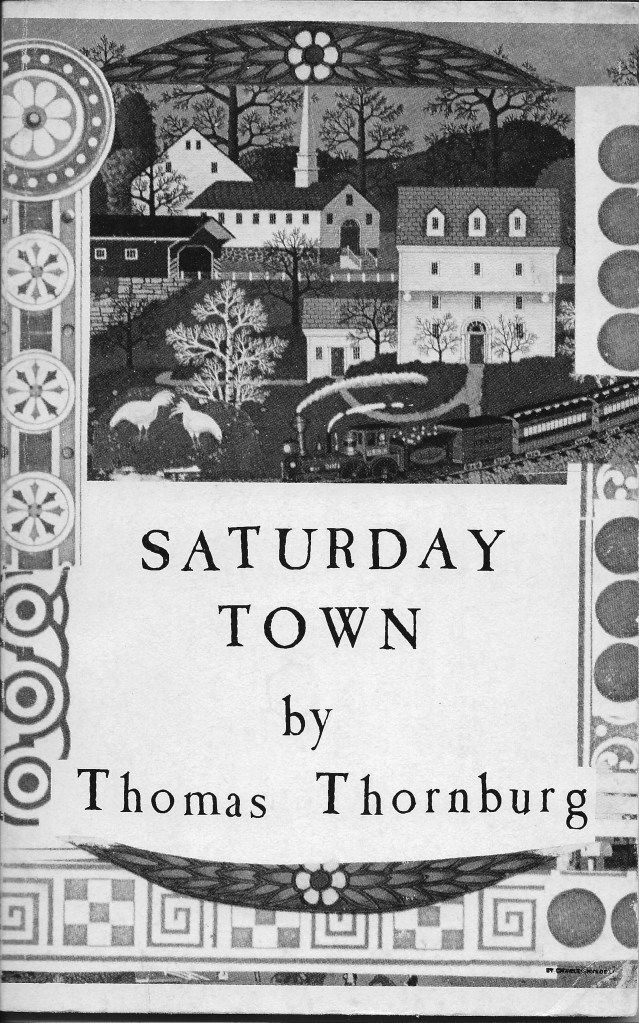
  • SATURDAY TOWN & other poems

    SATURDAY TOWN & other poems

    Dragon’s Teeth Press, 1976. 

    The following poems are from Thomas Thornburg’s first published collection, Saturday Town & other poems, published in 1976 by Dragon’s Teeth Press. 

    INTRODUCTION

    You, man or woman who hand this book
    Alive in this red world, looking
    To your own in your human heart
    The charged color of my high art,
    The word made flesh and the fleshed hoarding,
    Edged as one’s arm is, a supple knifing
    When knives come out and the thrust is in,
    Bone and blood is, kith and kinning,
    Hearth is and homeward, child and wiving
    Is this samethingness, blood and wording
    That is my labor,
    You are only my farthest neighbor.

    SATURDAY TOWN

    When I was a young stud heeling down
    The reebing streets of Saturday town
    The houses mewed and rafters rollicked,
    And who didn’t know me for a rounder?
    I played knick-knack while the sun fell, frolicked
    My heart like seven on the sawdust flooring
    Where the women boomed and the basses faddled
    I forked me a singular journey, saddled
    All the long moon where the dogstar diddled
    Till the cats closed shop for the dearth of dorking
    And the town turned over to see such sport;
    Oh, it was red money I spent indooring.
    One jig my heart snapped like a locket
    And I kissed it off to the fat and faring,
    Buckled my knees to the silver caring
    And hawsered my heart to an apron pocket.
    It’s luck I sing to the he and seeing,
    To the sidewalk shuffle of Saturday town
    (While the moon turns over and mountains scree)
    Where the owl and the pussycat buoy their drowning
    Ding-bat times in a stagging sea—
    Harts tine where the roe-bucked does are downing—
    And the Saturday man I used to be.

    AS I WALKED OUT IN THUNDERING APRIL

    As I walked out in thundering April
    And all the streets were runing
    And the day green-good went rilling for me,
    Freely I strolled in the curtained sunning;
    The world wave-wet, joyed and easily
    I nithing was, but not alone;
    There tulip and crocus and windy anemone
    Gayed in the giving rains, pleasing
    The very crows that the black wood cawed me,
    The trees in the rainy park applauded.
    As I youthed out in April, latching
    The careful door of my fathers’s house,
    A wind turned, catching my fellow slicker
    And the trafficking plash to market doused
    My sunday Pants; to the sexy dickering
    Town I puddled; it was time I forded,
    The pavement running seaward;
    There cunning I
    Brought fisted tulips to a boobing lady
    Who dawdled in her kinsman’s house;
    By back-alley ways where the lilac fawdled
    Rain-heavy blooms on my shoulder, purple;
    Sheer-bloused there in the corner-nook chair
    She sang an ancient turtling song,
    The morning ran over, the tall wood rooking.
    As I stepped into another April
    And capped my head, O, the winding day
    Carried the calling birds who circled
    In the peevish wet where the woods were graying;
    My hard-monied house stood still behind me
    Spelt home to children as they came hilling;
    It was a luffing wind my hart spilled,
    From the shrouding hangings of myself came, rilling
    Tulip and crocus and windy anemone
    To the hawser nithings, the port of onlies;
    It was not April ran my face
    But the figured sum of April tracing:
    Stood in that cycled hubbing weather
    Rounding my compassed heart until,
    My deaths aprilling my august knees,
    We walked the runing streets together

    to be continued, check back for updates

    Publication Status of Saturday Town

    Currently, no copies of Saturday Town are available anywhere on the Internet.  That status may change, and perhaps with some research, copies may be found.  I will continue to search for copies.

    Back Book Cover of Saturday Town

  • Elizabeth Barrett Browning’s Sonnet 4 “Thou hast thy calling to some palace-floor”

    Image: Elizabeth Barrett Browning – Getty Images

    Elizabeth Barrett Browning’s Sonnet 4 “Thou hast thy calling to some palace-floor”

    Elizabeth Barrett Browning’s sonnet 4 from Sonnets from the Portuguese continues with the speaker musing on her new relationship with her suitor, who seems too good to be true. 

    Introduction with Text of Sonnet 4 “Thou hast thy calling to some palace-floor”

    The speaker in Elizabeth Barrett Browning’s sonnet 4 “Thou hast thy calling to some palace-floor” seems to be searching for a reason to believe that such a match with a suitor  as distinguished as hers is even possible.  She continues to brood in a melancholy line of thought, even as she seems to be becoming enthralled with the notion of having a true love in her life. 

    The speaker’s past continues to cause her to brood and remain skeptical, as she has difficulty accepting her own accomplishments and poetic talent.   Likely, she is aware of her considerable ability, but when compared to her suitor, she feels that she cannot compete equally.

    Sonnet 4 “Thou hast thy calling to some palace-floor”

    Thou hast thy calling to some palace-floor,
    Most gracious singer of high poems! where
    The dancers will break footing, from the care
    Of watching up thy pregnant lips for more.
    And dost thou lift this house’s latch too poor
    For hand of thine? and canst thou think and bear
    To let thy music drop here unaware
    In folds of golden fulness at my door?
    Look up and see the casement broken in,
    The bats and owlets builders in the roof!
    My cricket chirps against thy mandolin.
    Hush, call no echo up in further proof
    Of desolation! there’s a voice within
    That weeps … as thou must sing … alone, aloof.

    Reading

    Commentary on Sonnet 4 “Thou hast thy calling to some palace-floor”

    Sonnet 4 marches on with the speaker’s musing on her new relationship with her suitor.  She seems to remain skeptical that such a relationship can endure, even as she obviously hopes that it will.

    She colorfully compares her lot with that of her suitor, by presenting an image of her dwelling juxtaposed with the image of the royal venue where her beloved is welcomed and where he performs.

    First Quatrain: Mesmerizing Kings, Queens, and Royal Guests

    Thou hast thy calling to some palace-floor,
    Most gracious singer of high poems! where
    The dancers will break footing, from the care
    Of watching up thy pregnant lips for more.

    In Sonnet 4 from Sonnets from the Portuguese, the speaker is addressing directly her suitor, as she continues her metaphorical comparison between the two lovers in a similar vain as she did with Sonnet 3.  Once again, she takes note of her suitor’s invitations to perform for royalty, as she colorfully remarks, “Thou hast thy calling to some palace-floor.” 

    Her illustrious suitor has been a “[m]ost gracious singer of high poems,” and the royal guests curiously stop dancing to listen to him recite his poetry.    The speaker visualizes her remarkable suitor at court, mesmerizing the king, queen, and royal guests with his poetic prowess.

    Second Quatrain:  Rhetorical Musings on Class Distinctions

    And dost thou lift this house’s latch too poor
    For hand of thine? and canst thou think and bear
    To let thy music drop here unaware
    In folds of golden fulness at my door?

    In the second quatrain, the speaker puts forth a rhetorical question in two-parts:

    1.  Being one of such high breeding and accomplishment, are you sure that you want to visit one who is lower class than you?
    2.  Are you sure that you do not mind reciting your substantial and rich poetry in such a low class place with one who is not of your high station?

    The questions remain rhetorical only in that the speaker entertains the deep hope that the answer to both parts of the question remains resoundingly in the affirmative.  Because readers of this sequence already know how the drama turns out, they must wonder if as she was writing these melancholy thoughts, she secretly held the sentiment of relief, knowing that her skepticism and doubt had been laid to rest.

    First Tercet:  Contrasting Visual and Auditory Images

    Look up and see the casement broken in,
    The bats and owlets builders in the roof!
    My cricket chirps against thy mandolin.

    The speaker then insists that her royalty-worthy suitor take a good look at where she lives. The windows of her house are in disrepair, and she cannot afford to have “the bats and owlets” removed from the nests that they have built in the roof of her house.  The final line of the first sestet offers a marvelous comparison that metaphorically states the difference between the suitor and speaker: “My cricket chirps against thy mandolin.” 

    On the literal level, she is only a plain woman living in a pastoral setting with simple possessions, while he is the opposite, cosmopolitan and richly endowed.  And he is famous enough to be summoned by royalty, possessing the expensive musical instrument with which he can embellish his already distinguished art.

    The lowly speaker’s “cricket” also metaphorically represent her own poems, which she likens to herself, poor creatures compared to the “high poems” and royal music of her illustrious suitor.   The suitor’s “mandolin,” therefore, literally exemplifies wealth and leisure because it accompanies his poetry performance, and it figuratively serves as a counterpart to the lowly cricket of the speaker.

    Second Tercet:  A Natural Mode of Expression

    Hush, call no echo up in further proof
    Of desolation! there’s a voice within
    That weeps … as thou must sing … alone, aloof.

    The speaker again makes a gentle demand of her suitor, begging him, please do not be concerned or troubled for my rumblings about poverty and my lowly station.   The speaker is asserting her belief that it is simply her natural mode of expression; her “voice within” is one that is given to melancholy, even as his voice is given to singing cheerfully.

    The speaker implies that because she has lived “alone, aloof,” it is only natural that her voice would reveal her loneliness and thus contrast herself somewhat negatively with one as illustrious and accomplished as her suitor.

  • Ron W. G.’s Prose: “Running a Marathon: Mostly a Mental Thing?”

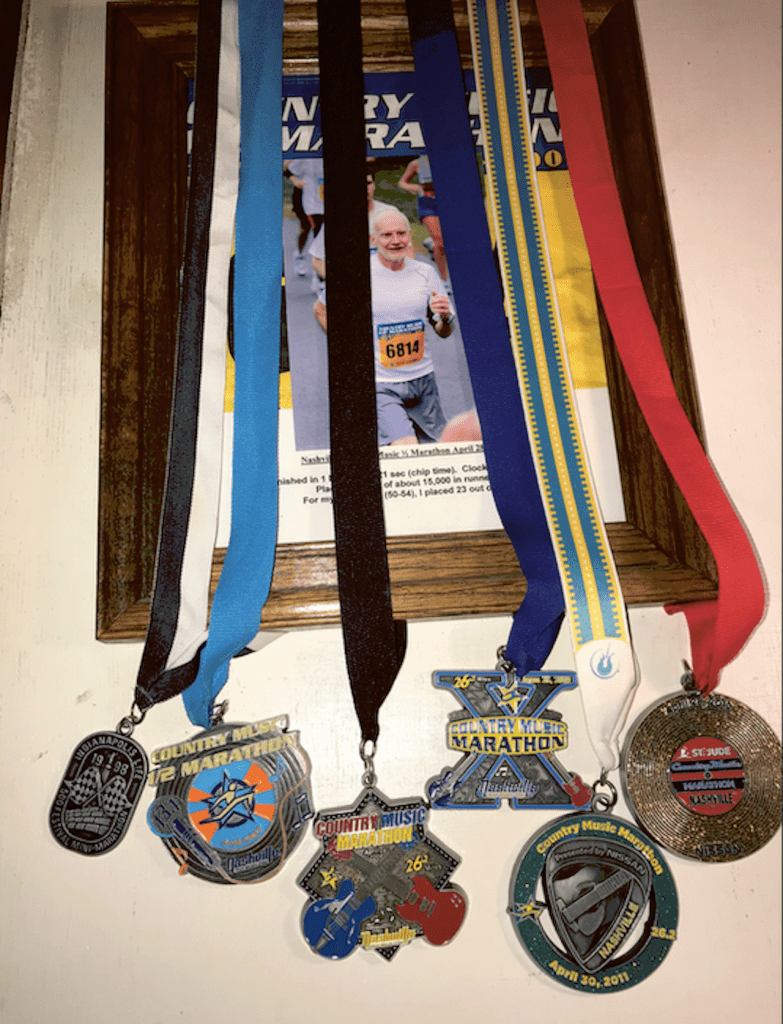
    Image: Ron running in the Nashville Country Music Marathon

    I have been running for over 40 years.  I started running when I was 24.  It wasn’t until I was 54 that I completed my first marathon.

    I always enjoyed reading books about running. I had run four half-marathons, but I never thought about running a full marathon. Until a comment from a stranger changed my thinking and my life.

    Changing Someone’s Life

    You may have changed someone’s life by something you said.

    A simple off-the-cuff comment can change a life forever. My life, especially as related to health and running, has been changed twice by comments someone made to me.

    My Sister Changed My Life

    The first life-changing comment occurred in 1978. I was living in a small town in Indiana and worked in a grocery store. I was married and had two children. I wanted to travel, and get an education, and I knew I couldn’t do both on a grocery clerk’s salary. I decided that joining the Army could help me reach those goals. I talked to a recruiter, who said that I would be able to take my family with me except during basic training. 

    Much to my surprise, my sister Faye joined the Army soon after I did. Faye went to basic training right away. I had a mobile home to sell, so I joined using the delayed entry program, which meant I would leave for basic training in the spring of 1979.

    A few weeks after Faye left for basic training she called me. During our brief conversation, Faye mentioned that she had run two miles. I was amazed. I said, “TWO MILES!” Faye down-played it by saying, “Well, just barely.” That didn’t matter to me. 

    The fact that she had run two miles changed my thinking. My sister had run TWO MILES! I was so impressed and so proud of her. Before Faye told me that she had run two miles, I had not thought about running at all. Faye’s two-mile run made me realize that I had to get in shape. I decided to start running right away.

    At First, It Made Me Sick

    I had to leave for work around 7:30 AM, so I started out running at 6:00 AM. I began running about a mile and then after a few weeks, I increased to two miles. For the first couple of weeks, I was so nauseated after each run that I had to lie on the bathroom floor. The nausea was overwhelming. I felt so sick that I couldn’t even sit up. If it wasn’t for the upcoming basic training, I would never have forced myself through that misery; however, as an enlisted person, I was owned by Uncle Sam, I had no choice. I had to get in shape. I had to keep running.

    After the first couple of weeks, my nausea started going away. Within two months I could run 5 miles and feel just fine afterward. I remember my father-in-law was impressed that I was running 5 miles. He said that since I could run five miles, I wouldn’t have to worry about basic training. He was right. Being able to run made basic training a lot easier for me.

    An Angel or a Demon?

    The second time my life was changed by a comment was about 20 years after I got out of the army when I was running a half marathon in Nashville, Tennessee. Runners parked at the finish line, and there was a bus to take them to the marathon starting line. 

    I got on the bus, and a lady sat next to me. She asked me if I was running the half marathon or the full marathon. I told her that I was running the half marathon, and then I said, “I don’t think that I could ever run a full marathon.” Then she said something that changed my life. She said, “If you can run five miles, you can run a marathon. It’s mostly a mental thing.” Wow, that so impacted my thinking. Running five miles was easy for me.

    Could I actually run 26.2 miles and complete a full marathon? I enjoyed reading books about marathon runners, but I had never thought that I would be able to run a marathon. The books I had read detailed the pain and difficulty involved in a marathon run. I did not think that I would ever put myself through that. This was my fourth half marathon. I had previously run three half marathons in Indianapolis, Indiana.

    I Could Not Let Go of the “It’s Mostly a Mental Thing” Comment

    The “It’s mostly a mental thing” comment by the lady on the bus stuck in my brain. Later that year, I decided to train for a full marathon. The first time I ran 20 miles, was a real eye-opener. I ignorantly did not take any water with me, and I must have become very dehydrated. By the end of the run, I was having a lot of back and abdominal pain. I thought, “Wow, it hurts to run 20 miles.” Later that day I had severe abdominal pain and ended up in the hospital with a kidney stone that had to be surgically removed.

    I recovered and trained hard for the marathon. I ran my first full marathon in April 2008. I was 54 years old. That marathon was a shock to me. My niece, Heather, had recently run a marathon, and she gave me the advice that I should start out slow. Of course, I started out way too fast. By mile 17 as I headed up a long hill, I was ready to collapse. I had to stop and walk part of the way. As I ran the last few miles, my leg muscles were screaming at me to stop. I wasn’t prepared for how painful it was. Each  step was excruciating pain.

    After My First Marathon

    The Nashville Marathon finish line was at the Tennessee Titans Football Stadium. The marathon was in late April, and it was cool at 6:00 AM when I arrived at the starting line area near the Nashville Parthenon. I wore a jacket and long pants over my running shorts and shirt. Just before the race started, I put the warm clothes in a gear bag. There were trucks to take the gear bags to the Titans Stadium so they can be picked up at the finish of the race.

    After I finished the marathon, I was in so much pain that I could barely walk. I headed toward one end of the stadium to pick up my gear bag. I don’t know why I didn’t ask someone where the gear trucks were. As I stepped down from a curb onto the road, pain shot through my leg muscles. I then had to walk through some gravel beside the stadium. Each step was pain-filled. It seemed like I could feel every muscle in my legs, and they all hurt a lot. I finally made it to the end of the stadium, but I did not see any trucks. I had left my clothes and car keys in the gear bag. I found a security guard and I said, “Where are the gear trucks?” He said, “They are over at the opposite end of the stadium.” My heart sank. I looked at him and said, “Oh God!”

    How could I have been so stupid that I didn’t find out where the busses were before I went to the wrong end of the stadium? I couldn’t believe that I had to walk that far. I didn’t think I could make it. I thought about asking a policeman to give me a ride to my car, but then I thought that if I told him I couldn’t walk to my car that he might not let me get into the car and try to drive home. I slowly made my way to the parking lot at the opposite end of the stadium. Along the way, I saw a grassy area and wanted to sit down, but realized that if I got down that there was no way I was going to be able to get back up. After many slow painful steps, I finally made it to the gear trucks and then to my car.

    During the last few miles of the marathon, my mental chant was, “Never again! I will never do this again.” When I got home and told my wife how difficult and painful it was, I said, “I will never do that again.” When I woke up the next morning, my first thought was, “I bet I can run the marathon faster next year.”

    Over 40 Years of Running

    I have now completed four marathons. Training for each marathon takes several months. To make sure that I am ready, I always complete at least one 20-mile run a few weeks prior to a marathon. So for me, a marathon is a lot of physical preparation. The “mostly mental” part for me was just believing that I could do it at all.

    I am not a fast runner. Initially, my goal was to run a marathon in 3 1/2 hours. I never accomplished that. Marathons always take me over 4 hours to complete.

    The only time I was able to actually run every step of the 26.2 miles without stopping at all was when I had a hip injury that caused me to limp. The day before the race, I wasn’t even sure I was going to attempt it. I decided that since I had already paid for it I would try and see how far I could run. The hip injury forced me to follow my niece’s advice and to start out slow. When I finished, I was elated that I had run every step of a full marathon.

    I often think of that lady on the bus who said that it was, “Mostly a mental thing.” During each marathon, when I was in excruciating pain, I wondered if that lady was an evil demon. A demon sent to make me suffer. Had I been so bad that I deserved that much suffering? Apparently so. 

    As of 2020, I am still running at the age of 66.  I only run 3 or 4 days a week now, and I have decreased the miles to 5 1/2 miles/day.  I am grateful that I am able to run.

    Most often when I think of that lady on the bus, I think that she must have been an angel. An angel sent to change my life by making me realize that I could do more than I had ever imagined.

    🕉

    For more information about the artist, Ron W. G., (Ron Grimes),
    please visit: Ron in TennesseeFacebook

  • Ron W. G.’s Prose “A Nightmare Comes True”

    The barn my grandfather built

    A Nightmare Comes True

    This is my experience of a recurring nightmare that came true.

    In 1970 I was 16 years old. We lived in a small town in Southeastern Indiana, in a little neighborhood just across the river from town. Our house was on the main road, and we had horses in a barn and pen area on the other side of the neighborhood. To get to the barn, we walked along a path that led past our grandparents’ house. The path led from our driveway, all the way across the neighborhood to the back road.

    On the way to the barn, our grandparents’ house was to the right, up a small hill past a yard with lots of trees and beautiful landscaping with flowers and shrubs.

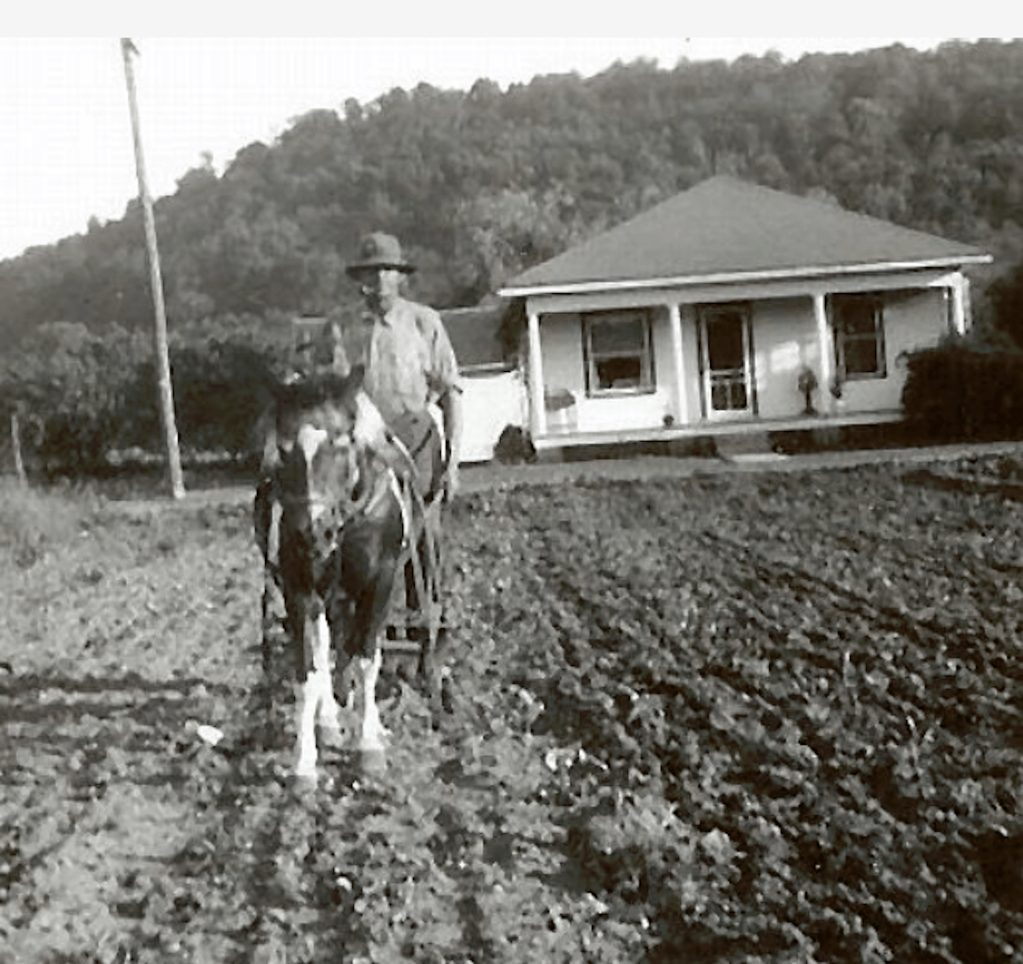
    Grandpa Plowing the Garden

    On the left side of the path was a huge flower garden with a grape arbor and many shrubs, small trees, and hundreds of flowers that bloomed in spring and summer.

    Our Grandparents Loved Animals

    When we were very little, our grandparents always had ponies and horses, and many other pets and animals. Grandpa used to take us for pony cart rides.

    Picture of grandpa and us on a pony cart ride

    Our grandparents had passed away years ago. From them, we inherited our love for animals.  We usually had a couple of ponies and horses, as well as several dogs. I loved horses and everything about them, so one of my chores was to feed the horses every morning before school. In the winter, that meant that I had to walk along the path across the neighborhood to the barn in the dark. That didn’t bother me at all. I carried a flashlight so I could see, but I wasn’t afraid of the dark. We knew everyone in the neighborhood, and I always felt completely safe there.

    The Nightmare

    One night I dreamed that when I went to the barn to feed the horses, there was a man in the barn. In the dream, as I was giving the horses hay, a man came up behind me. It scared me, and I usually woke up right away. I didn’t think too much about it at the time, but then I started having that dream every night. It started to scare me a lot, so I told my mom about the dreams. I told her that I was afraid to go over to the barn. 

    We had three German Shepherd dogs at the time, and Mom said, “Well, take the dogs with you.” So I started taking the dogs with me every morning. The dogs loved the early morning trek to the barn, and they were always eager to join me. Once I started taking the dogs with me, the dream stopped.

    A few weeks later, I started having the dream again. In one of the dreams, when the man in the barn came at me, I grabbed a pitchfork and stabbed him. That only happened in one of the dreams. In all the other dreams, I just saw a man in the barn, it scared me, and I woke up right away.

    After a few more nights of these dreams, I told mom that I was having that dream again and that I was afraid to go to the barn even though the dogs were with me. Mom said, “Take Randy with you.” Randy, my younger brother, was 14 years old at the time. He wasn’t obsessed with horses like I was, and he wasn’t exactly thrilled that he had to go out in the dark early morning cold, but he went along anyway. He loved the dogs, and he enjoyed seeing how excited they were to go on our morning excursions.

    The Dream Stops for Awhile

    After I started taking the dogs, and my brother with me to feed the horses, the dreams stopped, and all was good for a while.

    Then one night I had the dream again. I didn’t tell Mom or Randy that I had had the dream again. I didn’t know what else could be done, and since I had been having the dream on and off for several weeks and nothing bad had happened, I wasn’t too worried about it.

    That morning as we reached the barn, we noticed that the dogs were excitedly sniffing at the barn doors and running back and forth in front of the doors. I thought that they had probably just caught the scent of an animal, maybe a rabbit or something. I slid open the huge double barn doors, and the dogs immediately ran inside barking and growling. Inside the barn toward the back was the haystack.

    A man jumped up out of the hay and yelled as the dogs were at his feet. I couldn’t tell if the dogs bit him, but they were loudly barking and growling. Randy and I screamed and ran as fast as we could back to our house. The back door of our house faced the south side of the neighborhood and it was closest to the barn. The back door opened directly into the kitchen.

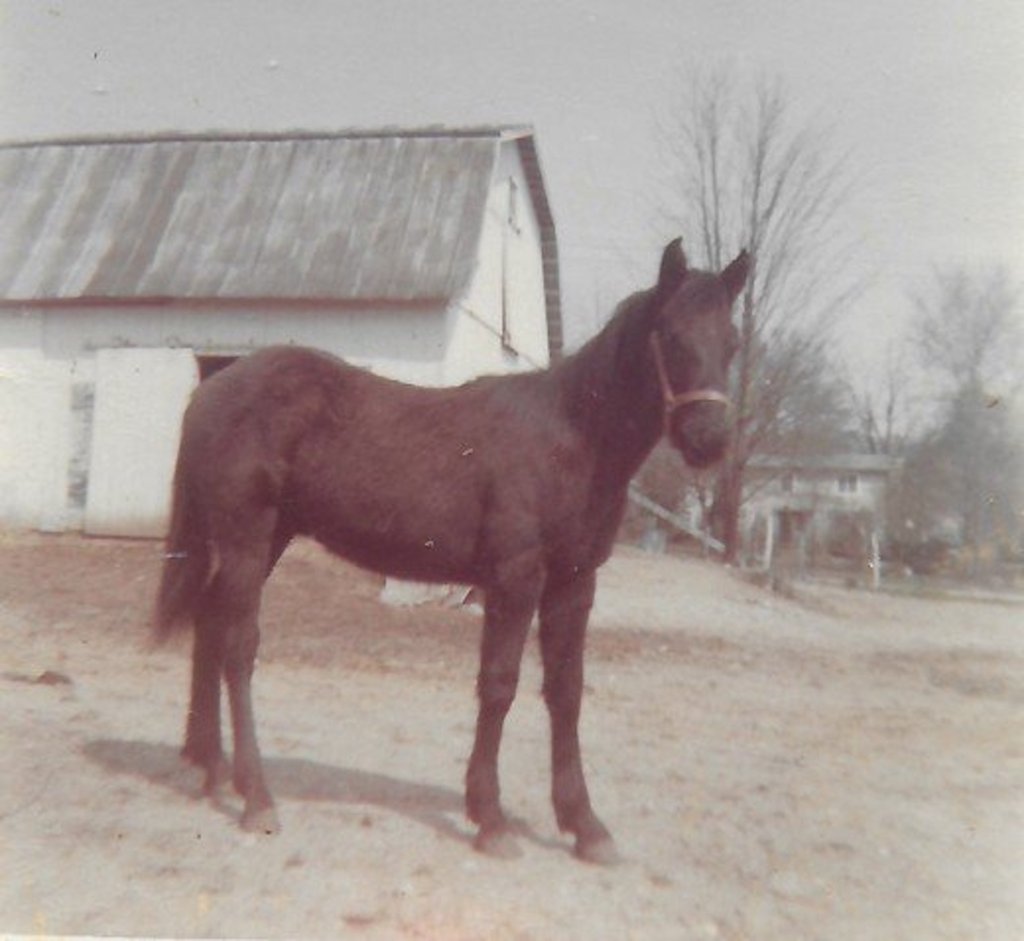
    My horse in back of the barn

    Randy and I ran in through the back door, and we both screamed, at the same time, “There’s a man in the barn!” In the kitchen were our Mom, our older brother Chuck, and our little sister Faye. At this point, I didn’t know if the dogs were still over at the barn, or if they had followed us back home. Our older brother, Chuck, grabbed a baseball bat and said, “Let’s go.” I remember being very impressed that Chuck was so brave.

    The dogs had come home, and they joined us as we returned to the barn. When we got to the barn, the man was gone. We could see where he had been sleeping in the hay, and where he had taken a leak on the floor. I fed the horses and we returned home. Mom said that she had called the sheriff, and he said that it was probably a bum just getting out of the cold. Then I felt sorry for the man. It must have been horrible to wake up with dogs attacking you.

    I Had Told My Family and Girlfriend About the Dreams

    I had told only my family and my girlfriend about those recurring dreams. My girlfriend lived just two houses down the road from our barn, and she loved horses as much as I did.

    After school that day, I was walking over to the barn as my girlfriend was walking up the road. When she got to the little hill which was on the back road just in front of the barn, I said, “There was a man in the barn this morning.” She said, “I just pinched myself to make sure I wasn’t dreaming.”

    The Dream Stops for Good

    I never had that dream again, and after a while, I no longer had to make Randy go with me to feed the horses. I did keep taking the dogs though since they loved going with me, and I enjoyed their company.

    I will admit that even though I wasn’t afraid anymore, I think that I was more alert as to my surroundings after that. I often wonder what might have happened if I had not had those dreams and if I had not told my mom about them.