The darkness and vastness of the center Bends over the vastness of each beginning— Over the rivers of memory, you spread Rivers of sick sorrow to each end.
The end of each vein springs blood And blood seeps into the water of light. Water finds its own reference point And each point fingers mud on granite.
The mud that covers your soul Will shuck itself in the soul of sorrow.
Image: Emily Dickinson – Amherst College – Daguerrotype of the poet at age 17, circa 1847 – likely the only authentic, extant likeness of the poet
Emily Dickinson’s “A Light exists in Spring”
The speaker in Emily Dickinson’s “A Light exists in Spring” is striving to portray a certain kind of light that “exists [only] in Spring” or very near spring.
Introduction with Text of “A Light exists in Spring”
Emily Dickinson’s “A Light exists in Spring” features five quatrains with a somewhat erratic rime scheme. Each quatrain follows a fairly regular pattern of ABCB with the second quatrain offering the slant rime, “fields / feels,” and the third quatrain offering no rime at all.
The final quatrain again features an irregular pair of rimes, “Content / Sacrament.” The theme of the poem focuses on a special feeling that becomes engendered in the observer as she experiences a certain kind of light.
A Light exists in Spring
A Light exists in Spring Not present on the Year At any other period – When March is scarcely here
A Color stands abroad On Solitary Fields That Science cannot overtake But Human Nature feels.
It waits upon the Lawn, It shows the furthest Tree Upon the furthest Slope you know It almost speaks to you.
Then as Horizons step Or Noons report away Without the Formula of sound It passes and we stay –
A quality of loss Affecting our Content As Trade had suddenly encroached Upon a Sacrament.
Commentary on “A Light exists in Spring”
Emily Dickinson has created a speaker in “A Light exists in Spring” who is musing upon and then striving to portray a certain kind of light that becomes visible only during the season of spring or, at least, very near that season of rebirth.
First Quatrain: A Particular Light
A Light exists in Spring Not present on the Year At any other period — When March is scarcely here
The speaker asserts that this light may be experienced “in Spring,” and this particular light cannot be seen at any other time of the year. However, the speaker then reports that this light does appear just after the month of March has arrived.
This claim, therefore, suggests that the light might also appear just before the actual season of spring has arrived. The season of spring does not begin until the third week of March, not in early March, as the speaker seems to be suggesting.
Second Quatrain: Not Identified by Science
A Color stands abroad On Solitary Fields That Science cannot overtake But Human Nature feels.
The speaker now claims that it is possible to observe a certain shade of color that has descended upon the “fields.” This extraordinary “color” apparently has not been identified in nature by science. However, human beings, according to this speaker, are capable of sensing this color without a name for or scientific description of it.
The speaker, therefore, hints that the color of this special light does not exist at all in nature, and it is perhaps only visible to the human soul—not the mind or even the heart—as such lights as rainbows or the aura borealis are visible to the human eye.
Third Quatrain: Unearthly, Perhaps Mystical
It waits upon the Lawn, It shows the furthest Tree Upon the furthest Slope you know It almost speaks to you.
This unearthly—perhaps even mystical—light with its special color may be experienced as it stands “upon the Lawn.” However, the light may also appear in trees that grow very far away and may also be gleaned from faraway, quite distant from the where the speaker views it. The speaker now reports that this strange mystical light may seem to converse with anyone, but its language would be one only known to the soul.
The speaker then strives to arouse in her listeners and readers an understanding that would be quite likely impossible to shape into words. The speaker has been carried to an indescribable place within her own soul.
This light that is capable of “wait[ing] upon the Lawn” but does not instantly pass across the lawn strongly suggests that it is capable of halting time for a short period—possibly to allow the observer to contemplate the nature of its existence.
Fourth Quatrain: As the Light Passes
Then as Horizons step Or Noons report away Without the Formula of sound It passes and we stay —
That time period which comes through experiencing that special light cannot wait long and thus “it passes.” Of course, the observer remains, that is, this speaker remains where she is while the light passes on.
The special light thus seems to resemble sunlight after it has passed overhead around the noon hour. Naturally, its final departure is without fanfare, although the speaker seems to have expected a sound, or some other sign to help her understand the strange feeling that this light has engendered in her.
Fifth Quatrain: An Inappropriate Intrusion
A quality of loss Affecting our Content As Trade had suddenly encroached Upon a Sacrament.
The speaker then asserts that she feels a kind of deep loss. It is as if something drastically inappropriate has happened. The speaker expresses that painful inappropriateness as the same as finding of “Trade” intruding “Upon a Sacrament.” She feels as wronged as Jesus felt upon encountering the money changers in the temple.
Spiritual Clarity
In Emily Dickinson’s “A Light exists in Spring,” the speaker has made a valiant effort to describe the ineffable. Such a task is impossible, but it is possible to portray the feelings that this ineffable entity has engendered in the heart and mind of the individual observer of that indescribable entity.
Thus the speaker has remained vague about what this light looks like, but she has made it quite clear how it has made her feel, and that is her reason for creating this particular little drama.
The speaker’s experience viewing this special light has moved her very deeply. Although she cannot portray the light’s physical nature, she can suggest the nature of the way the light has influenced her mentally and spiritually.
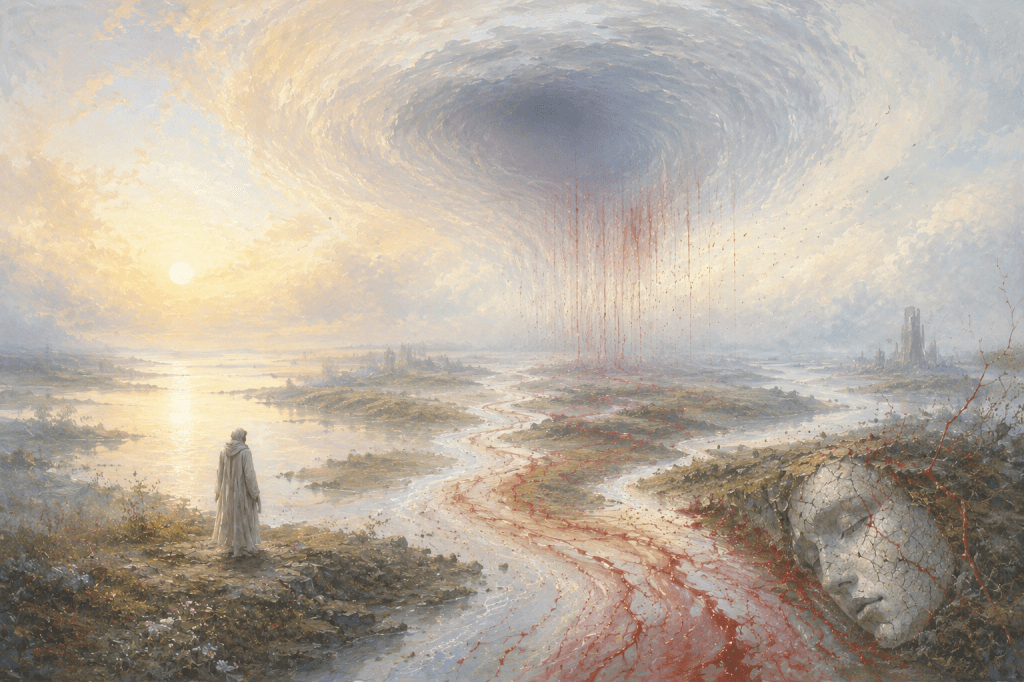
Image: Created by ChatGPT & Grok inspired by the poem
Options
Faces in the wind Seeming miles from shore A blank page awaits Walking fast past the window The pane seems real As any pain always will Slowing down is an option But you’d rather get answers Than continue to question
Fleeing is an option But a bridge looms large As rivers of memories emerge Standing is another option But the brink seems dangerous And a canyon of disdain May dismay the heart again
Leaving the woods Is an option Faster than crawling over logs Seizing the moment seems real Until the sunlight pierces the grass Then all bets are off and moving goes By trees that stand even more still than water Turning to ice in the snowy field Praying is an option Placing your life before the judge Allowing your soul to be guarded And guided as the weather booms And the horizon seems old and worn– I will make my bed of leaves, fold my hands Calm my heart and mind and the winter Storm will not touch my skin
Image: Emily Dickinson – Amherst College – Daguerrotype of the poet at age 17, circa 1847 – likely the only authentic, extant likeness of the poet
Emily Dickinson’s “The Brain – is wider than the Sky”
Emily Dickinson’s poem, “The Brain – is wider than the Sky,” compares and contrasts the human brain/mind with the sky, the sea, and God.
Introduction and Text of “The Brain – is wider than the Sky”
The idea that a human being is made in the image of God was not first conceived by a poet; that claim is found in the ancient text of the Holy Bible, and both Eastern and Western religious philosophical texts expound principles that the image of the Divine Creator exists in the children that He has created.
Emily Dickinson possessed a great depth of knowledge of the King James Version of the Bible. Undoubtedly, as she composed this poem, she quite obviously kept in mind the following biblical claim from Genesis 1:26: “And God said, Let us make man in our image, after our likeness.”
Dickinson’s poem, “The Brain – is wider than the Sky,” offers a unique expression of understanding regarding the unity of the Godhead and humankind. Emily Dickinson’s mystical ability allowed her to understand many ideas and concepts about the ineffable levels of being.
She was, therefore, able to interpret and expound on those ideas and concepts. However, instead of showcasing her knowledge in treatises, she chose to create little dramas with her poems.
The Brain – is wider than the Sky
The Brain – is wider than the Sky – For – put them side by side – The one the other will contain With ease – and You – beside –
The Brain is deeper than the sea – For – hold them – Blue to Blue – The one the other will absorb – As Sponges – Buckets – do –
The Brain is just the weight of God – For – Heft them – Pound for Pound – And they will differ – if they do – As Syllable from Sound –
Commentary on “The Brain – is wider than the Sky”
Metaphorically referring to the mind as the “Brain,” Dickinson’s speaker offers the essential truth that the Supreme Creator fashioned human beings in His image.
First Stanza: Brain Power
The Brain – is wider than the Sky – For – put them side by side – The one the other will contain With ease – and You – beside –
The first stanza contrasts the brain/mind with the sky claiming that the brain is wider because it can think about the sky and at the same time can think about the person who is thinking about the sky, and it can perform this operation easily.
That the brain can hold the sky reveals that the “Brain” is, indeed, a metaphor for “mind.” It is the mind, after all that, entertains the thought that is labeled “sky.” And while the mind is thinking “sky,” it also has the marvelous ability to retain thoughts of “you,” the reader, listener, audience—whoever might be hearing this lyric.
It will also be noted that the mind—”Brain”—possesses the ability to range even farther than the sky because it is “wider.” The width of the sky is not known; it is unlimited, thus the “mind” is even beyond unlimited—it being “wider.”
Such a quality must give one pause as one considers the possibility of possessing an instrument that can range beyond the limits of visual acuity. And this speaker is offering many instances that give the reader pause for thought—in order words, to exercise that mighty Brain/mind.
Second Stanza: More Brain Power
The Brain is deeper than the sea – For – hold them – Blue to Blue – The one the other will absorb – As Sponges – Buckets – do –
The second stanza contrasts the brain with the sea asserting that the brain can take in the sea as a sponge sucks up a bucket of water, once again referencing the vast thinking ability of the brain/mind.
If sponges can absorb buckets of water, they must be very large sponges and/or very many of them. The speaker is asserting again a vastness that is unlimited, even as sponges sucking up buckets of water might be.
But because she does not say two buckets, four buckets, or more, being absorbed by twenty or forty sponges, she has again allowed an unlimited number of items to come to mind. As the sky is limitless, those sponges and buckets must remain limitless as well, if their metaphorical likeness to the brain/mind is to remain operative.
Third Stanza: The Ultimate Brain Power
The Brain is just the weight of God – For – Heft them – Pound for Pound – And they will differ – if they do – As Syllable from Sound –
The third stanza contrasts but also compares the human brain to God. This stanza inflicts an interpretive difficulty; certain readers might mistakenly believe that the speaker is making a blasphemous assertion that the brain and God are the same. However, as elucidated in the following section, “God Is Not Limited,” such a claim is without merit.
God—the Unlimited
All devout believers contend that God is not limited by or to any one item of His creation. Almighty God—the Divine Belovèd and Father of All—is rightly considered to be vastly greater than all His creations taken together.
The human brain/mind thus is only one of God’s many creations, so to claim that “The Brain is just the weight of God” may at first without due reflection seem as if the speaker means that they are equal.
However, the blasphemy charge can be denied with a closer look at what the poem actually does, especially in the last three lines of the last stanza:
For – Heft them – Pound for Pound – And they will differ – if they do – As Syllable from Sound –
The speaker does not claim that the brain/mind and God are the exact same; she is concluding that the brain/mind and God are similar because of their vastness which she has demonstrated in her contrasts with the sky and sea.
The sky and the sea are massive—virtually cosmic in their proportions to other earthy creations—yet the brain/mind can conceive of them as ideas, which means that the brain/mind can hold them–that is, it can hold the ideas of those enormous entities.
As the speaker makes her claim that the brain/mind and God are close in essence, she expresses the reality that they do differ–they differ one from the other as a “syllable” differs from a “sound.” That difference is a solid one because there is a definite difference between a syllable and a sound.
The sense of the term “if”—in “if they do”—then becomes more accurately interpreted as “since” or “because.” She is offering the actual difference which negates the dual property of “if.”
However, because the aim of her speculation is to celebrate the significance as well as vastness of the brain/mind’s capabilities, the speaker avers that the brain/mind and God are similar. After all, it is the brain/mind that conceives the notion of God.
Still, God remains greater than the brain/mind because while the brain/mind is a “syllable,” God is “sound”; thus, the brain/mind becomes a perceivable symbolic representation of the ineffable God, as a syllable is a representation of sound. The difference is real, and ultimately, it is immeasurably more vast than the sky and ocean.
Image: Emily Dickinson – Amherst College – Daguerrotype of the poet at age 17, circa 1847 – likely the only authentic, extant likeness of the poet
Emily Dickinson’s “Two Butterflies went out at Noon”
Emily Dickinson possessed the gift of mystic vision, and that vision is displayed brilliantly in this enchanting poem that dramatizes two butterflies embarking on a mystical flight. The poem offers a glimpse into Dickinson’s ability to blend nature with transcendental themes.
Introduction and Text of “Two Butterflies went out at Noon”
In Emily Dickinson’s “Two Butterflies went out at Noon” (#533 in Thomas H. Johnson’s The Complete Poems of Emily Dickinson), the speaker is dramatizing an imaginary flight of two butterflies that ease out on a amazing journey.
Emily Dickinson creates a speaker, whose mystical vision is revealed in many of her poems, and this one serves as one of the finest examples of that vision. Her insightful gift accompanies her gift for creating little dramas that feature snippets of that insight in poetic form.
Two Butterflies went out at Noon
Two Butterflies went out at Noon – And waltzed above a Farm – Then stepped straight through the Firmament And rested on a Beam –
And then – together bore away Upon a shining Sea – Though never yet, in any Port – Their coming mentioned–be –
If spoken by the distant Bird – If met in Ether Sea By Frigate, or by Merchantman – No notice – was – to me –
Commentary on “Two Butterflies went out at Noon”
In Emily Dickinson’s “Two Butterflies went out at Noon,” the speaker dramatizes an imaginary flight of two butterflies embarking on an extraordinary journey. This poem exemplifies Dickinson’s mystical vision and her ability to craft poetic dramas that explore profound human themes through metaphorical imagery. It is a masterful example of her unique poetic voice.
First Stanza: Mysterious Arrival
Two Butterflies went out at Noon – And waltzed above a Farm – Then stepped straight through the Firmament And rested on a Beam –
The speaker begins with the simple yet intriguing statement, “Two Butterflies went out at Noon.” The butterflies’ sudden appearance is mysterious; they seemingly emerge from nowhere, unbound by any specific origin.
Their only marker is time—”Noon”—which suggests a moment of illumination or clarity. This temporal detail invites readers to ponder their symbolic significance as creatures of light and transformation.
The butterflies “waltzed above a Farm,” an image that evokes grace and harmony. Their movement suggests a carefree dance, embodying the beauty of nature’s fleeting moments.
The farm below serves as a grounding contrast to their ethereal presence, emphasizing their transcendence. Yet, their origin remains unknown, adding an air of mystery to their appearance and suggesting they are more than merely the physical beings well-known as butterflies.
The speaker does not clarify her own location during this observation, leaving readers to wonder whether she is physically present or perceiving them through an inner, mystical, transcendental vision.
After their graceful waltz, the butterflies “stepped straight through the Firmament,” ascending beyond the earthly realm into the heavens. This transition marks their departure from tangible reality into a cosmic or spiritual dimension.
Once beyond the firmament, the butterflies “rested on a Beam.” The beam could symbolize a ray of sunlight or divine energy, reinforcing their connection to higher realms.
This imagery suggests that the speaker’s perception extends beyond ordinary sight; she sees with an inner eye attuned to spiritual truths. The butterflies become metaphors for thoughts or souls—ephemeral entities that transcend physical boundaries.
Dickinson’s speaker’s metaphorical comparison likens these butterflies to thoughts—mysterious, fleeting, and boundless. Just as thoughts arise spontaneously and traverse unseen realms, so do these butterflies appear suddenly and vanish into intangible spaces with grace and speed.
The journey of these special butterflies mirrors the movement of ideas or spiritual insights that come unbidden and often disappear just as quickly. The nature of flight coincides with the nature of speed and lightness.
Second Stanza: Ephemeral Thoughts
And then – together bore away Upon a shining Sea – Though never yet, in any Port – Their coming mentioned–be –
In the second stanza, the butterflies continue their journey “Upon a shining Sea.” This sea symbolizes eternity or an infinite expanse, reflecting Dickinson’s life-long fascination with transcendence and the soul’s voyage beyond earthly confines.
The imagery evokes a sense of boundlessness, as the butterflies glide effortlessly over this luminous ocean without needing any vessel to carry them. Just as the soul, and even the mind, may seem to glide effortlessly from thought to feeling and back again.
The speaker notes that these remarkable butterfly-thoughts never stop at “any Port.” Their journey is uninterrupted by mundane destinations; they pass through existence without anchoring themselves in any fixed location. This detail emphasizes their ephemeral nature—they are not bound by material concerns but remain free to traverse limitless realms.
The absence of any mention of their arrival further underscores their elusiveness. The speaker suggests that if their presence had been detected in any port along their journey, it surely would have been noted or remarked upon by someone. Yet no such acknowledgment exists, heightening the sense of mystery surrounding their destination and purpose.
This seamless movement evokes wonder about where these itinerant butterflies will go next. Their path seems guided by an unseen force, reflecting Dickinson’s belief in the unseen powers that govern existence.
The butterflies’ journey becomes a metaphor for fleeting thoughts or spiritual revelations—beautiful yet transient experiences that defy capture or explanation. Even understanding by mental power exists beyond their realm.
Through this stanza, Dickinson’s speaker invites readers to reflect on the nature of impermanence and the ineffable qualities of spiritual experiences. The shining sea represents both possibility and mystery, a realm where boundaries dissolve and transformation occurs.
Third Stanza: Evading the Ultimate
If spoken by the distant Bird – If met in Ether Sea By Frigate, or by Merchantman – No notice – was – to me –
In the final stanza, the speaker avoids answering where the butterflies ultimately settle, instead emphasizing their elusive nature. She speculates about who might have observed them since their departure but concludes that no one has reported seeing them again. This lack of information reinforces their otherworldly quality—they exist beyond human comprehension or observation.
The speaker imagines possible witnesses who might have encountered these roaming butterflies: perhaps a “distant Bird” soaring high above or voyagers like frigates and merchantmen traversing vast seas.
These figures symbolize different perspectives—natural creatures attuned to the skies and human explorers navigating uncharted waters, like Christopher Columbus. Yet even these potential observers provide no reports of the butterflies’ whereabouts.
This absence of acknowledgment underscores their ethereal quality—they are invisible to ordinary perception and evade even those who might be best positioned to notice them. The butterflies symbolize fleeting thoughts or spiritual entities that traverse unseen dimensions, leaving no trace behind.
The speaker herself admits that she has no concrete knowledge of their final destination. Even as she entertains these butterfly-thoughts within her mind, she acknowledges their elusive nature—they come and go without leaving tangible evidence of their presence. Only through poetic imagination can she capture and display them for others to experience.
The speaker’s portrayal of these creatures reflects her longing for transcendence and her fascination with life’s mysteries. The poem becomes a devotional musing on impermanence, beauty, and the soul’s journey beyond the material level of existence.
A Poetic Meditation on Transcendence
In “Two Butterflies went out at Noon,” Emily Dickinson creates a speaker, who weaves an intricate tapestry of imagery and symbolism to explore themes of impermanence, transcendence, and spiritual insight.
The butterflies serve as metaphors for fleeting thoughts or souls—ephemeral entities that arise mysteriously, traverse unseen realms, and vanish without explanation—the nearly perfect description of the flight of thoughts and soul experience.
Through her vivid descriptions and enigmatic narrative, Dickinson’s speaker invites readers to reflect on life’s mysteries and embrace the beauty of impermanence. The poem exemplifies her ability to transform simple observations into profound musings on existence, showcasing her unique poetic vision.
Dickinson’s mystical perspective shines brightly in this work, offering readers not only a glimpse into her imaginative world but also an opportunity to contemplate their own journeys through life’s vast and mysterious landscapes.
Image: Emily Dickinson – Amherst College – Daguerrotype of the poet at age 17, circa 1847 – likely the only authentic, extant likeness of the poet
Emily Dickinson’s “I know a place where Summer strives”
In Emily Dickinson’s “I know a place where Summer strives,” the speaker personifies summer as a woman who struggles to overcome the coldness of late spring.
Introduction with Text of “I know a place where Summer strives”
The poet especially loved summer, and in this fascinating poem, she allows her speaker to convert summer into a gardener who experiences the obstacles that sometimes accompany the difficult birth of the summer season.
Sometimes it seems that it takes great effort or striving to overcome the coldness of late spring in New England, where residents may suffer snow and frost before the warmth of summer blossoms into the promised reality.
The poem offers a unique look at the arrival of the summer season. The speaker’s personification of summer as a woman tending her garden creates a magnificent drama that occurs every late spring.
Emily Dickinson’s poem, “I know a place where Summer strives,” consists of three stanzas. Each stanza has the rime scheme ABCB. The poems is #337 in Thomas H. Johnson’s The Complete Poems of Emily Dickinson.
I know a place where Summer strives
I know a place where Summer strives With such a practised Frost – She – each year – leads her Daisies back – Recording briefly – “Lost” –
But when the South Wind stirs the Pools And struggles in the lanes – Her Heart misgives Her, for Her Vow – And she pours soft Refrains
Into the lap of Adamant – And spices – and the Dew – That stiffens quietly to Quartz – Upon her Amber Shoe –
Commentary on “I know a place where Summer strives”
In Emily Dickinson’s “I know a place where Summer strives,” the speaker personifies summer as a woman who struggles to overcome the coldness of late spring.
First Stanza: Summer Endeavoring to Become
I know a place where Summer strives With such a practised Frost – She – each year – leads her Daisies back – Recording briefly – “Lost” –
In the first stanza, the speaker makes the puzzling claim that she knows “a place where Summer strives.” This remark is startling; one does not think of seasons as having the ability or the need to “strive.”
Only people are capable of striving. But in this poem, the speaker is, in fact, dramatizing the onset of summer by personifying Summer as a woman; Summer becomes a gardener who is endeavoring to accomplish the arrival of the summer growing season.
Unlike those who find the arrival of each season an automatic transition that is hardly noticeable, this speaker dramatically reveals that sometimes the Summer growing season is won by fits and starts. The speaker says that Summer “strives / With such a practised Frost.”
Late spring can remain cold in New England, where Dickinson lived all of her life. So it would seem that summer sometimes had a difficult birth, contending with frost and even snow. But Summer makes a great effort, and her endeavors result in bringing back the flowers, which seemed lost during the winter.
Second Stanza: A Helping Hand
But when the South Wind stirs the Pools And struggles in the lanes – Her Heart misgives Her, for Her Vow – And she pours soft Refrains
The speaker then asserts that for all the difficult attempts at arriving, a situation arises that offers a helping hand to Summer in bringing the season to full bloom. The “South Wind stirs the Pools,” and a summer storm blows up.
But Summer then still has some doubt about her success, and she has a promise to keep in delivering summer qualities of warmth and fertility so that seeds in the ground may grow into viable plants for food for people and animals. But then the rains begin, and Summer does absolutely arrive. All her striving has paid off.
Third Stanza: A Fierce Attempt
Into the lap of Adamant – And spices – and the Dew – That stiffens quietly to Quartz – Upon her Amber Shoe –
Summer “pours soft Refrains // Into the lap of Adamant”; she strives fiercely to arrive. She brings rain to the plants that will flourish during the growing season, which she had promised.
The rains will convert the landscape to a glowing green grassy hue that will illuminate the summer’s growing season. The Summer as a woman will tend her garden, and she will get mud on her shoes. That mud will become hardened like “Quartz.” Thus “Sumner” will sport shoes of “Amber.”
But happily, all her arduous striving will have succeeded: the flowers will gloriously come back. The frost will have finally departed, and the summer rains will be moistening the thirsty mouths of the plants.
Marvelous spices will result from Summer’s loving care of sun and rain. And even the gardener’s shoes will wear a beautiful “amber” because she has trampled in the mud caring for all the varieties of plants that help fill her larder for winter.
Dickinson’s “I know a place where Summer strives” rendered in song
The flowers are bright today. They take on an ethereal glow. They bloom in the flames of my tongue— And then remain silent.
They give off joy from a sacred place. Their fragrance shies away from contempt. As dumb as trees, they speak a holy tongue. Noise has no sway with their beauty.
They employ no mask to obfuscate dawn. They seek no retribution in the storm. They bend as needed— Not to a dictator but to their Liberator.
In the fires of eternity, they sing eternally. They rock their love in the equation Where humankind wishes to exist.
Image: Emily Dickinson – Amherst College – Daguerrotype of the poet at age 17, circa 1847 – likely the only authentic, extant likeness of the poet
Emily Dickinson’s “I cannot dance upon my Toes”
Famously, the poet Emily Dickinson lived a reclusive life. She protected her privacy. In her poetry canon, she often crafted little poetic dramas exploring and exposing the great joy her solitude afforded her. This poem is one of those little dramas.
Introduction with Text of “I cannot dance upon my Toes”
Emily Dickinson’s “I cannot dance upon my Toes” offers five stanzas, setting forth the poet’s famous slant rimes and non-traditional rhythms. The speaker is celebrating, with special emphasis, her personal experiences of “Glee.”
She knows that her readers/listeners will readily perceive her comparison to great performances in dance, theater, and opera. While her speaker does not link her joyous ecstasy to any particular public performances, she experiences great ecstatic bliss which she deems similar to the feelings heralded by such artistic displays.
I cannot dance upon my Toes
I cannot dance upon my Toes – No Man instructed me – But oftentimes, among my mind, A Glee possesseth me,
That had I Ballet knowledge – Would put itself abroad In Pirouette to blanch a Troupe – Or lay a Prima, mad,
And though I had no Gown of Gauze – No Ringlet, to my Hair, Nor hopped to Audiences – like Birds, One Claw upon the Air,
Nor tossed my shape in Eider Balls, Nor rolled on wheels of snow Till I was out of sight, in sound, The House encore me so –
Nor any know I know the Art I mention – easy –Here – Nor any Placard boast me – It’s full as Opera –
Commentary on “I cannot dance upon my Toes”
In Emily Dickinson’s “I cannot dance upon my Toes,” the speaker is creating a colorful poetic drama that examines the amazing joy afforded her through her engagement with solitude.
First Quatrain: The Joy of Dancing
I cannot dance upon my Toes – No Man instructed me – But oftentimes, among my mind, A Glee possesseth me,
The speaker asserts that she does not have the proficiency to dance as a ballerina would, because she has not received the necessary training and lessons that such dancers need to undergo. However, there are times during which she has the ability to experience indescribable joy of her soul. She suggests that such joy may be similar to that experienced through ballet.
The ability to dance upon one’s the toes remains a physical prowess, and very few individuals ever have the ability to reach such a lofty achievement. Because such ability and talent remain so rare, the speaker assumes that those who have the talent to render such performances must then experience “Glee.”
Second Quatrain: Skill That Remains Amazing
That had I Ballet knowledge – Would put itself abroad In Pirouette to blanch a Troupe – Or lay a Prima, mad,
The speaker then reports that if she ever had the special talent and physical agility to dance upon her toes, she would experience a fantastic level of “Glee.” The feeling would allow her to beam her talent as does the best of artists in the art of the ballet.
She is sure that her amazing skill would put the prima ballerina to shame causing that dancer to become maddened. The entire company of the ballet would become astonished by her amazing skill.
The speaker’s exaggeration places emphasize upon her belief that her soul qualities alone are responsible for her actual talent, and she wishes to pay homage to the Divine Essence which bestows on her such abilities.
Third Quatrain: No Fancy Outerwear
And though I had no Gown of Gauze – No Ringlet, to my Hair, Nor hopped to Audiences –like Birds, One Claw upon the Air,
In the third quatrain, the speaker reveals that she does not own gowns and gauze, as the famously public celebrity would possess. She also does not have the ability to sport other fancy clothing as theatrical talent may do. She also cannot have her hair styled into decorous fashion. No make-up artists ever visit her to ply their wares. She will wear no ringlets in her hair.
Because the speaker does not engage in the art of the ballet, she does not have the ability to fully comprehend that specialized art form. She freely admits that she has never engaged and will never experience the feelings that ballet dancers do as they cavort and prance upon the stage “like Birds” with “One Claw upon the Air.”
The speaker seems to express a modicum of disdain in describing the ballerinas as birds hopping across as stage with their hands in the air resembling the claw of a bird. That fascinating image elevates the description as it so colorfully fits the event.
Fourth Quatrain: Keeping Life Simple
Nor tossed my shape in Eider Balls, Nor rolled on wheels of snow Till I was out of sight, in sound, The House encore me so –
The speaker then offers further images that reveal experiences which she has never had and likely never will experience. For example, she has never “tossed” her body in “Eider Balls.”Instead of the fancy, intricate costumes which ballerinas and opera singers wear, this speaker dresses herself in simple clothing.
She has never finished a performance by dancing out of sight of the audience. She has never been called back to the stage by a ardent group of fans as they continue to applaud, prompting her to return to give them an enthusiastic “encore.”
Fifth Quatrain: Heavenly Rewards
Nor any know I know the Art I mention –easy –Here – Nor any Placard boast me – It’s full as Opera –
This speaker is demonstrating that she resides and thrives far outside of the milieu of ballet dancers. She suspects that no one with whom she is acquainted would even have an inkling that she has ever become aware that such an art exists.
Through intuition, this speaker can comprehend that the value of her work and her ultimate worth are equal to –if, in fact, they do not overtake in value –that of the performances that have received so many accolades of praise.
She is convinced that her accolades remain on a mystical level of being. Therefore, she can dance upon her toes –if only metaphorically and mystically –through her God-given talents reserved especially for her.
Through this speaker, the poet has paid tribute to her poetic talent and even, at least in her own mind, has elevated her own talent. In effect, she is averring that she is quite content to be unknown poet.
Even having the ability to be a celebrated prima ballerina cannot complete with the joy she experiences through her poetry creation. Her garden of verse offers her her own stage for performance that makes it possible for her to live a complete life.
Image: Emily Dickinson – Amherst College – Daguerrotype of the poet at age 17, circa 1847 – likely the only authentic, extant likeness of the poet
Emily Dickinson’s “I’ll tell you how the Sun rose”
The speaker in Dickinson’s poem “I’ll tell you how the Sun rose” is dramatizing what she knows about the sunrise but then hazards only a dramatic guess about sunset. Her choice for the target of her knowledge transforms the simple of act sunrise into a symbol.
Introduction with Text of “I’ll tell you how the Sun rose”
Emily Dickinson’s poem “I’ll tell you how the Sun rose” consists of sixteen lines, featuring her signature slant rimes and a generous sprinkling of dashes. The poem is written as one piece without divisions by stanzas but sections itself topically into four movements.
The first two movements describe how the sun came up on the particular morning of the speaker’s choosing, while in the second two movements, the speaker is simply dramatizing her suggestion for why she cannot explain how the sun set.
I’ll tell you how the Sun rose
I’ll tell you how the Sun rose – A Ribbon at a time – The Steeples swam in Amethyst – The news, like Squirrels, ran – The Hills untied their Bonnets – The Bobolinks – begun – Then I said softly to myself – “That must have been the Sun”! But how he set – I know not – There seemed a purple stile That little Yellow boys and girls Were climbing all the while – Till when they reached the other side, A Dominie in Gray – Put gently up the evening Bars – And led the flock away –
Commentary on “I’ll tell you how the Sun rose”
Emily Dickinson’s “I’ll tell you how the Sun rose” is dramatizing what the speaker knows about the sunrise but then hazards only a dramatic guess about sunset. Interestingly, she is suggesting that she can observe the sunrise but not the sunset.
First Movement: Explaining the Unexplainable
I’ll tell you how the Sun rose – A Ribbon at a time – The Steeples swam in Amethyst – The news, like Squirrels, ran –
The speaker announces that she will be explaining to her listeners, “how the Sun rose.” She then through the employment of metaphor likens the sun’s rays to ribbons that are released a single ribbon at a time. The colorful sun ribbons of rays are leisurely released, and they hover the ocean to a place where the steeples of churches appear to “sw[i]m in Amethyst.”
The sun’s fire then looms upon the blackness, immediately reverting to blue as it takes on a brightness, fully glowing because of the light that the sun has released. The luminescence of the sun spreads with great haste; thus the speaker compares its speed to the scampering of squirrels, as she calls the event “news.”
Second Movement: The Ordinary Made Extraordinary
The Hills untied their Bonnets – The Bobolinks – begun – Then I said softly to myself – “That must have been the Sun”!
The speaker now asserts that the hills removed their “Bonnets,” and the birds knowns as “Bobolinks” commenced their singing. The metaphoric personification of hills with bonnets suggests that all of nature is coming alive again, and the speaker knows this because she sees many colors that may be detected in the faraway hills. Birds have awakened, and they have begun their many layered chirping.
The speaker’s reaction is such that it would make it seem she is seeing this event for the first time. She muses and quotes herself breathlessly, for example, as she exclaims,”‘That must have been the Sun’!” The speaker is creating her little drama using ordinary items from her environment which she makes extraordinary in her reporting.
Third Movement: A Forceful Drama
But how he set – I know not – There seemed a purple stile That little Yellow boys and girls Were climbing all the while –
The speaker then envisions her situation to be nearer to sunrise than to sunset. This idea, of course, is merely fictional, but it offers her the ability to create her drama of how the sun rises. She knows she cannot explain scientifically such an event, but she can forcefully and dramatically imagine it.
So in order to explain sunset, she imagines she can see a set of steps that appear purple in color from a distance. Little Chinese children are climbing on those steps. Those children are likely just going home from a day of school or tending sheep.
Fourth Movement: The Cover of Darkness
Till when they reached the other side, A Dominie in Gray – Put gently up the evening Bars – And led the flock away –
The children have climbed to the other side of the stile, an event that signals the sun’s lowest point just as it then vanishes from sight. A shepherd or perhaps even a churchman secures the gate then leads the flock of sheep or perhaps children away from that area.
Because darkness is now hovering thick, the speaker cannot offer any images for what may be happening next. The speaker’s lack of knowledge about sunset is reflected in her word choices which are much less certain than her drama about how the sun rises. By suggesting that she can tell you all about how the sun rose but not so much about how it set implies the speaker prefers sunrise to sunset.
The Symbolism of Sunrise
In Emily Dickinson’s “I’ll tell you how the Sun rose,” sunrise becomes symbolic of life-enhancing positivity: the beginning of the day offers opportunities for living and creating. Sunset, on the other hand, simply offers the opportunity for sleep.
The curious active mind is always hankering for more positive opportunities for acting out its desires, for securing a stage for creativity, and for living its need for motion. That stage is daylight, after the sun rises and throws its life-giving rays upon land and its inhabitants.
Image: Emily Dickinson – Amherst College – Daguerrotype of the poet at age 17, circa 1847 – likely the only authentic, extant likeness of the poet
Emily Dickinson’s “There’s a certain Slant of light”
Dickinson closely observed and investigated her surroundings; she also keenly examined her own feelings then dramatized those feelings in poems. In “There’s a certain Slant of light,” her speaker is infusing melancholy into her perception of light streaming through a window on a winter afternoon.
Introduction with Text of “There’s a certain Slant of light”
Emily Dickinson developed the habit of closely observing as she investigated her surroundings. The poet then keenly examined and mused upon her own feelings, finally dramatizing those feelings in poems.
The poet created this speaker in “There’s a certain Slant of light” to reveal a mood of slight melancholy as she muses on a shaft of light streaming in through her window on a winter afternoon.
That streaming light through the window seems to tip and tilt, that is, “slant,” in a way that causes the speaker to undergo that sense of melancholy, which is no ordinary gloom but brings with it a spiritual aspect.
The speaker creates a little drama based on her intense feeling of spiritual intuition which has been motivated by a simple “Slant of light” streaming in through the window on a cold, winter afternoon.
There’s a certain Slant of light
There’s a certain Slant of light, Winter Afternoons – That oppresses, like the Heft Of Cathedral Tunes –
Heavenly Hurt, it gives us – We can find no scar, But internal difference, Where the Meanings, are –
None may teach it – Any – ‘Tis the Seal Despair – An imperial affliction Sent us of the air –
When it comes, the Landscape listens – Shadows – hold their breath – When it goes, ’tis like the Distance On the look of Death –
Reading of “There’s a certain Slant of light”
Commentary on “There’s a certain Slant of light”
A simple viewing of a shaft of light streaming into the room on a winter day engenders in this speaker a melancholy prompting this little drama. The spiritual experience thus is rendered in paradox—the ultimate literary device for communicating the ineffable.
First Stanza: The Oppression of Tilting Light
There’s a certain Slant of light, Winter Afternoons – That oppresses, like the Heft Of Cathedral Tunes –
The speaker begins the drama by asserting that on certain winter afternoons the light shining in through her window comes in at a “certain Slant” and that tilting light “oppresses” her in the way the heavy tones of sacred chants might do. Although light is weightless, to the speaker in this particular mood, it seems heavy enough to oppress her into melancholy.
A paradox results from the speaker finding the “light” to be as heavy as church music. Music experienced in church is meant to uplift, not weigh one down. If something that is meant to uplift does the opposite, then one has to explore the reasons for such oppression. Why would music that ordinarily produces a spiritual upliftment become an instrument of oppression—that is, something that is heavy?
Second Stanza: The Human Craving for Meaning
Heavenly Hurt, it gives us – We can find no scar, But internal difference, Where the Meanings, are –
The deeply inspiring sound of “Cathedral Tunes” brings the speaker to a place of “Heavenly Hurt.” Again, she paradoxically describes her experience: Heaven is a spiritual place where there is no hurt, no pain, no distress, no oppression—only bliss.
The speaker confirms as much as she avers that this “hurt” never results in a “scar.” And it also leaves no physical mark such as scar because this melancholy is inside of the speaker; it is her soul that has engaged with this music, this light, that has caused this spiritual experience.
The speaker employs the term, “Meaning”—all human beings on all levels of awareness crave meaning in their lives, and the speaker has become aware of the meaning of an inner life that is more important than the corporeal. True meaning come from the soul not from the body that changes and dies, nor from the mind that knows nothing but change.
Third Stanza: Soul Meaning
None may teach it – Any – ‘Tis the Seal Despair – An imperial affliction Sent us of the air –
The speaker then affirms that one cannot be taught this kind of soul meaning. The mystical state of the desire for meaning comes on one unbidden, as casually as taking a breath. “Despair” of the material world often leads one to ask the question, is this all there is to life?
But the individual becomes a seeker after she begins to entertain such questions. Divine cravings may be prompted by any outward experience such as light tilting in through a window, but those cravings for spiritual reality can be satisfied only through soul-union, which is Divine Awareness. The melancholy of spiritual desire is a first step to that Ultimate Awareness.
Fourth Stanza: The Nature of Reality
When it comes, the Landscape listens – Shadows – hold their breath – When it goes, ’tis like the Distance On the look of Death –
After the strong spiritual desire for meaning, that is, comprehending the nature of Reality approaches the sensibility of the individual, that individual wished to cease the flux of all phenomena in order to listen—”be still and know that I am God” (KJV, Psalm 46:10).
This speaker creates her drama by asserting that “Shadows – hold their breath.” Shadows holding their breath suggests a depth of quietness that is nearly unfathomable. A miraculous awareness engulfs the speaker.
The speaker has discovered that this “heavenly hurt,” this spiritual melancholy, transforms itself into the light of understanding. Death loses its grip and meaning after such a level of awareness is achieved, no longer grasping the heart and mind of the individual.
After death has become merely a distant force, the spiritual aspirant sees more clearly all other forces that operate in her sphere. The speaker has thus reached that inner Goal. Death is beaten and given its place to Awareness.
The Science and Symbolism of Light
That a simple “Slant of light” should engender a deep mystic state of awareness in this speaker is quite apt. Regarding the nature of light, in his spiritual classic, Autobiography of a Yogi [1], Paramahansa Yogananda has explained that the material universe is composed of light. Many modern discoveries have revealed to humanity that the cosmos is composed of various expressions of one power—light—guided by Divine Intelligence.
Paramahansa Yogananda has also explained that only differing rates of vibration account for the differing forms that exist throughout the cosmos:
Modern science has shown that everything in the universe is composed of energy (light), and that the apparent differentiation between solids, liquids, gases, sound, and light is merely a difference in their vibratory rates.
Also in his autobiography, Paramahansa Yogananda has explained in detail the nature of light, comparing it to other “waves”:
Among the trillion mysteries of the cosmos, the most phenomenal is light. Unlike sound waves, whose transmission requires air or other material media, light waves pass freely through the vacuum of interstellar space. Even the hypothetical ether, held as the interplanetary medium of light in the undulatory theory, may be discarded on the Einsteinian grounds that the geometrical properties of space render unnecessary a theory of ether. Under either hypothesis, light remains the most subtle, the freest from material dependence, of any natural manifestation.
The individual who has achieved the realization that “the essence of creation is light” is thus capable of operating the law of miracles. The term miracle simply applies to any phenomenon whose operation science [2] has yet to discover.
What the soul knows through intuition will always be running miles and years ahead of what physical science [3] knows because physical science can explore and examine only the created cosmos not the Creator of that cosmos. The soul, however, being a spark of the Creator, knows all that the Creator knows—either in fact or in potential.
Emily Dickinson’s employment of light in this poem thus results from her deep intuitive awareness that light is the building substance of the cosmos. Therefore, “light” becomes a symbol for that intuition that would continue to guide the poet as she continued to create her mystical, metaphysical, metaphorical “garden” of poetry.



 Linda's Literary Home