Linda's Literary Home

Tag: poetry

  • Arna Bontemps’ “God Give to Men”

    Arna Bontemps - Poetry Foundation - https://www.poetryfoundation.org/poets/arna-bontemps 
    Image: Arna Bontemps – Poetry Foundation 

    Arna Bontemps’ “God Give to Men”

    Arna Bontemps’ speaker makes a statement about three classifications of humankind, employing subtle but bitter irony to further his point of view.

    Introduction with Text of “God Give to Men”

    Arna Bontemps’ “God Give to Men” disguises its bitter irony in a prayer, in which the speaker seems to be asking God for certain gifts for each of three classifications of human beings: “the yellow man,” “blue-eyed men,” and “black man.” 

    The speaker’s subtle but bitter irony reveals his contempt as he actually denigrates two of classifications.  The speaker does not reveal explicitly to which classification he belongs.  Thus, readers are given some latitude to interpret the significance of each gift the speaker wishes to bestow on each class of men.

    An interesting thought experiment might include reading the poem from three different perspectives.  That is, if the speaker is a “yellow man,” what do his gifts to that class mean?   Also, if he is one of the “blue-eyed men,” how does that change the significance of each gift?   And if he is a member of the “black  man” classification, how might that impact his choices?

    The Weakness of Stereotyping 

    It should be noted that the speaker engages heavily in stereotyping for all three classifications.   Such a weakness could encourage the thought that this speaker does not belong to any of the classifications to which he is referring; for example, perhaps he is a red man or a brown man of Hispanic or Middle Eastern heritage, or perhaps he is an Indian from India.

    By stereotyping each classification of man and men, the speaker offers nothing of substance regarding each, but the question does arise regarding the possible animus he holds for certain of the classifications.

    Singular vs Plural

    Interestingly, the speaker refers to the first classification as “the yellow man,” while designating the second group as “blue-eyed men.” Then he returns to the singular for the third group. That distinction from singular for the “yellow man” to plural for the “blue-eyed men” and then back to singular for the “black man” offers an issue for interpretation. 

    Might pluralizing the “blue-eyed” indicate the speaker’s level of familiarity with that group?  Perhaps he simply finds the plural more rhythmic in its employment of pronouns.  Or perhaps, it a simple rookie mistake. Such distinctions remain for each reader to decide.

    God Give to Men

    God give the yellow man
    an easy breeze at blossom time.
    Grant his eager, slanting eyes to cover
    every land and dream
    of afterwhile. 

    Give blue-eyed men their swivel chairs
    to whirl in tall buildings.
    Allow them many ships at sea,
    and on land, soldiers
    and policemen.

    For black man, God,
    no need to bother more
    but only fill afresh his meed
    of laughter,
    his cup of tears.

    God suffer little men
    the taste of soul’s desire.

    Commentary on Arna Bontemps “God Give to Men”

    In this poem, the speaker puts on display stereotypes that he holds regarding three classifications of humankind. His evaluation of each classification becomes apparent through the gifts that he asks the Creator to bestow on each.

    First Stanza:  The Yellow Man

    God give the yellow man
    an easy breeze at blossom time.
    Grant his eager, slanting eyes to cover
    every land and dream
    of afterwhile. 

    In the first stanza, the speaker asks God to grant “the yellow man” gentle winds as he engages his “slanting eyes” observing the beauty of “blossom time.”  He then asks that this yellow man be afforded the prescience to peer into the “afterwhile.”

    The two gifts that the speaker is asking from God for the “yellow man” reveal two stereotypes that Westerners entertain regarding their Eastern brothers and sisters.  The first gift of “an easy breeze at blossom time” shows that the speaker has been influenced by Japanese and Chinese fine paintings that depict delicate “blossoms.” 

    In his second gift to the “yellow man,” the speaker is engaging the stereotype that assumes all Asians adhere to the tenets of reincarnation and karma.  He wishes God to grant this Eastern man the ability to see with his “slanting eyes” “every land and dream / of afterwhile.” 

    The magnanimity of both these gifts, however, is diminished by the mere fact that both gifts are based on stereotypes, not the individual heart-felt desire that each human being be given appropriate gifts from God.  

    But the insincerity of these stereotypical gifts becomes more than merely trivial.  The speaker is denigrating the yellow man for engaging in the mere frivolity of light sense pleasure; that “easy breeze at blossom time” thus competes with more important life-sustaining vital gifts that the speaker could have assigned the yellow man.  

    Note also that a poet writing today would be pilloried for using an expression such a “slanting eyes” to refer to an Asian individual—that is, unless that poet is of the ilk of LeRoi Jones, aka Amiri Baraka or Arna Bontemps.

    Second Stanza:   The Blue-Eyed Men

    Give blue-eyed men their swivel chairs
    to whirl in tall buildings.
    Allow them many ships at sea,
    and on land, soldiers
    and policemen.

    For the “blue-eyed men,” the speaker asks that God give them skyscrapers with office equipment, as well as mighty navies and armies with “soldiers”  as well as “policemen.”   Again, as with the yellow man,  the speaker employs a mere stereotype to designate which two gifts he thinks God should grant.  The first gift that God should grant the blue eyes is the comfortable chairs in office buildings that are tall. 

    The speaker is presenting the stereotype that blue-eyed men are materialists who work in offices with “swivel chairs” in “tall buildings.”  The second gift of vast military force and police officers again stereotypes the “blue-eyed men” as interested only in power and force. 

    By honing in on these two particular gifts instrumental in the use of force, the speaker reduces those men with blue eyes to power hungry monstrosities.  As this classification is much less of a protected class in the 21st century, the poet writing today could get away with much more invective stereotyping even than this one.  

    Third Stanza:   The Black Man

    For black man, God,
    no need to bother more
    but only fill afresh his meed
    of laughter,
    his cup of tears.

    The speaker then asks God’s gift to the “black man” be nothing special—just let him laugh plenty and cry as needed.  This classification dictates that it suffer the other classes to precede it, as this classification remains humble.    But the humility remains a mere façade as the bitter irony of the speaker’s requests has demonstrated his scant knowledge of all three classifications. 

    A stereotype can describe only a surface level of qualities, for example, the notion that black people all have rhythm and love watermelon and fried chicken becomes ludicrous after observation of real individuals forming this classification.   Yet, less obnoxious stereotypes are just as insidious, as they stand in for individual knowledge and mask ultimate reality.

    Fourth Stanza:   Suffering Their Desires

    God suffer little men
    the taste of soul’s desire.

    The fourth stanza consists of only two lines that ask a generalized gift from God.   The speaker wishes that each man of each classification “suffer” “the taste of soul’s desire.”  Essentially, the speaker is asking God make sure each of these “little men” are afflicted with whatever punishment they deserve for entertaining the desires that they hold.  

    The speaker has assigned each classification of human beings a “soul’s desire,” but that desire has been determined by a very biased speaker, who holds bitter contempt for his other-racial fellows.

    Asking God to grant each group of mankind their wishes, the speaker assumes that the yellow man wants to experience pretty flowers and contemplate the after life and that the blue-eyed men wish to accrue wealth and power.

    However, black man needs nothing at all; he remains so humble that all he wants is just to laugh and cry as he sees fit.  Thus the speaker is also implying that heretofore the black man has been denied his ability to laugh and cry according to his dictates.  But now through his humble prayer, the speaker hopes that God will give these well-deserved gifts, and then all will be right with the world.

    Reaping Bitter Fruit

    Readers likely wonder what may be the significance of race for the black poet Arno Bontemps.  The following poem by Bontemps is one example that demonstrates the poet’s attitude toward race:

    A Black Man Talks of Reaping

    I have sown beside all waters in my day.
    I planted deep, within my heart the fear
    That wind or fowl would take the grain away.
    I planted safe against this stark, lean year.
    I scattered seed enough to plant the land
    In rows from Canada to Mexico
    But for my reaping only what the hand
    Can hold at once is all that I can show.
    Yet what I sowed and what the orchard yields
    My brother’s sons are gathering stalk and root,
    Small wonder then my children glean in fields
    They have not sown, and feed on bitter fruit.

    The speaker in the Bontemps “The Black Man Speaks of Reaping” portrays black labor as vast, careful, but undercompensated; the speaker’s harvest is stolen by others, leaving descendants to glean only bitter, inherited injustice.  

    While Bontemps did not spout bitter personal hatred toward his fellows of other races—as did LeRoi Jones, aka Amiri Baraka—Bontemps did often decry the limitations he perceived that were placed on the black race.  He then often expressed his bitterness with irony and satire.  

    In “God Give to Men,” Bontemps has crafted a speaker, who is demonstrating a bitter attitude directed toward the races of men not his own, and although the piece engages subtle irony, it loses its heft because of the focus on stereotypes.
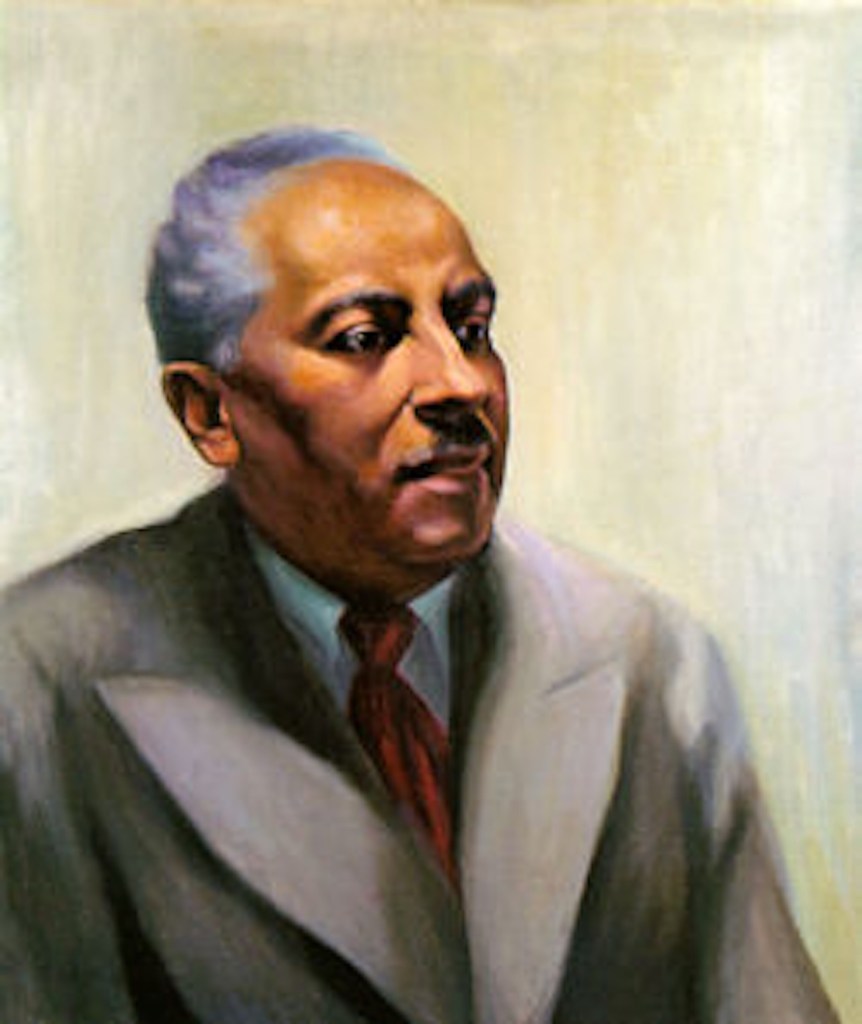
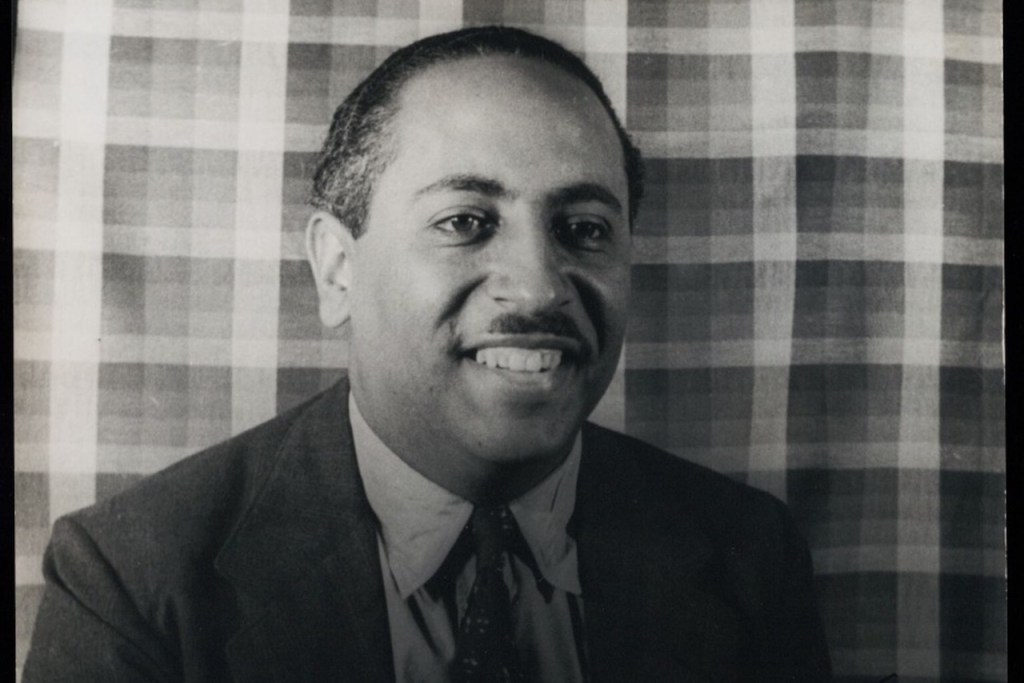
    Painting of Arna Bontemps  - Betsy Graves Reyneau, 1888 - 1964 https://www.si.edu/object/npg_NPG.67.79
    Image: Painting of Arna Bontemps  – Betsy Graves Reyneau, 1888 – 1964

  • Emily Dickinson’s “The Soul’s distinct connection”

    Image: Emily Dickinson - Amherst College - Daguerrotype of the poet at age 17, circa 1847 - likely the only authentic, extant likeness of the poet
    Image: Emily Dickinson – Amherst College – Daguerrotype of the poet at age 17, circa 1847 – likely the only authentic, extant likeness of the poet

    Emily Dickinson’s “The Soul’s distinct connection”

    The speaker in Emily Dickinson’s “The Soul’s distinct connection” reveals that immortality is suddenly disclosed through shock and danger experiences.

    Introduction and Text of “The Soul’s distinct connection”

    The speaker presents “The Soul’s distinct connection” as a compressed American-Innovative lyric exploring spiritual perception. Its short lines and slant rimes create a sudden movement from idea to visionary image. The speaker suggests immortality is not gradual knowledge but a flash of direct awareness.

    The speaker frames immortality as something revealed through sudden crisis rather than gradual understanding. The structure anticipates a metaphysical shock that disrupts ordinary perception.

    The Soul’s distinct connection”

    The Soul’s distinct connection
    With immortality
    Is best disclosed by Danger
    Or quick Calamity –

    As Lightning on a Landscape
    Exhibits Sheets of Place –
    Not yet suspected – but for Flash –
    And Click – and Suddenness.

    Commentary on “The Soul’s distinct connection”

    The speaker frames immortality as something revealed through sudden crisis rather than gradual understanding. The structure anticipates a metaphysical shock that disrupts ordinary perception.  Her vision aligns with Paramahansa Yogananda’s teaching that immortality is perceived through sudden inner awakening beyond ordinary awareness.

    First Stanza: The Soul and Immortality

    The Soul’s distinct connection
    With immortality
    Is best disclosed by Danger
    Or quick Calamity –

    In the first stanza, the speaker defines a direct relationship between the soul and immortality, presenting the connection as inherent rather than acquired, embedded within the very structure of consciousness itself. This connection is not continuously visible in ordinary perception, but it becomes evident when danger or sudden calamity interrupts the expected flow of life and thought. 

    Paramahansa Yogananda explains that the soul perceives immortality most clearly when the mind is startled into higher awareness beyond sensory routine, allowing intuitive consciousness to rise above temporal limitation enabling perception of immortality as immediate experience rather than abstract belief grounded in time-bound reasoning.

    In the phrase “Danger / Or quick Calamity,” the speaker emphasizes the disruptive force required to awaken spiritual perception, suggesting that only extreme interruption can break habitual mental patterns. 

    On my literary website Linda’s Literary Home, I have discussed the fact that Dickinson often uses shock imagery to reveal hidden spiritual states, where disruption becomes a gateway to deeper awareness of the soul. 

    Here the speaker suggests that spiritual awareness emerges when normal continuity is broken, forcing consciousness into a heightened state of perception that resembles awakening from illusion aligning consciousness with a sudden intuitive shift beyond habitual cognition.

    Second Stanza: Soul Suddenness

    As Lightning on a Landscape
    Exhibits Sheets of Place –
    Not yet suspected – but for Flash –
    And Click – and Suddenness.

    In the second stanza, the speaker uses lightning as the central image to describe how spiritual perception suddenly reveals the hidden structure of reality, revealing perception as a sudden cognitive rupture rather than a gradual interpretive process unfolding in time. 

    This revelation is not gradual but instantaneous, exposing “Sheets of Place” across the landscape of experience implying hidden dimensionality within ordinary perception itself. 

    Paramahansa Yogananda explains that divine insight often arrives like a flash of lightning, dissolving mental obscurity and awakening superconscious awareness where consciousness transcends linear reasoning and enters intuitive cognition.

    The speaker suggests that reality is composed of layers that are normally invisible, only becoming apparent when perception is abruptly illuminated suggesting that ordinary awareness conceals deeper structures until disrupted by sudden insight. 

    On my literary website Linda’s Literary Home, I have noted that Dickinson compresses vast metaphysical ideas into brief, electric imagery that mimics sudden spiritual awakening where brevity intensifies metaphysical meaning through concentrated symbolic expression that emphasizes non-linear cognition characteristic of mystical experience. 

    This structure mirrors mystical experience, where understanding arrives all at once rather than through linear reasoning reinforcing the immediacy of perception as a sudden cognitive awakening beyond temporal sequence, dissolving fragmentation into unified awareness that transcends sensory division aligning sensory faculties into a single integrated perception of truth.

    The imagery of flash and click emphasizes immediacy, suggesting a sudden recognition of truth that cannot be delayed or extended over time emphasizing that spiritual understanding arrives as a decisive moment rather than gradual accumulation. 

    Paramahansa Yogananda explains that when consciousness rises above sensory limitation, truth is perceived as a single unified moment of clarity marking transformation from illusion to awakened recognition within consciousness. 

    The speaker frames this experience as both visual and auditory, merging perception into one unified spiritual event where poetic compression mirrors expanded metaphysical insight through condensed language.

  • Emily Dickinson’s “The Soul that hath a Guest”

    Image: Emily Dickinson - Amherst College - Daguerrotype of the poet at age 17, circa 1847 - likely the only authentic, extant likeness of the poet
    Image: Emily Dickinson – Amherst College – Daguerrotype of the poet at age 17, circa 1847 – likely the only authentic, extant likeness of the poet

    Emily Dickinson’s “The Soul that hath a Guest”

    Emily Dickinson’s “The Soul that hath a Guest” dramatizes the soul’s complete fulfillment after welcoming the Divine Presence within consciousness.

    Introduction and Text of “The Soul that hath a Guest”

    Emily Dickinson’s “The Soul that hath a Guest” features a speaker contemplating the disposition of a soul that has become inwardly united with the Divine Reality. The compressed little lyric contains only two quatrain stanzas, yet the speaker manages to suggest an entire metaphysical philosophy regarding the soul’s preference for spiritual companionship over worldly diversion.

    The poem advances through two balanced, harmonious movements. The first quatrain establishes the soul’s contentment in remaining inwardly absorbed because of the “Diviner Crowd” dwelling within. The second quatrain stanza reveals that spiritual courtesy itself forbids abandoning one’s inward sanctuary while entertaining “The Emperor of Men.”

    This Dickinsonian drama recalls the teachings of the “Father of Yoga in the West” Paramahansa Yogananda, who often taught that communion with the Divine becomes so absorbing that worldly restlessness naturally diminishes. Dickinson’s speaker reveals the same intuition regarding the soul’s preference for inner bliss over outward entertainment.

    The Soul that hath a Guest

    The Soul that hath a Guest 

    Doth seldom go abroad –
    Diviner Crowd at Home –
    Obliterate the need –

    And Courtesy forbid
    A Host’s departure when
    Upon Himself be visiting
    The Emperor of Men –

    Commentary on “The Soul that hath a Guest”

    Emily Dickinson’s “The Soul that hath a Guest” portrays the soul’s inward fulfillment after receiving the companionship of the Divine Belovèd.

    First Stanza: God and Solitude

    The Soul that hath a Guest
    Doth seldom go abroad –
    Diviner Crowd at Home –
    Obliterate the need –

    The speaker begins with the remarkable assertion that the soul possessing “a Guest” no longer feels compelled to “go abroad.” The term “abroad” suggests worldly involvement, social distraction, and outward seeking among transient pleasures that can never permanently satisfy the human heart. The soul’s newfound inward richness renders external wandering increasingly unnecessary.

    The identity of the “Guest” gradually emerges through implication rather than direct declaration. Dickinson’s speakers often employ riddling language that hints rather than explains.

    And here the speaker permits the reader to infer that the “Guest” is none other than God or Divine Consciousness Itself. The presence of the “Diviner Crowd at Home” confirms that the soul has become inhabited by spiritual reality greater than ordinary earthly companionship.

    The phrase “Diviner Crowd” possesses a curious and mystical resonance because the speaker refers to a singular “Guest” but then transforms that singularity into a “Crowd.” Such language suggests the infinite qualities of Spirit that accompany divine communion: peace, joy, wisdom, harmony, and intuitive understanding. One divine Presence contains more richness than the multitude of worldly associations.

    The speaker then explains that the “Diviner Crowd” can “Obliterate the need.” The verb “obliterate” demonstrates the completeness of spiritual fulfillment because the soul no longer merely suppresses worldly cravings; instead, those cravings dissolve altogether in the greater attraction of divine companionship.

    The speaker understands that spiritual realization does not operate through deprivation but through replacement of lesser satisfactions with greater bliss.  Paramahansa Yogananda frequently emphasized that the soul’s true happiness arises from inward communion with God rather than dependence upon external entertainments. 

    Paramahansa Yogananda teaches, “When you know God as peace within, you will realize Him as peace existing in the universal harmony of all things without.” Dickinson’s speaker reveals that same calm inward certainty resulting from spiritual companionship.

    The speaker’s little drama also focuses on the same theme that Dickinson explores often because of her fascination with the soul’s hidden life.   Her speakers repeatedly suggest that external society pales beside the soul’s own immense inward kingdom. This speaker likewise demonstrates that once the soul discovers the Divine Reality, ordinary worldly movement loses much of its fascination.

    Second Stanza:  God and Hospitality

    And Courtesy forbid
    A Host’s departure when
    Upon Himself be visiting
    The Emperor of Men –

    The second stanza deepens the speaker’s conceit by employing the metaphor of hospitality. The soul now becomes a “Host,” while the divine Presence remains the honored “Guest.” Because the soul is entertaining such exalted company, ordinary “Courtesy” itself forbids departure from the inward sanctuary.

    The speaker’s use of “Courtesy” lends a delicate social elegance to the spiritual circumstance. Even in worldly etiquette, a gracious host would never abandon an honored visitor. Thus, the soul absorbed in divine awareness naturally remains inwardly attentive because no earthly obligation could surpass the importance of entertaining “The Emperor of Men.”

    The final phrase majestically identifies the Guest’s true stature. The “Emperor of Men” clearly symbolizes God as sovereign over all humanity and creation itself. The speaker therefore implies that once divine consciousness enters the soul’s awareness, all lesser attractions become secondary beside the majesty of that Presence.

    Dickinson’s speaker carefully avoids theological dogma while still conveying unmistakable spiritual intimacy. The poem remains experiential rather than doctrinal because the speaker focuses not upon religious systems but upon the soul’s transformed condition after inwardly realizing divine companionship. Such subtlety allows the poem to retain both mystical suggestiveness and artistic restraint.

    Paramahansa Yogananda similarly taught that the soul discovers its deepest fulfillment through interior communion with God. Paramahansa Yogananda explains, “The more you appreciate the divine image in everyone, the more you are alive with God’s consciousness.” 

    Dickinson’s speaker reveals a consciousness already so absorbed in the divine realm that outward movement appears unnecessary in comparison to the bliss of inward companionship.

    The speaker’s reverent inwardness also recalls Paramahansa Yogananda’s frequent emphasis on stillness and soul awareness. Divine realization requires inward receptivity, not ceaseless outward motion. Dickinson’s speaker therefore dramatizes the soul quietly remaining at home because the greatest conceivable Guest already dwells within.

  • Emily Dickinson’s “Whether my bark went down at sea”

    Image: Emily Dickinson - Amherst College - Daguerrotype of the poet at age 17, circa 1847 - likely the only authentic, extant likeness of the poet
    Image: Emily Dickinson – Amherst College – Daguerrotype of the poet at age 17, circa 1847 – likely the only authentic, extant likeness of the poet

    Emily Dickinson’s “Whether my bark went down at sea”

    Emily Dickinson’s “Whether my bark went down at sea” reveals the speaker’s serene contemplation of the soul’s destination after it departs the physical encasement.  She is envisioning a mystery so absolute that no earthly eye can resolve it—only a deeper, inward faculty of perception.

    Introduction and Text of “Whether my bark went down at sea”

    Emily Dickinson’s “Whether my bark went down at sea” is an American-Innovative lyric composed of two quatrains. Each stanza alternates between iambic tetrameter and iambic trimeter, held together by Dickinson’s characteristic slant or near rime, with the rime scheme playing out roughly ABCB in each stanza.

    The poem thematically divides itself into two equal dramatic movements: the first stanza catalogues the uncertainties of the soul’s departure, while the second stanza redirects attention from all those unresolvable questions toward the one vital act of seeking. 

    The speaker of the poem is dramatizing the human condition of unknowing;  that is condition in which no amount of rational inquiry can ascertain where the soul has gone or how it arrived there.

    Such beloved features and qualities of life, such as the sea, the gale, enchanted isles, and mystic moorings, all function in this poem as richly suggestive metaphors for the soul’s voyage beyond the physical plane. On a second note, the speaker also quietly establishes that the proper response to this mystery is not despair but active, searching attention—the outward sweep of the eye across the Bay.

    On the literal level, the poet is creating a speaker who surveys the unknown fate of a vessel whether it sank, was storm-tossed, or sailed to some enchanted destination. The vessel (“bark”) serves as a figure for the soul in transit, as it does in so many classical and mystical traditions of poetry and spiritual teaching.

    Because the destination of the bark remains radically uncertain, the speaker catalogues each possible fate in a series of parallel “whether” clauses, a rhetorical structure that enacts the very uncertainty it names. The poem’s form thus performs its meaning: the anaphoric “whether” accumulates unanswered questions that resist resolution on the terrestrial level.

    Posing as a brief riddle in the tradition of the sea-voyage lyric, Dickinson’s little drama serves as a musing on the inscrutability of the soul’s journey after death. By leaving every question open and redirecting the gaze outward to the “Bay,” the speaker suggests that active, loving attention is the only honest posture before the great mystery.

    Whether my bark went down at sea

    Whether my bark went down at sea –
    Whether she met with gales –
    Whether to isles enchanted
    She bent her docile sails –

    By what mystic mooring
    She is held today –
    This is the errand of the eye
    Out upon the Bay.

    Commentary on “Whether my bark went down at sea”

    Emily Dickinson’s “Whether my bark went down at sea” reveals an attitude of profound equanimity before the mystery of the soul’s passage—an attitude resonant with the mystical traditions the speaker drew upon in her long, contemplative solitude.

    The poem is a contemplative musing on the unknowable fate of a beloved soul, where the speaker catalogues every possible destination and then quietly turns the whole inquiry outward into an act of searching, reverent attention.

    First Stanza: Whether This or That

    Whether my bark went down at sea –
    Whether she met with gales –
    Whether to isles enchanted
    She bent her docile sails –

    In the first stanza, the speaker begins by introducing an unnamed vessel—”my bark”—whose fate remains entirely unresolved, suspended in a sequence of parallel questions that pile one upon another without resolution. 

    The use of the possessive “my” is not incidental: the bark belongs intimately to the speaker, suggesting that this is no impersonal vessel but rather a cherished soul whose journey the speaker has watched and cannot stop watching.

    The speaker then unfolds three possible fates: that the bark went down at sea, that it met with gales, or that it sailed serenely to “isles enchanted.”  Thus the poem’s formal symmetry makes no distinction among them, granting each the same weight. 

    That the bark’s sails are described as “docile” is one of the stanza’s subtlest and most moving details: the word suggests a soul that submitted willingly to whatever course the greater wind decreed, neither resisting nor lamenting its direction.

    The “isles enchanted” carry particular resonance within Dickinson’s imaginative world, where the otherworldly realm frequently appears as a kind of luminous, removed geography accessible only to the mystically attuned. 

    As noted in the “Life Sketch of Emily Dickinson” at my lit home, Linda’s Literary Home, the poet “lived a solitary life that in many ways paralleled that of a religious monastic,” and her deep contemplative practice gave her an unusually direct intuition about such otherworldly destinations—that they are neither fable nor mere metaphor but a genuine, if unseen, plane of existence.

    Second Stanza: Then Such and Such

    By what mystic mooring
    She is held today –
    This is the errand of the eye
    Out upon the Bay.

    In the second stanza, the speaker shifts her rhetorical inquiry from sequential questioning to a single, overarching wonder, essentially asking by what invisible anchor is the bark presently held? 

    The word “mystic” performs a great deal of work here, quietly confirming that whatever mooring detains the bark, it belongs to no earthly harbor and cannot be mapped by any nautical chart. The speaker does not mourn this unknowability; she names it with the calm precision of a mystic who has grown comfortable dwelling at the edge of the visible.

    The phrase “held today” is quietly startling: the bark, though departed from every familiar shore, is not lost or destroyed but positively held—secured, in some present and ongoing way, by a “mooring,” which the physical eye cannot locate. 

    This assertion is the poem’s most consoling proposition, and it echoes the teaching of Paramahansa Yogananda, who explains in “Understanding Death and Loss” that the soul, far from being destroyed at death, exists in continuing reality:   “We exist, and that existence is eternal.  The wave comes to the shore, and then goes back to the sea; it is not lost.” 

    Paramahansa Yogananda often employed the wave/ocean metaphor to explain the relationship of the individual soul to God.  Similarly in Dickinson’s poem, just as the wave does not cease to be because it is a part of the ocean, the bark that “went down at sea” has not ceased to be; it has simply passed beyond the range of the physical eye into a different mode of existence.

    The final couplet—”This is the errand of the eye / Out upon the Bay”—resolves the poem’s formal tension with a gesture that is simultaneously humble and active. All the unanswered questions of the first stanza, all the accumulated uncertainty, converge into one clean, clarifying act: the eye goes out upon the Bay. 

    The eye does not cease its searching; it does not abandon the bark to oblivion; it performs its one possible service—the loving, attentive gaze directed toward the water where the vessel last was seen. In this way, the speaker models what grief and love, at their most dignified, actually do: they watch, and they wait, and they continue to look.

    The poem is, finally, one of Dickinson’s most compact and formally nearly perfect riddles. The bark may have been destroyed, storm-damaged, or lured to enchanted shores; the speaker cannot determine which, and the poem refuses to pretend otherwise. 

    What the speaker can do—what the poem performs for the reader as well—is keep the eye upon the horizon, sustaining attention toward a mystery that the physical senses cannot penetrate but that the soul, as Dickinson’s long monastic practice had taught her, already knows from the inside.

  • Emily Dickinson’s “This was a Poet—It is That”

    Image: Emily Dickinson - Amherst College - Daguerrotype of the poet at age 17, circa 1847 - likely the only authentic, extant likeness of the poet
    Image: Emily Dickinson – Amherst College – Daguerrotype of the poet at age 17, circa 1847 – likely the only authentic, extant likeness of the poet

    Emily Dickinson’s “This was a Poet—It is That”

    Emily Dickinson’s “This was a Poet—It is That” dramatizes the speaker’s perception and understanding of the poet as a mystical revealer of hidden reality.

    Introduction and Text of “This was a Poet—It is That”

    Emily Dickinson’s “This was a Poet—It is That” offers one of the poet’s clearest definitions of the poetic art and the role of the genuine poet. The speaker fashions a minimalist musing that reveals the poet’s ability to extract rare significance from ordinary experience and familiar objects.

    Like many Dickinson poems, this lyric functions as a little philosophical drama. The speaker is not merely praising poets in general but is attempting to identify the mysterious process by which poetic vision transforms common reality into spiritual and artistic treasure.

    The speaker’s insight aligns with the mystical intuition described in Paramahansa Yogananda’s teachings on intuition and soul perception, wherein the individual learns to perceive divine meaning hidden beneath material appearances. Dickinson’s speaker similarly insists that the poet sees beyond surfaces into enduring truth.

    This was a Poet—It is That

    This was a Poet—It is That
    Distills amazing sense
    From ordinary Meanings
    And Attar so immense

    From the familiar species
    That perished by the Door
    We wonder it was not Ourselves
    Arrested it—before

    Of Pictures, the Discloser
    The Poet—it is He
    Entitles Us—by Contrast
    To ceaseless Poverty

    Of portion—so unconscious
    The Robbing—could not harm
    Himself—to Him—a Fortune
    Exterior—to Time

    Commentary on “This was a Poet—It is That”

    Emily Dickinson’s “This was a Poet—It is That” reveals the speaker’s conviction that the true poet transforms ordinary existence into spiritual wealth.

    First Stanza:  A Cryptic Announcement

    This was a Poet—It is That
    Distills amazing sense
    From ordinary Meanings
    And Attar so immense

    The speaker begins abruptly and somewhat cryptically by announcing, “This was a Poet—It is That.” The strange phrasing suggests that the poet cannot be defined through ordinary logical categories because poetic identity transcends temporal limitation. 

    Thus, the speaker is implying that the genuine poet remains perpetually alive through the continuing force of deep and universally significant poetic perception.  Such awareness, of course, can only be spoken of as that of  the soul because the physical encasement along with mental faculties remain mortal and pass away.

    The speaker then offers one of Dickinson’s most remarkable metaphors, claiming that the poet “Distills amazing sense / From ordinary Meanings.” The verb “distills” invokes the careful extraction of essence from raw material, suggesting that poetry refines common experience into concentrated wisdom. Much as fragrance may be distilled from flowers, poetic insight may be distilled from commonplace events and objects.

    The term “Attar” strengthens the image of spiritualized refinement because attar refers to concentrated perfume extracted from blossoms. The speaker implies that ordinary life contains hidden fragrance awaiting the poet’s transforming vision. Common reality may appear dull or repetitive to most observers, but the poet discovers within it rare beauty and significance.

    This emphasis on intuition parallels the observations in my “Life Sketch of Emily Dickinson”, where Dickinson’s “active mind and mystical intuition” are identified as central to her poetic achievement. 

    The speaker’s claims also resemble Paramahansa Yogananda’s teaching that intuition perceives truth directly rather than through the senses. The poet’s task, therefore, becomes an act of revelation rather than simple description.

    The speaker’s compact definition of poetry also reveals confidence in the permanence of art. If the poet can extract eternal fragrance from temporal experience, then poetry becomes capable of transcending ordinary decay. The poet preserves essence while physical forms perish.

    Second Stanza:  Addressing a Curious Blindness

    From the familiar species
    That perished by the Door
    We wonder it was not Ourselves
    Arrested it—before

    The speaker next turns attention toward the curious blindness of ordinary human perception. Familiar objects and experiences pass repeatedly “by the Door,” yet people fail to recognize their deeper significance until the poet reveals it. 

    The phrase “familiar species” broadens the reference beyond literal creatures to encompass all ordinary manifestations of earthly existence and even beyond earth life.  Deep thinking human beings are wont to discern the likelihood of creations beyond their ken and that sentient beings no doubt abound on all levels of being. 

    The speaker suggests that meaningful realities have long existed directly before humanity, but most individuals remain too distracted or spiritually dull to apprehend them. Only after the poet arrests attention does the audience suddenly perceive what had always been present. The poet therefore acts as an awakener of dormant awareness.

    The term “Arrested” becomes especially important because it implies both stopping and capturing. The poet halts the rushing stream of ordinary perception and compels observers to contemplate what they would otherwise overlook. Through poetic vision, fleeting reality becomes fixed long enough for contemplation.

    The speaker also introduces a subtle element of self-reproach by wondering why “it was not Ourselves” who noticed these truths earlier. Human beings possess the capacity for insight, yet they often neglect to exercise it. The poet differs not by inhabiting a different universe but by seeing more deeply into the same universe others inhabit inattentively.

    This notion resembles Dickinson’s frequent dramatization of hidden spiritual reality beneath ordinary appearances, as seen throughout my Dickinson commentaries. The speaker continually insists that profound truths surround humanity constantly. The tragedy lies not in absence of truth but in humanity’s failure to perceive it.

    The stanza therefore elevates the poet into the rôle of spiritual intermediary. The poet does not invent reality but reveals its concealed dimensions. Such revelation becomes both artistic and sacred.

    Third Stanza:  Definition of a Poet

    Of Pictures, the Discloser
    The Poet—it is He
    Entitles Us—by Contrast
    To ceaseless Poverty

    The speaker now defines the poet as “Of Pictures, the Discloser.” The poet uncovers meanings embedded within the pictures and scenes of earthly existence. Nature, human experience, and imagination become symbolic landscapes through which deeper truths emerge.

    The word “Discloser” emphasizes unveiling or revelation. The poet removes veils from perception, allowing readers to recognize riches previously hidden from them. Without the poet’s intervention, individuals remain spiritually impoverished because they fail to comprehend the significance of existence.

    The speaker’s assertion that the poet “Entitles Us—by Contrast / To ceaseless Poverty” initially sounds paradoxical. Yet the speaker means that exposure to genuine poetry reveals how poor ordinary perception actually is. Once readers glimpse the poet’s elevated vision, they recognize the limitations of their former understanding.

    The poet’s richness therefore illuminates the audience’s poverty by comparison. Still, this poverty is not merely negative because awareness of limitation may inspire spiritual and intellectual growth. The speaker is thus implying that poetry awakens aspiration toward higher consciousness.

    Such aspiration resembles Yogananda’s insistence that human beings possess hidden divine capacities awaiting development through deeper awareness. The speaker similarly presents poetry as a means of expanding consciousness beyond material appearances. The poet becomes a guide toward subtler perception.

    Dickinson’s speaker also demonstrates humility before poetic genius. The poet’s gift appears mysterious and virtually supernatural in origin. Ordinary language struggles to adequately define the magnitude of the poet’s visionary powers.

    Fourth Stanza:   What a Poet Possesses

    Of portion—so unconscious
    The Robbing—could not harm
    Himself—to Him—a Fortune
    Exterior—to Time

    In the final stanza, the speaker concludes that the poet possesses a “Fortune / Exterior—

    to Time.” Unlike material wealth, poetic and spiritual riches cannot be diminished by temporal change or worldly theft. The poet’s treasure exists beyond ordinary limitation.

    The speaker explains that the poet remains “so unconscious” of any robbery that such theft “could not harm.” Genuine poetic wealth derives from inward realization rather than external possession. 

    Because the poet’s riches arise from consciousness itself, they remain inaccessible to worldly corruption.  (See my commentary on “I robbed the woods” for expansion of this concept.)

    The speaker thus distinguishes between temporal and eternal value. Material fortunes decay, but spiritual and artistic insight survive beyond time’s destructive reach. The poet partakes of permanence precisely because poetic vision connects with enduring truth.

    This conclusion harmonizes with the mystical strain running through many Dickinson poems and noted throughout my discussions of Dickinson’s spirituality. The speaker presents poetry as a vehicle for transcending material limitation and participating in immortal reality.

    The poem finally stands as both tribute and testimony. The speaker honors the poet’s extraordinary powers while simultaneously revealing faith in the permanence of artistic and spiritual vision. Through poetry, ordinary life becomes transformed into enduring revelation.

  • Langston Hughes’ “Night Funeral in Harlem”

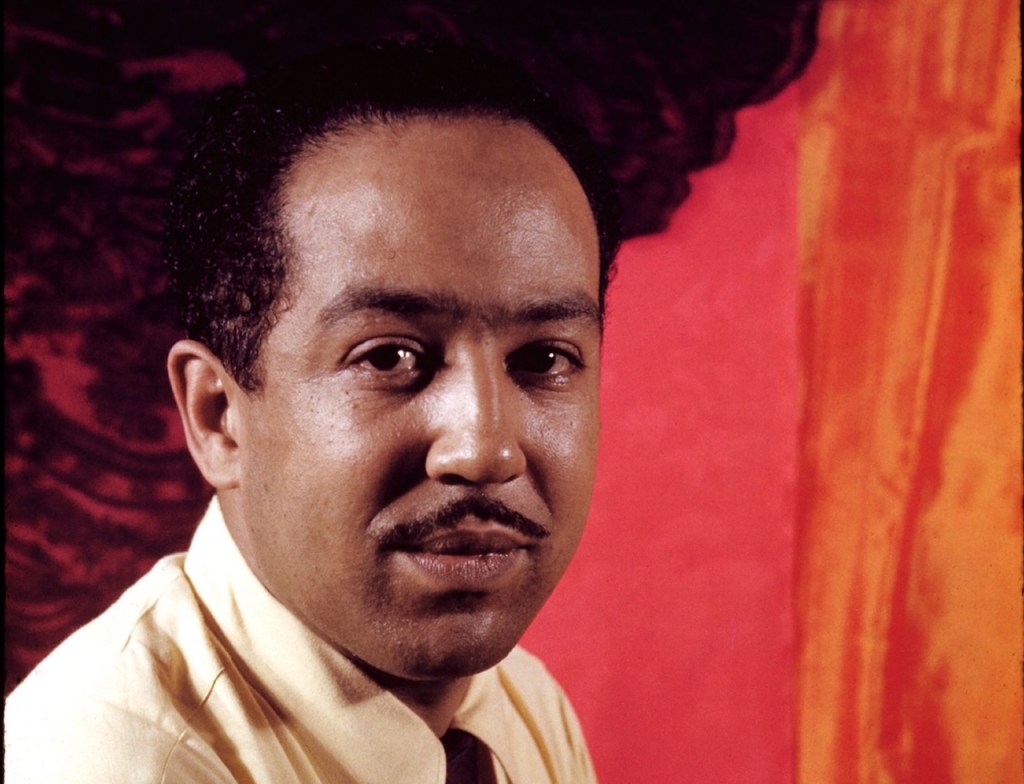
    Langston Hughes - https://www.newyorker.com/magazine/2015/02/23/sojourner - Photograph by Carl Van Vechten / Carl Van Vechten Trust / Beinecke Library, Yale - 1280
    Image: Langston Hughes – Photograph by Carl Van Vechten / Carl Van Vechten Trust / Beinecke Library, Yale – 1280

    Langston Hughes’ “Night Funeral in Harlem”

    The speaker in Langston Hughes’ “Night Funeral in Harlem” wonders how this poor dead boy’s friends and relatives are able to afford such a lavish funeral.

    Introduction and Text of “Night Funeral in Harlem”

    Langston Hughes’ “Night Funeral in Harlem” is an example of the poet’s affinity for the blues. He employs a form that includes the blues flavor, allowing the reader to hear a mournful voice that implies issues that he never actually discusses.

    The speaker’s questions are more than mere decoration, and their implications attempt to make a political and sociological, as well as religious, evaluation. The poem’s form features an inconsistent conglomeration of rimed stanzas, with varied refrains.

    Night Funeral in Harlem

         Night funeral
         In Harlem:

         Where did they get
         Them two fine cars?

    Insurance man, he did not pay—
    His insurance lapsed the other day—
    Yet they got a satin box
    for his head to lay.

         Night funeral
         In Harlem:

         Who was it sent
         That wreath of flowers?

    Them flowers came
    from that poor boy’s friends—
    They’ll want flowers, too,
    When they meet their ends.

         Night funeral
         in Harlem:

         Who preached that
         Black boy to his grave?

    Old preacher man
    Preached that boy away—
    Charged Five Dollars
    His girl friend had to pay.

         Night funeral
         In Harlem:

    When it was all over
    And the lid shut on his head
    and the organ had done played
    and the last prayers been said
    and six pallbearers
    Carried him out for dead
    And off down Lenox Avenue
    That long black hearse done sped,
         The street light
         At his corner
         Shined just like a tear—
    That boy that they was mournin’
    Was so dear, so dear
    To them folks that brought the flowers,
    To that girl who paid the preacher man—
    It was all their tears that made
         That poor boy’s
         Funeral grand.

         Night funeral
         In Harlem.

    Reading:  

    Commentary on “Night Funeral in Harlem”

    The speaker in Langston Hughes’ “Night Funeral in Harlem” jabs insults at these mourners as he wonders how this poor dead boy’s friends and relatives are able to afford such a lavish funeral.

    First Movement:  An Critical Observer

         Night funeral
         In Harlem:

         Where did they get
         Them two fine cars?

    Insurance man, he did not pay—
    His insurance lapsed the other day—
    Yet they got a satin box
    for his head to lay.

         Night funeral
         In Harlem:

         Who was it sent
         That wreath of flowers?

    The speaker begins with his refrain that features his subject, “Night funeral / In Harlem.” He then shoots in his first question that is ultimately insulting to the mourners. The speaker wonders, “Where did they get / Them two fine cars?” 

    The speaker’s dialect is intended to reveal him as an intimate with the mourners, yet his questions actually separate him from them. If he is one of them, why does he have to ask where the cars come from? His concern, therefore, comes across as disingenuous.

    The speaker then introduces the “insurance man,” who might be the reason for the “fine cars,” but no, the poor boy’s “insurance lapsed the other day.” Again, the speaker’s knowledge of the particulars of the situation clash; he knows the people well enough to know that their insurance lapsed, but yet not well enough to know who, in fact, is paying for the lavish funeral. 

    And then the speaker offers a further bit of incongruity that these poor folks have managed to supply a “satin box / for [the deceased’s] head to lay.” The speaker offers these incongruities but never manages to make clear his purpose.

    Second Movement:  A Question of Integrity

    Them flowers came
    from that poor boy’s friends—
    They’ll want flowers, too,
    When they meet their ends.

         Night funeral
         in Harlem:

         Who preached that
         Black boy to his grave?

    The speaker again introduces his next stanza with a variation on the opening refrain: “Night funeral / In Harlem: / / Who was it sent / That wreath of flowers?” Again, the speaker reveals that his distance from the mourners is so great that he has to ask about the flowers. But then he admits that he does actually know that the flowers came from “that poor boy’s friends.”

    But the speaker then insults those friends by accusing them of sending them only because “They’ll want flowers, too, / When they meet their ends,” and also implying that he wonders how those friends paid for the flowers.

    Third Movement:  Is Race Really the Issue?

    Night funeral
      Night funeral
         in Harlem:

         Who preached that
         Black boy to his grave?

    Old preacher man
    Preached that boy away—
    Charged Five Dollars
    His girl friend had to pay.

    The third stanza’s opening varied refrain asks, “Who preached that / Black boy to his grave?” He reveals for the first time that the deceased is black but does not clarify why he should offer the race of the dead at this point.  

    The had been implying that the deceased was black all along by using stereotypical Black English and placing the funeral in Harlem, which was heavily populated by African Americans at the time that the poet was writing.

    The preacher is portrayed then as a money-grubber, charging five dollars to “preach[ ] that boy away,” and the poor boy’s girlfriend had to pay the preacher the five dollar charge.  Again, how it is that the speaker knows the girlfriend paid the preacher, but that he does not know who paid for two limousines, casket, flowers?

    Fourth Movement:   Despite the Insults

        Night funeral
         In Harlem:

    When it was all over
    And the lid shut on his head
    and the organ had done played
    and the last prayers been said
    and six pallbearers
    Carried him out for dead
    And off down Lenox Avenue
    That long black hearse done sped,
         The street light
         At his corner
         Shined just like a tear—
    That boy that they was mournin’
    Was so dear, so dear
    To them folks that brought the flowers,
    To that girl who paid the preacher man—
    It was all their tears that made
         That poor boy’s
         Funeral grand.

         Night funeral
         In Harlem.

    The final stanza is a rather flabby summation of what has happened during this Harlem funeral at night. The opening refrain merely reiterates the subject, “Night funeral / In Harlem.”

    Gone is the additional commentary as appeared in the three opening refrains, but the speaker does leave the affair on a compassionate note; at least he can admit, “It was all their tears that made / That poor boy’s / Funeral grand.”  

    Despite his probing, insulting questions, he finally admits that the importance of the event is that it shows the love the mourners had for their dearly departed.

    Image:  Langston Hughes - Commemorative Stamp  http://usstampgallery.com/view.php?id=0787693b268f0944d0264088b300c02721d73814&Langston_Hughes&st=Langston%20Hughes&ss=&t=&s=8&syear=&eyear=  US Stamp Gallery
    Image: Langston Hughes – Commemorative Stamp  – US Stamp Gallery
  • James Weldon Johnson’s “O Black and Unknown Bards”

    Image: James Weldon Johnson - https://www.green-wood.com/event/the-autobiography-of-an-ex-colored-man-110-years-later/
    Image: James Weldon Johnson

    James Weldon Johnson’s “O Black and Unknown Bards”

    Johnson’s speaker dramatizes his amazement that slaves could have produced a music that would uplift of a entire race from debasement to spiritual attunement.

    Introduction and Text of Poem, “O Black and Unknown Bards”

    The speaker in James Weldon Johnson’s “O Black and Unknown Bards” celebrates the important spiritual achievement that mere slaves, oft thought the lowest rung on the ladder of society, managed to leave for future generations.  

    The poet James Weldon Johnson has well understood that through their spiritual singing to the Divine, these slaves were striving to unite their souls with God—the only true way to overcome all adversity.

    O Black and Unknown Bards

    O black and unknown bards of long ago,
    How came your lips to touch the sacred fire?
    How, in your darkness, did you come to know
    The power and beauty of the minstrel’s lyre?
    Who first from midst his bonds lifted his eyes?
    Who first from out the still watch, lone and long,
    Feeling the ancient faith of prophets rise
    Within his dark-kept soul, burst into song? 

    Heart of what slave poured out such melody
    As “Steal away to Jesus”? On its strains
    His spirit must have nightly floated free,
    Though still about his hands he felt his chains.
    Who heard great “Jordan roll”? Whose starward eye
    Saw chariot “swing low”? And who was he
    That breathed that comforting, melodic sigh,
    “Nobody knows de trouble I see”? 

    What merely living clod, what captive thing,
    Could up toward God through all its darkness grope,
    And find within its deadened heart to sing
    These songs of sorrow, love and faith, and hope?
    How did it catch that subtle undertone,
    That note in music heard not with the ears?
    How sound the elusive reed so seldom blown,
    Which stirs the soul or melts the heart to tears. 

    Not that great German master in his dream
    Of harmonies that thundered amongst the stars
    At the creation, ever heard a theme
    Nobler than “Go down, Moses.” Mark its bars
    How like a mighty trumpet-call they stir
    The blood. Such are the notes that men have sung
    Going to valorous deeds; such tones there were
    That helped make history when Time was young. 

    There is a wide, wide wonder in it all,
    That from degraded rest and servile toil
    The fiery spirit of the seer should call
    These simple children of the sun and soil.
    O black slave singers, gone, forgot, unfamed,
    You—you alone, of all the long, long line
    Of those who’ve sung untaught, unknown, unnamed,
    Have stretched out upward, seeking the divine. 

    You sang not deeds of heroes or of kings;
    No chant of bloody war, no exulting pean
    Of arms-won triumphs; but your humble strings
    You touched in chord with music empyrean.
    You sang far better than you knew; the songs
    That for your listeners’ hungry hearts sufficed
    Still live,—but more than this to you belongs:
    You sang a race from wood and stone to Christ.

    Commentary on “O Black and Unknown Bards”

    James Weldon Johnson’s speaker is dramatizing his amazed fascination that slaves could have created a music that would uplift of a downtrodden race from debasement to spiritual attunement.

    First Stanza: The Genius of Slaves

    O black and unknown bards of long ago,
    How came your lips to touch the sacred fire?
    How, in your darkness, did you come to know
    The power and beauty of the minstrel’s lyre?
    Who first from midst his bonds lifted his eyes?
    Who first from out the still watch, lone and long,
    Feeling the ancient faith of prophets rise
    Within his dark-kept soul, burst into song? 

    The speaker wonders how black slaves had the ability to fashion those beautiful, soulfilled songs.  These songs have revealed that these musicians were in tune with a heavenly realm, not of this earth.  They somehow came to understand and create with, “The power and beauty f the minstrel’s lyre.”  

    Although his questions cannot be answered, as they are essentially rhetorical in nature, he uses them to state quite clearly that these individuals were in tune with part of themselves that many fail to realize even exists. 

    The body may be whipped and suffer, but the soul cannot be beaten, nor can it suffer.  The uplifting nature of these wonderful soulful hymns demonstrates the power of the spirit over the body.

    The speaker then queries, “Who first from midst the bonds lifted his eye?”  He knows that instead of lifting the eye, the natural, common tendency is to pity oneself and continue to look downward, become hate filled and angry at one’s fellow humans for their ignorance.

    The speaker is aware that the beautiful songs unveil a spiritual level of being that can only be cherished and treasured for their qualities.  The speaker understands that instead of self-pity and angst, these soul singers were looking to God with a faith that might seem to lost.

    Second Stanza:  A Free Ranging Spirit

    Heart of what slave poured out such melody
    As “Steal away to Jesus”? On its strains
    His spirit must have nightly floated free,
    Though still about his hands he felt his chains.
    Who heard great “Jordan roll”? Whose starward eye
    Saw chariot “swing low”? And who was he
    That breathed that comforting, melodic sigh,
    “Nobody knows de trouble I see”? 

    In the second stanza, the speaker refers to four widely sung spiritual: “Steal Away to Jesus,” “Roll, Jordan, Roll,” and “Swing Low, Sweet Chariot,” and “Nobody Knows the Trouble I’ve Seen,” and he again wonders what slave could have created such an astounding tune. 

    The speaker then guesses that whoever the composer was, “His spirit must have nightly floated free.” The capacity for musical freedom as he continued to suffer his body bound in chains amazes the speaker, who becomes convinced that only a strong, abiding faith could have led the songwriter to such brilliance. 

    The speaker then alludes to the well-known spiritual, “Nobody knows de trouble I see,” as he asserts that the composer of this hymn felt the comforting, melodic sigh deep in his eing. The speaker, through his musing and questioning, is celebrating the wonderfully inspirational tone of these famous hymns. 

    Third Stanza:  The Mystery of Moving in Chains

    What merely living clod, what captive thing,
    Could up toward God through all its darkness grope,
    And find within its deadened heart to sing
    These songs of sorrow, love and faith, and hope?
    How did it catch that subtle undertone,
    That note in music heard not with the ears?
    How sound the elusive reed so seldom blown,
    Which stirs the soul or melts the heart to tears. 

    The speaker reports with his following question that those slave/hymn writers were considered mere property: “What merely living clod, what captive thing, / Could toward God through all it darkness grope . . . ?”

    The question suggests that those slaves were considered little more than mounds of unconscious clay, as they were required to function as the property of other men. 

    In the face of such degradation, these singer/songwriters managed to compose their lyrics that sing eternally Godward.  The divinity of the words cannot be missed by the perceptive observer as James Weldon Johnson was. 

    The speaker wonders how these sufferers with likely “deadened hearts,” managed to produce songs heard “not with the ears.”  He wonders how such suffering souls could have, “sound[ed] the elusive reed so seldom blown.”  He is aware that their sound was so majestic that “melts the heart.”

    Fourth Stanza:  Marvelous Spiritual That Helped Write History

    Not that great German master in his dream
    Of harmonies that thundered amongst the stars
    At the creation, ever heard a theme
    Nobler than “Go down, Moses.” Mark its bars
    How like a mighty trumpet-call they stir
    The blood. Such are the notes that men have sung
    Going to valorous deeds; such tones there were
    That helped make history when Time was young. 

    The speaker avers that is not even likely the great German composer, no doubt referring to Mozart, could have created a song, “Nobler than ‘Go down, Moses’.” He notes that its “bars / How like a mighty trumpet call they stir / The blood.” 

    The speaker compares those notes to the songs that military men have employed as they perform heroic valorous deeds. He states that the music of these marvelous spirituals helped write history. 

    Fifth Stanza: The Fiery Spirit of Servitude

    There is a wide, wide wonder in it all,
    That from degraded rest and servile toil
    The fiery spirit of the seer should call
    These simple children of the sun and soil.
    O black slave singers, gone, forgot, unfamed,
    You—you alone, of all the long, long line
    Of those who’ve sung untaught, unknown, unnamed,
    Have stretched out upward, seeking the divine. 

    The speaker again stresses the strange fact that those so depressed with the servitude of toil were able to display their fiery spirit, these simple children, these black slaves, who are gone, forgotten, unknown, yet they were capable  of “stretch[ing ] out upward, seeking the divine.” 

    They did not allow their souls to become degraded by seeking to acquire only physical comfort; these glorious forbearers looked Godward and acquired a measure of immortality that even the more well-known composers will likely not soon know. 

    Sixth Stanza: Slave Singer and the Blissful Reality of Spirit

    You sang not deeds of heroes or of kings;
    No chant of bloody war, no exulting pean
    Of arms-won triumphs; but your humble strings
    You touched in chord with music empyrean.
    You sang far better than you knew; the songs
    That for your listeners’ hungry hearts sufficed
    Still live,—but more than this to you belongs:
    You sang a race from wood and stone to Christ.

    Finally, the speaker notes that these slave singers did not compose lays about the deeds of kings and cultural heroes. They did not sing for the purpose glorifying battle.  They did not offer “exulting pean.” But they did “touch[ ] in chord with music empyrean.” Yet, they were not aware that they “sang far better than [they] knew.”

    Those slave/singers created hymns that continue to live on. Their musical creations were so vital that they “sang a race from wood and stone to Christ.” Their spiritual songs have lifted their fellows and generations to come from mere physical existence to the blissful reality of spirit.

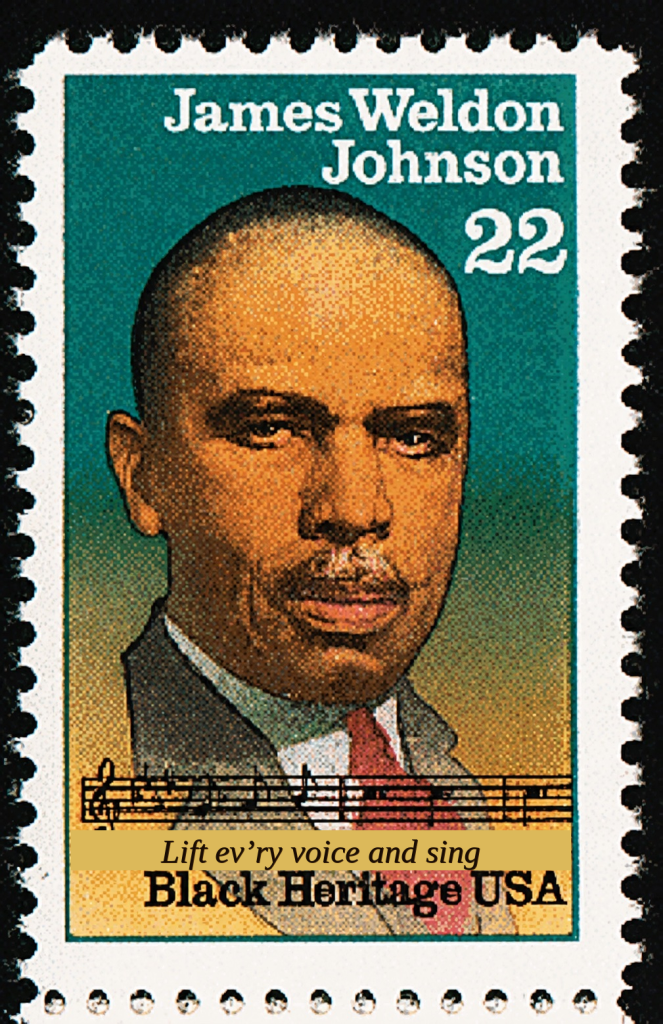
    Image: James Weldon Johnson - Commemorative Stamp - http://usstampgallery.com/view.php?id=e331c006856fe114a9ec83472d926981f48b72ec
    Image: James Weldon Johnson – Commemorative Stamp
  • James Weldon Johnson’s “Mother Night”

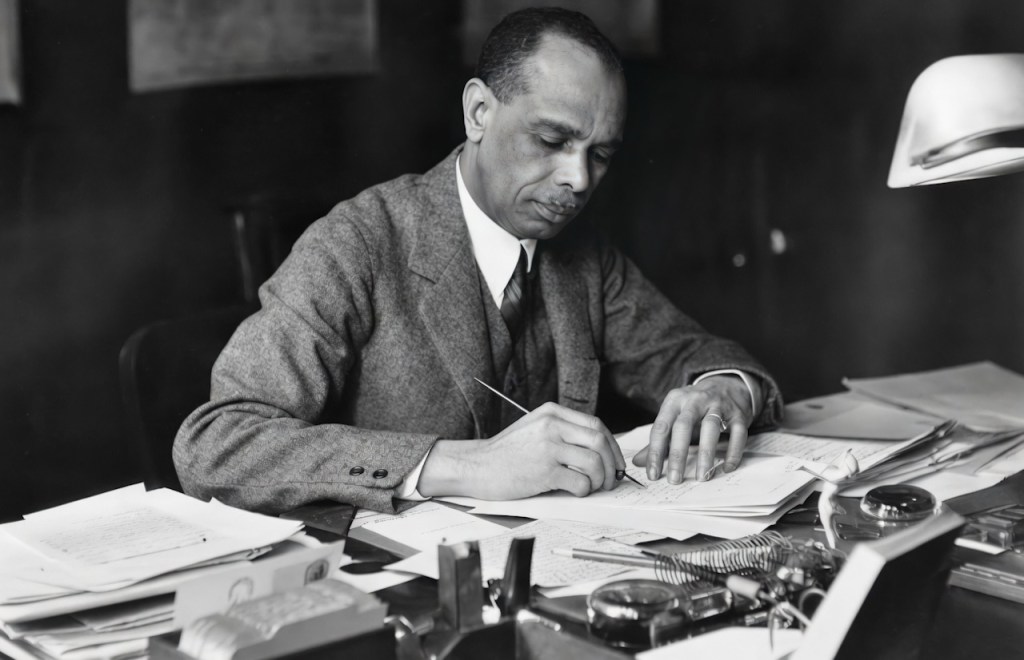
    Image: James Weldon Johnson - Portrait by Laura Wheeler Waring https://npg.si.edu/object/npg_NPG.67.40
    Image: James Weldon Johnson – Portrait by Laura Wheeler Waring

    James Weldon Johnson’s “Mother Night”

    The speaker in Johnson’s sonnet, “Mother Night,” likens his own existence and protection to that of the planets—all are created and protected by the same Divine Entity.  Thus his soul remains a spark from the Original Divine Flame.

    Introduction with Text of “Mother Night”

    James Weldon Johnson’s “Mother Night,” a Petrarchan (or Italian) sonnet, metaphorically dramatizes night as the calm union of the soul with the Oversoul or the individual self with Divine Self.

    The speaker, influenced by Eastern as well as Christian philosophical tenets, draws a parallel between the conflict of day and night in the cosmos and his own struggle with the pairs of opposites in his earthly sojourn.   This sonnet’s form offers polished Petrarchan rime-scheme:  ABBAABBA in the octave, and CDECDE in the sestet.

    Mother Night

    Eternities before the first-born day,
    Or ere the first sun fledged his wings of flame,
    Calm Night, the everlasting and the same,
    A brooding mother over chaos lay.
    And whirling suns shall blaze and then decay,
    Shall run their fiery courses and then claim
    The haven of the darkness whence they came;
    Back to Nirvanic peace shall grope their way. 

    So when my feeble sun of life burns out,
    And sounded is the hour for my long sleep,
    I shall, full weary of the feverish light,
    Welcome the darkness without fear or doubt,
    And heavy-lidded, I shall softly creep
    Into the quiet bosom of the Night.

    Commentary on “Mother Night”

    All creation is protected by its Creator, Who performs in various guises somewhat like a mother bird, who protects her progeny.  Nighttime is the time for rest, peaceful contemplation, and retreat from the hustle and bustle of day time activities.

    Thus, nighttime may be perceived as a protecting entity that offers solace and comfort to those in need and those who wish for such qualities in their lives.

    First Quatrain:  Existence Was Brooding before the First Created Day

    Eternities before the first-born day,
    Or ere the first sun fledged his wings of flame,
    Calm Night, the everlasting and the same,
    A brooding mother over chaos lay.

    Like a brooding mother, that is, a mother bird who is sitting on her brood of eggs and then who continues to protect and keep them warm as baby birds, “Calm Night” kept watch over the unmanifested entity until the first-born day, before the first planets were created and hurled into activity: “ere the first sun fledged his wings of flame.” 

    The mature planet of the sun is like a bird that is now flying off on its own, after having been tenderly nurtured by its mother.

    Mother Night tenderly nurtured the growing cosmos that ultimately resulted in planets and people. Johnson’s metaphoric Night represents the non-vibratory realm of reality where nothing is manifested, and only the mind of God exists in that vibrationless realm.

    There is no creation only a peaceful possibility, a potential. Until God chooses to create beings to populate His cosmos, He simply broods like a mother over chaos. 

    Here the term chaos does not refer to our modern usage of confusion and disorder but to infinite formlessness. The term originates from the Greek Khaos, indicating a dark void from which the gods originated.

    Second Quatrain:  The Projection of Light as It Creates the Cosmos

    And whirling suns shall blaze and then decay,
    Shall run their fiery courses and then claim
    The haven of the darkness whence they came;
    Back to Nirvanic peace shall grope their way. 

    The second quatrain describes the plight of whirling suns as they “blaze and then decay.” Those planets of fire will eventually burn out and after they do, they will return “[b]ack to Nirvanic peace.” 

    The speaker employs the term Nirvanic, adjectival form for “Nirvana,” the Buddhist term for God-union, which is “Samadhi” in  Hinduism, “Salvation” in Christianity, and “Fana” in Sufism, the mystical branch of Islam.

    The speaker cleverly plays by punning “whirling suns,” whereas sun puns son. With God as Mother Night, Her suns (sons) will “run their fiery courses” (live their passionate lives) and then recede back into the arms of the brooding mother or God. 

    First Tercet:  The Individual Self as It Careens Toward Oblivion

    So when my feeble sun of life burns out,
    And sounded is the hour for my long sleep,
    I shall, full weary of the feverish light,

    The sestet then shifts from the cosmos to the speaker himself, a son of the night mother. The speaker vows that he will react to his death a certain way, but he does not clarify that way yet, but merely sets up the conditions for his final claim. 

    As his life comes to an end, as he knows that it “is the hour for [his] long sleep,” he will be fully aware that his life is ebbing.

    Second Tercet:  Faith That Leads the Faithful toward Their True Home

    Welcome the darkness without fear or doubt,
    And heavy-lidded, I shall softly creep
    Into the quiet bosom of the Night.

    And the speaker will “[w]elcome the darkness without fear or doubt.” His strong faith and intuition allow him to realize that his soul is going home. 

    This speaker has mused long and hard upon the profundities that puzzle every thinking brain.  He has contemplated what science has discovered about the nature of the created Cosmos.

    The speaker has likewise compared the knowledge  of scientists to that of the tenets of religion and philosophy.  And the result of his in depth study now allows him to formulate a pathway to Divine Reality.  

    This prescient speaker has come to understand that his own soul is simply a spark of the Divine Flame, Who has fashioned out of chaos a marvelous entity of joy, peace, hope, and love.

    This speaker’s eyelids may droop, but his soul is ever ensconced in the omnipresent protection of the beautiful mother, the Mother Night—who parallels the Blessèd Divine Reality—who will throughout eternity continue to brood over and fiercely guide and guard her beloved son.  

  • Awaken In Me Divine Joy

    Image:  Created by Grok inspired by the poem/chant
    Image: Created by Grok inspired by the poem/chant

    Awaken In Me Divine Joy

    —after “O Thou King of the Infinite”

    Divine Belovèd,
    Awaken in me that joy—
    Bright and sustaining joy

    That comes only in union
    With Thee, O Belovèd Divine,
    Awaken in me that joy!