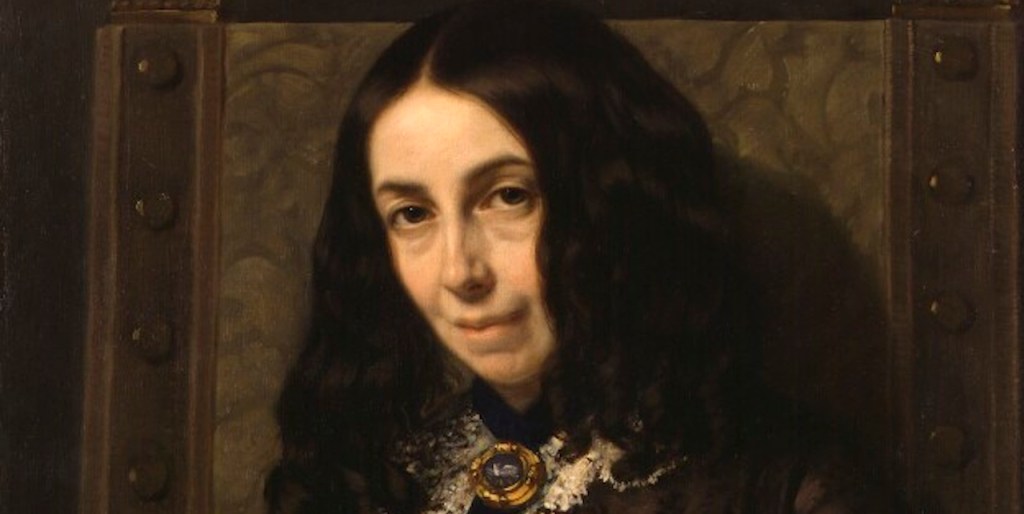
Image: Elizabeth Barrett Browning – NPG, London
Brief Life Sketch of Elizabeth Barrett Browning and Introduction to Sonnets from the Portuguese
Elizabeth Barrett Browning’s classic work Sonnets from the Portuguese is the poet’s most anthologized and widely published work, studied by students in secondary schools, colleges, and universities and appreciated by the general poetry lover.
Two Poets in Love
Robert Browning, while wooing Elizabeth Barrett, referred to his sweetheart lovingly by the nickname he had given her: “my little Portuguese” [1]. He chose that nickname for her because of her dark complexion. Elizabeth Barrett then quite consequentially titled her sonnet sequence Sonnets from the Portuguese.
Since its publication, Elizabeth Barrett Browning’s Sonnets from the Portuguese has become a beloved, often anthologized, and widely studied sonnet sequence. With this 44-sonnet sequence, Barrett Browning puts on display her mastery of the Petrarchan (Italian) sonnet form.
Throughout the sequence, Barrett Browning creates a speaker who develops the theme of the romantic relationship between Elizabeth Barrett and fellow poet, Robert Browning, the man whom she will ultimately marry.
As their relationship begins, the speaker is continually beset with deep doubts. She has little confidence that she can keep the affection of such an accomplished, world-renowned poet as Robert Browning [2].
The speaker, therefore, continues to dramatize her deep skepticism that the relationship will withstand their differences. The speaker is continually musing on her insecure nature and doubts as she even magnifies them. Her exploration and examination of her situation causes her much consternation. Likely, the poet’s prior experience with love relationships influences her hesitancy in engaging in a relationship with Robert Browning:
Much of E.B.B.’s hesitation came from knowing that love can bring injury as well as boon. She had suffered such injury. With great pain did she finally recognise that her father’s strangely heartless affection would have buried her sickroom, for how else could she interpret his squelching of her plan to travel south for health in 1846, when doctors practically ordered the journey to Italy as a last hope?
E.B.B. had had previous experience of one-sided affection, as we see in her diary of 1831-3, which concerns her relationship with the Greek scholar H.S. Boyd. For a year her entries calculate the bitter difference between his regard and her own, and she wonders if she can ever hope for reciprocation. In fact she finds her womanly capacity for feeling a liability and wishes she could feel less — “I am not of a cold nature, & cannot bear to be treated coldly. When cold water is thrown upon a hot iron, the iron hisses. I wish that water wd. make that iron as cold as self.” [3]
Elizabeth Barrett’s poor health is often emphasized in the many biographies of the poet. Few biographers have offered any speculations regarding the origin of the poet’s illness; nor have they attempted to name the disease from which the poet suffered.
However, Anne Buchanan, who is a research assistant in anthropology, has suggested that Elizabeth Barrett suffered from hypokalemic periodic paralysis (HKPP), a muscle disorder [4]. Buchanan’s daughter suffers from that same disease, which “causes blood levels of potassium to fall because potassium becomes trapped in muscle cells.”
Buchanan and her daughter Ellen Buchanan Weiss observed that the descriptions of Barrett Browning’s malady resembled closely those of the daughter. The Buchanans have thus suggested that a cold, moist climate often intensifies the pain associated with HKPP.
Throughout Barrett Browning’s lifetime, London’s cold, damp climate had exacerbated the poet’s health problems, and whatever the title of the disease, escaping the London’s weather was a Godsend to her.
Thus, her marriage to Robert Browning enhanced her health as well as her mental state because the coupled relocated to Italy, where they enjoyed the warm climate, which was amenable to Elizabeth’s health.
Because of Robert Browning, Elizabeth Barrett not only enjoyed a soulmate to love her, but she also found one who would protect her health and allow her live her remaining years more comfortably and productively.
The Petrarchan (Italian) Sonnet Form
The Petrarchan sonnet is named after the 14 century Italian poet, Francesco Petrarch [5]. It is also known as the Italian sonnet. The Petrarchan/Italian sonnet displays an eight-line octave and a six-line sestet. The octave contains two quatrains (four lines each), and the sestet contains two tercets (three lines each). The traditional rime scheme of the Petrarchan/Italian sonnet is ABBAABBA in the octave and CDCDCD in the sestet.
Poets, however, often display a variation on the sestet rime scheme, transforming it from CDCDCD to CDECDE. Many other poets vary the octave as well as create other schemes for the sestet. But Barrett Browning never varies the rime scheme; she retains the traditional rime scheme ABBAABBACDCDCD throughout the entire 44-sonnet sequence.
Following such a tight, restricted form that the poet chose to follow as she composed 44 sonnets magnifies her skill and her mastery of that sonnet form. The poet’s choice of the Petrarchan sonnet also reveals her deep affinity for the original Petrarchan theme, as she muses upon the relationship between herself and her belovèd as well as the relationship between the Divine Creator-Father and His human children.
According to Robert Stanley Martin, Petrarch “reimagined the conventions of love poetry in the most profound way: love for the idealized lady was the path towards learning how to properly love God . . .”:
[Petrarch’s] poems investigate the connection between love and chastity in the foreground of a political landscape, though many of them are also driven by emotion and sentimentality. Critic Robert Stanley Martin writes that Petrarch “reimagined the conventions of love poetry in the most profound way: love for the idealized lady was the path towards learning how to properly love God . . . .” [6]
Each sonnet in this sequence is displayed in only one stanza with its octave and sestet. However, engaging the sonnet’s quatrains and sestets separately allows the commentarian a clearer focus in concentrating on each line unit.

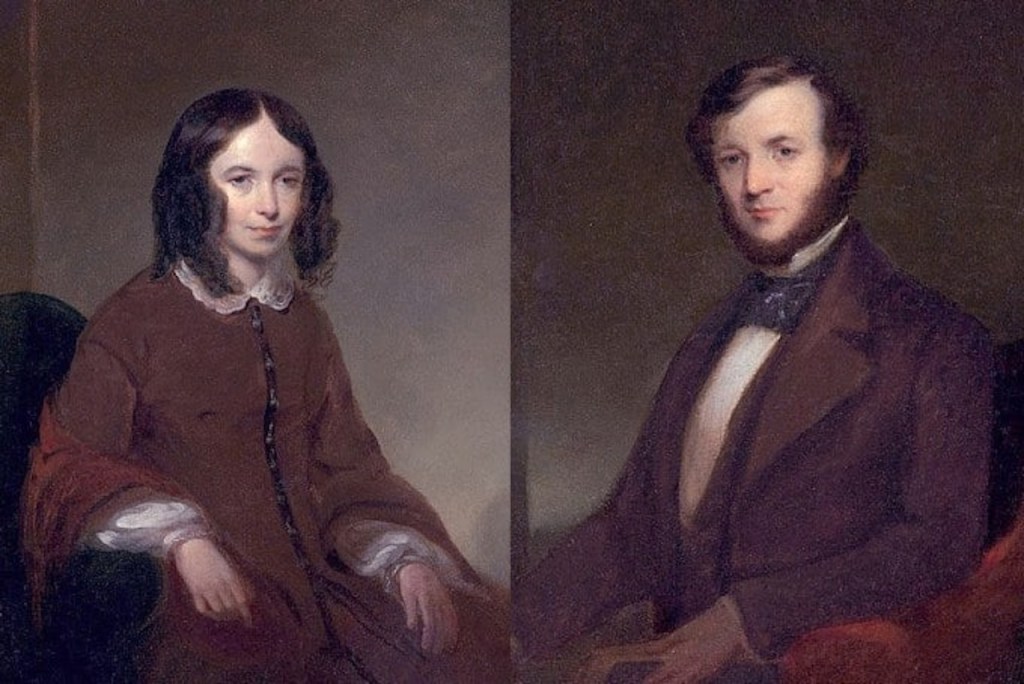
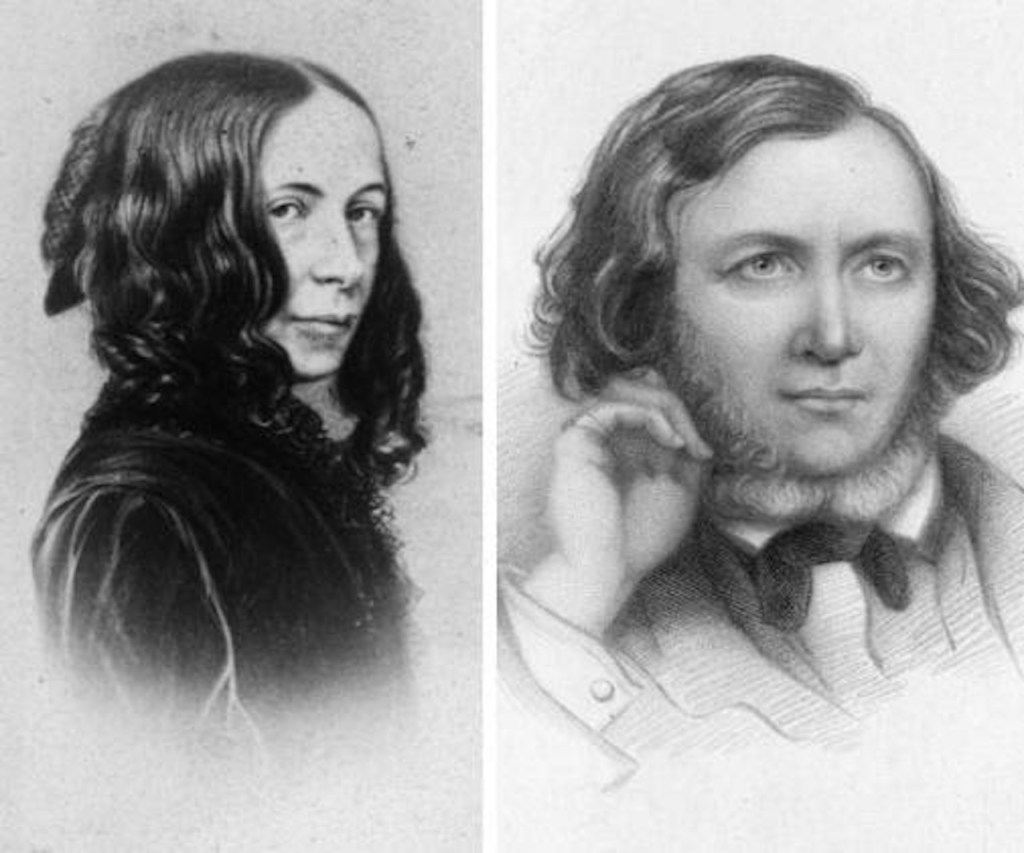
Image: Two Poets in Love
A Legacy of Love
Elizabeth Barrett Browning’s sonnet sequence offered the poet a remarkably open field as well as the imaginative opportunity for discovery of her true feelings. The poet’s life had become steeped in melancholy, as a result of her poor health and her family’s inability to understand and appreciate her abilities and sensibilities. Especially problematic was her difficult relationship with her father.
As the poet through her speaker navigates through the sonnet sequence, she demonstrates a change of mood. The speaker of the sequence grows from an individual holding the desperate thought that only death would remain her consort to one who could finally experience joy.
After her doubts that she and such a man of the world as Robert Browning could have a true relationship are finally removed, she finds life to be very different from what she has earlier experienced.
The confident, sophisticated Robert Browning brought Miss Barrett a happiness that genuinely gave her life meaning. The two poets’ relationship had to struggle against a host of trials and tribulations, but their love story results in one that remains one for the ages. The world is more acquainted with these two lover-poets than it would have otherwise been without their loving relationship:
In addition to being celebrated for their literary talents, Elizabeth and Robert are remembered as people who were deeply in love. As Sir Frederic Kenyon wrote, Elizabeth and Robert “gave the most beautiful example of [love] in their own lives.” The marriage of Elizabeth Barrett Browning and Robert Browning required courage and sacrifice, and they were willing to do whatever it took to build a beautiful life together. [7]
Barrett Browning’s 44-sonnets sequence recounts the journey of a poet who begins with many doubts. But she examines and muses upon the origins of those doubts and then finally blossoms into a joyous, creative individual after she accepts and engages with the love that Robert Browning had so generously and genuinely offered her. The story of the love relationship between these two poets has a become one of most inspirational stories in the literary world—or, for that matter, in any world.
Sources
[1] Jennifer Kingma Wall. “Love and Marriage: How Biographical Interpretation affected the Reception of Elizabeth Barrett Browning’s ‘Sonnets from the Portuguese’” The Victorian Web. Last modified May 4, 2005.
[2] Editors. “Robert Browning.” Poetry Foundation. Accessed March 2, 2023.
[3] Kathleen Blake. “The Relationship of Elizabeth Barrett Browning and Robert Browning.” The Victorian Web. 1991.
[4] Editors. “Elizabeth Barrett Browning’s Illness Deciphered after 150 Years.” American Association for the Advancement of Science. December 19, 2011.
[5] Editors. “Petrarch.” Academy of American Poets. Accessed March 2, 2023.
[6] Editors. “Petrarch.” Poetry Foundation. Accessed June 29, 2021.
[7] Taylor Jasmine. “The Literary Love Story of Elizabeth Barrett and Robert Browning.” Literary Ladies Guide. November 1, 2020.
The Psychological Narrative within Elizabeth Barrett Browning’s Sonnets from the Portuguese
Elizabeth Barrett Browning’s 44 Petrarchan sonnets in Sonnets from the Portuguese suggest a subtle sequence within a psychological narrative framework.
Composed during her courtship with Robert Browning, the sequence presents an evolution from despair, low self-esteem, and self-doubt toward acceptance of love, reframing of self-awareness, and final, faithful and faith-based commitment. The sequence sections itself into the following emotional stages:
1. Musing on Despair and Resistance (Sonnets 1–8)
The sequence begins with a speaker who feels emotionally exhausted, physically fragile, convinced she could never marry, especially because her father had dictated that none of his children would ever be allowed to marry. Also her illness had enfeebled her so dramatically that she likely had little energy and strength for beginning and maintaining a loving relationship and family of her own.
The main themes of this segment of sonnets are memory of suffering, expectation of death rather than love, and suspicion that the new affection cannot last.
In the first sonnet, the speaker senses being drawn away from concentration on death by an unanticipated presence, which can only be interpreted as Robert Browning entering her life.
2. Exploring the Fear of Being Unworthy of Love (Sonnets 9–15)
The next group focuses on a persistent anxiety: she feels that her beloved deserves someone stronger and happier. She believes she is too weak, ill, and melancholy to respond as she should to his affection; she feels she is near death. He insists that he loves her deeply, and that they will have a future together.
The tension that drives this segment of sonnets creates a suggestion that she may be arguing against the relationship, even though it is quite clear that in her heart of hearts she is strongly wishing for it to success.
3. Examining the Strength of the Lover’s Devotion (Sonnets 16–24)
Here the tone changes. The speaker begins to examine the lover’s commitment more carefully. She wonders if he merely pities her, or if the love may be only temporary, or if he does in face love her for the right reasons.
She insists that love must not rest on changeable qualities such as her smile, her voice, or her appearance. She insists that love must remain constant even as those qualities dim with time.
4. Gradual Recognition of Genuine Love (Sonnets 25–36)
Gradually, the speaker is beginning to accept that the suitor’s devotion is real. The sonnets in this segment focus on memories of shared moments, reflections on spiritual companionship, and growing emotional trust. She is beginning to sense a mutual affection which is eroding the painful doubt that has plagued her.
5. Final Acceptance and Joy (Sonnets 37–44)
In the final segment, her resistance has largely disappeared. She now accepts her suitor’s love, sensing that it us utterly transformative and refreshingly life-giving. The tone has changed from ingrained doubt to joyous confidence, a healing gratitude, and spiritual cohesiveness.
The widely anthologized sonnet 43—“How do I love thee? Let me count the ways”—belongs to this final stage and expresses love in multiple dimensions: depth, breadth, height, and moral and spiritual devotion.
The final sonnet 44 “Belovèd, thou hast brought me many flowers” presents the couple’s love as an entity that will live on beyond death, as it testifies to a spiritual faith. Such a faith transcends all mortal doubt, affords the speaker a truly new Weltanschauung.
Commentaries on Sonnets from the Portuguese
- Sonnet 1 “I thought once how Theocritus had sung”
- Sonnet 2 “But only three in all God’s universe”
- Sonnet 3 “Unlike are we, unlike, O princely Heart!”
- Sonnet 4 “Thou hast thy calling to some palace-floor”
- Sonnet 5 “I lift my heavy heart up solemnly”
- Sonnet 6 “Go from me. Yet I feel that I shall stand”
- Sonnet 7 “The face of all the world is changed, I think”
- Sonnet 8 “What can I give thee back, O liberal”
- Sonnet 9 “Can it be right to give what I can give?”
- Sonnet 10 “Yet, love, mere love, is beautiful indeed”
- Sonnet 11 “And therefore if to love can be desert”
- Sonnet 12 “Indeed this very love which is my boast”
- Sonnet 13 “And wilt thou have me fashion into speech”
- Sonnet 14 “If thou must love me, let it be for nought”
- Sonnet 15 “Accuse me not, beseech thee, that I wear”
- Sonnet 16 “And yet, because thou overcomest so”
- Sonnet 17 “My poet, thou canst touch on all the notes”
- Sonnet 18 “I never gave a lock of hair away”
- Sonnet 19 “The soul’s Rialto hath its merchandise”
- Sonnet 20 “Beloved, my Beloved, when I think”
- Sonnet 21 “Say over again, and yet once over again”
- Sonnet 22 “When our two souls stand up erect and strong”
- Sonnet 23 “Is it indeed so? If I lay here dead”
- Sonnet 24 “Let the world’s sharpness, like a clasping knife”
- Sonnet 25 “A heavy heart, Belovèd, have I borne”
- Sonnet 26 “I lived with visions for my company”
- Sonnet 27 “My own Belovèd, who hast lifted me”
- Sonnet 28 “My letters! all dead paper, mute and white!”
- Sonnet 29 “I think of thee!—my thoughts do twine and bud”
- Sonnet 30 “I see thine image through my tears to-night”
- Sonnet 31 “Thou comest! all is said without a word”
- Sonnet 32 “The first time that the sun rose on thine oath”
- Sonnet 33 “Yes, call me by my pet-name! let me hear”
- Sonnet 34 “With the same heart, I said, I’ll answer thee”
- Sonnet 35 “If I leave all for thee, wilt thou exchange”
- Sonnet 36 “When we met first and loved, I did not build”
- Sonnet 37 “Pardon, oh, pardon, that my soul should make”
- Sonnet 38 “First time he kissed me, he but only kissed”
- Sonnet 39 “Because thou hast the power and own’st the grace”
- Sonnet 40 “Oh, yes! they love through all this world of ours!”
- Sonnet 41 “I thank all who have loved me in their hearts”
- Sonnet 42 “‘My future will not copy fair my past’”
- Sonnet 43 “How do I love thee? Let me count the ways”
- Sonnet 44 “Belovèd, thou hast brought me many flowers”
 Linda's Literary Home

Good faith questions and comments welcome!