Some Bones
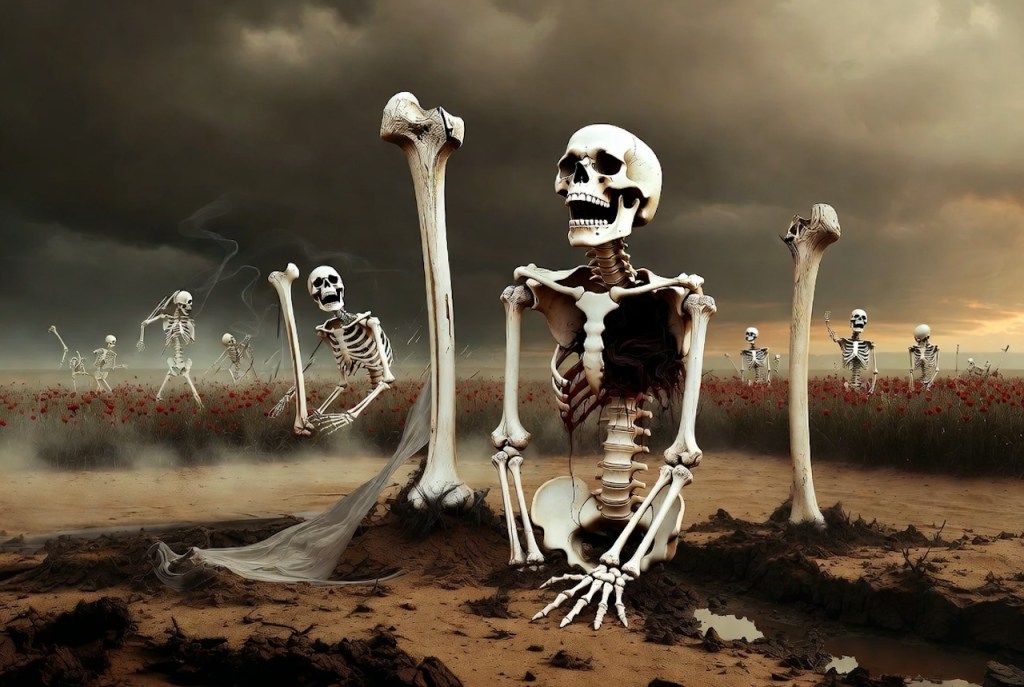
Some bones stand like corn stalks
After late harvest. They bristle in the field.
They remain unclean though they look
Bleached and scrubbed.
Skeletons may hang in closets
But not these bones—the ones
That are losing themselves
As they scream and pound sand.
Some bones cry for a thinner cloak
But unlike some hearts
They have never broken themselves
Over the pain of this mud ball.
Some bones slash themselves in early spring
And cleave to youth too late in summer.
A young brain cannot pool its dreams
To yield the pith of adult philosophy.
Some bones have no star to guide errant ways.
They may stitch themselves by valves
But sense no light in the chambers
That wobble and bleed ugly passions.
Some bones keep wobbling, sputtering,
Spitting in the face of any thought
That might hold them to account
Lingering in the mud of passing time.
A Prose Commentary on My Original Poem “Some Bones”
In my poem “Some Bones,” I have created a speaker who is musing on fragmentation, arrested development, and the failure of inner cohesion, using the recurring image of bones—stripped, exposed, and stubbornly animate—as a controlling metaphor for the human condition when it is cut off from spiritual integration.
Unlike the quiet endurance of stone, bone suggests a harsher, more restless existence: something once living that refuses, even in its partial ruin, to settle into peace. Such failure epitomizes the blocked condition of generations of unhappy, prideful, and dangerous individuals who have remained strangers to themselves.
The language remains constructively physical—bones, closets, sand, mud, valves—yet it continually gesticulates toward psychological and spiritual disarray. My speaker does not offer consolation; instead, she allows the imagery to confront the reader with a kind of unresolved agitation. Where wisdom might emerge, it does so jarringly, often obstructed by immaturity, illusion, or sheer refusal.
Underlying the poem is my own sense that without a guiding metaphysical orientation—whether one names it divine light, higher consciousness, or moral clarity—the human being risks becoming disjointed, reactive, and perpetually unfinished. Such an orientation of mind has been instilled in my mindset by my blessèd Guru Paramahansa Yogananda.
First Stanza: Residue after Harvest
In the opening stanza, my speaker presents bones as remnants, likened to corn stalks left standing after harvest. This simile is intentional: what remains is not fruitful but residual, something overlooked, perhaps even abandoned. The bones “bristle,” suggesting defensiveness, a kind of posturing that masks emptiness.
Though they appear “bleached and scrubbed,” they remain “unclean.” This contradiction establishes a central tension: outward purification does not equate to inner transformation.
The bones carry a stain that cannot be washed away by exposure or time alone. I wanted the speaker to imply that mere survival or endurance does not guarantee wisdom; one can persist and yet remain fundamentally unresolved.
Second Stanza: Refusal of Containment
Here, my speaker contrasts the familiar idiom of “skeletons in closets” with these bones, which refuse concealment. They are not hidden but actively “losing themselves / As they scream and pound sand.” The image is specifically chaotic and futile—pounding sand accomplishes nothing, yet it expresses frustration and desperation.
These bones are not passive relics but disintegrating agents, unable to maintain coherence. The phrase “losing themselves” suggests a failure of identity, a dissolution rather than a stable essence. The speaker is emphasizing a kind of existential noise: movement without direction, expression without meaning—a condition that will remind my readers of the influence of postmodernism on poetry.
Third Stanza: Avoidance of True Suffering
In this stanza, the bones “cry for a thinner cloak,” desiring relief or escape, yet my speaker contrasts them with hearts that have “broken themselves / Over the pain of this mud ball.” The implication is that these bones have avoided the kind of deep suffering that refines and transforms.
There is, in my view, a necessary breaking that accompanies genuine emotional or spiritual growth. These bones, however, remain intact in a superficial sense precisely because they have not undergone that process.
Their complaint is shallow; they seek comfort without having earned insight. The “mud ball” underscores the earth’s dirty imperfection, a condition that must be confronted rather than evaded.
Fourth Stanza: Temporal Dislocation and Immaturity
The fourth stanza examines the misalignment of time and development. The bones “slash themselves in early spring” and “cleave to youth too late in summer,” suggesting a disordered relationship to life’s natural phases. There is both premature self-harm and delayed attachment to youth.
The concluding line suggests frenetically what the imagery implies: maturity requires synthesis. Dreams alone, without discipline or time, cannot produce wisdom. I wanted the speaker to assert that intellectual and spiritual depth cannot be rushed or improvised; it must be cultivated through experience and reflection.
Fifth Stanza: Absence of Guiding Light
Here, my speaker turns sternly to the absence of direction. The image that “Some bones have no star to guide errant ways” invokes the ancient image of navigation by the heavens. Without such a reference point, these bones attempt a kind of self-repair—“stitch themselves by valves”—but the effort is mechanical and insufficient.
The “chambers” evoke both the heart and the mind, yet they “sense no light.” This lack is crucial: the structure exists, but illumination does not. The result is a system that “wobbles and bleed[s] ugly passions,” governed not by clarity but by disorder. The speaker is averring that without an orienting principle, human faculties become unstable, even grotesque.
Sixth Stanza: Defiance and Stagnation
In the final stanza, the bones persist in their agitation—“wobbling, sputtering”—but now their resistance is directed against accountability itself. They reject introspection or discipline.
The closing image, “Lingering in the mud of passing time,” echoes to the earlier “mud ball,” but now it emphasizes stagnation. Time moves, yet the bones do not progress; they remain mired, neither decaying fully nor transforming.
This eventuality is, perhaps, the most severe judgment in the poem: not suffering, not even failure, but refusal—the unwillingness to engage the very processes that might lead to growth.
An Afterthought
In “Some Bones,” I have attempted to portray a condition of partial existence—one in which the human being retains structure and motion but lacks integration, direction, and illumination. The bones are not dead, but neither are they fully alive in any meaningful sense.
Where my earlier musing on stone suggested endurance and the possibility of quiet wisdom, here I explore a more troubled state: persistence without purpose, animation without coherence.
The poem ultimately argues, though indirectly, that without a willingness to suffer, to mature, and to orient oneself toward a higher principle, one risks becoming like these bones—restless, exposed, and perpetually incomplete.
 Linda's Literary Home
Good faith questions and comments welcome!