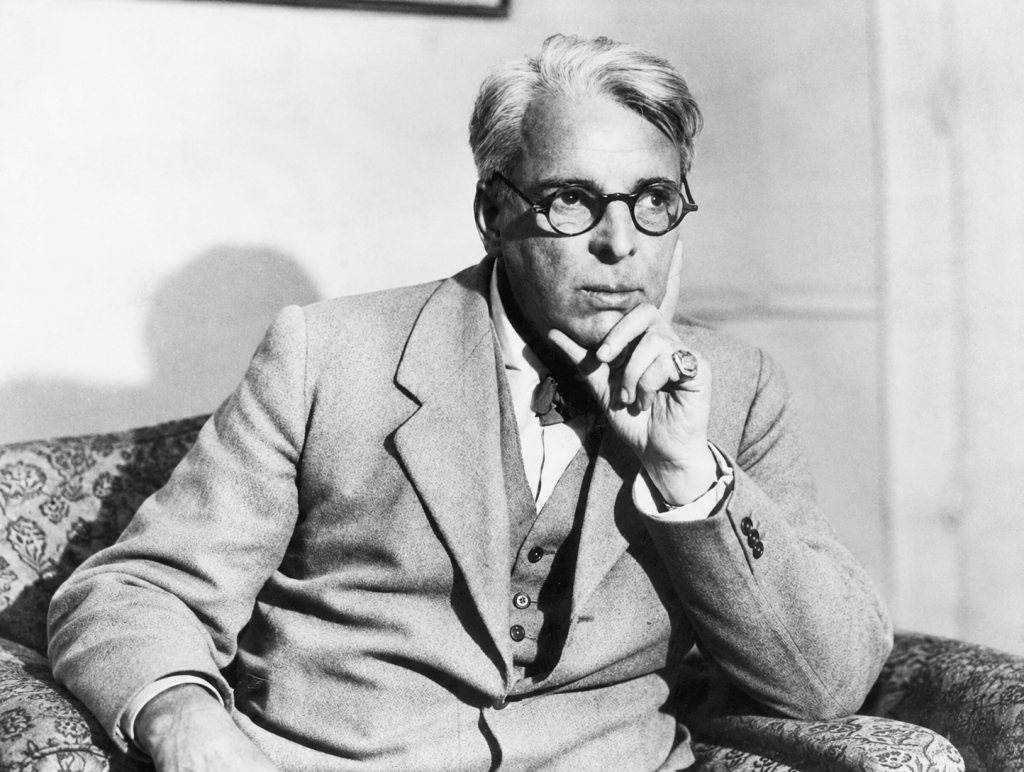
William Butler Yeats’ “Leda and the Swan”
William Butler Yeats’ “Leda and the Swan” focuses on an ancient Greek myth. Leda, wife of Tyndareus, was impregnated by Zeus disguised as a swan. Yeats’ speaker offers his musing regarding the nature of such an act and how it might have impacted Leda’s mental capacities.
Introduction and Text from “Leda and the Swan”
The London news outlet The Telegraph, April 28, 2012 edition, features an article titled, “‘Mythical’ Swan Photo Taken Down After ‘Bestiality’ Fears” [1], in which Hannah Furness reports about an incident involving this ancient myth.
Derrick Santini’s photograph depicting the mythological coupling of Leda and the god Zeus in his disguise as a swan was on display at The Scream, a gallery owned by Tyrone and Jamie Wood, sons of Ronnie Wood, legendary guitarist for The Rolling Stones.
A London police officer caught a glimpse of the photographic art piece and reported his observation; then two of the officer’s uniformed colleagues showed up at The Scream to investigate further.
Because of the law declaring bestiality an “arrestable offence,” the officers informed the gallery owners that they would have remove the offending piece of art. The curators quickly complied because the work had already been on display the entire month and was scheduled for removal anyway.
Had the officers appeared and made their censorious demands on the opening day the display, the gallery owners would likely have taken their battle over the issue to court. Jamie Wood explained,
We would of course have fought to keep the piece up otherwise. If anyone wants to view it, we still have it at the gallery. The purpose of art is to provoke debate and Derrick’s piece has certainly done that.
This scenario bespeaks a troublesome direction for Western culture—an law officer was unable to recognize a piece of art depicting an ancient Greek myth. Nevertheless, the clash between art and culture remains an issue for all time periods.
William Butler Yeats’ “Leda and the Swan” focuses on the ancient Greek myth, wherein the woman, Leda, wife of Tyndareus, was impregnated by the god Zeus in disguise as a swan. Yeats’ speaker is musing regarding the nature of such an act and how it might have impacted Leda’s mental capacities afterward.
William Butler Yeats’ refurbishing of the famous copulation scene features a modern day rethinking of the event, but adding to it implications that likely the original myth creators would find amusing at best, disturbing at worst.
In fact, the symbolism of the myth continues to offer occasion for interpretation, and individuals will approach the act of interpretation according to their own moral standards as well as their own repository of facts.
Yeats’ poem “Leda and the Swan” is an innovative sonnet (aka American-innovative sonnet) [2], sporting 15 lines rather than the traditional 14. In the Shakespeare 154-sonnet sequence, sonnet 99 [3] also contains an extra line, as the first stanza becomes a cinquain replacing the traditional quatrain.
Leda and the Swan
A sudden blow: the great wings beating still
Above the staggering girl, her thighs caressed
By the dark webs, her nape caught in his bill,
He holds her helpless breast upon his breast.
How can those terrified vague fingers push
The feathered glory from her loosening thighs?
And how can body, laid in that white rush,
But feel the strange heart beating where it lies?
A shudder in the loins engenders there
The broken wall, the burning roof and tower
And Agamemnon dead.
Being so caught up,
So mastered by the brute blood of the air,
Did she put on his knowledge with his power
Before the indifferent beak could let her drop?
Reading of “Leda and the Swan” by Siobhan McKena”
Commentary on “Leda and the Swan”
William Butler Yeats creates a speaker who is offering an interpretation of the ancient Greek myth, apparently to pose a question on which he has been and would likely continue to cogitate.
First Stanza: In the Middle of Things
A sudden blow: the great wings beating still
Above the staggering girl, her thighs caressed
By the dark webs, her nape caught in his bill,
He holds her helpless breast upon his breast.
The poem begins in medias res, that is, the coupling is in progress after the sudden descension of the swan that has swooped down and is now engaging with the woman Leda.
The wings of the swan continue to flutter, after he has caused the woman to stagger. He grasps her thighs with his “dark webs,” then grips her by the neck, holding her against his body. The woman remains helpless, unable to loosen herself from this grip.
This myth has often been interpreted as a rape, and Yeats’ interpretation certainly provides the violence that could indeed lead to that line of thinking. However, based on the actual mythic narrative, a case might be made that Leda was not actually an unwilling party to this act of coupling. Later that same day, Leda copulates with her husband.
The extraordinary result from those two acts is Leda giving birth to two sets of twins: one set includes Helen and Polydeuces fathered by the swan-Zeus, and the other set of twins is Castor and Clytemnestra fathered by Tyndareus.
Second Stanza: Questions
How can those terrified vague fingers push
The feathered glory from her loosening thighs?
And how can body, laid in that white rush,
But feel the strange heart beating where it lies?
The speaker of the Yeats poem speculates that the girl cannot push the swan away from her; she is too weak with only “terrified vague fingers,” and he is full of a “feathered glory,” after all he is a god—he is Zeus.
Zeus’ ability to loosen Leda’s thighs is absolute; thus, there is no hope that she could do other than to remain resigned to enduring that gigantic avian’s heart beating upon her. All she can do is struggle helplessly as he forces his masculinity into her feminine receptacle through his “white rush.”
Virtually all rhetorical questions function to answer themselves, and this speaker engages two rhetorical questions that follow that format. Yet, at the same time, those questions demonstrate that the speaker remains open to other answers. Fundamentally, this speaker is musing upon these events, as he wonders about certain issues, but in the end, he can offer no final answer to his questions.
Third Stanza: Changing the Course of World History
A shudder in the loins engenders there
The broken wall, the burning roof and tower
And Agamemnon dead.
Being so caught up,
So mastered by the brute blood of the air,
Did she put on his knowledge with his power
Before the indifferent beak could let her drop?
The swan/Zeus deposits his semen into Leda’s vaginal cavity, and all hell breaks loose. That spewed-forth froth coupling with Leda’s human ova will result in two children, who will change the course of history, especially Helen of Troy [4], over whom the Trojan War broke out.
Agamemnon then dies at the hands of his wife Clytemnestra, who was angered by her husband’s sacrifice of their daughter, Iphigenia. As Agamemnon was preparing to sail into war to retrieve Helen, his fleet encountered difficulty which would be assuaged only by sacrifice of his daughter.
Loss of their daughter Iphigenia angered his wife Clytemnestra, so she later kills him. Thus after that climactic “shudder in the loins,” the war flames out which results in the “broken wall, the burning roof and tower / And Agamemnon dead.”
The images of the “broken wall” and the “burning roof and tower” imply sexual imagery: the penetrated female by the male penetrator, as well as the plundering of the city of Troy, by the marauding band of warriors.
In the final musing of the poem, also fashioned as a rhetorical question, the speaker offers his final speculation. He wonders if while Leda was apparently violated by the intrusion of the god Zeus disguised as a swan, perhaps she was also altered.
Perhaps, she actually was able to take on a portion of his “knowledge” and a slice of his “power,” even though he remained “indifferent” to her predicament. Because of the god’s indifference, his swan’s beak just allows the violated woman to “drop.” Did she “drop” with a thud or a swish?
The Power of Myth
Because this poem originates from an interpretation of a Greek mythological narrative, it continues to be open to various interpretations. The decidedly absurd nature of a swan coupling with a human being in conjunction with the scientific fact that conception cannot be accomplished across species clearly indicates that the myth’s dramatic meaning that cannot be taken literally.
Then, too, there is the issue that Leda’s and Zeus’s offspring are born from eggs—not merely eggs in the form of human ova, but resembling avian eggs; it is helpful to remember that Zeus coupled with Leda as he masqueraded as an large bird—a swan.
In the original Zeus/Leda mythic narrative, the issue of coupling appears to be a seduction and not a rape. For example, about the nature of Zeus’ engaging women in sex, the ancient rhetorician Isocrates [5] has stated,
Zeus, lord of all, reveals his power in all else, but deigns to approach beauty in humble guise. For in the likeness of Amphitryon he came to Alcmena, and as a shower of gold he united with Danae, and in the guise of a swan he took refuge in the bosom of Nemesis, and again in this form he espoused Leda; ever with artifice manifestly, and not with violence, does he pursue beauty in women.
According to the Isocrates interpretation, Zeus seduced woman humbly in his various forms, and the god did so not out of selfish lust but for the sake of pursuing and enjoying the beauty in the women who possessed it.
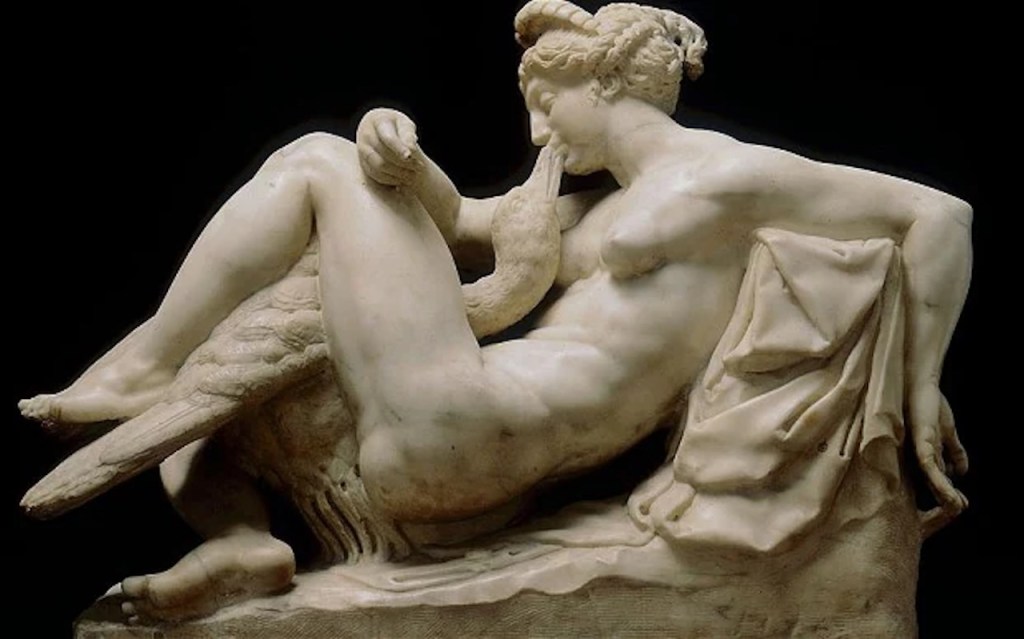
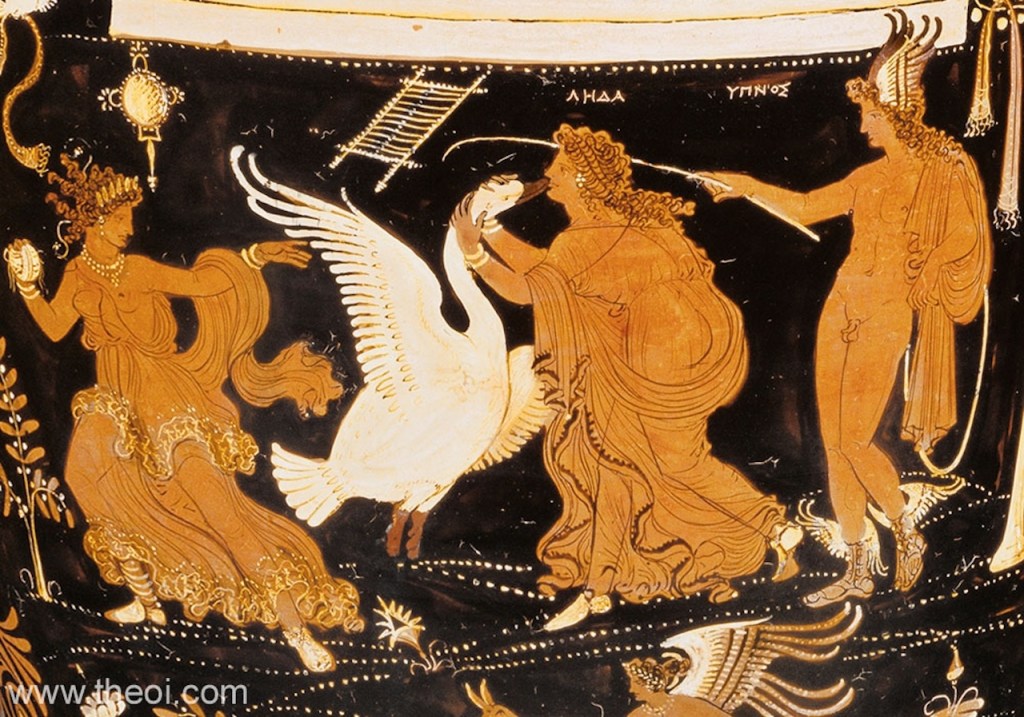
Many artistic expressions—see two examples below—focusing on the Zeus/Leda narrative for their subject matter portray Leda holding the swan affectionately, therefore, supporting Isocrates’ interpretation that the act was seduction not rape.
However, the Yeats poem is one of the interpretations that forces readers to reinterpret the myth as the rape of Leda by Zeus as a swan. Even though the Yeatsian speaker offers only a waffling about what he believes about the whole affair, ultimately he does seem to be strongly suggesting that the act was a rape.
Cleverly, the Yeatsian speaker also takes the direct emphasis off the issue of rape vs seduction by simply posing the rhetorical question about whether Leda took on some of the Zeusian powers.
Sources
[1] Hannah Furness. “‘Mythical’ Swan Photo Taken Down After ‘Bestiality’ Fears.” The Telegraph. April 28, 2012.
[2] Linda Sue Grimes. “Literary Devices: Tools of the Commentarian.” Linda’s Literary Home. February 9, 2026.
[3] – – -. “Shakespeare Sonnet 99: ‘The forward violet thus did I chide’.” Linda’s Literary Home. February 12, 2026.
[4] Editors. “Helen of Troy.” GreekMythology.com. Accessed October 1, 2026.
[5] George Norlin, editor. “Isocrates: Helen.” Perseus Digital Library. Accessed October 1, 2026.
Examples of Art Depicting Affection Not Rape


Good faith questions and comments welcome!