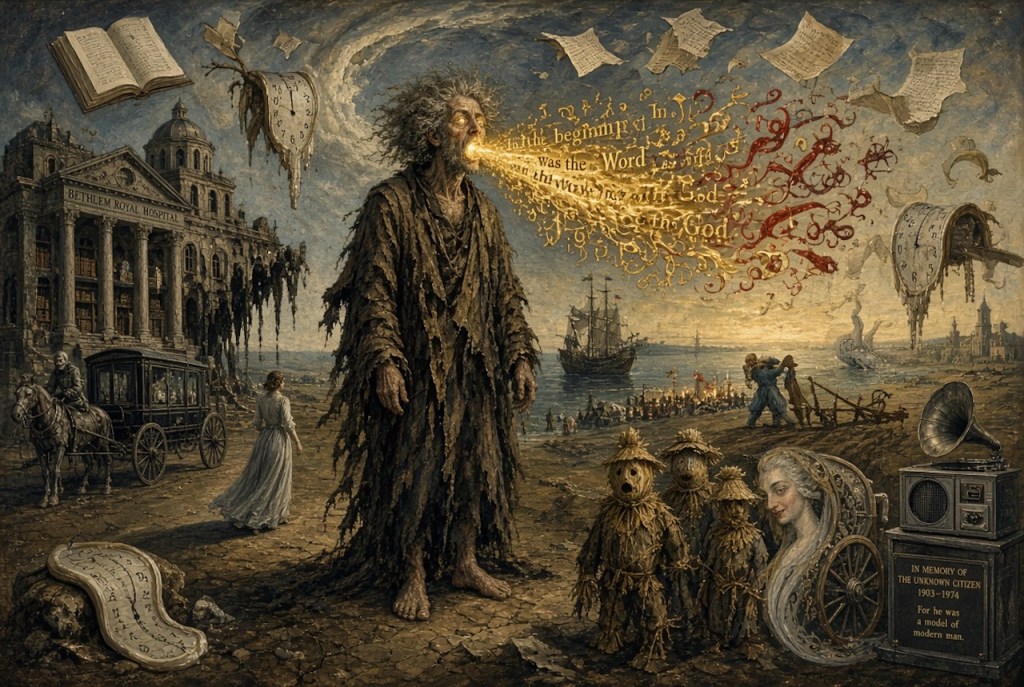
“Tom O’Bedlam” Speaks Verse: But There Is a Problem with This Modern-Day “Poor Tom”
There is an odd contradiction in the YouTube poetry readings of the man who calls himself “Tom O’Bedlam”*. His readings are often superb. He has one of those voices that seems almost made for poetry: resonant, measured, beautifully controlled, and capable of giving even familiar lines an unexpected authority.
I would very much like to employ his readings as accompaniments to my poetry commentaries on Linda’s Literary Home. Unfortunately, there is a problem: the character with the alias known as Tom O’Bedlam has a voice that is considerably more reliable than his literary commentary.
Pointing my readers to Poor Tom’s flapdoodle would be incompetent and irresponsible, so I assiduously avoid such pointing, even though I enjoy listening to the man’s interpretive reading of the poems. (One must wonder why the true identity this golden-voiced wonder is so carefully concealed.)
*The figure of Tom O’Bedlam remains one of the most enigmatic characters in English literary tradition—a wandering mendicant who is either mad or skillfully feigning madness, forever linked to the notorious Bethlem Royal Hospital and to the wild visionary speech of an anonymous seventeenth-century ballad. For further information about the character, please see my essay “Tom O’Bedlam: Mad Mendicant or Feigning Fraud?”
Just Read, Please!
Again and again, this modern-day “Tom O’Bedlam” besmirches a poem with an explanation that proves to be flat-out wrong, historically inaccurate, reductive, or simply unrelated to what the poem is actually doing.
Consider his introduction to Walt Whitman’s “Miracles.” He says that before Darwin, the most compelling explanation for the wonders of nature was that they were the handiwork of a divine creator but then adds: “The problem with such conclusions is that they inhibit further research.” That claim is historically false.
Natural theology itself encouraged generations of people to study the natural world as evidence of an intelligible creation. The relationship between Christianity and the development of modern science is vastly more complicated than O’Bedlam’s tidy before-Darwin/after-Darwin story.
More importantly, the statement has little to do with Whitman. The poem “Miracles” was published in 1856, three years before Darwin’s On the Origin of Species. Whitman’s subject is not the conflict between evolution and creation.
In “Miracles,” Whitman is doing something much more interesting: he calls ordinary existence miraculous: streets, houses, animals, trees, people, the sea, stars, food, work, and his own body all become miracles.
The poem’s point is not that science cannot explain these things but that explanation does not exhaust their wonder. The poem begins by asking, “Why, who makes much of a miracle?” and proceeds to make everything a miracle.
Poor Tom therefore manages to impose upon Whitman a philosophical argument that the poem itself never makes. His commentary is less an interpretation of “Miracles” than an opportunity to deliver a little sermon about science and religion, which is patently false. This unfortunate error marks the beginning of further problematic errors.
Emily Dickinson’s “Because I could not stop for Death”: No Clue What It Means
About Emily Dickinson’s “Because I could not stop for Death,” the identity-concealing, magic-voiced crooner known as Tom O’Bedlam confesses, “I have no idea what it means or whether there’s any literal sense in it at all.” But he then makes a remarkable leap, claiming that it nevertheless conveys “what it must have been like to be Emily Dickinson.” How could he possibly know that?
Dickinson’s “Because I could not stop for Death” is not a diary entry or a transparent record of Dickinson’s private experience. It is a carefully constructed work of metaphor, personification, ambiguity, and spiritual expression. It gives us a speaker encountering Death, Immortality, and Eternity; it does not give us direct access to Dickinson’s mind.
O’Bedlam thus turns his inability to interpret the poem into an unsupported biographical claim. He says he does not know what the poem means, yet at the same time claims to know what it was like to be its author. This witless codswallop is painfully plain.
Shakespeare Sonnet 2 “When forty winters shall besiege thy brow”: Reduction Leading to Absurdity
The Tom-O’Bedlam-appropriator reduces Shakespeare’s intricate musing on aging, beauty, procreation, and mortality to a sentimental anecdote about his daughter. His assertion that she provides “immortality” merely substitutes personal emotion for interpretation.
The claim is especially ludicrous because offspring do not confer personal immortality, a quality which cannot be measured by degrees: a child often carries forward a parent’s genes, resemblance, or family line, but that is biological succession, not immortality.
In traditional, spiritual understanding, it is the human soul—not the body or its descendants—that survives death. O’Bedlam thus replaces Shakespeare’s musing with a shallow autobiographical sentiment and confuses metaphorical continuity with the immortality of the individual soul.
By inserting the issue of “immortality” into the discussion, O’Bedlam is introducing an issue with which the Shakespeare speaker is not even concerned: the Shakespeare sonnet is one of the “Marriage Sonnets” whose only purposes is to persuade a young man to marry and produced lovely offering.
Thus, O’Bedlam deserves a modicum of credit for his first statement about the sonnet: “The sonnet is addressed to a young man and it recommends maintaining youth and beauty vicariously by having a son by the age of forty.” O’Bedlam is close, but his formulation subtly misstates the sonnet’s purpose.
The Shakespeare speaker does not recommend “maintaining” youth and beauty through a son; youth and beauty inevitably fade. Rather, the young man (“The Marriage Sonnets”) is urged to reproduce so that the father’s lost beauty may be passed on in his child, who will likely resemble his father by inheriting his good qualities—and thus remain before his eyes.
Shakespeare Sonnet 18 “Shall I compare thee to a summer’s day?”: The Shakespearean Muse
Tom O’Bedlam correctly observes that claims about Shakespeare’s sexuality often exceed the evidence, but this observation is irrelevant to interpreting Sonnet 18. His central error is assuming the sonnet addresses a young male patron.
Within the sequence of sonnets 18–126 (“The Muse Sonnets”), the addressee is more plausibly Shakespeare’s muse: his poetic talent, whose inspiration sustains his art. The sonnet celebrates not a young man’s physical beauty but poetry’s power to preserve beauty beyond time and death, granting ideas and things of beauty immortality through verse.
The entire sequence is a musing on the poet’s art, often addressing his muse, his periods of creative dryness, and even the sonnet itself. Careful reading will show that there is no young man or any person at all in any of these sonnets.
T. S. Eliot’s “Prufrock”: Turning a Poem into a Biographical Diagnosis
O’Bedlam’s introduction to T. S. Eliot’s “The Love Song of J. Alfred Prufrock” provides another example of this problematic tendency. The YouTube description associated with his reading characterizes the poem as being about “a young man’s social diffidence and lack of self-assurance” and adds the assertion that Eliot “was still a virgin at the time.”
The first statement is defensible as a starting point, though woefully incomplete. The second is a different matter. It turns an uncertain biographical inference into a supposed key to the poem. But Prufrock is not simply Eliot confessing the anxieties of a sexually inexperienced young man.
The poem is a dramatic construction whose speaker is uncertain not merely about sexual experience but about time, identity, social performance, desire, mortality, and his ability to act at all.
The speaker in “Prufrock” repeatedly imagines himself as an object being observed and judged. He asks whether he dares “disturb the universe” and imagines women discussing Michelangelo while he remains trapped in self-consciousness. His anxiety is existential—much more so than sexual.
The biographical claim therefore encourages exactly the wrong kind of reading. Instead of asking what Eliot has constructed in the voice of Prufrock, the listener is invited to treat the poem as evidence about Eliot’s sex life at age twenty-two. That is not literary interpretation; it is speculation dressed up as biography.
Walt Whitman’s “O Captain! My Captain!”: Irresponsibly Absurd
O’Bedlam’s claim that “O Captain! My Captain!” shows no clear relevance to Lincoln’s assassination without Whitman’s own word is simply wrong. The poem’s entire extended metaphor—the fearful voyage completed, the prize won, the port reached, the people exulting, and the Captain lying cold and dead on the deck—maps with precision the American Civil War’s end and Lincoln’s murder at the moment of victory.
Clearly, the ship is the Union; the Captain is Lincoln. That is not vague metaphor but deliberate elegiac design, as Whitman and every subsequent reader have recognized. O’Bedlam’s commentary is not merely inadequate; it mistakes the limitations of his own reading for limitations in Whitman’s poem.
Whitman need not name Lincoln for the poem to be historically and emotionally relevant. To dismiss its relevance because its metaphors require interpretation is to confuse literary illiteracy with critical insight. The gratuitous speculation about Moby-Dick only reinforces the error.
John Donne’s “The Indifferent”: Abandonment of Lit for Psych
Poor Tom’s commentary on John Donne’s “The Indifferent” mistakes Donne’s dramatic seducer for a spokesman on jealousy then wanders into speculative evolutionary psychology, amateur diagnosis, and relationship advice.
None of these examples of misdirection illuminates the poem’s wit, rhetorical strategy, or satirical exposure of a man who rationalizes promiscuity while attempting to recruit a woman into his self-serving philosophy.
The speaker’s argument is not Donne’s doctrine. To mistake a calculated poetic performance for a treatise on human behavior is to abandon literary criticism for irrelevant, often incoherent digression.
Andrew Marvell, “To His Coy Mistress”: Another Error in Reduction
O’Bedlam’s YouTube description says: “A reading of Marvell’s poem whose purpose is to persuade a virgin to have sexual intercourse with him.” The problem is emphasis on the woman being a “a virgin.” The speaker calls her his “coy mistress,” and the entire seduction depends upon her resistance, but emphasis on virginity misdirects the emphasis of the poem.
That mistake may seem a small error, but it is revealing. O’Bedlam directs the poem’s major emphasis to a minor detail; it is likely that readers assume the young woman is a virgin but her virginity is a mere detail, not the major emphasis of the poem.
The poem’s first section is deliberately extravagant: if they had infinite time, the speaker says, her reluctance would not matter. But “Time’s wingèd chariot” is suddenly bearing down upon them. The argument is carpe diem, not a biographical report about the woman’s sexual status.
More significantly, the word “purpose” makes the commentary more reductive than the poem. Marvell’s speaker is obviously attempting seduction, but the poem is also an extraordinarily elaborate comic exercise in rhetoric, mortality, time, desire, and the transformation of courtly love conventions.
Reducing the poem’s achievement to the act of “persuading a virgin to have sexual intercourse” is rather like describing Hamlet as “a play in which a prince wants to kill his uncle.”
T. S. Eliot’s “The Hollow Men”: Simplistic Blather
O’Bedlam’s reading is extensively circulated and used in educational material. But the interpretive danger here is particularly acute because explanations of the poem often turn Eliot’s religious development into a simplistic key.
T. S. Eliot’s “The Hollow Men” was published in 1925, but Eliot did not formally convert to Anglo-Catholicism until 1927. That chronology is real and interesting. But saying that the poem simply expresses Eliot’s “longing for spiritual fulfillment” risks turning a complicated, fragmented poem into a two-year countdown to conversion. The poem’s speakers are themselves unstable: “We are the hollow men / We are the stuffed men.”
The poem deliberately refuses to give us a stable explanatory framework. It mixes Dante, Conrad, Christian prayer, nursery rime, fragmentation, and apocalyptic imagery. The famous ending—“This is the way the world ends / Not with a bang but a whimper”—is not a thesis that can simply be translated into “Eliot thought modern civilization was spiritually bankrupt.” It is a deliberately theatrical and fractured construction.
W. H. Auden’s “The Unknown Citizen”: Speculation and Irrelevance
The Verse Speaker’s reading of W. H. Auden’s “The Unknown Citizen” is excellent as usual, but his commentary offers only speculation and irrelevance. He introduces several interesting observations, yet too often wanders away from Auden’s central satire.
Poor Tom compares the poem to George Orwell’s 1984 and suggests that Orwell probably read it. The resemblance is certainly worth noticing—both works examine societies in which individuality is threatened by bureaucratic control—but speculation about whether Orwell actually read Auden contributes nothing to an understanding of the poem. Auden’s poem, published in 1939, stands perfectly well on its own.
Poor Tom also spends time discussing whether certain expressions sound British or American and makes an extended comparison between Auden’s list of consumer goods and various Chinese “Four Goods.” These observations may be interesting trivia, but they distract from the poem’s much sharper joke.
The “phonograph, radio, car and frigidaire” matter because they are treated as evidence that the citizen has purchased the correct things and therefore lived correctly. Auden is mocking a society that reduces human beings to measurable statistics.
O’Bedlam is more useful when he mentions eugenics. The poem’s reference to the “Eugenist” illustrates its larger criticism: even reproduction has become something institutions can measure and regulate. The citizen’s five children are not presented as individuals but as the “right number.” Everything about him has been converted into a statistic.
And that fact is the essential point O’Bedlam’s commentary sometimes obscures. Auden is not simply attacking one particular political system. The poem inventories the citizen through his employer, union, insurance company, newspaper, government, advertisers, social scientists, and even the eugenics movement. Every institution can certify that he has behaved normally. Yet none can answer the only questions that ultimately matter: “Was he free? Was he happy?”
The official response—“The question is absurd”—is the poem’s devastating punch line. The authorities assume that if the man had been unhappy or unfree, they would have known. But their entire system is designed to measure behavior rather than understand an inner life.
The title itself makes the irony even sharper. Like the Unknown Soldier, this citizen has been memorialized by the State. But the soldier is unknown because his identity was lost; Auden’s citizen is unknown because, despite possessing an enormous bureaucratic record, nobody ever truly knew him.
O’Bedlam’s excellent delivery captures the poem’s deadpan humor, but his commentary occasionally buries that humor beneath unnecessary historical speculation. Auden does not need Orwell, the Chinese “Four Goods,” or an extended discussion of vocabulary to make his point. The poem’s satire is already complete: the State knows everything about the citizen that can be recorded, measured, or counted—and nothing about the person himself.
W. H. Auden’s “Musée des Beaux Arts”
Tom O’Bedlam’s introduction to his reading of W. H. Auden’s “Musée des Beaux Arts” contains a dizzying number of questionable assertions. He begins reasonably enough by identifying Auden’s visit to the museum in Brussels in 1938 and Bruegel’s Landscape with the Fall of Icarus. But then he launches into a long argument about the painting and the history of art.
The most vulnerable assertion is this: “Photography changed Art fundamentally with the concept of a moment in time captured.” He then argues that before photography artists did not concern themselves with capturing a moment in time, that artists painted what they knew rather than what they saw, and that Impressionists painted “what they noticed rather than what they saw.”
He goes on to suggest that before photography art was essentially a commercial enterprise, with apprentices painting backgrounds and specialists painting such things as hands and drapery. He even speculates that mythological subjects were sometimes merely “an excuse to paint naked people,” calling some of them effectively pornography.
This drivel spews out an extraordinarily sweeping theory of Western art, and much of it remains simply untenable as history. The most obvious problem is chronology. Bruegel’s Landscape with the Fall of Icarus dates from about 1560, more than two centuries before photography. But the painting’s unusual treatment of time and perspective cannot be dismissed as an artist’s inability to think photographically.
The Open University notes that Bruegel deliberately makes the ploughman the dominant figure and places Icarus almost invisibly in the lower corner; it also notes that the setting sun is an actual feature of the composition.
More importantly, O’Bedlam’s own explanation actually misunderstands what is fascinating about Auden’s poem. Auden is not complaining that Bruegel failed to depict a sufficiently dramatic “moment”; he is interested in the fact that Icarus’ catastrophe is visually subordinated to ordinary human activity.
The ploughman ploughs, the ship sails, the sun shines. Columbia’s discussion of the painting and poem identifies precisely this theme: human ambition and suffering occur while the rest of the world continues its business.
And O’Bedlam’s claim that the ship’s sails being full of wind while other things are unaffected proves something about the painting is particularly weak. The Open University actually observes the setting sun and the lighting effects on the ploughman’s field, horse, and furrows.
His broader history of art is even more problematic. Art did not become a commercial enterprise only after artists began working for clients, nor did artists before photography simply paint what they “knew.” Religious, political, ceremonial, devotional, private, decorative, and purely aesthetic purposes existed throughout the history of art.
And the suggestion that mythological paintings were basically opportunities for wealthy patrons to obtain pornography is an amusing aside, perhaps, but it is not serious art history. O’Bedlam has taken a complicated subject and produced a woefully confident single explanation for it.
W. H. Auden’s “Funeral Blues”: The “Woman” and “Satire” Problem
O’Bedlam’s introduction to “Funeral Blues” is also worth noting. O’Bedlam says that the speaker is a woman and that the poem was originally satire rather than pathos. He explains that the poem was written as a cabaret song for soprano Hedli Anderson and that its appearance in Four Weddings and a Funeral subsequently gave it a significance that was not intended.
There is a kernel of truth here, which makes the error more interesting. The poem really did originate in Auden and Christopher Isherwood’s 1936 play The Ascent of F6, and Auden later substantially revised it as two cabaret songs for Hedli Anderson. The original dramatic context was satirical. But O’Bedlam’s statement that “the speaker is a woman” is too categorical.
The revised song was performed by a female singer, but that fact does not establish the sex of the poem’s speaker. Indeed, scholarship on the poem specifically notes that the later version has a female singer while the Collected Poems does not identify a particular speaker, thereby preserving the poem’s flexibility.
Even more important is the assertion that it was “satire, not pathos.” That confuses the poem’s original dramatic context with the poem’s subsequent existence. The revision transformed the piece. The later “Funeral Blues” is emphatically capable of functioning as a lament, and its enormous emotional effect is not simply an accidental distortion created by the movie.
The historical scholarship recognizes both its comic/cabaret origins and its later melancholy form. So this poem’s exegesis presents a subtler case than “Miracles.” O’Bedlam has a legitimate historical fact in his hand and then pushes it too far. He turns “This poem originated in a satirical play” into “This poem is satire, not pathos.” Those are not the same proposition.
The Problem with O’Bedlam’s Interpretations
Literary interpretation is not a mathematics examination. Reasonable readers can disagree. A poem can sustain several interpretations—some more plausible than others. The problem with O’Bedlam’s commentaries is something different: he too often presents debatable interpretations, biographical conjectures, or sweeping historical claims as settled facts.
His commentary on poems is especially unfortunate because the readings themselves are so good. The listener naturally assumes that someone capable of reading a poem with such sensitivity must also understand everything he says about it. But these are two very different accomplishments.
“Tom O’Bedlam,” “SpokenVerse”—or whoever he is— is a gifted reader. His recordings can bring poetry vividly to life. His commentary on the poems, however, should be regarded as opinion rather than fact—and more often than not, those opinions require immediate fact-checking.
The irony is that his commentaries occasionally commit the very offense he attributes to religion in “Miracles”: they tidy up our ignorance into a single concept. A difficult poem becomes a simple psychological diagnosis; a complicated history becomes a before-and-after story; a dramatic speaker becomes the poet; an ambiguity becomes an answer. The poems deserve better.
So by all means, listen to “Tom O’Bedlam” (aka SpokenVerse). His voice is wonderfully suited to read poems. But after he finishes explaining the poem, go back and read the poem again, and by all means fact-check Poor Tom’s claims for accuracy. The poem is far more intelligent than an O’Bedlamian explanatory guess.


Questions, comments, suggestions offered in good faith are always welcome. If you use a pseudonym, please include your real name, if you expect a response.