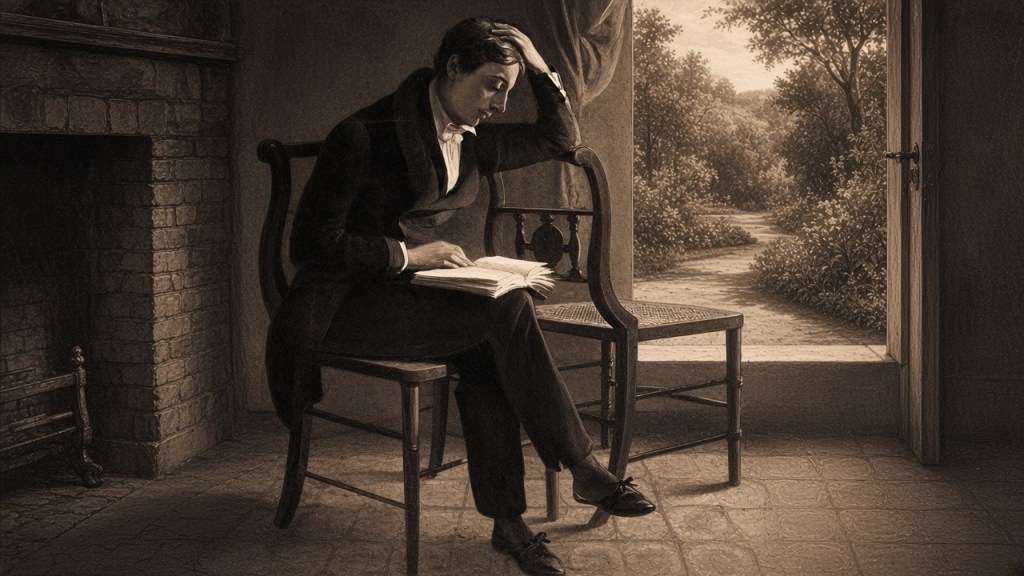
John Keats’ Sonnet VII “O Solitude! if I must with thee dwell”
The speaker in Keats’ “O Solitude!” claims that he would be content to live a rural life alone but then decides he might prefer the company of a kindred spirit.
Introduction with Text of Sonnet VII:”O Solitude! if I must with thee dwell”
John Keats’ sonnet VII “O Solitude! if I must with thee dwell” is a Petrarchan sonnet with the rime scheme ABBAABBACDDCDC; it dramatizes a basic tenet of the Romantic Movement, the desire to live a bucolic life and to commune with nature.
This sonnet appears in The Poetical Works of John Keats, edited by Harry Buxton Forman and was published in London in by Reeves and Turner in 1884. It is the seventh sonnet in a seventeen-sonnet sequence.
Sonnet VII “O Solitude! if I must with thee dwell”
O Solitude! if I must with thee dwell,
Let it not be among the jumbled heap
Of murky buildings; climb with me the steep,—
Nature’s observatory—whence the dell,
Its flowery slopes, its river’s crystal swell,
May seem a span; let me thy vigils keep
’Mongst boughs pavillion’d, where the deer’s swift leap
Startles the wild bee from the fox-glove bell.
But though I’ll gladly trace these scenes with thee,
Yet the sweet converse of an innocent mind,
Whose words are images of thoughts refin’d,
Is my soul’s pleasure; and it sure must be
Almost the highest bliss of human-kind,
When to thy haunts two kindred spirits flee.
Reading
Commentary on Sonnet VII “O Solitude! if I must with thee dwell”
True to the Romantic Movement’s tenets, the speaker in Keats’ sonnet VII “O Solitude! if I must with thee dwell” expresses the desire to live in a bucolic setting, alone if necessary. But then he decides that having someone who shares his sensibilities would be even better. Thus, he does hope for a kindred spirit to share his country life.
Octave: Choosing a Rustic Life
O Solitude! if I must with thee dwell,
Let it not be among the jumbled heap
Of murky buildings; climb with me the steep,—
Nature’s observatory—whence the dell,
Its flowery slopes, its river’s crystal swell,
May seem a span; let me thy vigils keep
’Mongst boughs pavillion’d, where the deer’s swift leap
Startles the wild bee from the fox-glove bell.
In the octave, the speaker declares that if he must live alone or in “Solitude,” he would choose to live in a rural setting. He particularly scorns the city and demonstrates that feeling by asking of “Solitude” not to require him to live “among the jumbled heap / Of murky buildings.”
The speaker clearly disdains humankind’s clumping together in edifices in the city. Personifying he addressee, the speaker invites Solitude to “climb with me the steep.” He wants to roam in the hills in the open air and remain unencumbered by streets, signs, and crowds of people.
He desires the green grass and the sounds of rivers moving naturally through the rural landscape. The speaker issues forth the Romantic sensibility of yearning for “Nature’s observatory,” from which “the dell, / Its flowery slopes, its river’s crystal swell.”
He craves to reside among the flowers and clear river on a hillside, instead of living in a shabby city apartment. He adds that he would prefer to keep watch where trees are abundant and wild life can be observed, where he may observe a deer as it frightens a bee gathering its treasure from a flower.
His lovely pastoral descriptions are the stuff that made the hearts of the Romantics flutter with ecstasy, as they conveniently omitted from their country-life fantasies the inconveniences that had originally motivated human beings to construct and collect in cities.
Sestet: A Shared Experience in Bucolic Living
But though I’ll gladly trace these scenes with thee,
Yet the sweet converse of an innocent mind,
Whose words are images of thoughts refin’d,
Is my soul’s pleasure; and it sure must be
Almost the highest bliss of human-kind,
When to thy haunts two kindred spirits flee.
In the sestet commencing with the traditional volta designated by “[b]ut though”, the speaker adds a proviso to his notion of a perfect solitary life lived out in the country. He reveals that even though he would happily live alone as described in the octave, he would prefer to be accompanied by someone who is capable of offering him the opportunity for pleasant interaction, someone whose goals are as simple and uncomplicated as his own.
His “soul’s pleasure” is to be able to have conversations with someone who is like minded, someone “[w]hose words are images of thoughts refin’d.” He wants to share his bucolic existence with someone who thinks as poetically as he does.
What he ultimately discloses is that he would like to live in the country with solitude, but not total solitude, because he has decided that the height of the “bliss of human-kind” is when two like-minded people–”two kindred spirits”—can escape from the city and fly to the rustic country together.
Tribute to Nature
The Romantic Movement saw many such tributes to nature, singing the praises of a “river’s crystal swell” or “the deer’s swift leap” where it “startles the wild bee from the fox-glove bell.”
But Keats adds a clever dimension to his Petrarchan sonnet. He would be sublimely happy to live in solitude in a pastoral setting, but he would find it even more blissful to have a companion who loves nature and poetry as much as he does. The two could then split from the city and flit off to the “haunts” of country life and live their bucolic existence in “the highest bliss.”


Questions, comments, suggestions offered in good faith are always welcome. If you use a pseudonym, please include your real name, if you expect a response.