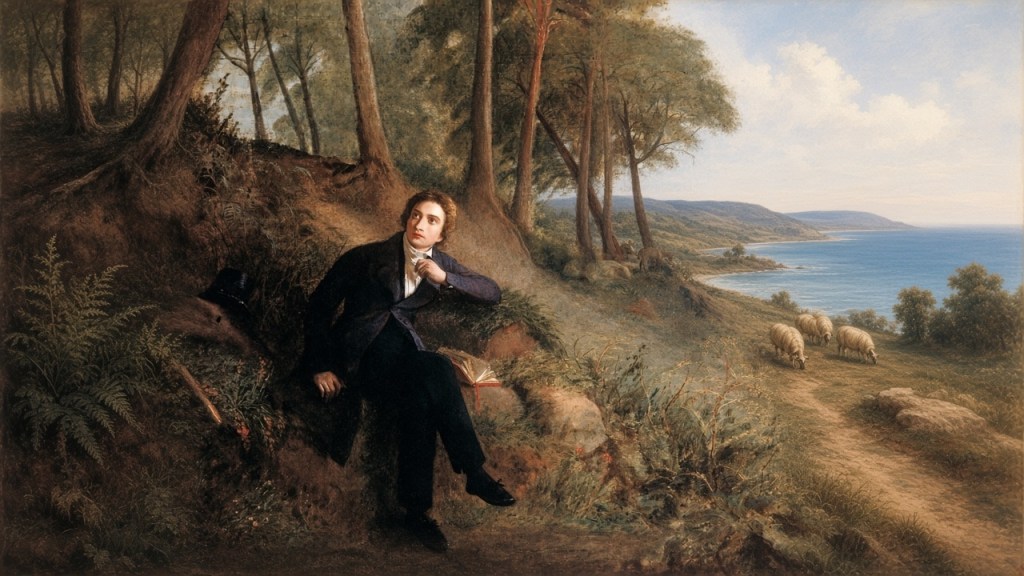
John Keats’ “To Autumn”
The autumn season provides an essence of a delicately poetic season. Likely, more poems have been created about autumn than any other season. Beauty tinged with melancholy offers an enticing subject. Keats’ “To Autumn” celebrates the season’s beauty as well as its melancholy.
Introduction and Text of “To Autumn”
John Keats’ speaker in “To Autumn” is celebrating the unique qualities of beauty along with melancholy that permeate the fall season. The poem plays out in three stanzas. Each well-crafted stanza contains eleven rimed lines. The rime-scheme of the first stanza is ABABCDEDCCE. The rime-scheme of the second stanza as well as the third stanza is ABABCDECDDE.
To Autumn
Season of mists and mellow fruitfulness,
Close bosom-friend of the maturing sun;
Conspiring with him how to load and bless
With fruit the vines that round the thatch-eves run;
To bend with apples the moss’d cottage-trees,
And fill all fruit with ripeness to the core;
To swell the gourd, and plump the hazel shells
With a sweet kernel; to set budding more,
And still more, later flowers for the bees,
Until they think warm days will never cease,
For summer has o’er-brimm’d their clammy cells.
Who hath not seen thee oft amid thy store?
Sometimes whoever seeks abroad may find
Thee sitting careless on a granary floor,
Thy hair soft-lifted by the winnowing wind;
Or on a half-reap’d furrow sound asleep,
Drows’d with the fume of poppies, while thy hook
Spares the next swath and all its twined flowers:
And sometimes like a gleaner thou dost keep
Steady thy laden head across a brook;
Or by a cyder-press, with patient look,
Thou watchest the last oozings hours by hours.
Where are the songs of spring? Ay, Where are they?
Think not of them, thou hast thy music too,—
While barred clouds bloom the soft-dying day,
And touch the stubble-plains with rosy hue;
Then in a wailful choir the small gnats mourn
Among the river sallows, borne aloft
Or sinking as the light wind lives or dies;
And full-grown lambs loud bleat from hilly bourn;
Hedge-crickets sing; and now with treble soft
The red-breast whistles from a garden-croft
And gathering swallows twitter in the skies.
Commentary on “To Autumn”
Keats creates a speaker to celebrate the beautiful yet melancholy season of autumn.
First Stanza: The Fecundity of the Season
Season of mists and mellow fruitfulness,
Close bosom-friend of the maturing sun;
Conspiring with him how to load and bless
With fruit the vines that round the thatch-eves run;
To bend with apples the moss’d cottage-trees,
And fill all fruit with ripeness to the core;
To swell the gourd, and plump the hazel shells
With a sweet kernel; to set budding more,
And still more, later flowers for the bees,
Until they think warm days will never cease,
For summer has o’er-brimm’d their clammy cells.
In the first stanza, the speaker is overheard dramatizing a summary that describes the autumn season along with what may often occur during that colorful time of year: misty fog often appears, the sun seems to become “mature,” the season along with the mature sun seem to work together to cause the luscious fruits to hang on vines.
The speaker allows the season of autumn to “conspir[e]” with the sun in order to create the juicy grapes and other fruits that will be harvested soon. The season works with the sun to motivate the trees to “bend with apples,” and to “fill all fruit with ripeness to the core,” and “To swell the gourd, and plump the hazel shells.” The marvelous season encourages the flower-power of the plants “for the bees,” and the bees “think warm days will never cease.”
Second Stanza: Conversing with the Season
Who hath not seen thee oft amid thy store?
Sometimes whoever seeks abroad may find
Thee sitting careless on a granary floor,
Thy hair soft-lifted by the winnowing wind;
Or on a half-reap’d furrow sound asleep,
Drows’d with the fume of poppies, while thy hook
Spares the next swath and all its twined flowers:
And sometimes like a gleaner thou dost keep
Steady thy laden head across a brook;
Or by a cyder-press, with patient look,
Thou watchest the last oozings hours by hours.
In the second stanza, the speakers then shifts his concern from merely describing to directly addressing the fecund season, as he speaks to autumn as if it were a human being. Autumn has now been transformed into a woman, whose “soft-hair” is being blown about pleasantly on a gentle wind.
The fascinatingly personified autumn may also be located in the fields that are drowsing from the scented emissions coming from “poppies.” At other times, this autumn personified may be seen as someone who keeps watch over and keeps pure the meanderings of a “brook.” Autumn may also be found “by a cyder-press” as it watches the tasty cider being pressed from the apples that had been seen bending the trees.
Third Stanza: Comparison to Spring
Where are the songs of spring? Ay, Where are they?
Think not of them, thou hast thy music too,—
While barred clouds bloom the soft-dying day,
And touch the stubble-plains with rosy hue;
Then in a wailful choir the small gnats mourn
Among the river sallows, borne aloft
Or sinking as the light wind lives or dies;
And full-grown lambs loud bleat from hilly bourn;
Hedge-crickets sing; and now with treble soft
The red-breast whistles from a garden-croft
And gathering swallows twitter in the skies.
The third stanza now finds the speaker shifting his gaze once again: he continues to speak to autumn as if the season were a human being, a friend even. However, the speaker now is making a single-sided comparison of autumn with spring. He queries the season with intensity: “Where are the songs of Spring?” And then he repeats his inquiry: “Ay, where are they?”
The repetition encourages his listeners and readers to sense that the speaker is, in fact, in the process of complaining about the loss of the song of spring, but then he warns the personified autumn not to be bothered about that lack of songs, because autumn possesses a music of its own. The speaker then renders a catalogue of the sounds which throng the season of ripe autumn.
As a setting for those sounds of autumn, the speaker creates a marvelous image: slow moving clouds abound as the day slows to a close; the could sprinkle a rosy glow over the fields of stubble. The reader or listener can then intuitively hear the music of a “wailful choir” of small gnats “mourn[ing],” “river-swallows, borne aloft,” “the light wind lives or dies.”
Readers and listeners can also listen to “full-grown lambs” bleating, “[h]edge crickets” singing, “with treble soft / The redbreast whistles,” and “gathering swallows twitter in the skies.”
Keats’ marvelous images have provided his audience with more than enough beauty through melancholy to make the fall season a favorite, making that season compete with spring and summer while giving winter a definite run for its money.


Questions, comments, suggestions offered in good faith are always welcome. If you use a pseudonym, please include your real name, if you expect a response.