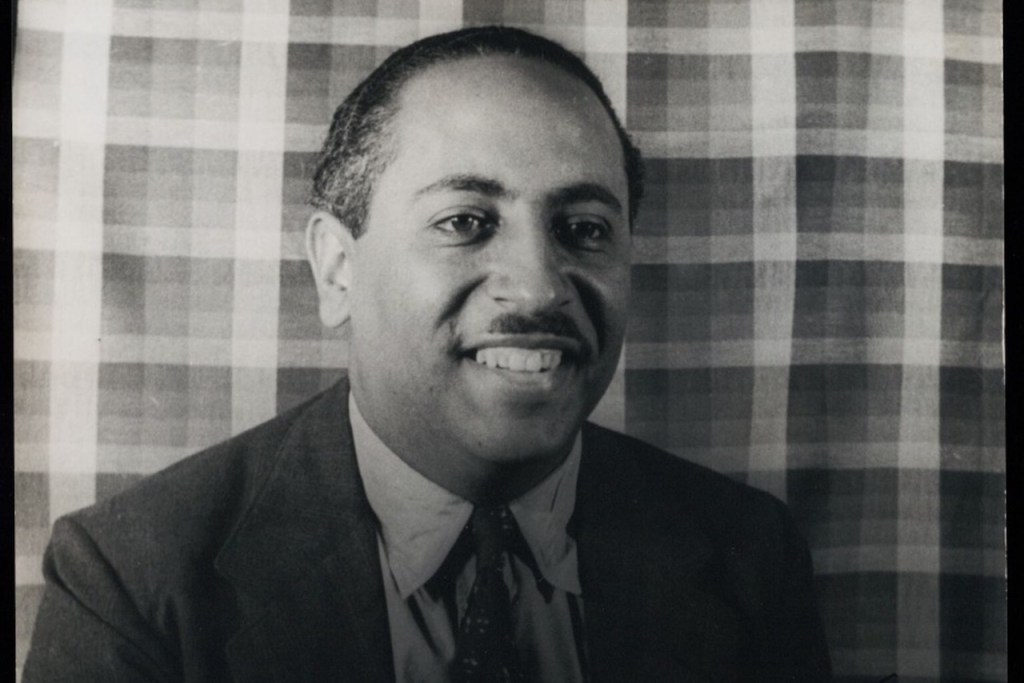
Arna Bontemps’ “God Give to Men”
Arna Bontemps’ speaker makes a statement about three classifications of humankind, employing subtle but bitter irony to further his point of view.
Introduction with Text of “God Give to Men”
Arna Bontemps’ “God Give to Men” disguises its bitter irony in a prayer, in which the speaker seems to be asking God for certain gifts for each of three classifications of human beings: “the yellow man,” “blue-eyed men,” and “black man.”
The speaker’s subtle but bitter irony reveals his contempt as he actually denigrates two of classifications. The speaker does not reveal explicitly to which classification he belongs. Thus, readers are given some latitude to interpret the significance of each gift the speaker wishes to bestow on each class of men.
An interesting thought experiment might include reading the poem from three different perspectives. That is, if the speaker is a “yellow man,” what do his gifts to that class mean? Also, if he is one of the “blue-eyed men,” how does that change the significance of each gift? And if he is a member of the “black man” classification, how might that impact his choices?
The Weakness of Stereotyping
It should be noted that the speaker engages heavily in stereotyping for all three classifications. Such a weakness could encourage the thought that this speaker does not belong to any of the classifications to which he is referring; for example, perhaps he is a red man or a brown man of Hispanic or Middle Eastern heritage, or perhaps he is an Indian from India.
By stereotyping each classification of man and men, the speaker offers nothing of substance regarding each, but the question does arise regarding the possible animus he holds for certain of the classifications.
Singular vs Plural
Interestingly, the speaker refers to the first classification as “the yellow man,” while designating the second group as “blue-eyed men.” Then he returns to the singular for the third group. That distinction from singular for the “yellow man” to plural for the “blue-eyed men” and then back to singular for the “black man” offers an issue for interpretation.
Might pluralizing the “blue-eyed” indicate the speaker’s level of familiarity with that group? Perhaps he simply finds the plural more rhythmic in its employment of pronouns. Or perhaps, it a simple rookie mistake. Such distinctions remain for each reader to decide.
God Give to Men
God give the yellow man
an easy breeze at blossom time.
Grant his eager, slanting eyes to cover
every land and dream
of afterwhile.
Give blue-eyed men their swivel chairs
to whirl in tall buildings.
Allow them many ships at sea,
and on land, soldiers
and policemen.
For black man, God,
no need to bother more
but only fill afresh his meed
of laughter,
his cup of tears.
God suffer little men
the taste of soul’s desire.
Commentary on Arna Bontemps “God Give to Men”
In this poem, the speaker puts on display stereotypes that he holds regarding three classifications of humankind. His evaluation of each classification becomes apparent through the gifts that he asks the Creator to bestow on each.
First Stanza: The Yellow Man
God give the yellow man
an easy breeze at blossom time.
Grant his eager, slanting eyes to cover
every land and dream
of afterwhile.
In the first stanza, the speaker asks God to grant “the yellow man” gentle winds as he engages his “slanting eyes” observing the beauty of “blossom time.” He then asks that this yellow man be afforded the prescience to peer into the “afterwhile.”
The two gifts that the speaker is asking from God for the “yellow man” reveal two stereotypes that Westerners entertain regarding their Eastern brothers and sisters. The first gift of “an easy breeze at blossom time” shows that the speaker has been influenced by Japanese and Chinese fine paintings that depict delicate “blossoms.”
In his second gift to the “yellow man,” the speaker is engaging the stereotype that assumes all Asians adhere to the tenets of reincarnation and karma. He wishes God to grant this Eastern man the ability to see with his “slanting eyes” “every land and dream / of afterwhile.”
The magnanimity of both these gifts, however, is diminished by the mere fact that both gifts are based on stereotypes, not the individual heart-felt desire that each human being be given appropriate gifts from God.
But the insincerity of these stereotypical gifts becomes more than merely trivial. The speaker is denigrating the yellow man for engaging in the mere frivolity of light sense pleasure; that “easy breeze at blossom time” thus competes with more important life-sustaining vital gifts that the speaker could have assigned the yellow man.
Note also that a poet writing today would be pilloried for using an expression such a “slanting eyes” to refer to an Asian individual—that is, unless that poet is of the ilk of LeRoi Jones, aka Amiri Baraka or Arna Bontemps.
Second Stanza: The Blue-Eyed Men
Give blue-eyed men their swivel chairs
to whirl in tall buildings.
Allow them many ships at sea,
and on land, soldiers
and policemen.
For the “blue-eyed men,” the speaker asks that God give them skyscrapers with office equipment, as well as mighty navies and armies with “soldiers” as well as “policemen.” Again, as with the yellow man, the speaker employs a mere stereotype to designate which two gifts he thinks God should grant. The first gift that God should grant the blue eyes is the comfortable chairs in office buildings that are tall.
The speaker is presenting the stereotype that blue-eyed men are materialists who work in offices with “swivel chairs” in “tall buildings.” The second gift of vast military force and police officers again stereotypes the “blue-eyed men” as interested only in power and force.
By honing in on these two particular gifts instrumental in the use of force, the speaker reduces those men with blue eyes to power hungry monstrosities. As this classification is much less of a protected class in the 21st century, the poet writing today could get away with much more invective stereotyping even than this one.
Third Stanza: The Black Man
For black man, God,
no need to bother more
but only fill afresh his meed
of laughter,
his cup of tears.
The speaker then asks God’s gift to the “black man” be nothing special—just let him laugh plenty and cry as needed. This classification dictates that it suffer the other classes to precede it, as this classification remains humble. But the humility remains a mere façade as the bitter irony of the speaker’s requests has demonstrated his scant knowledge of all three classifications.
A stereotype can describe only a surface level of qualities, for example, the notion that black people all have rhythm and love watermelon and fried chicken becomes ludicrous after observation of real individuals forming this classification. Yet, less obnoxious stereotypes are just as insidious, as they stand in for individual knowledge and mask ultimate reality.
Fourth Stanza: Suffering Their Desires
God suffer little men
the taste of soul’s desire.
The fourth stanza consists of only two lines that ask a generalized gift from God. The speaker wishes that each man of each classification “suffer” “the taste of soul’s desire.” Essentially, the speaker is asking God make sure each of these “little men” are afflicted with whatever punishment they deserve for entertaining the desires that they hold.
The speaker has assigned each classification of human beings a “soul’s desire,” but that desire has been determined by a very biased speaker, who holds bitter contempt for his other-racial fellows.
Asking God to grant each group of mankind their wishes, the speaker assumes that the yellow man wants to experience pretty flowers and contemplate the after life and that the blue-eyed men wish to accrue wealth and power.
However, black man needs nothing at all; he remains so humble that all he wants is just to laugh and cry as he sees fit. Thus the speaker is also implying that heretofore the black man has been denied his ability to laugh and cry according to his dictates. But now through his humble prayer, the speaker hopes that God will give these well-deserved gifts, and then all will be right with the world.
Reaping Bitter Fruit
Readers likely wonder what may be the significance of race for the black poet Arno Bontemps. The following poem by Bontemps is one example that demonstrates the poet’s attitude toward race:
A Black Man Talks of Reaping
I have sown beside all waters in my day.
I planted deep, within my heart the fear
That wind or fowl would take the grain away.
I planted safe against this stark, lean year.
I scattered seed enough to plant the land
In rows from Canada to Mexico
But for my reaping only what the hand
Can hold at once is all that I can show.
Yet what I sowed and what the orchard yields
My brother’s sons are gathering stalk and root,
Small wonder then my children glean in fields
They have not sown, and feed on bitter fruit.
The speaker in the Bontemps “The Black Man Speaks of Reaping” portrays black labor as vast, careful, but undercompensated; the speaker’s harvest is stolen by others, leaving descendants to glean only bitter, inherited injustice.
While Bontemps did not spout bitter personal hatred toward his fellows of other races—as did LeRoi Jones, aka Amiri Baraka—Bontemps did often decry the limitations he perceived that were placed on the black race. He then often expressed his bitterness with irony and satire.
In “God Give to Men,” Bontemps has crafted a speaker, who is demonstrating a bitter attitude directed toward the races of men not his own, and although the piece engages subtle irony, it loses its heft because of the focus on stereotypes.


Questions, comments, suggestions offered in good faith are always welcome. If you use a pseudonym, please include your real name, if you expect a response.