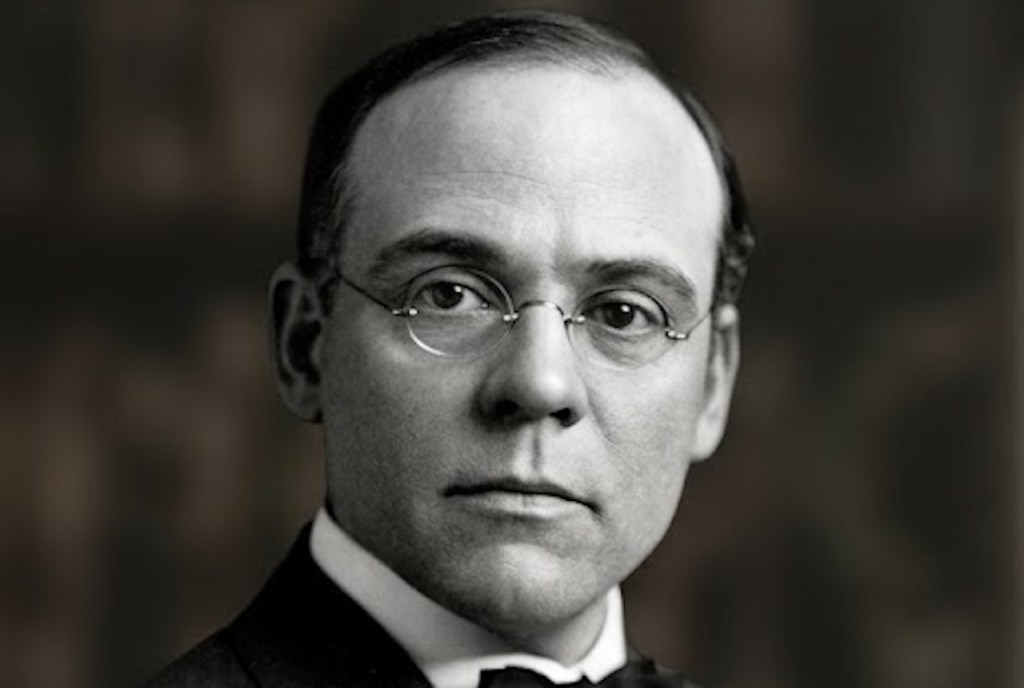
Edgar Lee Masters’ “Minerva Jones”
The “Minerva Jones” epitaph features one of the most depraved characters of the Spoon River talking dead. She is self-absorbed and haughty, lacking empathy and self-awareness, causing her to remain ignorant of her own discordant thoughts.
Introduction with Text of “Minerva Jones”
This epitaph “Minerva Jones” is the first in a series of five interrelated epitaphs: “‘Indignation’ Jones,” “Doctor Meyers,” “Mrs. Meyers,” and “‘Butch’ Weldy.” Edgar Lee Masters’ “Minerva Jones” from his American classic, Spoon River Anthology, dramatizes the report of a dense, young woman, who died after undergoing an abortion.
The issue of forced intercourse drives much of the discussion by casual readers in the interpretation of this epitaph. Minerva does not state directly that Butch Weldy forced himself upon her.
Instead, she implies that the two were engaged in a relationship prior to her becoming pregnant with Weldy’s child. The issue of rape becomes a tool for rehabilitating Minerva’s character and making her abortion seem less abhorrent. It needs to be remembered that abortion was illegal during this time period of American history.
Interestingly, the information revealed by the other characters in his series does not clarify Minerva’s motives. The character most closely involved with Minerva’s situation is Butch Weldy, and he does not even mention her in his harrowing tale.
Mrs. Meyers remarks about her husband Doctor Meyers, who performed Minerva’s abortion procedure, “he was not at fault for Minerva’s fall.” Mrs. Mayers’ statement indicates that Minerva was, in fact, less than the victim she professes. It was Minerva’s “fall” even if others were intimately or tangentially involved.
Minerva Jones
I am Minerva, the village poetess,
Hooted at, jeered at by the Yahoos of the street
For my heavy body, cock-eye, and rolling walk,
And all the more when “Butch” Weldy
Captured me after a brutal hunt.
He left me to my fate with Doctor Meyers;
And I sank into death, growing numb from the feet up,
Like one stepping deeper and deeper into a stream of ice.
Will some one go to the village newspaper,
And gather into a book the verses I wrote?—
I thirsted so for love!
I hungered so for life!
Commentary on “Minerva Jones”
In this epitaph, Minerva Jones, professing herself to be “the village poetess,” presents herself as a victim of the hooting mobs of the town. But worse for her is that she is also a victim, left alone and pregnant by another Spoon River character “Butch” Weldy. Still worse is that she finally loses her life after being victimized by a medical procedure performed by another Spoon River character Doctor Meyers.
First Movement: Acquainted with Classic Works
I am Minerva, the village poetess,
Hooted at, jeered at by the Yahoos of the street
For my heavy body, cock-eye, and rolling walk,
And all the more when “Butch” Weldy
Captured me after a brutal hunt.
Minerva proudly proclaims herself as the poet of Spoon River. But then she complains that she was jeered at by the townspeople. Likening the boorish individuals of the village to the Swiftian characters “the Yahoos” in Gulliver’s Travels, Minerva demonstrates that she is, in fact, acquainted with classic literary works.
Such knowledge allows her to deem herself above her fellow citizens of Spoon River, similar to her father “Indignation” Jones. These “Yahoos” taunted poor Minerva because of her huge body, crooked eyes, and abnormal gait. And these characteristics were only exacerbated by her pregnancy.
Minerva then describes her relationship with “Butch” Weldy as a “brutal hunt” after which he “captured” her. This description indicates that she is attempting to portray herself as a victim, in order to excuse her own deeds: he hunted her, he captured her. As a victim, she considers her own deeds not under her control.
Thus in her own mind, Minerva remains the innocent victim of the brutal man “Butch” Weldy. However, Minerva does not state specifically that Butch forced himself upon her, although she does attempt to imply as much. Those implications demonstrate that she is now excusing her own behavior—a typical response of many of the Spoon River residents to their own flaws.
Second Movement: Abandoned to Her Fate
He left me to my fate with Doctor Meyers;
And I sank into death, growing numb from the feet up,
Like one stepping deeper and deeper into a stream of ice.
Minerva then states that Butch “left me to my fate with Doctor Meyers.” By stating that he “left” her, she is implying that they were, in fact, a couple. It is unlikely that a woman who has been brutally raped would lament being “left” by her rapist.
After being abandoned by her baby’s father, Minerva attempts to solve her problem pregnancy by seeking out a doctor who is willing to illegally abort her baby. And sadly the procedure performed by Doctor Meyers results in her death.
Third Movement: No Thought of the New Life
Will some one go to the village newspaper,
And gather into a book the verses I wrote?—
With no thought given to the baby’s death, Minerva’s attention turns to her “verses” which had been published in the “village newspaper.” She then suggests that some citizen of the town visit the newspaper office to collect her verses and publish them in a book.
The selfishness demonstrated by this request should alert readers to the depravity of Minerva’s character. She gives not a single thought to the baby’s life she has snuffed out. Instead, first decrying her own death, which is certainly understandable, but then her second thought of asking someone to collect and publish her poetry for her shows her heartless, audacious selfishness.
Fourth Movement: The Epitome of Irony
I thirsted so for love!
I hungered so for life!
Minerva’s final flourish reveals the epitome of irony: she “thirsted so for love!” Might she not have had much love to give and receive from the child she aborted? She “hungered so for life!” Not the life that was growing inside her, however.
Minerva reveals herself to be one of the most disturbed and duplicitous characters of Spoon River. After losing her life, Minerva is now asking for someone to collect her verses into a book to demonstrate that what happened to her was a great tragedy because she “thirsted so for love!” and “hungered so for life!”
Rehabilitating Minerva Jones’ Character
In the epitaph, “Minerva Jones,” the issue of forced intercourse drives much of the discussion of the interpretation of this poem. Minerva does not state directly that Butch attacked her for sex, but rather she implies that the two were engaged in a relationship prior to her becoming pregnant with Weldy’s child.
By insisting that she was brutally attacked and forcibly coerced, some readers attempt to rehabilitate Minerva’s reputation; according to their logic, if she were attacked and forced, then she would be a faultless victim, and thus her ending her pregnancy would be more easily justified.
Even legislation that seeks to end or limit abortion often allows for the procedure in cases of incest and rape. So it is important to those who wish to support easy access to abortion procedures that the fictional character Minerva Jones remain a victim entitled to the procedure because she was attacked and forced to experience sexual intercourse.
But if Minerva and Butch were both willing lovers until the pregnancy ended the relationship, then Minerva’s choosing to abort the “love child” becomes more likely to bring disgrace upon her. Suffering the inconvenience of pregnancy cannot compare with suffering the victimhood of a forcible attack.
Finally, Minerva’s exclamatory insistence that she “thirsted so for love!” and “hungered so for life!” ring ironically hollow: she aborted the one individual who could have given her love through the child’s very life.
Whether she was attacked and forced or was the willing participant in her relationship with Butch Weldy, she could have had a child to love and nurture. But her final words demonstrate that she cared more about her published verse than she did for the life that she had carried. Such depravity and selfishness cannot be rehabilitated, despite the attempts by pro-abortionists.
The Minerva Jones Sequence
- Minerva Jones The “Minerva Jones” epitaph features one of the most depraved characters of the Spoon River talking dead. She is self-absorbed and haughty, lacking empathy and self-awareness, causing her to remain ignorant of her own discordant thoughts.
- “Indignation” Jones In the second epitaph of the “Minerva” series, the poetess’ father, “Indignation” Jones, fulminates against Spoon River society.
- Doctor Meyers The third epitaph in the Minerva Jones series features “Doctor Meyers,” who performed the abortion that led to the death of the unfortunate poetess.
- Mrs. Meyers In the fourth epitaph in this series,”Mrs. Meyers,” Dr. Meyers’ wife testifies that her husband, whom she calls “poor soul,” reaped what he sowed for his actions in life. The religious woman offers advice for a pleasant and peaceful life, reminding humanity to “Love God and keep his commandments.”
- “Butch” Weldy The fifth and final epitaph “‘Butch’ Weldy” concludes the “Minerva Jones” series. Butch declaims about his ordeal after a work related accident—with nary a nod to Minerva.


Questions, comments, suggestions offered in good faith are always welcome. If you use a pseudonym, please include your real name, if you expect a response.