Day and night, day and night I wait for signs divine On the path I have chosen. My heart and mind keep praying deep. Bowing my head, I listen for sacred whispers— O joy is mine for I may soon see the star!
The moon is humming soulful tunes. Sunlight beams blazing in a holy hymn Leading me softly through my days. I pray my songs shred sorrows and woes. Bowing my head, I listen for sacred whispers— O joy is mine for I know I’ll soon see the star!
The moon is slipping silently away. The sun lights the way on my sacred path Though the glory of each day. My laurels will be blessed by all that shines. Bowing my head, I listen for sacred whispers— O joy is mine for I know I now glimpse the star!
I sing and dream of a night that is clear. I sing and dream of lifting every veil
That hides my eyes from my Belovèd Divine— My music now hums in tones gold, blue, and white. Bowing my head, I listen for sacred whispers— O joy is mine for I now see the star!
Blue haired girl Running with the wind Blue haired girl certain that She knows where she has been In this unlikely world She is my little blue haired girl
Sometimes her thoughts just break the bonds Of gravity and time Sometimes she waits for pathless melodies She makes her own reminders When storm clouds start to swirl She is my little blue haired girl
She floods her life with passion Never minding lesser frills Of almond eyes and striking reveries She takes her own direction When miseries are hurled She is my little blue haired girl
I’ve watched her grow from babyhood To stand taller now than I. I’ve wondered How her thoughts steal through her plans. I think she must be making Her own image of the world She is my little blue haired girl
Blue haired girl Running with the wind Blue haired girl certain that She knows where she has been In this unlikely world She is my little blue haired girl
To listen to my musical rendition of this poem, please visit “Blue Haired Girl” at SoundCloud.
The first poem here replaces the original entry to this suite, which appears here as a much-revised poem 19. That original entry along with slightly different versions of poems 2 through 14 appear in my published collection Turtle Woman & Other Poems under the title “Man in the Poem: A Suite of 14 Poems”; thus, I have expanded my man-in-the-poem sequence to 19 poems.
The Man in the Poem 1
A fantasy on a motorcycle, Lorenzo Lamas as Reno Raines
I
Your six two, one eighty eases these bleary eyes that brighten for pretty things, and the screen adores every inch and pound. You throb this old girl’s heart now that David Hasselhoff’s Baywatch is rendering up reruns of reruns; your Renegade dismisses my school daze. A martial artist, kicking in heads, then beautifully escaping the corrupt cops that would corrupt your loveliness in a gray cell, and leave your fresh flesh rotting on death row, victim of their frame-up.
I tingle like a school girl watching your long legs and bulbed muscles. Your divine face proves God. Angels sigh when you speak. From hair to boots you remind me that there is so much more to pleasure than is dreamed of by nervous network executives. I’ll write you into the script of my poems, because your form is blazing across the marquee of my mind.
II
In my temple of dreams you carry candles & light up Indiana & the church swells with voices of answered prayers. Although I’ve never motorcycled, I’ve a mind to hog now that I’ve caught your long hair stroking your shoulders & that shadow of Latin manhood stressing your sleek jaw. I fancy I’ll ride with you awhile. My body tight against yours as you whisk us off to—oh, maybe San Diego or Mexico.
III
Your divine face proves God, and angels sigh when you speak. The cleverest magician could not conjure up the magic your image impresses on my soul. I’ve known beauty in the human form before, or at least I thought I had: the gods of Greece flicker in the light of your Latin flame.
But you were not born with the silver spoon of beauty in your mouth: you’ve pumped iron and jogged, and grown lean on dinner salads. your appearance in Grease affirms your youthful form clothed itself in baby fat; that mute, blond, Nordic jock you portrayed did not hint at the solid rock of muscle you stock, and long, slim lines you draw now.
The Man in the Poem 2
The man in the poem Wears his life like a belt.
He trusts poets to tell him truths That only saints and prophets know.
He worships indecision And martyrdom and God’s nicknames.
What he knows he has dived deep for Though he sometimes confuses the two blues.
He guesses his brain is not As wide as the sky.
But he suspects his mind has scuttled Along the floor of many an ocean,
And after a few drinks, his syllables Heft greater than any god he knows.
The Man in the Poem 3
When she first wrote him here She knew he wasn’t just a figment Of a warped imagination. She knew he was the kind to stick with, To hold a mirror up to life with, To bat round words with, To usher in a great movement with.
She knew that he meant every claim he made And would defend his soft underbelly With the steel-plate in his brain. She knew he would always seek higher ground Upon which to build his foundations; To him the salt mines were not just a metaphor.
She knew he would never guess, however, that All she had to do is dream, And write poems full of sweet, little lies.
The Man in the Poem 4
You might have caught a falling star to light your cigarette and Jude would have gloried,
but she felt a simple admiration that translates love into a thousand languages and in a thousand poems she could not begin to draw the lines tight enough to hold you.
You might have raised Cain and cried over Abel and Moses would have parted the water for you alone,
but she has lost that school girl crush that she seemed to lose with lost saints for she has left to seek the wisdom that drives hearts to see no wicked and hear no evil
and think no such thoughts.
The Man in the Poem 5
Will they ever guess how many poems he plays in? She doesn’t even know, for sure.
Turtle Woman accosted him with her question, but he had no answer, so she withdrew her head and legs and dropped out of his race.
Maya Shedd avoids him; she seeks mystical lovers and he grovels in primal mud up to his eyebrows.
A professor needs him more than she does, more than Turtle Woman does, but this particular professor is not willing to be promoted, so don’t look for workshop uniformity to organize his fate.
How many fingers must they have to trace his footsteps in her lines? How many ears to catch echoes of his voice? How many noses to smell the faint scent of a man?
He strides through her pages and on the rare occasions when he steps outside the poem, he is in danger of being picked up by prose.
Don’t worry, as long as she dedicates her pen to the poem he will have a place to play.
The Man in the Poem 6
You were a shot & dangled off a long pier; somewhere over IOWA you lost a barrel of tobacco & SOUTH CAROLINA grieved for you
You gobbled a frog & spit out his tufts but your mother never forgave you for muddying up her 2 X 4s
Down by the creek close to that rock shack you felt like King Tutank with your mummy shroud down
But that worm won’t fly & you backed out of hell ran on a dime & sucked grapes out the end of a steeplejack
–if you wanted clear roses to grow off cowed lilies –if you longed for cold biscuits and ice butter –if you scorched the earth with your elbows –if you left a trail of butts with lipstick
Some screedless owl will forgive you & you will spread gravy over your pages yet.
The Man in the Poem 7
owed to Ron Smits’ “Wolf Creek”
He walked the creek bank Musing at the ice-clogged shallows— Confusing the stream With a great she-wolf In her birthing. He saw her Clear as ice Expelling wonder Compelling him to think she must Have performed these miracles For him alone, Like a wife who pushes Against mighty muscles Until she bleeds forth a child.
He would ask nothing more Than to walk this creek in moonlight Beside his beloved who Combs her hair with thistle, offers Crumbs to birds through the open window, Humming a tune to the cold night air, Drumming his heart with her willingness To die night after night in his arms.
The Man in the Poem 8
He has left her with no words To praise him And no inclination to.
He used to seize her By the scruff And drag her into the words Down by the creek Where summer bit the moon.
She lost her glasses And went without them for three years And when she finally got some more She didn’t see him anywhere. Her neck had grown a blue scar.
She shook him out of her poems And he fell in purple flakes All over her bed—
You think she should hate him, But how his eyes used to catch her When she’d stumble up Blueberry Hill And just knowing he wanted her tongue Set gold afire in both eardrums.
She could not sing without him Even if the telephone poles Strung guitar strings And the moon chased a dog around a fiddle.
The Man in the Poem 9
Once he unloads his gun He will sit by the fire awhile Offering shells to Agni.
He cracks them with his bare hands Picks out the nut meats As tenderly as a woman He used to know in his hometown.
But she hated his bad language And so he started writing poems To kill her and he killed her So many times that he earned His seat in hell’s kitchen
Peeling potatoes and deep frying them. He kills his poems now and eats them As a side dish beside the fried potatoes.
The woman eats boiled rice And still picks out the nut meats Tenderly , O so tenderly.
And when she writes her poems She thanks the man in the poem For showing her where to hide Her belly and where to let Just a little bit of leg show.
The Man in the poem 10
She used to call him Snowbird but he stings like the scorpion, he does not sing like the bird. His claim that he desired to take part in the Sundance was a ruse to confuse her.
He admired Achilles and reckoned he knew the Greeks better then they knew themselves, but he does not know that poems begin by bodies of waters.
If he could listen to the river, He would hear the ancient water in poems— ancient wisdom comes spilling down from mountains, comes pouring down into the plains, comes with the sun and the legs to dance to it.
The Man in the Poem 11
He cut that heart as if it were a piece of cloth. Red drops of dye dripped down & ran down through the legs & on down through the toes— red running over the grass, oozing through the fence rising like mud-river in floodstage spreading goo over the cornfields.
The hovering birds take each eye for a painted grape. They’re not concerned that she is only the portrait of a worm; they want to take her home to babies whose mouths open up to the sky, whose sharp little beaks attack her from the comfort of their nests.
Tie up that heart with string. Stop the red dye from pulsating out of that breast, out of that brain: She’s lost gallons of sweet love & all the pointed thoughts that might have stitched up that slashed heart— no etherized mask, let her faint & hallucinate him & her entwined like emblematic snakes.
If he keeps squeezing those scissors, the red dye will eventually soak his shoes.
The Man in the Poem 12
Barbed thoughts slash her brain:
his youth embraced her and tied her anxious arms
his mouth took hers, wired her tongue and she became a babbling vagrant
his lust played her like a rock guitar and she vibrated a deflowered lullaby
his sermon drew her soul to his god and she worshiped with her fork
she licked the boots of his fascism and struck a luciferin match.
Turning to stone in the rain is cleaner than writhing in the dirt
like a worm.
The Man in the Poem 13
That night he pulled off along the side of the road And stared hard at the full face of the moon. Turning back to her he grinned white fangs. Tearing the seat with his claws, he swore He didn’t know what got into him, but soon He knew his dog-days sweat would earn its fame.
He knew how to use his brain, he said. The poet in his breast would sing louder than her cries. And he bit off a part of her lip, a syllable, he called it. In the close night air she begged to know why The man left him, why he became part Beast: too many questions stain her mind, he claimed.
Then he sank those fangs into her breast And the victim in her heart stained his teeth.
The Man in the Poem 14
His squeal was not at all As pathetic as the barnyard pig Whose blood jets propelled That old expression, “bled like a stuck hog”— He bled beautifully, just the right color And sticky-sweet texture she expected from him And his flesh shucked off those bones easy And clean as pulling his t-shirt right off his back. His plump rump slid off as easy as his white cotton undies. His joints unhooked quick as any brassiere she ever shucked.
Standing ankle-deep in guts She marveled at the cooperation Of the sum of his parts, They seemed to want to be put asunder.
Still, she’s truly sorry it had to end that way— She’d rather his tongue be sliding over hers Than down the gullet of those buzzards—but oh well, His cherubic face glowing like the moon Is a bright charm dangling from her bracelet of old lovers.
The Man in the Poem 15
The man in the wall
He never comes out for air, Never leaves his shoes in the middle of the floor— Yet I hear him breathing in there And I swear his heavy feet do walk All over my heart. He never relaxes beside me evenings But mornings I smell his burning tobacco— He never leaves ashes in a tray But I swear he does dump butts All over my heart. He never comes to bed but as I doze off I swear he hovers over me— Once (just once) I reached to draw him to my heart But he escaped back into the wall.
The Man in the Poem 16
The man on the ceiling
The deadbolt fell out and she was afraid; She did not know he was already hiding on the ceiling.
The sound of the damn deadbolt dropping Warned her that losing something is always Hovering above this city— And the man was ready to strike out—
While she stood open-mouthed Turning the deadbolt over in her hands, He grabbed his chance:
Before she could telephone the landlady He had escaped through the deadbolt hole.
The Man in the Poem 17
The man in the tree
“. . . and when I die, O Mother, do put me high on a branch of the tamal tree . . . ” —from “My Krishna Is Blue,” Cosmic Chants by Paramahansa Yogananda
This morning he is singing with the birds— His notes rise several octaves Above the feathered warblers’—you wish You would make the bed and do the dishes But instead you sit sipping coffee Listening to him sing, just listening to him sing.
You remember how last summer While mowing the lawn You saw him for the first time— He perched so lightly upon a high branch. You knew he would never go away And he never has.
At times you wish you could climb the tree But you are never sure about your motives: If you could climb, and you climbed to where he stands Would you pluck a feather and offer a crumb? Would you take his body gently in your hands? Would you gaze into his eyes and sing with him forever?
This morning you are especially magnetized— A long yellow cat has been trying to reach that branch And you don’t know how the natural enemy could live If she swallowed that kind of bird And you don’t know if you could face morning coffee Without the singing, without the singing.
The Man in the Poem 18
The man in the fireplace
He challenges me to start a fire— He claims the logs won’t burn, ‘You silly woman cannot set Those logs on fire.’
‘Die in hell, you liar,’ I reply— Stuffing old newspapers ankle-deep Around the fine-aged wood And striking the match stick
I watch the papers burst flames in his eyes. He cries and laughs, tries to snuff out my heat. But stirring the flames, rearranging the logs, I command, ‘you red devil, you will burn’:
And after the blaze wraps around the logs And jumps and looms and licks the bricks He reaches through the flames and catches in my heart And I just sit staring, silly and hot-faced.
The Man in the Poem 19
In Memoriam: Thomas Thornburg September 23, 1937 – July 8, 2020
The man in the poem is a poet. He practices his art Balancing at the edge of hell.
He muses with angels flaming From bottles of spirits That rouse and persuade him
To sow his words in the soil Of eternity as his mind moves His imagination along
Jagged mountains of love And despair, of greed and hate, Of pity and piety.
His heart is a woman Carrying an infant And a prayer the infant
Not be burdened in life And not be Too soon with death.
His voice plays magic With his words: He moves me to sigh
And smile and suffer To escape Into the poem with him.
He incites me To fear him, to spurn him, To adore him, to love him.
He spins planets, Splits waters, Catches meteors.
He burns and pulsates, Stands still and freezes On the rim of torment.
The man in the poem Is chained and checked Yet freer than freedom.
for Professor Thomas Thornburg——poet, friend, colleague, beautiful soul
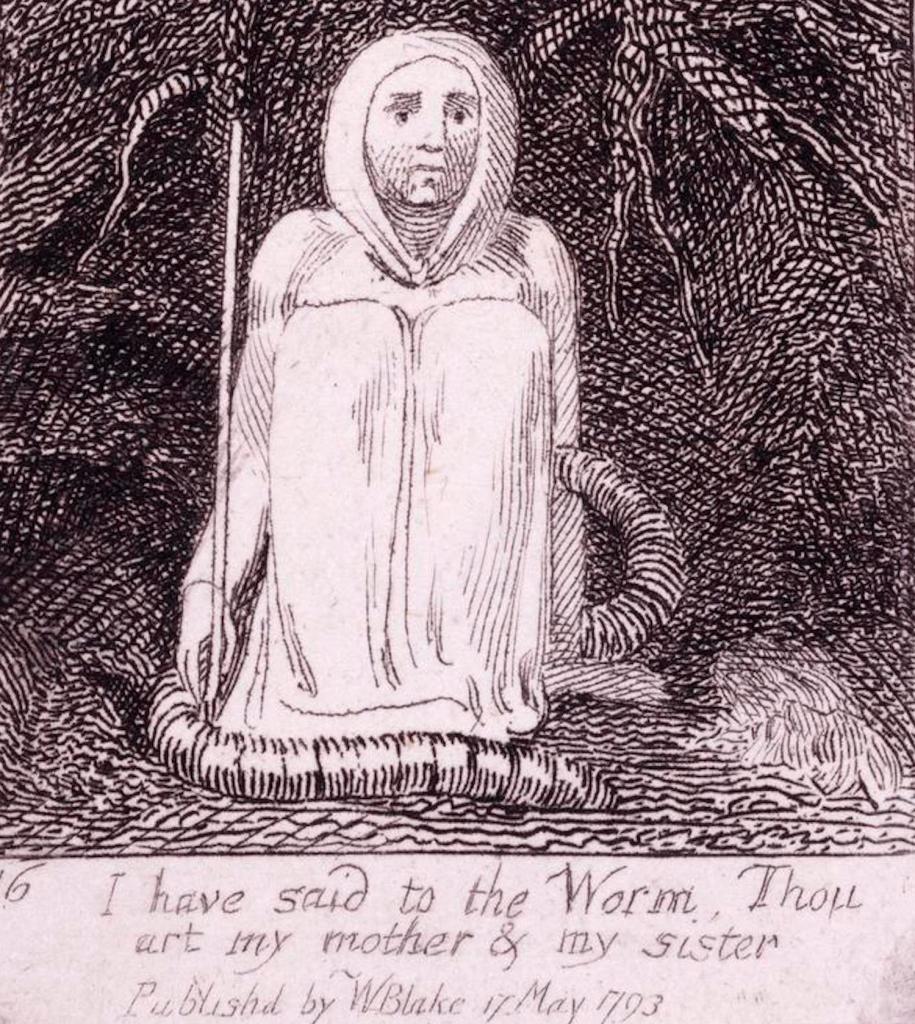
” . . . his dark secret love / Does thy life destroy.” ——William Blake, “The Sick Rose”
The invisible enemy is a worm— Not a Blakean worm as scholars understand him— (Perhaps a Blakean worm as Blake understood him.) After meeting in small rooms, saints carry their arguments Away in their heads, their hearts, Whereas scholars leave their stance in learned books, Where it remains tentative and drooping.
But the real worm—the worm that eats the saint’s heart Arouses in the saints’s brain a private worry A real agony that no book, read or written, can assuage.
I do no expect you to believe I am a saint I have seen you doubt those holier than I; But you know about the worm And you know about the tentativeness of the learned. You have helped me document him.
The real enemy is the worm That devours peace Without shedding blood. He grows deep in the soil Of our metaphysical hearts And the more we talk, the more he feeds Upon the silence that breaks Over the rock of our unpolished thoughts.
I lament dead ear, dim eye, dumb tongue of the poet faint in your heart. once on a night I would have yielded to your woo, but like a stone you sat upon the vacant shore waiting to glimpse moonlight dancers who would write your starry thought on golden sand, who would beam your fancy over the fecund sea.
I lament your blue death, your painted life your cup of anguish drained and tossed away, you fall against the knife of ignorance staggering along the streets where fools have no need of Truth. and they do not see you. not you. not the poor fool I lament, poor muse that I am.
I lament your rotting for the garden. when you died, I would have you gladly put on a gossamer shield. but your circus pride keeps you a spinning sense clown. too many smoky tongues have licked your beauty and the ash of your memory is scattered over the desert of your suffering.
I lament with closed eyes, with a heaving breast your open sorrow facing the icy wind of death. but you sat like a stone. heart like a stone. Turn your face away from me now. do not look on my lamentation. you who never believed in the blue lotus feet of the Belovèd— the only Word that writes a soul across Eternity.
as you you walk away i feel my heart beat. almost drop my suitcase on the concrete.
this heart beats for you without your answers even without your questions
you walk away to go build some bridge over the river of your memories.
i stand here watching you go. emptying my mind into a canyon of loneliness
II. Parting at the Airport
You drive away—my heart beats faster. Just a moment ago I did not notice This breaking heart that would drop to its knees Only to lose itself in the concrete.
You are already out of sight—what did I ask for But the gift of friendship? You had no answer. You could not find a place in your heart A place in your life for one such as me.
The bridge you build must be a sturdy one To expand over the loneliness you claim to own. Your ego-claim on words that belong To everyone, not just braggarts and scofflaws—
I empty my mind— calm my heart and breath And walk to the airplane.
That night we stopped by the side of the road You stared full in the face of the round moon And turning back to me your white fangs bore And tearing the seat with your claws you swore You didn’t know what got into you, but soon You knew these dog days would pay off your load
Of sorrow, but you never paid for pain. Those minutes as you ripped my hand, my heart— I felt the blood start and tears burn my eyes. Across squandered dreams I begged to now why The man left you, and you came apart Gazing hard on the blood and the stain.
And as you sank those fangs into my breast My heart became a victim of your beast.






 Linda's Literary Home
