Linda's Literary Home

Tag: William Butler Yeats

  • The Maud Gonne Rescue in W. B. Yeats’ “Among School Children”

    Image: William Butler Yeats NPG, London https://www.npg.org.uk/collections/search/portrait/mw118877/WB-Yeats
    Image: William Butler Yeats NPG, London

    The Maud Gonne Rescue in W. B. Yeats’ “Among School Children”

    As is is case with several of Yeats poems, “Among School Children” has suffered a misreading that defeats the poem’s actual achievement:  by reading into the poem the presence of Maud Gonne, critics have misinterpreted the mental quirkiness of an aging “public smiling man”—and thus the human mind universally.

    What the Poem Actually Says

    The conventional reading of W. B. Yeats’ “Among School Children” places Maud Gonne at the center of the poem’s middle stanzas. According to this interpretation, the sixty-year-old Yeats, visiting a school, looks at the children and remembers Gonne as a girl. 

    His thoughts then move through youth, beauty, sexual love, motherhood, aging, philosophy, and finally the famous question of whether the dancer can be separated from the dance.

    This reading is so familiar that it can seem to be what the poem itself says. It is not. Maud Gonne is never named, described, recalled, or represented in the poem. She enters through biographical knowledge about Yeats and is then read back into the text. 

    Yeats did tell Gonne in a June 1928 letter that she would find “a reference to your self” in the poem, but he did not say that she was the child before him, the woman in the Ledaean fantasy, or the subject of a remembered episode [1].

    That distinction is crucial. A private authorial reference is not the same thing as a figure represented in the poem. The poem itself gives us a schoolroom, children, a nun, a sixty-year-old “smiling public man,” a Ledaean fantasy, and the psychological transformation of what the speaker sees.

    The first stanza establishes the dramatic situation precisely. The speaker enters “the long schoolroom,” encounters the children, and notices that their eyes stare at a “sixty-year-old smiling public man.” 

    There is no Maud Gonne. The phrase “smiling public man” is important because it establishes a distinction between the speaker’s public identity and his private mind. He is not simply an old poet remembering his youth; he is a public figure performing a role before an audience.

    The next stanza takes us into that private mind. He says, “I dream of a Ledaean body,” immediately invoking the myth of Leda, without any reference that would evoke Gonne. The passage turns toward sexual union and generation, imagining two natures blended into one.  Again, there is no Maud Gonne, despite the fact that Yeats was, in fact, sexually attracted to Gonne.

    It is at this point that the conventional interpretation begins to go wrong. The critic knows that Gonne was Yeats’ great love, knows that Yeats wrote to her about a reference to herself, sees the Ledaean woman, and supplies Gonne as her identity. But the poem does not make that identification. The poem’s movement is from Leda to the child, not from Gonne to the child.

    The Child Who Is Actually There

    The third stanza makes the distinction even clearer. Thinking about the Ledaean story, the speaker looks at “one child or t’other there” and wonders whether “she stood so at that age.” The children are physically present in the schoolroom, while the imagined woman is being projected onto the child by faulty critical analysis.

    Then comes the psychological center of the passage:  “And thereupon my heart is driven wild: / She stands before me as a living child.”  The conventional reading tends to make this mean that Gonne, remembered as a young girl, suddenly appears vividly to Yeats’ imagination. But the poem does not say that. It says that she stands before him as a living child.

    The Ledaean woman has become imaginatively present through the child who is physically standing before him. The child has not become Gonne. Rather, the speaker’s imagination has overlaid the present child with the woman of the Ledaean fantasy.

    That distinction is exactly what the Gonne interpretation suppresses. Once Gonne is inserted, the psychological event becomes familiar and safe: an aging man looks at children, remembers the girl he once loved, feels the pain of lost youth, and moves toward a contemplative musing on aging.

    But the actual poem is stranger. The speaker is looking at a child while imagining Leda; his “heart is driven wild”; and he experiences the imagined woman as a “living child.” The poem is dramatizing the activity of the speaker’s mind in the presence of an actual child. Maud Gonne is not necessary to explain it, excerpt to attempt to explain away what dirty minds might tend to supply.

    How Gonne Gets into the Poem

    The question, then, is how Maud Gonne became so firmly established in criticism. The answer is biographical. Yeats’ letter gives critics a legitimate reason to suspect that Gonne is somehow being alluded to, and that suspicion has gradually hardened into interpretive certainty.

    But there is a substantial difference between saying that Yeats privately intended Gonne as a reference and saying that the poem represents him remembering Gonne as a girl. The first statement is supported by the letter; the second must be demonstrated from the poem itself.

    Yeats’ wording is notably restrained. He does not tell Gonne that she is the woman in stanza II or the child in stanza III. He does not say that the poem describes her childhood or that the schoolchildren reminded him of her. He says only that she will find “a reference to your self.”

    A reference can be oblique, private, symbolic, or embedded in an image without turning the person referenced into the poem’s subject. The critical error occurs when a reference is converted into a presence and then the presence is treated as though the poem itself had named it.

    Pacey’s “Hub”

    Desmond Pacey provides a particularly useful example. Pacey writes that “The first stanza is the hub of the wheel; the succeeding stanzas are spokes radiating from this hub.” He also describes the poem as a series of “observations, memories, and meditations” upon finding himself “among a class of schoolchildren” [2].

    This distinction offers an important insight. The schoolroom is not merely the place where the poem begins and then disappears. It is the hub from which the later reflections radiate. The children remain part of the dramatic situation even when the speaker’s thoughts move into myth, memory, philosophy, and speculation about generation.

    Yet Pacey then says, “Stanzas II to IV relate to the particular case of Maud Gonne, who was once a child like these but is now an ageing woman.” At this point, the critical displacement occurs. Pacey correctly identifies the schoolroom as the poem’s hub, but then relocates the central psychological action into Gonne’s biography.

    The poem itself does not do that. The speaker looks at “one child or t’other there”; his heart is “driven wild”; and he sees a “living child.” Pacey’s identification of Gonne turns that child into a remembered historical person, but the poem never makes that transformation.

    The “Smiling Public Man”

    At this point in he poem, the Gonne interpretation most seriously obscures the actual event along with its meaning.  The speaker begins as “a sixty-year-old smiling public man.” He then enters a private mental world in which he dreams of Leda, looks at a child, and experiences an intense emotional response. 

    Then he says: “Her present image floats into the mind—” and immediately interrupts himself:  “I … had pretty plumage once—enough of that, / Better to smile on all that smile, and show / There is a comfortable kind of old scarecrow.”

    The psychological sequence is coherent without Gonne:  public man – private fantasy – child – emotional disturbance – self-interruption – return to public performance.  The Gonne reading replaces the actual sequence with a safer sequence:  public man – memory of young Gonne – nostalgia – recognition of aging.

    The second sequence may be biographically plausible, but it is not what the poem explicitly represents. “Enough of that” sounds like an act of self-interruption. The speaker has allowed his imagination to go somewhere he does not wish to pursue, at least in his public role, and thus he deliberately restores his socially appropriate face.

    The poem does not say that the speaker intends to do anything to the child. The important fact is psychological: an image arises in his mind, becomes disturbingly immediate, produces an intense emotional response, and is then suppressed. That ambiguity is precisely what the Gonne interpretation removes.

    Generation Rather Than Gonne

    The fifth stanza naturally continues the poem’s concern with the child. The speaker asks what youthful mother, with “a shape upon her lap,” could have imagined that the child she bore would one day become an aged person.

    The poem has moved from the Ledaean fantasy to generation, from generation to motherhood, and from motherhood to aging. Nothing in this movement requires a memory of Maud Gonne. 

    The child before the speaker represents the beginning of the process whose end he himself embodies at sixty. The poem can therefore move directly from the living child to the aging man without inserting a remembered woman from his past between them.

    The Gonne reading narrows this universal contemplative musing into a biographical one. Instead of seeing the child as the immediate occasion for reflections on generation and aging, the critic turns the child into a disguised portrait of Gonne.

    Philosophy Does Not Rescue the Speaker

    The sixth stanza introduces Plato, Aristotle, and Pythagoras, but the philosophers do not restore the poem to Maud Gonne. They appear because the speaker is trying to understand the problems that have emerged from his encounter with the children: body and mind, youth and age, generation and identity.

    Even the philosophers are rendered bodily. Pythagoras is “golden-thighed,” Aristotle “played the taws,” and the stanza ends with the philosophers reduced to “Old clothes upon old sticks to scare a bird.”

    The movement is therefore not from Gonne to philosophy. It is from the child and the speaker’s experience of the child toward increasingly abstract attempts to understand human existence. Yet those abstractions repeatedly collapse back into bodies. The philosophers become scarecrows. The body remains inescapable.

    The seventh stanza continues the same line of thought when it says, “Both nuns and mothers worship images.” The poem then speaks of “Presences” known through “passion, piety or affection” and finally calls them “self-born mockers of man’s enterprise.”

    These images are relevant to the speaker’s experience because his own mind has produced an image that he has not entirely chosen. The Ledaean figure enters his consciousness, becomes entangled with the child before him, and generates an emotional response that he then attempts to suppress.

    The phrase “self-born” is especially suggestive. The poem has become increasingly concerned with images produced within human consciousness: religious images, maternal images, erotic images, memories, fantasies, and philosophical constructions. 

    The speaker’s Ledaean fantasy belongs to this same world of internally generated “Presences.” His problem is not that he cannot remember Gonne clearly enough; it is that he cannot entirely control what his own imagination produces.

    The Final Stanza

    The final stanza is often treated as the poem’s philosophical resolution, but its famous conclusion is actually a question:  “How can we know the dancer from the dance?”  The question follows naturally from everything that has preceded it. 

    Throughout the poem, the speaker has attempted, consciously or unconsciously, to distinguish past from present, image from reality, body from mind, public identity from private thought, and youth from age. Yet these categories repeatedly become entangled.

    Leda and the child become entangled. The child and the old man are joined through generation. The philosophers become bodies. The public man cannot escape the private mind.  The final question therefore does not require Maud Gonne. It grows naturally from the poem’s sustained examination of the inseparability of embodied existence and consciousness.

    The Critical Insertion of Gonne

    The conventional Gonne interpretation does something more consequential than merely emphasizing Yeats’ biography. It inserts a person into the poem who is not represented there and then uses that person to explain away the psychological event the poem actually represents.

    Once Gonne has been inserted, the child can be interpreted as Gonne’s younger self, the Ledaean fantasy as a memory of Gonne’s beauty, the speaker’s emotional disturbance as nostalgia, and “enough of that” as a conventional recognition of old age.

    But none of these steps is required by the poem. They depend upon first placing Gonne into it.  That makes the reasoning circular. Critics begin with the biographical knowledge that Yeats loved Gonne and that he told her she would recognize herself in the poem. 

    They then interpret the Ledaean woman as Gonne, interpret the child as Gonne, and finally point to the resulting interpretation as evidence that Gonne must have been the poem’s subject. The biographical premise has been transformed into the textual conclusion.

    The proper direction of interpretation should be reversed. Begin with what the poem actually gives us: a public man among schoolchildren; a Ledaean dream; a child; an intense emotional reaction; an image becoming present; a sudden “enough of that”; and a return to the public smile. Only after establishing that sequence should we ask whether a private biographical allusion may lie behind it.

    The Direction of the Poem

    The decisive difference can therefore be stated simply:  The poem moves from Leda to the child, whereas conventional criticism makes it move from Gonne to the child.  That reversal is not a harmless change of emphasis. 

    Leda is explicitly present in the poem; Gonne is not. The child is explicitly present; Gonne is not. The speaker’s heart is explicitly “driven wild”; a nostalgic recollection of Gonne is not. The speaker explicitly says “enough of that”; he does not say that he has had enough of remembering Gonne. He is expressing his dismay at the thoughts that have assailed him against he wishes.

    Once these facts control the reading, the poem’s psychological structure becomes clearer. The “smiling public man” is the man the children see, but the poem takes us inside his mind and shows us a fantasy that becomes unexpectedly immediate. 

    The child remains physically present while the speaker’s imagination overlays her with the Ledaean woman. His response becomes intense enough that he interrupts himself and returns to the socially acceptable smile.

    The subsequent musing on generation, aging, philosophy, and the inseparability of dancer and dance develops from that experience rather than from a recollection of Maud Gonne.  As a matter of fact, the recollection of Gonne would not require such a question of identifying the dancer and the dance.

    Do Not Put Gonne Where Yeats Put the Child

    The strongest evidence for putting Maud Gonne into “Among School Children” is Yeats’ own letter, and that evidence should not be ignored. But the letter says only that Gonne would find “a reference to your self.”

    It does not say that she is the child, that she is Leda, that the speaker is remembering her, or that the poem describes their youthful relationship. Those are later critical constructions. The poem itself never identifies Gonne, never names her, never narrates a memory of her, and never gives the speaker a reason to be thinking about her.

    What the poem actually gives us is much more specific: a sixty-year-old “smiling public man” enters a schoolroom; encounters children; dreams of a Ledaean body; looks at “one child or t’other there”; feels his heart “driven wild”; sees the woman of his imagination standing before him “as a living child”; allows her image to “float into the mind”; remembers his own “pretty plumage”; and then says “enough of that.”  He returns to smiling and presents himself as an “old scarecrow.” 

    The poem subsequently moves through generation, aging, philosophy, religious, and emotional images, and finally the question of whether dancer and dance can be separated.  That sequence follows a continuous psychological and philosophical movement. Maud Gonne is not needed anywhere within it; her presence actually dismisses the very important question of distinguishing the dancer from the dance.

    The conventional interpretation therefore gets the crucial passage backwards. The poem does not recall Maud Gonne; the critic recalls Maud Gonne and then attributes that recollection to the speaker. In doing so, criticism displaces the child who is actually there and replaces the speaker’s disturbing Ledaean fantasy with a much more manageable memory of a beloved woman.

    The task is not to deny that Yeats privately associated Gonne with the poem. It is to refuse to let that private association override the poem’s dramatic facts. Gonne may exist in the history surrounding the poem; she does not exist in its represented scene.

    The child does. Leda does. The speaker’s “wild” heart does. The command “enough of that” does. The smiling public man does. And the tension between that public man and the mind operating beneath his public smile is the psychological problem from which the rest of the poem develops.

    Maud Gonne is not the hidden answer to the poem. She is the critic’s answer to a problem the poem never asks us to solve by naming her. The poem asks us instead to watch what happens inside the mind of the man who stands among the children [3]—and then to ask, with him, whether we can ever finally distinguish the dancer from the dance, this is, the thoughts that may arise in the mind unbidden.

    Sources

    [1] William Butler Yeats. Letter to Maud Gonne.  The Letters of W. B. Yeats. Rupert Hart-Davis, 1954.
    [2]  Desmond Pacey. “Children in the Poetry of Yeats.” enotes.  Accessed October 7, 2026.
    [3] Linda Sue Grimes. “William Butler Yeats’ ‘Among School Children’.” Linda’s Literary Home. Accessed October 7, 2026.

  • William Butler Yeats’ “Lapis Lazuli”

    Image 1: Williams Butler Yeats - Chicago History Museum https://images.chicagohistory.org/search/?searchQuery=william+butler+yeats
    Image: Williams Butler Yeats – Chicago History Museum

    William Butler Yeats’ “Lapis Lazuli”

    In his poem “Lapis Lazuli,”  William Butler Yeats has his speaker explore the issue of peace and tranquility despite a chaotic environment.

    Introduction and Text of “Lapis Lazuli”

    The speaker of  William Butler Yeats’ Eastern-philosophically influenced piece “Lapis Lazuli” opens his disquisition by announcing to his readers that the hysterical women are dismayed by artists who remain in non-attachment, while the times seem to require some definite movement against evil in order that they do not fall victim to obliteration.  

    Yeats composed “Lapis Lazuli” in 1938 as WWII was gearing up in Europe; thus the women are afraid that they will be become targets of the Zeppelins and airplanes that were employed to bomb London in WWI.  The allusion to “King Billy bomb-balls in” consists of a pun on William III at the Battle of the Boyne and Kaiser Wilhelm.

    Lapis Lazuli

    (for Harry Clifton)

    I have heard that hysterical women say
    They are sick of the palette and fiddle-bow,
    Of poets that are always gay,
    For everybody knows or else should know
    That if nothing drastic is done
    Aeroplane and Zeppelin will come out,
    Pitch like King Billy bomb-balls in
    Until the town lie beaten flat. 

    All perform their tragic play,
    There struts Hamlet, there is Lear,
    That’s Ophelia, that Cordelia;
    Yet they, should the last scene be there,
    The great stage curtain about to drop,
    If worthy their prominent part in the play,
    Do not break up their lines to weep.
    They know that Hamlet and Lear are gay;
    Gaiety transfiguring all that dread.
    All men have aimed at, found and lost;
    Black out; Heaven blazing into the head:
    Tragedy wrought to its uttermost.
    Though Hamlet rambles and Lear rages,
    And all the drop scenes drop at once
    Upon a hundred thousand stages,
    It cannot grow by an inch or an ounce. 

    On their own feet they came, or on shipboard,
    Camel-back, horse-back, ass-back, mule-back,
    Old civilisations put to the sword.
    Then they and their wisdom went to rack:
    No handiwork of Callimachus
    Who handled marble as if it were bronze,
    Made draperies that seemed to rise
    When sea-wind swept the corner, stands;
    His long lamp chimney shaped like the stem
    Of a slender palm, stood but a day;
    All things fall and are built again
    And those that build them again are gay. 

    Two Chinamen, behind them a third,
    Are carved in Lapis Lazuli,
    Over them flies a long-legged bird
    A symbol of longevity;
    The third, doubtless a serving-man,
    Carries a musical instrument. 

    Every discolouration of the stone,
    Every accidental crack or dent
    Seems a water-course or an avalanche,
    Or lofty slope where it still snows
    Though doubtless plum or cherry-branch
    Sweetens the little half-way house
    Those Chinamen climb towards, and I
    Delight to imagine them seated there;
    There, on the mountain and the sky,
    On all the tragic scene they stare.
    One asks for mournful melodies;
    Accomplished fingers begin to play.
    Their eyes mid many wrinkles, their eyes,
    Their ancient, glittering eyes, are gay.

    Dylan Thomas’ dramatic reading 

    Commentary on “Lapis Lazuli”

    The speaker is examining the issue of peace and tranquility despite a chaotic environment.

    First Stanza:  What the Speaker Believes

    I have heard that hysterical women say
    They are sick of the palette and fiddle-bow,
    Of poets that are always gay,
    For everybody knows or else should know
    That if nothing drastic is done
    Aeroplane and Zeppelin will come out,
    Pitch like King Billy bomb-balls in
    Until the town lie beaten flat. 

    The speaker sets up his argument to show that he believes certain complaining women are hysterical because they are lamenting a rather natural flux of history. The speaker will be attempting to demonstrate the healing affects of art, despite what those who descend into hysterics cry and wail about.

    Second Stanza:   Scenes from Plays

    All perform their tragic play,
    There struts Hamlet, there is Lear,
    That’s Ophelia, that Cordelia;
    Yet they, should the last scene be there,
    The great stage curtain about to drop,
    If worthy their prominent part in the play,
    Do not break up their lines to weep.
    They know that Hamlet and Lear are gay;
    Gaiety transfiguring all that dread.
    All men have aimed at, found and lost;
    Black out; Heaven blazing into the head:
    Tragedy wrought to its uttermost.
    Though Hamlet rambles and Lear rages,
    And all the drop scenes drop at once
    Upon a hundred thousand stages,
    It cannot grow by an inch or an ounce. 

    The second stanza continues by exemplifying scenes from famous plays.  The speaker is alluding to Shakespearean dramas of Hamlet and King Lear.  As actors portray the characters in the plays, they do so in a dignified and rather unattached manner. The actors fulfill the drama with their roles but do not allow their feelings to intrude upon their lines with weeping. 

    The actors never stop to lament over the tragedy that infuses their characters.   The actors know that the characters they are dramatizing while sporting great depth of emotion must be portrayed accurately.  Therefore they are not steeped in outward displays of lamentation. 

    Those actors pursuing theatre art remain self-possessed.  Otherwise their art would have suffered from over-emotional dabbing.  If art is to assist in mitigating sorrow, turbulence, and evil, then it must filter out the bathos that brings on hysterics.  The art of the actors prevents them from descending into deep depression over their characters, despite the depth of feeling that they must portray. 

    While tragedy by definition holds a range of emotion from despair to disdain to sorrowful outbursts, the act of making art brings on a settlement of feeling, otherwise no art could sustain itself. 

    Theatre art has always served society as a sort of safety valve wherein both actors and audience can view the subject of the performances with some distance.  That distance must then be framed in a way that not only lowers the temperature on sorrow but also elevates with the beauty of the truth that the content portrays.

    Third Stanza:   Civilizations Come and Go

    On their own feet they came, or on shipboard,
    Camel-back, horse-back, ass-back, mule-back,
    Old civilisations put to the sword.
    Then they and their wisdom went to rack:
    No handiwork of Callimachus
    Who handled marble as if it were bronze,
    Made draperies that seemed to rise
    When sea-wind swept the corner, stands;
    His long lamp chimney shaped like the stem
    Of a slender palm, stood but a day;
    All things fall and are built again
    And those that build them again are gay. 

    The third stanza reminds readers/listeners that civilization come and go, that the story of humankind is replete with societies rising and falling, like waves in the ocean.  While the thought may provoke gloom, it remains a fact that those civilization have indeed been vanquished. Even the great art of a Callimachus has come and gone.  

    That great sculptor was able to work his magic on marble as if it were a softer material, but where is he now?  Like those great civilization, he has come and gone. Despite the fact that societies and great artists come and go, there is still hope because just as they are torn down, they rise again.  Civilizations rise again, edifices are rebuilt, and new artists replace the old.

    Fourth Stanza:   The Carving

    Two Chinamen, behind them a third,
    Are carved in Lapis Lazuli,
    Over them flies a long-legged bird
    A symbol of longevity;
    The third, doubtless a serving-man,
    Carries a musical instrument. 

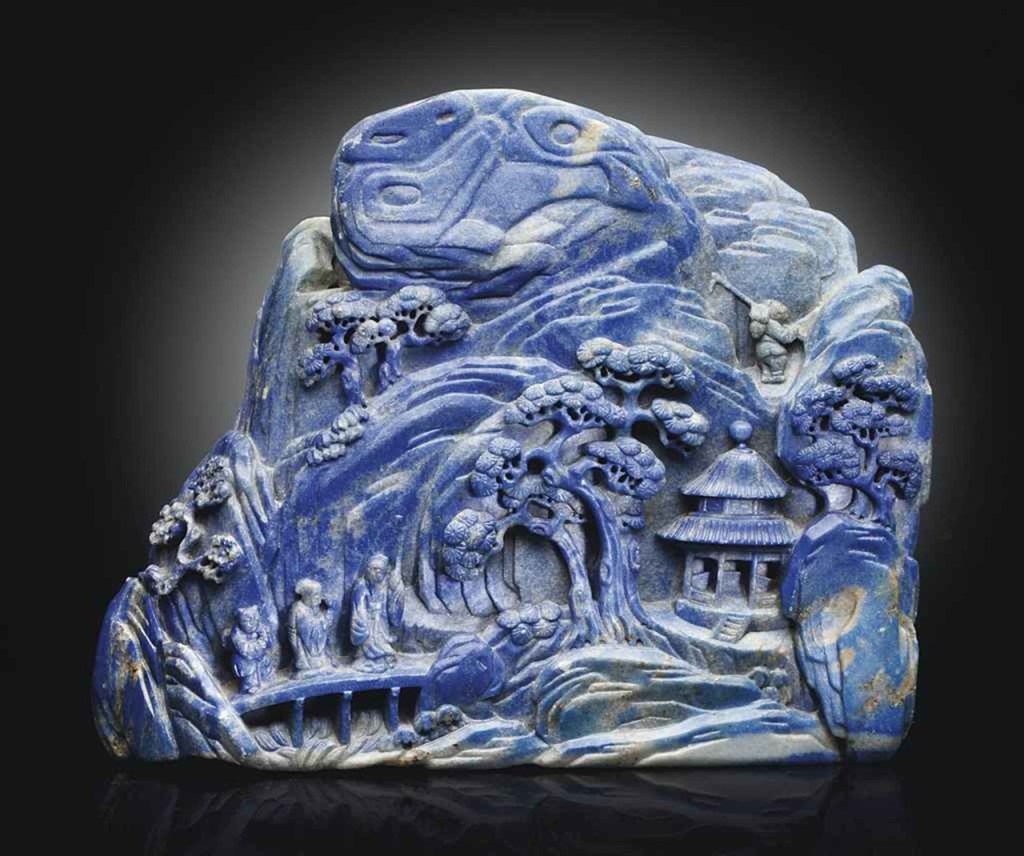
    In 1935, four years before the death of William Butler Yeats, the poet Harry Clifton gave Yeats a carving that according to Yeats some Chinese sculptor had done in lapis lazuli.  The gift accounts for Yeats’ dedication of the poem to Clifton. That carving of lapis lazuli feature a scene in which three Chinese men are trekking up a mountain-side.  

    Also featured is a long-legged bird flying overhead. The speaker claims that this bird is a symbol of a long life.  One of the Chinese men, the speaker claims, is a servant because he is transporting a musical instrument. 

    Fifth Stanza:  Men on a Stone

    Every discolouration of the stone,
    Every accidental crack or dent
    Seems a water-course or an avalanche,
    Or lofty slope where it still snows
    Though doubtless plum or cherry-branch
    Sweetens the little half-way house
    Those Chinamen climb towards, and I
    Delight to imagine them seated there;
    There, on the mountain and the sky,
    On all the tragic scene they stare.
    One asks for mournful melodies;
    Accomplished fingers begin to play.
    Their eyes mid many wrinkles, their eyes,
    Their ancient, glittering eyes, are gay.

    The three men are hiking up the mountain toward what Yeats’ speaker assumes is a little half-way house. Readers, however, might sense that that little house might be a temple. (Oddly, Yeats even claims that building is a “temple” in his letter to Dorothy Wellesley.  See below.) 

    Yeats’ speaker is interpreting that edifice as a building that resembles an Irish pub, in which the men may stop for refreshment and listen to some sorrowful tunes before trekking on.

    It may also be likely that the men are Buddhist monks, and they will stop at a temple to meditate, worship, and pray; the musical instrument will be employed for their chanting. But for the Yeatsian sensibility, as the scene unfolds, one may ask to hear a sad, melancholy tune, and the player begins to offer a rendition. 

    Thus, Chinese men listening to melancholy tunes may parallel the Western theatre audience watching Hamlet or King Lear.  The ancient faces of the Chinese men look on smiling but rather detached as they enjoy the melodies.

    The Lapis Lazuli Sculpture

    Image:  Lapis lazuli sculpture:  https://images.rapgenius.com/1516dda553e878f4bf585267a0061d8e.340x311x1.jpg
    Image: Lapis lazuli sculpture

    The painter, Sesshu, produced a long scroll of his painting inspired by his trek through China in the 15th century.  Both the theme and the appearance of the painting and this sculpture in lapis lazuli are similar. 

    Letter to Dorothy Wellesley, July 6 1935

    The following excerpt from his letter to Dorothy Wellesley describes the sculpture that inspired his poem “Lapis Lazuli”:

     [Lapis Lazuli] carved by some Chinese sculptor into the semblance of a mountain with temple, trees, paths, and an ascetic and pupil about to climb the mountain. Ascetic, pupil, hard stone, eternal theme of the sensual east. The heroic cry in the midst of despair. But no, I am wrong, the east has its solutions always and therefore knows nothing of tragedy. It is we, not the east, that must raise the heroic cry.”

    William Butler Yeats retained an interest in Eastern philosophy and art, and many of his poems, plays, and essays reflect that interest.  Although his understanding of Eastern religious philosophy was tantamount to a “romantic misunderstanding,” as described by T. S. Eliot, his poems are still worth studying.

  • William Butler Yeats’ “Among School Children”

    Image 1:  Williams Butler Yeats  - Chicago History Museum https://images.chicagohistory.org/search/?searchQuery=william+butler+yeats
    Image: Williams Butler Yeats – Chicago History Museum

    William Butler Yeats’ “Among School Children”

    From 1922–1928, poet William Butler Yeats served in the senate of the newly formed Irish Free State.  In “Among School Children,” the poet creates a speaker who dramatizes an event from the poet/senator’s official duties—visiting a classroom of children at an Irish school. 

    Introduction with Text of “Among School Children”

    While William Butler Yeats is without a doubt a great poet, who delved deeply into truth and tried to understand historical events, he was not always successful in understanding certain principles.  

    He set out on a journey of study that led him to Eastern philosophical and religious thought, but he did not quite understand the Eastern concepts that he attempted to exploit in many of his poems.

    Although not among his works that directly broach the Eastern philosophical concepts, “Among School Children” is one of Yeats’ most anthologized poems.  It features numerous allusions to ancient Greek mythology and philosophy.  Yeats was always a thinker, even if not always a clear thinking one. 

    Among School Children

    I
    I walk through the long schoolroom questioning;
    A kind old nun in a white hood replies;
    The children learn to cipher and to sing,
    To study reading-books and history,
    To cut and sew, be neat in everything
    In the best modern way—the children’s eyes
    In momentary wonder stare upon
    A sixty-year-old smiling public man.

    II
    I dream of a Ledaean body, bent
    Above a sinking fire, a tale that she
    Told of a harsh reproof, or trivial event
    That changed some childish day to tragedy—
    Told, and it seemed that our two natures blent
    Into a sphere from youthful sympathy,
    Or else, to alter Plato’s parable,
    Into the yolk and white of the one shell.

    III
    And thinking of that fit of grief or rage
    I look upon one child or t’other there
    And wonder if she stood so at that age—
    For even daughters of the swan can share
    Something of every paddler’s heritage—
    And had that colour upon cheek or hair,
    And thereupon my heart is driven wild:
    She stands before me as a living child.

    IV
    Her present image floats into the mind—
    Did Quattrocento finger fashion it
    Hollow of cheek as though it drank the wind
    And took a mess of shadows for its meat?
    And I though never of Ledaean kind
    Had pretty plumage once—enough of that,
    Better to smile on all that smile, and show
    There is a comfortable kind of old scarecrow.

    V
    What youthful mother, a shape upon her lap
    Honey of generation had betrayed,
    And that must sleep, shriek, struggle to escape
    As recollection or the drug decide,
    Would think her son, did she but see that shape
    With sixty or more winters on its head,
    A compensation for the pang of his birth,
    Or the uncertainty of his setting forth?

    VI
    Plato thought nature but a spume that plays
    Upon a ghostly paradigm of things;
    Solider Aristotle played the taws
    Upon the bottom of a king of kings;
    World-famous golden-thighed Pythagoras
    Fingered upon a fiddle-stick or strings
    What a star sang and careless Muses heard:
    Old clothes upon old sticks to scare a bird.

    VII
    Both nuns and mothers worship images,
    But those the candles light are not as those
    That animate a mother’s reveries,
    But keep a marble or a bronze repose.
    And yet they too break hearts—O Presences
    That passion, piety or affection knows,
    And that all heavenly glory symbolise—
    O self-born mockers of man’s enterprise;

    VIII
    Labour is blossoming or dancing where
    The body is not bruised to pleasure soul,
    Nor beauty born out of its own despair,
    Nor blear-eyed wisdom out of midnight oil.
    O chestnut tree, great rooted blossomer,
    Are you the leaf, the blossom or the bole?
    O body swayed to music, O brightening glance,
    How can we know the dancer from the dance?

    Reading  

    Commentary on “Among School Children”

    William Butler Yeats served from 1922-1928 in the senate of the  newly formed Irish Free State. His speaker in “Among School Children” is dramatizing what was likely an official, mandatory visit to a Catholic school.

    First Stanza:  An Old Man Visiting a School

    I
    I walk through the long schoolroom questioning;
    A kind old nun in a white hood replies;
    The children learn to cipher and to sing,
    To study reading-books and history,
    To cut and sew, be neat in everything
    In the best modern way—the children’s eyes
    In momentary wonder stare upon
    A sixty-year-old smiling public man.

    The speaker is visiting a Catholic school and “a kind old nun in a white hood” is escorting him through the “long schoolroom,” explaining the lessons that the pupils are studying.  

    They study math and music; they read and study history.  They receive instruction in sewing, as they learn to be “neat in everything.”  All this is accomplished in the “best modern way.”

    The speaker then notices that the children are staring at him, who is a “sixty-year-old smiling public man.”  Yeats was born is 1865; thus he would be 60 years old in 1925, which means that he is visiting this school in the third year of his service in the senate.  

    As a political man, he, of course, would be smiling, as he meets his public, even if they are only school age children.

    Second Stanza:  The Politics of Perversion

    II
    I dream of a Ledaean body, bent
    Above a sinking fire, a tale that she
    Told of a harsh reproof, or trivial event
    That changed some childish day to tragedy—
    Told, and it seemed that our two natures blent
    Into a sphere from youthful sympathy,
    Or else, to alter Plato’s parable,
    Into the yolk and white of the one shell.

    The speaker has begun his narration in which he refers to himself as a “smiling public man.”  As a political official his public must always see him smiling; thus, he keeps up the façade even as he meets with little children.  He then veers off into a “dream” of a young girl whose copulation with the god Zeus has been considered a rape by some including the smiling man himself in his poem “Leda and the Swan.”

    The speaker paints a drama of the event with the brush of a “body, bent / Above a sinking fire.”  He adds into the mix the young girl telling “a tale” “of harsh reproof.”  Or perhaps it was merely a “trivial event” but still it alters the child’s day from “childish” to “tragedy.” 

    He then implies a coupling by employing the images of “two natures blent” into which the swan’s semen and the girl’s ova blend into a version of “Plato’s parable” of “yolk and white of the one shell.”

    Third Stanza: Rape Musing

    III
    And thinking of that fit of grief or rage
    I look upon one child or t’other there
    And wonder if she stood so at that age—
    For even daughters of the swan can share
    Something of every paddler’s heritage—
    And had that colour upon cheek or hair,
    And thereupon my heart is driven wild:
    She stands before me as a living child.

    The speaker then continues his musing about the rape of Leda by the Zeusian swan.  While continuing to muse about that coupling, he is staring intently at “one child or t’other” as he wonders if this child’s countenance and behavior may resemble that of the young Leda.  And as he thinks of this scenario, the speaker asserts that his “heart is driven wild,” observing this little girl standing in from of him “as a living child.” 

    Fourth Stanza:  A Dream of Indulgence

    IV
    Her present image floats into the mind—
    Did Quattrocento finger fashion it
    Hollow of cheek as though it drank the wind
    And took a mess of shadows for its meat?
    And I though never of Ledaean kind
    Had pretty plumage once—enough of that,
    Better to smile on all that smile, and show
    There is a comfortable kind of old scarecrow.

    The speaker then unveils an image of his own qualities, suggesting that they might change the little girl if she were impregnated with his spawn.  He wonders how stately and beautiful such a creature would be if resulting from a grandiose Irish senator and  little girl attending this Catholic school. 

    On the other hand, all these intrusive images might be resulting from nothing more than “a mess of shadows,” as he speculates.  Then the speaker seems to be wrenched out of his dream as he claims he was “never of Ledaean kind,” though he once went about as a very handsome man indeed, with “pretty plumage”—akin to the Zeusian swan, no doubt!  

    But then “enough of that”—he must snap back into senator, public man persona, smile and show that he is still a “smiling public man” who resembles more a “comfortable kind of old scarecrow” than the dramatic features of the Ledaean scenario, including a Zeusian swan with fine feathers. 

    Fifth Stanza:  Uncertain Future of Each Child

    V
    What youthful mother, a shape upon her lap
    Honey of generation had betrayed,
    And that must sleep, shriek, struggle to escape
    As recollection or the drug decide,
    Would think her son, did she but see that shape
    With sixty or more winters on its head,
    A compensation for the pang of his birth,
    Or the uncertainty of his setting forth?

    The speaker then instead of remaining that comfortable old scarecrow now continues to envision the result of copulation.  He now imagines a “youthful mother” holding a baby. 

    He then wonders—through the gestation period and the difficulty of giving birth and then the reality of the child right there on her lap—if the young mother could possibly think of that child after it has lived for sixty or so years as a worthwhile accomplishment, that is, would the “pang of his birth” be worth it.  After all, his future will always remain an “uncertainty.”

    The speaker now is ruminating on his own uncertainty, as he has further delved dreamlike into the issue with these little girls—an issue that has inexplicably resulted in images of himself.

    Sixth Stanza:  The Prospect of Scaring a Bird

    VI
    Plato thought nature but a spume that plays
    Upon a ghostly paradigm of things;
    Solider Aristotle played the taws
    Upon the bottom of a king of kings;
    World-famous golden-thighed Pythagoras
    Fingered upon a fiddle-stick or strings
    What a star sang and careless Muses heard:
    Old clothes upon old sticks to scare a bird.

    Again the speaker inserts himself into the narrative, “old clothes upon old sticks to scare a bird”—the scarecrow image again.  He seems to be railing against his own aging and appearance.  But he nevertheless cannot leave the notion that his own hidden nature has imposed unexpected, disturbing dreams including these innocent little girls. 

    Thus the disgruntled speaker then enlists “Plato” again to insert suggestive words that refer to his libido, for example, “nature but a spume,” and Aristotle playing the taws “upon the bottom of a king,” along with “golden-thighed Pythagoras,” and “fingered upon a fiddle-sick.”  These terms have invaded the senator’s state of mind, rendering him contemplative of the nature of hidden drives that spring up unbidden in unlikely places and events.

    Seventh Stanza:  Images and Worship

    VII
    Both nuns and mothers worship images,
    But those the candles light are not as those
    That animate a mother’s reveries,
    But keep a marble or a bronze repose.
    And yet they too break hearts—O Presences
    That passion, piety or affection knows,
    And that all heavenly glory symbolise—
    O self-born mockers of man’s enterprise;

    The speaker then draws a contrast between what a nun worships and what an ordinary mother worships.  They both “worship images,” but those images are not the same.  The nun worships images that are hard, harsh, and tinged with craven-spelled beings that break hearts.

    Mothers, on the other hand, worship “Presences,” which inculcate passion along with piety and affection that dulls human awareness to the point that those who mock humankind are merely “self-born.” 

    The wisdom of the ages cannot penetrate a small school where little girls can become targets for aged men who cannot seem to control their hidden urges with which they are born and against which those mothers have no power to struggle.

    Eighth Stanza:  The Nature of Unity

    VIII
    Labour is blossoming or dancing where
    The body is not bruised to pleasure soul,
    Nor beauty born out of its own despair,
    Nor blear-eyed wisdom out of midnight oil.
    O chestnut tree, great rooted blossomer,
    Are you the leaf, the blossom or the bole?
    O body swayed to music, O brightening glance,
    How can we know the dancer from the dance?

    The eighth and final stanza of this poem does not rest comfortably with the first seven.  It could, in fact, stand alone as its own full throated poem.  It offers a melding of body and soul along with the yogic idea of the unity of knower-knowing-known.  

    The speaker is offering the notions that the soul need not require the body to suffer for it, that beauty need not come from despair, and that the acquisition of knowledge need not require burning the “midnight oil.”  

    He, thus, is implying that unity of creation is exemplified in the “chestnut tree” which features roots, leaves, blossoms, and boles, and it, therefore, remains impossible to know which part that “great rooted blossomer” actually is. 

    Also, when a dancer is dancing and swaying to music, and an observer looks with delight upon that dance, the rhetorical question in the final line, paradoxically asks, “How can we know the dancer from the dance?”  The obvious answer, of course, forces itself upon the mind that they are, in fact, united—they are the same entity as one cannot know one from the other.

    Uniting the Final Stanza

    While the final stanza seems to separate itself from the rest of this poem, the uniting element is that all thoughts and all events ultimately proceed out of the mind of one Creative Force.  

    The speaker has been visited dreamlike by mythological characters and events that he would likely never have deliberately thought to contemplate, especially as he is performing a civic duty in a public place.   Thus the question: are the speaker and his thoughts the same or are they separate entities?  

    If they are separate then the speaker may be filled with guilt because of his thoughts about the “living” child who stood before him, causing his heart to race.  One the other hand, if it is all of one fabric and all is related, his thoughts come as naturally as a dancer dancing or as a tree being the sum of its parts.

    Thus readers could take away from the poem the notion that the final stanza works to place in perspective the speaker’s possible self-judgment. He can accept his thoughts as naturally occurring.  Or he can self-flagellate and likely disrupt his own ability to continue doing the work he must do.

  • Rabindranath Tagore’s “The Last Bargain”

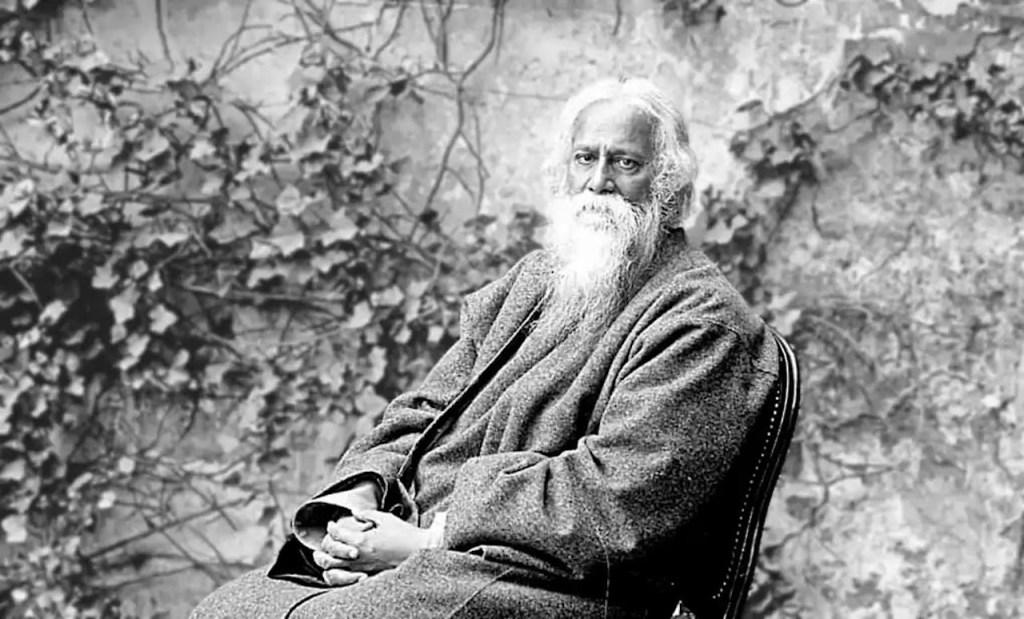
    Image:  Rabindranath Tagore  -  Britannica

    Image:  Rabindranath Tagore  – Britannica

    Rabindranath Tagore’s “The Last Bargain”

    Rabindranath Tagore’s “The Last Bargain” focuses on what seems to be an quandary:  how is it that a child’s offering of “nothing” to a seeker becomes the “last bargain” as well as the best bargain?

    Introduction and Text of “The Last Bargain”

    The human mind/hear/soul engages in the spiritual search in order to gain freedom and bliss.  Much sorrow and pain afflict those who focus solely on the material level of existence.  

    As the speaker in Rabindranath Tagore’s “The Last Bargain” searches for a job, he is, in fact, demonstrating the difference between focusing on the material level of being and focusing on the spiritual level.

    The Last Bargain

    “Come and hire me,” I cried, while in the morning I was walking on the stone-paved road.
    Sword in hand, the King came in his chariot.
    He held my hand and said, “I will hire you with my power.”
    But his power counted for nought, and he went away in his chariot.

    In the heat of the midday the houses stood with shut doors.
    I wandered along the crooked lane.
    An old man came out with his bag of gold.
    He pondered and said, “I will hire you with my money.”
    He weighed his coins one by one, but I turned away.

    It was evening. The garden hedge was all aflower.
    The fair maid came out and said, “I will hire you with a smile.”
    Her smile paled and melted into tears, and she went back alone into the dark.

    The sun glistened on the sand, and the sea waves broke waywardly.
    A child sat playing with shells.
    He raised his head and seemed to know me, and said, “I hire you with nothing.”
    From thenceforward that bargain struck in child’s play made me a free man.

    Commentary on “The Last Bargain”

    Rabindranath Tagore’s “The Last Bargain” presents an enigma:  how can it be that a child offering nothing can be the bargain that makes a “free man” of the seeker?

    First Movement:   Seeking Employment

    “Come and hire me,” I cried, while in the morning I was walking on the stone-paved road.
    Sword in hand, the King came in his chariot.
    He held my hand and said, “I will hire you with my power.”
    But his power counted for nought, and he went away in his chariot.

    The opening movement taking place in the morning finds the speaker apparently seeking employment; thus he announces, “Come and hire me.”  A king then comes on the scene, offering the individual employment through his “power.”

    However, the job seeker determines that the king’s power held very little value.  The king then moves away in his “chariot.”  Then the speaker continues to search.  Now, the reader is likely to suspect that this speaker is not seeking a job on the material, planet Earth, physical sense.

    Second Movement:  Continuing the Search

    In the heat of the midday the houses stood with shut doors.
    I wandered along the crooked lane.
    An old man came out with his bag of gold.
    He pondered and said, “I will hire you with my money.”
    He weighed his coins one by one, but I turned away.

    The speaker keeps up his search, and the time now is “midday.”  He takes notice that the doors to all of the houses are closed.  All of a sudden, an old man comes on the scene; he is carrying a “bag of gold.” The old man then inform the seeker that he will offer him a job “with [his] money.”

    The old man counts out his coins piece by piece, which demonstrates his attachment to money—a physical level necessity and reality.  However, that display of physical attachment annoys this spiritual seeker, who then turns away in disgust.

    The speaker remains unimpressed by the power of a king, and he is not favorable to an old man’s “gold.”  The reader can now be assured that the speaker is not seeking an earthly job and thus not seeking worldly goods; instead, he is searching for the spiritual love that comes only from God.  Worldly wealth and power hold no importance for him.

    Third Movement:    Experiencing a Change

    It was evening. The garden hedge was all aflower.
    The fair maid came out and said, “I will hire you with a smile.”
    Her smile paled and melted into tears, and she went back alone into the dark.

    However, the seeker continues on well into evening, when he sees, a “garden hedge [ ] all aflower.”  Then he encounters a “fair maid” who says, “I will hire you with a smile.”  But he inevitably experiences the transformation that comes to the aged human being as the smile “paled and melted into tears.”  Thus rejected, the maiden “went back alone into the dark.”

    Fourth Movement:   The Best Bargain

    The sun glistened on the sand, and the sea waves broke waywardly.
    A child sat playing with shells.
    He raised his head and seemed to know me, and said, “I hire you with nothing.”
    From thenceforward that bargain struck in child’s play made me a free man.

    In the final movement, the speaker, as he is walking along the ocean’s shore, watching the turbulent waves, and meeting a child who is playing on the shore, is afforded his final bargain: the child affirms, “I hire you with nothing.”  This final bargain thus results in a situation that ultimately becomes the best bargain.

    The best bargain is the one that liberates the seeker from searching for satisfaction from earthly things.  He, then instead, may focus his attention on his own soul, where the real “job” of seeking freedom, liberation, and bliss exist.

    It is the quiet Spirit—the seeming nothingness contrasting with materiality, the space transcending time and matter—that turns out to be the genuine, true employer.  Working for the Celestial, Divine Employer (God) affords the laborer the true freedom, soul realization, and bliss—none of which can achieved by earthly power, gold, and physical affection.

  • Rabindranath Tagore

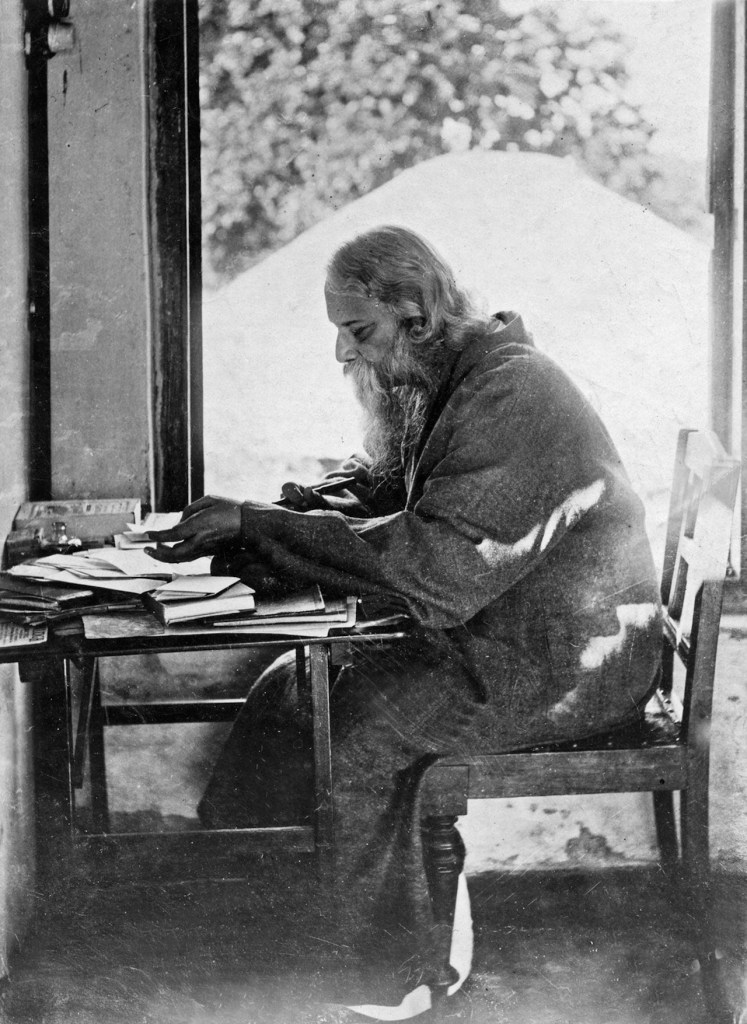
    Image: Rabindranath Tagore Beshara Magazine

    Life Sketch of Rabindranath Tagore

    In 1913, Rabindranath Tagore, Indian Nobel Laureate, won the literature prize for his prose translations of Gitanjali, Bengali for “song offerings.”  A true Renaissance man, he served as a poet, social reformer, and founder of a school.

    Early Life and Education

    Rabindranath Tagore, (in Bengali, Rabīndranāth Ṭhākur), was born May 7, 1861, Calcutta, India, to the religious reformer Debendranath Tagore (1817–1905) and Sarada Devi (1830–1875).  Sarada gave birth to fifteen children with Debendranath Tagore [1].  

    Rabindranath was the youngest of the children and was raised primarily by his oldest sister and servants.  His mother fell ill after giving birth to her last child, and she died when Rabindranath was only fourteen years of age.

    Tagore came to disdain formal education.  He was first enrolled in public education at the Oriental Seminary School in Calcutta.  At only seven years of age, he dropped out of school after attending for one month.  Students at the school were punished by being beaten with sticks.

    After enrolling in the school of Saint Xavier in 1876, he managed to attend for six months but then again left the institution.  However, he did retain some pleasant memories of his attendance at Saint Xavier and in 1927, he gifted the school with a statue of Jesus Christ from his personal collection.

    Saint Xavier values its relationship with Tagore, despite its brevity,  and commemorates his birthday anniversary, even holding their ceremony during the pandemic in 2021:

    The principal of the college, Father Dominic Savio, said: “We have decided to remember him on his birthday not only for paying tribute to a true Xaverian, who preached universal humanism but also to get inspiration from his writings, preaching and philosophy, particularly at this trying time”.[2]

    Tagore was richly homeschooled by his many accomplished siblings; his brother Hemendranath trained his younger brother in physical culture, having “Rabi” swim in the Ganges and hike through the surrounding hills. 

    Rabindranath also practiced gymnastics, wresting, and judo, under the watchful eye of his older brother.  With other siblings, Tagore studied history, geography, drawing, anatomy, mathematics.  Most importantly for his future writing career, he studied Sanskrit and English literature.

    Tagore’s contempt for formal schooling was on display when he enrolled in Presidency College but then spent only one day at the school.   His philosophy of teaching held that appropriate teaching included fueling curiosity not merely explaining situations.

    Founding His Own School

    Ironically, Tagore’s later interest in education led him to the founding of his own school in 1901 at Santiniketan (“Peaceful Abode”) in the bucolic countryside in West Bengal.    His school was established as an experimental educational institution, which would blend the best features of Eastern and Western traditions in education.

    Tagore relocated from Calcutta to reside permanently at his school.  In 1921, it became officially known as Visva-Bharati University, an important learning institution still flourishing today.  The following is from the school’s mission statement:


    The principal of the college, Father Dominic Savio, said: “We have decided to remember him on his birthday not only for paying tribute to a true Xaverian, who preached universal humanism but also to get inspiration from his writings, preaching and philosophy, particularly at this trying time”.[2]

    To bring into more intimate relation with one another, through patient study and research, the different cultures of the East on the basis of their underlying unity.

    To approach the West from the standpoint of such a unity of the life and thought of Asia.

    To seek to realize in a common fellowship of study the meeting of the East and the West, and thus ultimately to strengthen the fundamental conditions of world peace through the establishment of free communication of ideas between the two hemispheres.  [3]

    Tagore’s keen perception and deep understanding of the areas in which public education had become hopelessly corrupt prompted him to create a learning environment in which his vision of holistic learning could become a reality while continuing to grow and flourish.

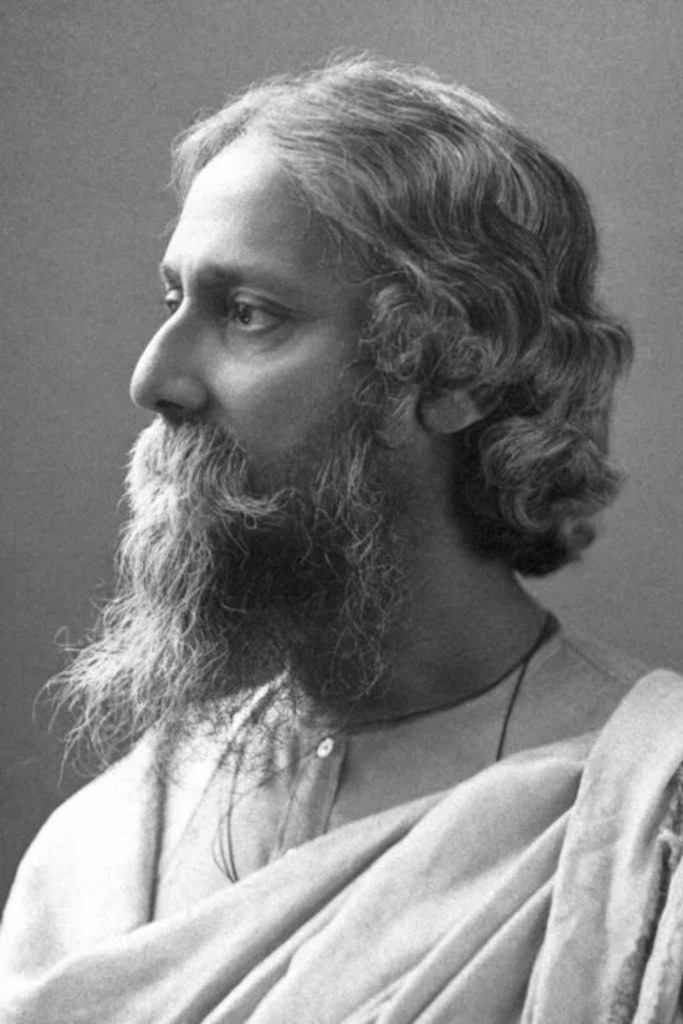
    Image: Rabindranath Tagore – Nobel Prize

    Nobel Prize for Literature

    The English painter and art critic William Rothenstein [4] became deeply interested in the philosophy and writings of Rabindranath Tagore. The painter especially was attracted to Tagore’s prose poems from Gitanjali, Bengali for “song offerings.”    The beauty and charm of these poems compelled Rothenstein to suggest to Tagore that he translate them into English so people in the West could appreciate them.

    Tagore, following Rothenstein’s advice, translated his song offerings in Gitanjali into English prose renderings. In 1913, Rabindranath Tagore was awarded the Nobel Prize for literature primarily for this volume of poems.   Also in 1913, the publishing house Macmillan brought out the hardcover copy of Tagore’s prose translations of Gitanjali.   

    William Butler Yeats, the greatest Irish poet, also a Nobel Laureate (1923), penned the introduction to Gitanjali.    Yeats reports that this volume of poems “stirred [his] blood as nothing has for years.” About Indian culture in general, Yeats opines, “The work of a supreme culture, they yet appear as much the growth of the common soil as the grass and the rushes.”  

    Yeats’ interest and perusal of Eastern philosophy intensified, and he was particularly moved by Tagore’s spiritual writing.  Yeats avers that Tagore’s tradition was one wherein 

    poetry and religion are the same thing and that it has passed through the centuries, gathering from learned and unlearned metaphor and emotion, and carried back again to the multitude the thought of the scholar and of the noble.  [5]

    Yeats later composed many poems based on Eastern concepts, although their subtleties at times evaded him [6]. Nevertheless, Yeats deserves credit for advancing the West’s attention and interest in the spiritual essence of those concepts.    Yeats further asserts in his introductory piece to Gitanjali, 

    If our life was not a continual warfare, we would not have taste, we would not know what is good, we would not find hearers and readers. Four-fifths of our energy is spent in this quarrel with bad taste, whether in our own minds or in the minds of others. 

    Yeats’ decidedly severe appraisal of Western culture quite accurately reflects the mood of his era:  the Irish poet’s birth and death dates (1861-1939) sandwiches his life between two bloody Western wars, the American Civil War (1861–1965) and World War II (1939–1945).  

    Yeats also accurately speaks to Tagore’s achievement as he reports that Tagore’s songs “are not only respected and admired by scholars, but also they are sung in the fields by peasants.”  The Irish poet would have been astonished and delighted if his own poetic efforts had been accepted by such a wide spectrum of the populace. 

    In Yeats’ poem, “The Fisherman,” he creates a speaker who is asserting the need for such an organic, pastoral style of poetry.  He is calling for a poetry that will be meaningful for the common folk. 

    Yeats reveals his contempt for charlatans, while encouraging an ideal that he feels must guide culture and art. Yeats encouraged a style of art that he felt most closely appealed to the culture of the Irish.  Thus, the Irish poet comprehended the beauty and simplicity native to the concept of a poetry for the common folk.

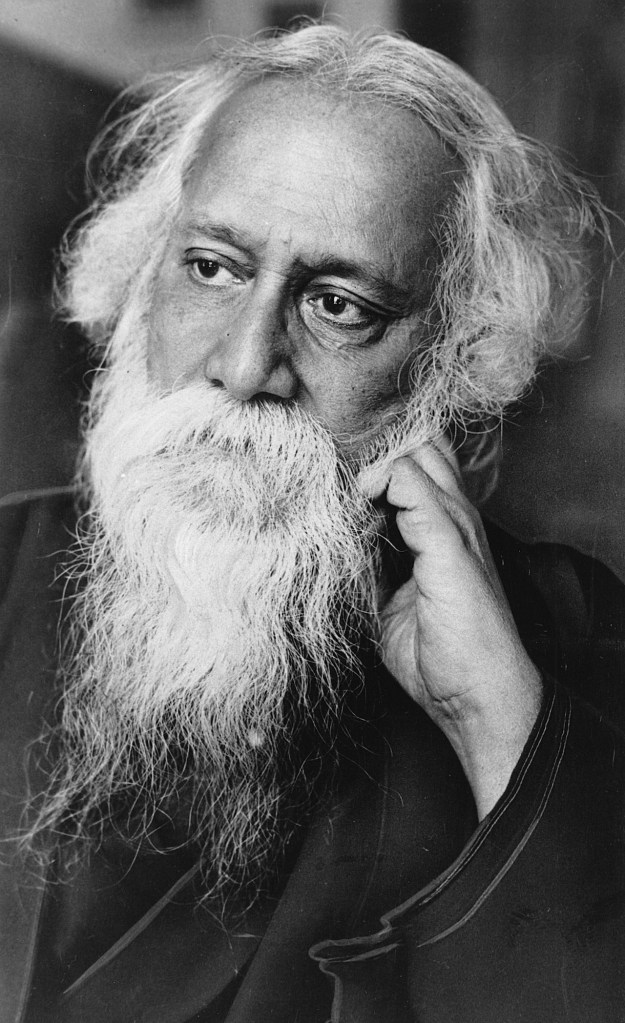
    Image: Rabindranath Tagore

    Sample Poem from Gitanjali

    The following prose-poem rendering #7 is representative of the Gitanjali’s form and content: 

    My song has put off her adornments. She has no pride of dress and decoration. Ornaments would mar our union. They would come between thee and me. Their jingling would drown thy whispers. 

    My poet’s vanity dies in shame before thy sight. O Master Poet, I have sat down at thy feet. Only let me make my life simple and straight like a flute of reed for thee to fill with music. 

    This poem unveils a charm that remains humble: it is, in fact, a prayer to soften the poet’s heart to his Belovèd Master Poet (God), without unnecessary words and gestures.    A poet steeped in vanity produces only ego-centered poetry, but this guileless poet/devotee seeks only to be open to the simple humbleness of truth that only the Heavenly Father-Creator can bestow upon his soul. 

    As the Irish poet William Butler Yeats has averred, these songs emerge from a culture in which art and religion have become synonymous.  Thus, it comes as no surprise that the offerer of these humble songs is speaking directly to the Divine Belovèd (God) in song after song, and song rendering #7 remains a perfect example.   

    In the last line of song #7 is a subtle allusion [7] to Bhagavan Krishna. The great yogi/poet Paramahansa Yogananda elucidates the meaning: 

    Krishna is shown in Hindu art with a flute; on it he plays the enrapturing song that recalls to their true home the human souls wandering in delusion.

    Tagore’s employment of religious themes remains a subtle yet integral part of his works.  He seldom engages in overtly polemical exposition, only a natural, organic art that inspires even as it educates and entertains.

    Renaissance Man

    Rabindranath Tagore became an accomplished writer of poetry, essays, plays, and novels. And despite his early disagreeable relationship with schooling, he is also noted for becoming an educator and founder of Visva-Bharati University in Santiniketan, West Bengal, India.  

    Tagore’ many accomplishments renders him a perfect example of a Renaissance man, who is skilled in many fields of endeavor, including spiritual poetry.  Despite being a world traveler, Rabindranath Tagore lived most of his life in the same house in which he was born.  On August 7, 1941, he died in that same house, three months after his 80thbirthday.

    Sources

    [1]  Editors. “Rabindranath Tagore.”  Britannica.  Accessed February 17, 2022.

    [2]  Debraj Mitra.  “Rabindranath Tagore’s Birthday Celebrated at Xavier’s.”  The Telegraph Online.  October 5, 2021.

    [3] Official Website of Visva-Bharati University.  Accessed February 19, 2023.

    [4]  William Rothenstein. Rabindranath Tagore.  Imperfect Encounter : Letters of William Rothenstein and Rabindranath Tagore, 1911-1941.  Semantic Scholar. Accessed January 2, 2024.

    [5]  Malcolm Sen.  “Mythologising a ‘Mystic’:  W.B. Yeats on the Poetry of Rabindranath Tagore.”  History Ireland.  July/August 2010.

    [6]  Linda S. Grimes. “William Butler Yeats’ Transformations of Eastern Religious Concepts.” Dissertation Abstract.  Ball State University. Advisor: Thomas R. Thornburg. 1987.

    [7]  Paramahansa Yogananda.  “Chapter 15: The Cauliflower Robbery from Autobiography of a Yogi.”  Hinduwebsite.com.  Accessed February 17, 2022.

    🕉

    Commentaries on Rabindranath Tagore Poems

    • Rabindranath Tagore’s Gitanjali #48: “The morning sea of silence…”  Rabindranath Tagore’s poem elucidating a metaphorical and metaphysical journey is number 48 in his most noted collection titledGitanjali. The poet received the Nobel Prize for Literature in 1913, specifically for that collection.
    • Rabindranath Tagore’s “Light the Lamp of Thy Love”  Rabindranath Tagore’s poem “Light the Lamp of Thy Love” is a devotional lyric that expresses the speaker’s longing for self-realization. Through colorful imagery, the poem explores themes of transformation, redemption, and the transcendence of human limitation through spiritual awakening.
    • Rabindranath Tagore’s “The Last Bargain”  Rabindranath Tagore’s “The Last Bargain” focuses on what seems to be an quandary:  how is it that a child’s offering of “nothing” to a seeker becomes the “last bargain” as well as the best bargain?

  • William Butler Yeats’ “The Second Coming”

    Image: William Butler Yeats – Howard Coster – National Portrait Galley, London

    William Butler Yeats’ “The Second Coming”

    William Butler Yeats’ “The Second Coming” remains one of the most widely misunderstood poems of the 20th century. Many scholars and critics have failed to criticize the exaggeration in the first stanza and the absurd metaphor in the second stanza, which render a potentially fine poem a critical failure.

    Introduction with Text of “The Second Coming”

    Poems, in order to communicate, must be as logical as the purpose and content require. For example, if the poet wishes to comment on or criticize an issue, he must adhere to physical facts in his poetic drama. If the poet wishes to emote, equivocate, or demonstrate the chaotic nature of his cosmic thinking, he may legitimately do so without much seeming sense.

    For example, Robert Bly’s lines—”Sometimes a man walks by a pond, and a hand / Reaches out and pulls him in” / / “The pond was lonely, or needed / Calcium, bones would do,”—are ludicrous [1] on every level.   Even if one explicates the speaker’s personifying the pond, the lines remain absurd, at least in part because if a person needs calcium, grabbing the bones of another human being will not take care of that deficiency. 

    The absurdity of a lake needing “calcium” should be abundantly clear on its face.  Nevertheless, the image of the lake grabbing a man may ultimately be accepted as the funny nonsense that it is.   William Butler Yeats’ “The Second Coming” cannot be dismissed so easily; while the Yeats poem does not depict the universe as totally chaotic, it does bemoan that fact that events seem to be leading society to armageddon.

    The absurdity surrounding the metaphor of the “rough beast” in the Yeats poem renders the musing on world events without practical substance.

    The Second Coming

    Turning and turning in the widening gyre   
    The falcon cannot hear the falconer;
    Things fall apart; the centre cannot hold;
    Mere anarchy is loosed upon the world,
    The blood-dimmed tide is loosed, and everywhere   
    The ceremony of innocence is drowned;
    The best lack all conviction, while the worst   
    Are full of passionate intensity. 

    Surely some revelation is at hand;
    Surely the Second Coming is at hand.   
    The Second Coming! Hardly are those words out  
    When a vast image out of Spiritus Mundi
    Troubles my sight: somewhere in sands of the desert   
    A shape with lion body and the head of a man,   
    A gaze blank and pitiless as the sun,   
    Is moving its slow thighs, while all about it   
    Reel shadows of the indignant desert birds.   
    The darkness drops again; but now I know   
    That twenty centuries of stony sleep
    Were vexed to nightmare by a rocking cradle,  
    And what rough beast, its hour come round at last,   
    Slouches towards Bethlehem to be born? 

    Commentary on “The Second Coming”

    William Butler Yeats’ “The Second Coming” remains one of the most widely anthologized poems in world literature.  Yet its hyperbole in the first stanza and ludicrous “rough beast” metaphor in the second stanza result in a blur of unworkable speculation.

    First Stanza: Sorrowful over Chaos

    Turning and turning in the widening gyre   
    The falcon cannot hear the falconer;
    Things fall apart; the centre cannot hold;
    Mere anarchy is loosed upon the world,
    The blood-dimmed tide is loosed, and everywhere   
    The ceremony of innocence is drowned;
    The best lack all conviction, while the worst   
    Are full of passionate intensity. 

    The speaker is sorrowing over the chaos of world events that have left in their wake many dead people.  Clashes of groups of ideologues have wreaked havoc, and much blood shed has smeared the tranquil lives of innocent people who wish to live quiet, productive lives. 

    The speaker likens the seemingly out of control situation of society to a falconer losing control of the falcon as he attempts to tame it.   Everyday life has become chaotic as corrupt governments have spurred revolutions.  Lack of respect for leadership has left a vacuum which is filled with force and violence.

    The overstated claim that “The best lack all conviction, while the worst / Are full of passionate intensity” should have alerted the poet that he needed to rinse out the generic hyperbole in favor of more accuracy on the world stage.  

    Such a blanket, unqualified statement, especially in a poem, lacks the ring of truth:  it simply cannot be true that the “best lack all conviction.”  Surely, some the best still retain some level of conviction, or else improvement could never be expected.  

    It also cannot be true that all the worst are passionate; some of the worst are likely not passionate at all but remain sycophantic, indifferent followers.  Any reader should be wary of such all-inclusive, absolutist statements in both prose and poetry.  

    Anytime a writer subsumes an entirety with the terms “all,” “none,” “everything,” “everyone,” “always,” or “never,” the reader should question the statement for its accuracy.  All too often such terms are signals for stereotypes, which produce the same inaccuracy as groupthink.

    Second Stanza: What Revelation?

    Surely some revelation is at hand;
    Surely the Second Coming is at hand.   
    The Second Coming! Hardly are those words out  
    When a vast image out of Spiritus Mundi
    Troubles my sight: somewhere in sands of the desert   
    A shape with lion body and the head of a man,   
    A gaze blank and pitiless as the sun,   
    Is moving its slow thighs, while all about it   
    Reel shadows of the indignant desert birds.   
    The darkness drops again; but now I know   
    That twenty centuries of stony sleep
    Were vexed to nightmare by a rocking cradle,  
    And what rough beast, its hour come round at last,   
    Slouches towards Bethlehem to be born? 

    The idea of “some revelation” leads the speaker to the mythological second coming of Christ.  So he speculates on what a second coming might entail.  However, instead of “Christ,” the speaker conjures the notion that an Egyptian-Sphinx-like character with ill-intent might arrive instead.  

    Therefore, in place of a second coming of godliness and virtue, as is the purpose of the original second coming, the speaker wonders:  what if the actual second coming will be more like an Anti-Christ?  What if all this chaos of bloodshed and disarray has been brought on by the opposite of Christian virtue?

    Postmodern Absurdity and the “Rough Beast”

    The “rough beast” in Yeats’ “The Second Coming” is an aberration of imagination, not a viable symbol for what Yeats’ speaker thought he was achieving in his critique of culture. If, as the postmodernists contend, there is no order [2] in the universe and nothing really makes any sense anyway, then it becomes perfectly fine to write nonsense. 

    Because this poet is a contemporary of modernism but not postmodernism [3], William Butler Yeats’ poetry and poetics do not quite devolve to the level of postmodern angst that blankets everything with the nonsensical.  Yet, his manifesto titled A Vision is, undoubtedly, one of the contributing factors to that line of meretricious ideology. 

    Hazarding a Guess Can Be Hazardous

    The first stanza of Yeats’ “The Second Coming” begins by metaphorically comparing a falconer losing control of the falcon to nations and governments losing control because of the current world disorder, in which “[t]hings fall apart; the centre cannot hold.” 

    Political factions employ these lines against their opposition during the time in which their opposition is in power, as they spew forth praise for their own order that somehow magically appears with their taking the seat of power.

    The poem has been co-opted by the political class so often that Dorian Lynskey, overviewing the poem in his essay, “‘Things fall apart’: the Apocalyptic Appeal of WB Yeats’s The Second Coming,” writes, “There was apparently no geopolitical drama to which it could not be applied” [4].

    The second stanza dramatizes the speaker’s musing about a revelation that has popped into his head, and he likens that revelation to the second coming of Christ; however, this time the coming, he speculates, may be something much different.  

    The speaker does not know what the second coming will herald, but he does not mind hazarding a dramatic guess about the possibility.   Thus, he guesses that the entity of a new “second coming” would likely be something that resembles the Egyptian sphinx; it would not be the return of the Christ with the return of virtue but perhaps its opposite—vice. 

    The speaker concludes his guess with an allusion to the birth of such an entity as he likens the Blessed Virgin Mother to the “rough beast.”   The Blessèd Virgin Mother, as a newfangled, postmodern creature, will be “slouching toward Bethlehem” because that is the location to which the first coming came.  

    The allusion to “Bethlehem” functions solely as a vague juxtaposition to the phrase “second coming” in hopes that the reader will make the connection that the first coming and the second coming may have something in common.  The speaker speculates that at this very moment wherein the speaker is doing his speculation some “rough beast” might be pregnant with the creature of the “second coming.” 

    And as the time arrives for the creature to be born, the rough beast will go “slouching” towards its lair to give birth to this “second coming” creature: “its hour come round at last” refers to the rough beast being in labor. 

    The Flaw of Yeats’ “The Second Coming” 

    The speaker then poses the nonsensical question: “And what rough beast, its hour come round at last, / Slouches towards Bethlehem to be born?”   In order to make the case that the speaker wishes to make, these last two lines should be restructured in one of two ways: 

    And what rough beast, its hour come round at last,
    Slouches towards Bethlehem to give birth? 

     or

    And what rough beast’s babe, its time come at last,
    Is in transport to Bethlehem to be born?

    An unborn being cannot “slouch” toward a destination.  The pregnant mother of the unborn being can “slouch” toward a destination.   But the speaker is not contemplating the nature of the rough beast’s mother; he is contemplating the nature of the rough beast itself.  

    The speaker does not suggest that the literal Sphinx will travel to Bethlehem. He is merely implying that a Sphinx-like creature might resemble the creature of the second coming.  Once an individual has discounted the return of Jesus the Christ as a literal or even spiritual fact, one might offer personal speculation about just what a second coming would look like. 

    It is doubtful that anyone would argue that the poem is dramatizing a literal birth, rather than a spiritual or metaphorical one.    It is also unreasonable to argue that the speaker of this poem—or Yeats for that matter—thought that the second coming actually referred to the Sphinx.   A ridiculous image develops from the fabrication of the Sphinx moving toward Bethlehem. Yeats was more prudent than that. 

    Exaggerated Importance of Poem

    William Butler Yeats composed a manifesto to display his worldview and poetics titled A Vision, in which he set down certain tenets of his thoughts on poetry, creativity, and world history.   Although seemingly taken quite seriously by some Yeatsian scholars, A Vision is of little value in understanding either meaning in poetry or the meaning of the world, particularly in terms of historical events.  

    An important example of Yeats’ misunderstanding of world cycles is his explanation of the cyclical nature of history, exemplified with what he called “gyres” (pronounced with a hard “g.”)  Two particular points in the Yeatsian explanation demonstrate the fallacy of his thinking:

    1. In his diagram, Yeats set the position of the gyres inaccurately; they should not be intersecting but instead one should rest  one on top of the other:  cycles shrink and enlarge in scope; they do not overlap, as they would have to do if the Yeatsian model were accurate. 

    Image :  Gyres – Inaccurate Configuration from A Vision

    Image:  Gyres –  Accurate Configuration

    2.  In the traditional Second Coming, Christ is figured to come again but as an adult, not as in infant as is implied in Yeats’ poem “The Second Coming.”

    Of great significance in Yeats’ poem is the “rough beast,” apparently the Anti-Christ, who has not been born yet.  And most problematic is that the rough beast is “slouch[ing] towards Bethlehem to be born.”  The question is, how can such a creature be slouching if it has not yet been born?  There is no indication the speaker wishes to attribute this second coming fiasco to the mother of the rough beast.

    This illogical event is never mentioned by critics who seem to accept the slouching as a possible occurrence.  On this score, it seems critics and scholars have lent the poem an unusually wide and encompassing poetic license.

    The Accurate Meaning of the Second Coming

    Paramahansa Yogananda has explained in depth the original, spiritual meaning of the phrase “the second coming”[5] which does not signify the literal coming again of Jesus the Christ, but the spiritual awakening of each individual soul to its Divine Nature through the Christ Consciousness.  

    Paramahansa Yogananda summarizes his two volume work The Second Coming of Christ: The Resurrection of the Christ Within You:

    In titling this work The Second Coming of Christ, I am not referring to a literal return of Jesus to earth . . . 

    A thousand Christs sent to earth would not redeem its people unless they themselves become Christlike by purifying and expanding their individual consciousness to receive therein the second coming of the Christ Consciousness, as was manifested in Jesus . . . 

    Contact with this Consciousness, experienced in the ever new joy of meditation, will be the real second coming of Christ—and it will take place right in the devotee’s own consciousness. (my emphasis added)

    Interestingly, knowledge of the meaning of that phrase “the second coming” as explained by Paramahansa Yogananda renders unnecessary the musings of Yeats’ poem “The Second Coming”and most other speculation about the subject. Still, the poem as an artifact of 20th century thinking remains an important object for study. 

    Sources

    [1]  Linda Sue Grimes.  “Robert Bly’s ‘The Cat in the Kitchen’ and ‘Driving to Town Late to Mail a Letter’.”  Linda’s Literary Home. December 24, 2025. 

    [2]  David Solway.  “The Origins of Postmodernitis.”  PJ Media.  March 25, 2011.  

    [3]  Linda Sue Grimes. “Poetry and Politics under the Influence of Postmodernism.” Linda’s Literary Home.  Accessed December 3, 2025.

    [4]  Dorian Lynsey. “‘Things fall apart’: the Apocalyptic Appeal of WB Yeats’s The Second Coming.” The Guardian.  May 30, 2020.

    [5]  Editors. “The Truth Hidden in the Gospels.  Self-Realization Fellowship. Accessed October 27, 2023.

  • Essays: Literary Works with Commentaries

    Image:   Van Gogh: The Complete Paintings

    Essays: Literary Works with Commentaries

    This room in my literary home holds links to poems, novels, and other literary works primarily written by others along with my personal commentaries on the works.

    Thank you for visiting my literary home.  Questions, comments, and suggestions offered in good faith are always welcome.

    Poems with Commentaries

    1. Sterling A. Brown’s “Southern Cop”
    2. Barack Obama’s “Pop”
    3. Barack Obama’s “Underground”
    4. Malcolm M. Sedam’s “The Hill Maiden”
    5. W. B. Yeats’ “The Second Coming”
    6. Al Gore’s “One thin September soon”
    7. W. H. Auden’s “Doggerel by a Senior Citizen”
    8. Gloria’s “To the Man I Married”  
    9. Sharon Olds’ “The Victims”
    10. Ben Okri’s Poem “Obama”
    11. Ella Wheeler Wilcox’s “The Queen’s Last Ride”
    12. Audre Lorde’s “Father Son and Holy Ghost”
    13. Seamus Heaney’s “Whatever You Say, Say Nothing”
    14. Walter de la Mare’s “Silver”
    15. Henry Wadsworth Longfellow’s “Christmas Bells”
    16. Henry Wadsworth Longfellow’s “A Psalm of Life”  
    17. D. H. Lawrence’s “Afternoon in School: The Last Lesson”
    18. Paul Laurence Dunbar’s “Sympathy” 
    19. Robert Bly’s “The Cat in the Kitchen” and “Driving to Town Late to Mail a Letter” 
    20. Thomas Thornburg’s “Serving the South”
    21. Sara Teasdale’s “Barter”
    22. Sylvia Plath’s “Mirror” 
    23. Renée Nicole Macklin’s “On Learning to Dissect Fetal Pigs”
    24. Sara Teasdale’s “I Am Not Yours”
    25. Cornelius Eady’s “Renée Nicole Good Is Murdered”  
    26. Malcolm M. Sedam’s “Desafinado” 
    27. Walt Whitman’s “When Lilacs Last in the Dooryard Bloom’d”
    28. Thomas Gray’s “Elegy Written in a Country Churchyard”
    29. Amanda Gorman’s “For Renee Nicole Good”  
    30. Robert Hayden’s “Those Winter Sundays”
    31. Alfred, Lord Tennyson’s “Come not, When I Am Dead”
    32. E. A. Robinson’s “Richard Cory”
    33. Stephen Crane’s “The Wayfarer” and Other Versanelles
    34. Percy Bysshe Shelley’s “The Sensitive Plant”
    35. Arna Bontemps’ “God Give to Men”
    36. Lucille Clifton’s “homage to my hips”
    37. Lucille Clifton’s “at the cemetery, walnut grove plantation, south carolina, 1989”
    38. A. E. Housman’s “Is my team ploughing” (XXVII)
    39. W. H. Auden’s “The Unknown Citizen”
    40. Matthew Arnold’s “Dover Beach”
    41. Vachel Lindsay’s “Abraham Lincoln Walks at Midnight”
    42. Andrew Marvell’s “To His Coy Mistress”
    43. William Wordsworth’s “Surprised by Joy”

    Songs with Commentaries

    1. Gary Clarks’s “Mary’s Prayer”: A Yogic Interpretation 
    2. .38 Special’s “Second Chance”

    Novels

    1. D. H. Lawrence’s Women in Love