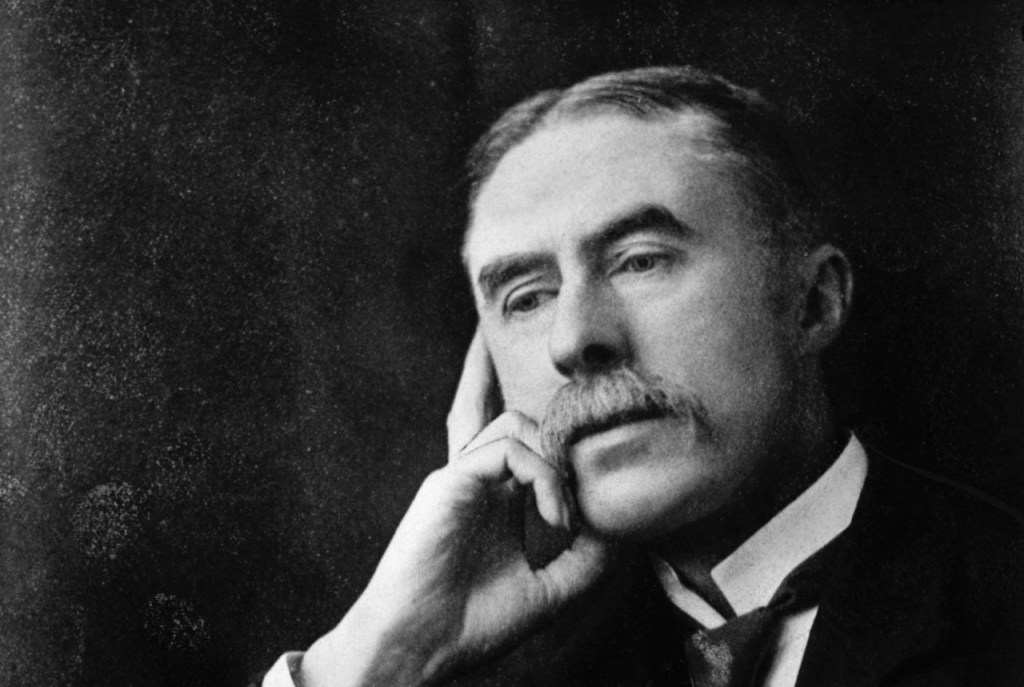
A.E. Housman’s Poem XXVII “Is my team ploughing”
Two speakers appear in A. E. Housman’s “Is my team ploughing”: one a dead man, the other his living friend. The dead man asks for a report about how things are going now that he has died.
Introduction and Text of “Is my team ploughing”
A E. Housman’s “Is my team ploughing” (XXVII) appears in A Shropshire Lad, the poet’s well-known, somewhat autobiographical collection. In the poem, a deceased man questions a living friend about various aspects of their life together before the dead man died.
The eight stanzas are sectioned into question and response, similar to an interview, with the dead man beginning with a question. The dead man’s questions appear in quotation marks, followed by the living friend’s response without quotation marks.
XXVII Is my team ploughing
“Is my team ploughing,
That I was used to drive
And hear the harness jingle
When I was man alive?”
Ay, the horses trample,
The harness jingles now;
No change though you lie under
The land you used to plough.
“Is football playing
Along the river shore,
With lads to chase the leather,
Now I stand up no more?”
Ay the ball is flying,
The lads play heart and soul;
The goal stands up, the keeper
Stands up to keep the goal.
“Is my girl happy,
That I thought hard to leave,
And has she tired of weeping
As she lies down at eve?”
Ay, she lies down lightly,
She lies not down to weep:
Your girl is well contented.
Be still, my lad, and sleep.
“Is my friend hearty,
Now I am thin and pine,
And has he found to sleep in
A better bed than mine?”
Yes, lad, I lie easy,
I lie as lads would choose;
I cheer a dead man’s sweetheart,
Never ask me whose.
Commentary on “Is my team ploughing”
Two speakers appear in these lines: one a dead man, the other his living friend. The dead man asks for a report about how things are going now that he has died.
First Stanza: The Dead Man Asks a Question
“Is my team ploughing,
That I was used to drive
And hear the harness jingle
When I was man alive?”
The dead man begins by asking a question of his friend who is still alive. The deceased wishes to find out if his team of horses that he employed in ploughing his fields is still performing that function.
Therefore he puts the question to his friend: “Is my team ploughing?” Continuing he adds, “That I used to drive, / And hear the harness jingle.” The dead speaker, no longer possessing the capability of tilling his farm fields, nor of listening to the jingling of the horses’ harnesses, seeks answers to the mystery of how those still living are functioning now that the deceased is no longer “man alive.”
Second Stanzas: The Living Man Responds
Ay, the horses trample,
The harness jingles now;
No change though you lie under
The land you used to plough.
The friend immediately responds that the horses are indeed continuing to plough and their harnesses are still making their jingling sounds. Life has continued on as before the deceased became deceased. Everything goes on as it did before the poor dead farmer’s body was placed “under / The land [he] used to plough.”
Third Stanza: No Longer Able to Play
“Is football playing
Along the river shore,
With lads to chase the leather,
Now I stand up no more?”
The dead speaker then wants to know if their other friends are still playing football; he shows that he remembers where they used to play, adding the colorful fact of the boys chasing the ball as they played their game.
He emphasizes his current status to his living friend that he can no long join in the game. He makes sure the friend does not forget that being dead he can no longer play and enjoy himself as he did before.
Fourth Stanzas: Contrast Between the Living and the Dead
Ay the ball is flying,
The lads play heart and soul;
The goal stands up, the keeper
Stands up to keep the goal.
The friend then responds that yes the boys are still playing their lively game. He stresses his positive answer, saying, the goal is still in place and the goalie still performs his task in the game. By repeating the term “stands” the speaker emphasizes the contrast between the living players and the deceased questioner who can no longer “stand.”
Fifth Stanza: Hated to Leave His Sweetheart
“Is my girl happy,
That I thought hard to leave,
And has she tired of weeping
As she lies down at eve?”
The dead man then queries after his girlfriend. He hated having to leave her, and he says, he “thought hard” on the issue. He wonders if she has ceased mourning the loss of him, as he surmises that his sweetheart would have bitterly mourned his passing and that she might still be in mourning for him.
Sixth Stanza: A Well-Satisfied Sweetheart
Ay, she lies down lightly,
She lies not down to weep:
Your girl is well contented.
Be still, my lad, and sleep.
However, the friend assures the dead man that the sweetheart is well satisfied, and as she lies down in bed at night, she is not pining nor shedding tears. This turning point reveals that the friend may not be such a good friend to the dead man as it might have seemed; the living friend knows too much about the sweetheart and has revealed to the dead man more than the poor fool would have wanted to know.
Seventh Stanza: His Hearty Friend
“Is my friend hearty,
Now I am thin and pine,
And has he found to sleep in
A better bed than mine?”
The dead speaker then poses a final question about his friend, the one he has been interviewing all along. The dead man asks if his friend is “hearty,” as he once again emphasizes his own status as a dead man. Instead of “hearty,” he is “thin and pine.” Thus he asks if the still living friend has found a better place to sleep than the grave. Is it possible that the dead already knows, or suspects, the answer to that question?
Eighth Stanza: Quite Well and Sleeping Well
Yes, lad, I lie easy,
I lie as lads would choose;
I cheer a dead man’s sweetheart,
Never ask me whose.
The living friend then assures his dead friend that he is quite well, and he sleeps well. And he adds, “I cheer a dead man’s sweetheart.” When the living friend, who has usurped the place of the dead man with the latter’s sweetheart, adds, “Never ask me whose,” the questioning does cease.
But how likely is it that the dead man does not already have the answers to all of his questions? The dead man’s questions seem to elicit responses that unveil the treachery of his so-called living friend. Such an examination of possibilities places before the minds of readers and listeners the unending route of knowledge, experience, and truth that does not end with death.
The Extended Paradox of a Dead Man Speaking
Readers of A.E. Housman’s “Is my team ploughing” may react to the implausibility of a dead man holding a conversation with a living man. That reaction will depend on how literally one takes the conversation. Obviously, a literal conversation is impossible; thus, one must consider the fact that the conversation itself is a figure of speech, an extended paradox.
Paradoxes, which at first seem absurd, are justified upon further explanation. But how does one justify a conversation between a dead man and a living man? Only the living man can be offering a report of this conversation; thus, the dead man’s part of the conversation is also coming from the mind of the living man. But why would a living man hold such a conversation, even if imaginary?
The answer is that the living man is being tormented with guilt at the way he treated the dead man while the latter was living, and now that his so-called friend is dead, he is committing the ultimate sin against their friendship by taking his place with the dead man’s sweetheart. The living friend is merely attempting to assuage his own guilty conscience by holding the imaginary conversation in which he seems to be attempting to solace his former friend.


Questions, comments, suggestions offered in good faith are always welcome. If you use a pseudonym, please include your real name, if you expect a response.