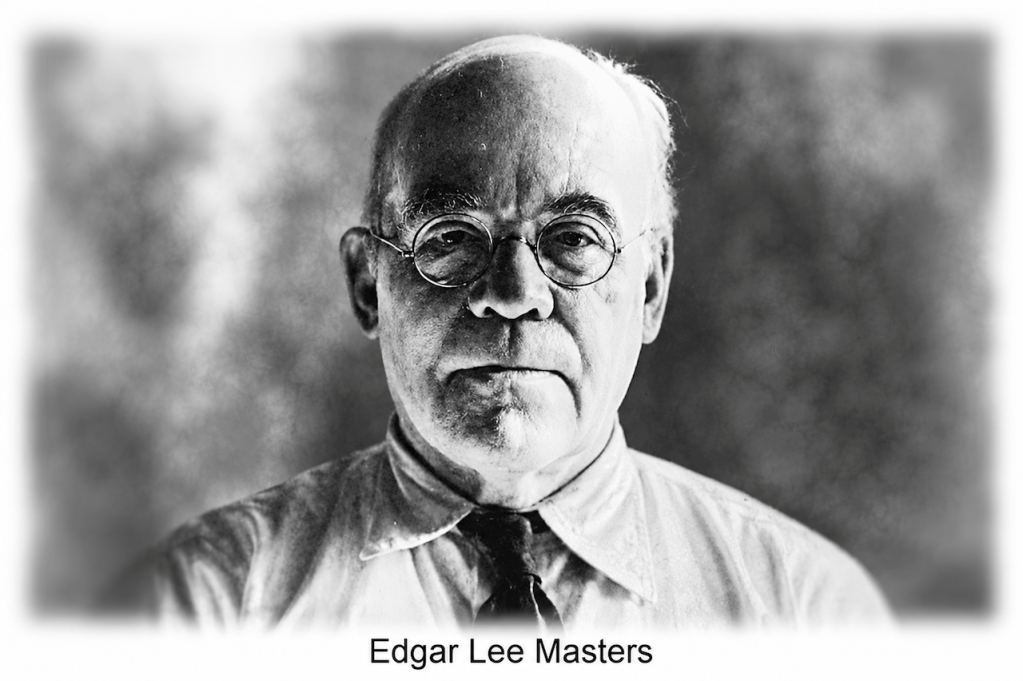
Edgar Lee Masters‘ “Jacob Goodpasture”
The speaker in the epitaph “Jacob Goodpasture” is lamenting the outbreak of the American Civil War (1861-8165). He considers the war unjustified, and he has lost his son, who served as a soldier in the war.
Introduction and Text of “Jacob Goodpasture”
In Edgar Lee Masters’ “Jacob Goodpasture” from Masters’ American classic Spoon River Anthology, the speaker disparages his own long life as he parallels it with the condition of his country.
As Jacob Goodpasture laments the outbreak of the American Civil War 1861-8165 [1], he makes it clear that he believes the war to be unjustified. He suggests that freedom itself is belong lost in an unnecessary war, and he is no doubt speaking from the position of a father in mourning; he lost his soldier son to the war effort.
Jacob Goodpasture
When Fort Sumter fell and the war came
I cried out in bitterness of soul:
“O glorious republic now no more!”
When they buried my soldier son
To the call of trumpets and the sound of drums
My heart broke beneath the weight
Of eighty years, and I cried:
“Oh, son who died in a cause unjust!
In the strife of Freedom slain!”
And I crept here under the grass.
And now from the battlements of time, behold:
Thrice thirty million souls being bound together
In the love of larger truth,
Rapt in the expectation of the birth
Of a new Beauty,
Sprung from Brotherhood and Wisdom.
I with eyes of spirit see the Transfiguration
Before you see it.
But ye infinite brood of golden eagles nesting ever higher,
Wheeling ever higher, the sun-light wooing
Of lofty places of Thought,
Forgive the blindness of the departed owl.
Commentary on “Jacob Goodpasture”
Jacob Goodpasture is one of the epitaph speakers who is suffering the pangs of life. He laments having lived during wartime and losing a son to the war effort. But he also offers a prediction about the republic, as well as an apology for his generation’s failure.
First Movement: A Father’s Grief
When Fort Sumter fell and the war came
I cried out in bitterness of soul:
“O glorious republic now no more!”
As a grieving father, Goodpasture commences his lamentation, exclaiming in deep agony that as the war began with the firing on Fort Sumter, his pain and anguish caused him to believe that the end of the republic had been foisted upon the citizens.
Goodpasture begins his epitaph looking back from a position sometime in the future. But he appears to conflate his own death with that future time; thus his time-line remains somewhat muddled.
Second Movement: An “Unjust” War
When they buried my soldier son
To the call of trumpets and the sound of drums
My heart broke beneath the weight
Of eighty years, and I cried:
“Oh, son who died in a cause unjust!
In the strife of Freedom slain!”
Goodpasture is suffering after the death of his son, who has become a casualty of the war. Goodpasture deems the war “unjust.” His suffering became intense as he listened to the trumpets and heard the sound of the drums beating for his son’s military funeral.
The eighty-year-old Goodpasture senses the heavy burden of his long life; he is unable to find any comfort in having his son give his life for the protection of his freedom. Goodpasture is decrying the death of his son, but he is also insisting that even freedom itself was “slain” in the unjust war.
That Goodpasture seems to suggest he was eighty years old when his son dies adds a puzzling quirk to the narrative. Eighty years old seems a bit old have a son die in war; perhaps a grandson or even a great-grandson would be more likely. Soldiers going off the fight in the Civil War were, of course, all ages, but the majority of them were likely in the twenties.
On the other hand, Goodpasture could be implying that it was much later that his “heart broke” at the sound of the military funeral, although the juxtaposition of his claims places his age and his death at the same time and contingent upon the death of his son.
Third Movement: Foreseeing a New Golden Age
And I crept here under the grass.
And now from the battlements of time, behold:
Thrice thirty million souls being bound together
In the love of larger truth,
Rapt in the expectation of the birth
Of a new Beauty,
Sprung from Brotherhood and Wisdom.
I with eyes of spirit see the Transfiguration
Before you see it.
But ye infinite brood of golden eagles nesting ever higher,
Wheeling ever higher, the sun-light wooing
Of lofty places of Thought,
Forgive the blindness of the departed owl.
Goodpasture dramatizes his emotion, signifying this own death by remarking dramatically, “I crept here under the grass.” Goodpasture then asserts an outrageous claim that he perceives truths that others fail to see. He makes a prediction about his country, the United States, after its population has tripled in size: “thrice thirty million.”
The U.S. population, indeed, was about 32 million [2] at the outset of the Civil War years. Goodpasture offers his prediction that the 90 million American souls will unite in “the love of larger truth.” He suggests that “a new Beauty” will come to fruition in “Brotherhood and Wisdom.”
The U.S.A. reached that 90,000,000 mark in 1909, less than a decade before it became embroiled in War War I, as Jim Crow Laws and Black Codes [3] were still blighting the American South.
Also, it was close to six decades before enactment of the Civil Rights Act of 1964 [4] that finally demanded American blacks be able to enjoy their full citizenship as originally granted by the 13th, 14th, and 15th Amendments. Thus Goodpasture’s prediction was less than stellar.
Despite the fact that Goodpasture labels the war “unjust” and not needed, he somehow remains optimistic that later generations will benefit from the true goal of this supposed unjust conflict.
Of course, the very purpose of the war was do just what Goodpasture thinks will happen in future. As the speaker is reporting from a state of mourning, he is likely attempting to assuage his own pain, so his predictions miss the mark by several decades.
Goodpasture asserts that he can know the future of his country before the living residents perceive it. He metaphorically compares the coming generation to “golden eagles,” asking them to forgive his war-mongering generation, which resembles a blind owl that has now left the picture.
Uncertain Time-Frame
The timing of Goodpasture’s prediction raises problematic issues. The reader may gather that he died around age eighty. But it remains unclear if he was, in fact, age eighty at the outbreak of the war.
If Goodpasture has lived around twenty years after the war, he likely could have seen certain results of the war effort. Yet in order to brag up his prediction, he has to be asserting that he possessed the foresight to predict those war results.
Goodpasture’s patriotism seems to be aligned with the death of his son; yet he is lamenting the son’s death as well as his opinion that the war has caused also the death of freedom.
Goodpasture seems to be trying to have it both ways—the war caused the death of freedom, yet in future he seems to perceive the rise of freedom; in his prediction, however, he was off by about six decades and one million in population: a semblance of that golden age he seems to predict came as the population reach 191 million rather than the 90 million he claims to foresee.
Sources
[1] Editors. “American Civil War—Facts, Events and Information.” History.net. Accessed August 10, 2026.
[2] Research Department. “U.S. Population 1776-date.” Armstrong Economics. Accessed August 10, 2026..
[3] Jason Shvili. “Black Codes and Jim Crow Laws.” WorldAtlas. November 8 2021.
[4] Curators. “The Civil Rights Act of 1964: A Long Struggle for Freedom.” Library of Congress. A Accessed August 10, 2026..


Questions, comments, suggestions offered in good faith are always welcome. If you use a pseudonym, please include your real name, if you expect a response.