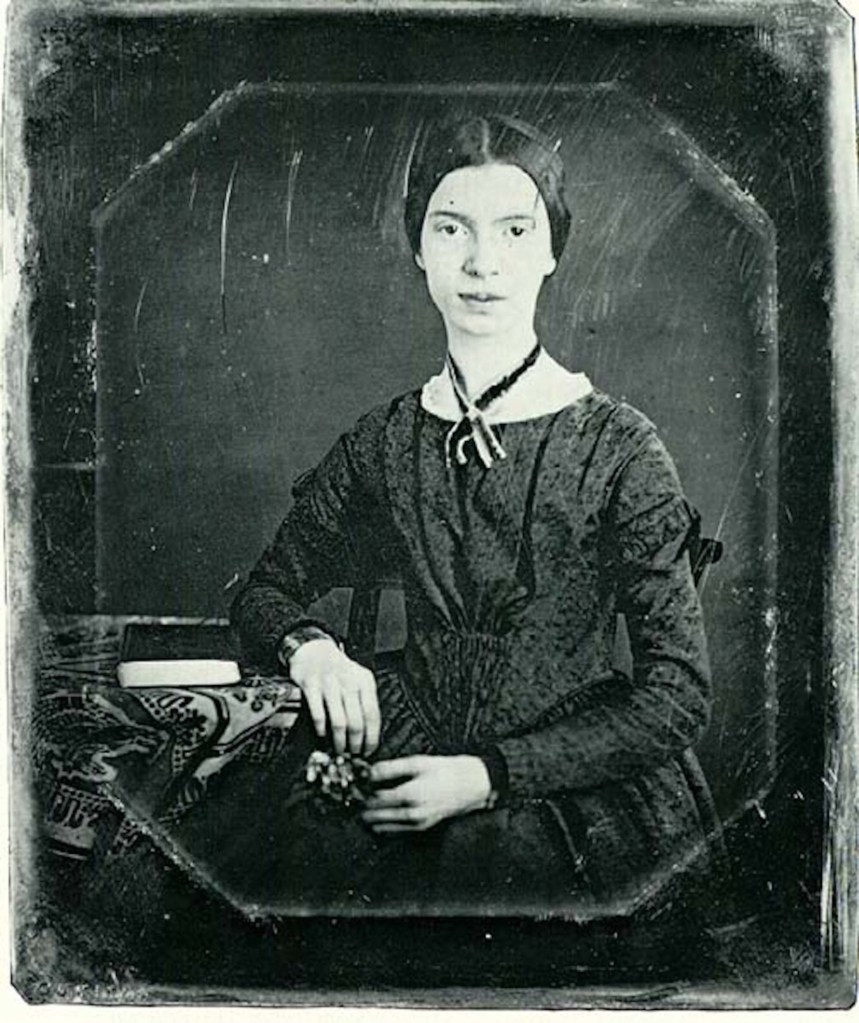
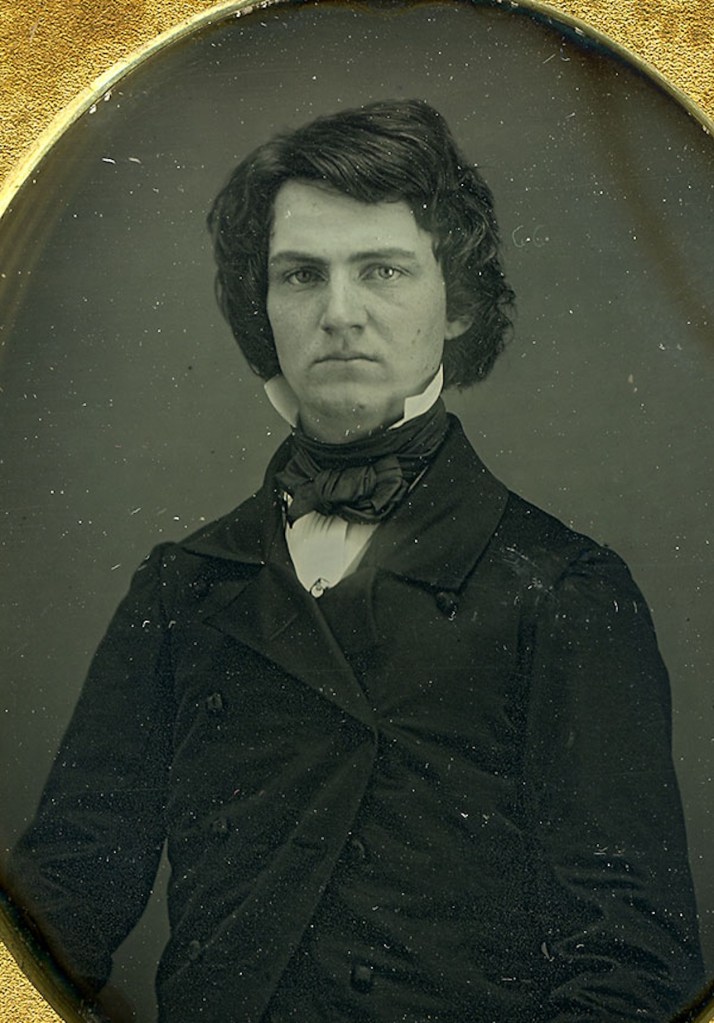
Image: Emily Dickinson – Amherst College – Daguerrotype of the poet at age 17, circa 1847 – likely the only authentic, extant image of the poet
Emily Dickinson’s “Publication – is the Auction”
Emily Dickinson’s “Publication – is the Auction” remains one of the poet’s starkest statements on the value of authenticity in creative effort—in her case the writing of poetry.
Introduction and Text of Emily Dickinson’s “Publication – is the Auction”
In her poem “Publication – is the Auction,” Emily Dickinson has created a speaker who is musing on the issue of allowing one’s inner thoughts to be made public through publication in media, including newspapers, magazines, or books.
Ultimately, she is saying that remaining true to one’s values and beliefs is more important than writing to sell to a wide audience. Dickinson’s spirituality, contingent upon mysticism, gave her the strong will to continue exploring the world for truth and then telling it without reservation.
Her speaker avers that publication of literary works can even become a threat to one’s inner life, as achievement is so often shunted aside solely for the purpose of increasing sales. Her speaker engages metaphors and images in areas of commerce and religion in order to approach a notion of purity.
Her speaker feels that reverence for one’s mental faculties will naturally garner restraint that will ethically prevent rash decisions to expose one’s inner talent to a world interested primarily in financial achievement over literary accomplishments.
Publication – is the Auction
Publication – is the Auction Of the Mind of Man – Poverty – be justifying For so foul a thing
Possibly – but We – would rather From Our Garret go White – unto the White Creator – Than invest – Our Snow –
Thought belong to Him who gave it – Then – to Him Who bear Its Corporeal illustration – Sell The Royal Air –
In the Parcel – Be the Merchant Of the Heavenly Grace – But reduce no Human Spirit To Disgrace of Price –
Commentary on “Publication – is the Auction”
Emily Dickinson published very few poems during her lifetime. Although she seemed to seek publication as she first conversed with Thomas Wentworth Higginson, her ultimate goal was to produce a body of work the meant something for her soul. She seemed to learn very quickly and early that publication had its pitfalls, and it seems that she struggled to avoid them.
Stanza 1: “Publication – is the Auction”
Publication – is the Auction Of the Mind of Man – Poverty – be justifying For so foul a thing
The speaker opens with a candid statement that publishing is tantamount to selling one’s soul. Although she buffers the claim by inserting “Mind” instead of soul, the ultimate meaning of inner awareness becomes more comparable to soul-awareness than mere mental capacity and observance.
The speaker avers that selling one’s words is equal to selling one’s own consciousness, not merely the paper, ink, and stream of words across a page. Such an insistence makes it abundantly clear that such a sale cannot be justified. In fact, remaining in “Poverty” is better than engaging in “so foul a thing” as selling one’s inner being.
The speaker then is implying that the creative writer’s mind becomes a mere object that is diminished by such a sordid undertaking. The economy with which the speaker has presented such a sapient idea demonstrates the strength her metaphor is exerting.
One can imagine an auctioneer rattling off numbers above the head of man, who is selling his head’s contents to the highest bidder. Such a scenario mocks the very notion of trying to sell one’s wares that have come into being through deep thought about spiritually vital things.
One might question such a strong stance against publication for money, but it is important to keep in mind that the speaker is no doubt referring to the creation and sale of poetry. The genesis of poetry remains a very different one from writing expository and informative essays and/or news articles.
Even the writing of fiction such as plays, short stories, or novels carries a different moral impact. If the speaker were focusing on those genres, the poem would have undoubtedly taken a very different approach.
Stanza 2: “Possibly – but We – would rather”
Possibly – but We – would rather From Our Garret go White – unto the White Creator – Than invest – Our Snow –
In the second stanza, the speaker switches from the general to the personal. Employing the editorial “We,” she asserts that despite the possibly of living in poverty, first principles and ethics remain inviolable.
Thus, if the poet must leave her “Garret”—symbol for poverty—she need not go rushing toward the marketplace. Instead, she can and must associate herself with purity: she employs “White” as a symbol of that purity. Thus, rather than “invest” her “Snow”—another symbol of purity as well as a metaphor for her creative writing pieces—she will go toward the “White Creator”—the Ultimate symbol of purity.
Investing one’s “Snow” signals turning one’s purity (works of art) into money, and such an exchange would cause those works and the mind that created them to become contaminated. Imagine handling a ball of snow—it does not remain snow but instead it melts into a pool of water.
Although water is a useful commodity, after melting from snow the original element has lost its original defining qualities. A work of art/poem may become further damaged even by the process of being readied for publication: how often have we heard writers lament that their original words were changed by an editor?
The speaker then is asserting that she prefers total obscurity to the compromise demanded by attempts at publication. And she is not asserting this stance out fear but instead out of fidelity to her ethical position regarding her sacred principles and values.
She is implying rather strongly that remaining in poverty is the better way to preserve her inner dedication to truth; that way she need never make excuses for losing spiritual purity.
Stanza 3: “Thought belong to Him who gave it”
Thought belong to Him who gave it – Then – to Him Who bear Its Corporeal illustration – Sell The Royal Air –
The speaker now offers her most profound reason for eschewing publication: because all thought belongs to the Ultimate Reality or God. God owns all thought just as He owns all of the air we breathe. Selling thought then becomes tantamount to selling air—a truly absurd notion, easily assimilated and understood.
The writer/artist becomes an instrument of the Divine, a steward not a proprietor. Ownership is not conferred by merely having taken a thought and shaped it into a poem; the Divine Poet, who awarded the poem to the poet, still owns the work.
Stanza 4: “In the Parcel – Be the Merchant”
In the Parcel – Be the Merchant Of the Heavenly Grace – But reduce no Human Spirit To Disgrace of Price –
In the final stanza, the speaker commands her audience of artists—and likely most important herself as a poet—to accept the package (the art work/poem but think of it as coming from its Divine Source. By thinking thusly, the poet/artist can happily continue to create—as the Great Creator does—but without the stain conferred by the fickle marketplace.
The artist must remain true to her own inner values, and the most natural and divine way to do that is to realize their Source—create for the original Creator alone; the art that is thus produced will reflect only love, beauty, and truth. These qualities are the only ones with which the true artist can contend, for they remain free from taint, stain, and corruption that surge by trying to please multifaceted humankind.
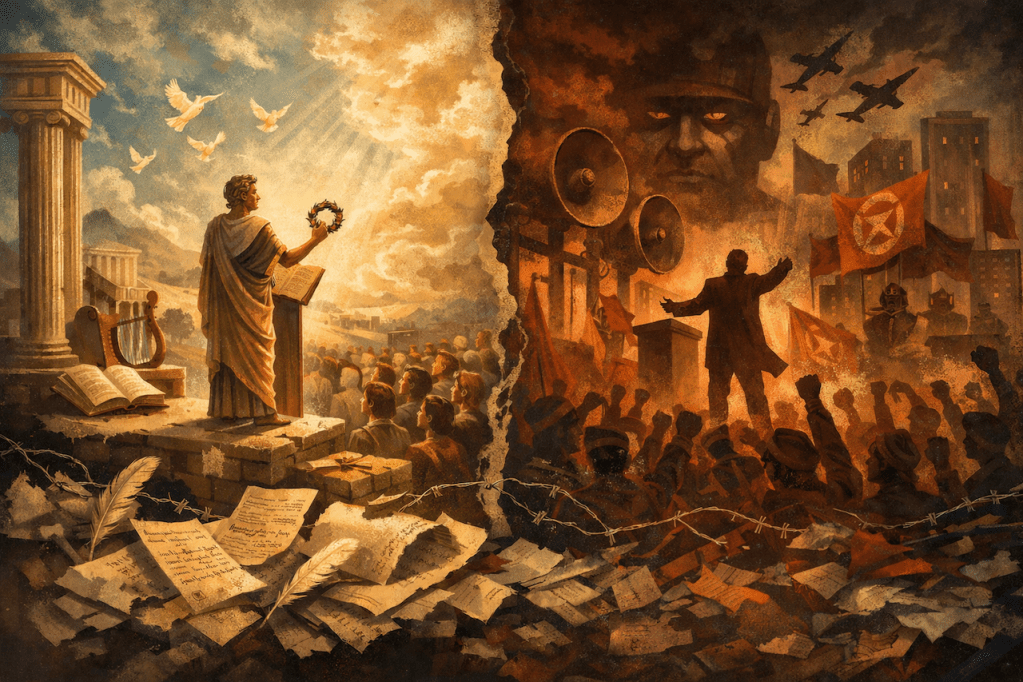
The Lost Art of Poetic Persuasion and the Rise of Propaganda
The art of poetry, once central to cultural formation and moral imagination, has largely vanished from the public consciousness of the twenty-first century. Yet its techniques survive, not in poems, but in political speeches that seek to persuade, mobilize, and command allegiance. What once elevated the soul through truth now often manipulates the will through propaganda.
Historical Transcendence
Poetry historically functioned as a discourse for transcendent truth—or revealing shared characteristics and/or experience of the ineffable. That discourse was articulated through rhythm, rime, metaphor, image, and moral vision. Its purpose was not merely aesthetic but revelatory, offering insight into human nature and cosmic order.
In contrast, modern political rhetoric consistently borrows poetic devices while discarding poetry’s practical, etherial center. An important distinction between poetry and propaganda lies not in technique but in intent. Poetry aims to reveal truth through beauty of shared experience, while propaganda aims to impose belief through emotional coercion. This inversion inserts a profound cultural and political danger upon the culture.
The “cosmic voice” in poetry exemplifies the highest function of language as truth-telling. Poets such as Emily Dickinson and Rabindranath Tagore speak from a vantage point that transcends time, space, and merely personal, temporal interest by remaining true to their own felt experience. Their art invites contemplation rather than compliance.
Narrowing of Vision
By contrast, political persuasion narrows vision instead of expanding it. While employing supposedly elevated diction and often ridiculous, sweeping claims, it constricts thought to a prescribed moral frame. What appears poetic in form becomes propagandistic in function. It limits the world view to us vs them, even as it touts unreasonable and unrealistic visions of collectiveness and togetherness.
Aristotle distinguished rhetoric as the art of persuasion, separate from poetry, which he viewed as an reflected image of universal truth [1]. Modern politics collapses this distinction by weaponizing poetic techniques for rhetorical domination. The result is speech that sounds elevated but functions coercively.
The decline of poetry education has contributed to this confusion. Citizens no longer trained to discern metaphor, irony, and symbolic language become vulnerable to emotional manipulation. Without poetic literacy, propaganda passes for profundity.
Political speeches frequently invoke collective destiny, moral urgency, and historical inevitability. These elements mirror the cosmic voice but lack its grounding in transcendent truth. Instead of illuminating reality, they overwrite it.
The cosmic voice speaks from deep intuition aligned with self-evident moral law. Propaganda speaks from strategic calculation aligned with power. Though their cadences may resemble one another, their spiritual origins differ radically.
A Shared Humanity
Walt Whitman’s expansive voice celebrated the unity of the American soul without demanding ideological conformity. His poetry invited readers into shared humanity rather than partisan allegiance [2]. Modern political rhetoric reverses this impulse.
Totalitarian movements of the twentieth century demonstrated the lethal potential of propagandistic language. Adolf Hitler’s speeches, saturated with mythic imagery and rhythmic repetition, exemplify corrupted poetic form [3]. Beauty of language became an accomplice to brutality.
George Orwell warned that political language is designed “to make lies sound truthful and murder respectable” [4]. His insight underscores how poetic devices, stripped of ethical restraint, become tools of domination. Language ceases to clarify and begins to conceal.
The American founding generation understood the moral weight of language. The Federalist Papers, though persuasive, relied on reasoned argument rather than emotional spectacle [5]. Their restraint contrasts sharply with contemporary political performance.
Prioritizing Applause Lines
Modern speechwriters often prioritize applause lines over logical coherence. Repetition, chant-like phrasing, and simplified behavioral binaries replace substantive argument. These techniques mirror incantation more than deliberation.
Propaganda thrives where citizens abandon critical thinking for emotional identification. It offers belonging in exchange for obedience. Poetry, by contrast, invites solitude, reflection, and inner awakening. The cosmic voice requires humility before truth. Propaganda requires submission to narrative. One liberates the mind; the other enslaves it.
Media amplification intensifies this danger. Televised and digital platforms reward emotionally charged language over nuanced thought. Political speech increasingly resembles performance art devoid of contemplative depth. The poet speaks across centuries; the propagandist speaks to the moment. Poetry endures because it aligns with permanent truths. Propaganda expires when power shifts, leaving cultural debris.
Spiritual Realization over Persuasion
Paramahansa Yogananda’s poems and poetic prose exemplify language joined with spiritual realization rather than persuasion [6]. His words expand consciousness rather than direct behavior. Such writing resists political appropriation.
When political speech adopts cosmic imagery, it often falsifies transcendence. Appeals to “history,” “the people,” or “the future” replace genuine moral reasoning. Abstract collectives become moral/ethcial authorities. This substitution erodes individual conscience. Citizens are urged to surrender judgment to the supposed inevitability of political progress. Poetry affirms the inner reality of awareness; propaganda suppresses it.
The labeling of persuasive political language as “poetry” obscures its manipulative intent—especially when displayed in poems. Calling propaganda poetic grants it unearned authority and legitimacy.
Precision in language is therefore a civic necessity. Freedom depends on the ability to discern truth from emotional coercion. When citizens mistake propaganda for poetry, they become susceptible to ideological captivity. Liberty erodes quietly through linguistic corruption.
Absence of Classical Rhetoric and Poetry
Education in classical rhetoric and poetry once fortified citizens against demagoguery. Its absence leaves a vacuum filled by spectacle and slogan. Cultural amnesia thus becomes a political liability. The cosmic voice unites humanity by revealing shared being. Propaganda divides humanity by enforcing ideological boundaries. Poetry heals; propaganda fractures.
Political movements that rely on constant rhetorical escalation reveal their fragility. Truth does not require perpetual amplification. Only falsehood fears silence. The recovery of poetic literacy is therefore an act of resistance. Reading true poetry reawakens discernment and humility. It trains the ear to recognize authenticity.
Citizens must relearn to ask not how language makes them feel, but whether it aligns with reality. Emotional intensity is not evidence of truth. Poetry teaches this distinction; propaganda erases it.
The survival of the American republic depends on linguistic vigilance. Freedom requires citizens capable of resisting seductive falsehoods. Propaganda must be recognized, resisted, and rejected. True poetry remains a guidepost for this resistance. Its cosmic voice reminds humanity of higher order beyond power. In reclaiming poetry, citizens reclaim freedom.
Sources
[1] Aristotle. Poetics. Translated by S. H. Butcher. Project Gutenberg. Accessed January 9, 2026.
[2] Walt Whitman.Leaves of Grass. Project Gutenberg. Accessed January 9, 2026.
[3] Victor Klemperer. The Language of the Third Reich. Bloomsbury Academic. 2006. Internet Archive. Accessed January 9, 2026.
The speaker of a poem is seldom the poet. A poem is a dramatization similar to a play. The speaker is a created character, crafted by the poet to speak the message of the poem. Even when a poet shares sentiment with the speaker, they should be considered separate entities.
Poet and Speaker of a Poem: Seldom the
While referring to the speaker of a poem, it is always more accurate and safer to say, “the speaker” instead of “the poet” because the speaker of a poem is not always the poet. A poem is a crafted performance, a portrayal, or a dramatization similar to a play. The speaker is quite often a created character, just as the characters who are on display in a play are created characters. Most poets keep a heartfelt, sincere fondness for their poems.
They give in to no compunction about claiming the importance of their life experience, their personal goals, dreams, and heartfelt struggles that inform their poems. Quite frankly, poetry could not be created without such profound feelings and struggles experienced by the creators of poetry.
But poets quite often create characters through which to expresses that experience and those struggles. Thus, the safer answer to the question—”Who speaks the poem?”—is “the speaker speaks the poem.”
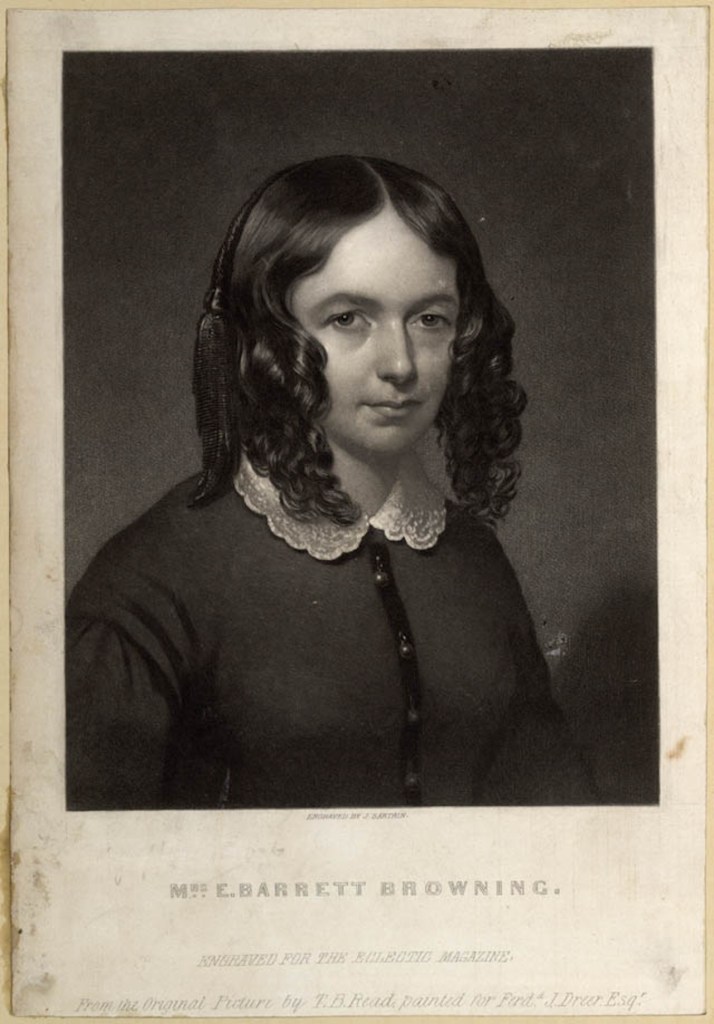
Even if the speaker is obviously delving into her own feelings and situation, such as Elizabeth Barrett Browning’s Sonnets from the Portuguese, it remains more accurate to refer to the speaker of the poem as “the speaker” rather than “the poet,” “Elizabeth,” or “Barrett Browning.”
Speaking through Characters
Often poets may claim that their poems are their children; thus, it is important to keep in mind that children and their parents are not the same. Children may, and often do, hold very different ideas, beliefs and attitudes from those of their parents. A poem’s speaker may profess very different attitudes from the poet who wrote that speaker into existence—many times for that exact purpose.
Even though poets are close to their poems, they may not always place biographical information in their poems. Poets may not always reveal their exact beliefs in their poems. Like playwrights, poets usually create characters through which they speak in their poems.
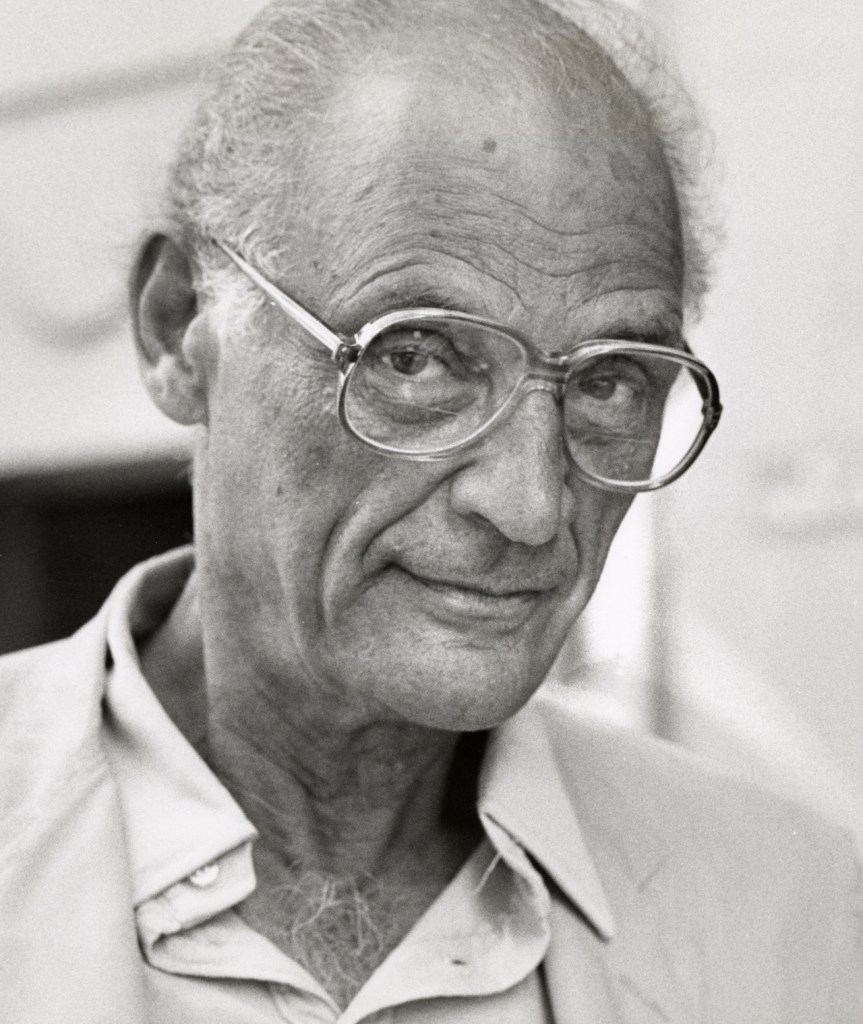
Arthur Miller during Paddy Chayefsky’s Funeral at Riverside Memorial Chapel in New York City, NY, United States. (Photo by Ron Galella/WireImage)
Readers are not likely to confuse the characters in a play with the playwright. Thus, no one would make the mistake of thinking that Willie Loman, the character in Arthur Miller’s Death of a Salesman, is Miller himself. Miller has explained that the Loman character is, in fact, based on the experiences of one of Miller’s uncles.
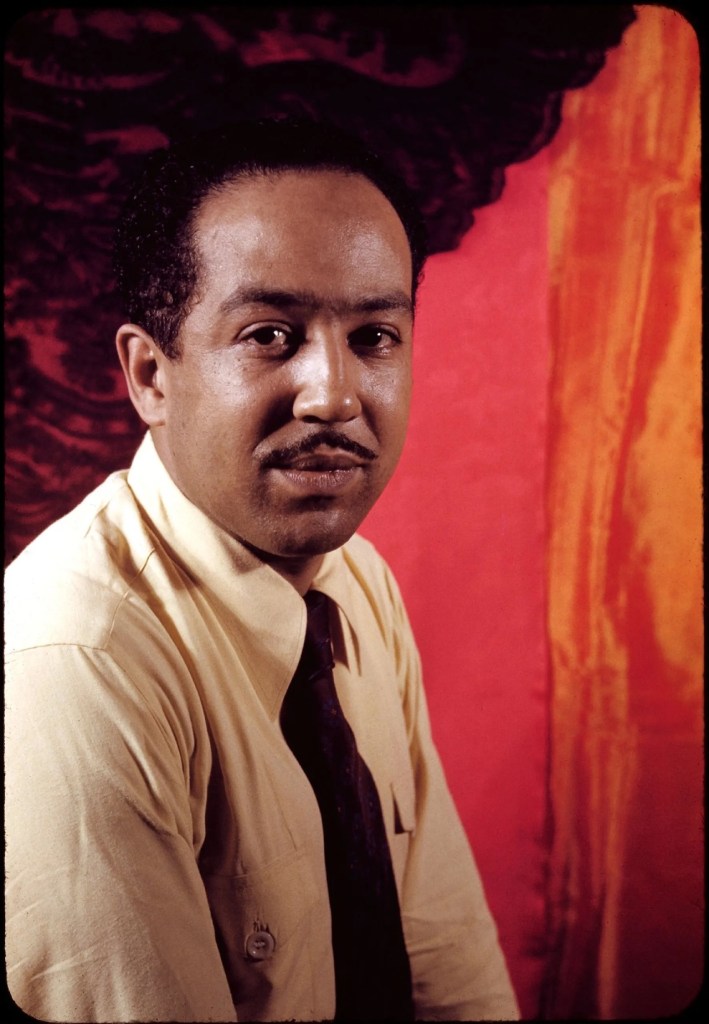
Image d: Langston Hughes – Carl Van Vechten – The New Yorker
Yet because Langston Hughes has written in his poem titled “Cross,” “My old man is a white old man / And my old mothers black,” readers often surmise that Langston Hughes himself had a white father and a black mother. Both of Hughes’ parents, however, were black. Hughes has created a character in his poem, just as Arthur Miller created Willie Loman in his play.
The Speaker’s Voice
While discussing a poem, the reader is always on more solid ground if he refers to the person vocalizing the words as “the speaker,” instead of “the poet.” A poet can give his character any ideas or beliefs that are necessary for the execution of the poem’s purpose. According to Anna Story, discussing this issue in “How to Tell Who the Speaker Is in a Poem,”
The speaker is the voice or “persona” of a poem. One should not assume that the poet is the speaker, because the poet may be writing from a perspective entirely different from his own, even with the voice of another gender, race or species, or even of a material object. [1]
In his poem “Cross,” Langston Hughes explores the idea of how an individual of mixed race might feel. So he created a mixed race character and let him speak. Hughes, himself, cannot be testifying as to how that person feels, because he does not actually have the experience himself. But he is perfectly capable of exploring the idea, the “what if” situation that poets engage in quite often.
A Caveat: Observation vs Inner Sturm und Drang
Langston Hughes’ “Cross” would likely have been a better poem had he not chosen to engage the first person. Some issues simply cry out for authenticity that speculation of this kind cannot provide.
Hughes’ message could have remained somewhat similar, but he would have avoided the twofold issue that he would be mistaken for a mixed race individual and that the plight of the speaker remains under a cloud of doubt.
Image e: Emily Dickinson – Amherst College – Daguerrotype of the poet at age 17, circa 1847 – likely the only authentic, extant likeness of the poet
That fact does not detract from what other poets have achieved in their character creation. For example, Emily Dickinson assumes the persona of adult male to express the experience of “There’s been a Death, in the Opposite House,” and her portrayal remains genuine.
Unlike Hughes’ “Cross,” Dickinson’s speaker is reporting on an observation, not a deeply felt inner turmoil. Whether the speaker in Dickinson’s poem were a boy or a girl at the time of the observation matters very little, but if the poem had delved into deep seated feelings that the observation caused, it would have been less authentic to speak through the opposite sex.
Inner turmoil can be very differently experienced depending on the sex of the individual. As Paramahansa Yogananda has explained, females are guided more by feeling and males by reason; although both sexes possess both feeling and reason. In postlapsarian humanity, those qualities need to regain their balance and unity [2].
Exploration and Creativity
Poets, as well as novelists and playwrights, often explore feelings and thoughts and situations that they have not personally experienced. They often explore and dramatize beliefs that they do not necessarily hold.
For this reason, it is always safer to assume that the poet is creating a character rather than merely testifying, that he is exploring ideas rather than merely elaborating his own beliefs, thoughts, or feelings.Even though the poet may, in fact, be testifying and issuing her own beliefs, thoughts, or feelings, it is still more accurate and safer to assume that the poem is being spoken by a character, rather than by the poet.
This room in my literary home holds links to poems primarily written by others along with my personal commentaries on the poems. Some of these additions include commentaries that appear on HubPages.
Image: Emily Dickinson – Amherst College – Daguerrotype of the poet at age 17, circa 1847 – likely the only authentic, extant likeness of the poet
Life Sketch of Emily Dickinson
Dickinson lived a solitary life that in many ways paralleled that of a religious monastic. She passed her life in quiet contemplation, becoming addicted to creating little dramas resulting in her fascicles of 1775 poems, with subject matter ranging from flowers to the concept of immortality.
Nineteenth-Century American Poet
Emily Dickinson may be the most famous American poet of the nineteenth century. Her poems focus on a number of topics—some considered her “flood subjects”—including death, philosophy of life, immortality, riddles, birds, flowers, sunsets, people, and many others.
She fashioned little manuscripts—bundles of poems called “fascicles”—totaling 1775 poems, and enough letters to result in three published volumes [1]. Her active mind and mystical intuition [2] led her to pen some of the most brilliant poetry ever written, well-crafted and filled with insight into nature, humanity, and even scientific subjects.
Her poem “The Brain — is wider than the Sky” demonstrates a deep understanding of the nature of the human mind in its relationship to the Ultimate Reality (God). This poem dramatizes a spiritual truth: the human brain is the seat of ultimate wisdom.
In yoga philosophy, the highest center of consciousness is the “thousand-petaled lotus” in the brain. The lotus is the flower metaphorically representing the opening of the center of consciousness upon God-union, a state in which the human soul unites consciously with the Over-Soul (God).
In Autobiography of a Yogi, Paramahansa Yogananda, “Father of Yoga in the West,” explains,
The seventh center, the ‘thousand-petaled lotus’ in the brain, is the throne of the Infinite Consciousness. In the state of divine illumination, the yogi is said to perceive Brahma or God the Creator as Padmaja, ‘the One born of the lotus’. [3]
While it is not likely that Dickinson studied any form of yoga, nor that she was even acquainted with the Bhagavad Gita, which was just being introduced in America during her lifetime, her insight into certain concepts suggests that she possessed an extraordinary mental gift.
A contemporary of Dickinson’s, the philosopher Ralph Waldo Emerson, had studied Eastern philosophy, including the Gita, and he had some knowledge of the Vedas. But Dickinson’s awareness came from pure intuition on her part.
Emily Dickinson’s quiet, solitary life resembled in many ways that of a cloistered monastic; she has even been referred to as the “Nun of Amherst” [4]. Biographers have described her life as reclusive, even hermit-like. She employed her hours and minutes, studying scripture, becoming well-versed in Judeo-Christian biblical lore and concepts.
As a child and young adult, the poet had attended church with her parents and siblings. Later in her life, she chose to cloister herself, which resulted in the development of her mystical powers.
She paid her close attention to the details of nature including birds, flowers, and the transitioning of the seasons. She also observed closely the visitors to her family home, but as time wore on, she seldom met with them on a personal level.
During her monastic period of life, Dickinson engaged in the contemplation of important questions, such as the purpose of life, how human beings should live, and above all how they should worship.
Thus, Dickinson choose to live a reclusive life, avoiding social activities as much as possible. Her reclusiveness extended to her decision to “keep the sabbath” by staying home instead of attending church services.
Dickinson created a speaker who explores that decision in her poem, “Some keep the Sabbath going to Church”:
Some keep the Sabbath going to Church – I keep it, staying at Home – With a Bobolink for a Chorister – And an Orchard, for a Dome –
Some keep the Sabbath in Surplice – I just wear my Wings – And instead of tolling the Bell, for Church, Our little Sexton – sings.
God preaches, a noted Clergyman – And the sermon is never long, So instead of getting to Heaven, at last – I’m going, all along.
Reading of “Some keep the Sabbath going to Church”
This poem celebrates and emphasizes the belief held by “the nun of Amherst” that merely by staying home and worshipping, she could go to heaven all along instead of waiting.
In this poem, the speaker renders God’s creations, not those of mankind’s, the instruments of worship—a bird serves the position of the choir director, and fruit trees serve as the roof of her church. As a worshiper, she wears her metaphorical “wings” instead of a church sanctioned garment.
And the most impressive part of this speaker’s “church service” is that God is doing the preaching, delivering short sermons, which offer the worshiper more time to meditate, instead of merely listening to the learned words delivered by the customary clergyman.
No Death for the Soul
Emily Dickinson became deeply interested in pursuing the knowledge about what happens to the human soul after death. Whenever she heard of a death, she was very eager to hear what the dying person said or did while in the process of dying—that is, while the soul is in the process of transitioning out of the physical encasement (body).
As Dickinson’s eight-year-old nephew Gilbert, son of her brother Austin, lay dying, she heard him utter words suggesting to her that the boy’s soul was a being escorted from its physical encasement by angels.
Dickinson’s study of death and dying led her to believe in the concept of immortality, a topic often referred to as her “flood subject.” Her poem “Because I could not stop for Death” represents her conclusion about dying.
The speaker in this little drama portrays death as a gentleman caller, arriving to escort a lady out for the evening; the journey symbolizes the idea that one’s life passes before one’s gaze during the process of dying.
But she quickly passes over the final cemetery scene, and the conflation of time seems like a dream, as the speaker reports that she is still riding with the “Horses’ Heads” “toward Eternity.”
Dickinson believed in immortality more certainly than most of the other conventionally religious members of her generation did. Her intense studies and contemplations surely led to meditation on the Creator (God). Her insights into life and immortality cannot be explained any other way.
Emily Elizabeth Dickinson was born on December 10, 1830, in Amherst, Massachusetts, to Edward Dickinson and Emily Norcross Dickinson. Emily was the second child of three: her older brother Austin was born April 16, 1829, and her younger sister Lavinia was born February 28, 1833. The poet died on May 15, 1886.
The Dickinson New England heritage was strong, including her paternal grandfather, Samuel Dickinson, who was one of the founders of Amherst College.
Her father was a lawyer, who was elected to and served one term in the state legislature (1837-1839); later between 1852 and 1855, he served one term in the U.S. House of Representative as a representative of Massachusetts.
Education
Dickinson attended elementary school in a one room building until she was sent to Amherst Academy, which later became Amherst College. The school boasted the ability to offer college level courses in the sciences from astronomy to zoology.
The poet enjoyed her school years, and her poems testify to the skill with which she mastered the academic lessons.
After a seven year stint at Amherst Academy, she then entered Mount Holyoke Female Seminary in the fall of 1847, remaining at the seminary for only a year.
Much speculation abounds regarding the poet’s early departure from formal education—from the atmosphere of religiosity at the school to the simple fact that the seminary could offer nothing new or important for the sharp minded Dickinson to learn.
Dickinson was quite content to leave formal education in order to stay home. Likely her reclusiveness was beginning, and she felt deeply the need to control her own learning. She was convinced she had to ability to schedule her own life activities.
As a stay-at-home daughter in 19th-century New England, Dickinson was expected to tackle her share of domestic duties, including housework, likely to help prepare said daughters for handling their own homes after marriage.
It is likely that the poet quite early discerned that her life would not be the traditional one of a householder; she has even suggested as much in a letter to her friend Abiah Root: “God keep me from what they call households.”
Spiritual Reclusiveness
In her householder-in-training position, however, Dickinson especially disdained the rôle as host to the many guests visiting the family. Her father’s position in community service required his family to entertain often.
The poet/mystic found such entertaining mind-boggling, and all that time spent with others meant less time for her own creative, more rewarding, efforts. By this time in her life, she was surely discovering the joy of soul-discovery through her art.
Although many have speculated that Dickinson’s dismissal of and aversion to the prevailing religious metaphor suggested that she embraced atheism, quite the opposite is evident as her poems testify to her deep spiritual awareness that far exceeds the religious rhetoric of the period.
In fact, Dickinson was, no doubt, discovering that her intuition about all things spiritual demonstrated an sensitivity that far exceeded that of any of her family’s and compatriots’ abilities. Thus, her focus became her poetry—her main interest in life.
Emily Dickinson’s life of poetry remains the focus of many researchers, and much speculation still abounds regarding some of the most known facts about her.
For example, after the age of seventeen, even as she remained cloistered in her father’s home, rarely moving from the house beyond the front gate, she yet created some of the wisest, deepest poetry ever produced anywhere at any time.
Dickinson’s works, however, reflect a journey to understand the human heart and mind—not necessarily the worldly ways of humanity.
Regardless of Emily’s personal reasons for living nun-like, readers continue to find much to admire, enjoy, and appreciate about her poems. Though her poems often seem baffling upon first encounter, they reward those who stay with each poem and dig out the nuggets of wisdom.
The difficulty with Dickinson’s poems rests in her minimalism and her unconventional grammatical/technical style. Editors who have tried to regularize her unorthodox scribbling have, however, only managed to lose some of her nuanced meanings.
Publication
Only a handful of Dickinson’s poems appeared in print during her lifetime; it was only after her death that her sister Vinnie discovered the bundles of poems, called fascicles, in the poet’s room. A total of 1775 individual poems have since that time made their way to publication.
The first publications of her works to appear were gathered and edited by Mabel Loomis Todd, a supposed paramour of the poet’s brother Austin, and the editor Thomas Wentworth Higginson.
Unfortunately, Todd and Higginson altered Dickinson’s unique works to the point of changing the meanings of her poems. Even the regularization of her technical achievements with grammar and punctuation erased some of the high achievement that the poet had so creatively accomplished.
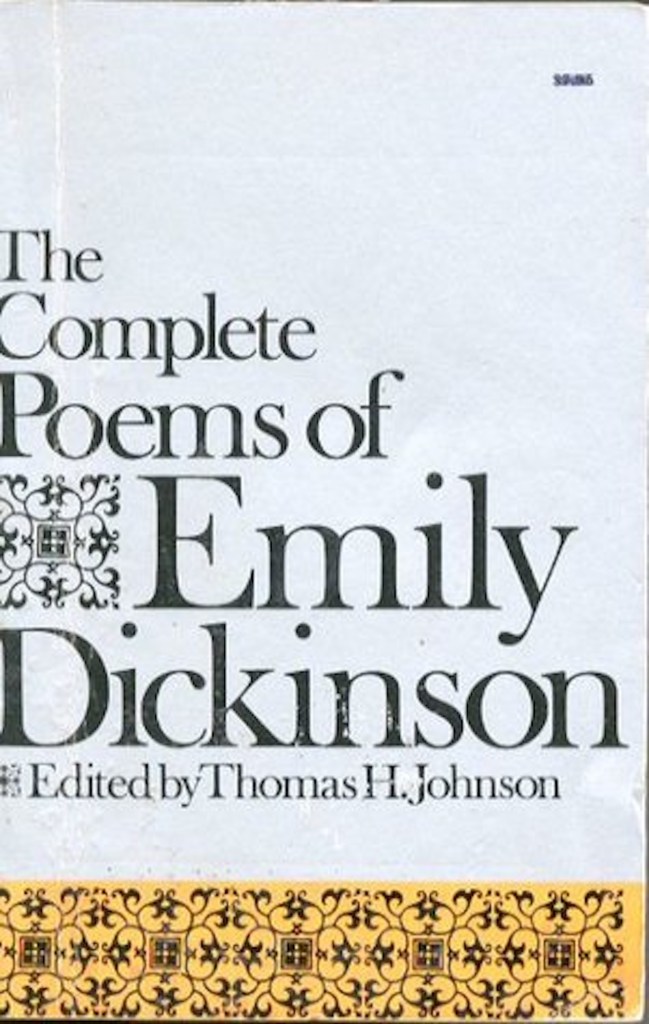
Readers can thank Thomas H. Johnson [5], who in the mid-1950s went to work at restoring the poet’s poems to their original—at least near— original forms.
Johnson’s valuable work restored Dickinson’s many dashes, spacings, and other grammar/mechanical features that earlier editors had “corrected” for the poet—corrections that actually resulted in the obliteration of the poetic achievement reached by Dickinson’s mystically brilliant talent.
Sources
[1] Richard B. Sewall. The Life of Emily Dickinson. Farrar, Straus, Giroux. New York. 1987. Print.
This room in my literary home holds links to poems written by Emily Dickinson along with commentaries on the poems.
Poems with Commentaries
Please note: Emily Dickinson did not provide titles to most of her 1,775 poems; therefore, each poem’s first line becomes the title in commentaries. According to the MLA style guidelines, “When the first line of a poem serves as the title of the poem, reproduce the line exactly as it appears in the text.” Thus I have kept Dickinson’s idiosyncratic use of capital letters and punctuation in her first lines, which serve as titles.




 Linda's Literary Home
