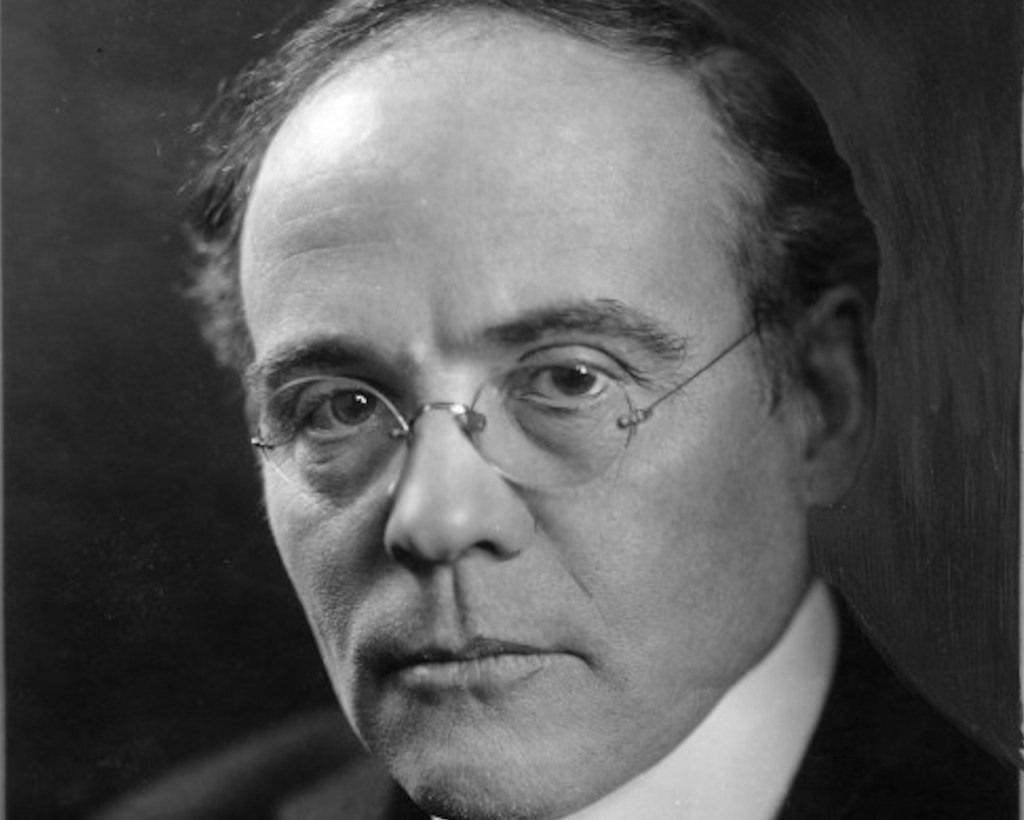
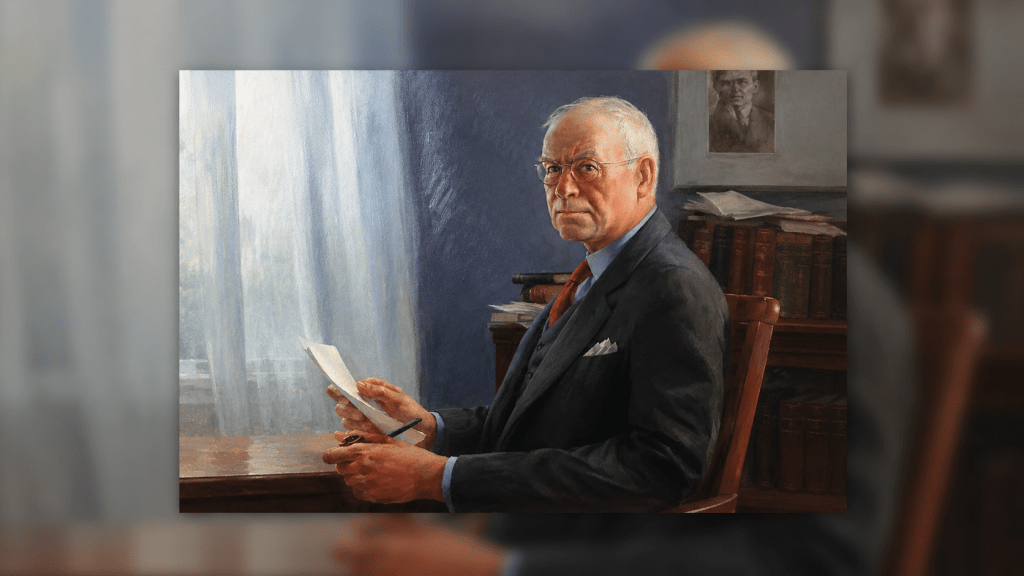
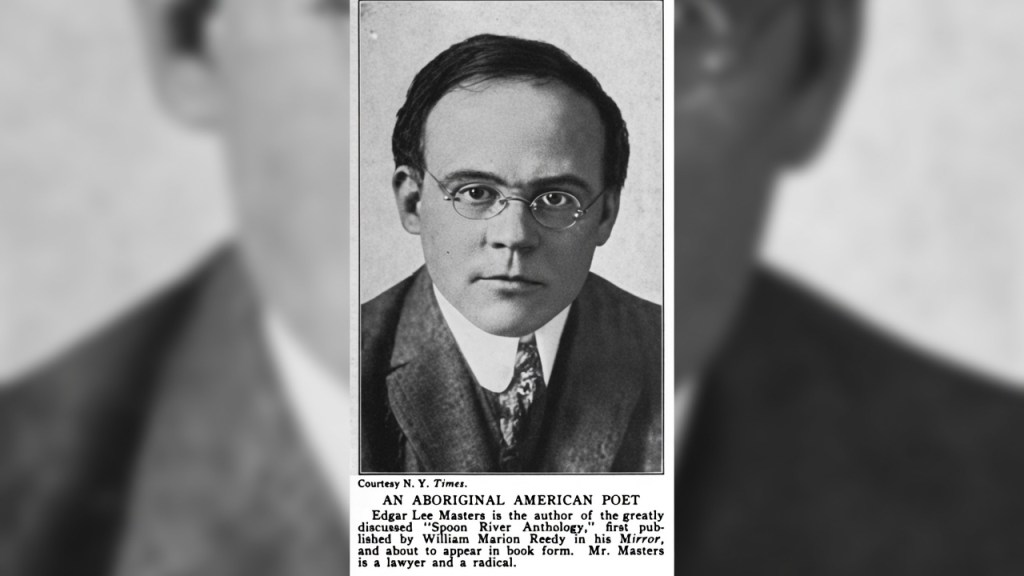
The character, Willard Fluke, is spared an ignominious confession but at a great price.
Introduction and Text of “Willard Fluke”
Edgar Lee Masters’ “Willard Fluke” from his American classic Spoon River Anthology is the name of the father of “Lois Spears,” the blind woman whose simple purity serves as a welcome cleansing after interacting with the many unsavory speakers the reader meets in this anthology.
Willard Fluke
My wife lost her health, And dwindled until she weighed scarce ninety pounds. Then that woman, whom the men Styled Cleopatra, came along. And we—we married ones All broke our vows, myself among the rest. Years passed and one by one Death claimed them all in some hideous form, And I was borne along by dreams Of God’s particular grace for me, And I began to write, write, write, reams on reams Of the second coming of Christ. Then Christ came to me and said, “Go into the church and stand before the congregation And confess your sin.” But just as I stood up and began to speak I saw my little girl, who was sitting in the front seat— My little girl who was born blind! After that, all is blackness!
Commentary on“Willard Fluke”
The character, Willard Fluke, is spared an ignominious confession but at a great price.
First Movement: The Sick Wife
My wife lost her health, And dwindled until she weighed scarce ninety pounds. Then that woman, whom the men Styled Cleopatra, came along. And we—we married ones All broke our vows, myself among the rest.
Willard begins by reporting about his wife, who “lost her health.” His wife lost so much weight that she “weighed scare ninety pounds.” Willard does not reveal the nature of his wife’s affliction—just that this loss of her health apparently triggered breaking of his marital vows, after “that woman, whom the men / Styled Cleopatra, came along.”
Along with the other men, Willard succumbs to temptation with the woman they “styled Cleopatra.” He allows the reader to draw the appropriate conclusions about the temptress because his only point is that he sinned through his weakness.
Second Movement: Time Flies
Years passed and one by one Death claimed them all in some hideous form, And I was borne along by dreams Of God’s particular grace for me, And I began to write, write, write, reams on reams Of the second coming of Christ.
Time fled by as it is wont to do, and all the men involved with the cleopatrian temptress died one by one in “some hideous form.” Willard was strangely motivated to write about “the second coming of Christ.” He wrote “reams on reams.” Spurred on by guilt, trying desperately to save his soul, he used his writing is an alternative to meditation.
Willard stresses that he was “borne along by dreams / Of God’s particular grace for [him].” Because he placed his mind so squarely on God, he was motivated to write those reams. His dreaming and writing served him as a form of worship.
Third Movement: A Visitation
Then Christ came to me and said, “Go into the church and stand before the congregation And confess your sin.”
Through Willard’s concentration on God’s grace and intense relationship with Christ in writing about the second coming, Willard so prepared his soul for a visit from the Savior.
When Christ did honor Willard with a visitation, the Savior advised Willard to “confess [his] sin” “before the congregation.” Willard was admonished to stand before the entire church and admit his sin.
The reader will note that Willard says “sin”—not sins. This designation indicates that it is only the one adulterous sin that has rifled his life—only that one sin that motivated him to concentrate on God and write reams for Jesus. It, of course, was a great sin, and Willard has taken it very seriously as tries to wipe it from his karma.
Fourth Movement: Delivered by Death?
But just as I stood up and began to speak I saw my little girl, who was sitting in the front seat— My little girl who was born blind! After that, all is blackness!
Willard attempts to obey Christ’s demand that he confess before the church; however, as Willard stands and begins to speak, he sees Lois, his little girl, “who was born blind!” At that point, we lose Willard, who simply reports, “After that, all is blackness!”
The reader may understand only that Willard fainted before he was able to confess. But then the reader is left wondering if Willard also died at this point. The possibility is great because Willard obviously has taken on guilt for Lois’ blindness. He has suffered for a lifetime, and quite possibly his heart just gave out before he could confess.
If Willard did die at this point, the reader may interpret his death as God’s mercy because Willard did not have to endure the ignominy of confessing his sin to the church but was spared just as Abraham was spared of sacrificing his son, Isaac; that confession would have hurt his little blind daughter, but she, too, was spared.
Unbuckled pride strains credulity On cinder blocks in the rain— Profit the man of steel Whose chalk mentality scratches Gold flecks of a summer night. Blank as the dank posted willows That slum the crum tide leeching The verbiage of metaphor walking Like sticks stuck down by the tracks.
In the brain waves of goats, they look For crystalline stalactites, But thiamine quelled the stretch As the Man of Steel hovered The neighborhood and plunged Into the hypocrisy of postmodern wit. Narrowing a brow, lifting a finger, Touting the untoutable, scraping The wilderness out of a circus town.
Night closes ultimately and Whimsy may fade But Dr. Frankenstink will cozy up to her lost foot As long as grapevines tangle on the waste land. Neither past nor future calls his name, and no island Brings comfort as much as departure without infamy. He left no logical heir to fan the flames of his poetry— That dust-drilled style of poetry that everybody reads Until morning echoes in the bottom of a bucket. Run on, Soul of the Man of Steel, to heaven’s loft.
Image: Emily Dickinson – Amherst College – Daguerrotype of the poet at age 17, circa 1847 – likely the only authentic, extant likeness of the poet
Emily Dickinson’s “A little East of Jordan”
Emily Dickinson’s “A little East of Jordan” dramatizes the speaker’s retelling of Jacob’s wrestling match with the angel, transforming a familiar Genesis episode into a study of stubborn, victorious will.
Introduction and Text of “A little East of Jordan”
In “A little East of Jordan,” the speaker reimagines the KJV Genesis 32: 1–32 wrestling match between Jacob and the angel as an athletic contest, casting the angel as a “Gymnast” who ultimately loses to the mortal’s persistence. The speaker’s playful diction transforms sacred narrative into a witty demonstration of the power of unyielding will.
A little East of Jordan
A little East of Jordan, Evangelists record, A Gymnast and an Angel Did wrestle long and hard –
Till morning touching mountain – And Jacob, waxing strong, The Angel begged permission To Breakfast – to return –
Not so, said cunning Jacob! “I will not let thee go Except thou bless me” – Stranger! The which acceded to –
Light swung the silver fleeces “Peniel” Hills beyond, And the bewildered Gymnast Found he had worsted God!
Commentary on “A little East of Jordan”
The speaker recasts a solemn biblical account as a spirited contest, using wit to explore how persistence itself becomes a spiritual discipline capable of overturning even divine resistance.
First Stanza: “A little East of Jordan”
A little East of Jordan, Evangelists record, A Gymnast and an Angel Did wrestle long and hard –
The speaker opens by locating the scene precisely, “a little East of Jordan,” grounding a supernatural encounter in geography familiar to any reader of scripture. The phrase “Evangelists record” signals that the speaker relies on inherited testimony rather than firsthand witness.
Naming the angel a “Gymnast” is the speaker’s first great irreverence. The lofty biblical wrestler becomes an athlete, a figure of muscle and technique rather than pure spirit. This diction lowers the encounter to human scale even while its outcome remains cosmically divine.
The verb “wrestle” and the adverbial pairing “long and hard” emphasize duration and effort. The speaker insists that this contest was no brief skirmish but a sustained trial, foreshadowing that endurance, not strength alone, will determine the victor.
Paramahansa Yogananda explains that persistence carries its own guarantee of fulfillment: “When you persist, refusing to accept failure, the object of will must materialize.” Jacob’s marathon struggle embodies this very principle of sustained, unrelenting will.
In my earlier essays on Dickinsonian poems, I have discussed the speaker’s habit of privileging inner evidence over public display, a habit already visible here in her quiet trust that private struggle yields real spiritual gain.
Second Stanza “Till morning touching mountain”
Till morning touching mountain – And Jacob, waxing strong, The Angel begged permission To Breakfast – to return –
The stanza opens with a striking image, morning itself “touching mountain,” as though dawn were a physical presence arriving to interrupt the combat. Time becomes tactile, marking the passage of an entire night spent in struggle.
Jacob, meanwhile, is “waxing strong,” a phrase borrowed almost directly from scripture yet given new emphasis by the speaker’s placement. Rather than weakening under supernatural assault, the human contestant grows more powerful as the hours pass.
The reversal culminates in the angel’s request: it “begged permission / To Breakfast – to return.” The heavenly being now pleads with the mortal, reduced to requesting release for so mundane a purpose as a meal.
This comic deflation, an angel wanting breakfast, allows the speaker to needle at solemn religious authority while never abandoning the story’s essential gravity. The sacred and the domestic collide, and neither cancels the other.
The speaker’s contemplative musing on this exchange suggests that true power resides not alone in supernatural station but in the will to endure until dawn, a lesson equally applicable to any poet’s own persistent labor.
Third Stanza: “Not so, said cunning Jacob!”
Not so, said cunning Jacob! “I will not let thee go Except thou bless me” – Stranger! The which acceded to –
Jacob’s refusal arrives as direct speech, the poem’s only moment of quoted dialogue. Calling him “cunning” credits the patriarch with strategy rather than mere stubbornness; he recognizes leverage and refuses to relinquish it.
The demand “I will not let thee go / Except thou bless me” reproduces the biblical ultimatum nearly verbatim, yet the speaker’s surrounding commentary, calling the angel “Stranger,” reminds readers that Jacob himself does not yet know with whom he grapples.
That the angel simply “acceded” without further struggle marks the turning point. Divine resistance yields not to force but to a condition, a bargain struck between unequal parties in which the lesser somehow commands the terms.
The speaker’s compression here, four short lines carrying the whole negotiation, mirrors the suddenness of surrender itself. What took a night to accomplish through physical struggle resolves in a single spoken sentence.
Such a bargain illustrates a spiritual economy in which blessing must be actively claimed rather than passively awaited, a principle the speaker elsewhere applies to the poet’s own claims upon poetic immortality.
Fourth Stanza: “Light swung the silver fleeces”
Light swung the silver fleeces “Peniel” Hills beyond, And the bewildered Gymnast Found he had worsted God!
The final stanza opens with an image of dawn clouds, “silver fleeces” swinging with light, a pastoral softness that contrasts sharply with the night’s violence. Nature itself seems to exhale after the long contest concludes.
Naming “Peniel” anchors the scene to its scriptural source, the place where Jacob declares he has seen God face to face. The speaker trusts her reader to recognize the allusion without further explanation, letting the place-name carry its full theological weight.
The angel returns as “bewildered Gymnast,” a phrase that closes the poem’s athletic conceit even as it reveals the being’s astonishment. Losing was never anticipated; the contest’s outcome upends the expected hierarchy between mortal and messenger.
The closing line, “Found he had worsted God,” delivers the poem’s central audacity. The speaker allows the possibility that Jacob’s opponent was divinity itself, and that a mortal, through sheer refusal to release his grip, defeated that divinity.
In my earlier essays on Dickinsonian poems, I have discussed the speaker’s fondness for such theological daring, moments where scripture becomes raw material for testing the boundaries between human will and heavenly authority.
The poem finally suggests that blessing is not simply granted from above but wrested through persistent, even cunning, engagement, a conclusion the speaker offers with characteristic wit rather than solemnity.
Dispelling Postmodern Critical Misreading of Dickinson’s “A little East of Jordan”
Postmodern critics like to argue that Emily Dickinson’s poetry exhibits atheistic tendencies that match their own. Some mask that their claim by calling her “pagan” even using her own hyperbolic and metaphoric claims for support. Others use equally fabulous reasoning to spout their misunderstanding, such as the following exampleshereandhere.
Emily Dickinson’s “A little East of Jordan” is not an atheist text; it is a vivid dramatization of intimate, embodied encounter between the human and the divine.
Far from denying God’s reality or relevance, the poem insists on the nearness of God to His struggling children and on the possibility that persistent human will can wrest blessing from that nearness.
The poem retells KJV Genesis 32: the night-long wrestling of Jacob with the mysterious figure who is finally recognized as God (or God’s messenger). Dickinson’s speaker does not demythologize the episode or reduce it to psychology.
She keeps the biblical geography (“A little East of Jordan”), the scriptural testimony (“Evangelists record”), the place-name Peniel, and the decisive demand for blessing.
The diction is playful—“Gymnast,” “Breakfast,” “cunning Jacob,” “bewildered Gymnast”—but the playfulness is the Dickinsonian mode of seriousness: she lowers the sublime just enough to make the encounter tactile and human-scale without emptying it of its theological weight.
An atheist reading that seizes on the final line (“Found he had worsted God!”) as evidence of divine defeat or absence simply misreads the tone and the tradition. In the biblical narrative, and in Dickinson’s recasting of it, Jacob does not overthrow God; he clings until God yields a blessing.
The “worsting” is the paradoxical victory of the lesser over the greater that is possible only because the greater has drawn near and allowed itself to be held. As Paramahansa Yogananda explains, God can be captured by love.
That nearness is the poem’s central affirmation. Jacob does not pray at a distance or receive an abstract revelation. He grapples through the night with a bodily presence; dawn itself becomes a participant (“morning touching mountain”); the angel must ask permission to leave.
And the human will refuses release “Except thou bless me.” The divine is not remote, impersonal, or optional. It is close enough to be seized, resisted, and finally forced into a covenant of blessing.
Dickinson’s Jacob is “cunning” and “waxing strong,” yet the strength is exercised against and with the divine antagonist. The outcome is not the vanishing of God but the disclosure that God can be engaged, that blessing is not merely bestowed from on high but can be claimed in the struggle itself.
This situation produces a belief system that remains the opposite of atheism. Atheism declares there is no one to wrestle with. Dickinson’s poem shows a God so present that a mortal can refuse to let Him go.
In my commentary on this poem, I have noted the poem’s transformation of solemn narrative into athletic contest and its interest in “stubborn, victorious will.” That will, however, is not autonomous or self-sufficient; it operates inside a relationship that the poem never dissolves.
The angel’s bewilderment and the final recognition that the opponent was God do not mock divinity; they underline the astonishing intimacy of the encounter.
Dickinson’s characteristic theological daring—treating scripture as living material rather than sealed authority—does not erase God; it tests the boundaries of human access to Him and finds those boundaries permeable.
Persistence becomes a spiritual discipline precisely because there is a real Divine Presence against which (and with which) persistence can act.
In short, the poem does not argue that God is absent or irrelevant. It stages the closeness of God to His fallen children: a God who can be met in the dark, held until morning, and compelled by human tenacity to bestow a name and a blessing.
That belief system is not atheism, agnosticism, or even paganism. It is a fierce, witty, and deeply theistic vision of divine-human encounter that expresses deep spiritual conviction that God is real and knowable.
Some dreams signal ghastly deeds In past lives; likely, we prefer Not to be reminded. The exorcism Of karmic fire offers the only cleansing.
Some dream ghosts you grasp: your mother’s Broken heart healed, your public nakedness, robbers Breaking down the door.
But this one recurs and baffles your equilibrium. It is an invasion corrupting your private heart: The one who baffles you
Is neither a father nor a God figure, Just a former acquaintance you never knew well And never touched (at least in this life).
Nor do you touch in the dream, except innocently, Informally, though some strong emotion seems to float Beneath the surface of dream skin.
In your society of thoughts, you flesh out reasons For this intrusion: a past life, too dim to remember, Gives the only succor, as you await enlightenment.
Trying to neutralize resentment, jealousy, or betrayal, Your subconscious may be accusing, judging, condemning, But for what you remain unaware.
Each visit of the form reshapes your conscience And the day crawls on its belly: You feel a sick-sweet love
Coiling and spurning itself until you forget again And get on with other details, but give it days or weeks And the phantom reappears.
It begs exorcism: Burning karmic seeds to release The ghost in smoke. You hope this specter is free of you— You prefer to think this aberration is yours alone.
Original poem appearing in my collection titled “Turtle Woman & Other Poems” under the title “Aberration”
The epitaph and character of “Lois Spears” will delight readers who have grown somewhat jaded with the jaded characters offered them in Masters’ Spoon River Anthology.
Introduction and Text of “Lois Spears”
Edgar Lee Masters’ “Lois Spears” from American classic Spoon River Anthology surprises readers with its simple purity. The many complaints from those who pursued lives on the seamy side and then tried to blame others for their misfortunes resonant with such volume that encountering a soul such as Lois provides a shock albeit a pleasant one.
This poem features only three movements. The first movement’s opening sounds as if a third party is reporting for Lois, but then it becomes clear that it is Lois speaking in the last parenthetical line.
It is also important to note that the information in the parenthetical is deemphasized, though for the world it is of great moment. The second movement finds Lois proclaiming herself “the happiest of women,” while the third and final movement reveals the reason for her height of happiness.
Lois Spears
Here lies the body of Lois Spears, Born Lois Fluke, daughter of Willard Fluke, Wife of Cyrus Spears, Mother of Myrtle and Virgil Spears, Children with clear eyes and sound limbs— (I was born blind). I was the happiest of women As wife, mother and housekeeper, Caring for my loved ones, And making my home A place of order and bounteous hospitality: For I went about the rooms, And about the garden With an instinct as sure as sight, As though there were eyes in my finger tips— Glory to God in the highest.
Commentary on “Lois Spears”
Edgar Lee Master’ epitaph “Lois Spears” will be a welcome delight to readers who have grown somewhat annoyed with the jaded characters offered them in the American classic Spoon River Anthology.
First Movement: Official Announcement
Here lies the body of Lois Spears, Born Lois Fluke, daughter of Willard Fluke, Wife of Cyrus Spears, Mother of Myrtle and Virgil Spears, Children with clear eyes and sound limbs— (I was born blind).
Lois begins her report with a rather official sounding declaration, “Here lies the body of Lois Spears.” She continues by identifying herself further with her maiden name, “Lois Fluke,” and that she was the “daughter of Willard Fluke.”
The significance of her maiden name becomes apparent as the reader encounters the strange, delightful character she exhibits. She is, indeed, a fluke of nature, especially when found among the many disingenuous and shady characters of Spoon River.
Lois further defines her identity by stating that she was the wife of “Cyrus Spears, / Mother of Myrtle and Virgil Spears.” Her children, she is no doubt happy to report, both had “clear eyes”—they were not born with the same affliction that their mother had to endure.
Her children, furthermore, were otherwise healthy with “sound limbs.” It is only after Lois has revealed the rudimentary biographical facts that she imparts the crucial information that she “was born blind.”
Second Movement: No Need for Pity
I was the happiest of women As wife, mother and housekeeper, Caring for my loved ones, And making my home A place of order and bounteous hospitality:
Lest her hearers begin to pity her, Lois immediately dispels the notion that she requires any by declaring herself, “the happiest of women.” She was so happy because she cared for her “loved ones” and made her home “a place of order and bounteous hospitality.”
The magnanimity of such a remark offers solace to all who have struggled with positions that they deem beneath them—the lowly housewife, who was also blind, was able to function as the happiest of women simply by nurturing and making a home for her loved ones.
Third Movement: All Glory to God
For I went about the rooms, And about the garden With an instinct as sure as sight, As though there were eyes in my finger tips— Glory to God in the highest.
In the final movement, Lois proclaims that all glory belongs to “God in the highest.” Lois was able to go about the rooms of her home and even grow a garden and claims she did so “with instinct as sure as sight.”
Lois Spears worked and achieved high accomplishments “[a]s though there were eyes in [her] finger tips.” That Mrs. Spears praises the Divine for her happy fluke of a life lifts her capital to further heights. Mrs. Lois Spears takes her rank as one of the fine, pure souls who inhabited the otherwise carping village of Spoon River.
Some dream ghosts whisk by nearly unremarkable: No broken hearts, no public nudity, no murderers Closing in on your heels, just puppies and ice cream,
While others baffle and throw you off kilter. They invade, painting you in a scene You would never have willingly entered.
Why should you couple with this one For whom you have no attraction in the light of day? Who seems to walk out of some distant past
Entering the space occupied by another— Recognized, yet unrecognized, in this dream-mare? Karma is sometimes a bitch that barks at you
And other times growls, trying to get your attention You suppose, but for what purpose? You know you have seeds to burn. You know you could
Have been coupled in a past life. But why Are you forced to revisit it now against your will? Oh, you do know dreams come to you against your will.
You may enjoy some, scorn others; still, they come Spewing forth from the old memory hole. Life is a series of lessons; you have learned that much
From God and experience. You can control What you do with your eyes open, but when you close them And try to rest that brain and its soldiers, you would
Have your rest be peaceful and unfettered by past Emotional, and possibly physical ties, that time And death and life again have broken—
Dr. Siegfried Iseman is the typical Spoon River speaker who blames others for his own destructive path.
Introduction and Text of “Dr. Siegfried Iseman”
The speaker in Edgar Lee Masters’ “Dr. Siegfried Iseman” from Spoon River Anthology is a disgraced physician who goes to imprison for peddling a concoction he called the “Elixir of Youth.”
Dr. Siegfried Iseman will be recognized as the typical Spoon River epitaph speaker who touts himself as a victim, as he huffs and puffs, blaming others for his own crimes on his path to self-destruction.
As scoundrels often justify their own perfidy, they not only blame others for their mishaps but they also feel an inner high-moral ground that sounds logical only to their misguided and twisted thinking.
Dr. Siegfried Iseman
I said when they handed me my diploma, I said to myself I will be good And wise and brave and helpful to others; I said I will carry the Christian creed Into the practice of medicine! Somehow the world and the other doctors Know what’s in your heart as soon as you make This high-souled resolution. And the way of it is they starve you out. And no one comes to you but the poor. And you find too late that being a doctor Is just a way of making a living. And when you are poor and have to carry The Christian creed and wife and children All on your back, it is too much! That’s why I made the Elixir of Youth, Which landed me in the jail at Peoria Branded a swindler and a crook By the upright Federal Judge!
Commentary on “Dr. Siegfried Iseman”
Dr. Siegfried Iseman is the typical Spoon River speaker who blames others for his own destructive path.
First Movement: The No-Witness Convenience
I said when they handed me my diploma, I said to myself I will be good And wise and brave and helpful to others; I said I will carry the Christian creed Into the practice of medicine!
Dr. Iseman begins his confessional by recalling that at the beginning of his entry into the profession of medicine, he promised to be a good Christian doctor. He intended to be “good / And wise and brave and helpful to others.” Even as Iseman was “handed” his diploma, these promises he mouthed to himself.
Interestingly, because the doctor had only silently “said” these things, there is conveniently no witness to his testimony. The lack of any evidence that Iseman had intended to acquit himself honorably allows him to backslide at least without others knowing about this original intentions, a fact that, no doubt, in the beginning of his moral failure gave him a sense of comfort.
Second Movement: Scoundrel Justification
Somehow the world and the other doctors Know what’s in your heart as soon as you make This high-souled resolution.
Siegfried then philosophically laments that making such a “high-souled resolution” opened him to the fraud, greed, and graft of “the world and the other doctors.” Completely without substantial support for the claim, Iseman decries the fact that they all “know” what is the heart of the man of good intentions. But this kind of conclusion is necessary when a scoundrel needs to justify his own improprieties.
Third Movement: Self-Victimized
And the way of it is they starve you out. And no one comes to you but the poor. And you find too late that being a doctor Is just a way of making a living.
Because Siegfried had made a pledge to himself to be good and noble, he became a victim of the other doctors who were not bound by such high-souled intentions. They were free to “starve [him] out.”
Because only the poor came to Dr. Iseman, he found that he could not thrive financially as the others did. Iseman’s lack of financial success ultimately led him to believe that, “being a doctor / Is just a way of making a living.” And he learned this lesson “too late”—this is, too late to change his good intentions and thus begin acting unconscionably as the others had.
Fourth Movement: The Burden of Duty
And when you are poor and have to carry The Christian creed and wife and children All on your back, it is too much!
Poor Siegfried, who remained poor, despite his medical practice became burdened by his “Christian creed” as well as by a “wife and children.” With such heavy responsibilities “on [his] back,” Iseman exclaims, “it is too much!”
Fifth Movement: It’s the Judge’s Fault
That’s why I made the Elixir of Youth, Which landed me in the jail at Peoria Branded a swindler and a crook By the upright Federal Judge!
Siegfried finally reveals that he concocted “the Elixir of Youth,” and that concoction “landed [him] in jail in Peoria.” Iseman’s reputation was ruined, and he was “[b]randed a swindler and a crook.”
He sarcastically blames “the upright Federal Judge” for his predicament. Dr. Siegfried Iseman’s testimony from the grave resembles so many other Spoon River deceased, who excuse their own behavior by claiming themselves victims of someone else.
Named for America’s first feminist writer Margaret Fuller, Mrs. Slack laments marriage and motherhood that crushed her dreams of greatness in becoming a famous writer or the next George Eliot.
Introduction and Text of “Margaret Fuller Slack”
Edgar Lee Masters’ “Margaret Fuller Slack” from his American classic Spoon River Anthology depicts a tormented woman, who believes motherhood doomed her ambition to become a great writer.
Ironically named after the first American feminist, “Margaret Fuller,” Mrs. Slack does possess the egotistical personality of her namesake, while suffering the ills that they both decry.
Margaret Fuller Slack
I would have been as great as George Eliot But for an untoward fate. For look at the photograph of me made by Penniwit, Chin resting on hand, and deep-set eyes— Gray, too, and far-searching. But there was the old, old problem: Should it be celibacy, matrimony or unchastity? Then John Slack, the rich druggist, wooed me, Luring me with the promise of leisure for my novel, And I married him, giving birth to eight children, And had no time to write. It was all over with me, anyway, When I ran the needle in my hand While washing the baby’s things, And died from lock-jaw, an ironical death. Hear me, ambitious souls, Sex is the curse of life!
Commentary on “Margaret Fuller Slack”
Named for America’s first feminist writer, Margaret Fuller, Mrs. Slack laments marriage and motherhood that crushed her dreams of greatness in becoming the next George Eliot.
First Movement: She Would Have
I would have been as great as George Eliot But for an untoward fate.
Mrs. Slack begins her tirade by proclaiming the greatness she “would have” accomplished: she “would have been as great as George Eliot.” Nevertheless, this speaker did not ascend to such a great height, because “untoward fate” stepped on her dreams.
Second Movement: A Photo of Profundity
For look at the photograph of me made by Penniwit, Chin resting on hand, and deep-set eyes— Gray, too, and far-searching.
Mrs. Slack possesses a “photograph of [herself] made by Penniwit,” an artist who later also speaks in the Spoon River Anthology. Margaret uses the photograph to support her contention that she was marked for greatness.
In the photo, she sits with her “chin resting on hand,” and she has “deep-set eyes” that are “gray” and “far-searching.” These qualities in her estimation reveal a profundity that should have allowed her to accomplish greatness, the absence of which she now laments.
Third Movement: The Age Old Problem
But there was the old, old problem: Should it be celibacy, matrimony or unchastity?
Margaret then philosophizes about the human condition, claiming the “old, old problem” is whether one should remain celibate, marry, or simply commit fornication. Mrs. Slack does not reveal how deeply she thought about those alternatives, or even if she had thought about them at all. As the speaker reminisces, she, no doubt, adds to her own self worth, by implying that she had thought and pondered those issues.
Fourth Movement: The Promise of Leisure
Then John Slack, the rich druggist, wooed me, Luring me with the promise of leisure for my novel, And I married him, giving birth to eight children, And had no time to write.
Before Mrs. Slack had the opportunity to determine which path was the right one for her to travel to fame, she found herself “wooed” by “John Slack, the rich druggist.” The druggist “lur[ed]” her by “promis[ing] [her] leisure”—time she would use to write “[her] novel.”
With this promise of leisure, Margaret married the druggist, but instead of writing, she proceeded to give birth to “eight children.” Of course, with eight children, she can fall back on the excuse that she “had no time to write.” Apparently, Mrs. Slack remained blissfully unaware that famous poet, Anne Bradstreet, created a significant body of writing while birthing and raising eight children.
Fifth Movement: Dying of Lock-Jaw, Filled with Words
It was all over with me, anyway, When I ran the needle in my hand While washing the baby’s things, And died from lock-jaw, an ironical death.
Margaret then reveals how she died, “It was all over with me, anyway, / When I ran the needle in my hand.” She met with this sad fate, while “washing the baby’s things.” She contracted “lock-jaw” and died.
Mrs. Slack finds dying of lock-jaw to be “ironical,” no doubt, because she considered herself filled with words—words unfortunately that would remain unexpressed because of the time-consuming servitude of raising a family. And, of course, in keeping with her own selfishness, she does not consider how her absence will impact the lives of the children she leaves behind.
Sixth Movement: The Urge vs the Philosophy
Hear me, ambitious souls, Sex is the curse of life!
Margaret’s final statement oversimplifies her lot but reveals her philosophical conclusion about “life” as she remarks, “Sex is the curse of life!” Readers, unfortunately, will never be able to experience the profundity of that statement because Margaret’s ambition to write was obliterated by her urge to procreate.
The pair of sonnets pays a glancing tribute to the lives of Aunt Winnie and her niece Linda Sue—two opposite personality dispositions with a few deeply ingrained temperaments in common, which tied their hearts and souls together in loving embrace.
An Intense Heart
In memoriam: Winifred Lucille Richardson Goodin December 22, 1932 – July 4, 2026
I am not now that girl of tender years, My womanhood from girlhood having grown— Roses push forth where once did dwell my tears; Daisies push up while hands have turned to stone.
An intense heart had I, my breath took flight; Now carved in stone, my name with years proclaim. Those marbled voices bound with softer might Than ever did my own out-spoken frame.
She dwells in ash, yet clutches at my core, Though I have risen past her earthly stage. Her silence tugs, yet I am hers no more— A bird slipped from the prison of her cage.
Pure skin of light is mine, not hers to keep, She decomposes, held in the big sleep.
A Quiet Soul
In memoriam futuram: Linda Sue Richardson Grimes January 7, 1946 –
I am not now that girl of tender years, My womanhood from girlhood having grown— Roses push forth where once did dwell my tears; Daisies push up while hands have turned to stone.
A quiet soul I was, my breath held tight; Now carved in stone, my name with years proclaim. Those marbled voices bound with greater might Than ever did my own soft-spoken frame.
She dwells in ash, yet clutches at my core, Though I have risen past her earthly stage. Her silence tugs, yet I am hers no more— A bird slipped from the prison of her cage.
Pure skin of light is mine, not hers to keep, She decomposes, held in the big sleep.
Image: Emily Dickinson – Amherst College – Daguerrotype of the poet at age 17, circa 1847 – likely the only authentic, extant likeness of the poet
Emily Dickinson’s “Delayed till she had ceased to know”
Emily Dickinson’s “Delayed till she had ceased to know” explores the tragic irony of fulfillment arriving only after the recipient has surrendered consciousness, while its spiritual implications echo Paramahansa Yogananda’s emphasis on inner realization, perseverance, and the danger of abandoning the search for divine fulfillment too soon.
Introduction and Text of “Delayed till she had ceased to know”
In my earlier essays on Dickinsonian poems, I have discussed the speaker’s tendency to privilege inward experience over outward appearances. In “Delayed till she had ceased to know,” the speaker turns that concern toward the painful consequences of mistimed fulfillment.
The poem presents a woman who dies only an hour before the arrival of some long-awaited joy or victory. The terrible irony is not merely that fulfillment comes too late, but that it comes so close to her death that the knowledge of its approach might have enabled her to continue living.
This idea has a meaningful parallel in the teachings of Paramahansa Yogananda, who repeatedly emphasizes that genuine fulfillment must ultimately be discovered within rather than dependent upon changing external circumstances.
From that perspective, the poem’s tragedy can be understood not simply as the loss of an earthly reward, but as the surrender of hope immediately before the possibility of fulfillment becomes apparent.
The speaker does not explicitly identify the anticipated “bliss” as divine realization, and the poem wisely leaves its nature uncertain. Nevertheless, Yogananda’s spiritual emphasis on perseverance and inner awareness provides a useful lens through which to consider the speaker’s haunting question: What if the defeated soul had known how near the victory really was?
Delayed till she had ceased to know
Delayed till she had ceased to know – Delayed till in its vest of snow Her loving bosom lay – An hour behind the fleeting breath – Later by just an hour than Death – Oh lagging Yesterday!
Could she have guessed that it would be – Could but a crier of the joy Have climbed the distant hill – Had not the bliss so slow a pace Who knows but this surrendered face Were undefeated still?
Oh if there may departing be Any forgot by Victory In her imperial round – Show them this meek appareled thing That could not stop to be a king – Doubtful if it be crowned!
Commentary on “Delayed till she had ceased to know”
Emily Dickinson’s “Delayed till she had ceased to know” examines the poignant consequences of a victory or blessing that arrives only after the person who longed for it has passed beyond the ability to receive it.
First Movement: “Delayed till she had ceased to know”
Delayed till she had ceased to know – Delayed till in its vest of snow Her loving bosom lay – An hour behind the fleeting breath – Later by just an hour than Death – Oh lagging Yesterday!
The speaker begins with the stark repetition of the word “Delayed.” The repetition immediately establishes the central grievance: something desirable was coming, but it came too late.
The woman has “ceased to know” before the anticipated joy arrives, suggesting that the tragedy involves not simply physical death but the loss of consciousness necessary to experience fulfillment.
The speaker then places the woman’s “loving bosom” within a “vest of snow.” The image of snow suggests both physical burial and emotional stillness. The warmth associated with the “loving bosom” has been overcome by the cold finality of death.
The contrast between love and snow emphasizes the gulf between the woman’s former vitality and her present condition. The precise measurement of time makes the tragedy especially painful: “An hour behind the fleeting breath – / Later by just an hour than Death –.”
The speaker could have described the reward as arriving long after the woman’s death, but instead the poem specifies “an hour.” The narrow interval intensifies the sense of missed possibility. The desired fulfillment was not impossibly distant; it was almost within reach. Death simply arrived first.
The closing apostrophe—“Oh lagging Yesterday!”—personifies the past as something capable of moving too slowly. Yesterday itself seems responsible for the delay. Time, rather than simply passing, has become an adversary that has failed the woman at the precise moment when she needed it to move differently.
From Yogananda’s perspective, the passage can also suggest the spiritual danger of allowing external circumstances to determine one’s inner state. Yogananda repeatedly taught that lasting peace and fulfillment are not ultimately dependent upon the changing conditions of the material world.
The woman, however, appears to have reached a point at which the external arrival of bliss matters desperately because she has no evidence that it is coming. The tragedy therefore lies partly in the absence of inward assurance.
If the soul could remain convinced of an approaching fulfillment even when outward circumstances offered no confirmation, surrender might be postponed. The first movement thus establishes the poem’s fundamental irony: fulfillment was not necessarily impossible; it was simply not known to be coming before death intervened.
Second Movement: “Could she have guessed that it would be”
Could she have guessed that it would be – Could but a crier of the joy Have climbed the distant hill – Had not the bliss so slow a pace Who knows but this surrendered face Were undefeated still?
The second movement shifts from certainty about death to speculation about what might have happened differently. The speaker asks whether the woman could have survived if she had somehow known that joy was approaching.
The image of a “crier of the joy” is especially significant. A crier is a herald, someone who announces important news before the event itself occurs. The speaker imagines such a messenger appearing on a distant hill, carrying evidence that fulfillment is approaching. The joy itself might still be far away, but knowledge of its arrival could have provided the hope necessary to endure.
The distance of the hill is important as well. The messenger is not yet at the woman’s side. The desired event remains separated from her by space and time. Nevertheless, even an announcement of its approach might have changed her decision to surrender.
This possibility resonates particularly strongly with Yogananda’s emphasis on perseverance in spiritual life. His teachings repeatedly encourage the seeker not to abandon the inward quest merely because the desired realization has not yet appeared.
Spiritual progress may remain invisible for a considerable period before its results become apparent. In that sense, the speaker’s “distant hill” can be read metaphorically as the place from which the first evidence of approaching fulfillment might appear.
Yet the speaker is more uncertain than a straightforward spiritual teaching would be. The poem does not say that the woman would certainly have survived. Instead, the speaker asks: “Who knows but this surrendered face / Were undefeated still?”
The phrase “Who knows” preserves the poem’s mystery. The speaker can imagine another outcome but cannot prove it. The woman’s surrender may have been premature, but the poem cannot determine whether knowledge of the approaching bliss would actually have saved her.
The word “surrendered” nevertheless connects physical death with spiritual defeat. The woman’s face has yielded because hope apparently arrived too late. Yogananda’s teachings provide an illuminating counterpoint here: the spiritual seeker must continue looking inward even when external circumstances seem to announce defeat. Inner awareness can sustain perseverance precisely when visible evidence is absent or contrary.
The tragedy, then, is not simply that the woman died. It is that the poem leaves readers wondering whether she died one hour before she needed to, because the knowledge of impending joy might have given her the strength to continue.
Third Movement: “Oh if there may departing be”
Oh if there may departing be Any forgot by Victory In her imperial round – Show them this meek appareled thing That could not stop to be a king – Doubtful if it be crowned!
In the final movement, the speaker broadens the poem from the fate of one woman to the larger question of those whom Victory overlooks. Victory is personified as a powerful imperial figure moving through the world in a triumphant procession: “Any forgot by Victory / In her imperial round –.”
The language of “imperial” introduces images of conquest, authority, and worldly power. Victory seems almost like a monarch distributing crowns to those who have succeeded.
Yet the speaker asks that, if Victory ever forgets anyone along her grand procession, she should be shown this particular woman. The contrast between imperial grandeur and personal humility becomes especially striking in: “Show them this meek appareled thing”
The woman is not dressed in the outward symbols of power. She is “meek,” apparently possessing none of the conventional magnificence associated with victory. Yet the speaker asks that Victory recognize her nonetheless. The next line deepens the irony “That could not stop to be a king –.”
The woman did not live long enough to claim the triumph that may have been approaching. The word “king” continues the poem’s imagery of crowns, imperial power, and worldly recognition.
Yet the speaker’s phrasing also makes conventional victory seem strangely inadequate. The woman who could not become a “king” may possess a worth that does not depend upon earthly status.
Here again, Yogananda’s distinction between external achievement and inward realization offers a useful parallel. The world’s definition of victory depends upon visible accomplishment, recognition, and the attainment of desired circumstances. Spiritual realization, by contrast, is inward. A person may appear externally defeated while possessing an inner consciousness that is untouched by worldly failure.
The woman occupies precisely this ambiguous position. Outwardly, she has lost. She has died before receiving the anticipated joy. She has not become a “king,” and she does not receive an obvious crown. Yet the speaker refuses to reduce her to defeat. That refusal becomes most powerful in the final line: “Doubtful if it be crowned!”
The speaker does not resolve the question by declaring that the woman ultimately receives a spiritual crown. Instead, the speaker leaves her status uncertain. The uncertainty is essential. The woman may have missed worldly victory, but perhaps worldly victory was never the highest measure of her worth.
Yogananda’s spiritual philosophy can therefore deepen, rather than settle, the poem’s ambiguity. If true fulfillment is inward, then the external delay of victory need not determine the ultimate condition of the soul.
Yet the speaker refuses to reveal whether such an inward victory was actually achieved. The final “Doubtful” keeps the poem suspended between tragedy and transcendence.
Ultimately, “Delayed till she had ceased to know” is a poem about the cruel importance of timing, but it is also a poem about the relationship between outward circumstances and inward endurance.
The speaker presents fulfillment as something that may exist only a moment beyond the reach of the person who desires it. The poem’s deepest tragedy is that the woman might have endured had she known how near the promised joy had become.
Read alongside Paramahansa Yogananda’s teachings, the poem acquires an additional spiritual dimension. Yogananda’s emphasis on inner realization suggests that the seeker should not measure ultimate fulfillment solely by external events or abandon the inward search because visible victory has been delayed.
The speaker, however, remains deliberately less certain. The poem does not assure us that the woman possessed such inward certainty, nor does it identify the delayed bliss as explicitly divine. Instead, the speaker leaves her audience with the haunting possibility that the woman surrendered at the very threshold of fulfillment.
By placing the “meek appareled thing” before the personified figure of Victory, the speaker finally questions whether conventional victory can adequately measure human worth. The woman may never have received her earthly crown, but perhaps the absence of that crown does not constitute the final truth about her.
In the space between surrender and victory, between death and delayed bliss, the speaker leaves readers to contemplate a question that Yogananda’s spiritual teachings likewise encourage us to consider: How can we know how close we may be to fulfillment when outward circumstances give us no evidence that it is near?