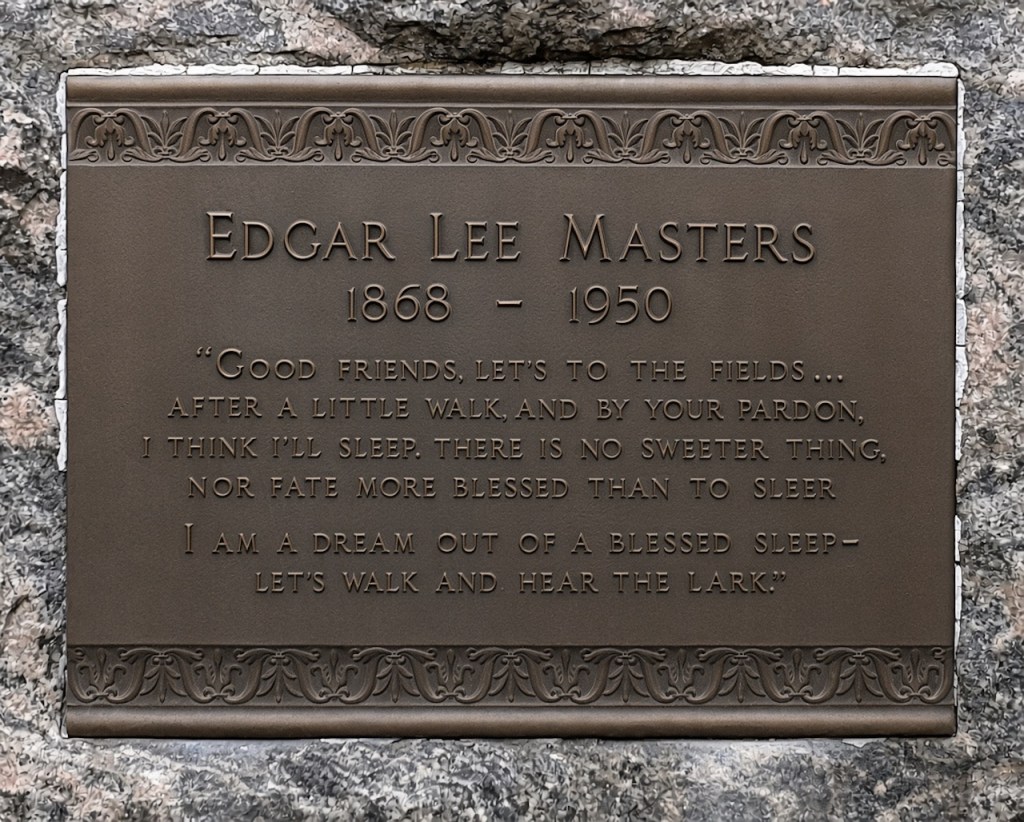
Edgar Lee Masters’ “George Trimble”
George Trimble deems himself the victim of his wife’s ruinous goading and now he lies unmourned in his Spoon River grave. But because his wife’s side of the story is never reported, the issue about her blame may raise doubts about Trimble’s accusation.
Introduction and Text of “George Trimble”
Edgar Lee Masters’ “George Trimble” from Masters’ American classic Spoon River Anthology features a failed politician, who blames his wife for goading him into throwing his hat into the ring.
Lying unnoticed, therefore unmourned, in his Spoon River grave, George Trimble considers himself a victim of his wife’s nagging. George joins the long, sad parade of characters who use their epitaphs to complain about their victimhood brought on by the behavior and urging of others.
George Trimble
Do you remember when I stood on the steps
Of the Court House and talked free-silver,
And the single-tax of Henry George?
Then do you remember that, when the Peerless Leader
Lost the first battle, I began to talk prohibition,
And became active in the church?
That was due to my wife,
Who pictured to me my destruction
If I did not prove my morality to the people.
Well, she ruined me:
For the radicals grew suspicious of me,
And the conservatives were never sure of me—
And here I lie, unwept of all.
Commentary on “George Trimble”
“George Trimble” tried to become a politician, but he had no solid political positions; therefore, he was unable to attract a following. Like many of the other Spoon River epitaphs, his report is filled with attempts to rehabilitate his reputation, not by admitting his own blame but by placing the blame on others—especially his own wife.
First Movement: Remembering His Speech
Do you remember when I stood on the steps
Of the Court House and talked free-silver,
And the single-tax of Henry George?
George Trimble begins his lamentation from the grave by posing a question to his Spoon River fellow citizens: he asks them if they remember a speech that he gave standing on the courthouse steps. In that speech, he spoke about “free-silver” and the “single-tax of Henry George.”
The references to “free silver” and “Henry George” demonstrate Trimble’s supposed political positions. Those who favored the Free Silver policies wanted to replace the gold standard with silver.
And Henry George, who gained a reputation as an economist, believed that only land owners should be taxed. Although Henry George ran for office several times, he never succeeded in securing election.
However, Henry George did become quite famous through his writing and publishing his book, Progress and Poverty, which influenced the fields of politics as well as the economy. In his book, Progress and Poverty, George attempts to work out and explain the issue of wide-spread poverty:
Henry George seeks to explain why poverty exists notwithstanding widespread advances in technology and even where there is a concentration of great wealth such as in cities.
Henry George’s influence through the “single tax” based on land value earned him a widely-noted reputation as he called for free trade, limitation on immigration from China, which was impacting employment options, encouragement of state ownership of certain natural resources, and regulation of monopolies.
Unlike Henry George, George Trimble does not appear to hold any strong beliefs regarding any political position or policy; thus his lament becomes pathetic. While Henry George did not allow losing elections to impede his progress as a thinker and achiever, George Trimble simply gave up any effort at success, and thus he had to engage a scapegoat to blame for his own lack of striving.
Second Movement: Losing the Election
Then do you remember that, when the Peerless Leader
Lost the first battle, I began to talk prohibition,
And became active in the church?
Without much political savvy or ideological conviction, Trimble loses the election. He ironically refers to himself as “the Peerless Leader” who “lost the first battle.” After this loss, Trimble says he took up the discussion of “prohibition,” and he joined the church, becoming an active member. Thus he is showing some energy as he seems to be continuing to strive for accomplish of some political goal.
However, the disparity between his actions and his paltry discourse shows a deeply conflicted psyche. By juxtaposing discussion about prohibition and becoming a church member, he is attempting to rehabilitate his moral fiber.
Third Movement: Weakness of Character
That was due to my wife,
Who pictured to me my destruction
If I did not prove my morality to the people.
George Trimble now concedes that he has done those things because of his wife. He claims that she played on his sense of guilt by telling him he would court “destruction,” if he did not prove to people that he possessed “morality.” George is revealing his weakness of character if it was, in fact, accurate that his wife goaded him into trying to be that which he was not.
He appears to fail at every turn to think for himself, for after he reveals that it was his wife, who talked him into joining the church just to “prove [his] morality,” he seems to be implying that his wife might have been the reason he ran for office in the first place.
Sadly, the reader never learns what, if anything, George actually did accomplish. Many of the other grave-yard residents possess that same flaw; their opinion of themselves remains much higher than any of their neighbors could muster in their favor.
Fourth Movement: A Shrewish Wife
Well, she ruined me:
For the radicals grew suspicious of me,
And the conservatives were never sure of me—
And here I lie, unwept of all.
Finally, George levels his severe charge against his wife, whose side of the story is never told. He declares vehemently, “Well, she ruined me.” He never gains any political backing, because “the radicals” became “suspicious of [him],” and “the conservatives were never sure of [him].”
Likely, Trimble does not even understand why both the “radicals” and the “conservatives” failed to trust him. He fails to recognize that he had no solid political platform on which to base specific policies. Little wonder that the two opposing parties would both remain wary of him.
Now, George Trimble lies in his grave, and no one cares. By Spoon River standards, he has gotten off lightly. At least, he does not seem to have suffered the severe trauma of living as the target of hatred, as some of the other residents have lamented.
Still, George blames his wife that he has died an unremarkable death. Unfortunately, readers will continue to remain skeptical that even Mrs. Trimble were to blame because her side of issue is never revealed.
But as George Trimble’s behavior goes, he joins many of his fellow cemetery reporters; blaming others for their own misfortune and lack of achievement is often the modus operandi of the Spoon River speakers from the grave.


Questions, comments, suggestions offered in good faith are always welcome. If you use a pseudonym, please include your real name, if you expect a response.