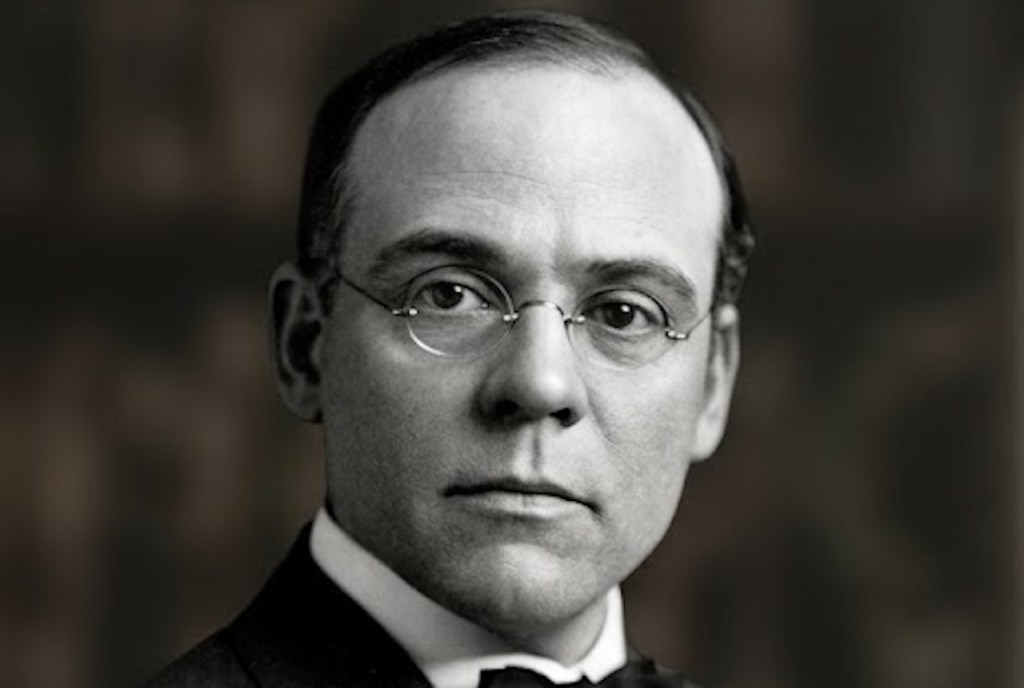
Edgar Lee Masters’ “Justice Arnett”
Justice Arnett is featured in his own poem where he demonstrates weakness and confusion, commensurate with many other of his fellow citizens of Spoon River.
Introduction and Text of “Justice Arnett”
Edgar Lee Masters’ “Justice Arnett” from the American classic Spoon River Anthology features a character, who died after his court docket fell and gashed his bald head. This character is mentioned in three other anthology entries: “Daisy Fraser,” “Lydia Puckett” and “A. D. Blood.”
Justice Arnett
It is true, fellow citizens,
That my old docket lying there for years
On a shelf above my head and over
The seat of justice, I say it is true
That docket had an iron rim
Which gashed my baldness when it fell—
(Somehow I think it was shaken loose
By the heave of the air all over town
When the gasoline tank at the canning works
Blew up and burned Butch Weldy)—
But let us argue points in order,
And reason the whole case carefully:
First I concede my head was cut,
But second the frightful thing was this:
The leaves of the docket shot and showered
Around me like a deck of cards
In the hands of a sleight of hand performer.
And up to the end I saw those leaves
Till I said at last, “Those are not leaves,
Why, can’t you see they are days and days
And the days and days of seventy years?
And why do you torture me with leaves
And the little entries on them?”
Commentary on “Justice Arnett”
Justice Arnett demonstrates weakness and confusion, similar to many of the other weak and/or corrupt citizens, portrayed in the Spoon River collection of epitaphs.
First Movement: Confirming a Rumor
It is true, fellow citizens,
That my old docket lying there for years
On a shelf above my head and over
The seat of justice, I say it is true
That docket had an iron rim
Which gashed my baldness when it fell—
Opening his monologue, the justice seems to be confirming the details of his demise as if there had been some speculation about it. To end the speculation, he confirms, “It is true, fellow citizens.” The docket that had been lying above his head for many years did, in fact, fall, and when it did, it “gashed [his] baldness.”
Arnett positions the docket on a shelf not only above his head but also “over the seat of justice.” He seems to need to emphasize that he occupied this “seat of justice,” for he wants to put himself in the best light, as most of the Spoon River speakers do.
Second Movement: The Cause of the Falling Docket
(Somehow I think it was shaken loose
By the heave of the air all over town
When the gasoline tank at the canning works
Blew up and burned Butch Weldy)—
The reader then learns what caused the docket to fall. The reader will recall the “Butch” Weldy incident, in which Weldy suffered two broken legs and was blinded for life. Weldy was pouring gasoline into the tank at the canning factory when the tank blew up.
Arnett makes light of Weldy’s injuries by merely stating the accident “burned Butch Weldy.” But the justice speculates that the explosion so “heaved the air all over town” that it shook loose the docket and caused it to fall.
Third Movement: Points of Order on Dying
But let us argue points in order,
And reason the whole case carefully:
First I concede my head was cut,
But second the frightful thing was this:
The justice then shifts to legalese to inflate his philosophizing about his ultimate demise: “let us argue points in order.” He has two points to “argue”: one is that his “head was cut,” and two is that there was a frightful component to this incident.
The reader will sense that the justice sounds somewhat demented in his explanation. The dementia might stem from Alzheimer’s disease or it might simply be the trauma of having been conked on the noggin by a big, heavy, metal-edged book.
Fourth Movement: The Image of Leaves
The leaves of the docket shot and showered
Around me like a deck of cards
In the hands of a sleight of hand performer.
Arnett describes the events of the frightful occurrence, “[t]he leaves of the docket shot and showered / Around me like a deck of cards / In the hands of a sleight of hand performer.” This description sounds quite realistic, and Arnett’s listeners can readily see the image he presents.
Fifth Movement: Logic and Dementia
And up to the end I saw those leaves
Till I said at last, “Those are not leaves,
Why, can’t you see they are days and days
And the days and days of seventy years?
And why do you torture me with leaves
And the little entries on them?”
Arnett’s final words reveal the fright, possible dementia, and as well as a fairly well grounded logic. The deck-of-card image turns back to leaves, which makes sense because pages in a book are called “leaves.” But then the justice recounts that he “said at last, ‘Those are not leaves’.”
Suddenly, Arnett is speaking as if refuting someone who has accused him of having nothing more than “leaves” in his court docket. He reprimands his imaginary accuser, “Why, can’t you see they are days and days / And the days and days of seventy years?”
The justice disabuses his accuser of the notion that his docket was merely filled with leaves; it was filled with his life’s work. Day after day for seventy years, he has recorded his life’s work in that docket.
But then the justice makes a remarkable confession when he asks, “And why do you torture me with leaves / And the little entries on them?”
Suddenly those days and days of the justice’s life’s work are again reduced to leaves with “little entries on them.” In his fright and confusion, he is no longer certain that his life has made sense or even had any value.


Questions, comments, suggestions offered in good faith are always welcome. If you use a pseudonym, please include your real name, if you expect a response.