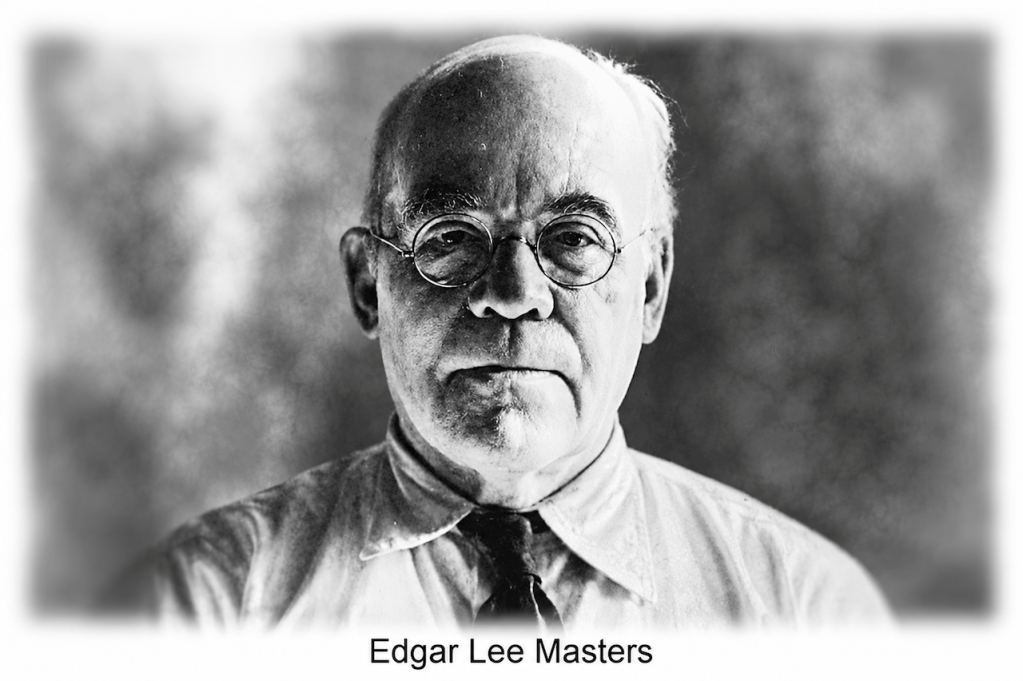
Edgar Lee Masters’ “Homer Clapp”
“Homer Clapp” is the third epitaph in the series which began with “Aner Clute.” Homer is a pitiful character, who feels sorry for himself because of the way he was treated by Aner Clute.
Introduction and Text of “Homer Clapp”
In Edgar Lee Masters’ epitaph titled “Homer Clapp” from Masters’ American classic Spoon River Anthology, the character laments an existence which resulted in his considering himself one of “Life’s fools.”
Masters’ epitaph “Homer Clapp” is the third in the series beginning with “Aner Clute” and followed by “Lucius Atherton“; Homer is a sorry character, who complains that he was played for fool by Aner Clute.
Homer Clapp
Often Aner Clute at the gate
Refused me the parting kiss,
Saying we should be engaged before that;
And just with a distant clasp of the hand
She bade me good-night, as I brought her home
From the skating rink or the revival.
No sooner did my departing footsteps die away
Than Lucius Atherton,
(So I learned when Aner went to Peoria)
Stole in at her window, or took her riding
Behind his spanking team of bays
Into the country.
The shock of it made me settle down,
And I put all the money I got from my father’s estate
Into the canning factory, to get the job
Of head accountant, and lost it all.
And then I knew I was one of Life’s fools,
Whom only death would treat as the equal
Of other men, making me feel like a man.
Commentary on “Homer Clapp”
The third epitaph in the series “Homer Clapp” begins with “Aner Clute” followed by “Lucius Atherton.” Homer is a pitiful character, who feels sorry for himself because of how he was treated by Aner Clute.
First Movement: A Ridiculous Spectacle
Often Aner Clute at the gate
Refused me the parting kiss,
Saying we should be engaged before that;
And just with a distant clasp of the hand
She bade me good-night, as I brought her home
From the skating rink or the revival.
The character “Homer Clapp” is sad man, whose association with Aner Clute, the prostitute, left him degraded and beaten. Aner had claimed that she began her life as a hooker because of being rebuffed by Lucius Atherton.
Later, however, Aner recants her story and claims ridiculously that she started living the life because of the way society views prostitutes—kind of like the way society views a boy who steals apples from a grocery store.
Homer commences his pathetic story “at the gate” with Aner Clute refusing to kiss him goodnight. She always refused to give him a good-bye kiss after he had taken her on a date either to “the skating rink” or “the revival.”
Aner would extend to him only a “distant clasp of the hand,” remarking that before she would permit him to kiss her, they would have to have become “engaged” to be married. This ridiculous spectacle shows clearly Aner’s disingenuous nature and dramatizes her behavior which is full of deceit, making her resemble so many of the other dissembling Spoon River characters.
Second Movement: Town Gossip
No sooner did my departing footsteps die away
Than Lucius Atherton,
(So I learned when Aner went to Peoria)
Stole in at her window, or took her riding
Behind his spanking team of bays
Into the country.
Homer then appears to be providing town gossip as he claims that after he had left Aner at the gate, Lucius Atherton came sneaking in at Aner’s window. The two then went about with “her riding / Behind his spanking team of bays.”
The window sneaking sounds like an over-dramatic claim. It remains somewhat vague and a shaky notion that Lucius would need to sneak in to take Aner for a ride. However, Homer does report that he found out about Aner’s deceptive behavior only after she had relocated to Peoria. The timeline seems to impart the notion that Aner had actually moved to Peoria for the purpose of becoming a prostitute.
Aner, however, had concocted her narrative about being jilted by Atherton before she moved from Spoon River. Still, it seems that Homer had heard about this claim of Aner’s only after she had left Spoon River for Peoria.
Homer’s bit of gossip that Atherton owned “a spanking team of bays” might hint that Atherton had, in fact, been considered a “rich man” by Aner and other Spoon River residents who were less well off than Atherton was.
Third Movement: No Kiss Until Engaged
The shock of it made me settle down,
And I put all the money I got from my father’s estate
Into the canning factory, to get the job
Of head accountant, and lost it all.
Homer’s story turns out to be that because of Aner’s deception of dating Homer while leading him on and demanding that they be engaged before a kiss, and at the same time fooling around with Lucius, Homer experienced “shock.”
That shock caused Homer to sink his inheritance into the canning factory. and after placing all that money into the canning factory in order “to get the job / Of head accountant,” Homer “lost it all.”
Apparently, Homer lost his job along with his money as well as any chance for marital happiness. However, Homer remains quite vague at this point and does not make clear what he means when he says he lost “it all.”
Fourth Movement: Just a Fool
And then I knew I was one of Life’s fools,
Whom only death would treat as the equal
Of other men, making me feel like a man.
Homer complains that his experiences in life, especially the Aner situation and loss of his money have convinced him that “[he] was one of Life’s fools.” Homer considers himself the type of fool that, “only death would treat as the equal / Of other men.”
Therefore, because death will come to all men equally, Homer can “feel like a man,” with the knowledge that death would definitely arrive for him just as it will do for all other men.


Questions, comments, suggestions offered in good faith are always welcome. If you use a pseudonym, please include your real name, if you expect a response.